How Water Hardness Affects CMC Hydration and Viscosity in Textile Printing
Water hardness can change how CMC hydrates, expands and builds viscosity. Calcium and magnesium can...
Water hardness is a hidden formulation variable in textile printing because sodium carboxymethyl cellulose (CMC) is an anionic polyelectrolyte whose hydration, chain conformation and rheology respond to dissolved ions. Calcium and magnesium can change CMC behavior differently from sodium salts, and the result is not always a simple viscosity decrease. The response depends on ion concentration, CMC degree of substitution, molecular weight, substitution distribution, polymer concentration, pH and the complete printing formula. This guide explains how textile mills should compare plant water with a controlled reference water before blaming a CMC batch for slow hydration, viscosity drift, gel particles or unstable printing paste.
What Is Water Hardness in CMC Preparation?
Water hardness mainly describes the concentration of dissolved multivalent metal ions, especially calcium and magnesium.
In textile plants, water can vary because of:
Municipal supply changes
Groundwater
Well water
Seasonal variation
Water-treatment performance
Blending of different water sources
For CMC preparation, the important question is not only whether the water is classified as “soft” or “hard.”
The mill should know:
Total hardness
Calcium level
Magnesium level
Conductivity
pH
Other dissolved salts where relevant
Two water samples with similar total hardness can still affect CMC differently if their ionic composition differs.
Why CMC Responds to Dissolved Ions
Sodium CMC contains negatively charged carboxymethyl groups under typical aqueous conditions.
These charges repel each other and influence polymer-chain expansion in water.
That electrostatic behavior contributes to:
Hydration
Chain conformation
Solution viscosity
Rheology
When ions are added, they interact with the charged polymer environment.
Monovalent salts such as sodium chloride can screen electrostatic repulsion and change chain dimensions.
Divalent ions such as Ca²⁺ and Mg²⁺ can create stronger ionic interactions and, under some conditions, promote interchain association or bridging.
Published rheology research confirms that CMC solution behavior changes with counterion valence and type rather than simply with “salt concentration.”
Why Calcium and Magnesium Behave Differently from Sodium Salts
Calcium and magnesium carry two positive charges, while sodium carries one.
This difference changes how they interact with anionic CMC chains.
Research on CMC has shown that divalent ions can change:
Effective polymer charge
Chain interactions
Aggregation
Viscoelastic response
Calcium and magnesium are also not necessarily identical to each other.
Recent studies of CMC with divalent counterions have shown ion-specific differences in association and structural behavior.
Therefore, the practical question for a textile mill should be:
“How does our actual plant water affect this specific CMC grade?”
not:
“Is the hardness number below one universal limit?”
How Hard Water Can Affect CMC Hydration
Hydration begins when water penetrates the powder and the polymer chains separate into the aqueous phase.
If ionic strength is already high during this stage, the polymer can hydrate differently from the same CMC in deionized or softened water.
Possible observations include:
Slower viscosity development
More difficult dispersion
Persistent fish-eyes
Gel particles
Different final solution clarity
Published CMC rheology literature notes that dissolution in saline media can be slower than dissolution in deionized water, which can create apparent viscosity differences if hydration is incomplete.
This means a “low viscosity” result may sometimes be a preparation problem rather than a true loss of polymer thickening capacity.
Always check whether both samples have reached complete and comparable hydration before interpreting the viscosity.
How Water Hardness Can Change CMC Viscosity
Water hardness can change measured CMC viscosity through several mechanisms.
Divalent ions can interact more strongly with carboxylate groups than monovalent ions.
Interchain Interaction
Under some conditions, multivalent ions can increase association between CMC chains.
Incomplete Hydration
Hard or saline water can slow dissolution, so a sample measured too early may appear to have lower viscosity.
The final response therefore depends on:
Hardness level
Ca²⁺ / Mg²⁺ ratio
CMC DS
Molecular weight
Polymer concentration
pH
Temperature
Measurement method
Why Hard Water Does Not Always Mean Lower Viscosity
A common oversimplification is:
“Hard water always reduces CMC viscosity.”
This is not technically reliable.
Some systems do show viscosity reduction as ionic strength increases.
Other systems can show increased apparent viscosity or stronger association at selected concentrations of divalent ions.
Published studies have reported both viscosity loss and viscosity increase depending on CMC structure, concentration and ion conditions.
This is why the article’s practical rule is:
Hard water changes CMC viscosity; the direction and magnitude must be measured for the actual grade and formula.
For factory troubleshooting, this statement is much more useful than assuming one universal trend.
How Degree of Substitution Changes Hard-Water Tolerance
Degree of substitution (DS) describes the average number of cellulose hydroxyl groups replaced by carboxymethyl groups.
DS affects:
Water compatibility
Charge density
Salt tolerance
Acid response
Solution behavior
Research on multivalent-ion tolerance has shown that CMC grades with different DS and substitution structure can respond differently to Ca²⁺.
Higher-substitution routes are commonly evaluated when buyers require stronger electrolyte tolerance, but:
Higher DS does not mean complete immunity to hard water.
The effect still depends on ion concentration, molecular weight and substitution distribution.
FSX Chemical therefore compares CMC-HD, CMC-MD and CMC-LD by DS, viscosity, dissolution and formulation performance rather than presenting DS as a universal quality ranking.
How Molecular Weight and Concentration Change the Response
Molecular weight influences the baseline viscosity-building ability of CMC.
Polymer concentration also determines whether the solution behaves in a dilute, semidilute or more strongly entangled regime.
As concentration increases, chain overlap and interaction become more important.
Therefore, the same hardness level can affect:
0.5% CMC solution
1.0% CMC solution
2.0% CMC solution
differently.
Never compare water-hardness tolerance using different CMC concentrations without clearly accounting for the difference.
Why Substitution Uniformity Matters
Average DS does not fully describe how carboxymethyl groups are distributed along the polymer chain.
Research on multivalent-ion salt tolerance has shown that CMC products with similar overall DS can have different tolerance when substitution distribution differs.
This means two grades labeled with the same DS can still respond differently to hard water.
In practical QC, substitution uniformity is often evaluated indirectly through:
Dissolution
Solution clarity
Salt-addition response
Filtration residue
Batch repeatability
For textile buyers, this is another reason not to qualify a CMC grade from DS alone.
What Hard Water Changes in Textile Printing Paste
The water used for CMC preparation becomes part of the printing paste.
If hardness changes CMC hydration or rheology, it can indirectly change:
Paste body
Flow
Screen release
Penetration
Print definition
Color uniformity
Holding stability
Hard water can also interact with:
Dyes
Pigment binders
Dispersants
Alkali
Other anionic polymers
Therefore, the complete printing paste should be checked after the water comparison.
A CMC grade that looks acceptable in a pure-water beaker can still behave differently in a full production formula.
Reactive Printing: Why Hardness Can Be Especially Important
Reactive printing formulas can contain several ionic components.
These may include:
Reactive dyes
Alkali
Salts
Anti-reducing components
Other auxiliaries
Hard water adds another ionic variable to this system.
For CMC-based or CMC-containing reactive formulations, evaluate:
Initial hydration
Viscosity after complete formula preparation
Holding stability
Color yield
Background staining
Wash-off
CMC should not be treated as a universal one-to-one sodium alginate replacement simply because it maintains viscosity in hard water.
The final dye-thickener interaction and printing result still require validation.
Pigment, Disperse and Compound Systems
Pigment Printing
Hard water can influence CMC together with binder, cationic or anionic auxiliaries and crosslinking chemistry.
Check:
Binder compatibility
Flocculation
Paste viscosity
Curing
Rubbing fastness
Disperse Printing
Check the interaction among CMC, dispersants, dye particles, salts and thermal fixation conditions.
Compound Thickeners
A blend can contain multiple polymers with different calcium and magnesium tolerance.
Hard-water performance of the final blend may therefore differ from the behavior of each polymer tested separately.
Always evaluate the complete thickener system.
Plant Water vs. Reference Water: The Fastest Diagnostic Test
When a mill reports unexpected CMC viscosity or hydration problems, one of the fastest useful tests is a two-water comparison.
Sample A
Prepare the CMC using the actual plant water.
Sample B
Prepare the same CMC using softened, deionized or another controlled reference water.
Keep everything else identical:
CMC batch
CMC concentration
Powder addition rate
Mixer speed
Mixing time
Hydration time
Temperature
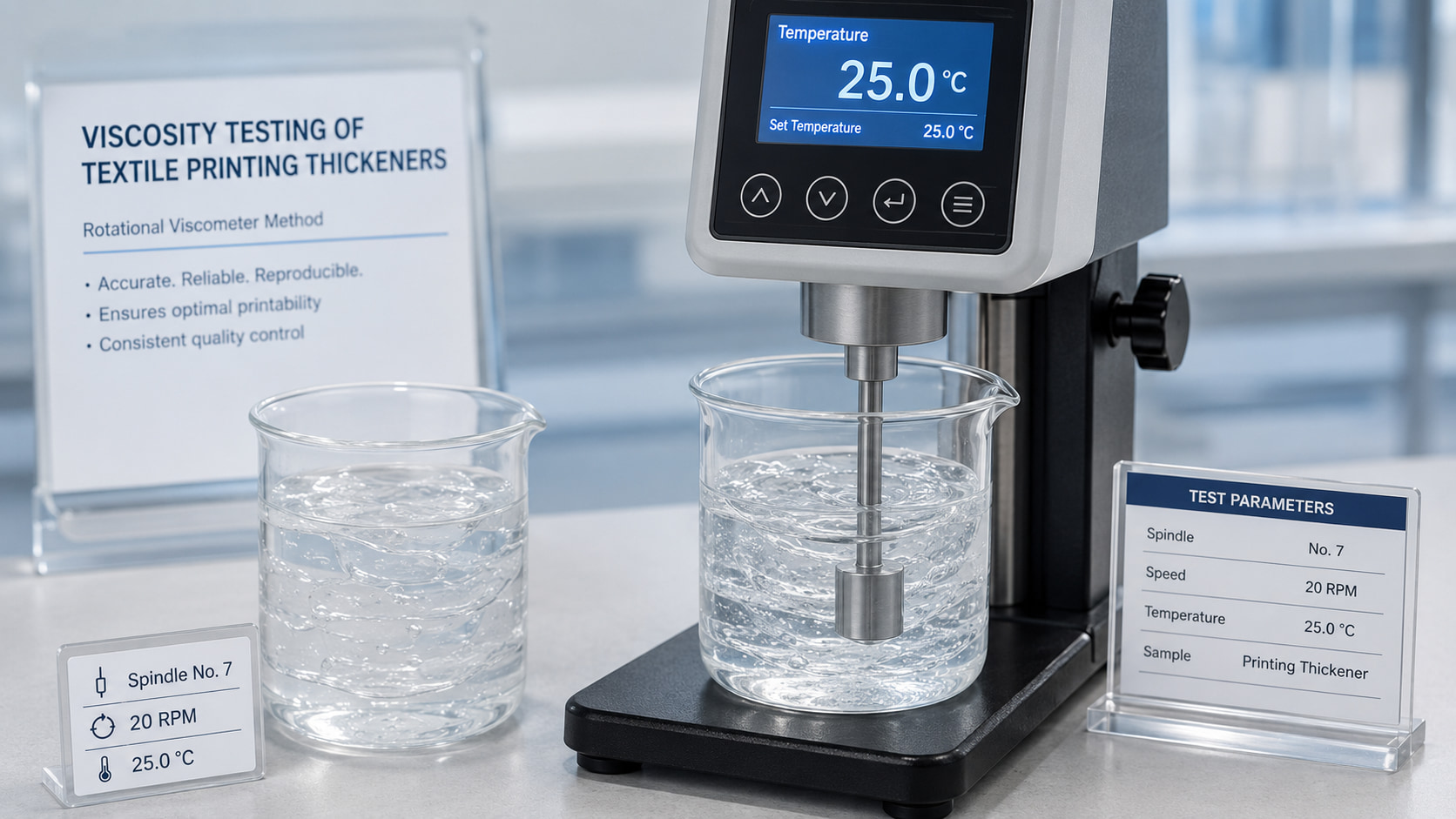
Viscosity method
Then compare:
Dissolution time
Fish-eyes
Solution clarity
Viscosity
Filtration residue
If the difference is large, water quality should be investigated before the CMC batch is rejected.
How to Build a Water-Hardness Response Curve
For a more detailed qualification, build a controlled hardness curve.
Step 1: Select a Reference Water
Use a consistent starting water.
Step 2: Create Several Controlled Hardness Levels
Use a laboratory method appropriate to the plant’s real Ca²⁺ and Mg²⁺ profile.
Step 3: Prepare the Same CMC at Each Level
Keep concentration and preparation method constant.
Step 4: Record Hydration Development
Measure viscosity at defined time points instead of only one final reading.
Step 5: Inspect Physical Stability
Record:
Clarity
Gel particles
Sediment
Filtration residue
Step 6: Add the Complete Printing Components
Repeat the comparison after dye, alkali, binder or other relevant auxiliaries are added.
Step 7: Define a Working Water Window
Approve a practical hardness range that maintains acceptable hydration, paste behavior and printing performance.
Does Mixing Order Matter?
Mixing order can matter, especially when CMC is exposed to a high ionic environment before full hydration.
A practical default development sequence is:
Water → Controlled CMC Addition → Full Hydration → Other Formula Components
rather than introducing CMC directly into a highly saline or highly concentrated auxiliary solution.
Some literature reports that CMC dissolved directly in saline water can hydrate more slowly than CMC first hydrated in low-salt water.
However, the magnitude of this effect depends on the grade and process.
Therefore, compare the exact production addition sequence during qualification.
Hard Water, Gel Particles and Filtration Residue
Water-related CMC instability can appear as:
Soft gel particles
Flocculation
Haze
Fine mineral residue
Rapid filter loading
But not every filter residue is caused by hardness.
Also check:
Incomplete hydration
Tank contamination
Powder lumps
Other formulation incompatibility
A useful diagnostic is to compare residue from plant-water and reference-water preparations.
If the plant-water sample shows much more residue under the same mixing conditions, the water chemistry becomes a stronger root-cause candidate.
Production QC for Water and CMC
Once the acceptable water window is established, production control can include:
Daily or shift water hardness check where variation is significant
Conductivity
pH
Water-treatment status
CMC batch number
Standard solution viscosity
Hydration time
Complete paste viscosity
If water source changes seasonally, retain the water-quality record together with the printing-paste batch data.
This improves root-cause analysis when viscosity or printing performance changes later.
Troubleshooting Water-Related CMC Problems
Observed Problem
First Checks
Do Not Assume
CMC hydrates slowly
Hardness, ionic strength, mixing, water temperature
The CMC batch is defective
Viscosity lower than normal
Water source, hardness, hydration time, test method
Water hardness, pH, conductivity, preparation method
The product grade changed
What Information Should You Send to a CMC Supplier?
If you suspect water hardness is affecting CMC, send:
Current CMC product or TDS
Degree of substitution
Viscosity and full test method
CMC concentration
Plant water source
Total hardness
Calcium and magnesium data where available
Conductivity
Water pH
Mixing sequence
Hydration time
Complete printing formula
Current filtration residue or gel observations
Printing route and fabric
Current viscosity or printing problem
FSX Chemical can use this information through Samples & Matching to compare CMC-HD, CMC-MD or CMC-LD as potential trial directions under matched water and formulation conditions.
How Should a Textile Mill Control Hard-Water Effects on CMC?
A practical sequence is:
Measure Water → Compare with Reference Water → Standardize CMC Hydration → Check Complete Formula → Print → Record Batch and Water Data
The key principles are:
Water hardness is part of the formulation, not just a utility parameter.
Ca²⁺ and Mg²⁺ can affect CMC differently from monovalent sodium salts.
Hard water does not always produce the same direction of viscosity change.
Hydration must be complete before viscosity is compared.
DS, molecular weight and substitution distribution influence hard-water response.
Use plant-water vs. reference-water testing before rejecting a CMC batch.
Frequently Asked Questions
1. Does hard water affect CMC viscosity?
Yes. Calcium, magnesium and overall ionic strength can change CMC chain interactions and measured viscosity. The direction and magnitude depend on the specific CMC and formulation.
2. Does hard water always reduce CMC viscosity?
No. Some conditions reduce viscosity, while selected divalent-ion conditions can increase apparent viscosity or association. Test the actual grade and water.
3. Why does CMC dissolve more slowly in hard water?
Higher ionic strength can change chain hydration and slow dissolution. Incomplete hydration can then appear as lower viscosity or gel particles.
4. Is calcium more harmful than magnesium to CMC?
Not universally. Calcium and magnesium can interact differently with CMC, and the practical result depends on concentration, DS, polymer structure and formulation.
5. Does higher-DS CMC tolerate hard water better?
Higher-DS routes are commonly evaluated for improved electrolyte tolerance, but higher DS does not make CMC immune to calcium or magnesium.
6. Can I test CMC only with deionized water?
DI water is useful as a reference, but production qualification should also include the plant’s actual process water.
7. What is the fastest way to check whether water causes a viscosity problem?
Prepare the same CMC batch at the same concentration using plant water and a controlled reference water, then compare hydration, viscosity and residue.
8. Can hard water create CMC filtration residue?
It can contribute to aggregation or mineral-related residue in some systems, but incomplete hydration and contamination should also be checked.
9. Should CMC be hydrated before salt or alkali is added?
In many formulations this is a useful starting approach because CMC can hydrate more slowly in a high-salt environment, but the exact production sequence should be validated.
10. Can two factories get different viscosity from the same CMC?
Yes. Water hardness, pH, conductivity, preparation method, temperature and viscosity test conditions can all create different results.
11. Should water hardness be listed in CMC QC?
If plant water varies enough to affect hydration or paste performance, hardness or conductivity should be included in process QC and batch records.
12. What should I send FSX Chemical for hard-water CMC matching?
Send the current CMC TDS, DS, viscosity method, plant-water hardness, Ca/Mg data if available, mixing method, full formula and current hydration or viscosity problem.
Match CMC to Your Plant Water with FSX Chemical
If the same CMC behaves differently between your laboratory and production line, or between two factories, water hardness may be part of the cause.
For textile printing, water is part of the CMC formulation. The most reliable grade is not simply the one with the highest viscosity in deionized water, but the one that hydrates and maintains useful rheology in the actual plant-water and printing-paste system.
Compare CMC, CMS, sodium alginate and digital printing paste for textile printing. Learn how each route fits reactive, disperse, pigment and digital processes, and what buyers should review before sample testing, grade matching and bulk purchase.
Carboxymethyl cellulose (CMC) is widely used in the printing, sizing, and dyeing processes of textiles. This guide will explain how to evaluate CMC grades, which parameters are most important, and how FSX Chemical can support purchasing decisions.
Carboxymethyl cellulose is used as a thickener and stabilizer in water-based inks, gravure printing, and inkjet pre-treatment. This guide covers the key grade parameters and sourcing considerations for procurement teams.
Choosing the right CMC supplier involves more than comparing price. This guide covers the evaluation criteria, documentation checklist, and trial process that procurement teams should follow before committing to a bulk order.
Both sodium alginate and CMC are used as thickeners in textile printing, but they suit different dye systems and process conditions. This guide explains the key differences and when to use each.
Food-grade and industrial-grade CMC share the same base chemistry but differ significantly in purity, DS range, and regulatory requirements. This guide explains the key differences and why using the wrong grade creates production problems.
CMS for textile printing paste can help adjust viscosity, improve paste handling, and support stable formulation performance. This guide explains how buyers can evaluate CMS grades by viscosity, DS, solubility, pH, moisture, and sample testing before bulk purchase.
Cellulose-based raw materials are used in textile printing, printing paste preparation, thickening, and formulation support. This guide explains how buyers can evaluate CMC, CMS, sodium alginate, textile printing thickeners, and printing paste products by specification, documentation, sample testing, and supplier support.
Cellulose derivatives are widely used in textile printing, printing paste preparation, thickening, and formulation support. This guide explains how overseas buyers can source CMC, CMS, sodium alginate, textile printing thickeners, and printing paste products from FSX Chemical with TDS, COA, sample testing, grade matching, and export document support.
Choosing textile industry chemicals requires more than comparing product names. This guide explains how textile printing buyers can match CMC, CMS, sodium alginate, textile printing thickeners, and printing paste products by application, specification, TDS, COA, sample testing, and batch consistency.
Chemical formulation support for textile printing should begin with clear application information. This guide explains what buyers should provide when requesting product matching, formulation adjustment, sample testing, TDS, COA, SDS, and technical support for CMC, CMS, sodium alginate, textile printing thickeners, and printing paste products.
Share the product name, application, quantity, destination and any TDS,
sample photo or document you already have. FSX Chemical will review the
information and recommend the next step for quotation, sample matching
or product selection.
Product InformationProduct name, grade, model, label photo or supplier reference.
Available DocumentsTDS, SDS, COA, sample photo, product list or test data.
Order DetailsEstimated quantity, packaging, destination country, port or trade term.
Application or IssueTextile printing process, formulation need, current issue or target performance.

 HI
HI  EN
EN  BN
BN  ES
ES  TR
TR  FR
FR  ID
ID  RU
RU  AR
AR  UR
UR  VI
VI  TL
TL