Pigment Digital Printing Pretreatment vs. Binder: What Does Each One Actually Do?
Pigment pretreatment and binder perform different functions. Pretreatment controls how pigment ink interacts with the...
Pigment pretreatment controls how ink meets the fabric; binder provides the polymer film that holds pigment to the textile. They are different functions, but a single formulation can contribute both. Binder may be delivered through the ink, a fabric pretreatment, a separate post-treatment or a combination specified by the system supplier. Evaluate image formation separately from film durability, then confirm that the complete architecture meets rubbing, washing and hand-feel requirements.
Pretreatment and Binder Are Not the Same Category
The title “pretreatment vs. binder” is useful for search, but technically the two terms describe different concepts.
Dastlabki ishlov describes a process stage and the formulation applied to the fabric before printing.
Binder describes a polymeric material or functional component whose primary role is to create a durable film around pigment particles and attach that film to the textile surface after curing.
A pigment pretreatment can contain cationic polymer, wetting-control agent, rheology or migration-control polymer, binder in selected architectures, crosslinking or curing auxiliaries where required, and other application-specific additives.
Therefore, the real technical question is not:
“Should I use pretreatment or binder?”
Bu:
“Which functions must be provided before printing, which must be provided during or after printing, and where should the binder function be located in the complete system?”
Why Pigment Printing Needs a Different Fixation Logic
Pigments are insoluble color particles. Unlike reactive dyes, they do not form the same type of fiber-specific covalent bond with cellulose. Unlike disperse dyes, they do not diffuse into polyester in the same way under heat.
Pigment printing therefore depends mainly on a physical polymer film to hold the pigment particles on the textile.
This is why pigment systems can be used across a broad range of fiber types, provided the binder and surface chemistry are compatible with the substrate and end-use requirement.
Technical training resources on pigment inkjet printing describe the binder as the polymeric “glue” that physically anchors pigment to the textile surface.
What Does Pigment Digital Pretreatment Actually Do?
Pigment pretreatment prepares the fabric surface so that a low-viscosity inkjet droplet behaves in a controlled way when it reaches the textile.
Its functions can include:
Controlling fabric wetting
Reducing lateral ink spreading
Improving pigment localization near the surface
Increasing apparent color intensity
Improving edge sharpness
Creating a more uniform receiving surface
Modifying surface charge
Supporting later binder adhesion in selected systems
These are primarily print-formation functions. Pretreatment affects what happens in the first seconds after the ink droplet lands.
Research on pigment-based textile inkjet printing has shown that pretreatment can influence both color gamut and crockfastness on cotton and polyester fabrics, confirming that surface preparation can affect more than appearance alone.
The binder’s primary role becomes especially important as the printed textile is dried and cured.
For a waterborne dispersion binder, water removal brings particles together and suitable conditions allow them to form a coherent film. Any further chemical curing or crosslinking depends on the binder design and approved process; it is not the same event as particle coalescence. Do not describe polymer chains and dispersed particles as interchangeable mechanisms.
The binder contributes directly to:
Dry rubbing fastness
Wet rubbing fastness
Wash durability
Pigment retention
Surface abrasion resistance
Binder chemistry can also influence fabric stiffness, hand feel, elasticity, surface tack, curing requirement and yellowing resistance.
A pigment print with excellent color strength but insufficient binder performance may look acceptable immediately after printing and still fail after rubbing or washing.
This is why pigment digital printing should not be approved from image quality alone.
Pretreatment vs. Binder: Practical Comparison
Baholash maydoni
Dastlabki ishlov
Binder
What it is
Fabric preparation stage/formulation
Polymeric fixation component
Main timing
Before printing
Film develops during drying; specified curing may further improve durability; binder may be delivered before printing
Main purpose
Control ink/fabric interaction
Physically anchor pigment particles
Major print effect
Sharpness, bleeding, penetration, color localization
Fastness, durability, film properties
Can affect color yield?
Yes, through localization and wetting
Yes, indirectly through film and pigment distribution
Can affect hand feel?
Yes
Often strongly, depending on binder level and modulus
Can it replace the other?
Not automatically
Not automatically
Pretreatment controls where the pigment ink goes; binder helps determine whether the pigment stays there after use.
Where Can the Binder Be Located in a Digital Pigment System?
Pigment inkjet systems can be designed in different ways.
1. Binder-in-Ink
The binder is included directly in the pigment ink. This can create a compact process, but the ink must remain suitable for the printhead. Binder loading can affect viscosity, particle stability, jetting reliability and nozzle cleanliness.
2. Binder in Pretreatment
Some systems place part or all of the binder function on the fabric before printing. This can reduce binder load carried through the printhead, but the pretreatment must remain uniform and compatible with pigment deposition.
3. Pretreatment + Binder-Containing Ink
Another architecture uses a surface-control pretreatment while the ink also contains binder. Pretreatment and binder still perform different primary functions.
4. Post-Binder or Over-Treatment
Selected systems apply a binder or fixation layer after printing to reduce binder load in the ink and protect jetting performance.
Research systems have also been developed using self-dispersing pigment particles that reduce or eliminate conventional binder and pretreatment requirements. These are separate ink technologies and should not be confused with standard commercial pigment ink systems.
How Pretreatment Affects Color Yield and Print Sharpness
Textile fabric is porous. If pigment ink penetrates deeply into the structure, less pigment remains near the visible surface.
This can reduce apparent color strength, optical density and edge definition.
A suitable pretreatment can modify wetting so more pigment remains in the useful imaging zone. It can also suppress feathering, wicking, excessive penetration and coffee-ring-type deposition.
Recent research on pigment inkjet printing of blended fabrics has shown that surface modification can significantly change droplet spreading, edge clarity and color intensity.
This supports the principle that pigment color yield is not controlled by pigment concentration alone.
How Binder Affects Rubbing and Washing Fastness
Because pigments generally remain as particles rather than becoming part of the fibre, durability depends strongly on the binder film, its distribution and its adhesion to the textile. Crosslinking can contribute where the selected binder system uses it.
If binder performance is insufficient, possible symptoms include poor dry rubbing fastness, poor wet rubbing fastness, pigment loss after washing, powdery surface or color transfer to another surface.
However, poor fastness should not automatically be corrected by adding more binder.
First check:
Curing temperature
Curing time
Binder chemistry
Pigment-to-binder balance
Fabric surface
Pretreatment compatibility
Inadequate drying, incomplete film development or an insufficient specified cure can impair durability even at high binder dosage. Determine which condition applies before adding more product.
Why More Binder Can Hurt Fabric Hand Feel
Binder creates a polymer film. That film is necessary for pigment durability, but it can also change the mechanical feel of the textile.
Increasing binder level or using a harder binder can increase stiffness, surface film feel, boardiness and loss of drape.
Research on pigment binder systems has shown that binder stiffness and substrate type can materially influence printed-fabric stiffness and crockfastness.
The highest binder dosage is not automatically the best binder dosage.
Cationic Pretreatment: Why Surface Charge Can Matter
Many pigment particles and dispersant systems carry surface charge. A cationic fabric pretreatment can alter the electrostatic interaction between ink and textile surface.
Under suitable conditions, this can help localize pigment near the surface and reduce uncontrolled movement.
Potential benefits can include higher apparent color strength, sharper boundaries and improved pigment retention.
However, stronger cationic treatment is not automatically better. Too much surface interaction can change ink drop coalescence, surface uniformity, hand feel and binder compatibility.
Cationic pretreatment should therefore be matched with the actual pigment ink and binder system.
Wetting, Penetration and Pigment Localization
A pigment pretreatment needs to create a fabric surface that is neither uncontrolledly absorbent nor excessively non-wetting.
If wetting is too fast, pigment can penetrate or spread before localization occurs.
If wetting is too low, droplets can remain as beads, coalesce with neighboring drops, create mottled solids or produce uneven coverage.
The target is controlled wetting.
A useful trial should evaluate fine-line sharpness, small text, solid areas, gradients and high ink-coverage zones. Do not select a pretreatment from one color patch alone.
Drying, Film Formation and Curing
Binder presence alone does not establish durability. The film must develop under suitable drying conditions, and any cure specified for that formulation must also be achieved. Check the actual fabric-temperature history, not only the oven set-point; not every binder has the same film-forming or crosslinking requirement.
Important variables include fabric temperature, curing temperature, dwell time, airflow, binder film-forming behavior and crosslinking chemistry where used.
Insufficient curing can cause poor fastness.
Excessive curing can create fabric yellowing, harder hand feel, energy waste or damage to heat-sensitive blends.
The curing window should be validated using the actual production machine rather than only the oven set-point.
Cotton, Polyester and Blends: Does the Same System Work?
One advantage of pigment printing is its broad substrate range, but “works on many fibers” does not mean “same pretreatment and binder settings work on every fabric.”
Paxta
Cotton is hydrophilic and can absorb liquid quickly. Pretreatment may need to control penetration while the binder system balances fastness and softness.
Poliester
Polyester is more hydrophobic and can behave differently in wetting and binder adhesion. Surface finish, silicone contamination and heat history can matter strongly.
Polyester/Cotton Blends
Blends contain two surfaces with different wetting behavior. A system that is ideal on cotton may not give the same result on polyester-rich blends.
Validation should include color strength, sharpness, rubbing fastness, wash fastness, fabric hand and stretch recovery where relevant.
Binder Compatibility with Pretreatment Chemistry
Pretreatment and binder must function together.
Compatibility can be influenced by pH, ionic charge, electrolytes, wetting agents, crosslinkers, defoamers and polymer concentration.
Possible incompatibility symptoms include flocculation, precipitation, uneven film, reduced fastness, poor hand feel and storage instability.
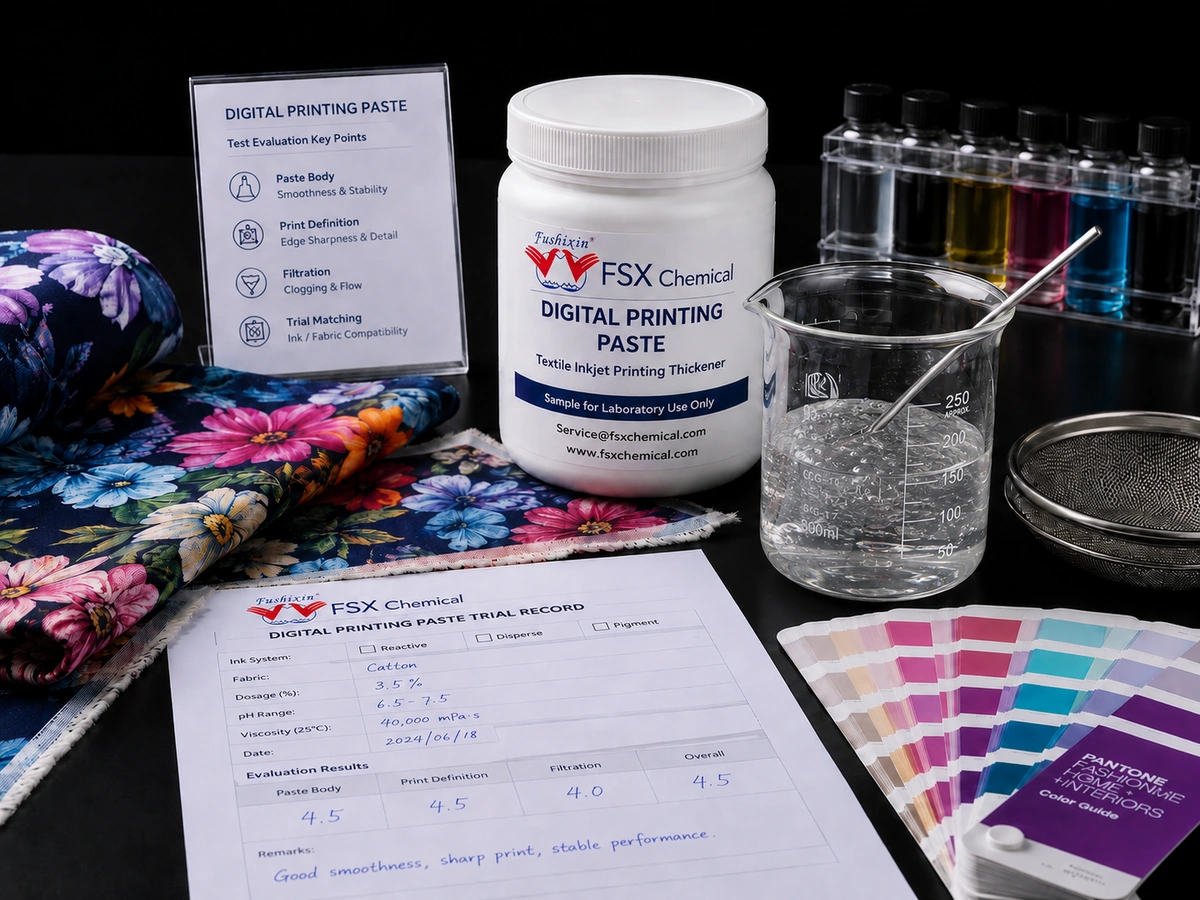
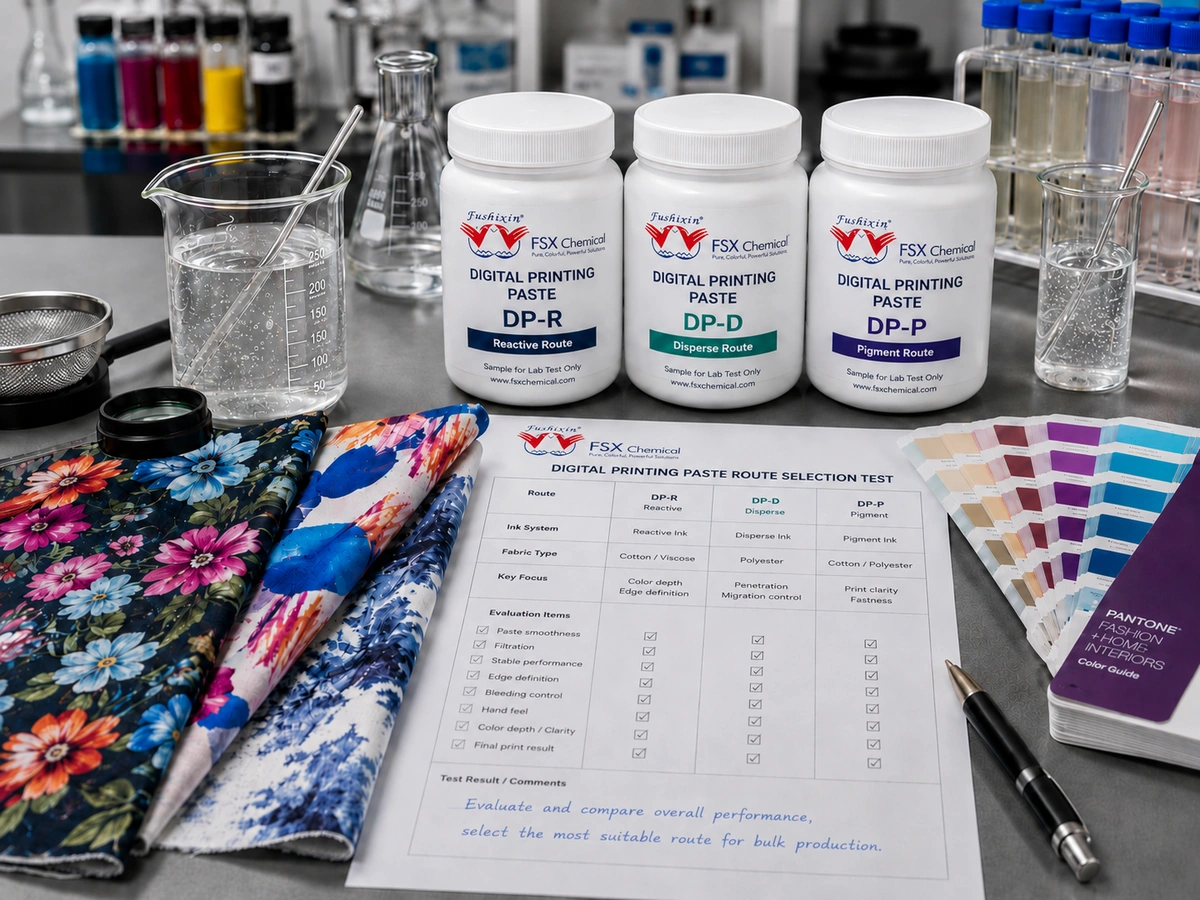
FSX Chemical’s pigment digital printing route therefore treats binder compatibility, curing conditions, fastness and fabric hand as key trial parameters rather than evaluating a pigment pretreatment from viscosity alone.
Equal percentages of two commercial liquids do not establish equal binder loading. Ask which component supplies the fixation polymer and whether its polymer content is known. A total-solids result can include salts, pigment or other ingredients, so it is not automatically a binder-solids result.
Binder location
Record for the comparison
Limit on interpretation
In the purchased ink
Ink identity and lot, ink consumption or deposited load, and the supplier’s required drying/fixation route.
If binder content is undisclosed, hold the approved ink constant. Do not assume unknown content means zero binder.
In a pretreatment or separate fabric-side layer
Product concentration, measured liquor pick-up or coating mass, and binder-polymer content where the supplier confirms it.
Compare polymer delivered per fabric mass or area where calculable, not liquid dosage alone. Keep surface-control chemistry under review.
Distributed across several stages
All binder-bearing products and their application quantities, plus the ink and fabric specifications.
A change at one stage can alter both localisation and total polymer deposit; its effect cannot be attributed to one function without a controlled comparison.
First confirm acceptable image formation at fixed ink and process settings. Then evaluate drying, the specified cure, fastness and handle on companion samples. A dry-looking print is not proof of complete film development or a sufficient chemical cure. Conversely, a sharp image does not establish rubbing durability.
Use the approved ink and binder instructions to define film-forming and cure conditions for the actual system; a general polymer mechanism does not supply a textile process specification. Do not add ordinary fabric-side pretreatment or binder to a printhead ink without explicit system-supplier qualification.
How to Build a Pretreatment-Binder Trial Matrix
A controlled trial should avoid changing every variable at once.
Step 1: Define the Current Benchmark
Record pigment ink brand/type, fabric composition, pretreatment product, pretreatment dosage or pick-up, binder location, binder dosage where known and curing conditions.
Step 2: Hold the Ink Constant
Use the same ink lot and printer settings.
Step 3: Compare Pretreatment First
Keep the binder architecture constant while comparing sharpness, bleeding, color strength and solid uniformity.
Step 4: Optimize Binder/Curing
Once print formation is acceptable, compare dry rubbing, wet rubbing, wash fastness, hand feel and curing efficiency.
Step 5: Evaluate Interaction
Confirm that the selected pretreatment does not reduce binder film performance and that the binder does not destroy the intended print definition.
Step 6: Run a Production Trial
Verify coating or padding uniformity, printer behavior, curing and repeatability.
Step 7: Approve the Complete System
Approve Fabric + Pretreatment + Ink + Binder Architecture + Curing rather than approving one component in isolation.
Common Pigment Printing Problems and Root Causes
Kuzatilgan muammo
Tekshirilishi kerak bo'lgan birinchi o'zgaruvchilar
Faraz qilmang
Good color but poor rubbing fastness
Binder level, binder chemistry, curing
More pretreatment will solve it
Good fastness but fabric feels too stiff
Binder level, binder modulus, curing
Higher fastness always requires a hard hand
Blurred edges
Pretreatment, fabric wetting, ink load
The binder is the main cause
Low color strength
Pretreatment localization, ink load, pigment distribution
More binder will deepen color
Print flakes after washing
Binder film, curing, substrate adhesion
The pigment concentration is too low
Notekis qattiq sohalar
Pretreatment uniformity, wetting, fabric surface
Binder dosage alone is responsible
Good lab result, poor production fastness
Actual fabric temperature, dwell time, coating uniformity
The lab binder sample was misleading
Can Pigment Digital Printing Work Without Binder or Pretreatment?
Selected research systems can.
In 2023, researchers reported self-dispersing pigment inks for cotton that were designed to print without conventional binder and without pretreatment while still achieving useful fastness under the reported test conditions.
This is an important innovation, but it should not be interpreted as proof that conventional commercial pigment inks no longer require binder or pretreatment.
The ink chemistry itself was redesigned to provide functionality that conventional systems obtain through additional components.
Conventional Pigment Ink System → Pretreatment and/or Binder Architecture Required According to the Ink Design
Special Self-Dispersing System → Some Conventional Functions Engineered Into the Pigment/Ink
These systems must be qualified separately.
Foydalanishdagi umumiy xarajatlarni qanday solishtirish
Do not compare pigment pretreatment and binder only by price per kilogram.
Important cost variables include pretreatment dosage, binder dosage, ink consumption, drying, curing energy, reprinting, rejected fabric, fastness failures and hand-feel complaints.
A useful framework is:
Cost per accepted m² = total in-scope pigment-printing cost ÷ accepted finished-fabric area. Include pretreatment, ink, any separately supplied binder, drying/curing and rework costs once. If binder is already included in the ink price, do not price that same material a second time. Use the same required fastness and handle to define accepted output.
A lower-binder system that fails rubbing fastness is not automatically cheaper.
A high-binder system that makes the fabric too stiff can also create commercial loss.
The target is a balanced system that achieves the required image quality, fastness and hand feel at a repeatable production cost.
What Information Should You Send to a Pretreatment Supplier?
For useful pigment digital pretreatment matching, provide:
Pigment ink brand or chemistry
Whether binder is already in the ink
Whether additional binder is used before or after printing
Fabric composition
Woven or knitted construction
Mato og'irligi
Current pretreatment product or TDS
Pretreatment dosage or measured pick-up
Pretreatment pH and viscosity method
Application equipment
Quritish sharoitlari
Curing temperature and time
Required dry/wet rubbing fastness
Required wash durability
Hand-feel target
Current color, bleeding, fastness or stiffness problem
FSX Chemical ushbu ma'lumotlardan orqali foydalanishi mumkin Namunalar va mos mahsulot tanlash to identify a relevant pigment pretreatment direction for controlled testing.
How Should a Mill Separate Pretreatment and Binder Problems?
Pretreatment is a process/formulation system; binder is a fixation polymer.
Pretreatment mainly controls print formation and pigment localization.
Binder mainly controls durable physical fixation after curing.
Binder may be located in the ink, pretreatment or post-treatment depending on system architecture.
More binder can improve durability but may reduce softness.
Final approval should balance color, sharpness, fastness and hand feel on the actual fabric.
Ko'p beriladigan savollar
1. Is pigment pretreatment the same as binder?
No. Pretreatment is the fabric-preparation stage and formulation. Binder is a polymeric component whose main role is to physically anchor pigment particles to the textile after curing.
2. What does pigment digital pretreatment do?
It can control wetting, ink spreading, penetration, pigment localization, surface charge and print uniformity before curing.
3. What does binder do in pigment printing?
Binder forms a polymer film that holds pigment particles on the fabric surface and contributes strongly to rubbing and washing durability.
4. Can pretreatment replace binder?
Not automatically. A pretreatment can improve pigment localization, but conventional pigment systems still require an appropriate fixation mechanism according to the ink architecture.
5. Can binder replace pretreatment?
Not automatically. Binder can improve fixation but may not adequately control ink spreading, penetration or fabric-surface uniformity.
6. Is binder always inside pigment ink?
No. Depending on the system, binder can be in the ink, in the pretreatment, applied separately after printing or distributed across multiple stages.
7. Why does more binder make fabric stiff?
Binder forms a film on and around fibers. Higher binder loading or a harder polymer can increase stiffness and reduce drape.
8. Why is rubbing fastness poor even with binder?
Possible causes include insufficient binder, unsuitable binder chemistry, incomplete curing, poor substrate adhesion or an incompatible pretreatment.
9. Can pretreatment improve pigment color strength?
Yes. By controlling penetration and pigment localization near the fabric surface, pretreatment can improve apparent color intensity and edge definition.
10. Do cotton and polyester need the same pigment pretreatment?
Not necessarily. Their wetting, surface chemistry and binder adhesion differ, so important fabrics should be validated separately.
11. Can pigment digital printing work without binder?
Special self-dispersing pigment ink technologies have demonstrated binder-free printing under specific research conditions, but conventional commercial systems should follow the ink supplier’s required fixation architecture.
12. What should I send FSX Chemical for pigment pretreatment matching?
Send the pigment ink, fabric, binder location and dosage where known, current pretreatment, pick-up, drying, curing, required fastness and hand-feel target.
Match Pigment Pretreatment and Binder Requirements with FSX Chemical
If your pigment digital printing shows good color but poor rubbing fastness, good fastness but excessive stiffness, or unstable sharpness across fabrics, FSX Chemical can help separate the pretreatment problem from the binder and curing problem.
In pigment digital printing, pretreatment and binder solve different problems. Pretreatment helps control where the ink goes; binder helps determine whether the pigment remains durable after curing. The best system balances both without sacrificing fabric hand.
To'qimachilik bosish uchun CMC, CMS, natriy alginat va raqamli bosish pastalarini solishtiring. Har bir usul reaktiv, dispers, pigment va raqamli jarayonlarga qanday mos kelishini hamda xaridorlar namuna sinovi, toifa mosligi va katta miqdorda xarid qilishdan oldin nima tekshirishlari kerakligini o'rganing.
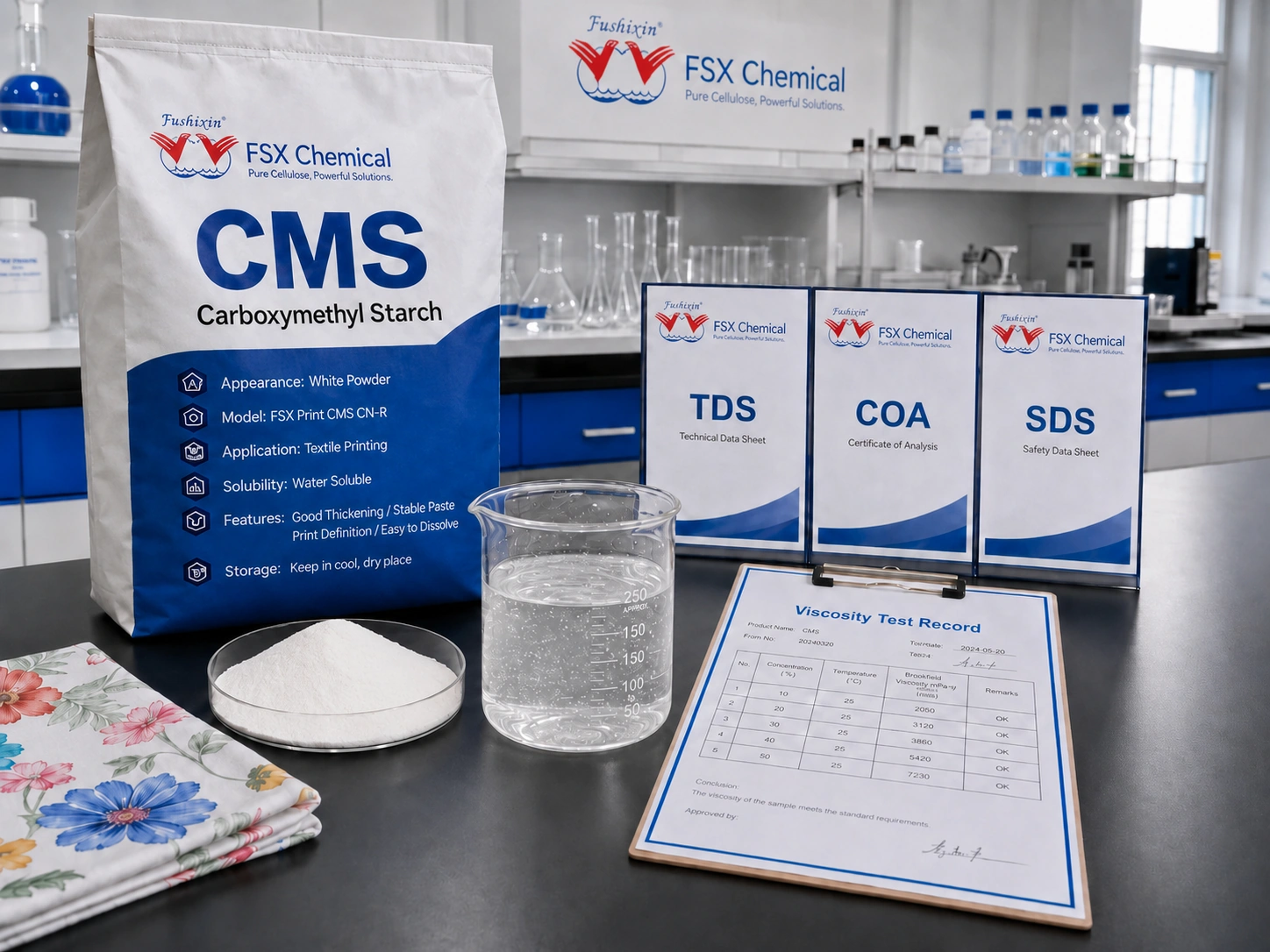
CMS can refer to generic carboxymethyl starch or to FSX’s commercial synthetic printing-thickener family. Identify the exact product before evaluating sizing, screen printing or digital fabric pretreatment, and qualify each application separately.
Viscosity control in digital textile printing involves two different systems: the jetting ink and the fabric pretreatment formulation. This guide explains how temperature, formulation, measurement methods and process conditions affect jetting stability and print quality.
Digital printing pastes should be selected by ink chemistry, fabric, application method and post-treatment. This guide compares sodium alginate, CMC, CMS, synthetic polymer and compound pretreatment routes for textile inkjet printing.
The best digital printing paste is the one matched to the ink chemistry, fabric and fixation route. This guide compares pretreatment requirements for reactive inkjet on cellulosic fabrics and direct disperse inkjet on polyester, then explains how buyers should evaluate samples before bulk purchasing.
Improving textile printing quality requires more than changing one chemical. This guide explains how FSX Chemical supports process-based selection of sodium alginate, CMC, CMS and digital printing paste, followed by sample testing, production validation and batch-document review.
An FSX-authored guide to checking digital pretreatment fit, trial evidence, product documents and sample-to-bulk traceability before supplier approval.
Affordable and premium textile thickeners should not be compared by price per kilogram alone. This guide explains how dosage, rheology, preparation, print quality, batch consistency, technical support and production risk determine which products truly stand out.
Factory-direct sourcing can create closer technical communication, clearer product identity, better sample-to-batch control and more transparent commercial discussions. This guide explains the practical advantages and the checks buyers should complete before ordering textile printing chemicals directly from a manufacturer.
Selecting a textile printing thickener becomes easier when you begin with the printing process, dye or ink system, fabric and equipment. This beginner-friendly guide explains the main product families, technical parameters, testing steps and supplier questions.
Stable digital printing paste requires more than a target viscosity. This guide explains how product selection, water quality, addition sequence, mixing, pH, temperature, filtration, hygiene, storage and quality records influence pretreatment and production consistency.
Effective viscosity management requires more than reaching one target number. This guide explains how test methods, temperature, concentration, hydration, shear, chemicals, storage and production conditions influence textile printing paste performance.
Mahsulot nomi, qo‘llanish sohasi, miqdori, yetkazib berish manzili hamda mavjud TDS, namuna surati yoki hujjatni yuboring. FSX Chemical ma’lumotlarni ko‘rib chiqib, narx taklifi, mos namuna yoki mahsulot tanlash uchun keyingi qadamni tavsiya qiladi.
Mahsulot haqida ma'lumotMahsulot nomi, markasi, modeli, yorliq surati yoki yetkazib beruvchi ma’lumoti.
Mavjud hujjatlarTDS, SDS, COA, namuna surati, mahsulotlar ro‘yxati yoki sinov ma’lumotlari.
Buyurtma tafsilotlariTaxminiy miqdor, qadoqlash, yetkazib beriladigan mamlakat, port yoki savdo sharti.
Qo‘llanish sohasi yoki muammoMatoga gul bosish jarayoni, retseptura talabi, amaldagi muammo yoki maqsadli natija.