Textile Printing Chemical Innovation: Evaluation Requirements
Textile printing chemical innovation in 2026 is moving beyond higher viscosity and stronger color. The...
Evaluate textile printing chemical innovations against a defined production need: chemical-input requirements, print quality, process resources, equipment compatibility and reliable supply. Biopolymers, hybrid binders, pigment dispersions, fabric pretreatments and alternative fixation methods require different evidence. A published experiment does not establish commercial availability or suitability for another printing route.
Textile printing chemicals are being redesigned around a broader set of manufacturing requirements. Printing mills still need sharp definition, stable paste viscosity, reliable machine operation and acceptable fastness, but they must increasingly consider restricted substances, energy use, wastewater, material origin and future supply-chain requirements.
As a result, innovation is no longer limited to developing a stronger thickener or a higher-color-yield binder. New systems are combining polymer science, biotechnology, nanotechnology, surface engineering and more application-specific chemical design.
The following ten directions provide a practical framework for evaluating chemical innovations. They are not a market ranking or a forecast of commercial adoption. Confirm the evidence, product identity and supply status of each proposed material at the time of purchase.
Some technologies are already available commercially. Others are still at laboratory or pilot scale. Buyers should therefore distinguish between a promising technical result and a product that can be supplied consistently with an established specification, Safety Data Sheet and commercial batch control.
What Counts as a Useful Textile Printing Chemical Innovation?
An innovation should create a meaningful improvement in chemical safety, application performance, resource efficiency, production reliability or textile functionality.
A new product name or a higher laboratory viscosity does not automatically represent innovation. The technology should solve a defined manufacturing problem and remain practical under real printing conditions.
Performance innovation
This may include better flow under shear, faster structural recovery, improved pigment adhesion, more stable dispersion or better compatibility with difficult fabrics.
Process innovation
A new chemical route may reduce curing temperature, shorten preparation, simplify washing or allow several operations to be combined.
Safety innovation
Reformulation may remove or reduce substances that create worker, environmental, wastewater or finished-product concerns.
Material innovation
Renewable gums, polysaccharides, proteins, waterborne polymers and functional particles may replace or complement conventional chemical routes.
Commercial innovation
A technically advanced material also needs repeatable batches, suitable documentation, reasonable storage stability and a realistic route from sample to bulk supply.
Ten Technology Directions and Buyer Checks
Innovation
Main Objective
Evidence to Request
Critical Buyer Check
Safer input chemistry
Reduce restricted-substance and PFAS-related risk
Product-specific conformity scope
Verify the exact product, scope and current documents
Biopolymer thickeners
Use renewable gums, proteins and polysaccharides
Grade identity and batch evidence
Test rheology, preservation and batch variation
Bio-based hybrid binders
Reduce reliance on conventional synthetic binder systems
Binder identity and supply status
Check fastness, handle, curing and storage
Nano waterborne binders
Improve pigment fixation through finer polymer structures
Particle specification and process evidence
Check wet rubbing, film durability and nanoparticle controls
Lower-energy fixation
Reduce conventional thermal-processing demand
Measured process and equipment evidence
Calculate equipment and scale-up requirements
Binder-free coloration
Combine color and fixation in one engineered particle
Fixation and durability evidence
Confirm wash durability and commercial reproducibility
Advanced pigment dispersion
Improve ink stability, filtration and jetting reliability
Ink-system and printhead evidence
Check particle size, sedimentation and printhead compatibility
Reduced-auxiliary systems
Lower the number or amount of process chemicals
Complete-process comparison
Compare complete process results, not ingredient count alone
Multifunctional printing
Add UV, antimicrobial, sensing or responsive properties
End-use and durability evidence
Verify durability, safety and end-use requirements
Bio-based discharge chemistry
Replace selected conventional oxidation or reduction routes
Grade identity and batch evidence
Check shade range, reaction control and storage stability
1. Safer Chemistry Designed Around MRSL and PFAS Reduction
Chemical-input control is an important evaluation requirement. Review the complete printing formulation against the applicable restricted-substance requirements, including minor auxiliaries and the scope of any conformity documents.
Manufacturing Restricted Substances Lists focus on chemical inputs used in production rather than waiting to test only the finished textile. This encourages suppliers to review surfactants, defoamers, wetting agents, preservatives, crosslinkers, carriers and other minor components.
Fluorine-free development
Regulatory and brand attention to PFAS is increasing interest in fluorine-free wetting, repellency and performance-chemical routes. Printing formulations may also need to consider fluorinated substances introduced through auxiliaries, contaminated equipment or multifunctional finishes.
Formaldehyde-conscious binder systems
Pigment-printing binder development increasingly focuses on durable film formation without relying on conventional formaldehyde-releasing crosslinking routes.
What buyers should verify
The exact commercial product and grade
The applicable MRSL or restricted-substance version
Whether conformity is self-declared or independently assessed
Whether the document covers every component in the supplied blend
Whether the claim applies to manufacturing inputs or finished textiles
A safer formulation still needs application testing. Removing one component may change foam, wetting, viscosity, storage or color performance.
2. Renewable Biopolymer Printing Thickeners
Sodium alginate, starch derivatives and cellulose derivatives already demonstrate the importance of renewable polymers in textile printing. Current research is expanding the range to other plant gums, proteins and hybrid biopolymer systems.
New natural gum sources
Researchers are evaluating gums isolated from fruits, agricultural materials and food-processing by-products as possible printing thickeners or combined thickener-binder materials.
Protein-polysaccharide combinations
Gelatine and alginate combinations illustrate how different natural polymers can be blended to adjust viscosity, shear-thinning behavior, film formation and pigment fixation.
Potential advantages
Renewable raw-material origin
New rheological combinations
Potential dual thickening and binding functions
Use of regional or agricultural raw materials
Opportunities for biodegradable formulation components
Commercial limitations
Natural origin does not guarantee consistent industrial quality. Agricultural source, extraction, purification, microbiological stability, odor, color and seasonal variation may affect commercial production.
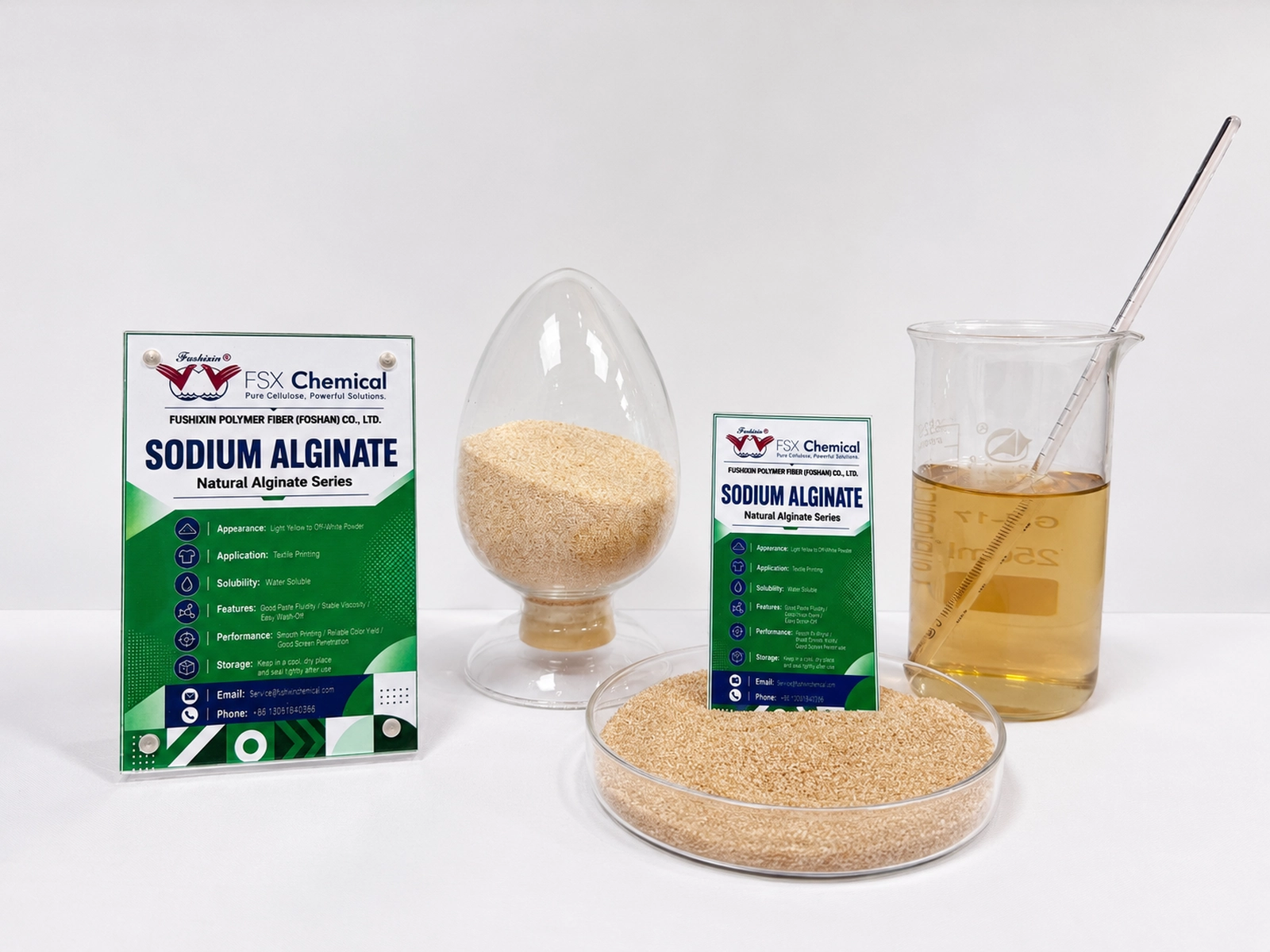
Compare proposed biopolymer systems with a qualified reference under the same printing conditions. Established Natriy alginati , CMC grades can provide relevant references. FSX CMS is a commercial synthetic-thickener family; do not classify it as a renewable starch derivative from its abbreviation or URL.
3. Bio-Based and Hybrid Pigment Binders
Pigment printing requires a binder because pigments generally do not have the same direct chemical affinity for textile fibres as reactive or acid dyes.
The challenge is to create sufficient adhesion and fastness without producing an excessively stiff film. Bio-based and hybrid binders are being studied to improve this balance.
Chitosan-based systems
Chitosan offers film-forming and functional properties and can be combined with synthetic or other natural materials. Its solubility, pH response, viscosity and compatibility must be controlled carefully.
Natural latex and gum hybrids
Plant latexes and natural gums may replace part of a conventional binder or serve as a functional component in a hybrid system.
Protein-polysaccharide binders
Gelatine-alginate systems demonstrate the possibility of combining thickening, binding and additional textile functionality in one paste.
Waterborne polyurethane, acrylic and polyurethane-acrylate hybrid binders are important development areas for pigment printing. Nano-scale polymer structures can provide a large effective surface area and controlled film formation.
A study published in Scientific Reports on 26 March 2026 evaluated synthesized polyurethane-acrylate binders for pigment screen printing on cotton, polyester and cotton-polyester fabrics. Its results depended on binder composition, concentration and thermal fixation; wet-rubbing performance on polyester and blends differed from cotton. It does not establish performance for every nano-scale binder or digital ink system.
Why nano-scale binders are attractive
Finer film-forming particles
Potentially improved pigment contact and adhesion
Opportunities to balance elasticity and strength
Suitability for waterborne systems
Possibility of incorporating functional nanoparticles
Important limitations
A strong result on cotton does not guarantee the same wet-rubbing performance on polyester or blends. Polymer type, textile surface, curing, pigment concentration and washing conditions remain important.
Commercial buyers should also ask how particle size is controlled, how the dispersion is stabilized and which safety information applies to the supplied material.
5. Lower-Energy Curing and Surface Activation
Conventional printing processes may require drying, steaming, thermofixation or curing. Innovation is increasingly focused on obtaining acceptable color and fastness with a more efficient energy route.
Microwave-assisted fixation
Microwave energy is being studied as an alternative way to heat and fix selected printed systems. Research using natural gums has shown that microwave conditions can influence color saturation and fixation.
Plasma surface activation
Plasma treatment can change fibre-surface wettability and surface chemistry before printing. Research on PET and polyamide showed that plasma-assisted inkjet printing can improve ink absorption, color strength and selected fastness results.
Why this matters to chemical suppliers
When surface energy changes, the required wetting agent, binder, pretreatment paste and rheology may also change. Process innovation and chemical innovation must therefore be developed together.
Scale-up questions
Can the equipment handle the required fabric width and speed?
Is treatment uniform across the full roll?
How long does the activated surface remain effective?
Does the new process change shade reproducibility?
What is the total energy use at commercial scale?
6. Binder-Free and Self-Fixing Colorant Systems
Traditional pigment printing separates the colorant from the binder. Binder-free research aims to engineer colored polymer particles that can provide both coloration and attachment to the textile.
Chitosan-modified colored polymer nanospheres and other self-fixing particles are examples of this direction.
Potential benefits
Reduced dependence on a separate binder
Potentially softer fabric handle
Simplified printing-paste formulation
More direct control of colorant-particle structure
Opportunities for lower film buildup
Qualification requirements for binder-free systems
Laboratory particle synthesis is different from large-scale pigment production. Commercialization requires stable particle size, repeatable shade, filtration, storage stability, cost control and long-term fastness.
Buyers should not assume that “binder-free” means “fixation-free.” Thermal or chemical treatment may still be required to achieve durable attachment.
7. Advanced Pigment Dispersants and Encapsulation
Digital pigment ink performance depends heavily on keeping very small pigment particles separated during manufacturing, storage, pumping and jetting.
Polymeric dispersants
New polymeric dispersants are designed to adsorb onto pigment surfaces and provide electrostatic, steric or combined stabilization.
Engineered nanoparticle dispersants
A 2025 study in Molecules examined polymeric nanoparticle dispersants for organic pigments in water, including inkjet printing on paper. It supports a dispersion-development concept, but it does not establish textile fastness, compatibility with a textile pretreatment or suitability for a particular printhead.
Pigment encapsulation
Encapsulating pigments inside or around a polymer structure can improve dispersion stability and may add binding or surface-interaction properties.
Important digital-ink checks
Particle-size distribution
Large-particle tail
Zeta potential or another relevant stability indicator
Sedimentation during storage
Viscosity at printhead operating temperature
Surface tension
Filtration behavior
Jetting reliability and nozzle recovery
An ink can show excellent color strength but still be commercially unsuitable if it settles, blocks filters or produces unstable droplets.
8. Reduced-Auxiliary and Lower-Water Printing Systems
Another major direction is reducing the number or amount of chemicals required around the printing step.
Reduced-urea and simplified paste systems
Some experimental bio-based pigment formulations have been prepared without conventional urea, phosphate components or synthetic binder. These results show the potential for simpler pastes, although they do not establish a universal replacement recipe.
Route-specific digital pretreatments
Digital printing paste development is becoming more application-specific. Reactive, disperse and pigment ink systems require different control of fabric pickup, pH, filtration, ink spreading, fixation and handle.
Evaluate digital fabric pretreatment by the actual reactive, disperse or pigment ink route. DG-20 is a confirmed FSX reactive-product code; request current grade identity and availability for any proposed disperse or pigment candidate.
Why fewer ingredients are not automatically better
Removing one chemical may increase the requirement for another operation or reduce storage stability. Total water, energy, washing, rework and finished-textile quality should be compared across the complete process.
9. Multifunctional Printing Chemicals
Printing is increasingly used to add function as well as color. Functional particles, polymers and biological materials can be included in a printing paste or binder system to produce additional textile properties.
Antimicrobial and UV-protective prints
Natural polymers and inorganic particles such as zinc oxide are being studied in systems that combine pigment fixation with antimicrobial or ultraviolet-protection properties.
Thermochromic and responsive prints
Thermochromic materials change visible appearance in response to temperature. Current research is improving microencapsulation, stability, textile integration and wash durability.
Printed sensors and conductive functions
Conductive, piezoresistive and responsive inks can be deposited onto or into textiles for wearable sensing and technical applications.
What buyers must verify
Functional performance before and after washing
Compatibility with the binder and thickener
Effect on shade and print definition
Particle migration or release
Skin-contact and end-use safety requirements
Durability after stretching, abrasion and laundering
A multifunctional claim should be supported by a defined test method and durability requirement, not only by an initial laboratory observation.
10. Bio-Based Discharge and Decolorization Chemistry
Discharge printing removes or changes an existing color in selected areas before or during application of another design. Conventional discharge systems can involve strong oxidation or reduction chemistry.
Enzyme-rich agricultural extracts
Recent research has evaluated potato-peel extracts containing oxidative enzymes as bio-based discharge agents for naturally dyed cotton and wool.
Potential benefits
Use of a food-processing by-product
Biocatalytic reaction routes
Potential reduction of selected conventional discharge chemicals
Compatibility with natural-dye development
Opportunities for lower-temperature processing
Commercial challenges
Crude biological extracts may vary in enzyme activity, color, odor, storage stability and microbial condition. Commercial production would require standardized extraction, activity measurement, preservation and batch control.
A bio-based discharge agent may also work only with selected dye structures. Shade range, reaction time, fabric damage and final fastness must be evaluated before scale-up.
Commercial Technologies vs Emerging Research
Buyers should separate three stages of innovation before changing a production formula.
Commercially established direction
The technology is supplied routinely with commercial grades, TDS, SDS, batch controls and established production references.
For any claimed commercial product, request the exact grade, current technical documents, available supply form and batch controls. A technology label such as waterborne, bio-based or nano-scale does not establish its supply stage.
Early commercial or pilot direction
The material can be produced beyond laboratory scale, but application range, supply volume or long-term batch data may remain limited.
For a pilot offer, establish the available quantity, specification, storage evidence and repeatability of the supplied batches. Assess the particular product rather than assigning every material in a chemical family to the same stage.
Research-stage direction
Published experiments demonstrate technical potential, but commercial specification, cost, storage, safety and supply repeatability have not yet been established.
When only a research sample or publication is available, qualify it as evidence of technical potential. Require separate evidence for a repeatable commercial grade, safe handling, storage, supply and production-scale performance.
How Manufacturers Should Evaluate an Innovation
Step 1: Define the manufacturing problem
Identify whether the objective is safer chemistry, lower temperature, better print definition, softer handle, reduced washing or additional textile functionality.
Step 2: Confirm the technology stage
Ask whether the material is a laboratory sample, pilot product or routine commercial grade.
Step 3: Request product identity and documents
Permanent commercial grade code
Joriy TDS va SDS
Relevant restricted-substance information
Recommended storage and preparation
Proposed batch COA parameters
Step 4: Standardize the comparison
Use the same water, concentration, mixer, fabric, colorant, curing, washing and test methods for the current product and candidate.
Step 5: Test the complete formulation
An innovative polymer may behave differently after pigments, dyes, alkalis, salts, binders, crosslinkers or functional particles are added.
Step 6: Conduct a production-relevant trial
Evaluate preparation, filtration, machine operation, holding stability and finished-textile performance.
Step 7: Compare total cost and risk
Include dosage, energy, labor, washing, waste, rework, documentation, equipment modification and supply continuity.
What These Innovations Mean for Thickener Selection
New binders, dispersants, functional particles and fixation methods can change the thickener requirement. A thickener approved in one conventional formula may not remain suitable after an innovative component is added.
Bio-based systems
Natural gums and proteins may require different preservation, hydration and temperature controls from conventional synthetic polymers.
Nano-particle systems
The thickener must maintain suspension and rheology without destabilizing fine pigment or functional particles.
Digital fabric pretreatment systems
Pretreatment viscosity must support uniform fabric application while controlling ink spreading. It should not be selected only by the highest viscosity number.
Lower-energy fixation
A different curing route may change binder-film formation, moisture retention and the required paste composition.
Start with established product families
Buyers can review FSX Chemical product families and evaluate whether sodium alginate, CMC, CMS, digital printing paste or a compound thickener is the most practical starting route.
Textile Printing Chemical Evaluation FAQ
How can buyers confirm commercial availability?
Commercial status must be checked for the specific supplier, grade and application. Request current product documents and supply evidence, then qualify the complete process. A publication, a chemical-family name or a product advertisement alone cannot establish routine commercial readiness.
Are bio-based textile thickeners automatically more sustainable?
No. Renewable origin is only one factor. Buyers should also consider land and feedstock sourcing, chemical modification, effective dosage, preparation energy, wash-off demand, wastewater, durability, transport and production waste.
How should a printing mill evaluate a new chemical technology?
Define the production problem, confirm the technology stage and current documentation, then use standardized laboratory tests followed by a controlled machine trial. Compare the complete printed result, repeatability, total cost in use and supply reliability rather than one laboratory claim.
Will new technologies replace sodium alginate, CMC or CMS?
Not as one universal replacement. Established thickeners will continue to be selected by fabric, dye or pigment system, application position, rheology, fixation, washing and cost. Use the printing-process selection guide and a sample matching trial to identify the practical route.
Build a Claim-to-Evidence Record Before a Trial
Use one record for each proposed innovation so that purchasing and production evaluate the same claim. Keep a laboratory result separate from a supplier’s commercial offer.
Record field
Question to resolve
Claim and boundary
Which fabric, printing route, colorant, application step and finished-textile requirement does the claim cover?
Evidence source
Is the support a published experiment, a grade-specific supplier document or a controlled comparison on your process?
Comparison basis
Were application amount, fixation, washing and final quality comparable with the approved reference?
Release decision
Which results and documents must be approved before moving from a sample to a commercial delivery?
For example, the 2026 polyurethane-acrylate study concerns specific pigment screen-printing binders. The 2025 nanoparticle-dispersant study includes paper inkjet results. Neither proves that an unrelated textile product will perform the same way. Likewise, a ZDHC MRSL input-chemistry assessment does not replace finished-fabric testing. Record unresolved questions explicitly, then design the next trial to answer them.
How FSX Chemical Supports New Printing-Chemical Projects
FSX Chemical supplies textile printing thickeners and digital printing paste routes for printing mills, paste formulators, chemical distributors and importers.
Buyers can discuss sodium alginate, CMC, the FSX CMS synthetic-thickener family and digital fabric-pretreatment requirements with FSX. Confirm the exact available commercial grade and its documents for each proposed application.
Buyers can provide
Current product TDS or representative sample
Printing route and equipment
Fabric and fibre composition
Dye, pigment or ink system
Maqsadli viskozitet va to'liq sinov usuli
Current formulation and dosage
Filtration and holding requirements
Main performance or sustainability objective
Estimated quantity, packaging and destination
Technical review may include
Identification of a suitable product family
Review of the existing supplier grade
Alignment of viscosity and preparation methods
Recommendation of a candidate commercial grade
Provision of relevant TDS and SDS information
Representative sample support
Guidance for side-by-side evaluation
Review of laboratory and production-trial feedback
Batch documentation for an approved commercial product
FSX Chemical does not claim to commercially supply every research technology described in this article. Product availability, suitability and documentation should be confirmed for the specific inquiry📧 Elektron pochtaService@fsxchemical.com
Mato, bo'yoq yoki siyoh, fiksatsiya, yuvib tashlash va bosib chiqarish sifati talablariga asoslanib reaktiv, dispergatsion, pigment va raqamli to'qimachilik bosib chiqarish uchun qalinlashtiruvchi va oldindan ishlov berish usullarini qanday tanlashni o'rganing.
Natriy alginati reaktiv bosma pastaning barqaror va yuviladigan qalinlashtiruvchisi sifatida to'qimachilik bosishda keng qo'llaniladi. Sotib olishdan oldin viskozlik darajasi, tozaligi va qo'llashga yaroqliligini qanday baholashni hamda FSX Chemical kompaniyasining global xaridorlarga texnik ma'lumotlar va namuna taqdim etish orqali qanday ko'maklashishini o'rganing.
Choose CMC for textile printing by application, DS, viscosity method and formulation trials. Use a practical checklist to compare grades before bulk purchase.
CMC asosidagi bosma xamir pigmentli, reaktiv va raqamli to'qimachilik bosishda ishlatiladi. Ushbu qo'llanma qaysi parametrlar muhimligini, yetkazib beruvchilarni qanday solishtirishni va katta miqdordagi buyurtma berishdan oldin nima so'rashni tushuntiradi.
Natriy alginat hamda CMC mato bosishda qalinlashtiruvchi moddalar sifatida ishlatiladi, ammo ular turli bo'yoq tizimlari va jarayon sharoitlariga mos keladi. Ushbu qo'llanma asosiy farqlarni va har birini qachon qo'llashni tushuntiradi.
Matolarga raqamli inkjet bosib chiqarish sitach bosib chiqarishga nisbatan turli xil xamir va oldindan ishlov berish talablariga ega. Ushbu qo'llanma natriy alginatning raqamli matobop bosib chiqarishda qanday qo'llanilishini va xarid guruhlari qaysi darajadagi parametrlarni belgilashi kerakligini tushuntiradi.
Reaktiv bo'yoq bilan bosishda bo'yoqni mahkamlash darajasi to'g'ridan-to'g'ri rang hosil bo'lish miqdoriga, yuvilish barqarorligiga va chiqindi suvlar hajmiga ta'sir qiladi. Ushbu qo'llanma natriy alginat bo'yoqni mahkamlashni qanday qo'llab-quvvatlashini, qanday xamir parametrlari mahkamlash darajasiga ta'sir qilishini va ishlab chiqarishda mahkamlash darajasi past bo'lganda muammolarni qanday bartaraf etishni tushuntiradi.
Mesh size describes sodium alginate powder particle size, not final viscosity or print quality. Compare dispersion, hydration, retained matter and complete-paste performance under a defined method.
Natriy alginatining tozalik spetsifikatsiyalari faqat bitta ko'rsatkichdan iborat emas. Ushbu qo'llanma faol modda miqdori, NaCl, erimaydigan moddalar va og'ir metallar bo'yicha ma'lumotlarning to'qimachilik bosma xamiri ishlashiga qanday ta'sir qilishini — va standart sanoat darajasiga nisbatan yuqori tozalikni qachon belgilash maqsadga muvofiq ekanligini tushuntiradi.
Diagnose sodium alginate paste viscosity drift using matched temperature, concentration, hydration and shear history. Separate flow response, timed recovery and holding stability before changing a grade or recipe.
Learn how to store sodium alginate powder and prepared paste, check shelf-life limits, and decide when a textile printing batch needs quarantine or retesting.
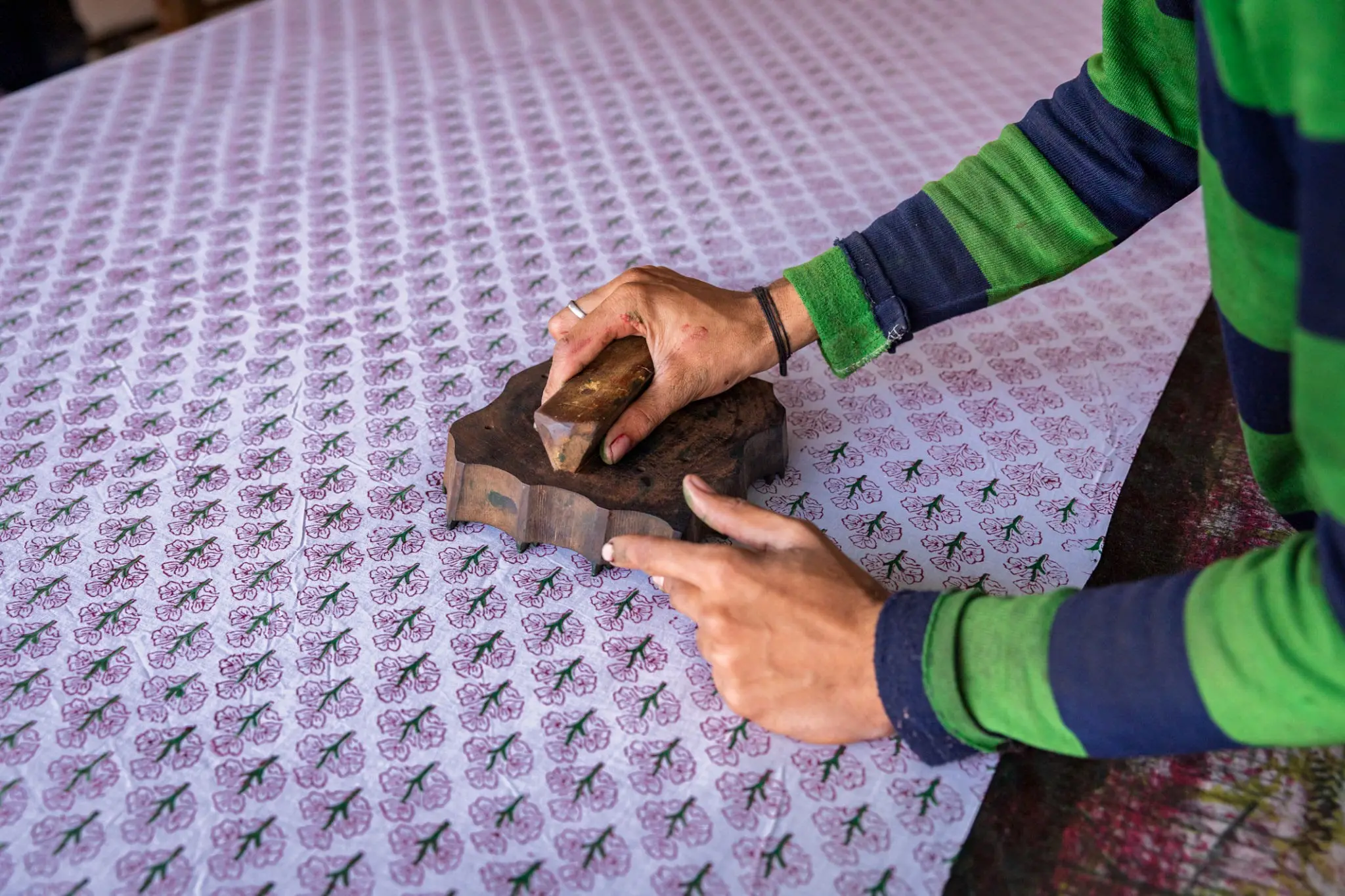
Evaluate sodium alginate for reactive-dye hand block printing using the actual block, fabric, recipe and fixation route. Compare preparation, transfer, edge control, holding stability and final wash-off before selecting a grade.
Mahsulot nomi, qo‘llanish sohasi, miqdori, yetkazib berish manzili hamda mavjud TDS, namuna surati yoki hujjatni yuboring. FSX Chemical ma’lumotlarni ko‘rib chiqib, narx taklifi, mos namuna yoki mahsulot tanlash uchun keyingi qadamni tavsiya qiladi.
Mahsulot haqida ma'lumotMahsulot nomi, markasi, modeli, yorliq surati yoki yetkazib beruvchi ma’lumoti.
Mavjud hujjatlarTDS, SDS, COA, namuna surati, mahsulotlar ro‘yxati yoki sinov ma’lumotlari.
Buyurtma tafsilotlariTaxminiy miqdor, qadoqlash, yetkazib beriladigan mamlakat, port yoki savdo sharti.
Qo‘llanish sohasi yoki muammoMatoga gul bosish jarayoni, retseptura talabi, amaldagi muammo yoki maqsadli natija.