Synthetic Thickener for Cotton, Polyester and CVC Pigment Printing: What Should Change?
Pigment printing can use the same basic binder-based color system on cotton, polyester and CVC,...
Pigment printing can be used on cotton, polyester and cotton/polyester blends because the pigment is fixed primarily by a binder film rather than by a fiber-specific dye reaction. However, that does not mean the same synthetic-thickener working window should be copied unchanged across every fabric. Cotton is more absorbent and can pull liquid deeper into the structure; polyester is much less absorbent and places greater emphasis on surface wetting, cleanliness and binder adhesion; CVC combines both fibers and can show mixed wetting and penetration behavior that is not simply the mathematical average of cotton and polyester. The correct approach is to keep pigment/binder chemistry under control while adjusting rheology, paste deposit, wetting, curing and thickener dosage to the real fabric construction and finishing history.
What Should Change Between Cotton, Polyester and CVC?
The pigment and binder system can often remain conceptually similar across cotton, polyester and CVC, but the operating window should be rechecked because the substrate changes how the wet paste behaves before curing.
The main variables that may need adjustment are:
Synthetic-thickener dosage
Low- and high-shear rheology
Wetting-agent level
Yopishtirish omonati
Binder level
Drying and curing conditions
To'g'ri jarayon mantiqi quyidagicha:
Identify Fiber / Construction → Check Surface Condition → Print the Same Controlled Reference Paste → Compare Wetting / Penetration / Transfer → Adjust Rheology or Binder Only Where Needed → Cure → Check Fastness and Hand
Do not start by creating three completely different formulas without first proving which variable actually needs to change.
Why Pigment Printing Can Work Across Different Fiber Types
Pigments are insoluble color particles.
Unlike reactive dyes, they do not need to form a covalent reaction with cellulose.
Unlike disperse dyes, they do not need to diffuse into polyester under heat.
In conventional pigment printing, the binder forms a film that adheres pigment particles to the textile surface.
This is why pigment printing can be applied to:
Paxta
Polyester
Cotton/polyester blends
Many other textile substrates
However, substrate-independent colorant chemistry does not mean substrate-independent process behavior.
The fabric still controls:
Wetting
Liquid absorption
Surface contact
Kirish
Binder adhesion
Final hand
That is where the thickener working window becomes fabric-specific.
What Does CVC Mean?
CVC is commonly used for a cotton/polyester blend in which cotton is the majority fiber.
It should not be treated as one fixed blend ratio.
Before formulation work, confirm the actual:
Cotton percentage
Polyester percentage
Knitted or woven construction
Mato og'irligi
Surface finish
A cotton-rich CVC can behave closer to cotton in some wetting and hand properties, while another blend with more polyester can behave differently.
Shuning uchun:
CVC Label ≠ Complete Substrate Specification.
The Four Fabric Variables That Matter Most
1. Liquid Absorption
Cotton absorbs water much more readily than polyester.
This changes how quickly the aqueous phase leaves the printed paste.
2. Surface Wetting
Polyester is less hydrophilic, so wetting and surface cleanliness can become more important.
3. Fabric Construction
Open knits, dense woven fabrics, brushed surfaces and different GSM values all change paste deposit and penetration.
4. Thermal / Finishing History
Heat setting, scouring, oils, softeners and other finishing treatments can change the surface that the binder must contact.
These four variables should be reviewed before blaming the synthetic thickener.
Synthetic Thickener for Cotton Pigment Printing
Cotton is hydrophilic and can absorb the aqueous phase of a pigment paste relatively quickly.
For thickener selection, the main objective is usually to balance:
Transfer → Controlled Penetration → Surface Color → Soft Hand
If the paste is too mobile:
Penetration can increase.
Edges can spread.
Surface color can weaken.
If the paste is too structured:
Screen transfer can fall.
Solid areas can become uneven.
Surface buildup can increase hand.
A cotton formula should therefore be optimized around the actual absorbency and construction of the fabric.
Cotton: Absorbency and Penetration Control
Two cotton fabrics can behave differently even if both are 100% cotton.
Variables include:
Sifatli qidiruv
Merserizatsiya
Knitted vs. woven structure
Mato og'irligi
Yarn twist
Surface hairiness
More absorbent cotton can pull the liquid phase into the structure faster.
In that case, the thickener may need enough low-shear body and recovery to keep pigment concentration near the surface.
But this does not mean cotton always requires a higher Brookfield viscosity.
A highly shear-thinning grade can print cleanly at a lower rest viscosity than a more Newtonian paste.
Always evaluate the complete rheology.
Cotton: Scouring, Bleaching and Surface Uniformity
Synthetic Thickener for Polyester Pigment Printing
Polyester has a very different wetting and moisture behavior from cotton.
The aqueous pigment paste tends to remain closer to the fabric surface rather than being absorbed rapidly into the fiber structure.
This can make surface wetting and binder adhesion especially important.
The thickener should support:
Uniform wetting
Controlled surface hold
Clean screen transfer
Stable binder distribution
Do not assume the cotton thickener dosage should be copied directly.
Polyester: Wetting and Surface Adhesion
A water-based pigment paste must spread sufficiently across the polyester surface to create a uniform binder film.
If wetting is inadequate:
Paste can bead or pull back.
Solid areas can become patchy.
Binder contact can become nonuniform.
If wetting is excessive and the paste is too mobile:
Edges can spread.
Fine definition can fall.
The thickener and wetting-agent package should therefore be evaluated together.
Do not try to solve a surface-wetting problem only by changing viscosity.
Polyester: Residual Oils and Surface Contamination
Polyester can carry residual:
Spinning oils
Knitting oils
Silicone
Softener
Finishing agents
These can interfere with:
Wetting
Binder adhesion
Print uniformity
If rubbing fastness or coverage is inconsistent, check fabric cleanliness before increasing binder or thickener.
A poorly prepared polyester surface can make a technically sound pigment paste appear defective.
Polyester: Rheology and Surface Hold
Because liquid does not enter polyester as readily as cotton, more of the wet paste can remain near the surface immediately after printing.
This may change the preferred balance between:
Low-shear body
High-shear flow
Post-transfer recovery
Too much low-shear structure can create a heavy surface layer.
Too little recovery can allow spreading before drying.
The optimum value depends on:
Fabric texture
Mesh
Squeegee conditions
Mashina tezligi
Again:
Same Viscosity ≠ Same Polyester Printing Performance.
Polyester: Drying and Curing
Pigment printing still requires the binder to form a durable film.
Polyester production may already include heat-setting steps, but that does not mean the existing thermal history automatically cures the pigment binder correctly.
Validate:
Quritish
Curing temperature
Curing time
Fabric dimensional behavior
Binder manufacturer guidance
Do not publish or use one universal curing temperature for every polyester pigment formula.
Synthetic Thickener for CVC Pigment Printing
CVC combines cotton and polyester in the same textile structure.
Pigment printing avoids the need to select separate reactive and disperse dye systems for the two fibers, but the wet paste still contacts a mixed surface.
This can create a unique balance of:
Cotton-driven absorption
Polyester-driven surface hold
Mixed wetting
Blend-dependent hand
CVC should therefore be treated as its own production substrate.
Do not simply average the cotton and polyester formulas.
CVC: Mixed Cotton/Polyester Surface Behavior
The surface of a CVC fabric is not necessarily a perfectly uniform 60/40 or 65/35 visual mixture at every microscopic point.
Yarn blending, knitting, weaving and finishing can create local differences in which fiber is more exposed.
This can influence:
Local wetting
Paste penetration
Binder contact
Surface appearance
A paste that looks uniform on pure cotton and pure polyester can still show different behavior on the blend.
This is why the actual CVC fabric must be included in the qualification trial.
Why the Cotton/Polyester Ratio Matters
A cotton-rich blend generally behaves more cotton-like in moisture interaction than a polyester-rich blend, but the relationship is not perfectly linear.
Confirm:
Actual fiber ratio
Whether the fabric is true CVC or another polyester/cotton blend
Matoning tuzilishi
Pre-finish / final finish
Do not approve a “CVC formula” without recording the actual blend composition.
Knit vs. Woven, Weight and Surface Structure
Fiber chemistry is only one part of the substrate.
A heavy CVC fleece, lightweight cotton jersey and dense polyester woven fabric require different transfer and penetration behavior even if the pigment/binder chemistry is similar.
Yozuv:
Knit or woven
GSM
Surface hairiness
Brushing / raising
Compactness
These variables can sometimes affect thickener selection more strongly than the fiber percentage alone.
Cotton vs. Polyester vs. CVC: Practical Comparison
Tanlov maydoni
Paxta
Polyester
CVC
Water interaction
More absorbent
Low absorbency
Mixed / blend-dependent
Main wet-paste risk
Ortiqcha kirish
Poor wetting / surface hold
Mixed penetration / wetting
Surface preparation
Scouring / absorbency consistency
Oil / finish removal
Both may matter
Thickener focus
Penetration control + transfer
Surface flow + recovery
Balanced mixed-surface control
Binder focus
Fastness + soft hand
Surface adhesion + fastness
Uniform adhesion across blend
Formula transferability
Requires fabric-specific verification
This table describes route-level tendencies, not fixed formulation rules.
Should the Target Viscosity Change by Fabric?
Possibly, but do not change the target before testing the same reference paste on all substrates.
A better sequence is:
Prepare one controlled pigment paste.
Measure its viscosity and rheology.
Print cotton, polyester and CVC under matched machine conditions.
Compare penetration, surface coverage and definition.
Adjust the working window only where the fabric result requires it.
This distinguishes:
Fabric Effect
from:
Formula Effect.
Should Synthetic-Thickener Dosage Change?
There is no universal cotton, polyester or CVC dosage.
Dosage should be adjusted only if the complete paste falls outside the useful rheology window for that substrate.
Masalan:
An absorbent cotton may need stronger penetration control.
A smooth polyester may need excellent leveling without excessive surface buildup.
A CVC may need a compromise that controls cotton absorption while maintaining uniform wetting over polyester-rich surface regions.
The objective is:
Lowest Thickener Dosage That Produces Stable Printing on the Actual Fabric.
Should Binder Dosage Change?
Binder requirement can change with:
Pigment loading
Fabric surface
Required rubbing fastness
Hand target
Curing efficiency
Polyester can place more emphasis on surface adhesion.
Cotton can place more emphasis on balancing fastness with softness.
CVC needs the binder film to perform across a mixed cotton/polyester surface.
However, do not increase binder simply because the fiber changes.
Use the lowest binder level that passes the required fastness under validated curing.
Wetting Agents and Surface Tension
Wetting-agent demand can differ between fabrics.
Polyester may need more attention to wetting than prepared cotton.
But excessive wetting agent can:
Increase foam
Change HASE rheology
Increase spreading
Therefore, optimize:
Wetting + Thickener + Defoamer
as one surface-control package.
Do not change wetting agent independently from paste rheology.
Penetration vs. Surface Color Yield
Pigment color yield depends strongly on where the pigment remains after printing and curing.
Excess penetration can reduce visible surface concentration.
Insufficient contact can reduce uniform coverage.
For each fabric, compare:
Face-side color
Reverse-side penetration
Solid-area uniformity
Nozik chiziq ta'rif
The optimum penetration on a heavy cotton knit may not be the optimum on a smooth polyester woven fabric.
Rubbing Fastness
Rubbing fastness depends strongly on:
Binder level
Binder taqsimoti
Pigment loading
Qotirish
The thickener influences fastness indirectly by controlling:
Yopishtirish omonati
Pigment tarqalishi
Binder taqsimoti
If polyester rubbing is poor, check surface contamination and binder adhesion before increasing thickener.
If cotton rubbing is poor, also check excessive penetration, binder ratio and curing.
For CVC, inspect whether the print is uniform across the mixed surface.
Fabric Hand
Pigment printing leaves a polymer film on the fabric.
How Should a Mill Adjust Synthetic Thickener Across Cotton, Polyester and CVC?
Amaliy boshqaruv zanjiri quyidagicha:
Confirm Fiber / Construction → Standardize Fabric Preparation → Print One Reference Paste → Compare Wetting / Penetration / Transfer → Adjust Rheology / Wetting / Binder Only Where Needed → Cure → Check Rubbing / Hand → Lock Fabric-Specific SOP
Asosiy tamoyillar quyidagilardan iborat:
Pigment printing is broadly suitable across cotton, polyester and blends because the binder fixes insoluble pigment to the fabric rather than relying on a fiber-specific dye reaction.
Cotton generally places more emphasis on absorbency and penetration control.
Polyester generally places more emphasis on surface wetting, cleanliness and binder adhesion.
CVC combines both fibers and should be validated as its own substrate rather than treated as a mathematical average.
Thickener dosage, binder level and target viscosity should change only when the actual fabric result shows a need.
The best formulation is the one that gives stable rheology, clean transfer, acceptable fastness and hand at the lowest practical Total Cost in Use for the specific fabric.
Ko'p beriladigan savollar
1. Can the same synthetic thickener be used for cotton and polyester pigment printing?
Potentially yes, but the working dosage and rheology should be validated because cotton and polyester have very different absorption and wetting behavior.
2. Does cotton always need higher viscosity?
No. Cotton may need stronger penetration control, but the correct result depends on shear thinning, recovery, fabric absorbency, screen settings and construction—not one Brookfield number.
3. Does polyester always need lower viscosity?
No. Polyester needs balanced surface wetting, transfer and recovery. The target viscosity is grade-, fabric- and machine-specific.
4. Why does pigment paste penetrate cotton more than polyester?
Cotton is more hydrophilic and absorbs the aqueous phase more readily, while polyester is much less absorbent.
5. Why can pigment printing be used on both fibers?
Pigment is mainly fixed by a binder film on the textile surface rather than through a fiber-specific dye reaction.
6. What does CVC mean?
CVC generally means a cotton/polyester blend in which cotton is the majority fiber. Confirm the actual ratio because CVC is not one fixed blend composition.
7. Should CVC use the cotton formula?
Not automatically. CVC has mixed cotton/polyester surface behavior and should be tested directly.
8. Why does polyester pigment printing sometimes have poor rubbing fastness?
Possible causes include surface oils or finishes, inadequate binder adhesion, incorrect binder level or incomplete curing. Thickener alone is not the main fixation mechanism.
9. Why does cotton pigment printing sometimes look weak even with enough pigment?
Excess penetration can reduce pigment concentration at the visible surface, lowering apparent color yield.
10. Should binder dosage be different for cotton and polyester?
Possibly, but determine the requirement from fastness, adhesion, pigment loading, hand and curing—not from fiber name alone.
11. What is the best way to compare the three fabrics?
Print all three first with one controlled reference paste, then adjust only the variable linked to the observed fabric-specific problem.
12. What should I send FSX Chemical for substrate matching?
Send fiber composition, CVC ratio if applicable, knit/woven structure, GSM, current thickener, viscosity method, pigment, binder, machine route, curing conditions and the main printing problem.
Match Synthetic Thickener to the Actual Fabric, Not Just the Pigment Formula
If the same pigment paste performs well on cotton but shows poor wetting on polyester, or if a CVC blend gives different penetration, hand or rubbing performance, FSX Chemical can help structure a controlled substrate comparison.
Foydali texnik ko'rib chiqish uchun yuboring:
Fabric composition and actual cotton/polyester ratio
Knit or woven construction and GSM
Sizning hozirgi sintetik qalinlashtiruvchi namunangiz, TDS yoki COA
Thickener dosage and viscosity test method
Pigment product and dosage
Binder grade and dosage
Wetting / defoamer system
Oxirgi xamir pH
Machine and screen conditions
Curing conditions
Current issue: penetration, wetting, color yield, rubbing or fabric hand
Bilan boshlang Namuna va moslik for a controlled current-vs-candidate evaluation.
Pigment chemistry may be broadly fiber-independent, but printing behavior is not. The most reliable synthetic-thickener selection starts with the actual fabric surface, absorbency, construction and finishing history, then adjusts rheology only where the substrate creates a measurable production need.
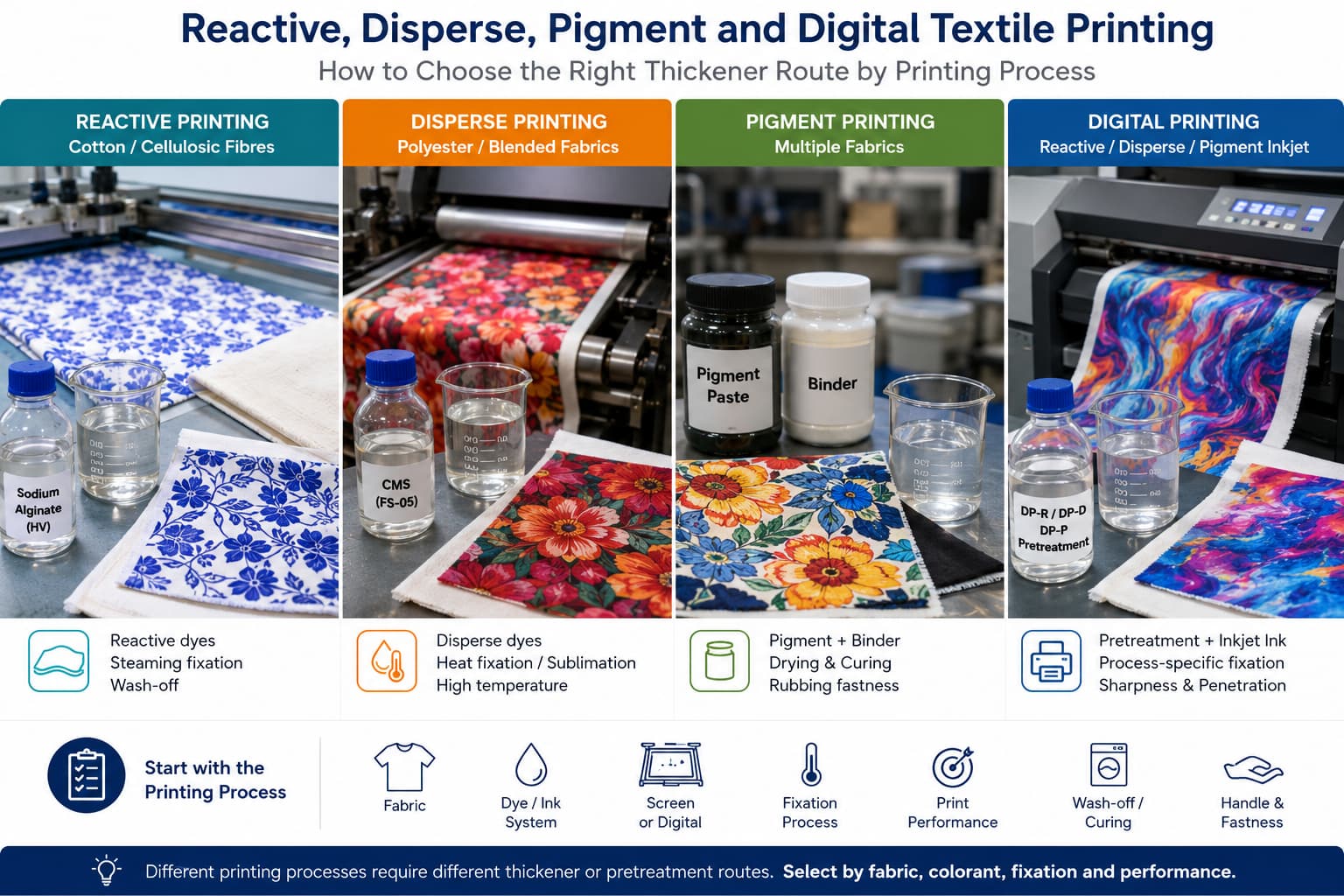
Mato, bo'yoq yoki siyoh, fiksatsiya, yuvib tashlash va bosib chiqarish sifati talablariga asoslanib reaktiv, dispergatsion, pigment va raqamli to'qimachilik bosib chiqarish uchun qalinlashtiruvchi va oldindan ishlov berish usullarini qanday tanlashni o'rganing.
CMC asosidagi bosma xamir pigmentli, reaktiv va raqamli to'qimachilik bosishda ishlatiladi. Ushbu qo'llanma qaysi parametrlar muhimligini, yetkazib beruvchilarni qanday solishtirishni va katta miqdordagi buyurtma berishdan oldin nima so'rashni tushuntiradi.
Natriy alginat hamda CMC mato bosishda qalinlashtiruvchi moddalar sifatida ishlatiladi, ammo ular turli bo'yoq tizimlari va jarayon sharoitlariga mos keladi. Ushbu qo'llanma asosiy farqlarni va har birini qachon qo'llashni tushuntiradi.
The right textile printing thickener is determined by more than fabric type. Buyers should match the thickener to the dye or pigment system, printing method, target rheology, wash-off requirements and actual factory trial conditions.
Textile printing performance depends on a coordinated chemical system, not one universal additive. This guide explains ten important chemical groups, their functions, where they fit and what buyers should verify before production trials.
To'qimachilik bosma qalinlashtiruvchilar kimyoviy tarkibi, reologiyasi, bo'yoq bilan mosligi va yuvilib ketish xususiyatlari bo'yicha farqlanadi. Ushbu qo'llanma asosiy qalinlashtiruvchi oilalarini, ularning umumiy qo'llash yo'nalishlarini va ishlab chiqarish sinovlaridan oldin xaridorlar tekshirishi kerak bo'lgan parametrlarni taqqoslaydi.
Digital printing pastes should be selected by ink chemistry, fabric, application method and post-treatment. This guide compares sodium alginate, CMC, CMS, synthetic polymer and compound pretreatment routes for textile inkjet printing.
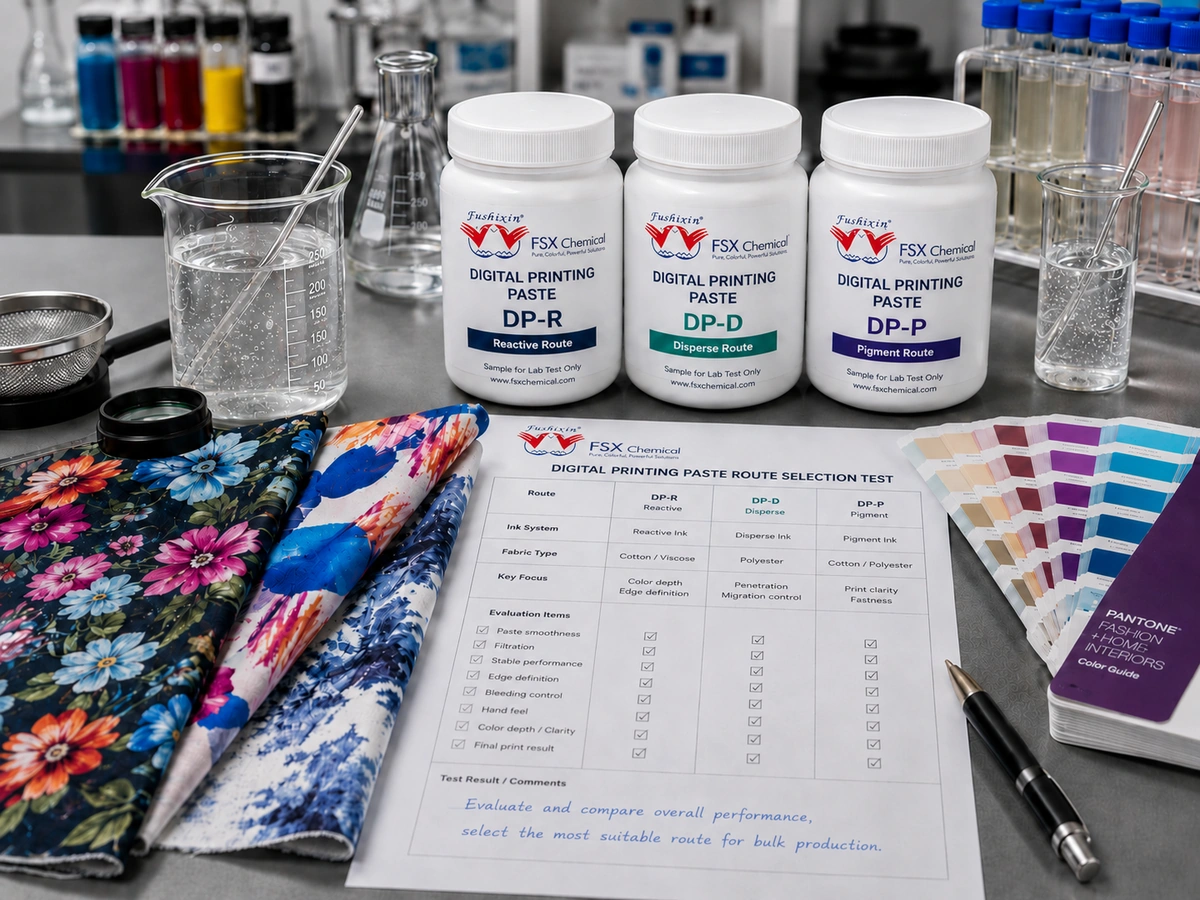
FSX Chemical offers separate digital printing paste routes for reactive, disperse and pigment systems, supported by application review, sample matching and technical documentation. This guide explains how buyers can evaluate the right route before bulk purchasing.
Stable digital printing paste requires more than a target viscosity. This guide explains how product selection, water quality, addition sequence, mixing, pH, temperature, filtration, hygiene, storage and quality records influence pretreatment and production consistency.
This product review examines FSX Digital Printing Paste as a textile inkjet pretreatment and thickening route, focusing on ink-system matching, rheology, filtration, print definition, stability and real production testing.
Digital textile printing requires more than advanced ink and printheads. Explore process-specific chemical solutions for reactive, disperse and pigment inkjet printing, from pretreatment and rheology to filtration, fixation and production validation.
Textile printing chemistry is evolving beyond simple viscosity and price comparisons. Explore five innovation directions shaping 2026, including safer chemical inputs, hybrid biopolymer thickeners, advanced pigment binders, shorter digital processes and multifunctional formulations.
Mahsulot nomi, qo'llanilishi, miqdori, manzili hamda mavjud bo'lsa har qanday TDS, namuna fotosurati yoki hujjatni taqdim eting. FSX Chemical ushbu ma'lumotlarni ko'rib chiqib, narx taklifi, namuna mosligi yoki mahsulot tanlovi bo'yicha keyingi bosqichni tavsiya qiladi.
Mahsulot haqida ma'lumotMahsulot nomi, toifasi, modeli, yorliqdagi rasm yoki yetkazib beruvchining ma'lumotnomasiga havola.
Mavjud hujjatlarTDS, SDS, COA, namuna fotosurati, mahsulotlar ro'yxati yoki sinov ma'lumotlari.
Buyurtma tafsilotlariTaxminiy miqdor, qadoqlash, manzil davlati, port yoki savdo sharti.
Ariza yoki muammoTo'qimachilik bosib chiqarish jarayoni, formulatsiya ehtiyoji, joriy muammo yoki maqsadli ko'rsatkich.