Textile Printing Chemical Innovations: Five Directions to Evaluate
Textile printing chemistry is evolving beyond simple viscosity and price comparisons. Explore five innovation directions...
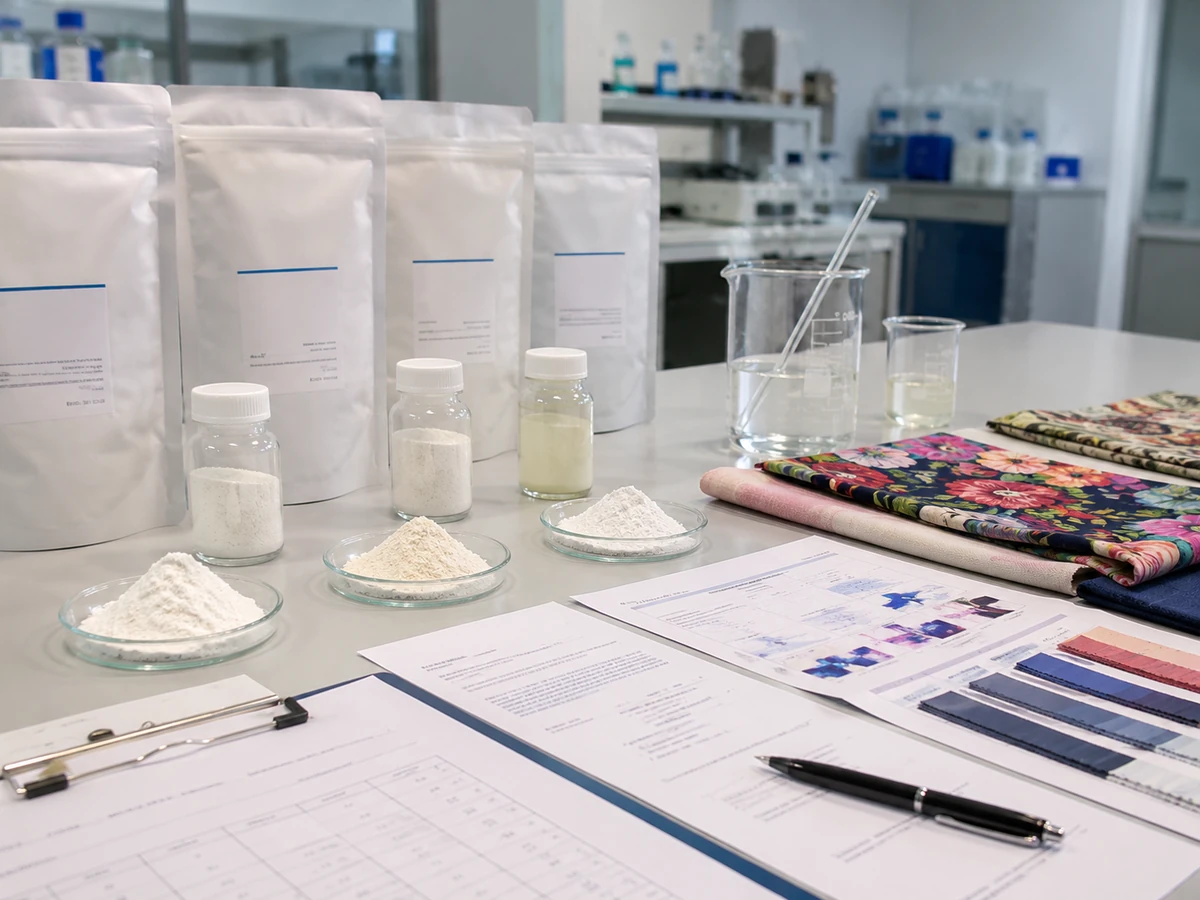
A textile printing chemical innovation is worth adopting only when a controlled comparison shows a useful improvement without an unacceptable loss in finished-fabric quality or process reliability. Five development directions to examine are input-chemical control, bio-based or hybrid thickeners, waterborne pigment binders, shorter digital workflows and multifunctional systems. Treat them as evaluation topics, not a ranking of newly proven FSX technologies.
For each proposed change, define the present commercial benchmark, the target improvement and the process stages that must remain within acceptance. Record the comparison on the same fabric and route; a new ingredient name does not establish a production benefit.
A new thickener is not valuable simply because it produces higher viscosity. A new binder is not automatically better because it uses a different polymer. A digital pretreatment should not be considered innovative only because it contains a newly marketed ingredient.
The more useful question is whether the chemistry helps the printing process become more controllable, resource-efficient and technically reliable while maintaining the required finished-fabric quality.
The five directions below are an editorial framework for assessing development proposals. They are not an exhaustive market survey, an official industry ranking or proof that a product is new. Individual formulations still require product-specific evidence and production validation.
What Counts as Innovation in Textile Printing Chemistry?
Textile chemical innovation does not always mean discovering a completely new molecule.
Significant innovation can also come from combining existing chemistries more intelligently, changing polymer architecture, reducing unnecessary process steps, improving chemical transparency or designing one formulation around a clearly defined printing route.
For a printing mill, useful innovation should improve at least one of these areas
Chemical-input control
Material efficiency
Reologiya
Paste stability
Filtrlash
Printing definition
Fixation or curing efficiency
Process simplicity
Finished-fabric quality
Partiya ichidagi barqarorlik
Ideally, the improvement should not create an unacceptable compromise elsewhere in the process.
Five Development Directions and Their Adoption Evidence
Development direction
Evidence to collect
Adoption boundary
Input-chemical control
Exact formulation identity, applicable restricted-substance requirements and current supporting evidence
An SDS or a general green claim is not proof of formulation conformance or finished-article compliance.
Bio-based or hybrid thickeners
Composition scope, dosage, complete-paste stability, print result and preparation losses
Renewable origin does not establish lower total environmental impact or universal dye compatibility.
Waterborne pigment binders
Actual fabric temperature and cure time, binder loading, required fastness and handle
A lower binder dosage or oven setting is not acceptable if film performance or durability fails.
Shorter digital workflows
All retained stages, pretreatment add-on, drying load, final fabric result and rework
A reactive, direct-disperse, pigment or transfer route cannot borrow another route’s omitted stages.
Multifunctional systems
Functions actually combined, dosing controls, recipe compatibility and holding stability
Convenient preparation must not hide a loss of adjustment control or an unresolved compatibility issue.
These directions overlap. A bio-based polymer may also form part of a multifunctional system, while an advanced digital pretreatment may combine several surface-control mechanisms.
1. Safer-Input and PFAS-Aware Chemical Formulation
Input-chemical control concerns the formulation entering production, including constituents that may not be visible on the finished print.
Assess chemical-input evidence before the formulation enters production, rather than treating a clean-looking print as evidence about its composition.
Why input chemistry matters
Trying to control unwanted substances only after printing or finishing is inefficient. The more practical approach is to understand chemical inputs before they enter the production system.
What this means for formulators
Evaluate printing performance alongside raw-material identity, restricted-substance requirements, supplier data and the evidence supporting each product claim.
What this means for buyers
Procurement teams should ask for product-specific information rather than relying on broad statements such as environmentally friendly, green or compliant.
A stronger qualification package may include
Clear commercial product identity
Joriy TDS
SDS
Relevant batch documentation
Applicable test or conformity evidence where required
Traceable manufacturer information
This innovation is ultimately about moving from marketing-based chemistry to evidence-based chemistry.
2. Bio-Based and Hybrid Thickener Systems
Natural polymers have been used in textile printing for a long time. Sodium alginate, cellulose derivatives and starch derivatives are familiar examples.
A hybrid development route may combine bio-derived or modified polymers to obtain complementary rheological behavior. The combination is a proposal to test, not proof of a newer or more sustainable technology.
Why hybrid systems are interesting
One polymer may provide viscosity while another contributes film formation, structural recovery, adhesion or another functional property.
Potential hybrid design goals include
Improved shear-thinning behavior
Better structural recovery
Reduced dependence on one polymer
Improved paste stability
Additional textile functionality
Optimized total polymer dosage
Natural origin is not enough
A bio-based material should not automatically be considered the most sustainable choice.
Its manufacturing route, required dosage, processing, waste and finished-textile performance should still be evaluated.
The important innovation is therefore functional polymer engineering, not simply replacing the word synthetic with natural.
3. High-Efficiency Waterborne Pigment Binders
Pigment printing remains highly dependent on binder chemistry because pigments do not rely on the same fiber-reactive mechanism as reactive dyes.
The binder must create a film capable of retaining pigment on the textile while maintaining an acceptable balance of durability, flexibility and fabric handle.
Binder Development Targets to Test
Waterborne polymer systems
More efficient film formation
Polymer particle architecture
Lower effective binder loading where technically possible
Improved adhesion
Better rubbing performance
Softer fabric handle
More efficient curing windows
Why polymer architecture matters
Binder performance depends on more than solids content. Particle size, reactive groups, film formation and crosslinking behavior can influence the relationship between dosage and printing performance.
Lower binder dosage is not automatically better
A reduction is valuable only if pigment fixation, rubbing performance, wash durability and hand feel remain acceptable.
The real innovation target is therefore higher functional efficiency, not simply less binder.
4. Shorter-Process Digital Printing Pretreatment
For a digital pretreatment project, define which stage is inefficient and which print-quality requirements must remain unchanged.
Traditional digital workflows can include several stages between raw fabric and finished print:
Illustrative process map: prepared fabric → any required fabric-side pretreatment and drying → inkjet printing → route-specific fixation or curing → required washing, clearing or finishing. Reactive, direct-disperse and pigment workflows differ; sublimation transfer additionally involves a transfer carrier and heat-transfer stage.
Each stage can add time, energy, water use, handling and process variation.
The innovation direction is process compression
Evaluate whether a proposed pretreatment can simplify preparation, reduce drying burden or combine functions while meeting the same agreed print-quality requirements.
Important development targets include
Lower pretreatment add-on
More uniform fabric pickup
Faster or simplified drying
Better ink migration control
High fine-line definition
Compatible fixation
Reduced unnecessary post-processing
Shorter does not automatically mean better
Removing one processing stage is useful only if definition, color result, fastness and fabric handle remain acceptable.
Production trials are therefore essential before converting a laboratory short-process concept into normal manufacturing.
5. Multifunctional and Application-Specific Chemical Systems
An application-specific formulation can address several defined requirements, but one polymer should not be assumed to solve every printing problem.
Modern compound and application-specific systems can combine several functions inside one controlled formulation.
Potential Formulation Functions
Base viscosity
Shear-thinning control
Structural recovery
Surface sizing
Namlik boshqaruvi
Elektrolit toleranti
Binder mosligi
Paste stability
This is particularly important in digital printing
Reactive, disperse and pigment inkjet systems require different fabric, ink and fixation conditions.
A universal digital printing paste is therefore less useful than a clearly defined product route designed around a specific ink and fabric system.
Compound does not automatically mean more complicated
A well-designed compound product can simplify the customer’s formulation if several functions have already been balanced during product development.
The critical requirement is repeatable manufacturing and clear application validation. Define what the combined system replaces, what the operator can still adjust and which change requires a new trial. Do not assume that a blended rheology system removes the need for filtration or other normal process controls.
Why Rheology Connects Several of These Innovations
Rheology is one of the central themes connecting thickener, binder, pretreatment and compound-system development.
A single viscosity number describes only one measurement condition. Printing exposes the chemical system to different levels of shear.
At low shear
Sufficient structure may support storage and holding stability.
Under higher shear
Easier flow can help pumping, coating and screen passage.
After application
Structural recovery may help limit uncontrolled spreading and maintain print definition.
This is why innovative thickener systems should be compared through rheological behavior and printing trials rather than viscosity alone.
What These Innovations Mean for Reactive Printing
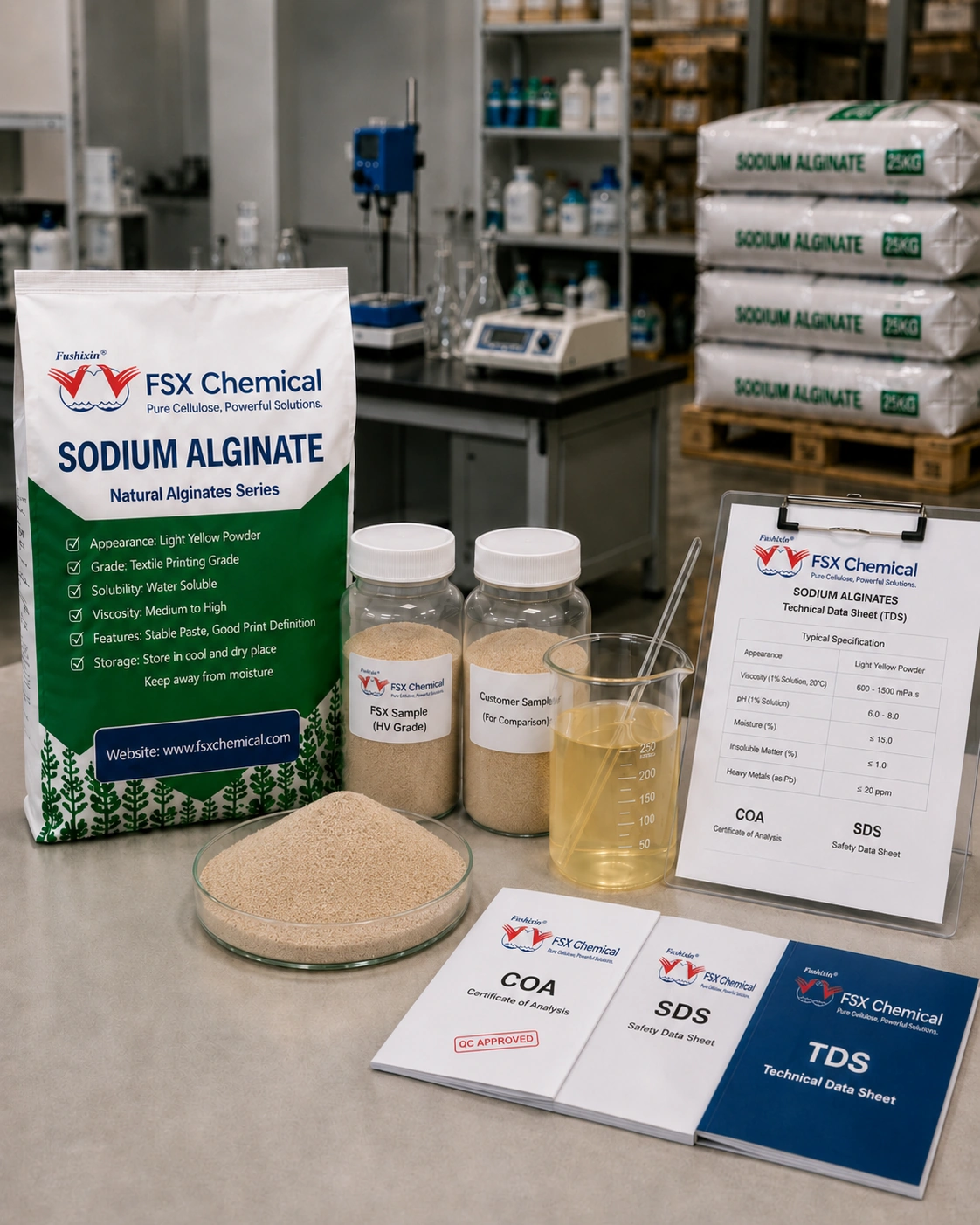
Conventional reactive screen printing still commonly begins with Natriy alginati as an important thickener route.
Innovation does not necessarily mean abandoning this established chemistry.
Instead, development can focus on:
More efficient viscosity grades
Better filtration
Improved rheological control
Compound systems for selected formulations
Reduced formulation correction
Better sample-to-bulk consistency
Any change to the thickener route should still be validated for reactive-dye compatibility, definition, fixation and wash-off.
What These Innovations Mean for Disperse Printing
For polyester disperse printing, select a thickener specifically documented for the intended screen, direct-inkjet or transfer workflow. These routes have different addition points and fixation requirements; approval in one route does not establish suitability in another.
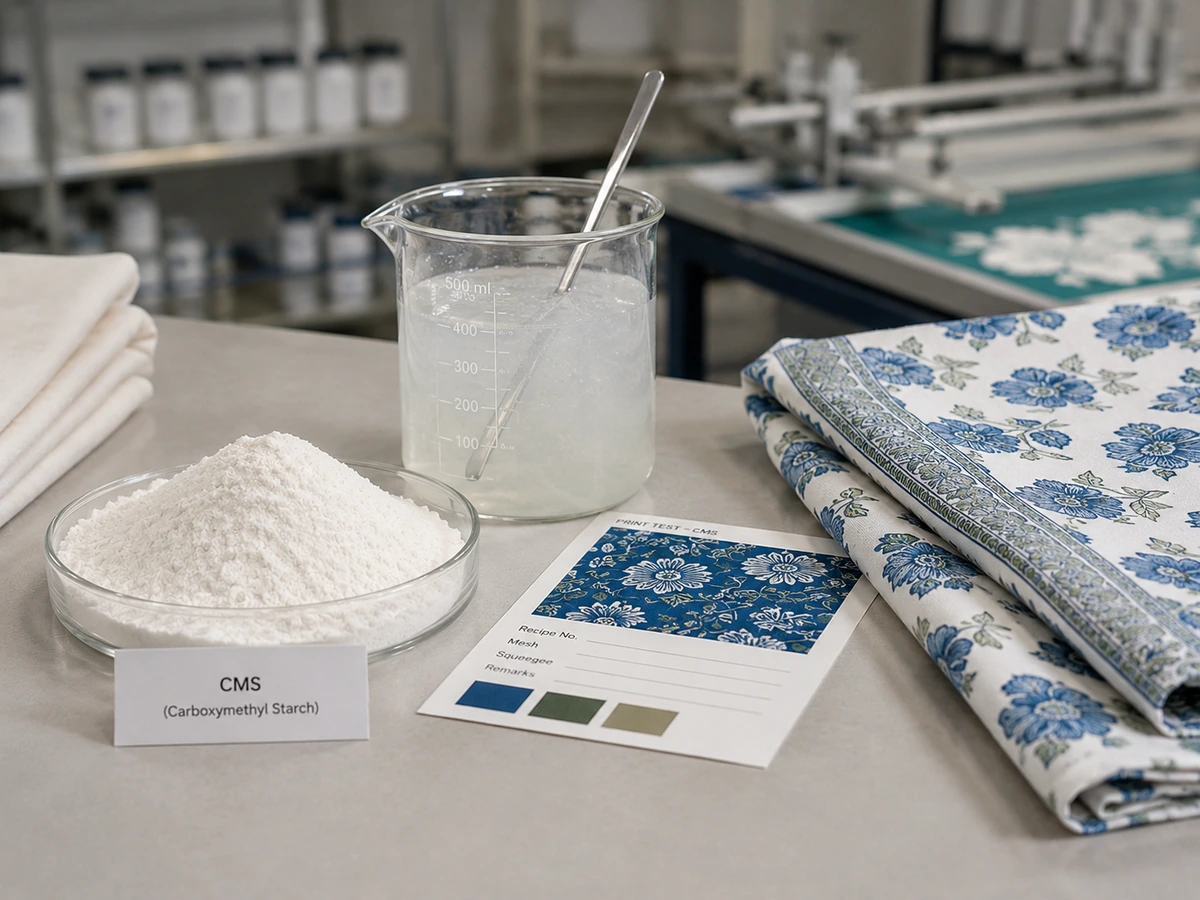
FSX CMS is a commercial synthetic printing-thickener family. Confirm grade identity and intended process in the current TDS instead of interpreting the CMS abbreviation as carboxymethyl starch. For a documented disperse screen-printing grade, evaluate screen passage, paste stability, fixation and finished-fabric results.
Innovation targets can include
Better effective thickening efficiency
Cleaner screen passage
Improved long-run paste stability
More consistent solid areas
Compatibility with thermal fixation
Final suitability depends on the actual disperse colorant, polyester fabric and fixation process.
What These Innovations Mean for Pigment Printing
Pigment printing is one of the areas where thickener and binder innovation are closely connected.
A high-performance pigment formulation needs the rheology system and binder to work together.
Important optimization targets include
Binder efficiency
Thickener-binder compatibility
Elektrolit toleranti
Ta'rifni chop etish
Film formation
Rubbing performance
Qotirish
Fabric handle
Improving one property at the expense of several others does not represent successful innovation.
What These Innovations Mean for Digital Textile Printing
Digital development proposals should first identify the ink system, substrate and fabric-side treatment route before comparing chemical options.
The chemistry should first be separated according to ink system.
Reactive inkjet
Evaluate fabric pretreatment for suitable cellulosic textiles, migration control, definition, fixation and wash-off.
Disperse inkjet
Evaluate polyester pretreatment for uniformity, filtration, drying and thermal-process compatibility.
Pigment inkjet
Evaluate pretreatment together with pigment ink, binder, curing, rubbing performance and fabric hand feel.
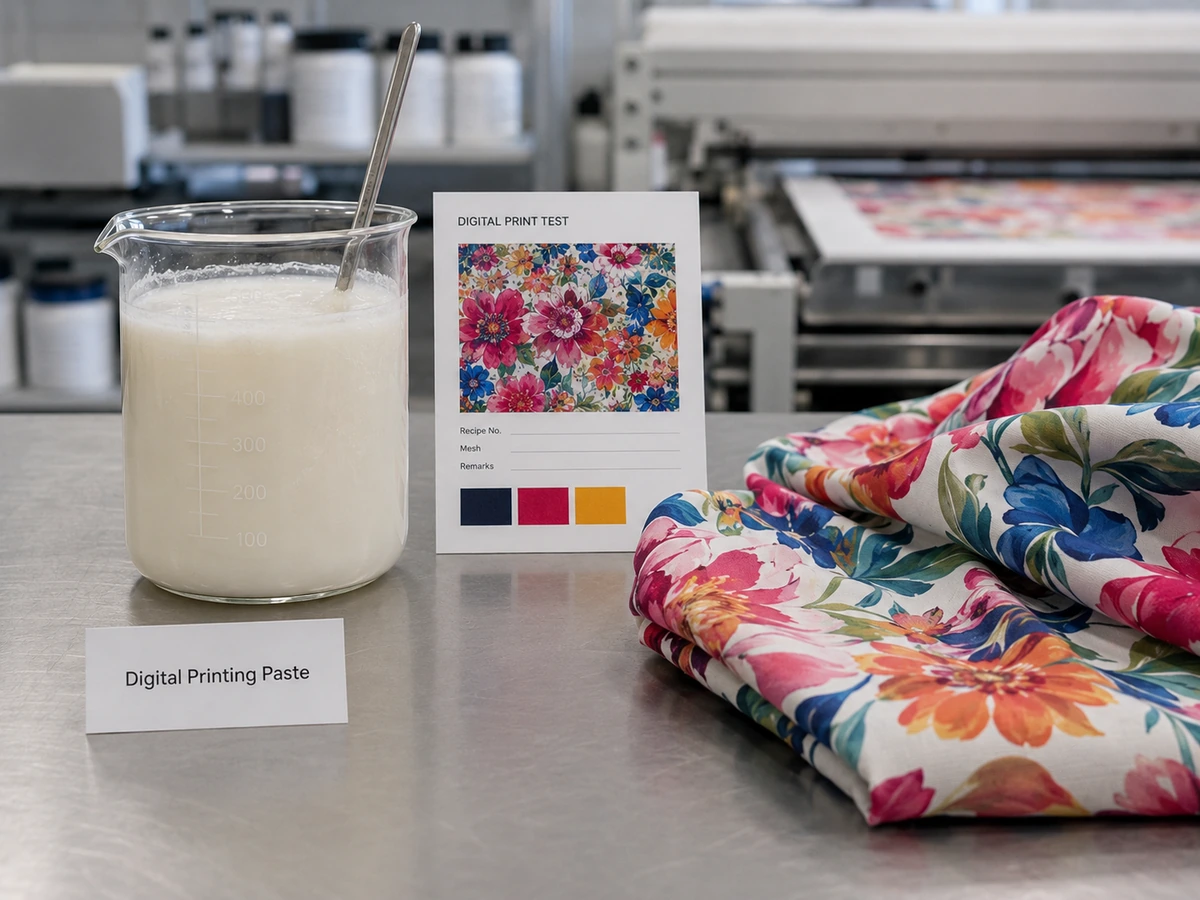
FSX Chemical separates these systems through Raqamli gul bosish pastasi routes designed for reactive, disperse and pigment printing trials.
Digital pretreatment paste should not simply be added directly to digital ink. Ink and fabric-side pretreatment are different formulation systems.
Innovation and Sustainable Printing
Sustainability claims need particular care when discussing new textile chemicals.
A bio-based ingredient, lower dosage or shorter process does not by itself prove a lower overall environmental impact.
A more practical evaluation includes
Actual chemical dosage
Paste waste
Filtration loss
Energy used in preparation and curing
Water used in washing
Rejected or reprinted fabric
Product durability
Partiya ichidagi barqarorlik
Sustainable innovation should therefore be connected with measurable process performance rather than broad environmental terminology.
Separate Input Evidence from Whole-Process Claims
The ZDHC Manufacturing Restricted Substances List addresses restricted substances in chemical inputs to textile and related manufacturing. It does not, by itself, prove print performance or the overall environmental impact of a printing route. Check the exact product, evidence scope and current requirements relevant to the buyer; this reference is not a claim that an FSX grade holds a particular conformance status.
When comparing resource use, use the same agreed quantity of accepted fabric as the denominator. Include preparation, drying, fixation or curing, required washing or clearing, off-spec production and rework inside the stated boundary. Report which stages were measured and which were excluded.
How to Evaluate an Innovative Textile Chemical
New chemistry should face a stronger test procedure than an established material because the buyer has less production history on which to rely.
Step 1: Define the current benchmark
Record the existing commercial product, formula, dosage and known production performance.
Step 2: Define the innovation objective
Decide whether the candidate is intended to improve filtration, rheology, dosage, curing, process length, sustainability or another measurable target.
Step 3: Compare basic laboratory properties
Ko'rinish
Qovushqoqlik
pH
Gidratlanish
Filtrlash
Physical stability
Step 4: Evaluate the complete formulation
Add the actual dyes, pigments, salts, alkalis, binders and auxiliaries used in production.
Step 5: Print the actual fabric
Use the same design, substrate and equipment conditions whenever possible.
Step 6: Complete post-treatment
Final evaluation should occur after fixation, curing and washing as required.
Step 7: Compare the original objective
Confirm whether the innovation actually improved the targeted parameter without creating new production problems.
Why Laboratory Innovation Must Survive Production Scale-Up
An innovative formulation can perform very well in a small laboratory batch and still behave differently in industrial production.
Scale-up changes
Mixer geometry
Batch size
Pump shear
Vaqtni ushlab turish
Harorat
Application speed
Fabric variation
Production validation should therefore be part of product development, not an afterthought.
Monitor the complete production run
Fabric from the beginning, middle and end should be compared when evaluating paste stability and printing consistency.
Verify the first bulk batch
The commercial material should remain connected to the approved sample through product identity and relevant batch documentation.
Innovation and Total Cost in Use
New textile chemistry is commercially useful only when its complete economic effect is understood.
Do not compare only price per kilogram
A more expensive product can still reduce total cost if it operates at a more efficient dosage or reduces expensive production losses.
Taqqoslang:
Delivered product price
Effective dosage
Preparation time
Filtrlash
Machine downtime
Printing speed
Paste waste
Fixation or curing
Reprinting and rejected fabric
Innovation should therefore be measured against an established technical and commercial benchmark.
How Buyers Should Evaluate Innovative Suppliers
Baholash maydoni
Question to Ask
Innovation Claim
What exactly is new about the product?
Technical Evidence
Which measurements support the claimed benefit?
Qo‘llanish sohasi
Which fabric and printing system was it designed for?
Benchmark
What should the product be compared against?
Namuna
Can I test the actual commercial grade?
Scale-Up
Has the chemistry been evaluated beyond a small laboratory batch?
Partiya sifat nazorati
Which properties are controlled in commercial production?
Documentation
Which product-specific technical and compliance documents are available?
Supply
Can the approved formulation be produced consistently for repeat orders?
A technically credible supplier should be willing to explain both the expected benefit and the limitations of a new chemistry.
How FSX Chemical Approaches New Printing Solutions
Innovation within textile printing does not require replacing every proven chemistry. In many cases, a better result can come from selecting the correct grade, optimizing rheology or developing a more appropriate compound system.
Through Namunalar va mos mahsulot tanlash , customers can use their current commercial product as the technical reference for evaluating a different grade or formulation direction.
Useful project information includes
Current commercial product and TDS
Physical reference sample
Viskozlik va to'liq sinov usuli
Hozirgi qo‘llash miqdori
Printing formulation
Mato
Reactive, disperse, pigment or digital process
Printing equipment
Current technical problem
Target improvement
The objective is to identify a technically relevant candidate and validate it through controlled comparison rather than assume that a product is superior simply because it is described as new📧 Elektron pochtaService@fsxchemical.com
Mato, bo'yoq yoki siyoh, fiksatsiya, yuvib tashlash va bosib chiqarish sifati talablariga asoslanib reaktiv, dispergatsion, pigment va raqamli to'qimachilik bosib chiqarish uchun qalinlashtiruvchi va oldindan ishlov berish usullarini qanday tanlashni o'rganing.
CMC asosidagi bosma xamir pigmentli, reaktiv va raqamli to'qimachilik bosishda ishlatiladi. Ushbu qo'llanma qaysi parametrlar muhimligini, yetkazib beruvchilarni qanday solishtirishni va katta miqdordagi buyurtma berishdan oldin nima so'rashni tushuntiradi.
Natriy alginat hamda CMC mato bosishda qalinlashtiruvchi moddalar sifatida ishlatiladi, ammo ular turli bo'yoq tizimlari va jarayon sharoitlariga mos keladi. Ushbu qo'llanma asosiy farqlarni va har birini qachon qo'llashni tushuntiradi.
Cellulose-based raw materials are used in textile printing, printing paste preparation, thickening, and formulation support. This guide explains how buyers can evaluate CMC, CMS, sodium alginate, textile printing thickeners, and printing paste products by specification, documentation, sample testing, and supplier support.
Wholesale sodium alginate purchasing requires more than comparing unit price. This guide explains how textile printing buyers can confirm viscosity, mesh size, purity grade, packaging, COA, sample testing, and batch consistency before placing bulk orders.
Cellulose derivatives are widely used in textile printing, printing paste preparation, thickening, and formulation support. This guide explains how overseas buyers can source CMC, CMS, sodium alginate, textile printing thickeners, and printing paste products from FSX Chemical with TDS, COA, sample testing, grade matching, and export document support.
Choosing a textile printing chemical supplier requires more than comparing product names and prices. This guide explains how buyers can evaluate product range, technical documents, sample testing, batch consistency, communication, and supplier support before cooperation.
Choosing textile industry chemicals requires more than comparing product names. This guide explains how textile printing buyers can match CMC, CMS, sodium alginate, textile printing thickeners, and printing paste products by application, specification, TDS, COA, sample testing, and batch consistency.
Choosing an industrial chemicals supplier for textile printing requires more than checking product names and prices. This guide explains how buyers can review ISO certificate scope, TDS, COA, SDS, sample testing, batch consistency, and export documents before placing bulk orders.
Chemical formulation support for textile printing should begin with clear application information. This guide explains what buyers should provide when requesting product matching, formulation adjustment, sample testing, TDS, COA, SDS, and technical support for CMC, CMS, sodium alginate, textile printing thickeners, and printing paste products.
Sodium alginate for textile coating is a vital bio-based option for global textile/printing firms. It solves key issues like poor adhesion (ideal for cotton) and low durability (boosts polyester coating resilience by 30%), while meeting regional rules—EU REACH (biodegradable) and US OEKO-TEX (non-toxic for babywear). This guide covers application tips (digital printing), alternatives comparison (vs acrylic binders), and how to pick global suppliers like fsxchemical.
The right textile printing thickener is determined by more than fabric type. Buyers should match the thickener to the dye or pigment system, printing method, target rheology, wash-off requirements and actual factory trial conditions.
Mahsulot nomi, qo‘llanish sohasi, miqdori, yetkazib berish manzili hamda mavjud TDS, namuna surati yoki hujjatni yuboring. FSX Chemical ma’lumotlarni ko‘rib chiqib, narx taklifi, mos namuna yoki mahsulot tanlash uchun keyingi qadamni tavsiya qiladi.
Mahsulot haqida ma'lumotMahsulot nomi, markasi, modeli, yorliq surati yoki yetkazib beruvchi ma’lumoti.
Mavjud hujjatlarTDS, SDS, COA, namuna surati, mahsulotlar ro‘yxati yoki sinov ma’lumotlari.
Buyurtma tafsilotlariTaxminiy miqdor, qadoqlash, yetkazib beriladigan mamlakat, port yoki savdo sharti.
Qo‘llanish sohasi yoki muammoMatoga gul bosish jarayoni, retseptura talabi, amaldagi muammo yoki maqsadli natija.