Textile Printing Chemical Innovations: Five Directions to Evaluate
Textile printing chemistry is evolving beyond simple viscosity and price comparisons. Explore five innovation directions...
A textile printing chemical innovation is worth adopting only when a controlled comparison shows a useful improvement without an unacceptable loss in finished-fabric quality or process reliability. Five development directions to examine are input-chemical control, bio-based or hybrid thickeners, waterborne pigment binders, shorter digital workflows and multifunctional systems. Treat them as evaluation topics, not a ranking of newly proven FSX technologies.
For each proposed change, define the present commercial benchmark, the target improvement and the process stages that must remain within acceptance. Record the comparison on the same fabric and route; a new ingredient name does not establish a production benefit.
A new thickener is not valuable simply because it produces higher viscosity. A new binder is not automatically better because it uses a different polymer. A digital pretreatment should not be considered innovative only because it contains a newly marketed ingredient.
The more useful question is whether the chemistry helps the printing process become more controllable, resource-efficient and technically reliable while maintaining the required finished-fabric quality.
The five directions below are an editorial framework for assessing development proposals. They are not an exhaustive market survey, an official industry ranking or proof that a product is new. Individual formulations still require product-specific evidence and production validation.
What Counts as Innovation in Textile Printing Chemistry?
Textile chemical innovation does not always mean discovering a completely new molecule.
Significant innovation can also come from combining existing chemistries more intelligently, changing polymer architecture, reducing unnecessary process steps, improving chemical transparency or designing one formulation around a clearly defined printing route.
For a printing mill, useful innovation should improve at least one of these areas
Chemical-input control
Material efficiency
रियोलॉजी
पेस्ट की स्थिरता
छानन
Printing definition
Fixation or curing efficiency
Process simplicity
तैयार कपड़े की गुणवत्ता
बैच की एकरूपता
Ideally, the improvement should not create an unacceptable compromise elsewhere in the process.
Five Development Directions and Their Adoption Evidence
Development direction
Evidence to collect
Adoption boundary
Input-chemical control
Exact formulation identity, applicable restricted-substance requirements and current supporting evidence
An SDS or a general green claim is not proof of formulation conformance or finished-article compliance.
Bio-based or hybrid thickeners
Composition scope, dosage, complete-paste stability, print result and preparation losses
Renewable origin does not establish lower total environmental impact or universal dye compatibility.
Waterborne pigment binders
Actual fabric temperature and cure time, binder loading, required fastness and handle
A lower binder dosage or oven setting is not acceptable if film performance or durability fails.
Shorter digital workflows
All retained stages, pretreatment add-on, drying load, final fabric result and rework
A reactive, direct-disperse, pigment or transfer route cannot borrow another route’s omitted stages.
Multifunctional systems
Functions actually combined, dosing controls, recipe compatibility and holding stability
Convenient preparation must not hide a loss of adjustment control or an unresolved compatibility issue.
These directions overlap. A bio-based polymer may also form part of a multifunctional system, while an advanced digital pretreatment may combine several surface-control mechanisms.
1. Safer-Input and PFAS-Aware Chemical Formulation
Input-chemical control concerns the formulation entering production, including constituents that may not be visible on the finished print.
Assess chemical-input evidence before the formulation enters production, rather than treating a clean-looking print as evidence about its composition.
Why input chemistry matters
Trying to control unwanted substances only after printing or finishing is inefficient. The more practical approach is to understand chemical inputs before they enter the production system.
What this means for formulators
Evaluate printing performance alongside raw-material identity, restricted-substance requirements, supplier data and the evidence supporting each product claim.
What this means for buyers
Procurement teams should ask for product-specific information rather than relying on broad statements such as environmentally friendly, green or compliant.
A stronger qualification package may include
Clear commercial product identity
वर्तमान टीडीएस
एसडीएस
Relevant batch documentation
Applicable test or conformity evidence where required
Traceable manufacturer information
This innovation is ultimately about moving from marketing-based chemistry to evidence-based chemistry.
2. Bio-Based and Hybrid Thickener Systems
Natural polymers have been used in textile printing for a long time. Sodium alginate, cellulose derivatives and starch derivatives are familiar examples.
A hybrid development route may combine bio-derived or modified polymers to obtain complementary rheological behavior. The combination is a proposal to test, not proof of a newer or more sustainable technology.
Why hybrid systems are interesting
One polymer may provide viscosity while another contributes film formation, structural recovery, adhesion or another functional property.
Potential hybrid design goals include
Improved shear-thinning behavior
Better structural recovery
Reduced dependence on one polymer
Improved paste stability
Additional textile functionality
Optimized total polymer dosage
Natural origin is not enough
A bio-based material should not automatically be considered the most sustainable choice.
Its manufacturing route, required dosage, processing, waste and finished-textile performance should still be evaluated.
The important innovation is therefore functional polymer engineering, not simply replacing the word synthetic with natural.
3. High-Efficiency Waterborne Pigment Binders
Pigment printing remains highly dependent on binder chemistry because pigments do not rely on the same fiber-reactive mechanism as reactive dyes.
The binder must create a film capable of retaining pigment on the textile while maintaining an acceptable balance of durability, flexibility and fabric handle.
Binder Development Targets to Test
Waterborne polymer systems
More efficient film formation
Polymer particle architecture
Lower effective binder loading where technically possible
Improved adhesion
Better rubbing performance
Softer fabric handle
More efficient curing windows
Why polymer architecture matters
Binder performance depends on more than solids content. Particle size, reactive groups, film formation and crosslinking behavior can influence the relationship between dosage and printing performance.
Lower binder dosage is not automatically better
A reduction is valuable only if pigment fixation, rubbing performance, wash durability and hand feel remain acceptable.
The real innovation target is therefore higher functional efficiency, not simply less binder.
4. Shorter-Process Digital Printing Pretreatment
For a digital pretreatment project, define which stage is inefficient and which print-quality requirements must remain unchanged.
Traditional digital workflows can include several stages between raw fabric and finished print:
Illustrative process map: prepared fabric → any required fabric-side pretreatment and drying → inkjet printing → route-specific fixation or curing → required washing, clearing or finishing. Reactive, direct-disperse and pigment workflows differ; sublimation transfer additionally involves a transfer carrier and heat-transfer stage.
Each stage can add time, energy, water use, handling and process variation.
The innovation direction is process compression
Evaluate whether a proposed pretreatment can simplify preparation, reduce drying burden or combine functions while meeting the same agreed print-quality requirements.
Important development targets include
Lower pretreatment add-on
More uniform fabric pickup
Faster or simplified drying
Better ink migration control
High fine-line definition
Compatible fixation
Reduced unnecessary post-processing
Shorter does not automatically mean better
Removing one processing stage is useful only if definition, color result, fastness and fabric handle remain acceptable.
Production trials are therefore essential before converting a laboratory short-process concept into normal manufacturing.
5. Multifunctional and Application-Specific Chemical Systems
An application-specific formulation can address several defined requirements, but one polymer should not be assumed to solve every printing problem.
Modern compound and application-specific systems can combine several functions inside one controlled formulation.
Potential Formulation Functions
आधार चिपचिपापन
Shear-thinning control
संरचनात्मक सुधार
सतही साइजिंग
नमी प्रबंधन
Electrolyte tolerance
बाइंडर अनुकूलता
पेस्ट की स्थिरता
This is particularly important in digital printing
Reactive, disperse and pigment inkjet systems require different fabric, ink and fixation conditions.
A universal digital printing paste is therefore less useful than a clearly defined product route designed around a specific ink and fabric system.
Compound does not automatically mean more complicated
A well-designed compound product can simplify the customer’s formulation if several functions have already been balanced during product development.
The critical requirement is repeatable manufacturing and clear application validation. Define what the combined system replaces, what the operator can still adjust and which change requires a new trial. Do not assume that a blended rheology system removes the need for filtration or other normal process controls.
Why Rheology Connects Several of These Innovations
Rheology is one of the central themes connecting thickener, binder, pretreatment and compound-system development.
A single viscosity number describes only one measurement condition. Printing exposes the chemical system to different levels of shear.
At low shear
Sufficient structure may support storage and holding stability.
Under higher shear
Easier flow can help pumping, coating and screen passage.
After application
Structural recovery may help limit uncontrolled spreading and maintain print definition.
This is why innovative thickener systems should be compared through rheological behavior and printing trials rather than viscosity alone.
What These Innovations Mean for Reactive Printing
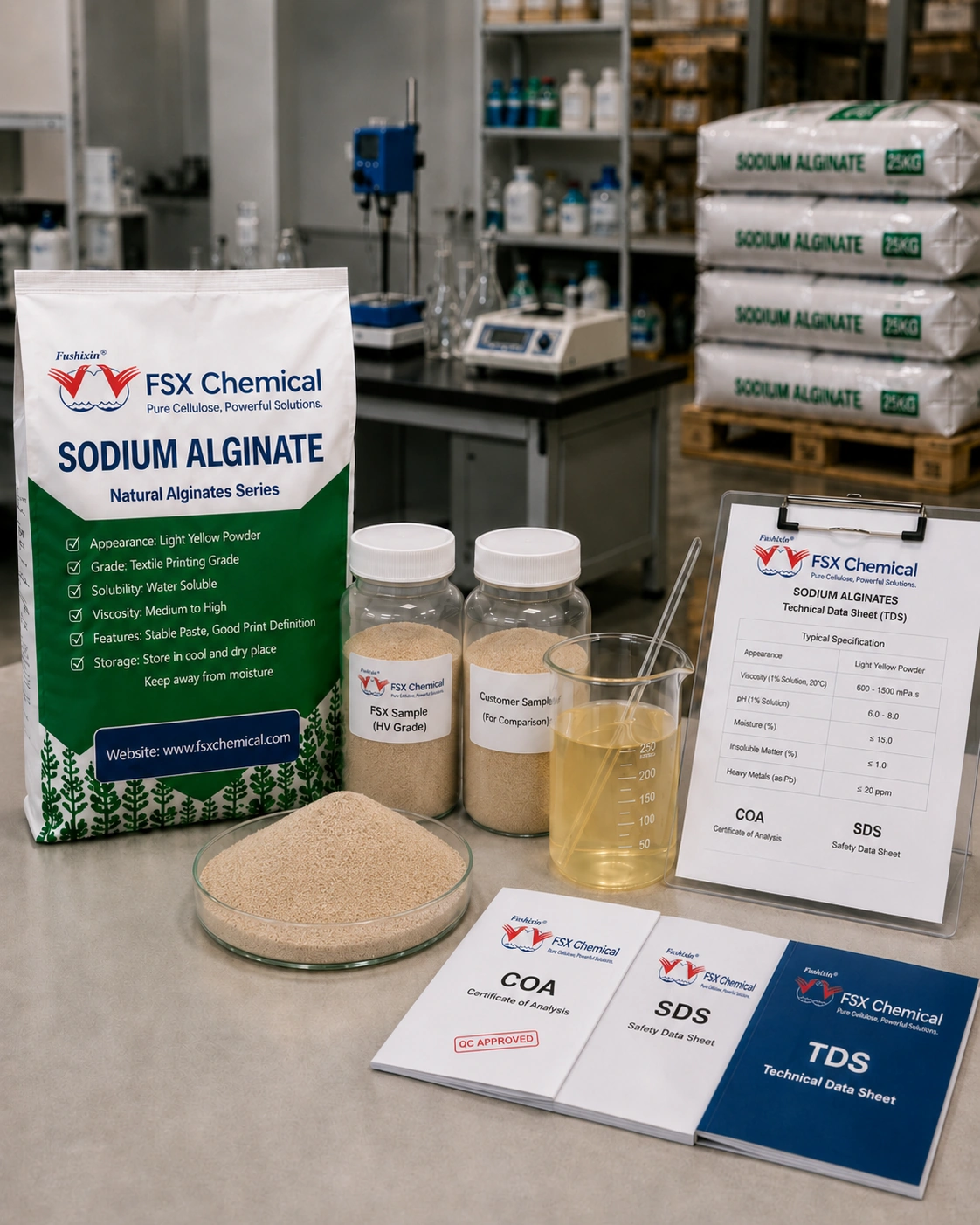
Conventional reactive screen printing still commonly begins with सोडियम अल्जीनेट as an important thickener route.
Innovation does not necessarily mean abandoning this established chemistry.
Instead, development can focus on:
More efficient viscosity grades
Better filtration
Improved rheological control
Compound systems for selected formulations
Reduced formulation correction
Better sample-to-bulk consistency
Any change to the thickener route should still be validated for reactive-dye compatibility, definition, fixation and wash-off.
What These Innovations Mean for Disperse Printing
For polyester disperse printing, select a thickener specifically documented for the intended screen, direct-inkjet or transfer workflow. These routes have different addition points and fixation requirements; approval in one route does not establish suitability in another.
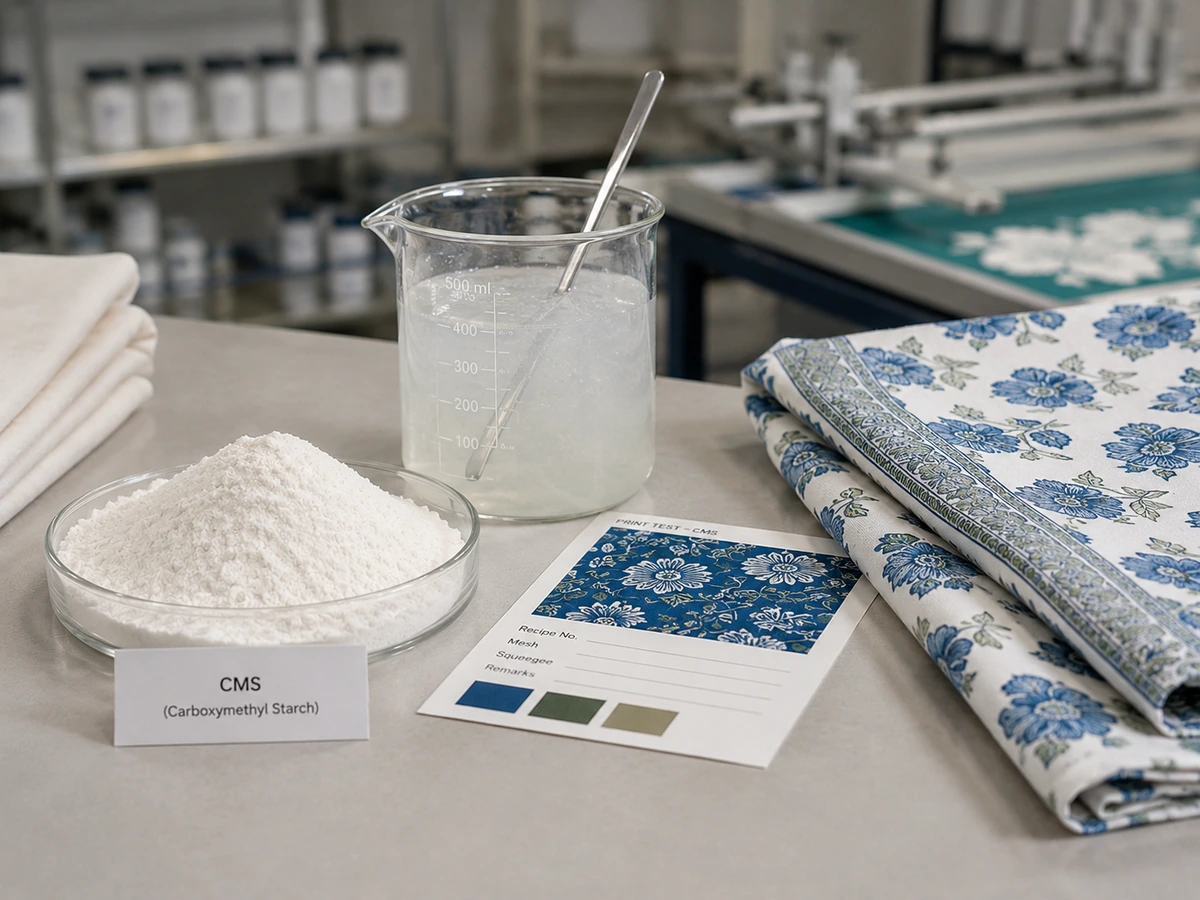
FSX CMS is a commercial synthetic printing-thickener family. Confirm grade identity and intended process in the current TDS instead of interpreting the CMS abbreviation as carboxymethyl starch. For a documented disperse screen-printing grade, evaluate screen passage, paste stability, fixation and finished-fabric results.
Innovation targets can include
Better effective thickening efficiency
Cleaner screen passage
Improved long-run paste stability
More consistent solid areas
थर्मल फिक्सेशन के साथ अनुकूलता
Final suitability depends on the actual disperse colorant, polyester fabric and fixation process.
What These Innovations Mean for Pigment Printing
Pigment printing is one of the areas where thickener and binder innovation are closely connected.
A high-performance pigment formulation needs the rheology system and binder to work together.
Important optimization targets include
Binder efficiency
Thickener-binder compatibility
Electrolyte tolerance
परिभाषा प्रिंट करें
Film formation
घर्षण प्रदर्शन
उपचार
कपड़े का हैंडल
Improving one property at the expense of several others does not represent successful innovation.
What These Innovations Mean for Digital Textile Printing
Digital development proposals should first identify the ink system, substrate and fabric-side treatment route before comparing chemical options.
The chemistry should first be separated according to ink system.
Reactive inkjet
Evaluate fabric pretreatment for suitable cellulosic textiles, migration control, definition, fixation and wash-off.
Disperse inkjet
Evaluate polyester pretreatment for uniformity, filtration, drying and thermal-process compatibility.
Pigment inkjet
Evaluate pretreatment together with pigment ink, binder, curing, rubbing performance and fabric hand feel.
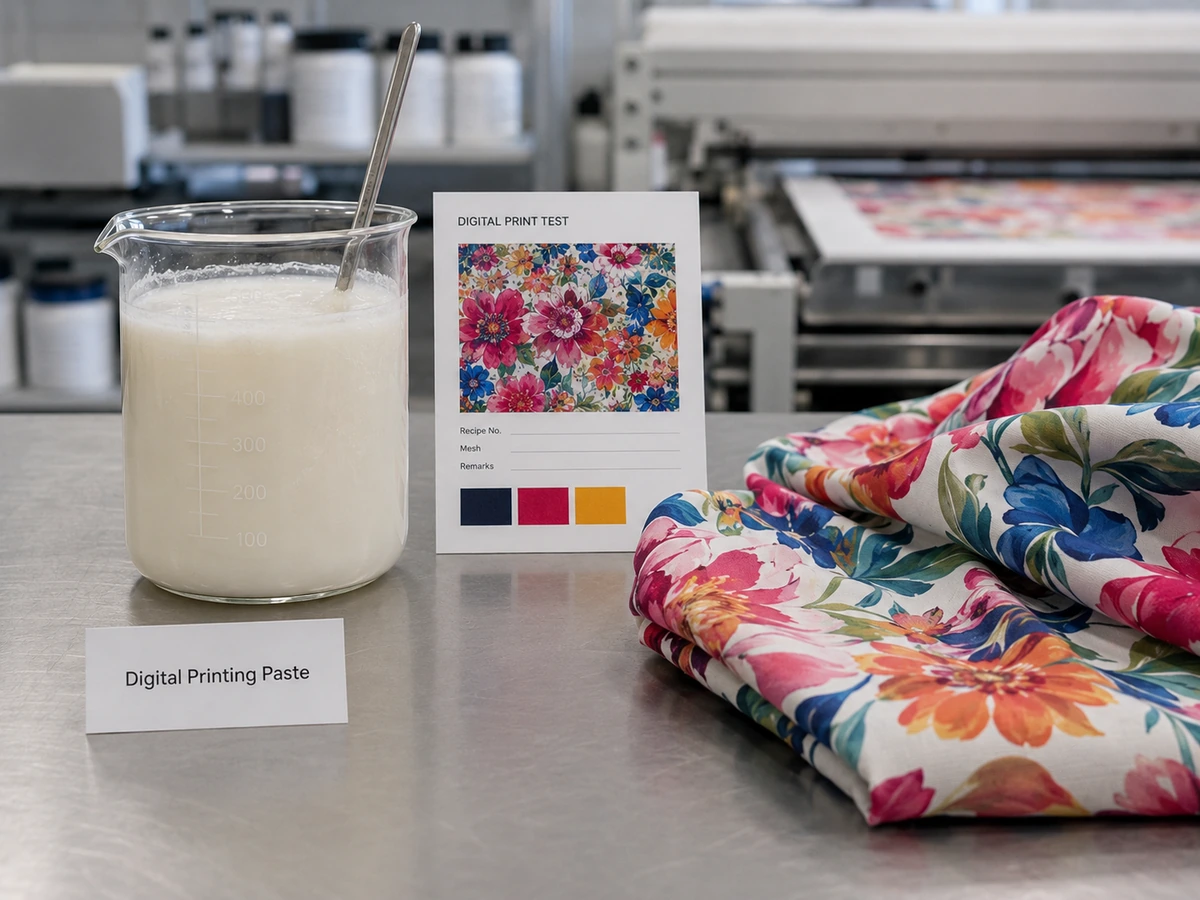
FSX Chemical separates these systems through डिजिटल प्रिंटिंग पेस्ट routes designed for reactive, disperse and pigment printing trials.
Digital pretreatment paste should not simply be added directly to digital ink. Ink and fabric-side pretreatment are different formulation systems.
Innovation and Sustainable Printing
Sustainability claims need particular care when discussing new textile chemicals.
A bio-based ingredient, lower dosage or shorter process does not by itself prove a lower overall environmental impact.
A more practical evaluation includes
Actual chemical dosage
कचरा चिपकाएँ
छनन हानि
Energy used in preparation and curing
Water used in washing
Rejected or reprinted fabric
Product durability
बैच की एकरूपता
Sustainable innovation should therefore be connected with measurable process performance rather than broad environmental terminology.
Separate Input Evidence from Whole-Process Claims
The ZDHC Manufacturing Restricted Substances List addresses restricted substances in chemical inputs to textile and related manufacturing. It does not, by itself, prove print performance or the overall environmental impact of a printing route. Check the exact product, evidence scope and current requirements relevant to the buyer; this reference is not a claim that an FSX grade holds a particular conformance status.
When comparing resource use, use the same agreed quantity of accepted fabric as the denominator. Include preparation, drying, fixation or curing, required washing or clearing, off-spec production and rework inside the stated boundary. Report which stages were measured and which were excluded.
How to Evaluate an Innovative Textile Chemical
New chemistry should face a stronger test procedure than an established material because the buyer has less production history on which to rely.
Step 1: Define the current benchmark
Record the existing commercial product, formula, dosage and known production performance.
Step 2: Define the innovation objective
Decide whether the candidate is intended to improve filtration, rheology, dosage, curing, process length, sustainability or another measurable target.
Step 3: Compare basic laboratory properties
दृश्यमानता
संधानशीलता
पीएच
जलपूरकता
छानन
भौतिक स्थिरता
Step 4: Evaluate the complete formulation
Add the actual dyes, pigments, salts, alkalis, binders and auxiliaries used in production.
Step 5: Print the actual fabric
Use the same design, substrate and equipment conditions whenever possible.
Step 6: Complete post-treatment
Final evaluation should occur after fixation, curing and washing as required.
Step 7: Compare the original objective
Confirm whether the innovation actually improved the targeted parameter without creating new production problems.
Why Laboratory Innovation Must Survive Production Scale-Up
An innovative formulation can perform very well in a small laboratory batch and still behave differently in industrial production.
Scale-up changes
मिक्सर ज्यामिति
बैच का आकार
पंप शीयर
समय बिताना
तापमान
आवेदन की गति
कपड़े का प्रकार
Production validation should therefore be part of product development, not an afterthought.
Monitor the complete production run
Fabric from the beginning, middle and end should be compared when evaluating paste stability and printing consistency.
Verify the first bulk batch
The commercial material should remain connected to the approved sample through product identity and relevant batch documentation.
Innovation and Total Cost in Use
New textile chemistry is commercially useful only when its complete economic effect is understood.
Do not compare only price per kilogram
A more expensive product can still reduce total cost if it operates at a more efficient dosage or reduces expensive production losses.
तुलना करें
पहुँचाए गए उत्पाद की कीमत
प्रभावी खुराक
तैयारी का समय
छानन
Machine downtime
Printing speed
कचरा चिपकाएँ
स्थिरीकरण या क्योरिंग
Reprinting and rejected fabric
Innovation should therefore be measured against an established technical and commercial benchmark.
How Buyers Should Evaluate Innovative Suppliers
मूल्यांकन क्षेत्र
Question to Ask
Innovation Claim
What exactly is new about the product?
Technical Evidence
Which measurements support the claimed benefit?
आवेदन
Which fabric and printing system was it designed for?
Benchmark
What should the product be compared against?
नमूना
Can I test the actual commercial grade?
Scale-Up
Has the chemistry been evaluated beyond a small laboratory batch?
बैच गुणवत्ता नियंत्रण
Which properties are controlled in commercial production?
Documentation
Which product-specific technical and compliance documents are available?
Supply
Can the approved formulation be produced consistently for repeat orders?
A technically credible supplier should be willing to explain both the expected benefit and the limitations of a new chemistry.
How FSX Chemical Approaches New Printing Solutions
Innovation within textile printing does not require replacing every proven chemistry. In many cases, a better result can come from selecting the correct grade, optimizing rheology or developing a more appropriate compound system.
के माध्यम से नमूने और मिलान , customers can use their current commercial product as the technical reference for evaluating a different grade or formulation direction.
Useful project information includes
Current commercial product and TDS
भौतिक संदर्भ नमूना
संधानशीलता और पूर्ण परीक्षण विधि
वर्तमान खुराक
Printing formulation
कपड़ा
Reactive, disperse, pigment or digital process
प्रिंटिंग उपकरण
वर्तमान तकनीकी समस्या
Target improvement
The objective is to identify a technically relevant candidate and validate it through controlled comparison rather than assume that a product is superior simply because it is described as new📧 ईमेल: Service@fsxchemical.com
कपड़े, रंग या स्याही, स्थिरीकरण, धोने पर छूटना और मुद्रण गुणवत्ता की आवश्यकताओं के आधार पर प्रतिक्रियाशील, डिस्पर्स, पिगमेंट और डिजिटल टेक्सटाइल प्रिंटिंग के लिए गाढ़ा करने वाले पदार्थ और पूर्व-उपचार मार्ग चुनने का तरीका जानें।.
CMC-आधारित प्रिंटिंग पेस्ट का उपयोग पिगमेंट, रिएक्टिव और डिजिटल टेक्सटाइल प्रिंटिंग में किया जाता है। यह मार्गदर्शिका बताती है कि किन मापदंडों का महत्व है, आपूर्तिकर्ताओं की तुलना कैसे करें, और थोक ऑर्डर देने से पहले क्या अनुरोध करना चाहिए।.
सोडियम अल्जिनेट और सीएमसी दोनों का उपयोग वस्त्र मुद्रण में गाढ़ा करने वाले पदार्थ के रूप में किया जाता है, लेकिन ये विभिन्न रंग प्रणाली और प्रक्रिया की शर्तों के लिए उपयुक्त होते हैं। यह मार्गदर्शिका प्रमुख अंतर और प्रत्येक का उपयोग कब करना चाहिए, यह बताती है।.
सेलूलोज़-आधारित कच्चे माल का उपयोग वस्त्र मुद्रण, प्रिंटिंग पेस्ट तैयारी, गाढ़ा करने और फॉर्मूलेशन सहायता में किया जाता है। यह मार्गदर्शिका बताती है कि खरीदार विनिर्देश, दस्तावेज़ीकरण, नमूना परीक्षण और आपूर्तिकर्ता सहायता के माध्यम से CMC, CMS, सोडियम अल्गीनेट, वस्त्र मुद्रण गाढ़ा करने वाले और प्रिंटिंग पेस्ट उत्पादों का मूल्यांकन कैसे कर सकते हैं।.
थोक सोडियम अल्गीनेट की खरीद में केवल इकाई मूल्य की तुलना करना पर्याप्त नहीं है। यह मार्गदर्शिका बताती है कि वस्त्र मुद्रण के खरीदार थोक ऑर्डर देने से पहले चिपचिपाहट, जाल आकार, शुद्धता ग्रेड, पैकेजिंग, COA, नमूना परीक्षण और बैच की एकरूपता कैसे सुनिश्चित कर सकते हैं।.
सेल्यूलोज़ व्युत्पन्न वस्त्र मुद्रण, मुद्रण पेस्ट तैयारी, गाढ़ा करने और फॉर्मूलेशन सहायता में व्यापक रूप से उपयोग किए जाते हैं। यह मार्गदर्शिका बताती है कि विदेशी खरीदार FSX केमिकल से TDS, COA, नमूना परीक्षण, ग्रेड मिलान और निर्यात दस्तावेज़ सहायता के साथ CMC, CMS, सोडियम अल्गीनेट, वस्त्र मुद्रण थिकनर और मुद्रण पेस्ट उत्पादों की आपूर्ति कैसे प्राप्त कर सकते हैं।.
टेक्सटाइल प्रिंटिंग केमिकल सप्लायर का चयन करते समय केवल उत्पाद के नाम और कीमतों की तुलना करना पर्याप्त नहीं होता। यह मार्गदर्शिका बताती है कि खरीदार सहयोग शुरू करने से पहले उत्पाद श्रृंखला, तकनीकी दस्तावेज़, नमूना परीक्षण, बैच की एकरूपता, संचार और सप्लायर सहायता का मूल्यांकन कैसे कर सकते हैं।.
टेक्सटाइल उद्योग के रसायनों का चयन केवल उत्पाद नामों की तुलना करने से कहीं अधिक है। यह मार्गदर्शिका बताती है कि टेक्सटाइल प्रिंटिंग खरीदार CMC, CMS, सोडियम अल्गीनेट, टेक्सटाइल प्रिंटिंग थिकनर और प्रिंटिंग पेस्ट उत्पादों को अनुप्रयोग, विनिर्देश, TDS, COA, नमूना परीक्षण और बैच निरंतरता के आधार पर कैसे मिलान कर सकते हैं।.
टेक्सटाइल प्रिंटिंग के लिए औद्योगिक रसायन आपूर्तिकर्ता चुनने में केवल उत्पाद के नाम और कीमतों की जांच करना ही पर्याप्त नहीं है। यह मार्गदर्शिका बताती है कि खरीदार थोक ऑर्डर देने से पहले ISO प्रमाणपत्र का दायरा, TDS, COA, SDS, नमूना परीक्षण, बैच की एकरूपता और निर्यात दस्तावेज़ों की समीक्षा कैसे कर सकते हैं।.
टेक्सटाइल प्रिंटिंग के लिए रासायनिक सूत्रीकरण सहायता स्पष्ट अनुप्रयोग जानकारी के साथ शुरू होनी चाहिए। यह मार्गदर्शिका बताती है कि खरीदारों को उत्पाद मिलान, सूत्रीकरण समायोजन, नमूना परीक्षण, टीडीएस, सीओए, एसडीएस, और सीएमसी, सीएमएस, सोडियम अल्जिनेट, टेक्सटाइल प्रिंटिंग थिकनर, और प्रिंटिंग पेस्ट उत्पादों के लिए तकनीकी सहायता का अनुरोध करते समय क्या प्रदान करना चाहिए।.
टेक्सटाइल कोटिंग के लिए सोडियम अल्गीनेट वैश्विक कपड़ा/प्रिंटिंग कंपनियों के लिए एक महत्वपूर्ण जैव-आधारित विकल्प है। यह कमजोर चिपकन (कपास के लिए आदर्श) और कम टिकाऊपन (पॉलिएस्टर कोटिंग की मजबूती में 30% की वृद्धि) जैसी प्रमुख समस्याओं का समाधान करता है, साथ ही क्षेत्रीय नियमों—EU REACH (जैव-विघटनशील) और US OEKO-TEX (शिशु परिधान के लिए गैर-विषाक्त)—का पालन करता है। यह गाइड अनुप्रयोग टिप्स (डिजिटल प्रिंटिंग), विकल्पों की तुलना (एक्रिलिक बाइंडर्स के साथ), और fsxchemical जैसे वैश्विक आपूर्तिकर्ताओं को चुनने के तरीके को कवर करती है।.
सही टेक्सटाइल प्रिंटिंग थिकनर का निर्धारण केवल कपड़े के प्रकार से नहीं होता। खरीदारों को थिकनर को डाई या पिगमेंट सिस्टम, प्रिंटिंग विधि, लक्षित रेओलॉजी, धोकर हटाने की आवश्यकताओं और वास्तविक फैक्ट्री परीक्षण परिस्थितियों के अनुरूप चुनना चाहिए।.
उत्पाद का नाम, उपयोग, मात्रा, गंतव्य और आपके पास पहले से मौजूद कोई भी टीडीएस, नमूना फोटो या दस्तावेज़ साझा करें। FSX केमिकल इस जानकारी की समीक्षा करेगा और कोटेशन, नमूना मिलान या उत्पाद चयन के लिए अगले कदम की सिफारिश करेगा।.
उत्पाद की जानकारीउत्पाद का नाम, ग्रेड, मॉडल, लेबल की तस्वीर या आपूर्तिकर्ता संदर्भ।.
उपलब्ध दस्तावेज़टीडीएस, एसडीएस, सीओए, नमूना फोटो, उत्पाद सूची या परीक्षण डेटा।.
आदेश विवरणअनुमानित मात्रा, पैकेजिंग, गंतव्य देश, बंदरगाह या व्यापारिक शर्त।.
आवेदन या समस्याटेक्सटाइल मुद्रण प्रक्रिया, सूत्रीकरण आवश्यकता, वर्तमान समस्या या लक्षित प्रदर्शन।.