5 đột phá hàng đầu trong lĩnh vực hóa chất in dệt may năm 2026
Textile printing chemistry is evolving beyond simple viscosity and price comparisons. Explore five innovation directions...
Textile printing chemistry in 2026 is moving beyond simple comparisons of viscosity, product price and polymer type. The most important innovation directions combine safer chemical inputs, advanced rheology, bio-based polymer systems, more efficient pigment binders, shorter digital processes and application-specific formulation.
Textile printing is entering a period in which chemical innovation is increasingly judged by what happens across the complete production process rather than by one technical specification.
A new thickener is not valuable simply because it produces higher viscosity. A new binder is not automatically better because it uses a different polymer. A digital pretreatment should not be considered innovative only because it contains a newly marketed ingredient.
The more useful question is whether the chemistry helps the printing process become more controllable, resource-efficient and technically reliable while maintaining the required finished-fabric quality.
This article presents five innovation directions that deserve particular attention in 2026. They are an editorial technology shortlist rather than an official industry ranking, and individual solutions still require laboratory and production validation.
What Counts as Innovation in Textile Printing Chemistry?
Textile chemical innovation does not always mean discovering a completely new molecule.
Significant innovation can also come from combining existing chemistries more intelligently, changing polymer architecture, reducing unnecessary process steps, improving chemical transparency or designing one formulation around a clearly defined printing route.
For a printing mill, useful innovation should improve at least one of these areas
Chemical-input control
Material efficiency
Rheology
Độ ổn định của hỗn hợp dán
Lọc
Printing definition
Fixation or curing efficiency
Process simplicity
Finished-fabric quality
Tính nhất quán của lô
Ideally, the improvement should not create an unacceptable compromise elsewhere in the process.
Quick View: Top 5 Innovations for 2026
Innovation
Main Technical Direction
Potential Industrial Value
Safer-Input Chemistry
Restricted-substance-aware formulation and stronger traceability
Lower chemical-management risk and clearer supplier qualification
Bio-Based Hybrid Thickeners
Combining renewable-origin polymers for complementary functions
New rheology, functionality and material-efficiency options
Advanced Waterborne Binders
More efficient polymer architecture for pigment fixation
Better balance among binder dosage, fastness and fabric handle
Shorter Digital Processes
Simplifying pretreatment, drying and related production stages
Potential reductions in time, energy and process complexity
Multifunctional Systems
Combining rheology, surface control and compatibility functions
More application-specific chemical design
These directions overlap. A bio-based polymer may also form part of a multifunctional system, while an advanced digital pretreatment may combine several surface-control mechanisms.
1. Safer-Input and PFAS-Aware Chemical Formulation
One of the most important innovations in textile chemistry is not visible on the printed fabric at all.
It is the shift toward designing and selecting chemicals with greater attention to what enters the manufacturing process from the beginning.
Why input chemistry matters
Trying to control unwanted substances only after printing or finishing is inefficient. The more practical approach is to understand chemical inputs before they enter the production system.
What this means for formulators
Chemical formulators increasingly need to consider not only printing performance but also raw-material identity, restricted-substance risk, supplier data and the evidence supporting product claims.
What this means for buyers
Procurement teams should ask for product-specific information rather than relying on broad statements such as environmentally friendly, green or compliant.
A stronger qualification package may include
Clear commercial product identity
TDS hiện tại
SDS
Relevant batch documentation
Applicable test or conformity evidence where required
Traceable manufacturer information
This innovation is ultimately about moving from marketing-based chemistry to evidence-based chemistry.
2. Bio-Based and Hybrid Thickener Systems
Natural polymers have been used in textile printing for a long time. Sodium alginate, cellulose derivatives and starch derivatives are familiar examples.
The newer innovation direction is not simply returning to natural thickeners. It is combining different bio-derived or modified polymer systems to obtain complementary rheological and functional behavior.
Why hybrid systems are interesting
One polymer may provide viscosity while another contributes film formation, structural recovery, adhesion or another functional property.
Potential hybrid design goals include
Improved shear-thinning behavior
Better structural recovery
Reduced dependence on one polymer
Improved paste stability
Additional textile functionality
Optimized total polymer dosage
Natural origin is not enough
A bio-based material should not automatically be considered the most sustainable choice.
Its manufacturing route, required dosage, processing, waste and finished-textile performance should still be evaluated.
The important innovation is therefore functional polymer engineering, not simply replacing the word synthetic with natural.
3. High-Efficiency Waterborne Pigment Binders
Pigment printing remains highly dependent on binder chemistry because pigments do not rely on the same fiber-reactive mechanism as reactive dyes.
The binder must create a film capable of retaining pigment on the textile while maintaining an acceptable balance of durability, flexibility and fabric handle.
Advanced binder development is increasingly focused on
Waterborne polymer systems
More efficient film formation
Polymer particle architecture
Lower effective binder loading where technically possible
Improved adhesion
Better rubbing performance
Softer fabric handle
More efficient curing windows
Why polymer architecture matters
Binder performance depends on more than solids content. Particle size, reactive groups, film formation and crosslinking behavior can influence the relationship between dosage and printing performance.
Lower binder dosage is not automatically better
A reduction is valuable only if pigment fixation, rubbing performance, wash durability and hand feel remain acceptable.
The real innovation target is therefore higher functional efficiency, not simply less binder.
4. Shorter-Process Digital Printing Pretreatment
Digital textile printing continues to create strong demand for more efficient fabric pretreatment.
Traditional digital workflows can include several stages between raw fabric and finished print:
Fabric → Pretreatment → Drying → Inkjet Printing → Fixation or Curing → Washing or Finishing
Each stage can add time, energy, water use, handling and process variation.
The innovation direction is process compression
New pretreatment approaches are increasingly evaluated according to whether they can simplify preparation, reduce drying burden or combine functions without damaging print quality.
Important development targets include
Lower pretreatment add-on
More uniform fabric pickup
Faster or simplified drying
Better ink migration control
High fine-line definition
Compatible fixation
Reduced unnecessary post-processing
Shorter does not automatically mean better
Removing one processing stage is useful only if definition, color result, fastness and fabric handle remain acceptable.
Production trials are therefore essential before converting a laboratory short-process concept into normal manufacturing.
5. Multifunctional and Application-Specific Chemical Systems
A major direction in textile printing chemistry is movement away from the idea that one polymer should solve every formulation problem.
Modern compound and application-specific systems can combine several functions inside one controlled formulation.
Possible functions include
Base viscosity
Shear-thinning control
Structural recovery
Surface sizing
Moisture management
Lọc
Khả năng dung nạp chất điện giải
Khả năng tương thích của chất kết dính
Độ ổn định của hỗn hợp dán
This is particularly important in digital printing
Reactive, disperse and pigment inkjet systems require different fabric, ink and fixation conditions.
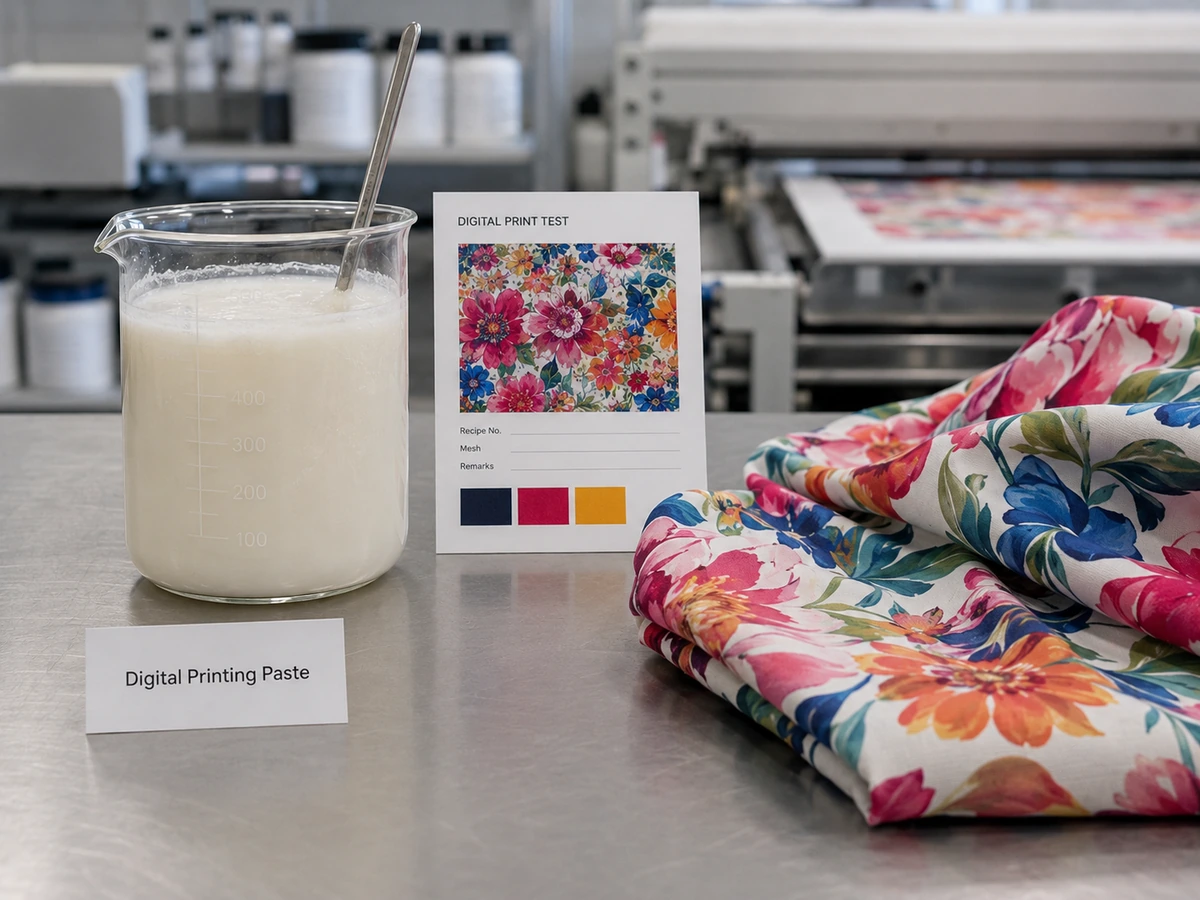
A universal digital printing paste is therefore less useful than a clearly defined product route designed around a specific ink and fabric system.
Compound does not automatically mean more complicated
A well-designed compound product can simplify the customer’s formulation if several functions have already been balanced during product development.
The critical requirement is repeatable manufacturing and clear application validation.
Why Rheology Connects Several of These Innovations
Rheology is one of the central themes connecting thickener, binder, pretreatment and compound-system development.
A single viscosity number describes only one measurement condition. Printing exposes the chemical system to different levels of shear.
At low shear
Sufficient structure may support storage and holding stability.
Under higher shear
Easier flow can help pumping, coating and screen passage.
After application
Structural recovery may help limit uncontrolled spreading and maintain print definition.
This is why innovative thickener systems should be compared through rheological behavior and printing trials rather than viscosity alone.
What These Innovations Mean for Reactive Printing
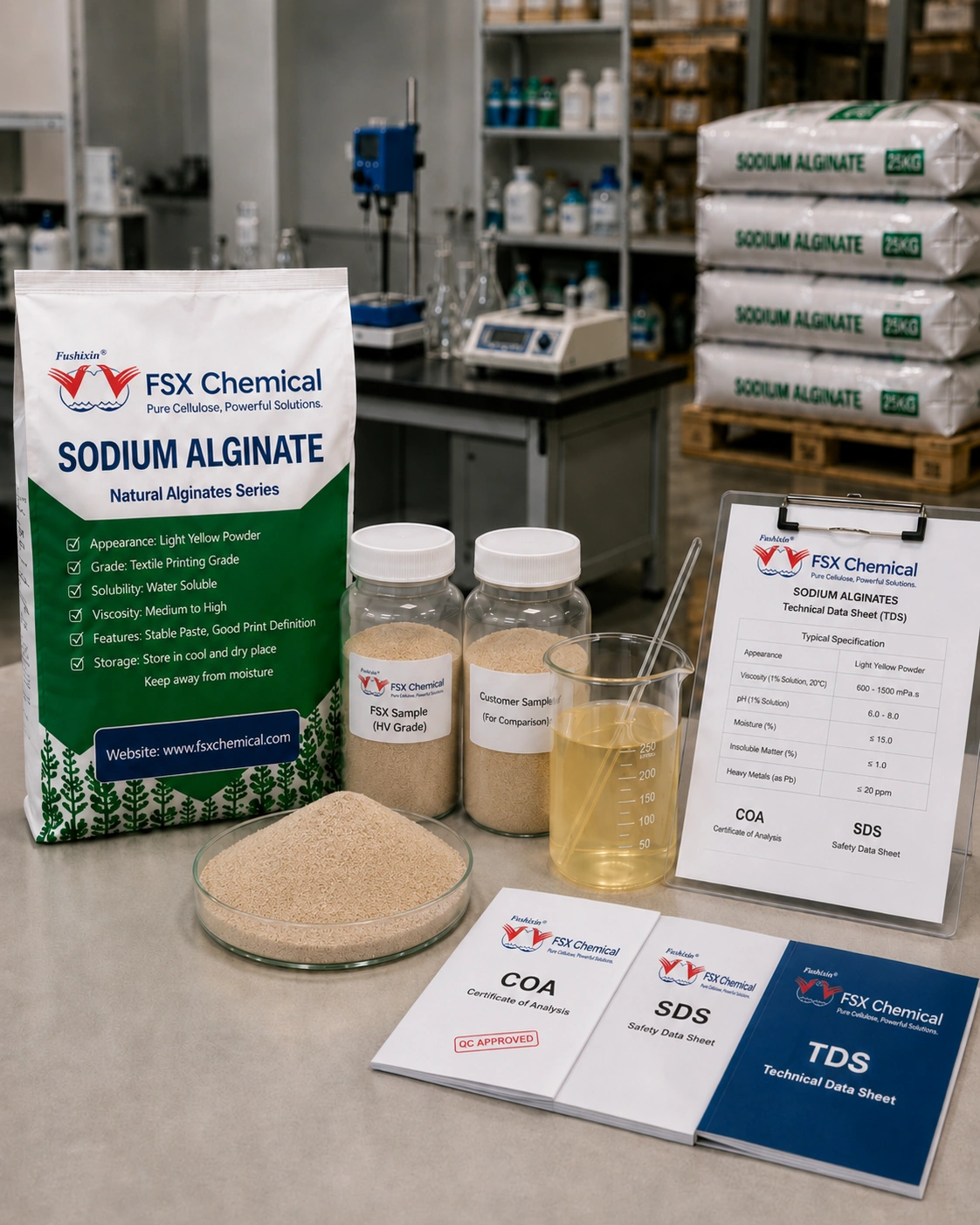
Conventional reactive screen printing still commonly begins with alginat natri as an important thickener route.
Innovation does not necessarily mean abandoning this established chemistry.
Instead, development can focus on:
More efficient viscosity grades
Khả năng lọc tốt hơn
Improved rheological control
Compound systems for selected formulations
Reduced formulation correction
Better sample-to-bulk consistency
Any change to the thickener route should still be validated for reactive-dye compatibility, definition, fixation and wash-off.
What These Innovations Mean for Disperse Printing
Polyester disperse printing creates opportunities for modified starch, compound thickener and process-specific systems.
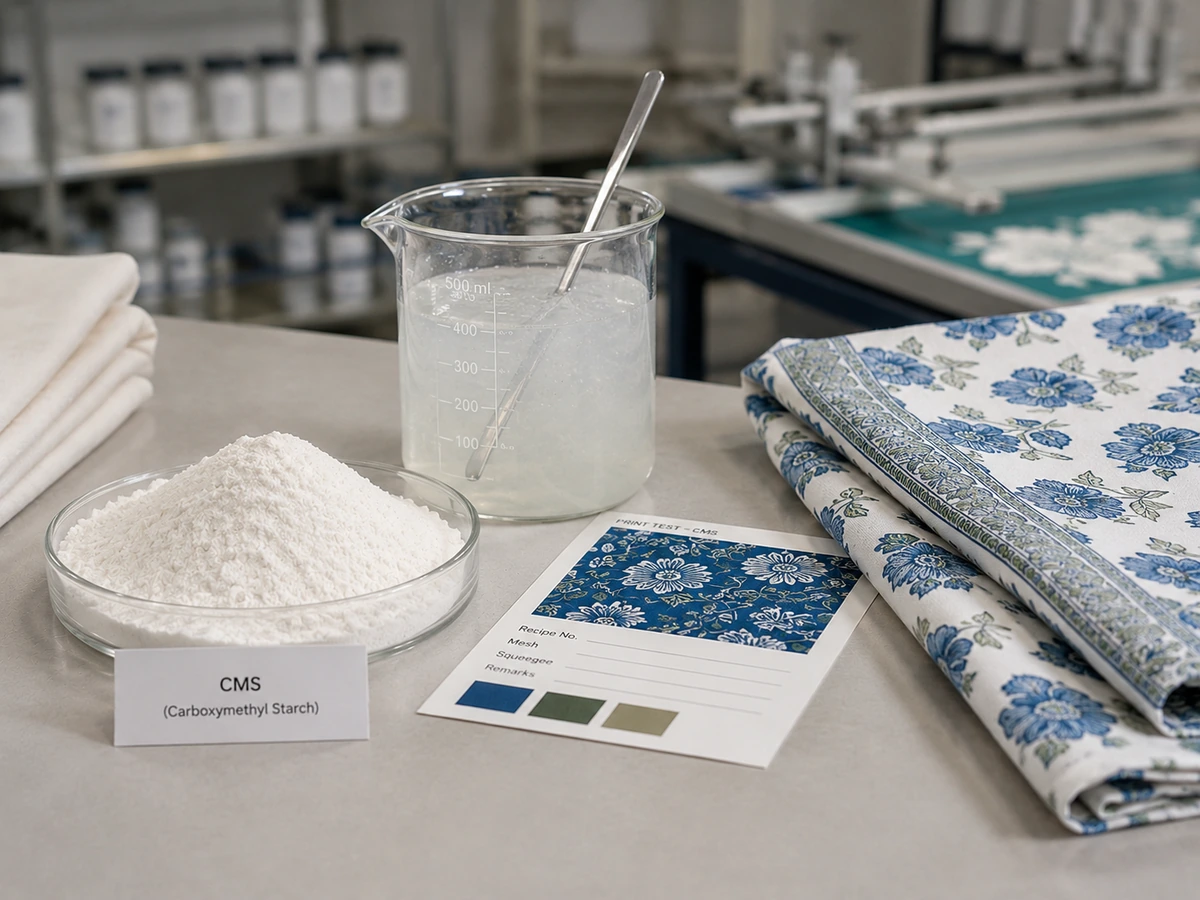
CMS and related routes can be evaluated where viscosity, screen passage, paste stability and commercial efficiency need to be balanced.
Innovation targets can include
Better effective thickening efficiency
Cleaner screen passage
Improved long-run paste stability
More consistent solid areas
Compatibility with thermal fixation
Final suitability depends on the actual disperse colorant, polyester fabric and fixation process.
What These Innovations Mean for Pigment Printing
Pigment printing is one of the areas where thickener and binder innovation are closely connected.
A high-performance pigment formulation needs the rheology system and binder to work together.
Important optimization targets include
Binder efficiency
Thickener-binder compatibility
Khả năng dung nạp chất điện giải
Định nghĩa về in ấn
Quá trình tạo màng
Hiệu suất chà xát
Quá trình làm cứng
Tay cầm bằng vải
Improving one property at the expense of several others does not represent successful innovation.
What These Innovations Mean for Digital Textile Printing
Digital printing is likely to remain one of the most important areas for process-specific textile chemical development.
The chemistry should first be separated according to ink system.
In phun phản ứng
Evaluate fabric pretreatment for suitable cellulosic textiles, migration control, definition, fixation and wash-off.
In phun phân tán
Evaluate polyester pretreatment for uniformity, filtration, drying and thermal-process compatibility.
Mực in phun dạng bột màu
Evaluate pretreatment together with pigment ink, binder, curing, rubbing performance and fabric hand feel.
FSX Chemical separates these systems through hỗn hợp in kỹ thuật số routes designed for reactive, disperse and pigment printing trials.
Digital pretreatment paste should not simply be added directly to digital ink. Ink and fabric-side pretreatment are different formulation systems.
Innovation and Sustainable Printing
Sustainability claims need particular care when discussing new textile chemicals.
A bio-based ingredient, lower dosage or shorter process does not by itself prove a lower overall environmental impact.
A more practical evaluation includes
Actual chemical dosage
Paste waste
Mất mát do lọc
Energy used in preparation and curing
Water used in washing
Rejected or reprinted fabric
Product durability
Tính nhất quán của lô
Sustainable innovation should therefore be connected with measurable process performance rather than broad environmental terminology.
How to Evaluate an Innovative Textile Chemical
New chemistry should face a stronger test procedure than an established material because the buyer has less production history on which to rely.
Step 1: Define the current benchmark
Record the existing commercial product, formula, dosage and known production performance.
Step 2: Define the innovation objective
Decide whether the candidate is intended to improve filtration, rheology, dosage, curing, process length, sustainability or another measurable target.
Step 3: Compare basic laboratory properties
Hình thức
Độ nhớt
pH
Bổ sung nước
Lọc
Physical stability
Step 4: Evaluate the complete formulation
Add the actual dyes, pigments, salts, alkalis, binders and auxiliaries used in production.
Step 5: Print the actual fabric
Use the same design, substrate and equipment conditions whenever possible.
Step 6: Complete post-treatment
Final evaluation should occur after fixation, curing and washing as required.
Step 7: Compare the original objective
Confirm whether the innovation actually improved the targeted parameter without creating new production problems.
Why Laboratory Innovation Must Survive Production Scale-Up
An innovative formulation can perform very well in a small laboratory batch and still behave differently in industrial production.
Scale-up changes
Mixer geometry
Batch size
Pump shear
Thời gian giữ
Nhiệt độ
Application speed
Fabric variation
Production validation should therefore be part of product development, not an afterthought.
Monitor the complete production run
Fabric from the beginning, middle and end should be compared when evaluating paste stability and printing consistency.
Verify the first bulk batch
The commercial material should remain connected to the approved sample through product identity and relevant batch documentation.
Innovation and Total Cost in Use
New textile chemistry is commercially useful only when its complete economic effect is understood.
Do not compare only price per kilogram
A more expensive product can still reduce total cost if it operates at a more efficient dosage or reduces expensive production losses.
So sánh
Delivered product price
Liều lượng hiệu quả
Thời gian chuẩn bị
Lọc
Machine downtime
Printing speed
Paste waste
Quá trình cố định hoặc đóng rắn
Reprinting and rejected fabric
Innovation should therefore be measured against an established technical and commercial benchmark.
How Buyers Should Evaluate Innovative Suppliers
Evaluation Area
Question to Ask
Innovation Claim
What exactly is new about the product?
Technical Evidence
Which measurements support the claimed benefit?
Ứng dụng
Which fabric and printing system was it designed for?
Benchmark
What should the product be compared against?
Ví dụ
Can I test the actual commercial grade?
Scale-Up
Has the chemistry been evaluated beyond a small laboratory batch?
Kiểm tra chất lượng theo lô
Which properties are controlled in commercial production?
Tài liệu hướng dẫn
Which product-specific technical and compliance documents are available?
Supply
Can the approved formulation be produced consistently for repeat orders?
A technically credible supplier should be willing to explain both the expected benefit and the limitations of a new chemistry.
How FSX Chemical Approaches New Printing Solutions
Innovation within textile printing does not require replacing every proven chemistry. In many cases, a better result can come from selecting the correct grade, optimizing rheology or developing a more appropriate compound system.
Thông qua Mẫu và việc kết hợp , customers can use their current commercial product as the technical reference for evaluating a different grade or formulation direction.
Useful project information includes
Current commercial product and TDS
Mẫu tham chiếu vật lý
Độ nhớt và phương pháp thử nghiệm toàn diện
Liều lượng hiện tại
Printing formulation
Vải
Reactive, disperse, pigment or digital process
Printing equipment
Current technical problem
Target improvement
The objective is to identify a technically relevant candidate and validate it through controlled comparison rather than assume that a product is superior simply because it is described as new📧 Email: Service@fsxchemical.com
Tìm hiểu cách lựa chọn chất làm đặc và quy trình tiền xử lý cho các phương pháp in dệt phản ứng, in phân tán, in sắc tố và in kỹ thuật số, dựa trên các yêu cầu về vải, thuốc nhuộm hoặc mực in, quá trình cố định màu, khả năng rửa trôi và chất lượng in.
Hỗn hợp in dựa trên CMC được sử dụng rộng rãi trong in vải bằng bột màu, in phản ứng và in kỹ thuật số. Hướng dẫn này giải thích các thông số quan trọng, cách so sánh các nhà cung cấp và những yêu cầu cần đưa ra trước khi đặt hàng số lượng lớn.
Cả natri alginat và CMC đều được sử dụng làm chất làm đặc trong in vải, nhưng chúng phù hợp với các hệ thống thuốc nhuộm và điều kiện quy trình khác nhau. Hướng dẫn này giải thích những điểm khác biệt chính và thời điểm nên sử dụng từng loại.
Nguyên liệu thô có nguồn gốc từ cellulose được sử dụng trong in ấn dệt may, pha chế hỗn hợp in, làm đặc và hỗ trợ công thức. Hướng dẫn này giải thích cách người mua có thể đánh giá các sản phẩm như CMC, CMS, alginat natri, chất làm đặc trong in ấn dệt may và các sản phẩm hỗn hợp in thông qua thông số kỹ thuật, tài liệu kỹ thuật, thử nghiệm mẫu và sự hỗ trợ từ nhà cung cấp.
Việc mua sỉ natri alginat không chỉ đơn thuần là so sánh giá đơn vị. Hướng dẫn này giải thích cách các nhà mua hàng trong lĩnh vực in ấn dệt may có thể xác minh độ nhớt, kích thước mắt lưới, cấp độ tinh khiết, bao bì, chứng nhận phân tích (COA), kiểm tra mẫu và tính đồng nhất giữa các lô hàng trước khi đặt hàng số lượng lớn.
Các dẫn xuất cellulose được ứng dụng rộng rãi trong in ấn dệt may, pha chế bột in, làm đặc và hỗ trợ công thức. Hướng dẫn này giải thích cách các nhà mua hàng nước ngoài có thể nhập khẩu CMC, CMS, natri alginat, chất làm đặc dùng trong in ấn dệt may và các sản phẩm bột in từ FSX Chemical, kèm theo các dịch vụ hỗ trợ như bảng dữ liệu kỹ thuật (TDS), chứng nhận phân tích (COA), thử nghiệm mẫu, đối chiếu tiêu chuẩn chất lượng và hỗ trợ thủ tục xuất khẩu.
Việc lựa chọn nhà cung cấp hóa chất in trên vải không chỉ đơn thuần là so sánh tên sản phẩm và giá cả. Hướng dẫn này giải thích cách người mua có thể đánh giá danh mục sản phẩm, tài liệu kỹ thuật, thử nghiệm mẫu, tính đồng nhất giữa các lô hàng, khả năng giao tiếp và sự hỗ trợ từ nhà cung cấp trước khi hợp tác.
Việc lựa chọn hóa chất trong ngành dệt may không chỉ đơn thuần là so sánh tên sản phẩm. Hướng dẫn này giải thích cách người mua hóa chất in dệt may có thể lựa chọn các sản phẩm như CMC, CMS, natri alginat, chất làm đặc trong in dệt may và bột in phù hợp dựa trên ứng dụng, thông số kỹ thuật, TDS, COA, thử nghiệm mẫu và tính đồng nhất giữa các lô sản phẩm.
Việc lựa chọn nhà cung cấp hóa chất công nghiệp cho ngành in dệt may không chỉ đơn thuần là kiểm tra tên sản phẩm và giá cả. Hướng dẫn này giải thích cách người mua có thể xem xét phạm vi chứng nhận ISO, TDS, COA, SDS, thử nghiệm mẫu, tính đồng nhất của lô hàng và các giấy tờ xuất khẩu trước khi đặt hàng số lượng lớn.
Việc hỗ trợ xây dựng công thức hóa chất cho in ấn dệt may cần bắt đầu từ việc cung cấp thông tin ứng dụng rõ ràng. Hướng dẫn này giải thích những thông tin mà người mua cần cung cấp khi yêu cầu đối chiếu sản phẩm, điều chỉnh công thức, thử nghiệm mẫu, TDS, COA, SDS và hỗ trợ kỹ thuật liên quan đến CMC, CMS, natri alginat, chất làm đặc trong in ấn dệt may và các sản phẩm bột in.
Alginat natri dùng trong phủ bề mặt dệt may là một giải pháp sinh học quan trọng dành cho các doanh nghiệp dệt may và in ấn trên toàn cầu. Sản phẩm này giải quyết các vấn đề then chốt như độ bám dính kém (lý tưởng cho vải cotton) và độ bền thấp (tăng cường độ bền của lớp phủ polyester lên 30%), đồng thời tuân thủ các quy định khu vực — EU REACH (có khả năng phân hủy sinh học) và US OEKO-TEX (không độc hại cho quần áo trẻ em). Hướng dẫn này bao gồm các mẹo ứng dụng (in kỹ thuật số), so sánh các giải pháp thay thế (so với chất kết dính acrylic) và cách lựa chọn các nhà cung cấp toàn cầu như fsxchemical.
Việc lựa chọn chất làm đặc phù hợp cho in ấn trên vải không chỉ phụ thuộc vào loại vải. Người mua nên lựa chọn chất làm đặc sao cho phù hợp với hệ thống thuốc nhuộm hoặc bột màu, phương pháp in, tính lưu biến mong muốn, yêu cầu về khả năng rửa trôi và các điều kiện thử nghiệm thực tế tại nhà máy.
Vui lòng cung cấp tên sản phẩm, ứng dụng, số lượng, điểm đến và bất kỳ tài liệu kỹ thuật (TDS),
hình ảnh mẫu hoặc tài liệu nào mà quý khách đã có. FSX Chemical sẽ xem xét
thông tin này và đề xuất bước tiếp theo liên quan đến báo giá, đối chiếu mẫu
hoặc lựa chọn sản phẩm.
Thông tin sản phẩmTên sản phẩm, cấp loại, mẫu mã, ảnh nhãn mác hoặc mã tham chiếu của nhà cung cấp.
Các tài liệu có sẵnTDS, SDS, COA, ảnh mẫu, danh mục sản phẩm hoặc dữ liệu thử nghiệm.
Chi tiết đơn hàngSố lượng dự kiến, hình thức đóng gói, nước nhập khẩu, cảng hoặc điều kiện thương mại.
Yêu cầu hoặc Vấn đềQuy trình in trên vải, yêu cầu về công thức, vấn đề hiện tại hoặc chỉ tiêu hiệu suất.