Las 5 principales innovaciones en productos químicos para la impresión textil en 2026
Textile printing chemistry is evolving beyond simple viscosity and price comparisons. Explore five innovation directions...
Textile printing chemistry in 2026 is moving beyond simple comparisons of viscosity, product price and polymer type. The most important innovation directions combine safer chemical inputs, advanced rheology, bio-based polymer systems, more efficient pigment binders, shorter digital processes and application-specific formulation.
Textile printing is entering a period in which chemical innovation is increasingly judged by what happens across the complete production process rather than by one technical specification.
A new thickener is not valuable simply because it produces higher viscosity. A new binder is not automatically better because it uses a different polymer. A digital pretreatment should not be considered innovative only because it contains a newly marketed ingredient.
The more useful question is whether the chemistry helps the printing process become more controllable, resource-efficient and technically reliable while maintaining the required finished-fabric quality.
This article presents five innovation directions that deserve particular attention in 2026. They are an editorial technology shortlist rather than an official industry ranking, and individual solutions still require laboratory and production validation.
What Counts as Innovation in Textile Printing Chemistry?
Textile chemical innovation does not always mean discovering a completely new molecule.
Significant innovation can also come from combining existing chemistries more intelligently, changing polymer architecture, reducing unnecessary process steps, improving chemical transparency or designing one formulation around a clearly defined printing route.
For a printing mill, useful innovation should improve at least one of these areas
Chemical-input control
Material efficiency
Reología
Estabilidad de la pasta
Filtración
Definición de impresión
Fixation or curing efficiency
Process simplicity
Calidad del tejido terminado
Consistencia entre lotes
Ideally, the improvement should not create an unacceptable compromise elsewhere in the process.
Quick View: Top 5 Innovations for 2026
Innovation
Main Technical Direction
Potential Industrial Value
Safer-Input Chemistry
Restricted-substance-aware formulation and stronger traceability
Lower chemical-management risk and clearer supplier qualification
Bio-Based Hybrid Thickeners
Combining renewable-origin polymers for complementary functions
New rheology, functionality and material-efficiency options
Advanced Waterborne Binders
More efficient polymer architecture for pigment fixation
Better balance among binder dosage, fastness and fabric handle
Shorter Digital Processes
Simplifying pretreatment, drying and related production stages
Potential reductions in time, energy and process complexity
Multifunctional Systems
Combining rheology, surface control and compatibility functions
More application-specific chemical design
These directions overlap. A bio-based polymer may also form part of a multifunctional system, while an advanced digital pretreatment may combine several surface-control mechanisms.
1. Safer-Input and PFAS-Aware Chemical Formulation
One of the most important innovations in textile chemistry is not visible on the printed fabric at all.
It is the shift toward designing and selecting chemicals with greater attention to what enters the manufacturing process from the beginning.
Why input chemistry matters
Trying to control unwanted substances only after printing or finishing is inefficient. The more practical approach is to understand chemical inputs before they enter the production system.
What this means for formulators
Chemical formulators increasingly need to consider not only printing performance but also raw-material identity, restricted-substance risk, supplier data and the evidence supporting product claims.
What this means for buyers
Procurement teams should ask for product-specific information rather than relying on broad statements such as environmentally friendly, green or compliant.
A stronger qualification package may include
Clear commercial product identity
TDS actual
SDS
Relevant batch documentation
Applicable test or conformity evidence where required
Traceable manufacturer information
This innovation is ultimately about moving from marketing-based chemistry to evidence-based chemistry.
2. Bio-Based and Hybrid Thickener Systems
Natural polymers have been used in textile printing for a long time. Sodium alginate, cellulose derivatives and starch derivatives are familiar examples.
The newer innovation direction is not simply returning to natural thickeners. It is combining different bio-derived or modified polymer systems to obtain complementary rheological and functional behavior.
Why hybrid systems are interesting
One polymer may provide viscosity while another contributes film formation, structural recovery, adhesion or another functional property.
Potential hybrid design goals include
Improved shear-thinning behavior
Better structural recovery
Reduced dependence on one polymer
Improved paste stability
Additional textile functionality
Optimized total polymer dosage
Natural origin is not enough
A bio-based material should not automatically be considered the most sustainable choice.
Its manufacturing route, required dosage, processing, waste and finished-textile performance should still be evaluated.
The important innovation is therefore functional polymer engineering, not simply replacing the word synthetic with natural.
3. High-Efficiency Waterborne Pigment Binders
Pigment printing remains highly dependent on binder chemistry because pigments do not rely on the same fiber-reactive mechanism as reactive dyes.
The binder must create a film capable of retaining pigment on the textile while maintaining an acceptable balance of durability, flexibility and fabric handle.
Advanced binder development is increasingly focused on
Waterborne polymer systems
More efficient film formation
Polymer particle architecture
Lower effective binder loading where technically possible
Improved adhesion
Better rubbing performance
Softer fabric handle
More efficient curing windows
Why polymer architecture matters
Binder performance depends on more than solids content. Particle size, reactive groups, film formation and crosslinking behavior can influence the relationship between dosage and printing performance.
Lower binder dosage is not automatically better
A reduction is valuable only if pigment fixation, rubbing performance, wash durability and hand feel remain acceptable.
The real innovation target is therefore higher functional efficiency, not simply less binder.
4. Shorter-Process Digital Printing Pretreatment
Digital textile printing continues to create strong demand for more efficient fabric pretreatment.
Traditional digital workflows can include several stages between raw fabric and finished print:
Fabric → Pretreatment → Drying → Inkjet Printing → Fixation or Curing → Washing or Finishing
Each stage can add time, energy, water use, handling and process variation.
The innovation direction is process compression
New pretreatment approaches are increasingly evaluated according to whether they can simplify preparation, reduce drying burden or combine functions without damaging print quality.
Important development targets include
Lower pretreatment add-on
More uniform fabric pickup
Faster or simplified drying
Better ink migration control
High fine-line definition
Compatible fixation
Reduced unnecessary post-processing
Shorter does not automatically mean better
Removing one processing stage is useful only if definition, color result, fastness and fabric handle remain acceptable.
Production trials are therefore essential before converting a laboratory short-process concept into normal manufacturing.
5. Multifunctional and Application-Specific Chemical Systems
A major direction in textile printing chemistry is movement away from the idea that one polymer should solve every formulation problem.
Modern compound and application-specific systems can combine several functions inside one controlled formulation.
Possible functions include
Viscosidad base
Shear-thinning control
Recuperación estructural
Dimensiones de la superficie
Control de la humedad
Filtración
Tolerancia a los electrolitos
Compatibilidad con aglutinantes
Estabilidad de la pasta
This is particularly important in digital printing
Reactive, disperse and pigment inkjet systems require different fabric, ink and fixation conditions.
A universal digital printing paste is therefore less useful than a clearly defined product route designed around a specific ink and fabric system.
Compound does not automatically mean more complicated
A well-designed compound product can simplify the customer’s formulation if several functions have already been balanced during product development.
The critical requirement is repeatable manufacturing and clear application validation.
Why Rheology Connects Several of These Innovations
Rheology is one of the central themes connecting thickener, binder, pretreatment and compound-system development.
A single viscosity number describes only one measurement condition. Printing exposes the chemical system to different levels of shear.
At low shear
Sufficient structure may support storage and holding stability.
Under higher shear
Easier flow can help pumping, coating and screen passage.
After application
Structural recovery may help limit uncontrolled spreading and maintain print definition.
This is why innovative thickener systems should be compared through rheological behavior and printing trials rather than viscosity alone.
What These Innovations Mean for Reactive Printing
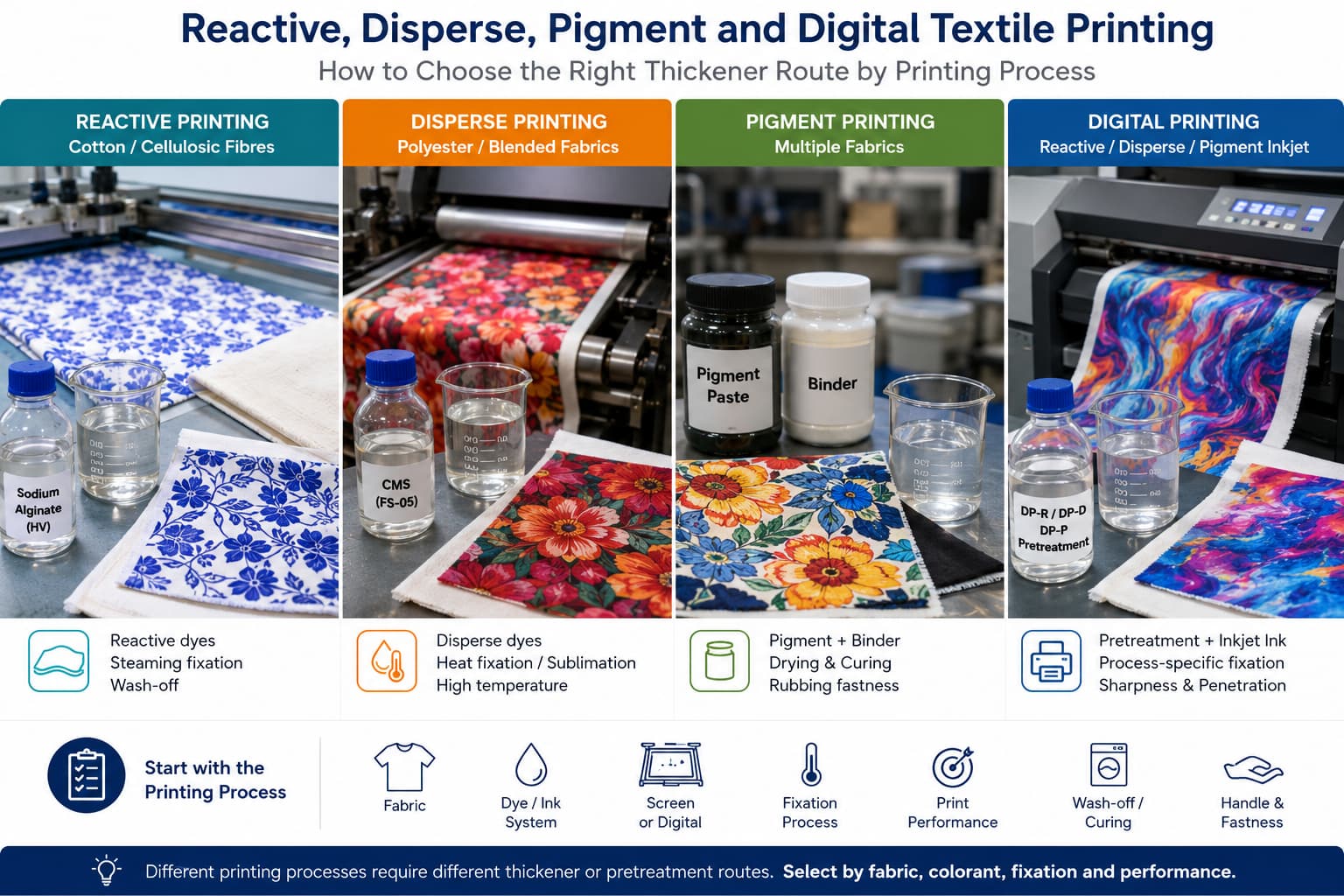
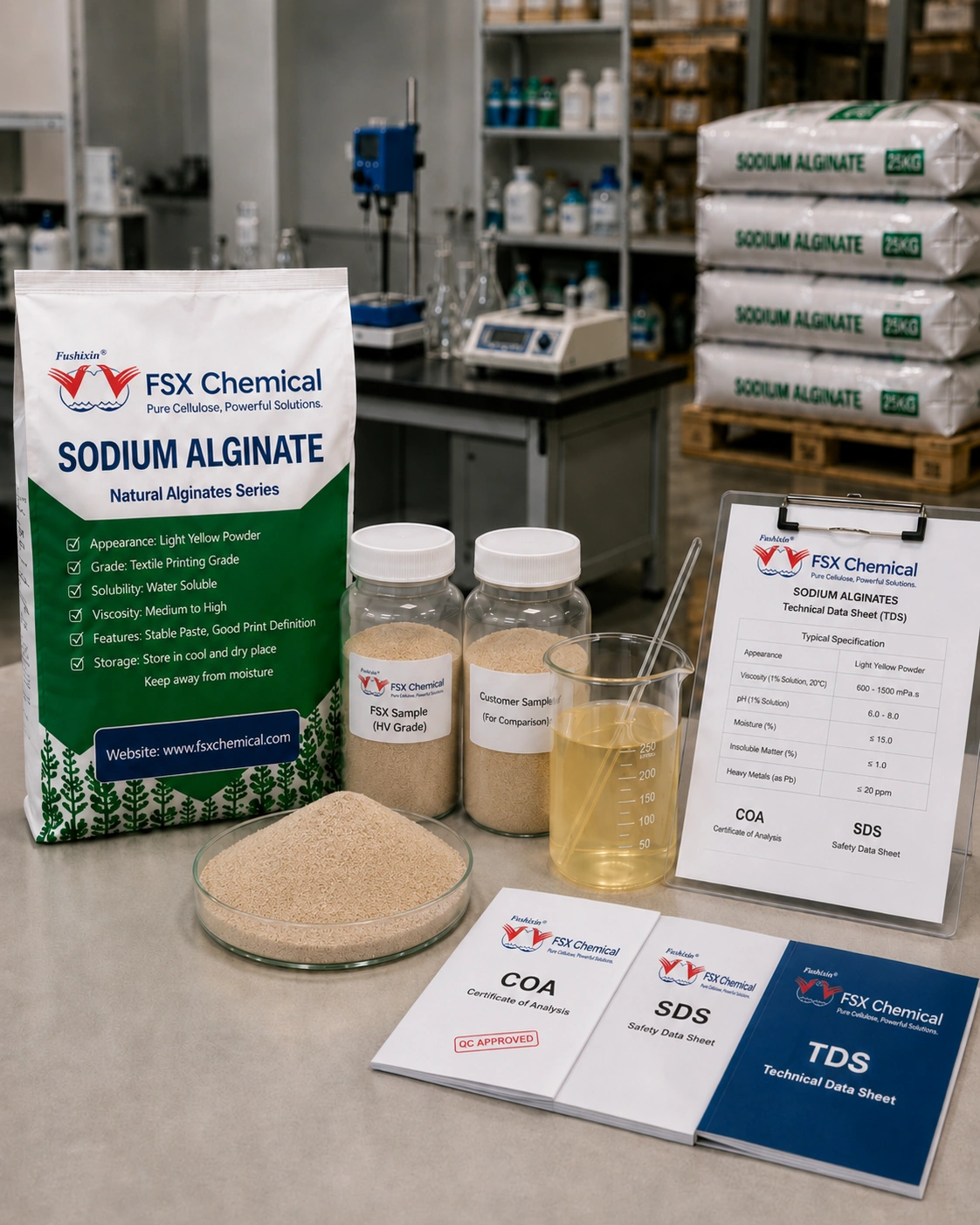
Conventional reactive screen printing still commonly begins with alginato de sodio as an important thickener route.
Innovation does not necessarily mean abandoning this established chemistry.
Instead, development can focus on:
More efficient viscosity grades
Better filtration
Improved rheological control
Compound systems for selected formulations
Reduced formulation correction
Better sample-to-bulk consistency
Any change to the thickener route should still be validated for reactive-dye compatibility, definition, fixation and wash-off.
What These Innovations Mean for Disperse Printing
Polyester disperse printing creates opportunities for modified starch, compound thickener and process-specific systems.
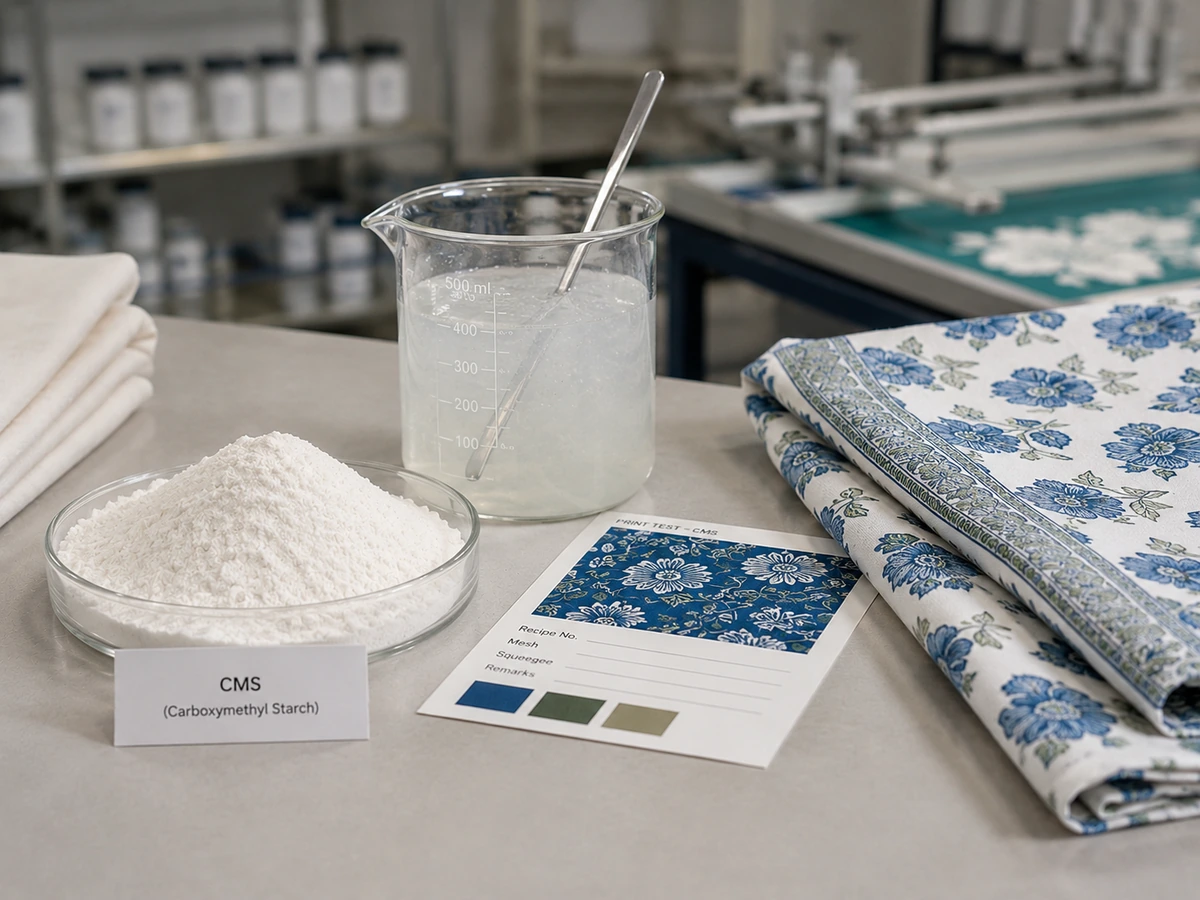
CMS and related routes can be evaluated where viscosity, screen passage, paste stability and commercial efficiency need to be balanced.
Innovation targets can include
Better effective thickening efficiency
Cleaner screen passage
Improved long-run paste stability
More consistent solid areas
Compatibilidad con la fijación térmica
Final suitability depends on the actual disperse colorant, polyester fabric and fixation process.
What These Innovations Mean for Pigment Printing
Pigment printing is one of the areas where thickener and binder innovation are closely connected.
A high-performance pigment formulation needs the rheology system and binder to work together.
Important optimization targets include
Binder efficiency
Thickener-binder compatibility
Tolerancia a los electrolitos
Definición de impresión
Film formation
Rendimiento de fricción
Curado
Mango de tela
Improving one property at the expense of several others does not represent successful innovation.
What These Innovations Mean for Digital Textile Printing
Digital printing is likely to remain one of the most important areas for process-specific textile chemical development.
The chemistry should first be separated according to ink system.
Inyección de tinta reactiva
Evaluate fabric pretreatment for suitable cellulosic textiles, migration control, definition, fixation and wash-off.
Inyección de tinta por dispersión
Evaluate polyester pretreatment for uniformity, filtration, drying and thermal-process compatibility.
Inyección de tinta con pigmentos
Evaluate pretreatment together with pigment ink, binder, curing, rubbing performance and fabric hand feel.
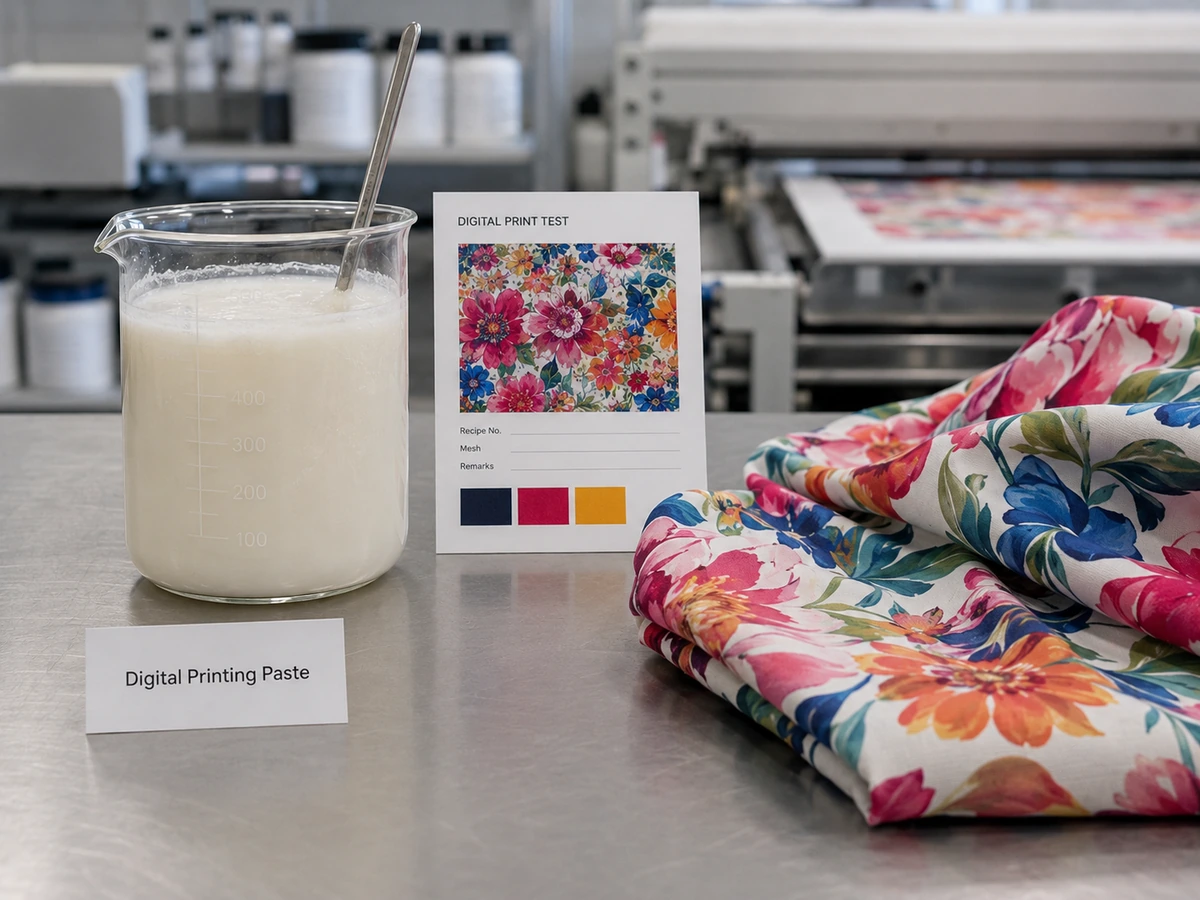
FSX Chemical separates these systems through pasta para impresión digital routes designed for reactive, disperse and pigment printing trials.
Digital pretreatment paste should not simply be added directly to digital ink. Ink and fabric-side pretreatment are different formulation systems.
Innovation and Sustainable Printing
Sustainability claims need particular care when discussing new textile chemicals.
A bio-based ingredient, lower dosage or shorter process does not by itself prove a lower overall environmental impact.
A more practical evaluation includes
Actual chemical dosage
Paste waste
Pérdida por filtración
Energy used in preparation and curing
Water used in washing
Rejected or reprinted fabric
Product durability
Consistencia entre lotes
Sustainable innovation should therefore be connected with measurable process performance rather than broad environmental terminology.
How to Evaluate an Innovative Textile Chemical
New chemistry should face a stronger test procedure than an established material because the buyer has less production history on which to rely.
Step 1: Define the current benchmark
Record the existing commercial product, formula, dosage and known production performance.
Step 2: Define the innovation objective
Decide whether the candidate is intended to improve filtration, rheology, dosage, curing, process length, sustainability or another measurable target.
Step 3: Compare basic laboratory properties
Apariencia
Viscosidad
pH
Hidratación
Filtración
Estabilidad física
Step 4: Evaluate the complete formulation
Add the actual dyes, pigments, salts, alkalis, binders and auxiliaries used in production.
Step 5: Print the actual fabric
Use the same design, substrate and equipment conditions whenever possible.
Step 6: Complete post-treatment
Final evaluation should occur after fixation, curing and washing as required.
Step 7: Compare the original objective
Confirm whether the innovation actually improved the targeted parameter without creating new production problems.
Why Laboratory Innovation Must Survive Production Scale-Up
An innovative formulation can perform very well in a small laboratory batch and still behave differently in industrial production.
Scale-up changes
Geometría del mezclador
Tamaño del lote
Pump shear
Tiempo de retención
Temperatura
Velocidad de aplicación
Fabric variation
Production validation should therefore be part of product development, not an afterthought.
Monitor the complete production run
Fabric from the beginning, middle and end should be compared when evaluating paste stability and printing consistency.
Verify the first bulk batch
The commercial material should remain connected to the approved sample through product identity and relevant batch documentation.
Innovation and Total Cost in Use
New textile chemistry is commercially useful only when its complete economic effect is understood.
Do not compare only price per kilogram
A more expensive product can still reduce total cost if it operates at a more efficient dosage or reduces expensive production losses.
Comparar
Delivered product price
Dosis eficaz
Preparation time
Filtración
Machine downtime
Printing speed
Paste waste
Fijación o curado
Reprinting and rejected fabric
Innovation should therefore be measured against an established technical and commercial benchmark.
How Buyers Should Evaluate Innovative Suppliers
Área de evaluación
Question to Ask
Innovation Claim
What exactly is new about the product?
Technical Evidence
Which measurements support the claimed benefit?
Solicitud
Which fabric and printing system was it designed for?
Benchmark
What should the product be compared against?
Ejemplo
Can I test the actual commercial grade?
Scale-Up
Has the chemistry been evaluated beyond a small laboratory batch?
Control de calidad por lotes
Which properties are controlled in commercial production?
Documentation
Which product-specific technical and compliance documents are available?
Supply
Can the approved formulation be produced consistently for repeat orders?
A technically credible supplier should be willing to explain both the expected benefit and the limitations of a new chemistry.
How FSX Chemical Approaches New Printing Solutions
Innovation within textile printing does not require replacing every proven chemistry. In many cases, a better result can come from selecting the correct grade, optimizing rheology or developing a more appropriate compound system.
A través de Muestras y combinación , customers can use their current commercial product as the technical reference for evaluating a different grade or formulation direction.
Useful project information includes
Current commercial product and TDS
Muestra física de referencia
Viscosidad y método de ensayo completo
Dosis actual
Printing formulation
Tela
Reactive, disperse, pigment or digital process
Printing equipment
Current technical problem
Target improvement
The objective is to identify a technically relevant candidate and validate it through controlled comparison rather than assume that a product is superior simply because it is described as new📧 Correo electrónico: Service@fsxchemical.com
Aprende a elegir espesantes y métodos de pretratamiento para la impresión textil reactiva, dispersa, con pigmentos y digital, según los requisitos del tejido, el colorante o la tinta, la fijación, la resistencia al lavado y la calidad de impresión.
La pasta de impresión a base de CMC se utiliza en la impresión textil con pigmentos, reactiva y digital. Esta guía explica qué parámetros son importantes, cómo comparar proveedores y qué solicitar antes de realizar un pedido al por mayor.
Tanto el alginato de sodio como la CMC se utilizan como espesantes en la impresión textil, pero se adaptan a diferentes sistemas de tinte y condiciones de proceso. Esta guía explica las diferencias clave y cuándo utilizar cada uno.
Cellulose-based raw materials are used in textile printing, printing paste preparation, thickening, and formulation support. This guide explains how buyers can evaluate CMC, CMS, sodium alginate, textile printing thickeners, and printing paste products by specification, documentation, sample testing, and supplier support.
La compra al por mayor de alginato de sodio requiere algo más que comparar el precio unitario. Esta guía explica cómo los compradores del sector de la impresión textil pueden verificar la viscosidad, el tamaño de malla, el grado de pureza, el empaque, el certificado de análisis (COA), las pruebas de muestras y la consistencia de los lotes antes de realizar pedidos a granel.
Cellulose derivatives are widely used in textile printing, printing paste preparation, thickening, and formulation support. This guide explains how overseas buyers can source CMC, CMS, sodium alginate, textile printing thickeners, and printing paste products from FSX Chemical with TDS, COA, sample testing, grade matching, and export document support.
Choosing a textile printing chemical supplier requires more than comparing product names and prices. This guide explains how buyers can evaluate product range, technical documents, sample testing, batch consistency, communication, and supplier support before cooperation.
Choosing textile industry chemicals requires more than comparing product names. This guide explains how textile printing buyers can match CMC, CMS, sodium alginate, textile printing thickeners, and printing paste products by application, specification, TDS, COA, sample testing, and batch consistency.
Choosing an industrial chemicals supplier for textile printing requires more than checking product names and prices. This guide explains how buyers can review ISO certificate scope, TDS, COA, SDS, sample testing, batch consistency, and export documents before placing bulk orders.
Chemical formulation support for textile printing should begin with clear application information. This guide explains what buyers should provide when requesting product matching, formulation adjustment, sample testing, TDS, COA, SDS, and technical support for CMC, CMS, sodium alginate, textile printing thickeners, and printing paste products.
Sodium alginate for textile coating is a vital bio-based option for global textile/printing firms. It solves key issues like poor adhesion (ideal for cotton) and low durability (boosts polyester coating resilience by 30%), while meeting regional rules—EU REACH (biodegradable) and US OEKO-TEX (non-toxic for babywear). This guide covers application tips (digital printing), alternatives comparison (vs acrylic binders), and how to pick global suppliers like fsxchemical.
La elección del espesante adecuado para la impresión textil no depende únicamente del tipo de tela. Los compradores deben seleccionar el espesante que mejor se adapte al sistema de tintes o pigmentos, al método de impresión, a la reología deseada, a los requisitos de lavado y a las condiciones reales de las pruebas en fábrica.
Comparta el nombre del producto, su aplicación, la cantidad, el destino y cualquier ficha técnica (TDS),
foto de muestra o documento que ya tenga. FSX Chemical revisará la
información y le recomendará el siguiente paso para la cotización, la comparación de muestras
o la selección del producto.
Información del productoNombre del producto, categoría, modelo, foto de la etiqueta o referencia del proveedor.
Documentos disponiblesTDS, SDS, COA, foto de muestra, lista de productos o datos de pruebas.
Detalles del pedidoCantidad estimada, embalaje, país de destino, puerto o término comercial.
Solicitud o problemaProceso de impresión textil, requisitos de formulación, problema actual o objetivo de rendimiento.