Hướng dẫn từng bước: Lựa chọn loại chất làm đặc dệt may phù hợp với quy trình in của bạn
Matching textile thickener grades requires more than finding the same viscosity. Follow a step-by-step process...
Matching textile thickener grades requires much more than finding the same viscosity. A reliable matching process begins with the printing chemistry and fabric, aligns laboratory methods, compares rheology and filtration, evaluates the complete printing paste and then confirms performance through fabric and production trials.
Textile printing mills frequently need to qualify a new thickener grade. The objective may be to establish a second supplier, reduce total cost, improve screen passage, solve a filtration problem, increase production stability or replace a product that is no longer commercially convenient.
At first, grade matching can appear straightforward. A mill takes the viscosity specification of its current product, asks another supplier for the same value and tests the candidate.
In practice, this method is incomplete.
Sodium alginate, CMC, CMS and compound thickeners can have similar viscosity values while showing different hydration, shear response, filtration, chemical compatibility and printing behavior.
The printing process must therefore come before the viscosity number. Professional grade matching connects the product to the actual fabric, colorant chemistry, machine, formulation and finished-textile requirements.
This step-by-step guide explains how to move from an existing approved thickener to a technically relevant candidate without assuming that a similar product name or laboratory number guarantees equivalent performance.
What Does Textile Thickener Grade Matching Mean?
Textile thickener grade matching is the process of identifying a candidate commercial grade that can operate within the technical and production requirements already established by the printing mill.
A matched grade does not necessarily mean that the candidate is chemically identical to the current product.
Instead, the objective is to determine whether the new product can provide comparable or acceptable performance under the customer’s actual manufacturing conditions.
A successful match can require similarity in
Effective viscosity
Hydration behavior
Rheology
Lọc
Độ ổn định của hỗn hợp dán
Chemical compatibility
Screen passage or application behavior
Định nghĩa về in ấn
Độ thâm nhập
Quá trình cố định hoặc đóng rắn
Wash-off where applicable
Liều lượng hiệu quả
The final acceptance criteria should be defined by the printing process rather than by one laboratory number alone.
Why the Printing Process Must Come First
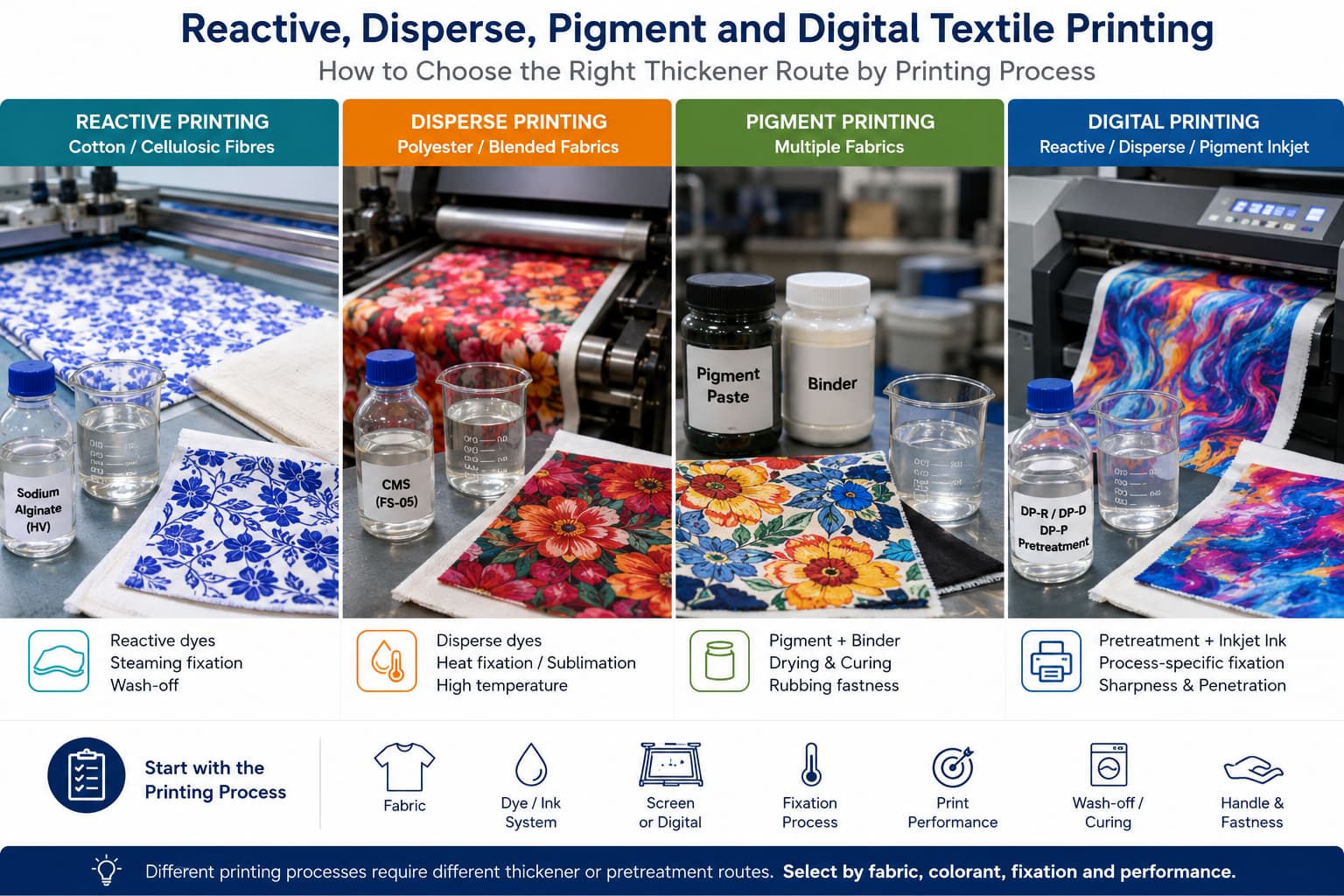
The same thickener cannot be assumed to perform identically across reactive, disperse, pigment and digital textile printing.
Each process exposes the polymer to different dyes or pigments, electrolytes, pH conditions, fabrics, application forces and post-treatment.
In phản ứng
The thickener needs to perform inside a dye paste that can contain reactive dye, alkali and other auxiliaries and must later pass through fixation and washing.
Disperse printing
The system is commonly associated with polyester and thermal fixation, creating different compatibility and application requirements.
Pigment printing
The rheology system must work with pigment dispersion, binder and curing chemistry.
Digital printing
The pretreatment is normally applied to the fabric rather than used as a conventional screen-printing paste.
Grade matching should therefore begin with the question: Where and how will this product actually be used?
Step 1: Define the Printing Process
Before comparing grades, record the exact production route.
Identify the printing technology
In trên màn hình phẳng
In lụa quay
Digital inkjet printing
Other application-specific printing systems
Identify the colorant chemistry
Reactive dye
Disperse dye or ink
Chất màu
Other application-specific systems
Identify the post-treatment
Hấp
Cố định bằng nhiệt
Quá trình làm cứng
Giặt giũ
Hoàn thiện
This information immediately eliminates thickener routes that are not technically relevant to the process.
Step 2: Identify the Fabric and Dye or Ink System
Fabric chemistry and structure strongly influence paste penetration, surface spreading and final print definition.
Record the fiber composition
Bông
Viscose or rayon
Polyester
Nylon
Len
Lụa
Hỗn hợp
Record the fabric construction
Knitted or woven
Fabric weight
Density
Surface texture
Stretch where relevant
Two fabrics made from the same fiber can still require different rheological behavior because their absorbency and construction differ.
The dye or ink route should then be connected with the fabric before a candidate thickener chemistry is selected.
Step 3: Document the Current Approved Thickener
If the printing mill already has a product that performs successfully, that material should become the reference.
Record
Manufacturer
Exact commercial grade
Product family
TDS hiện tại
Recent COA where available
Mẫu tham chiếu vật lý
Liều lượng hiện tại
Current preparation procedure
Current viscosity method
Known strengths
Known weaknesses
Do not describe the benchmark only as “high-viscosity sodium alginate” or “textile-grade CMC.”
The exact commercial grade provides a much stronger technical target.
Step 4: Align the Viscosity Test Method
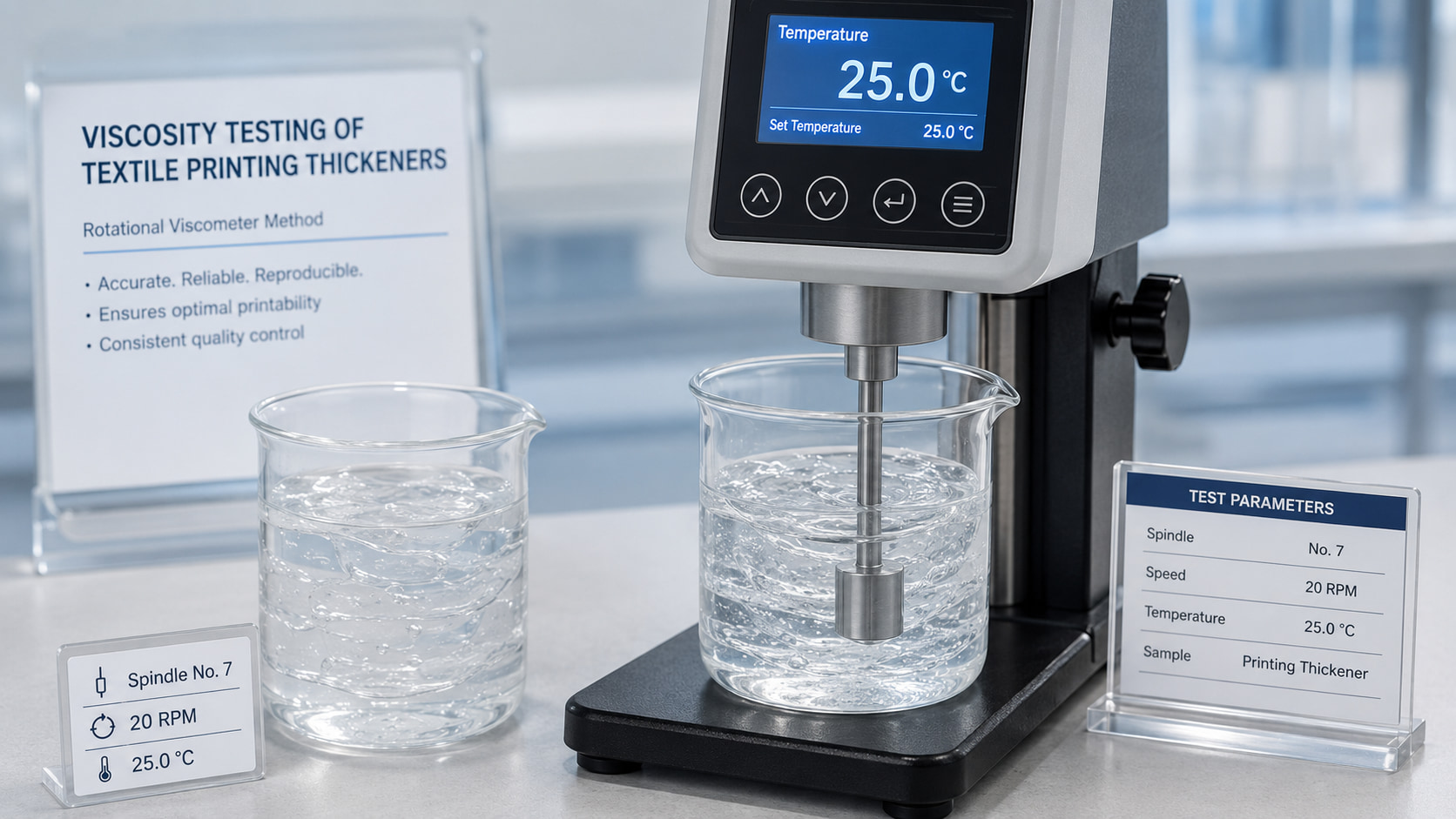
One of the most common causes of failed grade matching is comparing viscosity values generated by different methods.
Always record
Polymer concentration
Concentration basis
Chất lượng nước
Quy trình thêm bột
Tốc độ trộn
Thời gian trộn
Thời gian bù nước
Nhiệt độ đo
Viscometer
Trục chính, rôto hay hình học
Tốc độ quay
Thời gian đọc
Đơn vị được báo cáo
A reference product measured at one concentration cannot be fairly compared with a candidate reported at another concentration.
Similarly, changing temperature, spindle or rotational speed can change the result.
The test method must therefore be matched before the numerical target.
Step 5: Select the Candidate Thickener Chemistry
Once the application and reference product are understood, choose the technically relevant polymer route.
Quy trình in ấn
Common Starting Direction
Important Matching Criteria
Reactive Screen Printing
Alginat natri
Rheology, filtration, definition, fixation and wash-off
Selected Compound Systems
CMC, CMS or blended thickener
Compatibility, rheology, dosage and application performance
Disperse screen printing
A documented FSX CMS or other process-specific thickener
Paste stability, screen passage, transfer and the specified thermal fixation
In bằng mực màu
Synthetic or compound rheology system
Binder compatibility, electrolytes, curing and handle
Reactive Digital
Reactive digital pretreatment
Pickup, migration control, definition and wash-off
Direct disperse digital printing
Fabric pretreatment where required by the specified process
Application uniformity, filtration and thermal compatibility; assess paper-transfer printing separately
Pigment Digital
Pigment-compatible pretreatment
Binder compatibility, definition, curing and hand feel
These are starting directions rather than universal replacement rules.
Matching Sodium Alginate Grades
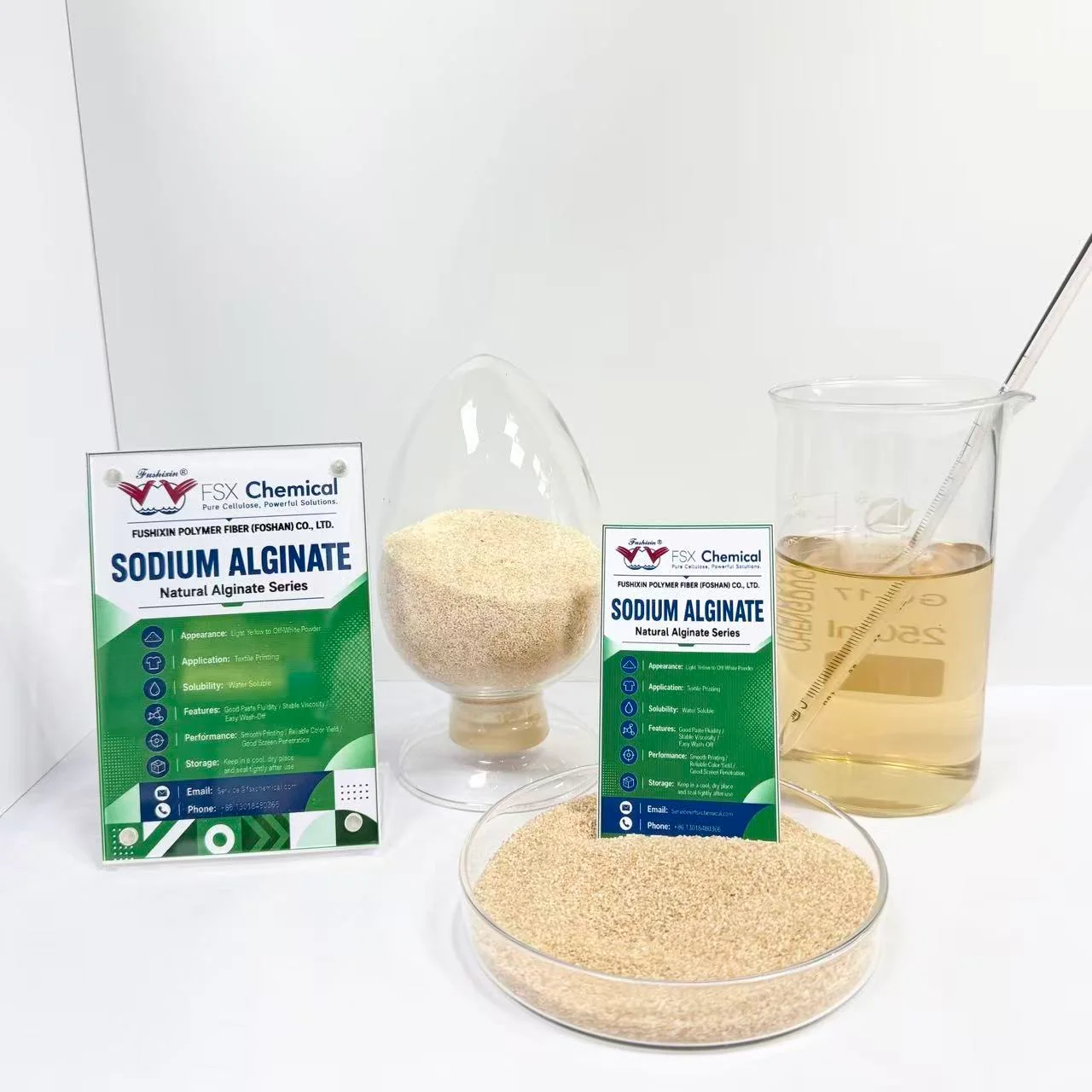
Alginat natri is a common benchmark route for conventional reactive printing on suitable cellulosic textiles.
Do not match only HV, MV or LV
These labels are supplier-defined categories and should not be assumed to represent identical numerical ranges across manufacturers.
So sánh
Actual viscosity
Nồng độ thử nghiệm
Bổ sung nước
Lọc
Rheology
Đoạn trích trên màn hình
Reactive-paste behavior
Định nghĩa về in ấn
Sự cố định
Rửa trôi
A higher-viscosity candidate is not automatically a better match.
Matching CMC Grades
Carboxymethyl cellulose is available in multiple grades with different structural and rheological characteristics.
Important CMC matching parameters include
Mức độ thay thế
Độ nhớt
Nồng độ thử nghiệm
Purity-related specification where applicable
Bổ sung nước
Sự tan rã
Lọc
Phản ứng điện giải
Rheology
Similar degree of substitution does not prove equivalent printing behavior, just as similar viscosity does not prove identical CMC.
Final approval must be made through the complete formulation and printing process.
Matching CMS Grades
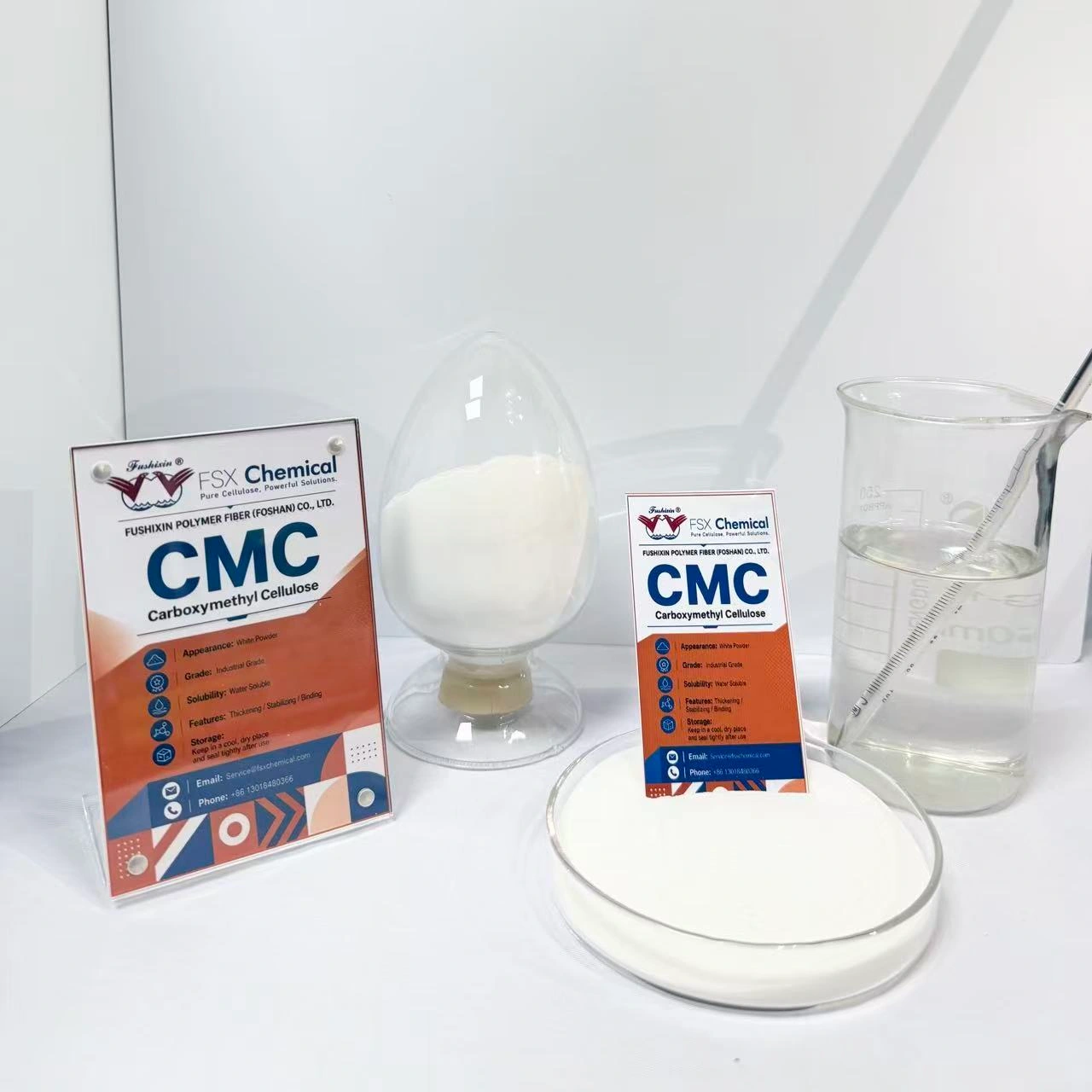
FSX CMS is a commercial synthetic printing-thickener family. Confirm grade identity, product form and the documented printing route; the abbreviation does not establish carboxymethyl starch composition or justify importing CMC DS criteria.
So sánh
Commercial grade identity
Viscosity method
Bổ sung nước
Lọc
Độ ổn định của hỗn hợp dán
Đoạn trích trên màn hình
Rheology
Liều lượng hiệu quả
Finished-textile performance
A CMS grade should not be selected simply because its raw-material price is lower than another polymer.
The meaningful comparison is technical performance at the optimized commercial dosage.
Matching Compound Thickeners
Compound thickeners require a slightly different matching strategy because the product may combine several polymers or rheology-control components.
Do not try to identify the match from one polymer percentage alone
Two compound products can achieve similar printing behavior through different formulation structures.
Instead compare functional performance
Base viscosity
Shear behavior
Structural recovery
Lọc
Khả năng dung nạp chất điện giải
Duy trì sự ổn định
Định nghĩa về in ấn
Liều lượng hiệu quả
Compound-thickener matching is therefore particularly dependent on complete-paste and fabric testing.
Matching Digital Printing Paste
Digital printing paste should be matched according to the ink system and fabric rather than treated as a generic high-viscosity polymer.
First identify
Reactive, disperse or pigment ink
Fabric composition
Pretreatment application method
Current dosage or pickup
pH
Drying process
Fixation or curing route
Digital pretreatment paste should not simply be added directly into inkjet ink. The fabric pretreatment and the ink formulation serve different technical functions.
Matching should therefore compare final printed textiles using the same ink and printer settings.
Step 6: Compare Hydration and Stock-Paste Properties
Once a candidate grade has been selected, prepare the reference and candidate under identical conditions.
Observe powder addition
Compare wetting, lump formation and dispersion during preparation.
Record hydration time
Some polymers develop viscosity gradually and should not be judged immediately after mixing.
Compare basic properties
Hình thức
Solution uniformity
Độ nhớt
pH
Bọt
Physical stability
Preparation efficiency is part of commercial performance because difficult hydration can increase labor, mixing and filtration costs.
Step 7: Compare Rheology
Similar single-point viscosity does not guarantee similar behavior during printing.
At low shear
The paste may need sufficient structure to remain stable during storage and holding.
Under higher shear
The paste must flow through pumping, circulation or screen systems.
After application
After application, assess whether flow becomes sufficiently limited to preserve the pattern. Time-dependent recovery requires an appropriate shear-and-rest test; do not infer it from equal single-speed readings or treat every bleeding defect as a recovery failure.
Where possible, compare the reference and candidate under several controlled shear conditions rather than relying on one viscosity reading.
Step 8: Compare Filtration
Filtration is an important practical test for printing thickeners.
Standardize
Polymer concentration
Phương pháp chế biến
Thời gian bù nước
Sample quantity
Filter material
Opening size or mesh
Filtration conditions
Inspect the retained residue
Residue may consist of incompletely hydrated polymer, gels, contamination or material formed through chemical incompatibility.
Test stock paste and complete paste separately
This helps determine whether the problem originates from the thickener or from another formulation component.
Step 9: Prepare the Complete Printing Paste
A thickener should not be approved from its performance in water alone.
The reference and candidate should be tested with the actual production formulation.
Depending on the process, this may include
Dyes
Pigments
Muối
Chất kiềm
Sổ bìa cứng
Chất giữ ẩm
Chất làm ướt
Chất khử bọt
Other auxiliaries
Monitor after each major addition when necessary
Staged addition can identify which chemical causes viscosity loss, precipitation, separation or filtration changes.
Complete-formula compatibility is one of the strongest tests of a candidate grade.
Step 10: Print the Actual Fabric
The purpose of a textile thickener is ultimately to perform during textile printing, so the actual production fabric should be tested.
Use a diagnostic design containing
Fine horizontal lines
Fine vertical lines
Small text
Sharp corners
Fine dots
Adjacent colors
Large solid areas
Dark shades where useful
Evaluate during printing
Đoạn trích trên màn hình
Paste transfer
Spreading
Độ thâm nhập
Độ đồng đều của vùng rắn
Evaluate after post-treatment
Complete the normal steaming, fixation, curing and washing process before making the final technical comparison.
Wet-print appearance alone is not sufficient for final approval.
Step 11: Optimize Effective Dosage
The first technical comparison should usually use a controlled baseline. After the candidate demonstrates acceptable performance, dosage can be optimized.
Do not assume weight-for-weight replacement
Different grades can have different thickening efficiency and rheological behavior.
Adjust gradually
Test a controlled range around the successful concentration instead of making a large dosage reduction immediately.
Repeat critical quality checks
Lowering dosage may change definition, penetration, stability or machine behavior.
Calculate commercial cost after optimization
Comparing price before determining the practical dosage can lead to an incorrect purchasing decision.
Step 12: Conduct a Production Trial
Laboratory approval is not the final stage.
Production changes batch size, mixer geometry, circulation, holding time, temperature and mechanical shear.
During the production trial, record
Thời gian chuẩn bị
Batch viscosity
Duy trì sự ổn định
Lọc
Pumping
Đoạn trích trên màn hình
Sự gián đoạn do máy móc
Paste consumption
Print quality
Check the entire production run
Compare fabric from the beginning, middle and end instead of approving the candidate from only the first meters.
A product should be considered successfully matched only after it performs inside the real production window.
Write the Approval Scope Before Calling a Grade Matched
Record a proposed match as a candidate until the necessary application checks pass. Keep the reference recipe and the candidate recipe distinguishable: a successful optimised recipe is not proof of a weight-for-weight replacement.
A similar abbreviation, grade label or number measured by another method.
Reference comparison
Actual fabric lot, colourant system, starting recipe, application conditions and finished-quality criteria.
A passing water solution or a visually stronger unwashed print.
Candidate optimisation
Changed dosage, balancing water and every deliberate process adjustment, with a separate trial identifier.
The assumption that the candidate works in the unchanged reference recipe.
Approved operating scope
Recipe revision, fabric range actually assessed, screen or digital route, equipment, holding time and post-treatment.
Another fibre blend, ink set, machine, fixation route or unreviewed product revision.
When a proposed use falls outside that scope, identify which difference requires a new comparison rather than copying an earlier approval. For a dosage-driven purchasing decision, use the same scope in the cost-per-accepted-output comparison.
Sample-to-Bulk Verification
A successful sample should remain traceable when the buyer moves to a commercial order.
The qualification chain should connect
Candidate sample
Permanent commercial grade
TDS
Laboratory approval
In thử
Approved dosage
Commercial quotation
Purchase order
Production batch
Package label
Batch-specific quality documentation where applicable
Verify the first commercial batch
Repeat the critical incoming laboratory checks before the first bulk shipment is released into unrestricted production.
This step is especially important when changing suppliers.
Reactive Printing Grade-Matching Example
Consider a cotton printing mill using a sodium alginate grade successfully in flat-screen reactive printing.
The wrong approach
Ask a new supplier only for the same viscosity and replace the current alginate at the same dosage.
The better approach
Record the current alginate grade and viscosity method.
Prepare reference and candidate at identical concentration.
Compare hydration, viscosity, rheology and filtration.
Prepare the actual reactive color paste.
Print the same cotton fabric.
Compare screen passage and definition.
Complete fixation and wash-off.
Optimize candidate dosage.
Run a controlled production trial.
This provides much stronger evidence of equivalence than matching the viscosity number alone.
Disperse Printing Grade-Matching Example
For polyester disperse printing, the candidate may be a CMS or another application-specific thickener.
Important comparison areas include
Stock-paste stability
Disperse color compatibility
Lọc
Đoạn trích trên màn hình
Chuyển nhượng
Độ đồng đều của vùng rắn
Thermal fixation performance
Final polyester surface quality
The product with the closest laboratory viscosity is not necessarily the product that performs most similarly on polyester.
Pigment Printing Grade-Matching Example
Pigment printing requires the thickener to operate with the pigment dispersion and binder system.
So sánh
Rheology
Khả năng tương thích của chất kết dính
Phản ứng điện giải
Độ ổn định của hỗn hợp dán
Định nghĩa về in ấn
Curing behavior
Dry and wet rubbing performance where required
Tay cầm bằng vải
A candidate that matches the viscosity but interacts poorly with the binder is not a successful replacement.
Digital Printing Grade-Matching Example
Digital textile printing requires a different comparison because the pretreatment is evaluated on the fabric side.
Match the ink route first
Determine whether the system uses reactive, disperse or pigment ink.
Then compare pretreatment
Chuẩn bị
Viscosity where relevant
Lọc
pH
Fabric pickup
Drying behavior
Sự di chuyển của mực
Fine-line definition
Use the same printer and ink
Changing the ink or printer settings during the same comparison makes it difficult to isolate the effect of the candidate pretreatment.
Final evaluation should occur after the appropriate fixation, curing and washing route.
Flat-Screen vs Rotary-Screen Matching
A grade that performs well on one screen-printing technology should not automatically be assumed to behave identically on another.
Flat-screen printing emphasizes
Squeegee transfer
Đoạn trích trên màn hình
Pattern definition
Độ thâm nhập
Repeat consistency
Rotary-screen printing emphasizes
Continuous circulation
Pumping
Practical filtration
Shear behavior
Long-run stability
Equipment should therefore be included in the grade-matching specification.
Troubleshooting a Poor Grade Match
Vấn đề được ghi nhận
Nguyên nhân có thể
What to Check
Candidate viscosity is lower
Different efficiency or incomplete hydration
Concentration, mixing, hydration and test method
Viscosity matches but edges bleed
Flow, fabric wetting or later-stage migration differs
Locate the first failing stage; compare fabric, liquid load, paste behaviour and drying or fixation
Viscosity matches but screen passage is poor
Filtration or flow difference
Residue, hydration, rheology and screen condition
Stock paste matches but color paste changes
Sự không tương thích hóa học
Dye, salt, alkali, binder or auxiliary interaction
Fine lines break
Poor transfer or excessive resistance
Rheology, viscosity, screen and pressure
Lab test passes but production fails
Scale-up difference
Batch size, mixer, circulation and holding time
Candidate needs much higher dosage
Different thickening efficiency
Optimized concentration and total cost in use
Lô hàng số lượng lớn khác với mẫu thử
Sample-to-bulk or QC issue
Grade identity, COA, retained sample and test method
Troubleshooting should always consider fabric, machine, formulation and post-treatment as well as the thickener itself.
Commercial Cost Comparison
Once the candidate has achieved acceptable technical performance, compare the commercial economics.
Delivered product cost
Compare prices using the same quantity, packing, destination and trade term.
Liều lượng hiệu quả
Use the optimized production dosage rather than equal kilograms of two different grades.
Chi phí chuẩn bị
Consider hydration, mixing, filtration and labor.
Machine efficiency
Include screen cleaning, downtime, printing speed and production interruptions.
Quality cost
Include rejected fabric, reprinting and additional post-treatment.
The most economical matched grade is therefore not necessarily the product with the lowest price per kilogram.
What Information to Send Your Supplier
Providing complete application information significantly improves the accuracy of a grade-matching recommendation.
Current product
Manufacturer
Commercial grade
Product family
TDS
Recent COA where available
Physical sample
Laboratory method
Độ nhớt
Nồng độ
Nước
Mixing procedure
Thời gian bù nước
Nhiệt độ
Instrument
Spindle and speed
Quy trình in ấn
Reactive, disperse, pigment or digital
Fabric composition
Flat screen, rotary screen or digital equipment
Current formula
Liều lượng hiện tại
Quá trình cố định hoặc đóng rắn
Washing where applicable
Performance target
Khả năng lọc tốt hơn
Sharper edges
Improved screen passage
Lower effective dosage
Better stability
Alternative supplier qualification
The more accurately the current process is defined, the more useful the candidate-grade recommendation can be.
Customers who already use another commercial product can begin with their current material as the benchmark.
Thông qua Mẫu và việc kết hợp , buyers can provide an existing TDS, physical sample, viscosity method and printing-process information for candidate-grade review.
A practical matching project can include
Review of the current product and application
Alignment of important test methods
Selection of a technically relevant candidate
Sample preparation
Customer laboratory comparison
Full printing-paste trial
Fabric evaluation
Dosage optimization
Production validation
Commercial quotation and bulk verification
The recommendation should be treated as a trial-grade starting point. Final suitability depends on the customer’s actual formulation, fabric, equipment and production conditions📧 Email: Service@fsxchemical.com
Tìm hiểu lý do tại sao không thể so sánh các giá trị độ nhớt của chất làm đặc trong in ấn dệt may nếu không đảm bảo các yếu tố như nồng độ, nhiệt độ, thiết bị, trục quay, tốc độ, phương pháp chuẩn bị và thời gian thử nghiệm đều giống nhau.
Tìm hiểu cách lựa chọn chất làm đặc và quy trình tiền xử lý cho các phương pháp in dệt phản ứng, in phân tán, in sắc tố và in kỹ thuật số, dựa trên các yêu cầu về vải, thuốc nhuộm hoặc mực in, quá trình cố định màu, khả năng rửa trôi và chất lượng in.
So sánh CMC, CMS, natri alginat và mực in kỹ thuật số trong in ấn dệt may. Tìm hiểu cách thức từng loại nguyên liệu phù hợp với các quy trình in phản ứng, in phân tán, in sắc tố và in kỹ thuật số, cũng như những yếu tố mà người mua cần xem xét trước khi thử mẫu, đối chiếu chất lượng và mua số lượng lớn.
Natri alginat được sử dụng rộng rãi trong in ấn dệt may với vai trò là chất làm đặc ổn định và có thể giặt được cho hỗn hợp in phản ứng. Tìm hiểu cách đánh giá cấp độ độ nhớt, độ tinh khiết và tính phù hợp trong ứng dụng trước khi mua hàng, cũng như cách FSX Chemical hỗ trợ người mua trên toàn cầu thông qua dữ liệu kỹ thuật và mẫu sản phẩm.
Choose CMC for textile printing by application, DS, viscosity method and formulation trials. Use a practical checklist to compare grades before bulk purchase.
Carboxymethyl cellulose được sử dụng làm chất làm đặc và chất ổn định trong mực in gốc nước, in ống đồng và quá trình tiền xử lý cho in phun. Hướng dẫn này trình bày các thông số kỹ thuật chính của sản phẩm và các yếu tố cần xem xét khi lựa chọn nhà cung cấp dành cho các đội ngũ mua hàng.
Hỗn hợp in dựa trên CMC được sử dụng rộng rãi trong in vải bằng bột màu, in phản ứng và in kỹ thuật số. Hướng dẫn này giải thích các thông số quan trọng, cách so sánh các nhà cung cấp và những yêu cầu cần đưa ra trước khi đặt hàng số lượng lớn.
Cả natri alginat và CMC đều được sử dụng làm chất làm đặc trong in vải, nhưng chúng phù hợp với các hệ thống thuốc nhuộm và điều kiện quy trình khác nhau. Hướng dẫn này giải thích những điểm khác biệt chính và thời điểm nên sử dụng từng loại.
In phun kỹ thuật số trên vải có các yêu cầu về hỗn hợp mực và xử lý sơ bộ khác so với in lụa. Hướng dẫn này giải thích cách sử dụng natri alginat trong in kỹ thuật số trên vải cũng như các thông số về cấp độ chất lượng mà các đội ngũ mua hàng cần quy định.
Food-grade and industrial-grade CMC labels do not define one universal DS, viscosity or purity comparison. Textile buyers should verify grade-specific assay and methods, then test the complete formulation; food-contact or pharmaceutical use needs separate, applicable documentation.
Prepare sodium alginate printing paste with a grade-specific concentration and controlled powder dispersion. Validate hydration, viscosity, filtration, air removal and holding time before production.
Assess sodium alginate in reactive-printing wastewater using measured COD load, product-specific biodegradation evidence and controlled process comparisons. Includes a buyer checklist and illustrative load calculation.
Vui lòng cung cấp tên sản phẩm, ứng dụng, số lượng, điểm đến và bất kỳ tài liệu kỹ thuật (TDS),
hình ảnh mẫu hoặc tài liệu nào mà quý khách đã có. FSX Chemical sẽ xem xét
thông tin này và đề xuất bước tiếp theo liên quan đến báo giá, đối chiếu mẫu
hoặc lựa chọn sản phẩm.
Thông tin sản phẩmTên sản phẩm, cấp loại, mẫu mã, ảnh nhãn mác hoặc mã tham chiếu của nhà cung cấp.
Các tài liệu có sẵnTDS, SDS, COA, ảnh mẫu, danh mục sản phẩm hoặc dữ liệu thử nghiệm.
Chi tiết đơn hàngSố lượng dự kiến, hình thức đóng gói, nước nhập khẩu, cảng hoặc điều kiện thương mại.
Yêu cầu hoặc Vấn đềQuy trình in trên vải, yêu cầu về công thức, vấn đề hiện tại hoặc chỉ tiêu hiệu suất.