Digital Textile Pretreatment by Padding vs. Coating vs. Spray: Which Application Route Fits Your Fabric?
Padding, coating and spray can all be used to apply textile pretreatment before digital printing,...
Padding, coating and spray can all be used to apply textile pretreatment before digital printing, but they do not create the same chemical distribution inside the fabric. Padding thoroughly wets the textile and uses a squeeze nip to control retained liquor. Coating meters a controlled layer onto the surface and is highly sensitive to coating gap, fabric tension, thickness and rheology. Spray meters droplets onto one or both fabric faces and can reduce the amount of water carried into drying, but nozzle overlap, atomization, line speed and fabric wetting become critical. The correct route should therefore be selected from fabric structure, required penetration, target dry chemical add-on, surface localization, drying capacity and widthwise uniformity—not from application-method preference alone.
Padding vs. Coating vs. Spray: Which Route Fits Your Fabric?
There is no universal best application route for digital textile pretreatment.
A practical starting rule is:
Padding: strongest starting route when the fabric needs thorough wetting, the mill already operates a stable padder/stenter line, and through-thickness chemical distribution is acceptable or desirable.
Coating: strongest starting route when surface-localized chemical add-on, controlled coating weight or limited penetration is important.
Spray: strongest starting route when low-liquor or face-specific application is desired and the equipment can control nozzle overlap, droplet distribution and fabric motion reliably.
The difference is where the liquid and chemistry are placed before printing.
How Padding Applies Digital Textile Pretreatment
Padding typically immerses or thoroughly wets the open-width fabric in a pretreatment liquor before the textile passes through squeeze rolls.
The nip controls the amount of liquid retained by the fabric.
A basic relationship is:
Dry Chemical Add-On ≈ Bath Concentration × Wet Pick-Up
Padding is therefore a combination of:
Fabric wetting
Liquor exchange inside the textile structure
Mechanical expression at the nip
This route can distribute pretreatment through a significant portion of the fabric thickness.
When Padding Is a Strong Starting Route
Padding is often a strong starting route when:
The fabric is processed open-width and dimensionally stable.
Uniform through-wetting is desirable.
The mill already controls wet pick-up reliably.
The fabric is relatively dense or thick and surface-only application would not provide sufficient chemical distribution.
The downstream dryer can handle the water load.
Padding is also attractive for mills that need a robust, familiar process with direct measurement of wet pick-up.
For reactive digital printing, measured wet pick-up gives a practical connection between bath concentration and actual polymer / alkali / urea add-on.
Padding Limitations to Control
Padding can create disadvantages when:
Wet pick-up is high and drying capacity is limited.
Chemistry penetrates deeper than needed.
Fabric hand is sensitive to total add-on.
Edge-center nip pressure is not uniform.
Stretch knits are distorted by tension or mechanical handling.
Higher water load can also increase:
Drying energy
Dryer residence demand
Risk of chemical migration during drying
Padding should therefore be optimized around the lowest stable wet pick-up that still provides the required dry chemical add-on and print performance.
How Coating Applies Digital Textile Pretreatment
Coating meters pretreatment onto the fabric surface rather than relying on full immersion followed by squeezing.
Knife coating is a common example.
Depending on the equipment, coating weight and penetration can be influenced by:
Knife gap
Knife angle / geometry
Fabric tension
Web speed
Fabric thickness
Pretreatment rheology
Coating can therefore be used to maintain more chemistry near the printable face when deep penetration is not required.
When Coating Is a Strong Starting Route
Coating is often worth testing when:
Surface localization is important for color yield or definition.
The mill wants to limit unnecessary face-to-back penetration.
A controlled coating weight can be maintained.
One printable face is the primary target.
The fabric is sufficiently stable for the selected coating geometry.
A surface-localized pretreatment can potentially improve apparent color depth because less functional chemistry is carried unnecessarily into the fabric interior.
However, the benefit must be verified after steaming and washing.
Coating Limitations to Control
Coating is highly sensitive to geometry and rheology.
Potential problems include:
Uneven coating gap
Fabric-thickness variation
Knife streaks
Excess surface film
Yomon tekislash
Insufficient penetration on thick or absorbent textiles
Knife-over-air systems are particularly dependent on fabric tension.
Knife-over-roll systems can provide precise gap control, but variations in substrate thickness can still create coating-weight variation.
Therefore, coating should be qualified on the actual fabric construction rather than on an ideal laboratory substrate alone.
How Spray Applies Digital Textile Pretreatment
Spray systems pump pretreatment through nozzles and deposit droplets onto one or both sides of moving fabric.
The amount and distribution depend on:
Nozzle flow rate
Nozzle spacing
Spray angle
Mounting height / distance
Pressure
Droplet size
Line speed
Fabric wetting
Because spray does not require fabric immersion, it can carry less water into the dryer than a conventional high-pick-up padding route.
But lower water does not automatically mean lower chemical add-on.
A properly designed spray route can target the same dry active add-on with less carrier water.
When Spray Is a Strong Starting Route
Spray is worth testing when:
The mill wants low-liquor application.
Drying capacity is a bottleneck.
One-side or two-side selective application is useful.
The fabric should avoid heavy nip compression.
The equipment can meter flow and nozzle overlap reliably.
Spray can be especially interesting where the pretreatment should remain closer to the face rather than saturating the entire textile structure.
However, this depends on:
Droplet size
Fabric absorbency
Application rate
Wetting chemistry
and must be confirmed through fabric trials.
Spray Limitations to Control
Spray uniformity is an engineering problem as well as a chemistry problem.
Potential failure modes include:
Nozzle striping
Blocked or partially blocked nozzles
Incorrect overlap between spray cones
Overspray
Edge under-application
Droplets too large for even coalescence
Droplets too fine for efficient deposition
Recent textile spray-pretreatment modeling confirms that nozzle spacing, mounting height and angle materially influence deposition uniformity on moving fabric.
This evidence comes from textile spray pretreatment / finishing rather than specifically reactive inkjet pretreatment, so final adoption should be verified on the actual digital-printing chemistry.
Do Not Compare Routes at Equal Bath Concentration
This is one of the most important trial-design rules.
Padding, coating and spray can apply very different amounts of liquid to the fabric.
If all three use the same bath concentration, they may deposit very different dry amounts of:
Polymer
Alkali
Moche
Other auxiliaries
A fair comparison should first define:
Target Dry Chemical Add-On
and then adjust the bath / application settings so each route approaches that target.
Only then should color yield, bleeding, fixation and hand be compared.
Wet Pick-Up vs. Dry Chemical Add-On
Wet pick-up describes how much pretreatment liquor is retained relative to dry fabric weight.
Dry chemical add-on describes how much nonvolatile pretreatment chemistry remains after water removal.
These are related but not identical.
Masalan:
High Wet Pick-Up × Low Bath Concentration
can potentially provide a similar dry active add-on to:
Lower Wet Pick-Up × Higher Bath Concentration
if chemistry remains stable and uniformly distributed.
Therefore, spray should not be judged “lower chemical” simply because its water application is lower.
Likewise, coating should not be judged “higher chemical” simply because the surface layer looks concentrated.
Through-Penetration vs. Surface Localization
Application-route selection is often fundamentally a penetration decision.
Padding tends to create more complete wetting through the textile structure.
Coating tends to favor surface localization when penetration is controlled.
Spray can range from surface-biased deposition to deeper penetration depending on:
Droplet size
Application volume
Wetting
Fabric absorbency
One-side vs. two-side application
For digital printing, the objective is not always minimum penetration.
The target is enough pretreatment distribution to support:
Ink localization
Reactive fixation
Uniform color
without unnecessary chemical placement through the fabric thickness.
Fabric Structure Changes the Route Decision
Fabric construction determines how quickly pretreatment enters the structure and how stable the textile remains under mechanical application.
Important variables include:
Knit vs. woven
GSM
Thickness
Porosity
Surface roughness
Stretch / dimensional stability
Shimuvchanlik
Textile-coating literature confirms that fabric openness, porosity and dimensional stability influence coating penetration and technique selection.
Therefore, route selection should start with the fabric rather than the pretreatment product name.
Woven Fabrics
Stable woven fabrics often provide the widest equipment options.
Padding is a strong starting point when full-width wetting and robust chemical penetration are required.
Coating is worth testing when surface localization and controlled coating weight are the priority.
Spray is worth testing when low-liquor application or one-side control is important.
For very tight woven fabrics, spray droplets or coating liquor may remain more surface-localized unless wetting and application conditions are adjusted.
For open woven fabrics, excessive coating penetration or spray-through should also be checked.
Knitted and Stretch Fabrics
Knits can change width, thickness and porosity under tension.
This makes application mechanics especially important.
Padding can work well, but tension and nip handling should not distort the fabric.
Knife-over-air coating can be sensitive because fabric tension directly affects blade depression and applied amount.
Spray can avoid nip compression, but nozzle uniformity and fabric support must remain stable.
For knits, compare:
Fabric width before / after application
GSM
Residual stretch
Widthwise add-on
in addition to print performance.
Heavy / Thick Fabrics
Heavy fabrics can require more attention to through-thickness distribution.
Padding can be a strong candidate because immersion and nip action help exchange liquor through the structure.
A surface coating may deliver excellent face color but insufficient chemistry deeper in the structure if the process actually requires more penetration.
Single-side spray can also under-treat the reverse side of a thick fabric.
Possible solutions include:
Two-side spray
Higher controlled spray add-on
Padding
Coating with deliberate penetration
The best route should be chosen after measuring both face and back behavior.
Lightweight and Open Fabrics
Lightweight or open fabrics can be difficult because excessive liquid can quickly penetrate through the structure.
Potential risks include:
High wet pick-up
Dripping / strike-through
Uneven drying
Fabric distortion
Coating or spray can be attractive when the mill wants lower liquid load or surface-biased application.
However, very open fabrics can also allow coating or spray to pass through rather than form a uniform face layer.
Use actual add-on and penetration measurements rather than assuming lighter fabric automatically favors spray.
Paxta
Cotton is compatible with all three routes in suitable equipment.
The choice depends more on fabric construction and production objective than on fiber identity alone.
For absorbent cotton:
Padding can produce high wet pick-up.
Coating can improve surface localization.
Spray can reduce carrier-water load if deposition remains uniform.
Record scouring, mercerization, GSM and absorbency because these factors strongly influence route behavior.
Viscose / Modal
Viscose and modal generally have high water uptake and swelling.
Padding can therefore produce high liquor pick-up unless squeeze conditions are tightly controlled.
Coating or spray can be useful when excessive penetration needs to be limited, but the higher absorbency of the fabric can still pull liquid into the structure.
For regenerated cellulose, route trials should compare:
Nam yig'ish
Quruq qo'shimcha
Kirish
Qoldiq namlik
Post-wash K/S
Lyocell / Tencel
Lyocell should be validated independently from viscose.
Fiber variant, fibrillation-control treatment and fabric construction can influence wetting and surface behavior.
Padding, coating and spray can all be technically possible, but the optimum route should preserve:
Surface definition
Mato qo'li
Dimensional stability
Berkitish
Do not transfer a viscose application setting directly to lyocell without testing.
When One-Side Application Matters
Some digital-printing processes mainly require chemistry on the printable face.
In this situation:
Coating can meter chemistry onto one face.
Spray can be configured for one-side or two-side application.
Padding naturally wets more of the fabric structure and both faces.
One-side application can reduce unnecessary chemical placement, but it can also create:
Face/back asymmetry
Fabric curl
Uneven moisture
on some fabrics.
Check dimensional stability and back-side behavior before approving a one-face route.
Pretreatment Rheology Requirements by Route
The same viscosity is not equally suitable for all application methods.
Padding requires sufficient flow and wetting for bath exchange while maintaining stable pickup and bath handling.
Coating places greater emphasis on metering, shear response, leveling and resistance to uncontrolled penetration.
Spray generally requires a liquid that can be pumped and atomized reliably without nozzle blockage, stringing or unstable droplet formation.
Shuning uchun:
Same Brookfield Viscosity ≠ Same Application Suitability.
Record viscosity together with application route and test conditions.
Wetting and Surface Tension
Wetting affects all three routes but becomes especially visible in coating and spray.
Poor wetting can cause:
Beading
Patchy deposition
Incomplete spreading
Excessive wetting can cause:
Too much penetration
Loss of surface localization
Bleeding risk after printing
Wetting should therefore be optimized with:
Fabric absorbency
Pretreatment polymer
Application volume
rather than by adding surfactant until the liquid spreads as fast as possible.
Padding Control Variables
Yozuv:
Bath concentration
Bath temperature
Bath viscosity
Bath pH
Fabric speed
Nip pressure
Roll hardness / condition
Measured wet pick-up
Widthwise pick-up profile
The most important output is not the pressure display.
It is the actual wet pick-up and chemical add-on on the fabric.
Coating Control Variables
Yozuv:
Coating geometry
Knife / blade gap
Blade angle / condition
Fabric tension
Line speed
Fabric thickness
Pretreatment viscosity / rheology
Wet / dry coating weight
Widthwise add-on profile
For knife-over-roll coating, gap and substrate thickness are especially important.
For knife-over-air, fabric tension becomes a primary metering variable.
Spray Control Variables
Yozuv:
Nozzle type
Nozzle flow rate
Pressure
Nozzle spacing
Spray angle
Distance to fabric
Line speed
One-side / two-side application
Pretreatment viscosity
Filtratsiya
Total wet add-on
Widthwise deposition profile
Spray performance depends on overlapping nozzle patterns.
A stable average flow rate does not prove uniform cross-width deposition.
Map the deposited add-on across the full working width.
How to Compare Widthwise Uniformity
Use the same fixed positions for all three routes:
Left → Left-Middle → Center → Right-Middle → Right
At each position, measure what is practical:
Wet pick-up / wet add-on
Quruq qo'shimcha
Qoldiq namlik
Post-wash K/S
Bleeding / line width
Kirish
Then repeat the width map at the beginning, middle and end of the production roll.
This separates:
Fixed machine geometry
Time-dependent bath drift
Nozzle / blade contamination
Fabric-lot variation
Drying Load and Chemical Migration
Application route strongly affects the amount of water entering the dryer.
Padding often carries more water because the fabric is thoroughly wetted.
Coating and spray can potentially reduce water load when they apply chemistry more selectively.
Lower water can reduce drying demand, but the commercial benefit depends on:
Actual wet add-on
Required bath concentration
Dryer efficiency
Production speed
Drying also creates chemical-migration risk.
More liquid moving through the textile during evaporation can move polymer, alkali or soluble auxiliaries.
Therefore, compare routes after drying—not only immediately after application.
Residual Moisture After Each Route
Reactive digital printing is sensitive to the fabric moisture state before printing and steaming.
If one route carries less water, the existing dryer setting may over-dry that fabric.
If another route carries more water, the same setting may leave higher residual moisture.
How Application Route Changes Ink Spreading and Color Yield
The application route changes where the migration-control polymer and fixation chemicals are located before ink arrives.
A surface-localized coating can potentially:
Restrict lateral spreading
Reduce deep penetration
Increase apparent surface color
if the film remains uniform and washable.
Padding can provide more complete chemical distribution through the textile but may dilute the surface concentration if excessive liquid penetrates deeply.
Spray can create surface-biased application, but only if droplet coverage and fabric wetting are uniform.
Always compare final post-wash K/S rather than predicting color from application route alone.
How Application Route Changes Reactive Fixation
Reactive fixation depends on enough alkali and moisture being present where the dye must react with cellulose.
An application route can produce high surface polymer control but insufficient alkali add-on if dry chemical deposition is too low.
Likewise, very deep padding can provide ample chemistry but change the surface localization of the printed dye.
For each route, verify:
Alkali add-on
Qoldiq namlik
Post-wash color
Fixation / fastness
The application route and steaming process should be developed as one connected system.
Wash-Off and Fabric Hand
Pretreatment must later be removed together with unfixed / hydrolyzed reactive dye and residual alkali.
Application route can change wash-off because it changes:
Total polymer add-on
Depth of polymer penetration
Surface-film concentration
A deeply padded polymer can require a different wash-off response from a thinner surface coating.
Likewise, an excessively concentrated surface film can also leave residue if chemistry or washing is poorly matched.
Solishtiring:
Post-wash hand
Residue
White-ground cleanliness
Fastness
before approving the route.
Padding vs. Coating vs. Spray Comparison Table
Decision Area
Padding
Coating
Spray
Application mechanism
Wet / saturate + squeeze
Meter controlled surface layer
Meter droplets onto one/both faces
Typical penetration tendency
Higher / through-structure
More surface-localized when controlled
Adjustable; often surface-biased at lower add-on
Main control variable
Wet pick-up / nip
Coating weight / gap / tension
Nozzle flow / overlap / line speed
Water carried to drying
Often higher
Can be lower
Can be lower
One-side application
Limited
Strong capability
Strong capability
Key fabric sensitivity
Absorbency / nip response
Thickness / tension / surface
Wetting / porosity / fabric stability
Major uniformity risk
Nip profile
Gap / tension / streaks
Nozzle stripes / overlap
Yakuniy tasdiq
Match dry active add-on, then compare printing / fixation / wash-off
This table is a route-selection guide, not a universal ranking.
Fabric-Based Route Selection Matrix
Fabric / Process Need
Padding
Coating
Spray
Dense stable woven requiring thorough wetting
Strong starting route
Test if surface localization is desired
Test if low-liquor application is important
High-absorbency viscose / modal
Control pick-up carefully
Useful for surface control
Useful if deposition remains uniform
Heavy / thick fabric
Strong candidate for through-wetting
Verify depth of chemistry
Consider two-side / higher controlled add-on
Lightweight / open fabric
Watch high pickup and distortion
Control strike-through
Control spray-through and support
Stretch knit
Control nip tension / width
Knife route can be tension-sensitive
Avoids nip compression; control fabric support
One-side printable-face treatment
Less selective
Strong candidate
Strong candidate
Dryer capacity is limiting
Optimize to lowest stable pickup
Potential lower-water route
Potential low-liquor route
“Strong candidate” means a rational trial starting point, not guaranteed superiority.
How to Run a Fair Three-Route Trial
Freeze the fabric lot, reactive ink and downstream steaming / washing conditions.
Define the target dry chemical add-on rather than one bath concentration.
Prepare each route at a technically suitable viscosity / rheology.
Measure actual wet add-on and dry add-on.
Map add-on across the fabric width.
Dry each route to a comparable controlled fabric-moisture condition.
Print one diagnostic design containing fine lines, gradients and high-ink-load solids.
Steam and wash identically.
Compare post-wash K/S, bleeding, penetration, fixation, hand and widthwise uniformity.
Then optimize the best one or two routes around production speed and Total Cost in Use.
Identify Fabric Structure → Define Required Chemical Penetration → Set Target Dry Add-On → Select Padding / Coating / Spray Candidate → Map Widthwise Add-On → Dry to Controlled Moisture → Print → Fix → Wash → Compare Final Performance → Scale Up
Asosiy tamoyillar quyidagilardan iborat:
Padding, coating and spray create different chemical-distribution profiles even when the pretreatment chemistry is identical.
Compare routes at matched dry active add-on rather than equal bath concentration.
Padding is strong for thorough wetting and nip-controlled pickup, coating is strong for controlled surface localization, and spray is strong for metered low-liquor or face-specific application when nozzle uniformity is controlled.
Fabric construction, absorbency, thickness and stretch can be more important than fiber name alone.
Changing application route changes drying load and residual moisture, so downstream drying and steaming must be revalidated.
The best route is the one that gives the required final printed performance with the widest stable production window and lowest practical Total Cost in Use.
Ko'p beriladigan savollar
1. Which pretreatment application route is best for reactive digital printing?
There is no universal best route. Padding is a strong starting point for thorough wetting, coating for surface localization and spray for metered low-liquor or face-specific application. The fabric and production target determine the final choice.
2. Is padding better for thick fabrics?
It can be a strong candidate because immersion and squeezing promote through-structure wetting, but the actual requirement depends on the target chemical distribution and fabric construction.
3. Does coating always give higher color yield?
No. Surface localization can improve apparent color in some systems, but coating uniformity, fixation and wash-off must also be correct.
4. Does spray always reduce chemical consumption?
No. Spray can reduce carrier water while still applying the required dry chemical amount. Compare dry active add-on, not wet volume alone.
5. Can spray be applied to only one side of the fabric?
Yes, depending on equipment. One-side spray can be useful for face-specific treatment, but check curl, penetration and reverse-side chemistry.
6. Why does spray application show stripes?
Regular spray stripes often point to nozzle spacing, overlap, flow variation, blockage, mounting height or line-speed issues.
7. Why is coating sensitive to fabric thickness?
In knife-over-roll coating, substrate thickness changes the effective gap between the fabric and blade, which can change coating thickness.
8. Why can the same pretreatment viscosity work in padding but fail in spray?
Padding, coating and spray impose different flow and shear requirements. Atomization and nozzle passage require different rheological behavior from immersion/nip application.
9. Should all routes use the same pretreatment concentration in a comparison?
Not necessarily. A fair comparison should target comparable dry chemical add-on and then adjust route-specific wet application conditions.
10. Which route is better for viscose?
No single route is automatically best. Viscose often has high absorbency, so padding pick-up must be controlled while coating or spray should be checked for penetration and surface uniformity.
11. Do I need to change the dryer after changing application route?
You should revalidate it. Different water add-on changes drying demand and residual moisture even when the dry chemical target is similar.
12. What should I send FSX Chemical for route selection?
Send the ink system, fabric fiber/construction/GSM, current pretreatment/TDS, application equipment, wet or dry add-on, viscosity, line speed, drying, fixation and your main target such as lower water, better color or more uniform application.
Choose the Pretreatment Application Route from the Fabric Backward
If you are deciding between padding, coating and spray for digital textile pretreatment, FSX Chemical can help structure a route comparison based on your actual fabric, ink system, application equipment and downstream fixation process.
Bilan boshlang Namuna va moslik and provide the current application route, fabric construction and target dry chemical add-on.
The correct application route is not the machine that applies the most or least liquid. It is the route that places the required chemistry in the right part of the fabric, keeps that distribution uniform across width and time, and delivers the required digital-print color, definition, fixation and hand at the lowest practical Total Cost in Use.
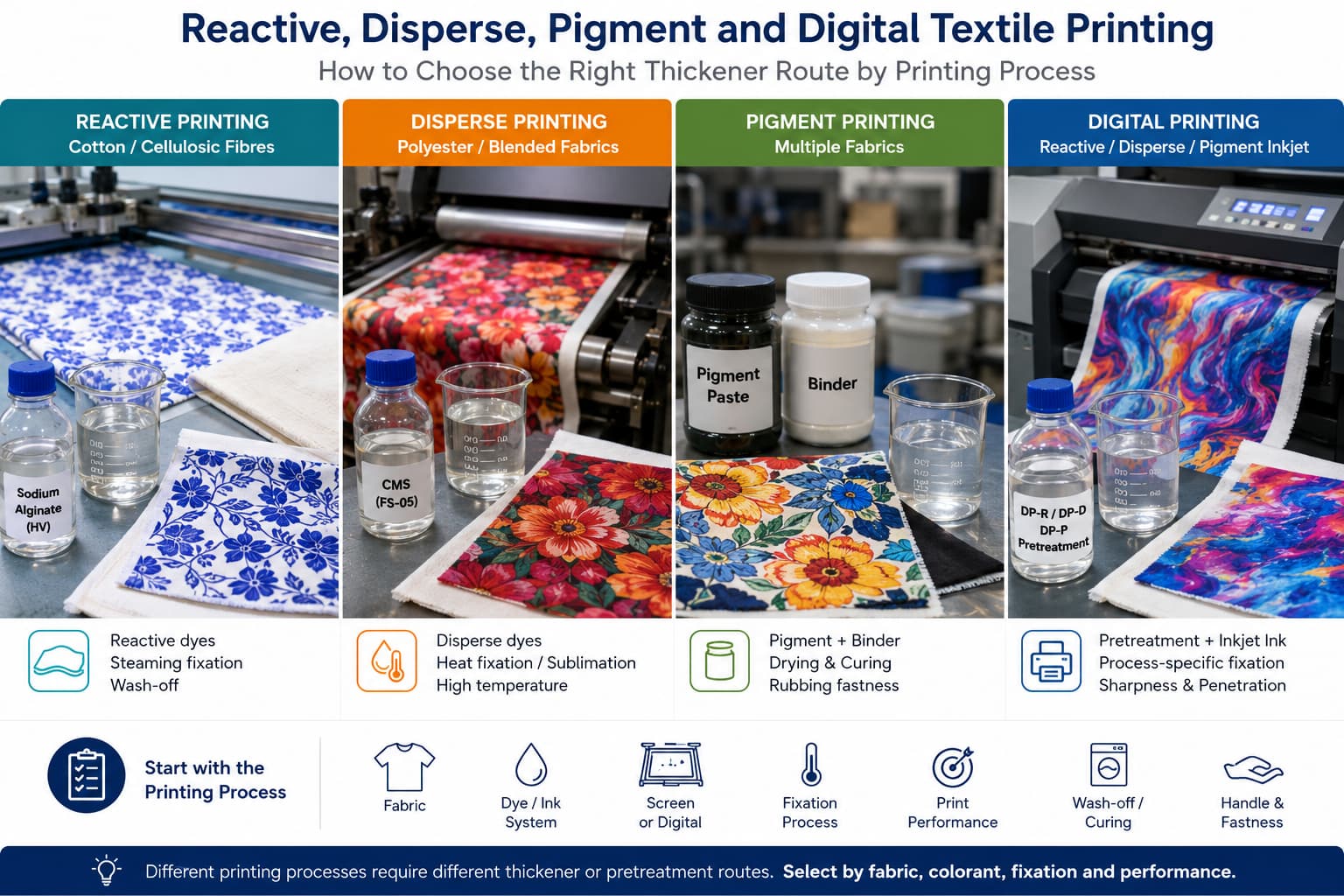
Mato, bo'yoq yoki siyoh, fiksatsiya, yuvib tashlash va bosib chiqarish sifati talablariga asoslanib reaktiv, dispergatsion, pigment va raqamli to'qimachilik bosib chiqarish uchun qalinlashtiruvchi va oldindan ishlov berish usullarini qanday tanlashni o'rganing.
Matolarga raqamli inkjet bosib chiqarish sitach bosib chiqarishga nisbatan turli xil xamir va oldindan ishlov berish talablariga ega. Ushbu qo'llanma natriy alginatning raqamli matobop bosib chiqarishda qanday qo'llanilishini va xarid guruhlari qaysi darajadagi parametrlarni belgilashi kerakligini tushuntiradi.
Sodium alginate for textile coating is a vital bio-based option for global textile/printing firms. It solves key issues like poor adhesion (ideal for cotton) and low durability (boosts polyester coating resilience by 30%), while meeting regional rules—EU REACH (biodegradable) and US OEKO-TEX (non-toxic for babywear). This guide covers application tips (digital printing), alternatives comparison (vs acrylic binders), and how to pick global suppliers like fsxchemical.
Sodium alginate is commonly used as a thickener in reactive textile printing paste, but other textile uses require application-specific validation. This guide compares printing, digital pretreatment, warp sizing, dyeing-related formulations, coating, and finishing by function, technical requirements, risks, documents, and sample tests.
Viscosity control in digital textile printing involves two different systems: the jetting ink and the fabric pretreatment formulation. This guide explains how temperature, formulation, measurement methods and process conditions affect jetting stability and print quality.
The best digital printing paste is the one matched to the ink chemistry, fabric and fixation route. This guide compares pretreatment requirements for reactive inkjet on cellulosic fabrics and direct disperse inkjet on polyester, then explains how buyers should evaluate samples before bulk purchasing.
The future of textile printing thickeners will be shaped by application-specific rheology, digital pretreatment, bio-based materials, hybrid formulations, faster preparation and data-driven process control. This guide explains which trends are commercially relevant and which still require industrial validation.
FSX Chemical offers separate digital printing paste routes for reactive, disperse and pigment systems, supported by application review, sample matching and technical documentation. This guide explains how buyers can evaluate the right route before bulk purchasing.
Matching the right CMC grade requires more than selecting a viscosity number. This guide explains how textile buyers can compare application route, degree of substitution, purity, particle size, hydration, rheology, chemical tolerance and sample performance.
Stable digital printing paste requires more than a target viscosity. This guide explains how product selection, water quality, addition sequence, mixing, pH, temperature, filtration, hygiene, storage and quality records influence pretreatment and production consistency.
Textile printing chemical innovation in 2026 is moving beyond higher viscosity and stronger color. The leading developments focus on safer inputs, renewable polymers, waterborne nano-binders, stable pigment dispersions, lower-energy fixation and multifunctional printing systems.
Viscosity control in digital textile printing is not about reaching one number. Reliable performance requires the right pretreatment rheology, test method, temperature, chemical compatibility, filtration, fabric pickup and holding stability.
Mahsulot nomi, qo'llanilishi, miqdori, manzili hamda mavjud bo'lsa har qanday TDS, namuna fotosurati yoki hujjatni taqdim eting. FSX Chemical ushbu ma'lumotlarni ko'rib chiqib, narx taklifi, namuna mosligi yoki mahsulot tanlovi bo'yicha keyingi bosqichni tavsiya qiladi.
Mahsulot haqida ma'lumotMahsulot nomi, toifasi, modeli, yorliqdagi rasm yoki yetkazib beruvchining ma'lumotnomasiga havola.
Mavjud hujjatlarTDS, SDS, COA, namuna fotosurati, mahsulotlar ro'yxati yoki sinov ma'lumotlari.
Buyurtma tafsilotlariTaxminiy miqdor, qadoqlash, manzil davlati, port yoki savdo sharti.
Ariza yoki muammoTo'qimachilik bosib chiqarish jarayoni, formulatsiya ehtiyoji, joriy muammo yoki maqsadli ko'rsatkich.