AR
AR  EN
EN  BN
BN  UR
UR  TR
TR  ID
ID  RU
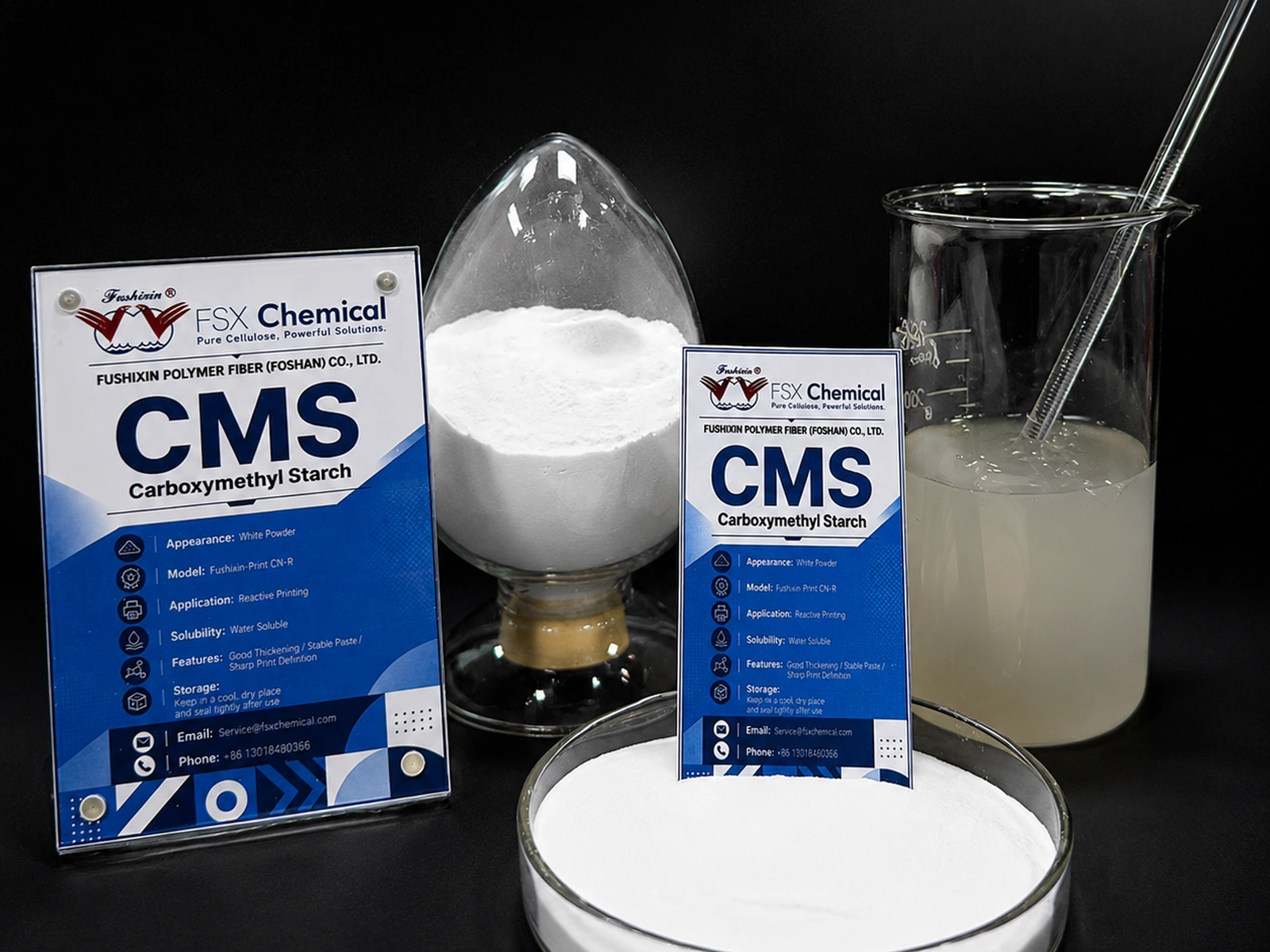
RU Carboxymethyl Starch (CMS)
Digital Printing Paste & Thickener
Digital Printing Paste & Thickener for Reactive, Disperse and Pigment Textile Printing
FSX Chemical supports textile printing mills and chemical distributors with DP-R, DP-D and DP-P product routes, sample matching, technical documents and export supply support.
Product Definition
What is CMS Textile Printing Thickener?
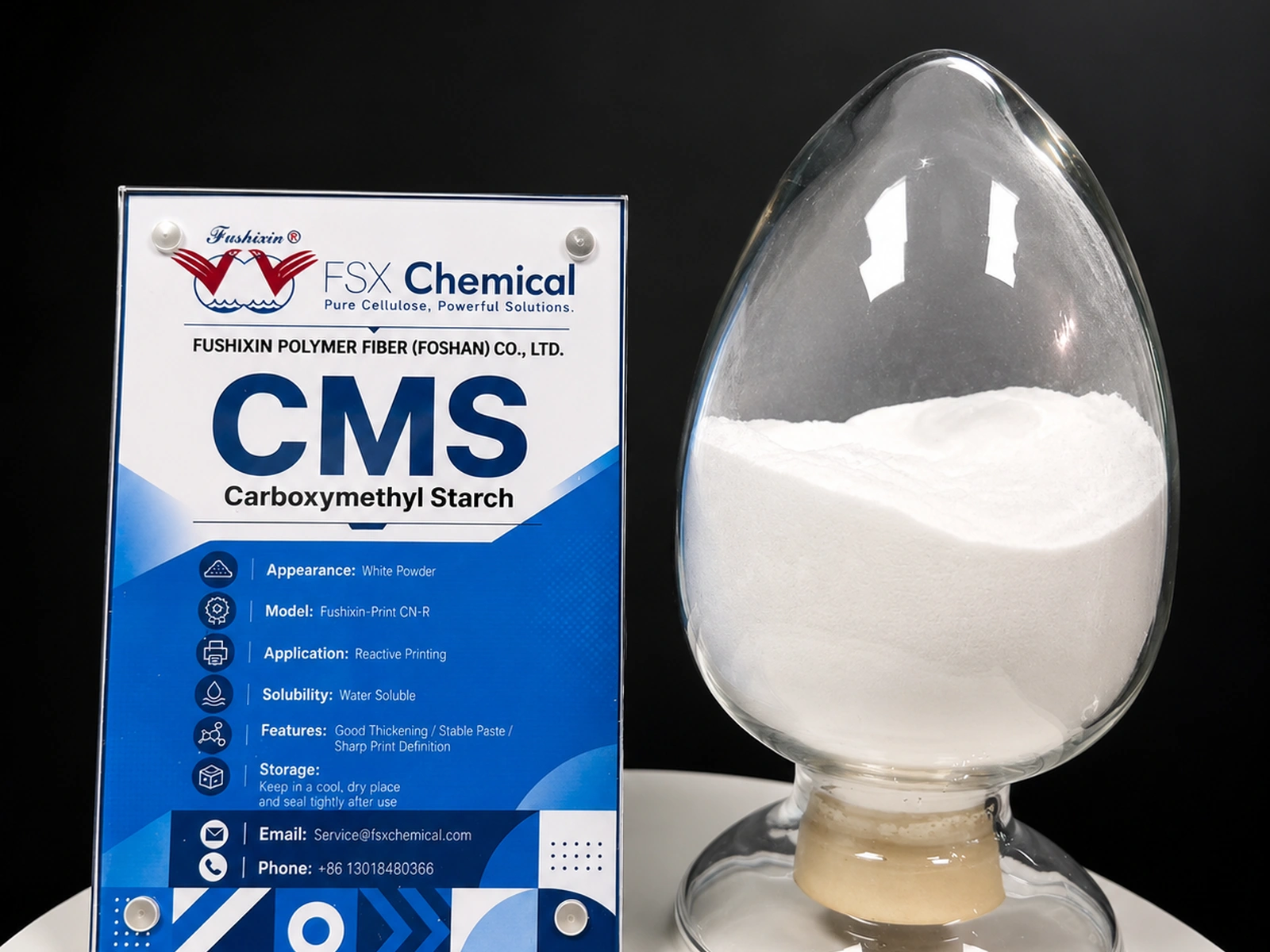
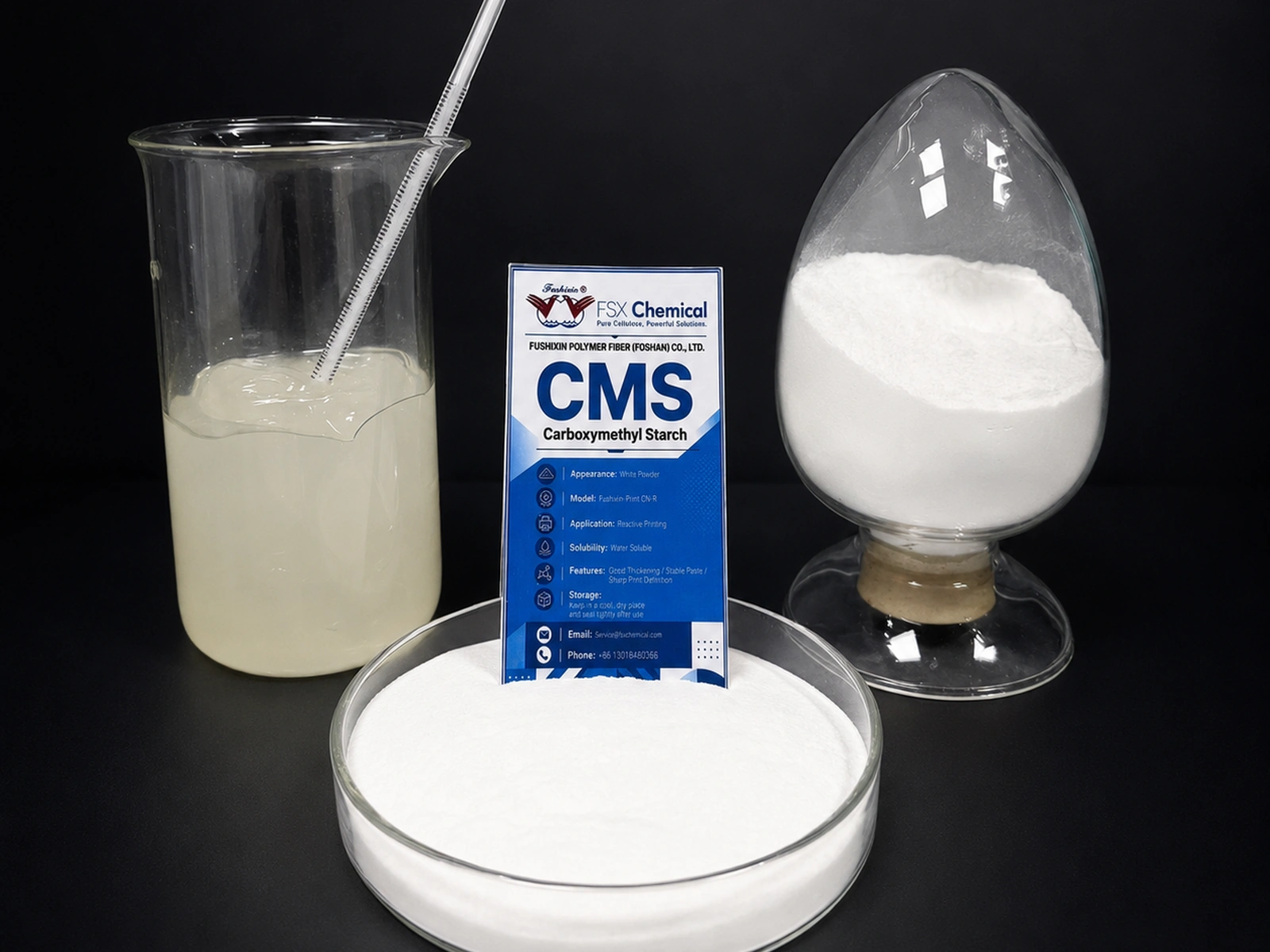
What is CMS?
CMS, or carboxymethyl starch, is a modified starch-based textile printing thickener used in printing paste systems. It is selected for paste body, print definition, processing stability and cost-performance balance in suitable formulations.
What does CMS do in textile printing?
CMS can be evaluated for reactive printing, disperse printing, vat discharge, alkali burn-out printing and selected blended thickener systems. The suitable grade depends on fabric, dye system, paste recipe, pH condition, viscosity method and production process.
How should CMS grades be compared?
CMS grades should be compared by printing process first, then by viscosity range, concentration, temperature, pH and application route. A matched sample should be tested under the buyer’s own laboratory or production conditions before bulk order.
CMS should not be selected only by product name or viscosity number. Start from the printing process, test method, paste performance and actual production conditions.
Application Selector
Explore the printing processes connected to this CMS product family
Product pages explain what FSX Chemical supplies. Application pages explain how CMS is evaluated within a specific printing process, formulation route or production problem.
CMS for Reactive Textile Printing
PrintCN-R is positioned for reactive printing on cotton and viscose, with focus on paste body, color yield, print sharpness and processing stability.
CMS for Disperse Textile Printing
FS-05 is positioned for disperse printing on polyester, where stable paste behavior, smooth processing and print definition are important.
CMS for Vat Discharge / Alkali Burn-out
H5 is positioned for special printing systems such as vat discharge and alkali burn-out printing that require process-specific validation.
CMS for Cost and Formulation Adjustment
CMS may be evaluated when buyers need cost adjustment, paste body control or formulation flexibility in selected textile printing systems.
Grade Comparison
Compare CMS grades by process, viscosity method and application fit
Use this table as a starting point for CMS grade comparison. Viscosity should only be compared under the same concentration, temperature, hydration time and testing method.
Fushixin PrintCN-R data is based on the current CN-R TDS. Fushixin Print FS-05 and Fushixin Print H5 data is based on the 2026 product catalogue until grade-specific TDS files are added. Final selection should be confirmed by laboratory or production-side testing.
| Grade | Viscosity / Method | Key Parameter | pH / Moisture | Application | Recommended Process | Action |
|---|---|---|---|---|---|---|
| Fushixin PrintCN-RReactive Printing CMS | 70,000–90,000 mPa·s5% · 25°C | D.S. N/A | 7.0–8.0 / Max. 10.0% | Reactive printing on cotton and viscose | CMS-based textile printing thickener for reactive printing on cotton and viscose. Recommended for customers requiring high color yield, clean print definition, stable paste performance and practical cost-performance balance. | Request TDS |
| Fushixin Print FS-05Disperse Printing CMS | 30,000–45,000 mPa·s5% · 25°C | D.S. N/A | 7–8 / Confirm by selected TDS / batch COA | Disperse printing on polyester | CMS thickener route for disperse printing on polyester. Recommended for buyers evaluating paste body, smooth processing and stable print definition in suitable disperse printing systems. | Request TDS |
| Fushixin Print H5Vat Discharge / Alkali Burn-out CMS | 30,000–40,000 mPa·s8% · 25°C | D.S. N/A | 10–12 / Confirm by selected TDS / batch COA | Vat discharge / alkali burn-out printing | CMS route for vat discharge and alkali burn-out printing systems. Recommended for special printing applications requiring higher pH tolerance and process-specific validation. | Request TDS |
CMS-based textile printing thickener for reactive printing on cotton and viscose. Recommended for customers requiring high color yield, clean print definition, stable paste performance and practical cost-performance balance.
CMS thickener route for disperse printing on polyester. Recommended for buyers evaluating paste body, smooth processing and stable print definition in suitable disperse printing systems.
CMS route for vat discharge and alkali burn-out printing systems. Recommended for special printing applications requiring higher pH tolerance and process-specific validation.
Not sure which CMS grade matches your printing process?
Send your current TDS, COA, viscosity method, printing process or sample requirement. FSX Chemical can compare CMS routes before recommending a validation direction.
Grade Selection Method
How to choose the right CMS printing thickener
Select CMS by printing process first, then compare viscosity method, pH condition, paste performance and sample results under your actual production conditions.
Step 1: Confirm the printing process
Start from reactive printing, disperse printing, vat discharge, alkali burn-out or blended thickener systems. Different CMS grades are positioned for different process routes.
Step 2: Compare viscosity method and pH
Check concentration, temperature, hydration time, test method and pH condition before judging whether two CMS grades are comparable.
Step 3: Test before bulk order
Run laboratory or production-side testing to confirm paste body, print definition, processing stability and wash-off before commercial use.
Sample Matching & Documents
Match your current product before bulk purchasing
Send your current sample, TDS or COA so our technical team can compare CMS route direction and document support before order confirmation.
Matching Workflow
Send your current TDS, COA, viscosity method or physical sample
We compare your current specification with FSX Chemical product data and recommend a matched CMS route for validation.
Send TDS, COA or a current product sample for comparison.
Confirm concentration, temperature, instrument and test method before judging viscosity equivalence.
Compare whether the product is used for reactive, disperse, discharge or blended systems.
Run internal or production-side testing before commercial use.
Factory / Lab / QC Proof
Factory, lab and QC proof
Use real production, testing and packing images to verify supply capability before sample evaluation.
Use real workshop, production line or factory exterior image here only after you insert the image.
Review formal manufacturing and production support for CMS orders.
Use viscosity testing, sample comparison and method-review images.
Batch documents and COA support for confirmed orders.
Standard 25 kg bags, pallet packing and export document support for international shipment.
Product FAQ
Resolve CMS grade risk before sample testing
Use real laboratory, product sample or engineer communication image.
Product FAQ
Questions buyers ask before selecting a CMS grade
These answers help buyers compare process route, viscosity method, samples and documents before sending an inquiry.
01What is CMS printing thickener used for?+
CMS printing thickener is used in textile printing paste systems for paste body, print definition and processing stability. FSX Chemical CMS routes can be evaluated for reactive printing, disperse printing, vat discharge, alkali burn-out printing and selected blended thickener systems.
02How do I choose between PrintCN-R, FS-05 and H5?+
Start from the printing process. PrintCN-R is positioned for reactive printing on cotton and viscose, FS-05 is positioned for disperse printing on polyester, and H5 is positioned for vat discharge or alkali burn-out printing. Final selection should be confirmed by sample testing.
03Can CMS replace sodium alginate?+
CMS may be evaluated as a partial or alternative thickener route in selected systems, but it is not a universal one-to-one replacement for sodium alginate. Suitability depends on dye system, fabric, paste recipe, wash-off requirement and final print performance.
04Why do CMS viscosity values need the full test method?+
Viscosity values are only comparable when concentration, temperature, hydration time and testing method are aligned. If two suppliers use different methods, the numbers may not represent the same paste behavior.
05What documents can FSX Chemical provide before order confirmation?+
TDS and SDS can be provided for the selected CMS product route. A batch-specific COA is normally prepared according to confirmed production batch and order requirements.
06How should CMS be stored?+
Store CMS sealed in a dry and ventilated place. Avoid moisture exposure after opening. Standard packing is normally 25 kg bag, with pallet packing available upon request.
Related Products
Carboxymethyl Cellulose (CMC)
Digital Printing Paste