Understanding the Role of Sodium Alginate in Reactive Textile Printing
Sodium alginate is more than a viscosity builder in reactive textile printing. Learn how its...
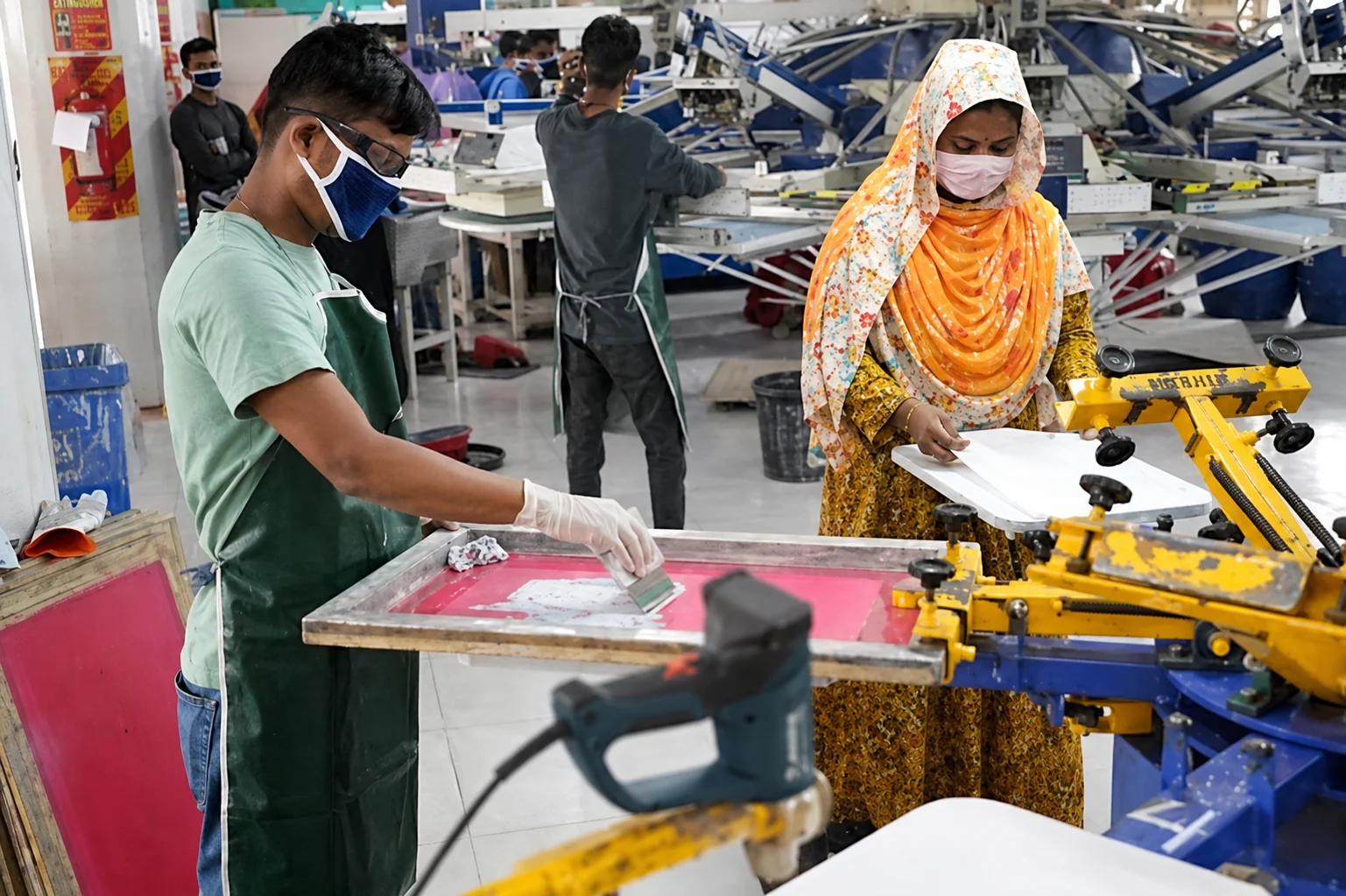
Sodium alginate plays a central role in conventional reactive textile printing because it provides controlled paste rheology while remaining comparatively non-reactive toward reactive dyes. Its real performance, however, depends on much more than choosing an HV, MV or LV grade. Viscosity method, hydration, filtration, fabric, dye system, fixation and wash-off all need to be evaluated together.
Reactive dye printing requires a thickener to perform several tasks at the same time. The paste must remain stable before printing, flow through the application system, transfer cleanly to the textile, limit uncontrolled spreading and then allow the printed fabric to pass through fixation and washing without creating unnecessary processing problems.
Sodium alginate has become one of the most established thickener routes for this purpose, particularly in conventional reactive printing on cotton, viscose and other suitable cellulosic textiles.
Its value is not simply that it makes water more viscous. Sodium alginate is useful because its polymer chemistry, rheological behavior and relatively low tendency to react with reactive dyes can support the balance required between paste stability, print definition, dye availability and wash-off.
However, sodium alginate should not be treated as one universal product. Commercial grades differ in viscosity, molecular characteristics, preparation behavior, filtration, rheology and effective dosage. Two products described as high viscosity can therefore behave differently in the same printing formula.
This guide explains the role of sodium alginate in reactive textile printing, how it works inside the printing paste, how to select and test a suitable grade, and how to move from laboratory evaluation to stable commercial production.
Apa Itu Sodium Alginat?
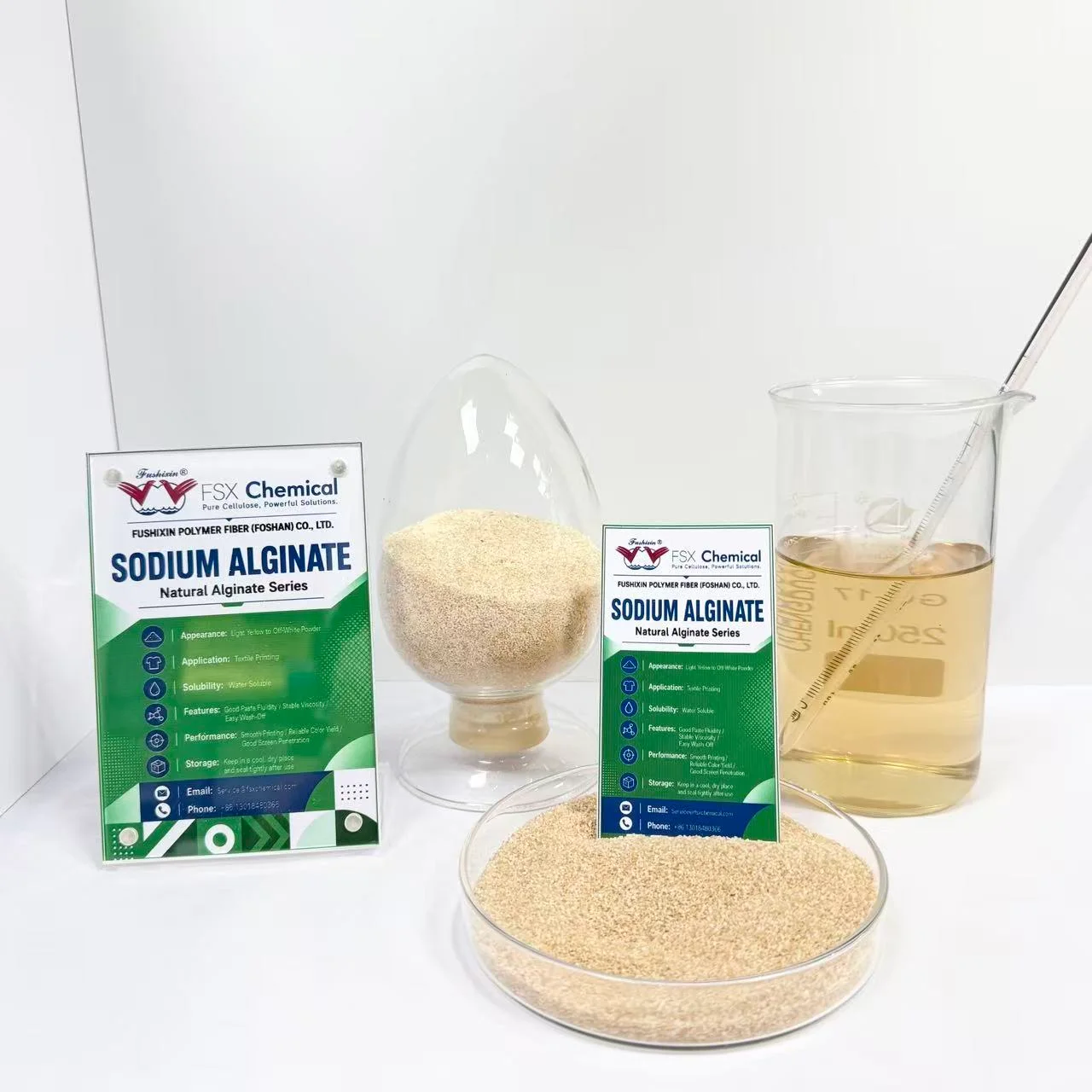
Sodium alginate is the sodium salt of alginic acid, a naturally occurring polysaccharide obtained from brown algae.
The polymer chain contains mannuronic-acid and guluronic-acid units in different sequences and proportions. These structural differences, along with molecular-weight distribution and processing conditions, can influence the behavior of commercial alginate grades.
In water, a suitable sodium alginate grade can form a viscous polymer solution. This makes it useful as a rheology-control material in textile printing.
Sodium alginate should not be treated as one fixed specification
Commercial textile grades can differ in:
Viskositas
Efisiensi viskositas
Particle characteristics
Hydration behavior
Penyaringan
Reologi
Kelembapan
Application performance
For this reason, product selection should use a complete specification and printing trial rather than the product name alone.
Why Sodium Alginate Is Widely Used in Reactive Printing
Reactive dyes are designed to form chemical bonds with suitable fiber groups during fixation. This creates a special requirement for the printing thickener: it should provide the required paste structure without unnecessarily competing with the textile for the reactive dye.
Sodium alginate is widely used because it combines useful rheological properties with comparatively low chemical reactivity toward many reactive dye systems.
A useful reactive-printing thickener should help provide
Stable paste before printing
Efficient screen passage
Controlled transfer to the textile
Limited lateral spreading
Good fine-detail reproduction
Dye availability during fixation
Practical removal during washing
Sodium alginate became an important benchmark because it can provide this combination when the grade and formulation are properly matched to the process.
The Main Roles of Sodium Alginate in a Reactive Printing Paste
Sodium alginate performs several connected functions rather than one isolated thickening function.
1. Building base viscosity
The polymer provides the body required to convert a low-viscosity aqueous color system into a printable paste.
2. Controlling flow under shear
A useful paste needs enough structure at rest but should still move through pumping, squeegee and screen conditions.
3. Limiting uncontrolled spreading
After the paste reaches the fabric, its rheological recovery helps influence how far the liquid moves laterally.
4. Controlling penetration
The paste should penetrate the textile sufficiently for the desired appearance without moving so deeply that the surface print loses strength or sharpness.
5. Supporting repeatable application
Stable preparation and batch-to-batch behavior help the printing mill keep machine settings and color-paste formulation more consistent.
Why Low Reactivity Toward Reactive Dyes Matters
The chemistry of reactive printing makes thickener-dye interaction particularly important.
Some polysaccharide thickeners contain functional groups that can compete with cellulose for reactive dye under printing conditions. This can reduce the amount of dye available to react with the fiber and can make the residual polymer-dye system more difficult to remove.
Sodium alginate is valued because its chemistry is comparatively less reactive toward reactive dyes than many hydroxyl-rich carbohydrate thickeners.
This can support
More efficient use of the reactive dye during fixation
Cleaner removal of residual thickener during washing
More predictable color development
This does not mean sodium alginate alone determines color yield or wash-off. Dye type, alkali, moisture, steaming, fabric preparation and washing conditions remain important.
Rheology: More Important Than One Viscosity Number
Viscosity is one of the first numbers buyers compare when purchasing sodium alginate, but one viscosity reading cannot describe the complete printing behavior.
Textile printing exposes the paste to changing shear conditions. A paste may be almost stationary in a storage container, experience increased shear during pumping, experience still different forces under a squeegee or rotary screen and then recover structure on the fabric.
Two sodium alginate grades can have similar viscosity and different printing behavior
Differences can appear in:
Shear-thinning response
Pemulihan struktural
Bagian layar
Transfer dengan cara menempelkan
Definisi garis halus
Penetrasi
This is why grade matching should compare rheology and application performance as well as the viscosity specification.
Shear Thinning and Structural Recovery
A useful reactive printing paste commonly becomes easier to flow as shear increases.
Before application
Sufficient low-shear structure can help the paste remain physically stable.
During printing
Lower apparent resistance under stronger shear can help the paste move through the screen and transfer to the fabric.
After printing
When the application force is removed, structural recovery can help limit continued spreading.
The most suitable sodium alginate is therefore not necessarily the grade with the highest viscosity. It is the grade that produces the required flow-and-recovery balance in the complete paste.
How Sodium Alginate Influences Print Definition
Print definition is strongly influenced by what happens immediately before and after the paste passes through the screen.
Good definition requires a balance
The paste needs to transfer cleanly through the open areas of the screen while resisting excessive sideways movement on the fabric.
Poor definition can appear as
Garis-garis halus yang kabur
Rounded corners
Loss of small text
Color bleeding between adjacent areas
Overly wide printed lines
Increasing sodium alginate concentration can sometimes change spreading, but increasing viscosity alone is not a universal solution. Screen, squeegee, fabric absorbency, paste formulation and rheological recovery should also be checked.
Controlling Penetration and Spreading
The correct amount of paste penetration depends on fabric construction and the required print effect.
If penetration is too high
The surface can appear weaker and fine details may become less distinct.
If penetration is too low
The print may remain too surface-heavy for some fabric constructions or coverage requirements.
Fabric matters
Lightweight cotton, heavy woven cotton, viscose knit and other cellulosic fabrics can absorb and transport liquid differently.
A sodium alginate grade should therefore be optimized on the actual production fabric rather than selected only from a laboratory viscosity table.
Sodium Alginate and Color Yield
Sodium alginate is often discussed in relation to color yield, but the thickener should not be treated as the only factor controlling final shade.
Final color can be influenced by
Reactive dye chemistry
Dye concentration
Sistem alkali
Kelembapan
Persiapan kain
Transfer dengan cara menempelkan
Steaming or fixation
Mencuci
Sodium alginate can influence color indirectly by controlling where the color paste remains and how effectively the dye is available during the fixation process.
Fair supplier comparisons should therefore keep the same dye, fabric, formula, printing conditions and post-treatment.
Why Wash-Off Is Part of Thickener Performance
Reactive printing does not end when the fabric leaves the printing table or machine.
After fixation, the textile normally undergoes washing to remove unfixed dye, residual auxiliaries and thickener.
Evaluate after washing
Kebersihan latar belakang
Final shade
Definisi pola
Sisa bahan pada permukaan
Pegangan dari kain
A sodium alginate grade that looks acceptable before washing may show important differences after the complete process.
This is why wash-off should be included in any serious grade-matching program for reactive printing.
Understanding HV, MV and LV Sodium Alginate
Sodium alginate is commonly sold as high-viscosity, medium-viscosity and low-viscosity grades.
These labels are useful within a supplier’s own product system, but they should not be assumed to represent universal industry ranges.
HV does not automatically mean premium quality
High viscosity describes one rheological direction under specified test conditions. It does not prove better filtration, print definition or wash-off.
MV can be the correct grade for some formulas
A medium-viscosity route may provide a better balance of dosage, transfer and screen behavior in a particular application.
LV can have specific uses
Lower-viscosity grades may be useful where higher polymer concentration, special blending or other process requirements are involved.
Buyers should therefore compare the actual specification and test method, not only the HV, MV or LV label.
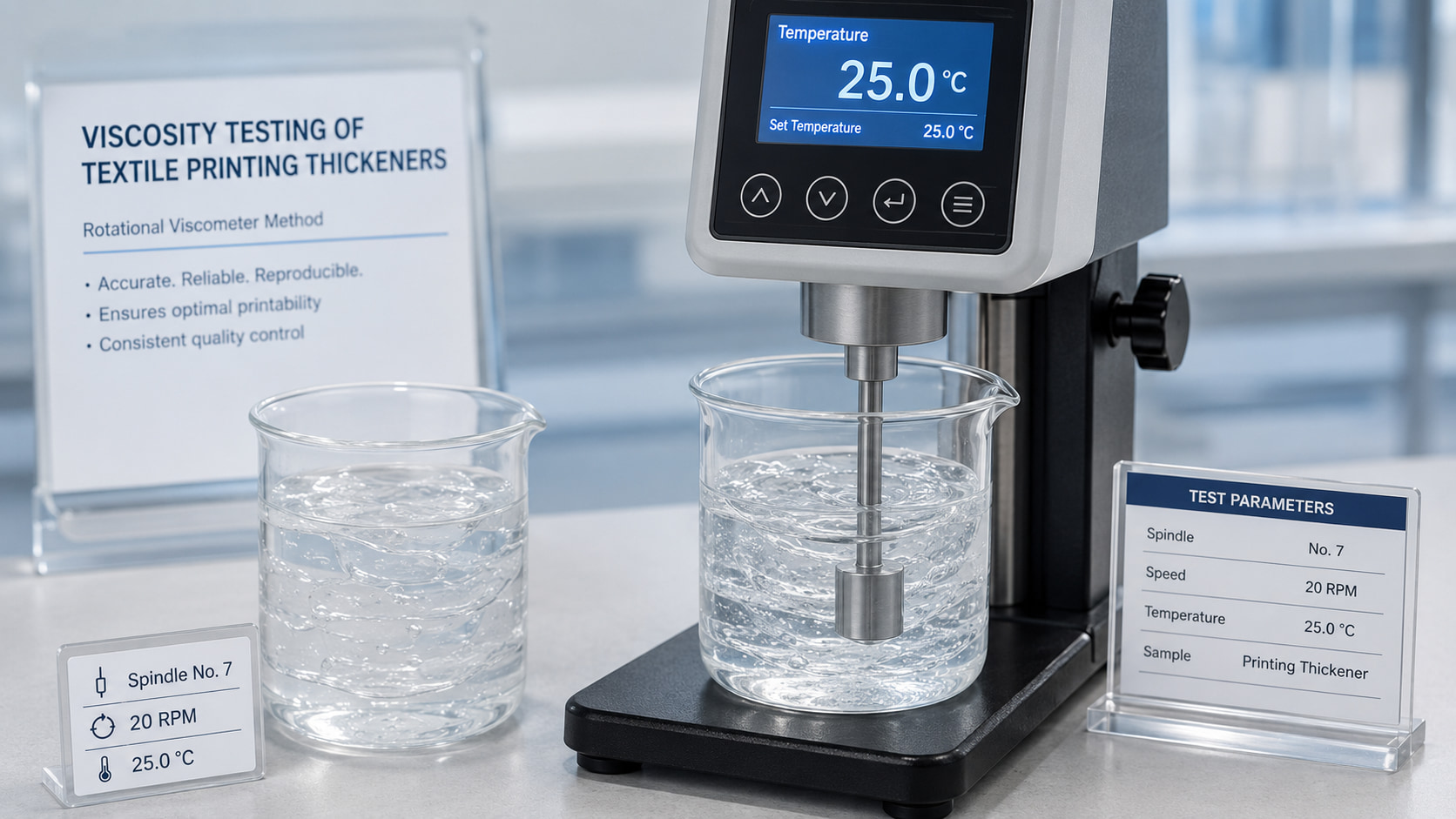
How to Compare Sodium Alginate Viscosity Correctly
A viscosity value without measurement conditions is incomplete.
Always confirm
Sodium alginate concentration
Concentration basis
Sumber air
Powder addition method
Mixing time and speed
Hidrasi atau waktu istirahat
Suhu
Viskosimeter
Poros atau rotor
Kecepatan putaran
Waktu membaca
Two suppliers can report the same number using different concentrations or test conditions. Those results should not be treated as equivalent until the methods are aligned.
For supplier qualification, prepare the reference and candidate under the same method and measure them side by side.
Hydration and Paste Preparation
Sodium alginate preparation strongly influences the reliability of viscosity and filtration results.
Add powder gradually
Rapid dumping can allow the outer surface of particles to hydrate while dry polymer remains inside, creating persistent lumps.
Use sufficient mixing
The mixing system should distribute the powder uniformly without introducing unnecessary air or excessive heat.
Allow a defined hydration period
Measuring too early can give a value that continues changing after the operator has already adjusted the batch.
Do not correct before checking hydration
Adding more alginate to a partially hydrated paste can produce excessive final viscosity after the polymer fully develops.
Water Quality and Ionic Contamination
Sodium alginate is an ionic polymer, so water quality deserves attention during both laboratory testing and production.
Hardness, dissolved salts and contamination can influence paste behavior. Calcium ions are particularly important because alginate can interact with multivalent cations and form stronger structures or gels.
For controlled comparisons
Use the same water source for the reference and candidate products.
When unexplained gels or filtration problems appear
Review water quality, storage containers and possible contamination from calcium-containing chemicals or residues.
A water-quality problem can be mistaken for a sodium alginate quality problem if it is not investigated systematically.
Filtration and Screen Passage
Filtration is one of the most useful practical tests for textile-grade sodium alginate.
Standardize the filtration method
Alginate concentration
Cara pembuatan
Waktu hidrasi
Jumlah sampel
Filter material
Opening or mesh size
Pressure or gravity conditions
Investigate the residue
Residue can be caused by incompletely hydrated alginate, gel particles, contamination or chemical interaction in the complete paste.
Good filtration does not guarantee zero screen problems
Screen condition, formulation, dye quality, fabric lint and production parameters can also contribute to blockage.
Holding Stability Before Printing
Reactive color paste may remain in production for a significant period before it is fully consumed.
A useful sodium alginate system should therefore be evaluated not only immediately after preparation but also after a realistic holding period.
Monitor
Viskositas
nilai pH jika berlaku
Penampilan
Busa
Separation
Penyaringan
Temperature, evaporation, microbial contamination and chemical interaction can all influence apparent stability.
Testing the Complete Reactive Printing Formula
A sodium alginate sample should not be approved from its water solution alone.
The complete reactive paste can contain dye, alkali, humectant and other auxiliaries that change the final rheology and stability.
A controlled comparison should use
The same reactive dye
The same dye concentration
The same alkali system
The same auxiliaries
The same water
The same preparation sequence
The same fabric
If a candidate matches the stock-paste viscosity but behaves differently after the complete formula is prepared, the interaction should be investigated before adjusting dosage.
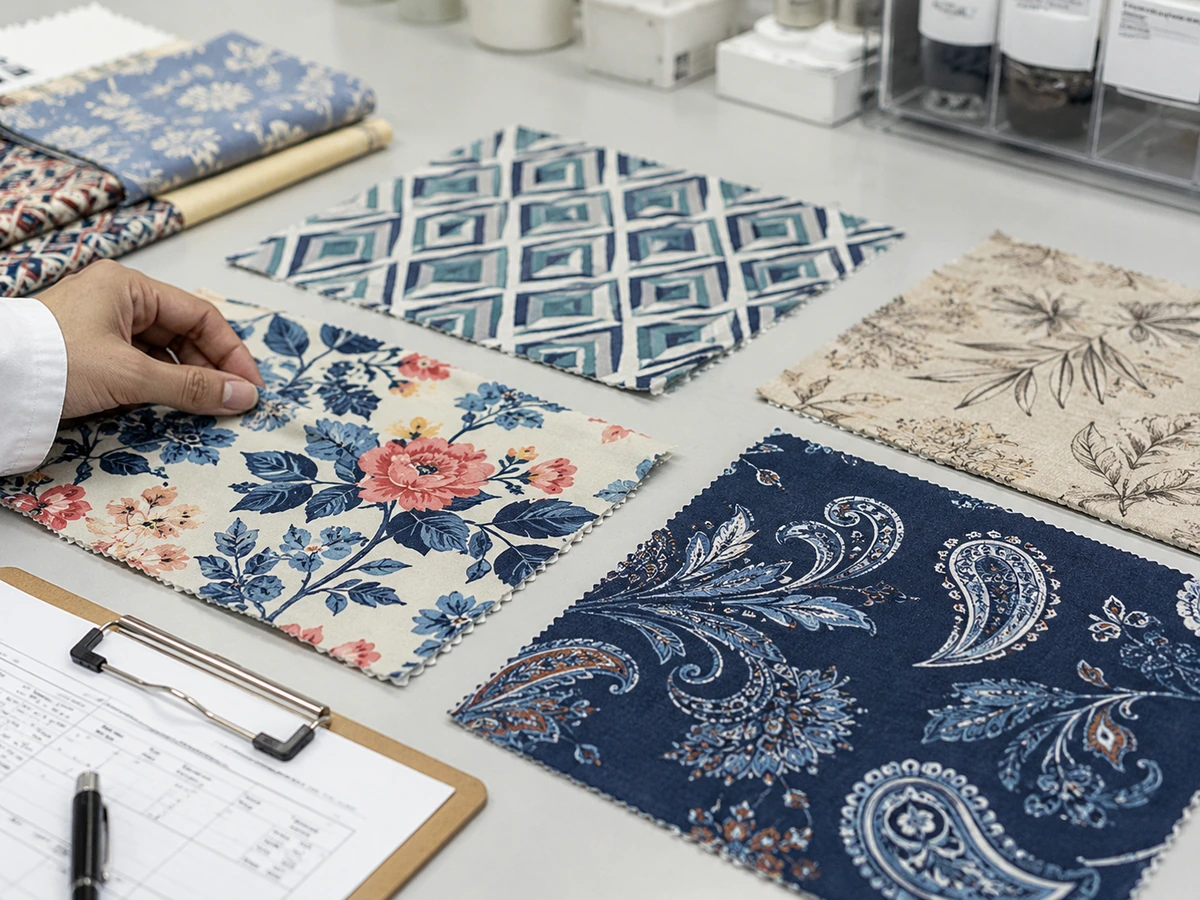
Cotton, Viscose and Other Cellulosic Fabrics
Sodium alginate is commonly evaluated for reactive printing on cotton, viscose and other suitable cellulosic textiles.
Fiber chemistry may be related, but fabric behavior is not identical.
Katun
Cotton fabric construction, weight and preparation can significantly influence paste penetration and definition.
Viskosa
Viscose can show strong liquid absorption, making migration and penetration control especially important in some constructions.
Other cellulosic fabrics
Linen, lyocell, modal and blends may require their own trials because absorbency, yarn structure and finishing vary.
The actual production fabric should therefore be used during final grade selection.
Sodium Alginate in Flat-Screen Printing
Flat-screen printing places the reactive paste under the mechanical action of the squeegee and screen.
Important evaluation factors include
Transfer dengan squeegee
Bagian layar
Penyamarataan pasta
Fine-line integrity
Penetrasi
Repeat consistency
When comparing two sodium alginate grades, squeegee pressure, speed, screen, fabric and paste formulation should remain as consistent as possible.
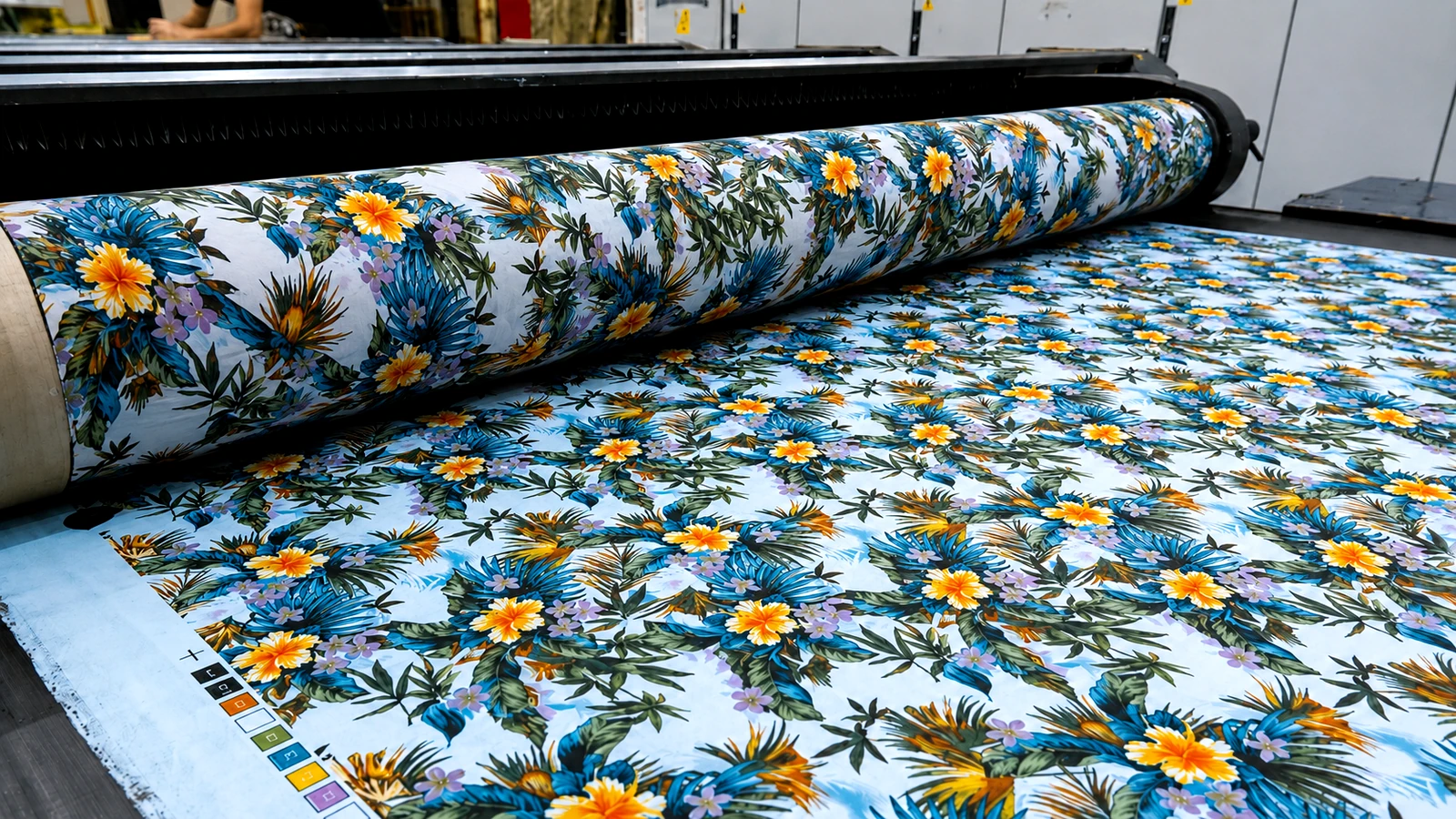
Sodium Alginate in Rotary-Screen Printing
Rotary-screen printing adds continuous pumping and circulation to the rheological demands of the paste.
Important characteristics include
Consistent preparation
Practical filtration
Stable circulation
Respon geser
Bagian layar
Long-run holding stability
A grade that performs well in a small flat-screen trial should still be validated under production-relevant rotary conditions before full conversion.
Fine Lines, Small Text and Large Solid Areas
A good sodium alginate trial should use a design that reveals several different aspects of paste performance.
Fine lines and small text test
Spreading control
Pemulihan struktural
Bagian layar
Transfer precision
Large solid areas test
Paste delivery
Keseragaman
Leveling
Penetrasi
A sodium alginate grade should not be approved from one easy laboratory pattern alone.
Dark Shades as a Useful Stress Test
Black and other deep shades can make differences in paste transfer, spreading and solid-area uniformity easier to see.
Dark-shade trials can reveal
Uneven coverage
Weak surface appearance
Edge spreading
Penetrasi yang berlebihan
Inconsistent transfer
However, the sodium alginate should not be credited or blamed for all color differences. Dye quality, concentration, fabric, fixation and washing remain major variables.
How to Optimize Sodium Alginate Dosage
Dosage should be optimized after the candidate grade has demonstrated basic technical compatibility.
Start with a controlled baseline
Compare the current product and candidate at an equal or otherwise clearly defined concentration so that their relative behavior can be understood.
Then optimize the candidate separately
Adjust gradually around the successful baseline to determine the practical concentration that gives the required paste behavior.
Recheck printing performance after every meaningful dosage change
Lower dosage may reduce viscosity, but it can also change transfer, penetration, definition and holding stability.
Calculate commercial cost at the approved dosage
Comparing supplier prices at equal kilograms is misleading if the two grades require different effective concentrations.
Can CMC or CMS Replace Sodium Alginate?
CMC, CMS and compound thickeners can be evaluated in selected textile printing formulations, but a universal one-to-one replacement for sodium alginate should not be assumed.
Changing the polymer family changes the chemistry and may alter electrolyte response, rheology, dye interaction, wash-off and effective dosage.
A cross-family replacement should be treated as formulation development
The candidate should be tested through:
Stock-paste preparation
Viskositas dan reologi
Penyaringan
Complete reactive formulation
Actual fabric printing
Fiksasi
Pencucian residu pengental
Dosage optimization
The correct objective is comparable production performance, not chemical identity.
Recommended Laboratory Evaluation Workflow
Langkah 1: Tentukan referensi saat ini
Record the current sodium alginate manufacturer, commercial grade, TDS, recent COA where available and normal dosage.
Step 2: Align the viscosity method
Standardize concentration, water, preparation, hydration, temperature, instrument, spindle and speed.
Langkah 3: Siapkan referensi dan kandidat secara bersamaan
Use the same equipment and timing.
Step 4: Compare stock-paste properties
Penampilan
Hidrasi
Viskositas
nilai pH jika berlaku
Penyaringan
Step 5: Compare rheology where possible
Use more than one controlled shear condition if equipment is available.
Step 6: Prepare the complete reactive paste
Use the same dye, alkali and auxiliaries.
Step 7: Check holding stability
Repeat critical measurements after a production-representative waiting period.
Step 8: Print the same fabric
Use a diagnostic design containing fine details and solid areas.
Step 9: Complete fixation and washing
Evaluate the finished textile rather than only the wet print.
Step 10: Optimize dosage
Determine the candidate’s practical operating concentration only after technical suitability is established.
Production Trial and Scale-Up
Laboratory approval is necessary, but large-scale production introduces additional variables.
Scale-up can change
Mixing energy
Batch size
Hydration uniformity
Pump shear
Circulation time
Holding time
Suhu
Application speed
Monitor the full production run
Compare fabric from the beginning, middle and end of the run to determine whether the paste remains stable.
Record operational behavior
Waktu persiapan
Penyaringan
Pemompaan
Pembersihan layar
Production interruptions
Paste consumption
Kualitas kain jadi
A grade should be approved for routine use only after it performs inside the customer’s actual production window.
Cara Mengatasi Masalah Umum yang Terkait dengan Sodium Alginat
Masalah yang Diamati
Possible Cause
Hal-hal yang Perlu Diperiksa
Viskositas di bawah target
Low concentration, incomplete hydration, temperature or grade difference
Weighing, hydration time, test method and product identity
Viskositas melebihi nilai target
Overdosage, evaporation, continued hydration or temperature
Formula, water loss, waiting time and test temperature
Benjolan yang tidak kunjung hilang
Poor powder wetting or rapid addition
Addition rate, mixing and preparation sequence
High filter residue
Incomplete hydration, gels or contamination
Water, mixing, filter method and storage condition
Unexpected gel formation
Multivalent ions or contamination
Water hardness, calcium sources and chemical sequence
Kualitas tampilan yang buruk
Unsuitable rheology, excessive viscosity or residue
Rheology, filtration, concentration and screen condition
Fine lines bleed
Insufficient recovery, fabric absorbency or excessive liquid movement
Rheology, fabric, dosage and squeegee settings
Fine lines are incomplete
Poor transfer or excessive resistance
Viscosity, screen passage, pressure and paste transfer
Paste changes during holding
Evaporation, temperature, contamination or instability
Tank condition, holding time, temperature and pH
Lab test passes but production fails
Scale-up or application difference
Mixer, batch size, circulation, screen and fabric
Troubleshooting should examine the complete process. Not every print defect is caused by the sodium alginate itself.
Total Biaya Penggunaan
Sodium alginate should not be purchased from price per kilogram alone.
Bandingkan dosis efektif
Higher viscosity efficiency may allow a different practical concentration, but the final printing result must remain acceptable.
Compare preparation
Hydration time, lump formation, filtration and operator correction can influence production cost.
Compare machine behavior
Screen cleaning, downtime and unstable circulation can cost more than a small difference in raw-material price.
Bandingkan kualitas kain jadi
Reprinting, rejected fabric or difficult wash-off can eliminate an apparent purchase-price saving.
The preferred sodium alginate grade is therefore the product that provides the required reactive-printing performance at an acceptable total cost in use.
How to Compare Sodium Alginate Suppliers
A supplier comparison should use technical and commercial evidence rather than grade names or price alone.
Compare the commercial grade
Record the exact product code and permanent specification.
Compare viscosity under the same method
Do not compare TDS numbers generated using different concentrations or instruments without adjustment.
Compare hydration and filtration
Preparation behavior can be as important as the final viscosity.
Compare the complete reactive paste
Use the customer’s actual dye system and fabric.
Compare batch documentation
Review available TDS, SDS, batch-specific COA or relevant quality data according to the purchasing stage.
Compare total cost in use
Calculate cost using the approved dosage and production performance.
Sample-to-Bulk Verification
Successful laboratory matching should remain traceable when the buyer places the first commercial order.
The qualification chain should connect
Candidate sample
Commercial sodium alginate grade
TDS and agreed test method
Laboratory comparison
Reactive printing trial
Approved dosage
Penawaran Harga
Purchase order
Batch produksi
Batch-specific documentation where applicable
Verifikasi pengiriman pertama
The first commercial batch should receive stronger incoming verification before unrestricted production use.
Bagaimana FSX Chemical Mendukung Penyesuaian Kualitas Sodium Alginat
Customers who already use another sodium alginate can begin with the current commercial product as the benchmark rather than selecting a new grade from HV, MV or LV terminology alone.
Melalui Sampel & Pencocokan Grade , buyers can provide the current sample, TDS, COA where available, viscosity method and printing conditions for technical review.
Useful matching information includes
Current manufacturer and grade
Current TDS or available COA
Physical reference sample
Viskositas dan konsentrasi uji
Instrument, spindle and speed
Current sodium alginate dosage
Reactive dye system
Fabric composition and construction
Peralatan dengan saringan datar atau saringan putar
Fixation and washing process
Current problem or improvement target
A recommended grade should be treated as a trial candidate. Final suitability needs to be confirmed under the buyer’s actual reactive printing conditions before commercial conversion.
Pertanyaan yang Sering Diajukan
Mengapa natrium alginat digunakan dalam pencetakan tekstil reaktif?
Sodium alginate provides useful paste viscosity and rheology while showing comparatively low reactivity toward many reactive dye systems. This helps make it a common benchmark thickener for reactive printing on suitable cellulosic fabrics.
Does sodium alginate react with reactive dyes?
Sodium alginate is valued because it is comparatively non-reactive toward reactive dyes compared with many hydroxyl-rich carbohydrate thickeners. The complete formulation and fixation conditions still need to be considered.
What fabrics are commonly printed with sodium alginate and reactive dyes?
Cotton, viscose and other suitable cellulosic textiles are common applications. Each fabric construction should still be tested for penetration, definition and wash-off.
Is HV sodium alginate always better than MV sodium alginate?
No. HV and MV are supplier-defined viscosity categories rather than quality rankings. The best grade depends on the target viscosity, rheology, filtration, fabric and printing process.
What viscosity should sodium alginate have for reactive printing?
There is no universal value. The required range depends on concentration, measurement method, printing formula, screen, fabric and production requirements.
Why can two sodium alginate grades with the same viscosity print differently?
Their hydration, molecular characteristics, shear-thinning behavior, structural recovery and filtration can differ even when one viscosity result is similar.
Why does sodium alginate form lumps during preparation?
Rapid powder addition or insufficient wetting can allow the outer surface to hydrate before the interior, forming persistent agglomerates. A controlled addition and mixing method is important.
Why is calcium a problem for sodium alginate?
Multivalent ions such as calcium can interact with alginate and create stronger structures or gels. Water quality and contamination should be checked when unexplained gel formation appears.
Does higher sodium alginate viscosity always improve print sharpness?
No. Print sharpness depends on rheology, structural recovery, screen transfer, fabric absorbency, dosage and machine conditions as well as viscosity.
Can CMC replace sodium alginate in reactive printing?
A universal one-to-one replacement should not be assumed. CMC has different polymer chemistry and should be evaluated through complete formulation, printing, fixation and washing trials.
Apakah CMS dapat menggantikan natrium alginat?
Selected CMS or compound systems can be evaluated in some formulations, but suitability depends on dye chemistry, rheology, dosage, fixation and wash-off.
What should I test when changing sodium alginate suppliers?
Compare viscosity under the same method, hydration, filtration, rheology, complete reactive-paste behavior, actual fabric printing, fixation, wash-off and effective dosage.
Is a COA enough to approve a new sodium alginate?
No. A COA provides selected batch-specific data, while the printing mill should also confirm suitability under its own formula, fabric and production conditions.
How can FSX Chemical match my current sodium alginate?
Buyers can provide the current sample or TDS together with viscosity concentration and test method, dosage, fabric and reactive-printing process so that a relevant candidate grade can be selected for controlled evaluation📧 Email: Service@fsxchemical.com
Need to Match a Sodium Alginate Grade for Reactive Printing?
Send FSX Chemical the TDS or physical sample of the sodium alginate you currently use together with the viscosity concentration, test method, current dosage and reactive-printing formula.
For a more accurate evaluation, include the fabric type, flat-screen or rotary-screen process, fixation and washing conditions, and the main issue you want to improve.
If the current problem is poor filtration, unstable viscosity, unclear edges, excessive penetration, weak solid-area uniformity or high effective dosage, these details can help define the most relevant starting grade.
Final suitability should be confirmed through controlled laboratory testing, actual reactive printing and first-commercial-batch verification.
Ketahui mengapa nilai viskositas pengental dalam pencetakan tekstil tidak dapat dibandingkan tanpa menyesuaikan konsentrasi, suhu, alat ukur, spindel, kecepatan, metode persiapan, dan waktu pengujian.
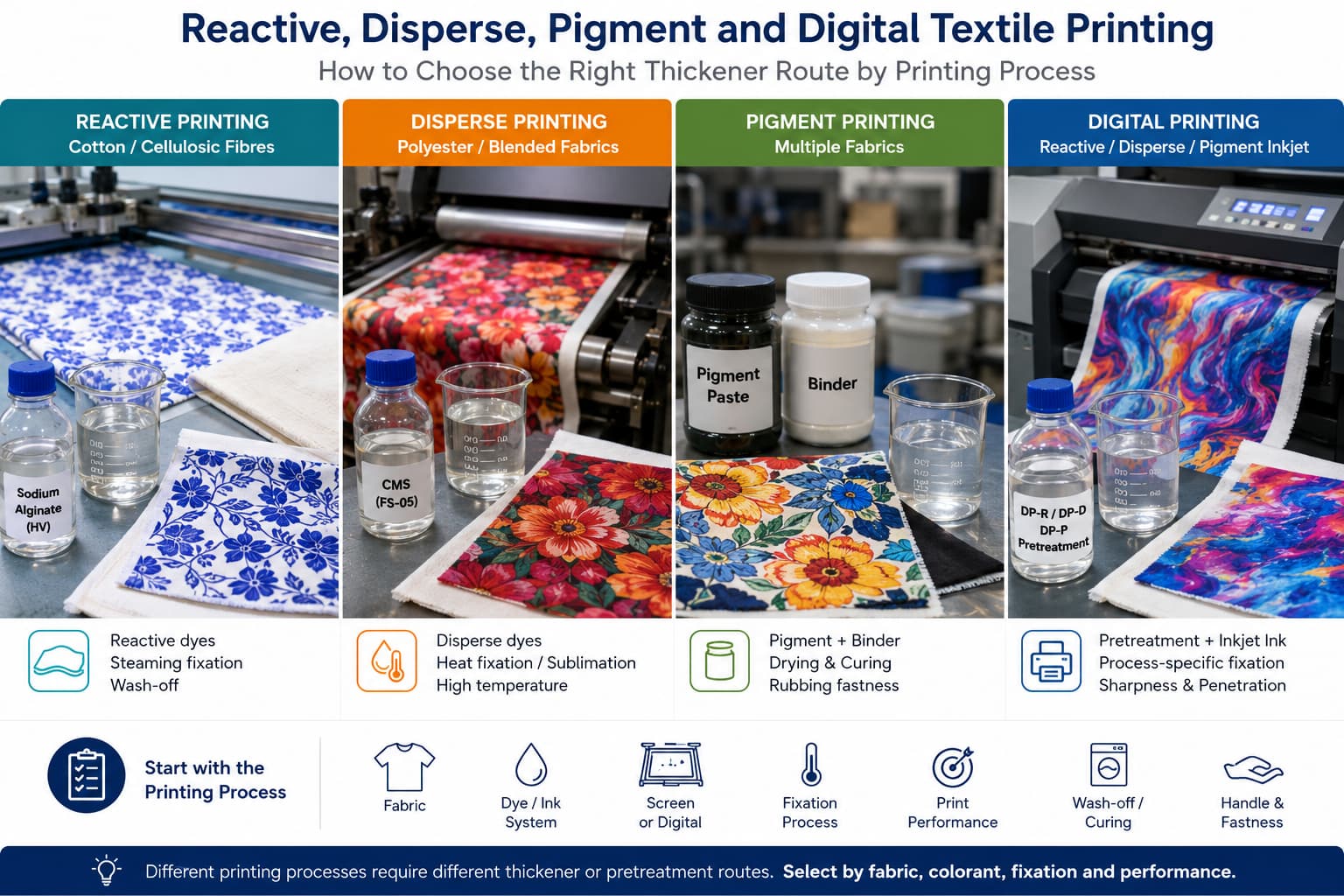
Pelajari cara memilih bahan pengental dan metode pra-perlakuan untuk pencetakan tekstil reaktif, disperse, pigmen, dan digital berdasarkan jenis kain, pewarna atau tinta, proses fiksasi, daya lepas saat pencucian, serta persyaratan kualitas cetakan.
Bandingkan CMC, CMS, natrium alginat, dan pasta cetak digital untuk pencetakan tekstil. Pelajari bagaimana masing-masing bahan tersebut sesuai dengan proses pencetakan reaktif, dispersi, pigmen, dan digital, serta hal-hal apa saja yang perlu diperhatikan pembeli sebelum melakukan pengujian sampel, penyesuaian kualitas, dan pembelian dalam jumlah besar.
Sodium alginat banyak digunakan dalam pencetakan tekstil sebagai pengental yang stabil dan tahan cuci untuk pasta cetak reaktif. Pelajari cara mengevaluasi tingkat viskositas, kemurnian, dan kesesuaian penggunaannya sebelum membeli, serta bagaimana FSX Chemical mendukung pembeli di seluruh dunia dengan data teknis dan sampel.
Pasta cetak berbasis CMC digunakan dalam pencetakan tekstil pigmen, reaktif, dan digital. Panduan ini menjelaskan parameter apa saja yang penting, cara membandingkan pemasok, serta hal-hal yang perlu diminta sebelum melakukan pemesanan dalam jumlah besar.
Baik natrium alginat maupun CMC digunakan sebagai pengental dalam pencetakan tekstil, namun keduanya cocok untuk sistem pewarnaan dan kondisi proses yang berbeda. Panduan ini menjelaskan perbedaan utama di antara keduanya serta kapan masing-masing harus digunakan.
Pencetakan inkjet digital pada tekstil memiliki persyaratan pasta dan pra-perlakuan yang berbeda dibandingkan dengan pencetakan sablon. Panduan ini menjelaskan bagaimana natrium alginat digunakan dalam pencetakan tekstil digital serta parameter kualitas apa saja yang harus ditentukan oleh tim pengadaan.
Persiapan pasta yang tepat sama pentingnya dengan pemilihan kadar dalam pencetakan tekstil dengan pewarna reaktif. Panduan ini membahas metode pelarutan natrium alginat, kisaran konsentrasi sesuai dengan penggunaannya, kondisi penyimpanan, serta cara mengatasi masalah umum dalam persiapan.
Sodium alginat adalah polimer alami yang dapat terurai secara hayati, namun penggunaannya dalam pencetakan tekstil menghasilkan air limbah yang perlu dikelola. Panduan ini membahas profil lingkungan sodium alginat, karakteristik air limbah hasil pencucian, serta hal-hal yang perlu dipahami oleh tim pengadaan terkait pemilihan bahan pengental dan dampaknya terhadap lingkungan.
Tingkat fiksasi pewarna secara langsung memengaruhi hasil warna, ketahanan luntur saat dicuci, dan beban limbah cair dalam proses pencetakan dengan pewarna reaktif. Panduan ini menjelaskan bagaimana natrium alginat mendukung proses fiksasi pewarna, parameter pasta apa saja yang memengaruhi tingkat fiksasi, serta cara mengatasi masalah fiksasi rendah dalam proses produksi.
Ukuran partikel natrium alginat (mesh) memengaruhi seberapa cepat bubuk tersebut larut, seberapa merata proses hidrasinya, serta bagaimana kinerja pasta yang dihasilkan dalam proses sablon. Panduan ini menjelaskan implikasi praktis dari spesifikasi mesh untuk aplikasi pasta cetak tekstil.
Persiapan pasta yang tepat sama pentingnya dengan pemilihan kadar dalam pencetakan tekstil dengan pewarna reaktif. Panduan ini membahas metode pelarutan natrium alginat, kisaran konsentrasi sesuai dengan penggunaannya, kondisi penyimpanan, serta cara mengatasi masalah umum dalam persiapan.
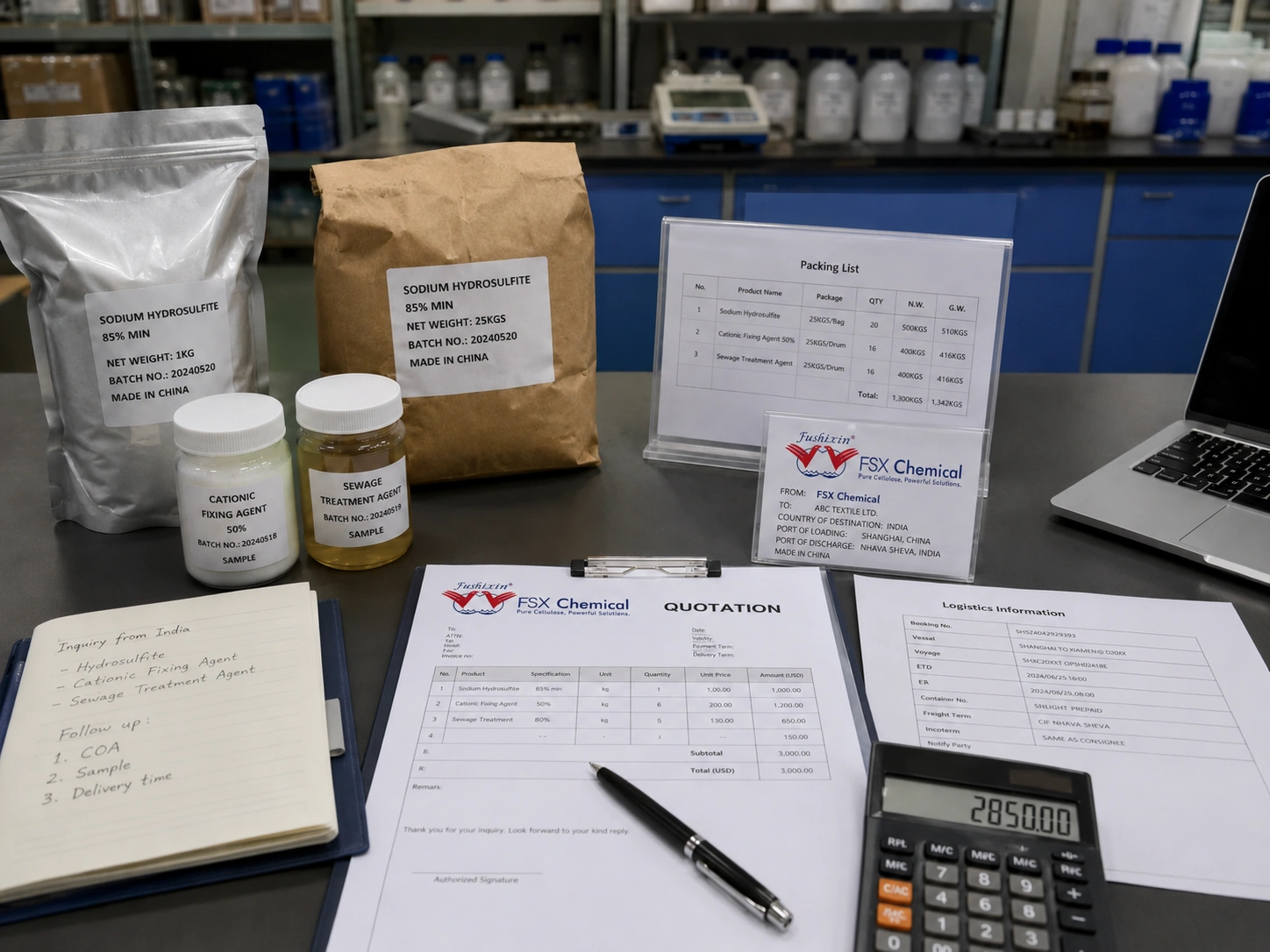
Berikan nama produk, kegunaan, jumlah, tujuan pengiriman, serta TDS,
foto sampel, atau dokumen lain yang sudah Anda miliki. FSX Chemical akan meninjau
informasi tersebut dan merekomendasikan langkah selanjutnya terkait penawaran harga, pencocokan sampel,
atau pemilihan produk.
Informasi ProdukNama produk, grade, model, foto label, atau referensi pemasok.
Dokumen yang TersediaTDS, SDS, COA, foto sampel, daftar produk, atau data pengujian.
Rincian PesananPerkiraan jumlah, kemasan, negara tujuan, pelabuhan, atau syarat perdagangan.
Aplikasi atau KendalaProses pencetakan tekstil, kebutuhan formulasi, masalah terkini, atau target kinerja.