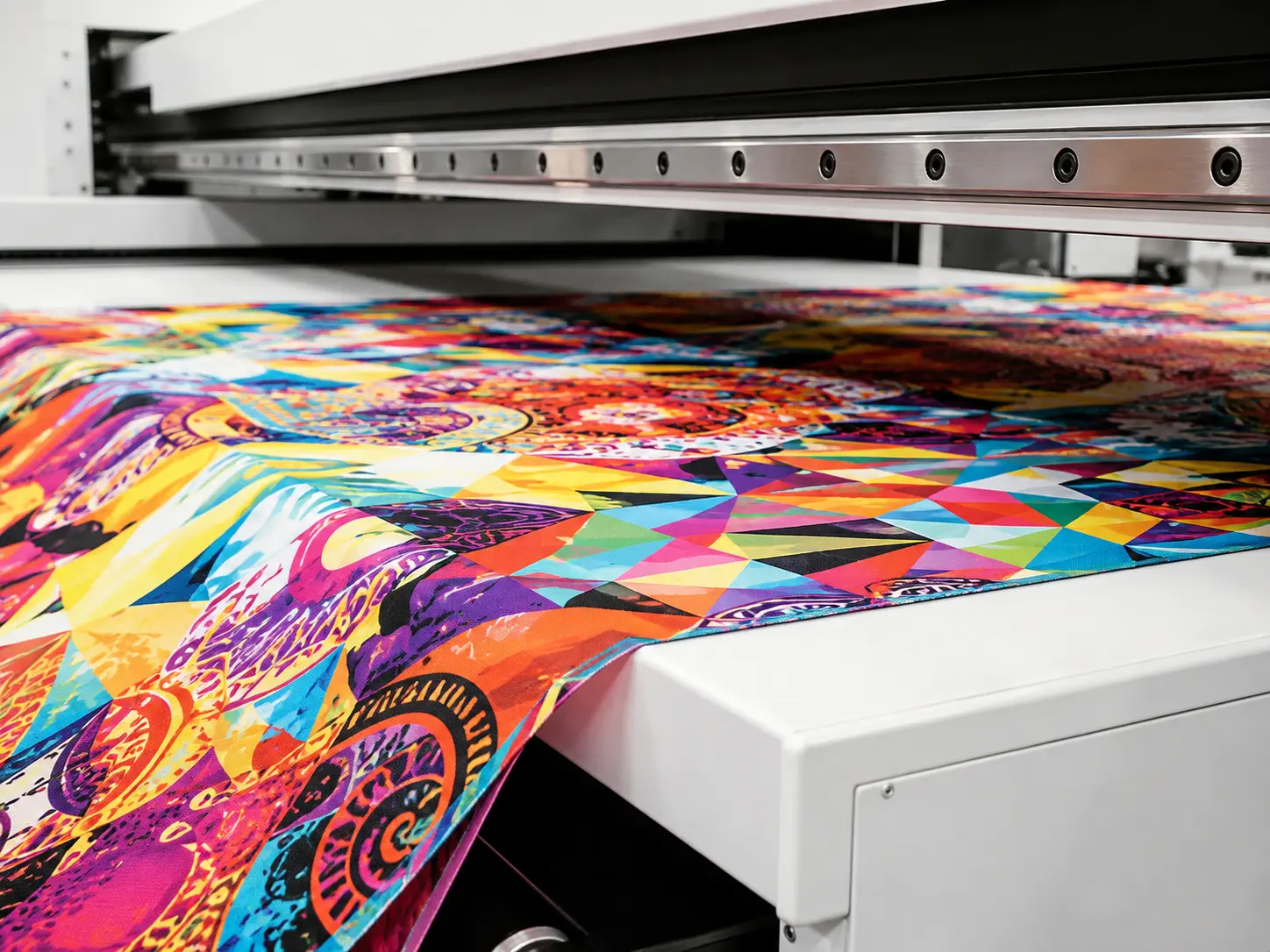
For reactive printing on cotton or viscose, sodium alginate is a common reference thickener because of its relatively low reactivity toward many reactive dyes and its useful wash-off behavior. Selected CMC grades or blends can also be evaluated for reactive printing. For either polymer, approval depends on the exact grade, dye or pigment system, fabric, preparation and finished-print results.
Do not approve a universal 1:1 substitution from viscosity alone. A fixed-dose comparison can screen thickening efficiency; a separate application trial can compare workable formulations, including matched apparent viscosity where useful. Keep those comparisons distinct and record concentration and the complete method. Evaluate flow, screen release, penetration, definition, fixation, color, wash-off, handle, holding stability and cost per accepted fabric area.
Sodium Alginate vs CMC: Technical Comparison Table
| Faktor penentu | Sodium alginat | CMC |
|---|---|---|
| Pencetakan dengan pewarna reaktif | Common reference route for cotton and viscose | Use only after grade-specific dye-compatibility and print trials |
| Pencetakan pigmen | Possible, but reactive-dye inertness is not the main requirement | Can be evaluated with the binder, pigment and electrolyte system |
| Key specification | Defined viscosity method, purity, insoluble matter, moisture, pH and particle size | DS, substitution uniformity, purity, viscosity method, salt tolerance and solubility |
| Ionic sensitivity | Divalent ions such as calcium can cause gel or lump formation | Electrolyte response depends on DS, purity and formulation |
| Reologi | Grade-dependent flow, screen release and water retention | Grade-dependent; equal viscosity does not ensure equal shear response |
| Kemudahan pencucian dan pegangan kain | Secara umum cocok untuk pencetakan reaktif | Must be checked by grade, fabric and process |
| Keputusan terkait biaya | Compare use level, yield and production consistency | Potential cost advantage must survive the complete print trial |
Use the detailed sodium alginate grade guide dan CMC procurement guide to define the two candidate specifications before comparison.
Mengapa Pemilihan Pengental Penting dalam Pencetakan Tekstil
Peran Pengental dalam Pasta Cetak
The thickener controls paste flow, transfer and placement of the colorant before fixation. The required behavior depends on the screen, fabric and printing conditions. Check migration during drying and removal during post-treatment in the complete process; an acceptable water-only viscosity does not guarantee sharpness, wash-off or handle.
Pemilihan bahan pengental juga memengaruhi hasil pewarnaan, ketajaman pola, dan stabilitas pasta selama penyimpanan. Dalam produksi skala besar, ketidakkonsistenan perilaku pasta antar-batch — yang disebabkan oleh variasi atau ketidakcocokan bahan pengental — dapat menimbulkan variasi warna dan meningkatkan kebutuhan pengerjaan ulang.
Bagaimana Pilihan yang Salah Mempengaruhi Kualitas Cetak
Dye or auxiliary incompatibility is one possible source of printing problems. Polymer–dye reaction may affect color availability or residue, while ionic interactions, dilution or other formulation changes can affect flow and stability. Screen blocking, bleeding or uneven coverage need separate process checks; one symptom does not identify the thickener as the cause.
Memahami mengapa setiap bahan pengental berperilaku berbeda dalam sistem reaktif dibandingkan dengan sistem pigmen merupakan titik awal untuk menentukan pilihan yang tepat.
Sodium Alginat: Keunggulan dan Aplikasi Umum
Kinerja dalam Sistem Pewarna Reaktif
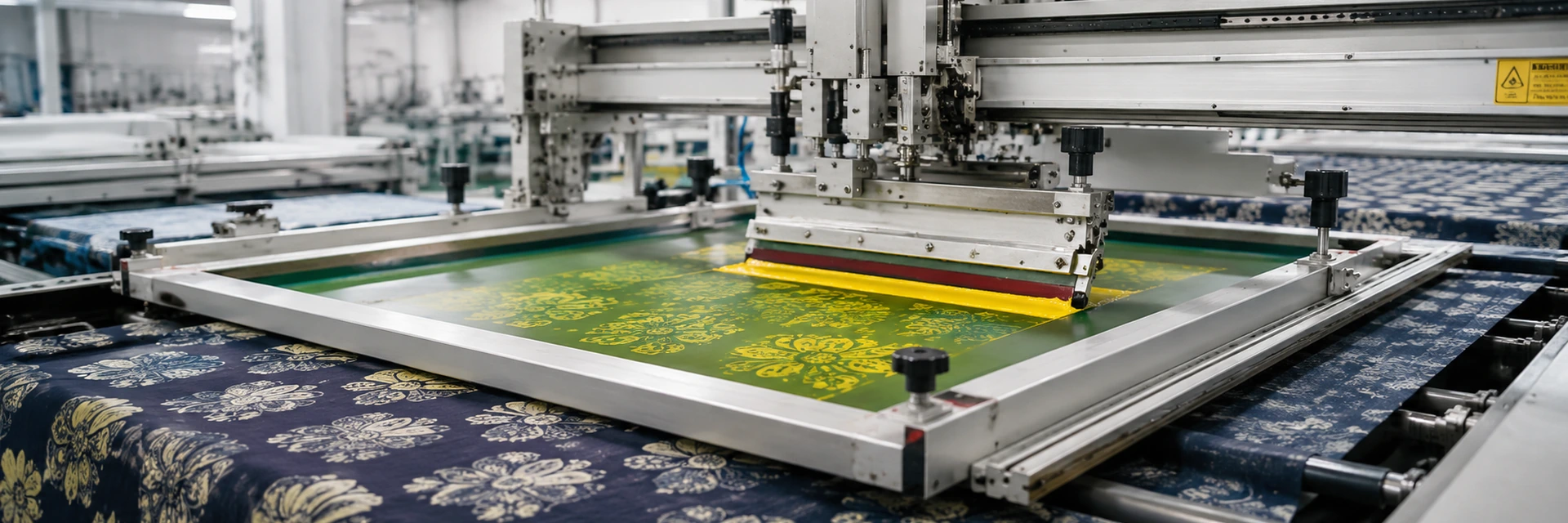
Sodium alginate is widely used as a reference thickener for reactive printing on suitable cellulosic fabrics. Its relatively low reaction tendency toward many reactive dyes is useful, but “chemically inert” should not be treated as an absolute guarantee for every dye and recipe. Validate the selected grade with the actual alkali, auxiliaries, fixation and washing route.
A reactive dye that binds to a thickener rather than the intended fiber can affect fixation, residue or handle. Alginate’s low dye reactivity helps explain its use, but it does not establish a universal color-yield ranking over every CMC grade or blend. Compare final washed color under controlled deposition, fixation and washing conditions.
Perilaku Viskositas dan Stabilitas Pasta
An alginate paste may show lower apparent viscosity at higher shear rate. The extent depends on grade, concentration, ions and formulation. Time-dependent recovery after a high-shear interval is a separate measurement: use a defined shear history and recovery interval instead of inferring recovery speed from a flow curve or a two-speed viscosity ratio. Relate both measurements to transfer and print definition in the actual process.
Establish holding stability for the prepared stock and complete color paste separately. Record temperature, pH, water, closure and elapsed time, and compare viscosity, residue and printing results against a fresh reference. Preparing smaller fresh batches may reduce holding exposure, but neither polymer name establishes a universal shelf life.
Where to Evaluate Sodium Alginate
- Pencetakan layar datar dan layar putar dengan pewarna reaktif pada kain katun
- Reactive digital fabric-pretreatment formulations, qualified separately from screen paste and printhead ink
- Pencetakan dengan metode discharge di mana komposisi pasta kompatibel dengan alginat
- Reactive applications where a qualified alginate grade provides the print-quality benchmark
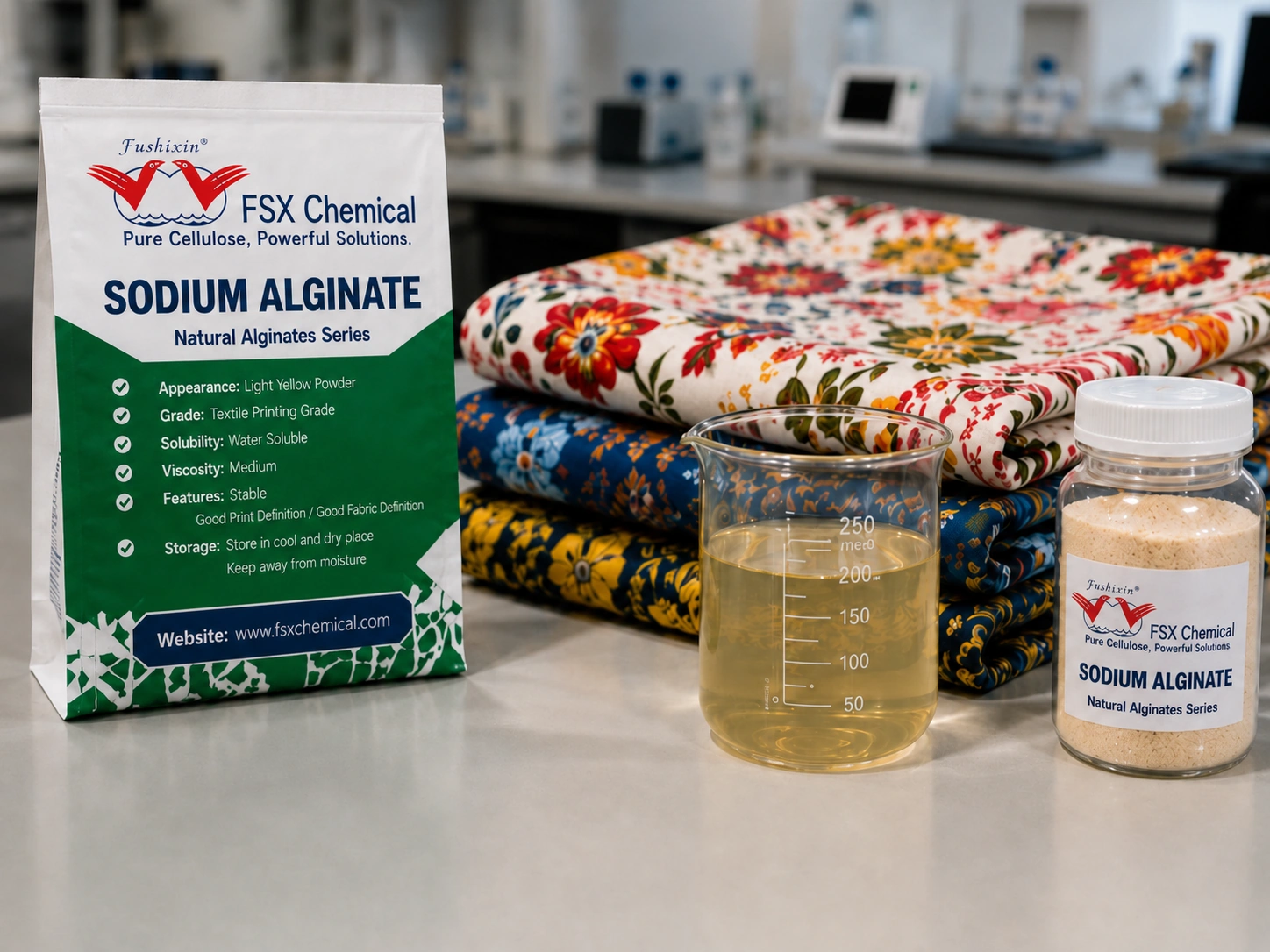
For reactive printing on cotton or viscose, an approved alginate grade can provide a useful benchmark against which to assess a proposed CMC grade or blend. Approval still depends on the complete finished-print trial.
CMC: Keunggulan dan Aplikasi Umum
Kinerja dalam Sistem Pencetakan Pigmen
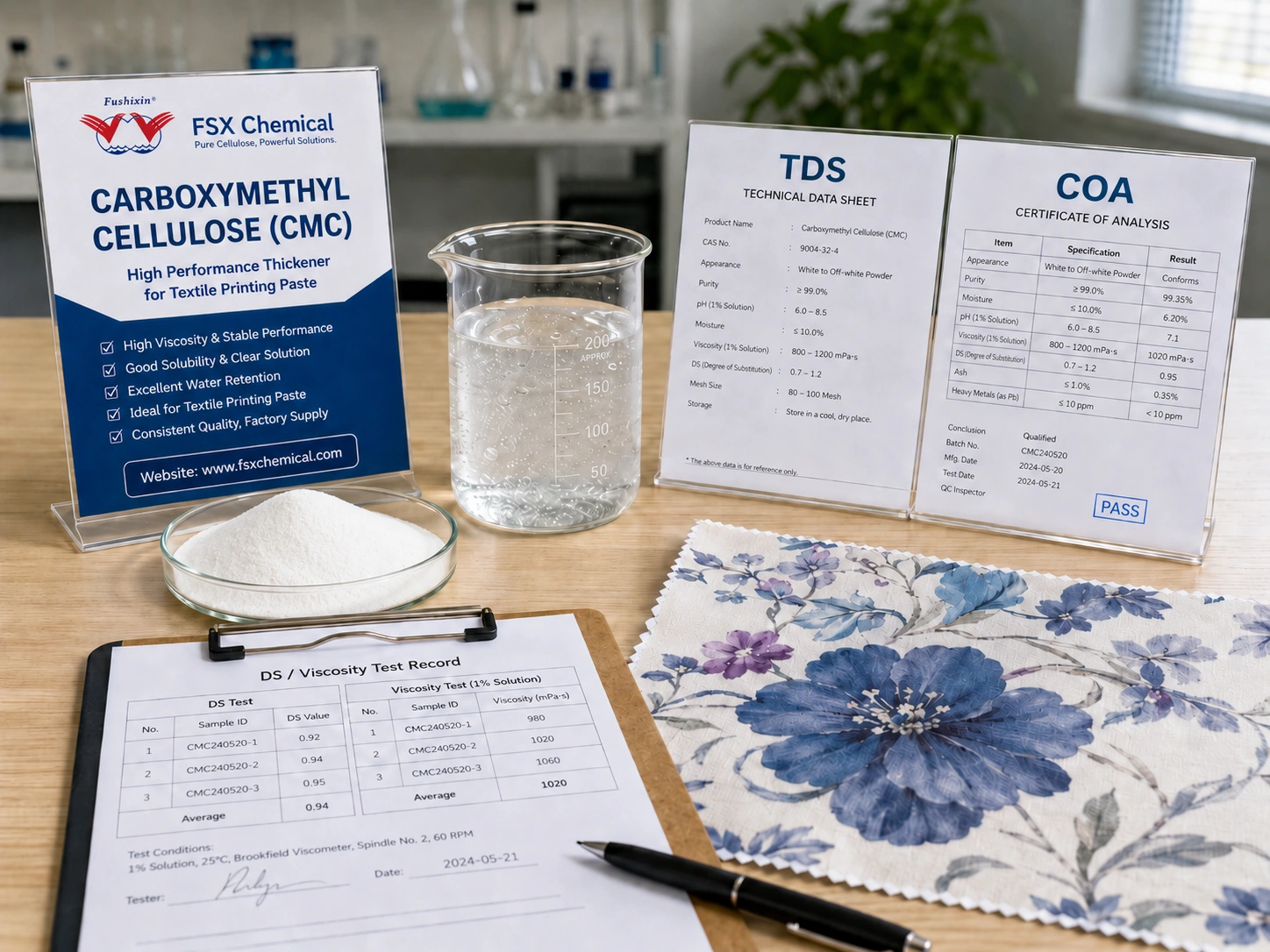
In pigment printing, the pigment particles are fixed through the binder system rather than the reactive dye–fiber fixation mechanism. A CMC candidate must be evaluated with the actual pigment, binder, auxiliaries and curing route. Thickener selection must preserve binder-film performance, rubbing fastness and handle as well as paste flow.
Do not infer binder compatibility from the generic CMC name. Check the grade’s ionic character, substitution profile, purity and response to the full recipe, including any cationic components. Evaluate storage, application and cured-fabric performance before approving the candidate.
Peran sebagai Pengental Tambahan atau Bahan Pengikat
Selain untuk pencetakan pigmen, CMC banyak digunakan dalam proses pengikatan serat tekstil (pengikatan benang lungsin sebelum ditenun) dan sebagai pengental tambahan dalam formulasi pasta campuran. Dalam aplikasi pengikatan serat, CMC membentuk lapisan pelindung pada permukaan benang yang mengurangi risiko putusnya benang selama proses penenunan — fungsi yang berbeda dari perannya dalam pasta cetak.
Dalam beberapa formulasi pasta cetak, CMC digunakan bersama dengan natrium alginat atau pengental sintetis untuk menyesuaikan sifat reologi atau menekan biaya, bukan sebagai pengental tunggal.
Where to Evaluate CMC
- Pencetakan pigmen pada kain katun, poliester, atau kain campuran
- Aplikasi pelapisan benang lungsin tekstil
- Grade-qualified reactive or pigment formulations assessed against complete print-quality and cost targets
- Sistem pasta campuran yang memerlukan bahan pengental tambahan untuk menyesuaikan viskositas atau konsistensi pasta
Perbandingan Langsung: Sodium Alginat vs. CMC
Kompatibilitas Sistem Pewarnaan
For reactive dyes, evaluate interaction with the thickener and the effect on final fixation, wash-off and handle. CMC’s substitution pattern, residual hydroxyl groups and manufacturing history can matter; average DS alone is not a universal pass/fail rule. Alginate is a useful low-reactivity reference, but compare the actual grades rather than an assumed chemistry-wide ranking.
For reactive printing, benchmark a candidate against a qualified reference under the intended recipe and process. For pigment printing, compare complete binder-containing formulations. Neither sodium alginate nor CMC is automatically the correct, cheaper or superior choice for every member of either printing system.
Profil Viskositas dan Reologi
Either polymer can show shear-dependent flow, but the profile varies with grade, concentration, temperature and formulation. Compare flow curves under matched measurement conditions. If post-shear recovery matters, run a separate timed test with the same pre-shear, measurement interval and reference basis; a steeper flow curve does not prove faster recovery.
Assess temperature response by measuring each formulation at controlled temperatures, then returning samples to the reference temperature. Assess holding stability at defined ages with matched preparation and storage histories. Distinguish reversible temperature effects from persistent change; no polymer-wide CMC advantage in temperature range or storage stability is established by the generic names.
Perilaku Pencucian dan Penghilangan Sisa Pelapis
The powders’ water solubility does not guarantee complete removal after printing, fixation or sizing. Check wash-off for the exact grade, deposit and dye or binder system. CMC sizing may be removable by an appropriate water-based desizing process, but a blend containing starch, PVA or other size components needs its own removal assessment.
Jika proses Anda melibatkan tahap pencucian yang sangat sensitif — misalnya, kain halus atau batasan suhu air — pastikan perilaku pembilasan dengan pemasok Anda melalui uji coba sebelum memutuskan pilihan pengental.
Pertimbangan Biaya dan Ketersediaan
Alginate is derived from brown seaweed; CMC is a chemically modified cellulose product. Obtain current like-for-like quotations for the exact qualified grades, delivered terms and quantities. Raw-material origin alone does not establish which product will have a lower or more stable future price.
Compare cost only after the formulations meet the same agreed print-quality requirements. Calculate material cost from actual consumption and delivered unit prices, add consistently allocated preparation, printing and finishing costs, then divide by accepted finished-fabric area. Keep one currency and process boundary, count losses once, and distinguish unpriced downtime or yield indicators from monetary charges.
Formulasi Campuran: Menggunakan Keduanya Secara Bersamaan
Kapan Penggabungan Itu Masuk Akal
Beberapa formulasi pasta cetak menggunakan natrium alginat dan CMC secara bersamaan, biasanya untuk mencapai profil reologi tertentu yang tidak dapat dihasilkan oleh masing-masing pengental tersebut secara terpisah. Pencampuran ini juga memungkinkan penggantian sebagian pengental yang lebih mahal dengan alternatif yang lebih murah, sambil tetap mempertahankan kinerja yang memadai.
An alginate–CMC blend may be evaluated in a suitable reactive or pigment formulation. Its performance depends on the exact grades, ratio and complete recipe; neither presumed market prevalence nor alginate’s low dye reactivity proves a blend is necessary or unsuitable.
Pertimbangan Praktis dalam Pencampuran
Jika Anda mempertimbangkan formulasi campuran, kompatibilitas kedua bahan pengental tersebut satu sama lain serta dengan semua komponen pasta lainnya perlu dipastikan melalui uji coba. Perilaku viskositas sistem campuran tidak selalu dapat diprediksi hanya berdasarkan spesifikasi masing-masing bahan pengental — uji coba formulasi skala kecil sangat penting dilakukan sebelum menerapkan campuran tersebut dalam produksi.
Cara Memilih Pengental yang Tepat untuk Proses Anda
- What colorant system are you using? In reactive printing, compare a qualified natrium alginat reference with an appropriate CMC candidate. In pigment printing, verify the complete binder-containing formulation.
- Apa prioritas utama Anda dalam hal kinerja? Compare CMC candidates against the same color, definition, fastness, handle and accepted-output cost criteria used for the reference; do not assign a winner from the polymer name.
- Apakah ada batasan khusus terkait formulasi? Kompatibilitas dengan bahan pengikat, bahan pengawet, atau bahan pembantu lainnya dapat memengaruhi jenis pengental mana yang cocok untuk resep lengkap Anda.
Jika Anda ragu, mintalah sampel kedua bahan pengental tersebut dari pemasok Anda dan lakukan uji perbandingan langsung dalam formulasi standar Anda. Hal ini akan memberi Anda data objektif yang spesifik untuk proses Anda, alih-alih hanya mengandalkan rekomendasi umum.
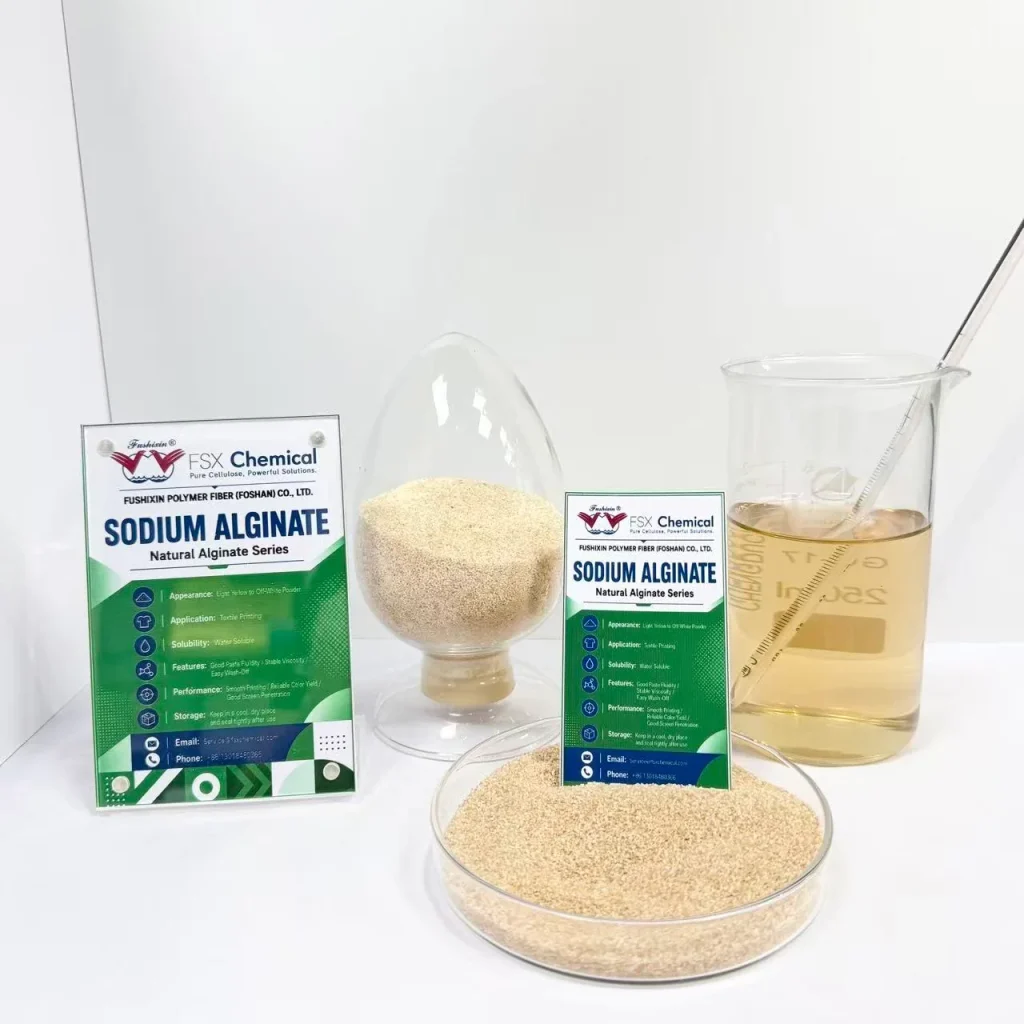
Laboratory-to-Production Qualification Checklist
- Confirm dye or pigment system, fabric, printing method and where the thickener is added.
- Use fully hydrated samples and matched final viscosity-test conditions; distinguish a fixed-dose screen from a workable-dose or matched-viscosity application trial.
- Compare paste rheology, filtration, storage stability and response to alkali and electrolytes.
- Print the same design and assess penetration, outline sharpness, color yield and screen release.
- Apply the matched, approved route-specific fixation or curing process and any required washing or conditioning, then compare fastness, residue and fabric handle.
- Approve a representative bulk batch only after the laboratory result is repeatable.
Pertanyaan yang Sering Diajukan
Can CMC replace sodium alginate 1:1?
Do not assume a universal ratio. CMC grades differ in DS, purity, salt response and rheology, while sodium alginate grades also differ by viscosity profile and purity. Determine the workable ratio through a controlled formulation and print trial.
Is CMC suitable for reactive printing?
Some textile-grade or blended CMC systems may be evaluated, but compatibility is grade- and dye-dependent. Confirm color yield, paste stability, fixation and wash-off rather than relying on the generic CMC name.
Which product has the lower cost?
Compare monetary production cost per accepted fabric area after equivalent quality approval. Use actual material consumption × unit price and stated time or energy rates; allocate costs consistently and avoid charging the same reject or rework input twice. Keep unpriced operating indicators separate. A lower product price per kilogram need not give a lower cost per accepted m².
Bagaimana FSX Chemical Mendukung Proses Pemilihan Anda
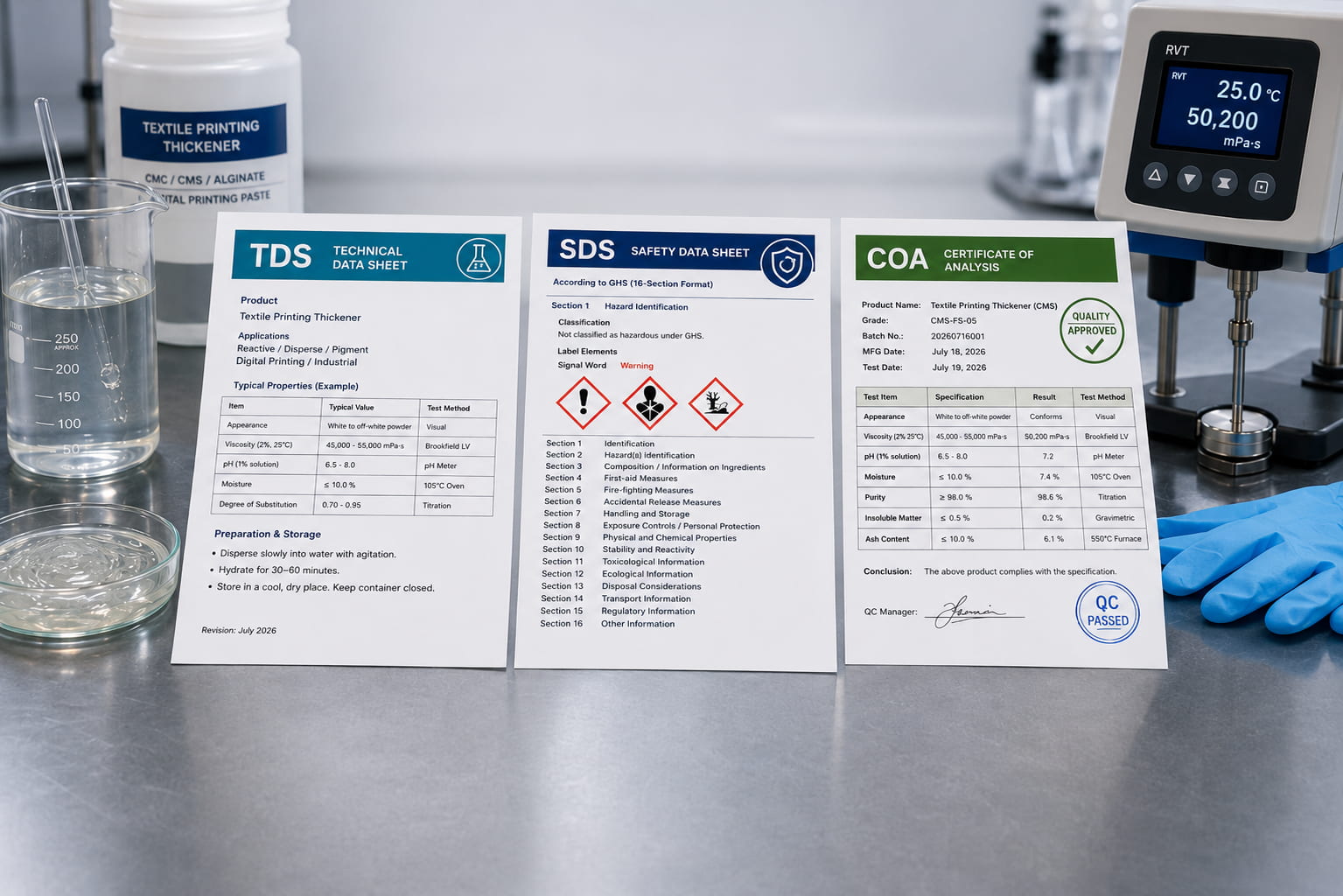
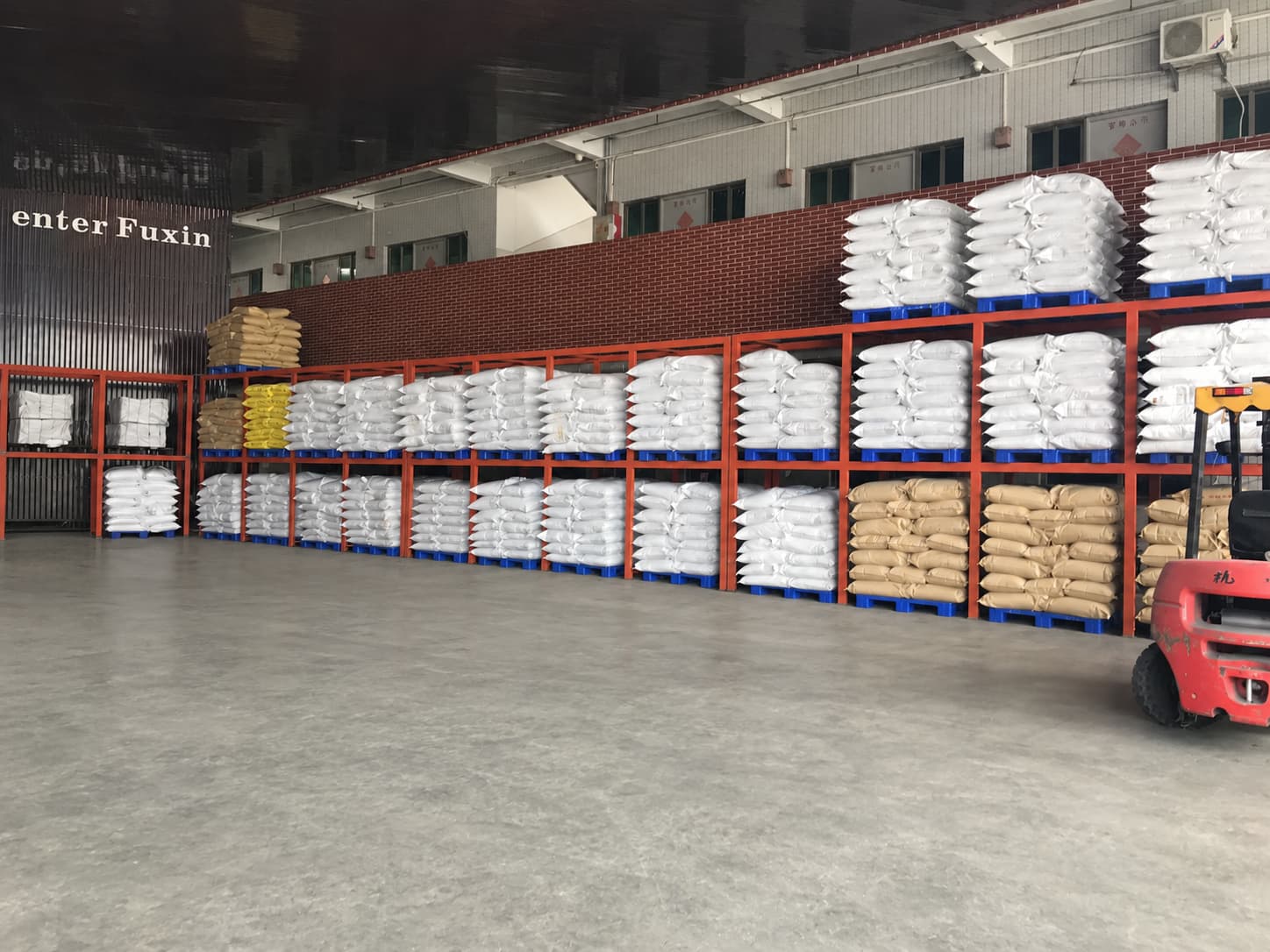
FSX Chemical menyediakan natrium alginat dan CMC untuk aplikasi pencetakan tekstil. Kami dapat menyediakan sampel kedua produk tersebut untuk uji perbandingan, beserta lembar data teknis yang mencantumkan parameter-parameter yang relevan untuk setiap jenis produk.
Jika Anda membagikan informasi mengenai sistem pewarnaan, metode pencetakan, dan jenis kain yang Anda gunakan, tim teknis kami dapat merekomendasikan langkah awal untuk uji coba Anda — baik itu natrium alginat, CMC, maupun campuran keduanya.
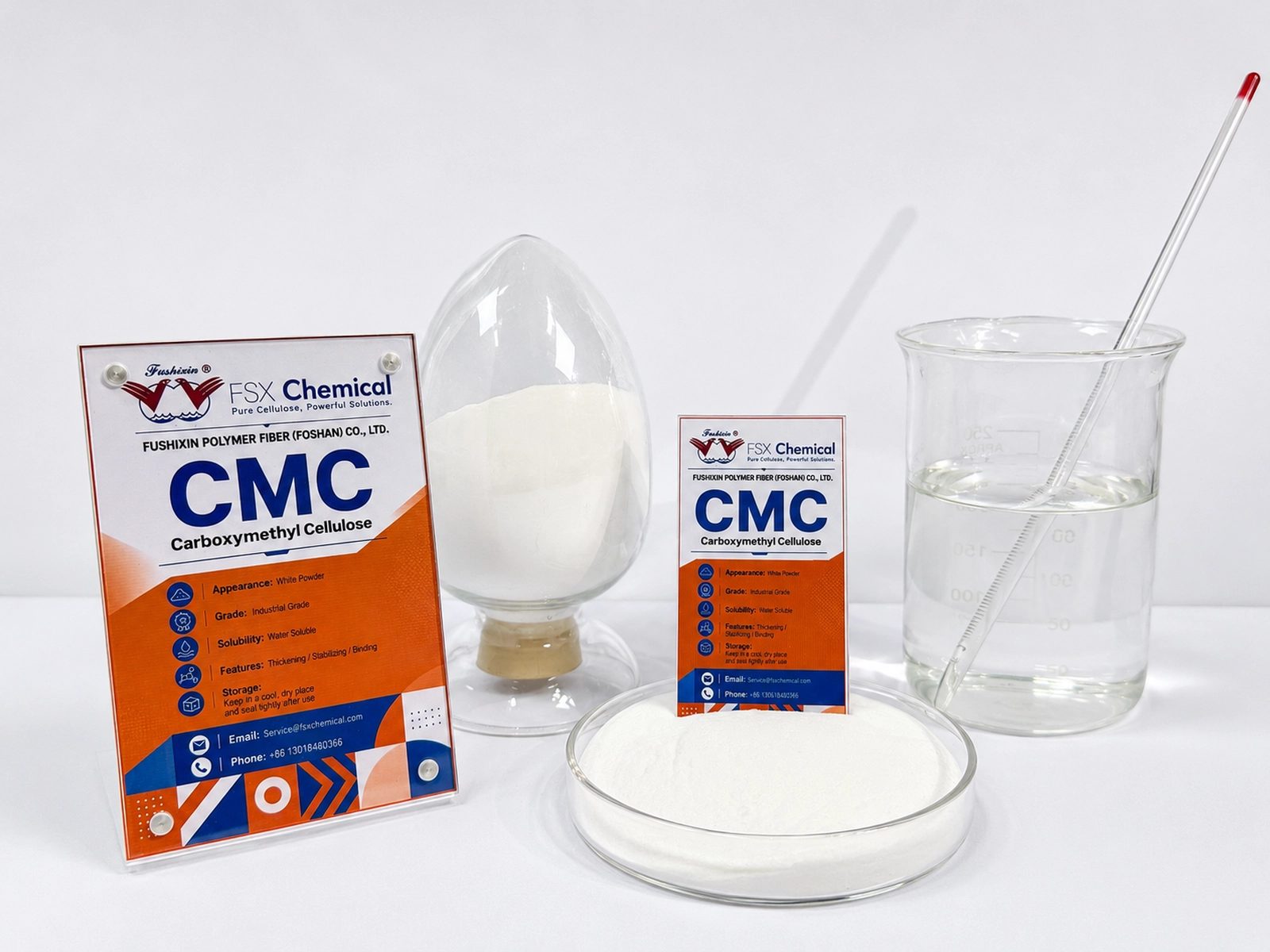
Langkah selanjutnya:
- Ajukan Permohonan TDS — untuk natrium alginat, CMC, atau keduanya, tergantung pada keperluan Anda
- Minta Sampel untuk Perbandingan — lakukan uji coba langsung secara berdampingan menggunakan formulasi Anda sendiri
- Minta Pencocokan Grade — bagikan rincian proses Anda untuk rekomendasi awal tertentu
- Hubungi Tim Teknis Kami — untuk pertanyaan mengenai formulasi atau peralihan antara sistem pengental📧 Email: Service@fsxchemical.com