
















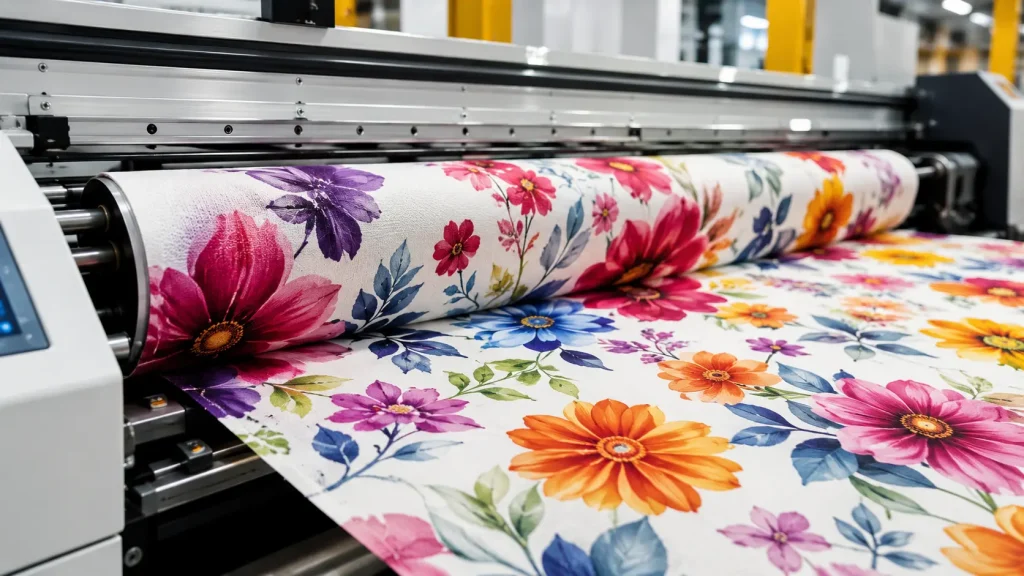
Untuk pencetakan dengan pewarna reaktif pada bahan katun atau viscose, natrium alginat biasanya merupakan bahan pengental awal yang lebih aman karena memiliki reaktivitas rendah terhadap pewarna reaktif dan umumnya mudah tercuci. Gum guar dapat dipertimbangkan dalam pencetakan dengan pigmen atau pada sistem-sistem tertentu yang telah dimodifikasi dan dicampur, namun gum guar mentah bukanlah pengganti universal dengan perbandingan 1:1 untuk natrium alginat.
Pilih terlebih dahulu berdasarkan sistem zat warna, kemudian bandingkan reologi, stabilitas pasta, ketajaman cetakan, penetrasi, hasil warna, kemudahan pencucian, dan total biaya pemakaian. Harga bubuk lebih rendah atau nilai viskositas serupa tidak membuktikan kesetaraan kinerja pencetakan.
Sodium Alginat vs. Guar Gum: Tabel Keputusan Singkat
| Faktor penentu | Sodium alginat | Gum guar atau turunannya |
|---|---|---|
| Pencetakan reaktif | Rute awal yang umum untuk kapas dan viscose | Guar mentah bukanlah pengganti standar dengan perbandingan 1:1; jenis yang telah dimodifikasi memerlukan pengujian |
| Pencetakan pigmen | Dapat digunakan, tetapi biasanya tidak dipilih hanya berdasarkan sifat inert terhadap zat warna | Dapat dipertimbangkan dengan sistem pengikat dan pigmen |
| Kompatibilitas kimia | Reaktivitas rendah terhadap banyak pewarna reaktif dalam kondisi proses normal | Sangat bergantung pada modifikasi, formulasi, dan sistem pewarna |
| Reologi | Aliran dan pelepasan pasta dari screen bergantung pada grade | Seringkali terjadi peningkatan viskositas yang efisien; profil aliran harus diukur |
| Kemudahan pencucian dan pegangan kain | Secara umum cocok untuk pencetakan reaktif | Residu dan pegangan kain harus diperiksa pada kain yang sebenarnya |
| Keputusan terkait biaya | Evaluasi dosis pemakaian, hasil warna, dan konsistensi produksi | Biaya bubuk yang lebih rendah belum tentu berarti biaya penggunaan yang lebih rendah |
| Persetujuan penggantian | Gunakan sebagai acuan jika sudah memenuhi syarat | Setujui hanya setelah uji laboratorium dan uji produksi |
Karena label viskositas tidak memiliki standar yang seragam di antara para pemasok, gunakan metode yang sama seperti yang dijelaskan dalam panduan kami panduan perbandingan viskositas pengental tekstil.
Apa Itu Guar Gum dan Bagaimana Penggunaannya dalam Pencetakan Tekstil
Asal-usul dan Kimia Dasar
Gum guar adalah polisakarida yang berasal dari endosperm biji guar (Cyamopsis tetragonoloba), yang sebagian besar dibudidayakan di India dan Pakistan. Guar gum merupakan galaktomanan — suatu polimer yang terdiri dari unit manosa dan galaktosa — yang membuatnya memiliki sifat kimia yang berbeda dari natrium alginat, suatu asam poliuronat yang berasal dari rumput laut.
Guar gum is water-soluble and can develop substantial viscosity at low concentration. Commercial grades differ in viscosity and preparation behavior; compare the actual grade and method rather than treating this as proof of greater printing efficiency than alginate. Guar is used in several industrial and food applications, including selected textile formulations.
Di Mana Guar Gum Digunakan dalam Pencetakan Tekstil
A guar or modified-guar candidate may be evaluated in pigment paste with the actual binder, pigment and auxiliary package. Use the declared grade identity and intended-use information to define any screen-printing or blended-formulation trial.
For reactive printing, distinguish native guar from a specifically modified derivative or blend. A lower quotation is a commercial observation to verify for the offered grades, not an inherent property of the polymer names. Approve dye compatibility and finished-fabric quality before comparing cost in use.
Kompatibilitas Sistem Pewarnaan: Faktor Pembeda Terpenting
Sodium Alginat dalam Sistem Pewarna Reaktif
Sodium alginate is a common reference thickener for reactive printing on cellulosic fabrics because of its relatively low reactivity toward reactive dyes. It is not absolutely inert, and its use does not preserve every dye molecule for fixation. Evaluate the complete dye, alkali and thickener paste through the actual fixation and wash-off route.
Gum Guar dalam Sistem Pewarna Reaktif
Native guar and modified guar should not be treated as the same printing material. Available hydroxyl groups and the particular chemical modification can affect interaction with reactive dyes. A candidate needs its own complete-paste and finished-fabric assessment; performance cannot be assigned from the name “guar gum” alone.
If viscosity changes after alkali addition, record grade identity, concentration basis, preparation, pH, temperature and paste age. Compare the reference and candidate using the same procedure. A viscosity decrease alone does not identify chain hydrolysis; investigate the measured change rather than assuming a universal alkali-catalyzed mechanism.
Measure color response, required fastness, wash-off and handle after the defined fixation and washing sequence. Do not assume that one polymer family always gives lower yield or poorer fastness at the same nominal concentration. A specifically modified guar or blend can behave differently from native guar.
Guar Gum dalam Pencetakan Pigmen
Dalam pencetakan pigmen, di mana fiksasi terjadi melalui lapisan pengikat (binder film) alih-alih reaksi kimia dengan serat, masalah reaktivitas antara pewarna dan pengental yang membatasi penggunaan gum guar dalam sistem reaktif tidak relevan. Gum guar dapat berfungsi secara efektif sebagai pengental dalam pasta pencetakan pigmen, memberikan viskositas dan konsistensi pasta yang memadai untuk aplikasi dengan saringan.
For pigment printing, evaluate a guar or derivative only with the actual binder and pigment system. Confirm paste stability, screen transfer, curing, rubbing performance and handle before deciding whether its measured consumption and current quotation offer a cost advantage.
Reologi dan Perilaku Viskositas
Perilaku Pengenceran Akibat Geser
Solutions and printing pastes based on alginate or guar can show shear-thinning behavior: apparent viscosity decreases as shear rate increases. This describes the flow response, not the speed or completeness of recovery after a printing stroke. Compare the actual grade, concentration and complete paste.
Where recovery matters, use a separate timed shear-history test. Keep the initial low-shear condition, high-shear interval, return condition, temperature and evaluation times consistent. Then check deposited paste and print definition on the actual fabric; a flow curve alone does not establish pattern stability.
Efisiensi Konsentrasi
Build a dosage-versus-working-paste-performance comparison for the exact grades. Use the same stated concentration basis and viscosity method, then retain the dosage that meets the complete printing requirements. A lower dose to match one water-viscosity value does not by itself demonstrate lower consumption at equivalent print quality.
For a reactive-printing substitution, keep unchanged-recipe and separately optimized-recipe trials identifiable. Compare final shade, fastness, wash-off and handle before calculating cost. Neither an assumed guar disadvantage nor an assumed alginate advantage replaces the finished-fabric evidence.
Stabilitas Viskositas Seiring Berjalannya Waktu dan Perubahan Suhu
Test fresh paste and the intended maximum holding time at the actual temperature and with the actual alkali system. Measure both reference and candidate with the same preparation, concentration and viscosity procedure. Holding stability is a result for that grade and formulation, not a universal ranking of all alginate and guar products.
If production paste is prepared in advance, record storage temperature, container and evaporation control, mixing history and time since alkali addition. Investigate a deviation before changing the grade; a viscosity result alone does not separate composition change, preparation history and polymer degradation.
Perilaku Pencucian dan Proses Pasca-Pencetakan
Penghilangan Natrium Alginat melalui Pencucian
Sodium alginate is water-soluble, but wash-off in a print must be assessed after the actual fixation process and paste deposit. Use the approved washing sequence and check residual material and fabric handle; solubility alone does not guarantee complete removal from every fabric or formulation.
When thickener removal is verified in the approved process, it supports finished-fabric cleanliness. Assess the required fastness separately after the actual dye fixation and wash-off sequence; removal of the thickener alone does not establish wash-fastness performance.
Penghilangan Gom Guar melalui Pencucian
For a guar or modified-guar paste, check removal and fabric handle after the same route-specific fixation and wash-off procedure used for its reference. Deposit, modification, formulation and fabric construction can change the result; do not infer complete removal or a fixed ranking from water solubility alone.
If residue remains, first identify the material and compare deposit, fixation and washing records. Any change in washing time, temperature or chemistry should stay within the fabric and dye system’s approved conditions and be checked on the finished textile.
Pertimbangan Biaya: Kapan Aspek Ekonomi Menguntungkan Masing-Masing Opsi
Kapan Guar Gum Menjadi Pilihan yang Hemat Biaya
Compare current delivered quotations and measured consumption only after each candidate meets the same finished-print requirements. Material cost per batch equals delivered price per kilogram of product as received multiplied by kilograms consumed. Allocate other costs consistently and divide by accepted fabric output.
Record quotation date, offered grade, quantity, delivery scope and currency. Recheck those commercial inputs when the order changes; historical commodity-price narratives do not establish the price relationship for the two grades being evaluated.
When to Keep the Qualified Alginate Reference
Where sodium alginate is already qualified for reactive printing, retain it as the production reference. Approve any guar derivative or blend through a controlled comparison. The economic decision depends on accepted output, measured dye and thickener consumption, corrections and post-treatment, not a presumed color-yield difference.
Where shade and fastness must meet a defined customer requirement, treat any unqualified candidate or recipe change as a production risk until it passes the agreed trials. This applies to changes within the same polymer family as well as changes between alginate, guar or a blend.
Turunan Guar Gum: Pilihan Modifikasi yang Layak Dipertimbangkan
Hydroxyethyl Guar dan Turunan Lainnya
Modified guar products differ by the modification and its extent; hydroxyethyl, hydroxypropyl, oxidized and other grades should not share one assumed dye-compatibility or alkaline-stability claim. Obtain the exact identity and current technical documents, then evaluate the candidate in the complete printing formulation.
Original research on modified guar in cotton reactive printing reports results for defined modified materials and trial conditions. It supports testing the specific derivative; it does not establish a universal performance gap, replacement ratio or cost advantage for a commercial grade.
Sistem Pengental Campuran
Campuran natrium alginat dan grade guar termodifikasi yang sesuai dapat dievaluasi untuk sistem zat warna dan pencetakan yang ditetapkan. Nama bahan saja tidak membuktikan kompatibilitas zat warna maupun biaya lebih rendah. Bandingkan penawaran grade aktual, dosis yang diperlukan untuk memenuhi kriteria mutu cetak yang sama, kehilangan saat persiapan, kemudahan pencucian, dan produk yang ditolak. Campuran hanya ekonomis jika total biaya terukur pada mutu yang dapat diterima mendukung kesimpulan tersebut.
Sistem campuran memerlukan formulasi yang cermat—rasio komponen, kompatibilitas dalam pasta, dan perilaku selama pengukusan harus divalidasi melalui uji coba. Kinerja campuran bukan sekadar rata-rata komponennya; interaksi antar pengental dan dengan komponen pasta lain dapat menghasilkan perubahan yang tidak terduga, baik menguntungkan maupun merugikan.
Ringkasan: Pengental Mana yang Cocok untuk Aplikasi Apa
- Reactive printing on cellulosic fabric — use the current qualified alginate paste as a reference where applicable; test the exact guar derivative or blend rather than assuming a 1:1 replacement.
- Pencetakan pigmen → Baik natrium alginat maupun gum guar (atau turunannya) dapat digunakan; pemilihan didasarkan pada biaya, kompatibilitas bahan pengikat, dan persyaratan stabilitas pasta. Disarankan untuk melakukan uji coba terlebih dahulu sebelum beralih.
- Digital fabric pretreatment — use a grade specifically proposed for the ink, fabric and application equipment. A screen-paste approval does not establish pretreatment suitability or approval for addition to printhead ink.
- Cost in use — compare current quotations and measured recipe consumption at equivalent finished-print acceptance, including dye, thickener, corrections, wash-off and rejected output.
Protokol Uji Penggantian
- Pastikan bahan kain, pewarna atau pigmen, bahan pembantu, kualitas air, dan kondisi fiksasi tetap sama.
- Catat konsentrasi, suhu, instrumen, spindel, kecepatan, dan waktu hidrasi untuk setiap hasil viskositas.
- Bandingkan aliran, pelepasan pasta dari screen, penetrasi, ketajaman kontur, dan stabilitas pasta.
- Ukur hasil warna, kemudahan pencucian, pegangan kain, dan residu setelah proses fiksasi dan pencucian yang sama.
- Hitung total biaya berdasarkan dosis pemakaian yang efektif, koreksi, pengerjaan ulang, dan konsistensi batch—bukan harga bubuk saja.
Pertanyaan yang Sering Diajukan
Apakah guar gum dapat menggantikan natrium alginat dengan perbandingan 1:1 dalam pencetakan reaktif?
Hal ini tidak boleh diasumsikan begitu saja. Guar mentah, guar yang dimodifikasi, dan produk campuran memiliki karakteristik yang berbeda-beda. Sesuaikan metode pengukuran viskositas, kemudian periksa kompatibilitas pewarna dan hasil pencetakan sebelum menentukan rasio penggantian.
Pengental mana yang lebih murah?
Harga bubuk saja tidak cukup untuk menjawabnya. Bandingkan konsentrasi yang efektif, hasil warna, stabilitas pasta, kemudahan pencucian, waktu koreksi, dan risiko kain ditolak.
Apakah viskositas yang sama berarti kinerja pencetakan yang sama?
Tidak. Viskositas yang sama tetap dapat menghasilkan respons geser, penetrasi, ketajaman garis luar, stabilitas, dan tingkat terbilas yang berbeda. Gunakan satu metode pengujian dan satu resep pencetakan untuk proses kualifikasi.
Bagaimana FSX Chemical Mendukung Evaluasi Pengental Anda
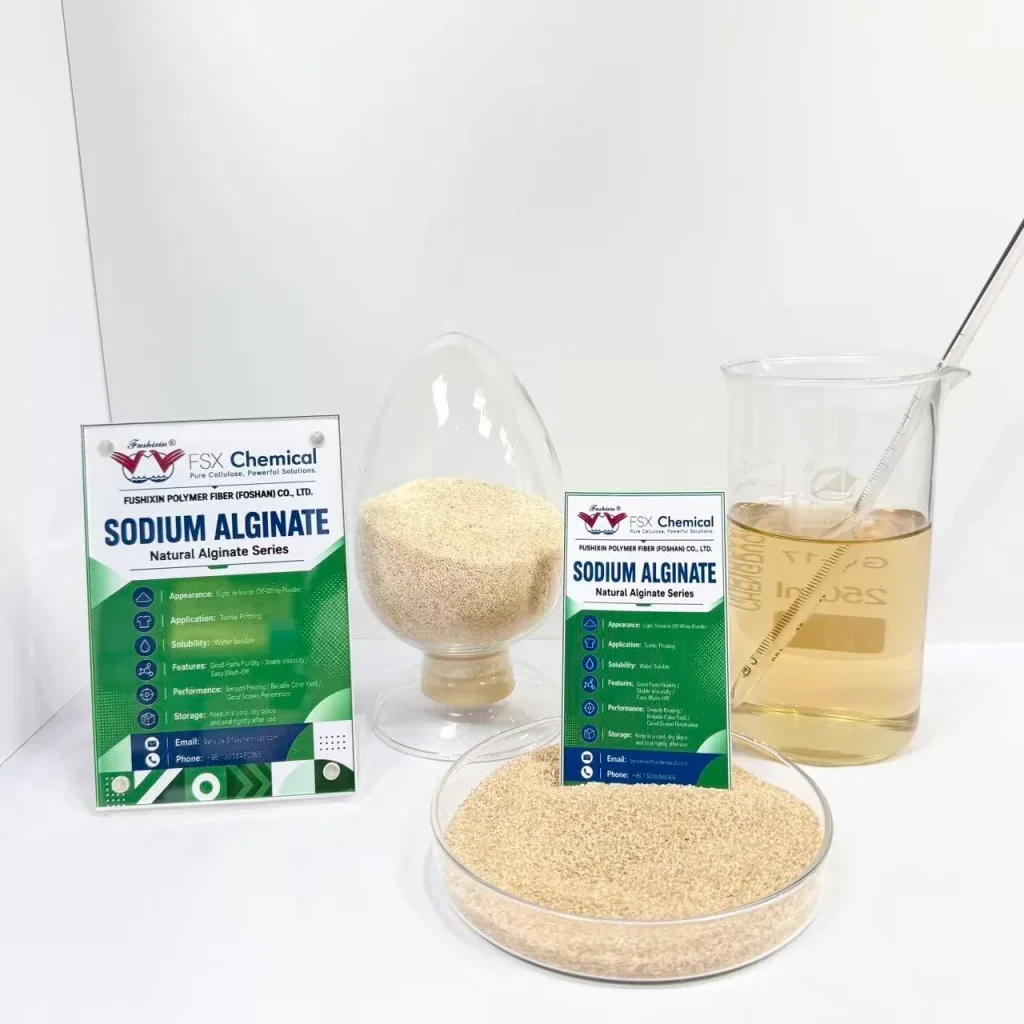
FSX Chemical menyediakan natrium alginat untuk aplikasi pencetakan tekstil dengan pewarna reaktif dan pigmen. Jika Anda sedang mempertimbangkan natrium alginat sebagai alternatif pengganti guar gum atau bahan pengental lainnya, kami dapat menyediakan sampel untuk uji coba pasta secara komparatif beserta lembar data teknis guna pemilihan jenis produk yang sesuai.
Tim teknis kami dapat membantu memberikan panduan formulasi untuk peralihan dari guar gum ke natrium alginat — termasuk rekomendasi penyesuaian konsentrasi, metode pelarutan, serta pertimbangan stabilitas pasta untuk sistem pewarna dan kondisi produksi Anda yang spesifik.
Langkah selanjutnya:
- Ajukan Permohonan TDS — tinjau spesifikasi kelas natrium alginat untuk aplikasi yang Anda tuju
- Minta Sampel — lakukan uji perbandingan pasta terhadap formulasi guar gum yang Anda gunakan saat ini
- Minta Pencocokan Grade — silakan bagikan sistem pewarnaan, jenis kain, dan parameter pasta yang Anda gunakan saat ini agar kami dapat memberikan rekomendasi yang spesifik
- Request grade and sample matching — share the current TDS, printing route, fabric and the result to improve before a controlled comparison.
