How Much Textile Thickener Sample Is Needed? Lab Screening vs. Production Trial Quantities
Calculate textile thickener sample quantity from the trial stage, final-mixture mass, as-supplied dose, machine inventory,...
How much textile thickener sample is enough depends on what the mill is trying to prove. For powder products, this guide uses illustrative starting budgets of 100–300 g for basic laboratory screening and 300 g–1 kg for repeated complete-formula work. These are planning examples, not observed industry norms or FSX minimums. Calculate every request, including a liquid or paste product, from the planned final-mixture mass and the candidate’s as-supplied dose, then add identified reserve and losses. A production trial cannot be sized from a fixed sample weight. This guide shows textile buyers and printing mills how to size samples for viscosity screening, full-formula validation, fabric printing, machine trials and supplier approval without wasting material or approving a grade from an undersized test.
Why Sample Quantity Changes the Quality of the Trial
A sample is useful only if it is large enough to answer the intended technical question.
Different trial stages answer different questions:
Does the identified product disperse, dilute, hydrate or activate correctly under its form-specific preparation method?
Does the viscosity match the target?
Does the complete formula remain stable?
Does the paste print correctly on the actual fabric?
Does it run consistently on the production machine?
Does the approved grade remain stable from sample to bulk supply?
A very small sample may answer the first two questions but not the last four.
This is why “How many grams do I need?” should always be followed by:
“What stage of approval are we trying to complete?”
FSX Chemical’s current sample-matching route separates laboratory evaluation from production confirmation and states that final suitability should be confirmed under the customer’s actual production conditions.
That is the correct technical logic: sample quantity should grow as the test moves closer to production.
The Four Sample-Quantity Stages
Trial Stage
Illustrative Powder-Product Budget
Main Purpose
Basic lab screening
About 100–300 g per grade
Hydration, standard viscosity, initial compatibility
These are illustrative as-supplied powder-product budgets, not measured industry norms, FSX sample limits or universal textile standards. A liquid or paste grade may need a different mass because its approved as-supplied dose and preparation differ. Use the calculation below to replace each example with the actual test plan.
The actual quantity depends on:
Thickener dosage
Number of candidate grades
Number of colors or formulations
Fabric width and length
Screen or application route
Machine dead volume
Printed coverage
Number of repeat tests
The most important rule is:
Do not use a laboratory sample size to pretend that a production trial has been completed.
Stage 1: Basic Lab Screening — Example Powder Budget: 100–300 g per Grade
Use 100–300 g per powder grade only as an initial budgeting example. Confirm the required mass from the number and size of preparations, the as-supplied product dose, planned repeats and retained material; the bracket itself does not establish that the test plan can be completed.
This stage can include:
Көрінісі
Dispersion
Гидратация
Standard solution viscosity
pH
Сүзу
Small complete-paste compatibility check
For example, a 200 g sample can make:
10 kg of paste at 2% thickener dosage
6.7 kg of paste at 3% dosage
4 kg of paste at 5% dosage
That sounds like a large amount of laboratory paste, but real testing consumes material through:
Preparation losses
Viscometer samples
Filter tests
Several formula variants
Fabric print trials
Retained samples
Therefore, 200 g is useful for screening, but the number of tests must still be planned.
Stage 2: Complete Formula & Repeat Testing — Example Powder Budget: 300 g–1 kg per Grade
Once a candidate passes basic screening, the next stage should reproduce the complete printing formula.
Depending on the application, this can include:
Dye or pigment
Salt
Alkali
Мочевина
Binder
Fixer
Dispersant
Other auxiliaries
The mill should also test more than one time point or formulation where relevant.
When the calculated powder-product requirement fits within 300 g–1 kg per grade, that example budget can cover the planned work below. Size each preparation and repeat explicitly:
Fresh vs. aged paste comparison
Light vs. dark shade
Different thickener dosages
Repeat viscosity measurements
Multiple fabric print swatches
Steaming / thermofixation / curing
Wash-off / reduction clearing
This is often the stage where a buyer can decide whether the candidate deserves a machine trial.
It is still not the same as commercial production approval.
Stage 3: Small Machine / Pilot Trial — Example Powder Budget: 1–5 kg per Grade
A kilogram-scale sample becomes useful when the mill wants to move from hand/lab printing toward machine-relevant testing.
A small pilot trial may evaluate:
Large-batch mixing
Paste pumpability
Сүзу
Screen or coating transfer
Machine shear
Short-run pattern consistency
Pickup / deposit
The 1–5 kg bracket is another illustrative powder-product budget, not a typical machine requirement. The calculated amount can be lower or much higher for a different dose, supplied form, system inventory or run length.
The key calculation is not the machine name.
It is:
How many kilograms of complete printing paste will the trial consume?
If the trial requires 100 kg of complete paste and the thickener dosage is 3%, the trial already needs 3 kg of thickener before allowing for losses or retained material.
Stage 4: Production Trial — Calculate from Paste Consumption
A true production trial should not be planned from a fixed sample weight.
Production paste consumption varies dramatically with:
Rotary vs. flat screen
Fabric width
Fabric weight
Printed length
Design coverage
Number of colors
Screen geometry
Squeegee conditions
Fabric absorbency
Paste consumption depends on the specific screen, design, fabric and running conditions. Use a documented material balance or the mill’s own records instead of an unverified industry average.
Therefore, use the mill’s own historical paste consumption whenever possible.
The production trial should be large enough to evaluate:
Start-up behavior
Steady running
Mid-run stability
End-run viscosity
Beginning-to-end color consistency
Machine interruptions
Finished fabric
Calculate Sample Quantity from the Test Plan and Dose Basis
Use the as-supplied product mass needed for each preparation, then add separately identified requirements. A stock-paste percentage, a commercial product percentage and an active-polymer percentage are not interchangeable.
Product required (kg) = final paste to prepare (kg) × as-supplied product dose (%) ÷ 100.
If a recipe contains 20% stock paste and that stock contains 10% as-supplied thickener product, the final recipe contains 2% of that product. It does not contain 20% powder. For a nonvolatile-material estimate, use a documented nonvolatile mass fraction and its test conditions. For active-polymer mass, use a separately verified active-component assay with its as-supplied or dry basis stated. Nonvolatile residue can include salts and other constituents; it is not an active-polymer assay. Do not apply a moisture correction twice when converting a dry-basis assay.
List the Requirements Before Adding a Contingency
Requirement
Planning basis
Avoid double counting
Laboratory preparations
Mass per preparation × number of independent preparations × each dose
Repeated readings from one cup do not require a new full batch
Machine trial
Measured or historical paste use for the selected run
Check whether start-up and residual paste are already included
Equipment inventory
Paste needed to fill and maintain the specific system
Do not multiply circulating inventory by the number of circulation passes
Reserve and losses
Retained raw product, planned repeats and documented preparation losses
Separate identified quantities from any additional contingency
Worked Examples: Planning Only
Laboratory example: twelve independent 0.5 kg preparations at 1.5% product require 12 × 0.5 × 0.015 = 0.09 kg, or 90 g. Adding a separately planned 20 g retained sample and 10 g handling allowance gives 120 g. This does not establish that every screening program needs that amount.
Machine example: if 40 kg will be applied during the run, 8 kg will remain as necessary system inventory, and 2 kg covers separately identified preparation/transfer losses, prepare 50 kg. At 3% product, that needs 1.5 kg, plus any raw-product reserve. With a 0.1 kg retained reserve, request 1.6 kg. If the mill’s 40 kg figure already includes inventory and losses, adding them again would overstate demand.
These are hypothetical calculations, not FSX minimum sample quantities or guaranteed consumption. Agree the actual trial scope with the laboratory and production team. If the available sample is insufficient, reduce the scope explicitly or arrange more material; do not claim that an undersized run demonstrates full production stability.
When Is a 200 g Sample Enough?
A 200 g sample can be sufficient when the objective is clearly limited.
Examples:
Verify standard viscosity
Check hydration
Compare one or two candidate concentrations
Prepare several small laboratory printing pastes
Print small fabric swatches
It is especially useful when the buyer already knows:
Current dosage
Target viscosity
Complete test method
Current formula
The sample can then be used efficiently instead of being consumed by exploratory tests.
When Is 200–500 g Not Enough?
Small samples become inadequate when the trial includes:
Several grades
Several dosage levels
Multiple dye shades
Holding-time testing
Repeated lab printing
Production-machine feed
Long-run stability
A common mistake is to request 200 g and then expect:
Lab QC + Formula Matching + Three Shades + Machine Trial + Retest
from the same sample.
This can force the laboratory to make very small batches that do not represent production mixing.
It can also leave no retained sample for investigation if the trial fails.
Testing Multiple Grades: Do Not Split the Sample Too Thinly
When comparing three grades, the total sample quantity should not simply be divided into tiny equal portions without considering dosage.
For example:
Grade A may be tested at 1.5%
Grade B at 3%
Grade C at 5%
Equal 200 g samples do not provide equal quantities of complete paste.
Instead, plan from:
Required Complete Paste × Candidate Dosage
This creates a fairer comparison.
It also prevents a candidate with a higher as-supplied dose from running out before the planned test is finished. A higher dose alone does not establish lower thickening efficiency because supplied form, composition and the required final result may differ.
Why the Current Thickener Should Be Tested Beside the Candidate
A candidate sample has little value without a reference.
Use the current approved thickener under the same:
Су
Formula
Мата
Viscosity method
Screen / application method
Бекіту
Washing / curing
Then compare:
Required dosage
Paste stability
Screen running
K/S / color
Жуып тасталатын
Hand
FSX Chemical’s current grade-matching guidance similarly recommends comparing candidates under matched process conditions rather than selecting from product names or one viscosity value.
Why Replicate Tests Matter
One successful beaker or fabric swatch is weak evidence.
Repeat testing helps reveal:
Mixing sensitivity
Viscosity variability
Color variation
Operator variation
Holding-time effects
For important purchasing decisions, keep enough sample for:
Initial test
Repeat confirmation
Retained reference
A sample plan that consumes 100% of the product in the first experiment leaves no way to investigate an unexpected result.
Reactive Printing Sample Planning
Reactive printing often requires testing:
Sodium alginate or alternative thickener
Reactive dye
Salt / anti-reducing auxiliaries where used
Alkali
Бумен пісіру
Жуу
Sample planning should allow:
Fresh paste
Held paste
At least one representative shade
Finished fabric after wash-off
If the mill wants to compare alkali timing or several shades, increase sample quantity before the trial starts.
Disperse Printing Sample Planning
Polyester disperse printing requires not only screen-running evaluation but also thermal fixation and dye release.
Plan enough sample for:
Complete color paste
Holding stability
Flat or rotary screen trial
Thermofixation / steaming
Reduction clearing / wash-off
A small viscosity-only test cannot confirm disperse-printing suitability.
If the candidate is a CMS or compound thickener, keep enough material to test repeatability and at least one production-relevant dye load.
Pigment Printing Sample Planning
Pigment printing must be evaluated as a binder system.
Allow sample for:
Pigment dispersion
Binder compatibility
Thickener rheology
Curing
Rubbing fastness
Fabric hand
Because binder and pigment solids affect paste rheology, one water-viscosity test is not enough.
A meaningful pigment trial usually consumes more sample than a simple polymer QC test.
Digital Pretreatment & Thickener Sample Planning
For a fabric-applied digital pretreatment, select only the stages required by the actual reactive, direct-disperse or pigment ink route. The checklist below is a menu, not a requirement that every route uses steaming and washing. This does not authorize adding the pretreatment product to printhead ink. Relevant stages can include:
Сүзу
Pretreatment preparation
Padding / coating / stenter application
Құрғату
Digital printing
Steaming / curing
Жуу
Machine trial quantity depends strongly on:
Application pickup
Fabric width
Fabric length
Pretreatment concentration
Calculate from the intended application liquor or paste consumption rather than requesting an arbitrary number of kilograms.
Why Machine Trial Quantity Can Vary So Much
Two mills running the same thickener can require very different trial quantities.
Reasons include:
One uses a 50-meter short test; another needs 1,000 meters.
One machine has low dead volume; another needs substantial paste just to fill the system.
One design covers 20% of the fabric; another is a large solid print.
One mill prints one color; another uses six screens.
A short run can consume a large proportion of its paste simply in filling the system. Distinguish the amount applied to fabric from paste held in tanks and lines when planning the trial.
The mill’s own paste-consumption records are normally the best planning source.
Printed Coverage and Design Matter
A production trial should not be calculated from fabric length alone.
Also consider:
Percentage printed area
Fine pattern vs. solid coverage
Number of screens/colors
Double-sided penetration target
Fabric absorbency
A 500-meter fine-line design can consume less paste than a much shorter solid print.
If exact design consumption is unknown, use a recent similar production order as the reference.
Why You Need a Safety Margin
Exact theoretical quantity is rarely enough.
Trial losses can occur through:
Mixing tank residue
Hoses
Pumps
Screens
Filter residue
QC sampling
Use the mill’s documented preparation and equipment losses where known. Add a separately stated contingency only for remaining uncertainty, and record what it covers; do not add the same tank inventory, reserve or loss both in the base estimate and again as a percentage.
Do not over-order large quantities before the laboratory direction is technically justified.
What Each Sample Size Can and Cannot Prove
Illustrative Powder-Product Budget
Possible Scope If Calculated Demand Fits
Cannot Reliably Prove
100–300 g
Basic lab screening
Long production stability
300 g–1 kg
Repeated complete-formula lab tests
Full machine scale-up
1–5 kg
Small pilot / machine-relevant trial
Every long-run commercial condition
Calculated production quantity
Production behavior under defined conditions
Future batch consistency by itself
Even a successful production trial does not prove every future batch.
Commercial approval also needs:
Agreed product grade
Specification
Test method
Batch COA / traceability
Sample-to-bulk consistency
From Sample Approval to Commercial Batch Approval
After the trial passes, confirm:
Which exact commercial grade was tested.
Which batch the sample came from.
Which viscosity and QC method will control bulk supply.
Which parameters belong in the agreed specification.
How the first production shipment will be checked.
FSX Chemical’s current sample process connects trial feedback with grade confirmation, technical documents and bulk-supply discussion rather than treating the sample as a disconnected giveaway.
This sample-to-bulk link is essential for procurement approval.
How to Avoid Wasting Free Samples
Before requesting several kilograms, provide the supplier with:
Current thickener
Target application
Current dosage
Viscosity method
Мата
Dye / pigment / ink system
Main problem
This can reduce unnecessary candidate grades.
Check the current Samples & Matching request terms and agree product availability, supplied form, number of grades and approved quantity with FSX before the test plan is finalized. A request-page allowance is not evidence that the quantity covers a production trial.
Use the approved quantity only for the scope it can actually cover; calculate and arrange any additional pilot or production material from expected consumption.
Calculate retained-product and repeat/QC requirements separately
Lab passes but production cannot be tested
Sample stage confused with production stage
Move to pilot/trial quantity after lab approval
Large trial quantity is wasted
Production quantity requested before lab screening
Use staged approval
Dark shade trial uses much more paste
Shade/formula differences ignored
Plan representative shade consumption
Customer requests “2 kg for production trial”
No paste-consumption calculation
Calculate machine requirement before confirming
What Information Should You Send Before Requesting a Sample?
For useful sample planning, provide:
Product required: sodium alginate, CMC, CMS or digital printing paste
Printing route
Мата
Dye / pigment / ink system
Current thickener grade or TDS
Current dosage
Target viscosity and complete test method
Number of candidate grades required
Lab screening or machine trial
Planned complete paste quantity
Expected production trial length where known
Main performance target
With these details, FSX Chemical can review whether a standard sample quantity is sufficient or whether a larger pilot quantity should be planned.
How Much Textile Thickener Sample Should You Request?
A practical decision sequence is:
Define Trial Stage → Estimate Complete Paste Needed → Apply Thickener Dosage → Add Trial Margin → Reserve Repeat Sample → Run Test → Move to Next Stage Only If It Passes
The key principles are:
Sample quantity should be based on the decision you need to make.
The illustrative 100–300 g powder budget is not production approval; confirm that it covers the calculated screening plan.
Treat 300 g–1 kg per powder grade as a budgeting example, then calculate the actual complete-formula preparations and repeats.
The 1–5 kg powder bracket is illustrative; machine inventory, actual final-mixture demand and as-supplied dose determine the request.
Production trial quantity should be calculated from actual paste consumption rather than a fixed kilogram number.
Keep enough material for repeat testing and sample-to-bulk traceability.
Frequently Asked Questions
1. Is 200 g enough for a textile thickener sample?
Only if the calculated preparations, dose, repeats and retained material fit within 200 g. It may support a limited powder-screening plan; sample mass alone does not establish whether a machine trial is meaningful.
2. How much sample is useful for complete-formula testing?
Use 300 g–1 kg per powder grade as an illustrative budget only. Calculate the actual request from each formulation’s final-mixture mass, as-supplied dose, independent repeats, losses and reserves; recalculate for liquid or paste products.
3. How much thickener is needed for a machine trial?
Multiply the final-mixture mass to prepare by the as-supplied product dose (%) and divide by 100. Add identified raw-product reserves, and include equipment inventory and losses only if the mixture estimate has not already included them.
4. Is 2 kg enough for a production trial?
Sometimes, but not automatically. At 3% dosage, 2 kg can make about 66.7 kg of complete paste before losses. Whether that is enough depends on the machine and planned run.
5. Why do I need extra sample beyond the theoretical amount?
Mixing tanks, pumps, hoses, screens, filters and QC sampling consume material. A margin also allows one repeat if something unexpected happens.
6. Should every candidate grade receive the same sample weight?
Not necessarily. If the candidates use different dosages, equal sample weights produce different amounts of complete paste. Plan by the actual test requirement.
7. How much sample should be kept as a retained reference?
Keep enough for at least one repeat QC or investigation where practical. The exact amount depends on the test method and available sample.
8. Can a free sample be used for production approval?
A free sample can support laboratory or selected pilot testing, but production approval should be based on a quantity large enough to reproduce actual operating conditions.
9. Why should the current thickener be tested at the same time?
It provides a controlled reference and helps determine whether the candidate is truly better, equivalent or unsuitable under the same process.
10. Does dark shade testing require more sample?
It can. Dark shades may use different dye loading, auxiliaries or paste volume and should be included if they represent an important production condition.
11. What happens after the sample passes?
Confirm the exact commercial grade, specification, viscosity method, COA/traceability and first bulk-shipment verification route.
12. What should I send FSX Chemical before requesting a sample?
Send your process, fabric, current thickener or TDS, dosage, viscosity method, dye/pigment/ink system, intended trial stage and estimated paste or production quantity.
Request the Right Sample Quantity for the Trial Stage
If you are evaluating sodium alginate, CMC, CMS or digital printing paste, FSX Chemical can help match the sample size to the actual test plan instead of sending either too little for a useful trial or too much before the technical direction is confirmed.
For sample planning, send:
Your current thickener or TDS
Printing process
Fabric and colorant system
Current dosage
Target viscosity and test method
Number of grades to compare
Lab, pilot or production-trial objective
Planned complete-paste quantity
Estimated trial length where available
Main target: viscosity, screen running, K/S, wash-off, hand or cost
The right sample quantity is not the largest quantity a supplier is willing to send. It is the smallest quantity that can answer the next technical question reliably—followed by a larger trial only after the previous stage passes.
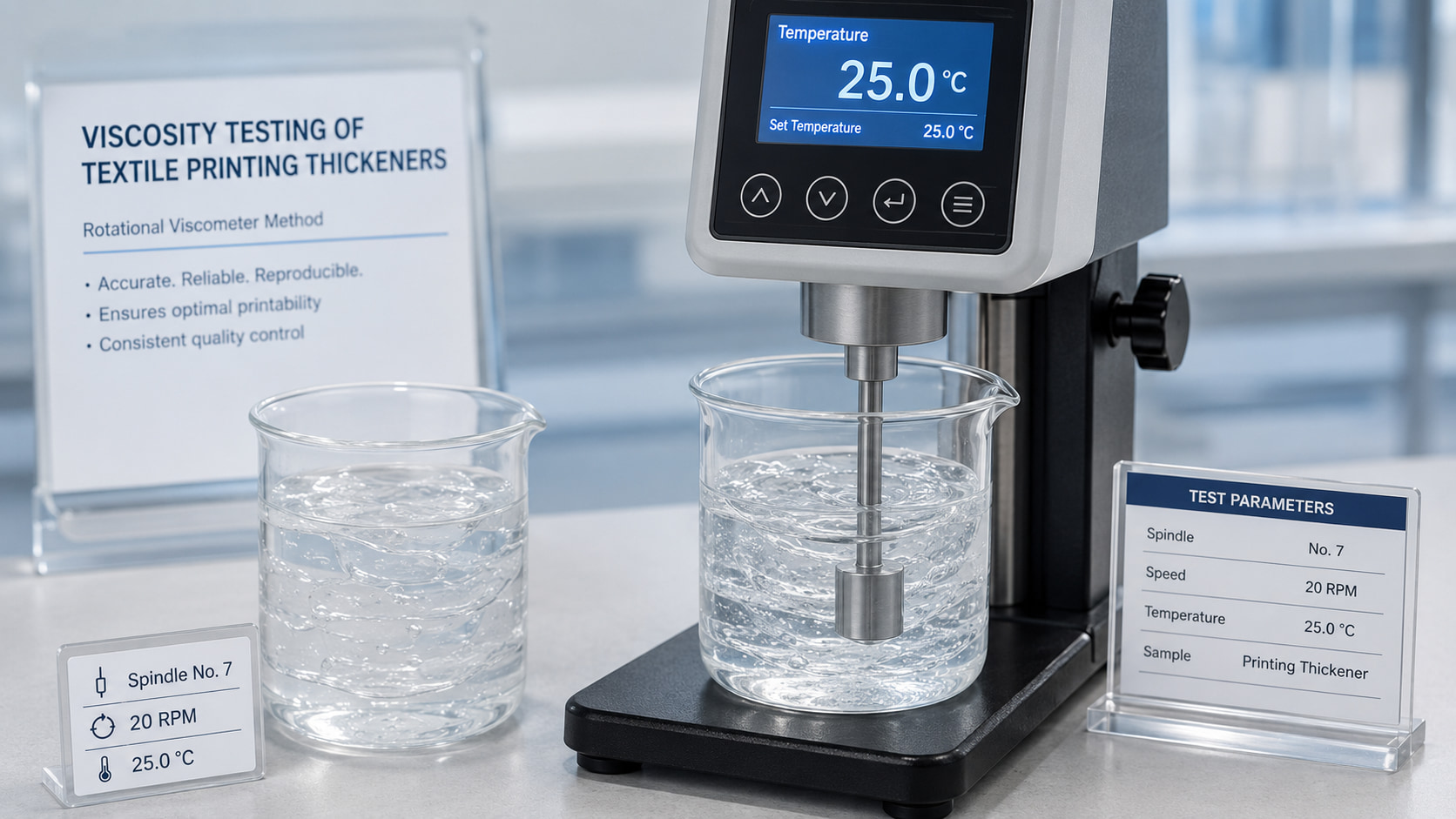
Тін басуға арналған қалыңдағыштың тұтқырлық мәндерін концентрациясы, температурасы, аспабы, шпинделі, жылдамдығы, дайындау әдісі және сынау уақыты сәйкес келмейінше салыстыруға болмайтынын біліңіз.
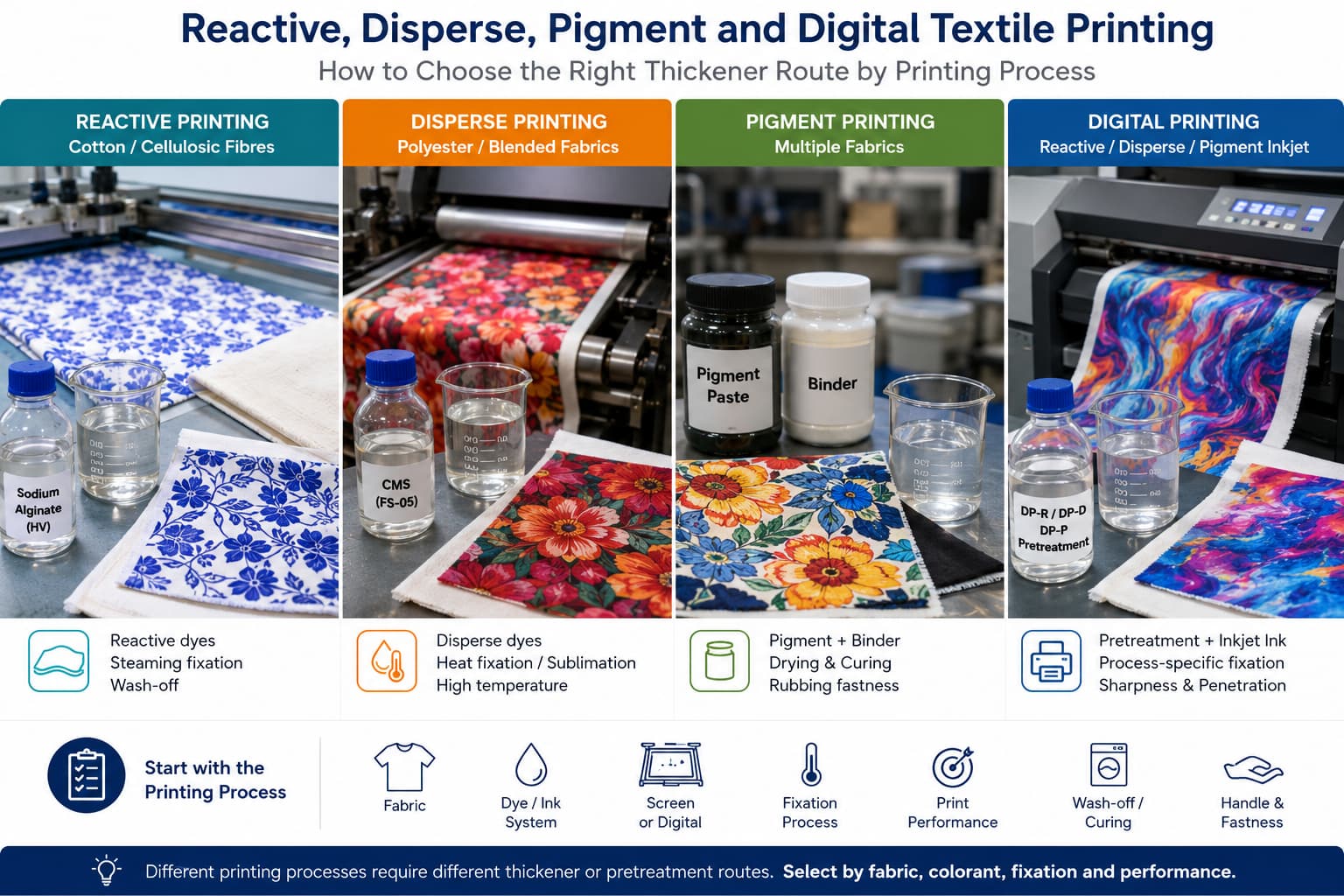
Мата, бояғыш немесе сияға негізделген реактивті, дисперсті, пигменттік және цифрлық тоқыма басып шығару үшін қалыңдағышты және алдын ала өңдеу әдістерін бекіту, жууға төзімділік және басып шығару сапасына қойылатын талаптарға сәйкес қалай таңдау керектігін үйреніңіз.
Текстиль басып шығаруда CMC, CMS, натрий алгинат және цифрлық басу пасталарын салыстырыңыз. Әрбір әдістің реактивті, дисперсті, пигментті және цифрлық процестерге қалай сәйкес келетінін және үлгі сынау, сортты сәйкестендіру және ірі көлемде сатып алу алдында сатып алушылар нені тексеруі керектігін біліңіз.
Натрий альгинаты реактивті басу пастасы үшін тұрақты әрі жуылатын қалыңдатқыш ретінде тоқыма басуда кеңінен қолданылады. Сатып алар алдында тұтқырлық дәрежесін, тазалық дәрежесін және қолдануға жарамдылығын қалай бағалау керектігін және FSX Chemical компаниясының әлемдік сатып алушыларға техникалық мәліметтер мен үлгілер арқылы қалай қолдау көрсететінін біліңіз.
Choose CMC for textile printing by application, DS, viscosity method and formulation trials. Use a practical checklist to compare grades before bulk purchase.
Карбоксиметилцеллюлоза су негізіндегі сияларда, гравюра баспасында және струмельді баспаға дейінгі өңдеуде қоюлағыш және тұрақтандырғыш ретінде қолданылады. Бұл нұсқаулық сатып алу топтары үшін негізгі сорт параметрлері мен жеткізу көздерін таңдау мәселелерін қамтиды.
CMC негізіндегі басып шығару пастасы пигменттік, реактивті және цифрлық тоқыма басып шығаруда қолданылады. Бұл нұсқаулық қандай параметрлер маңызды екенін, жеткізушілерді қалай салыстыру керектігін және ірі көлемдегі тапсырыс бергенге дейін нені сұрау керектігін түсіндіреді.
Натрий альгинаты мен CMC екеуі де тоқыма басуда қоюлағыш ретінде қолданылады, бірақ олар әртүрлі бояғыш жүйелері мен өңдеу шарттарына сәйкес келеді. Бұл нұсқаулық негізгі айырмашылықтарды және оларды қашан қолдану керектігін түсіндіреді.
Текстильге арналған сандық сия бүрку баспасының паста мен алдын ала өңдеу талаптары шелкографиядан ерекшеленеді. Бұл нұсқаулық натрий алгинатты сандық текстиль баспасында қалай қолданатынын және сатып алу топтары қандай сапа параметрлерін көрсетуі тиіс екенін түсіндіреді.
Food-grade and industrial-grade CMC labels do not define one universal DS, viscosity or purity comparison. Textile buyers should verify grade-specific assay and methods, then test the complete formulation; food-contact or pharmaceutical use needs separate, applicable documentation.
Prepare sodium alginate printing paste with a grade-specific concentration and controlled powder dispersion. Validate hydration, viscosity, filtration, air removal and holding time before production.
Assess sodium alginate in reactive-printing wastewater using measured COD load, product-specific biodegradation evidence and controlled process comparisons. Includes a buyer checklist and illustrative load calculation.
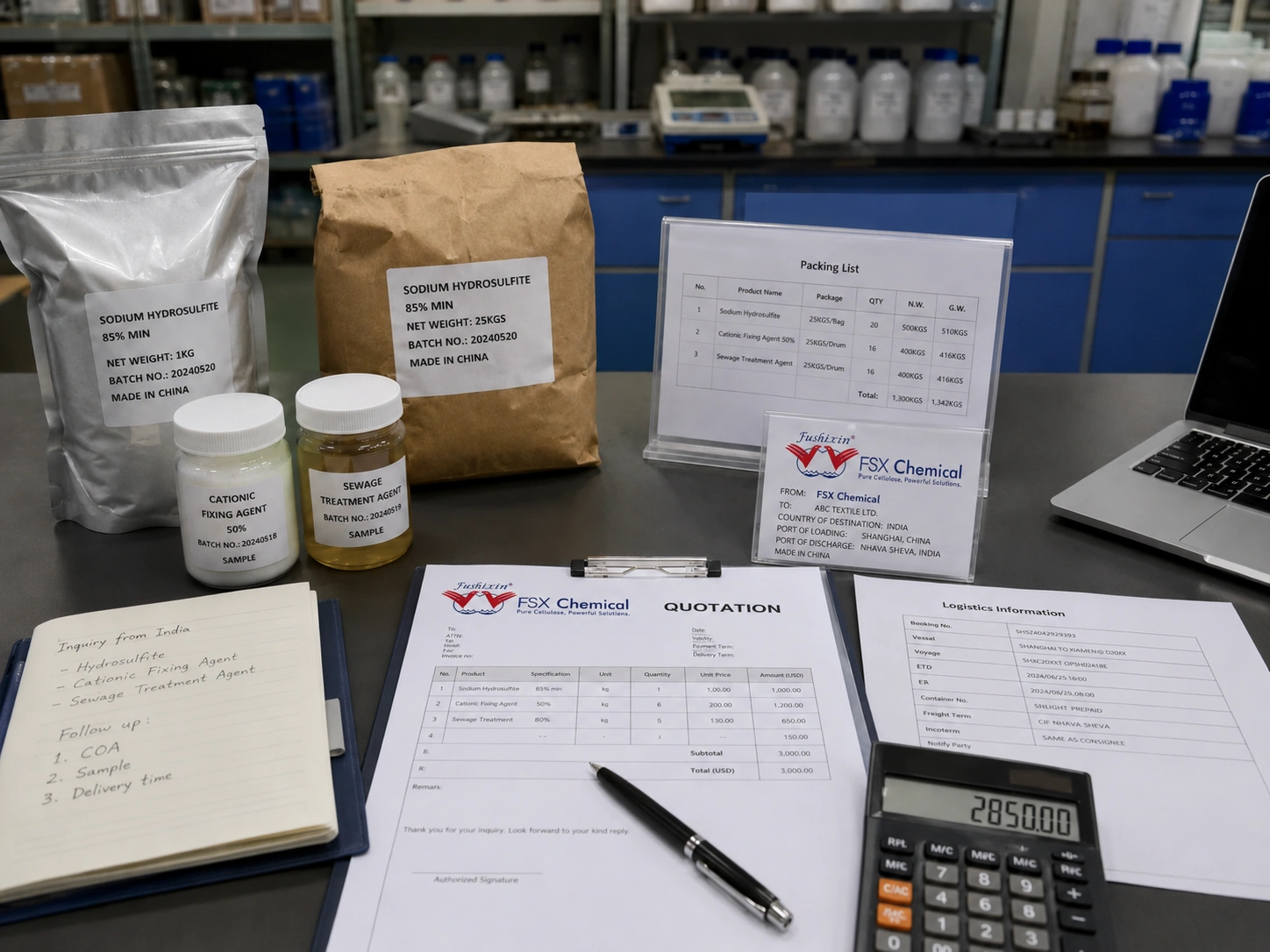
Өнімнің атауын, қолдану саласын, мөлшерін, жеткізу орнын және сізде бар кез келген TDS, үлгі фотосуреті немесе құжатты жіберіңіз. FSX Chemical бұл ақпаратты қарап шығып, баға ұсынысын алу, үлгі сәйкестендіру немесе өнімді таңдау бойынша келесі қадамды ұсынады.
Өнім туралы ақпаратӨнімнің атауы, сорты, моделі, жапсырмадағы фотосурет немесе жеткізушінің сілтемесі.
Қолжетімді құжаттарTDS, SDS, COA, үлгі фотосуреті, өнім тізімі немесе сынақ деректері.
Тапсырыс мәліметтеріЕсептелген мөлшер, қаптама, тағайындалған ел, порт немесе сауда шарты.
Өтінім немесе мәселеТекстиль басу процесі, формулалау қажеттілігі, ағымдағы мәселе немесе мақсатты көрсеткіштер.