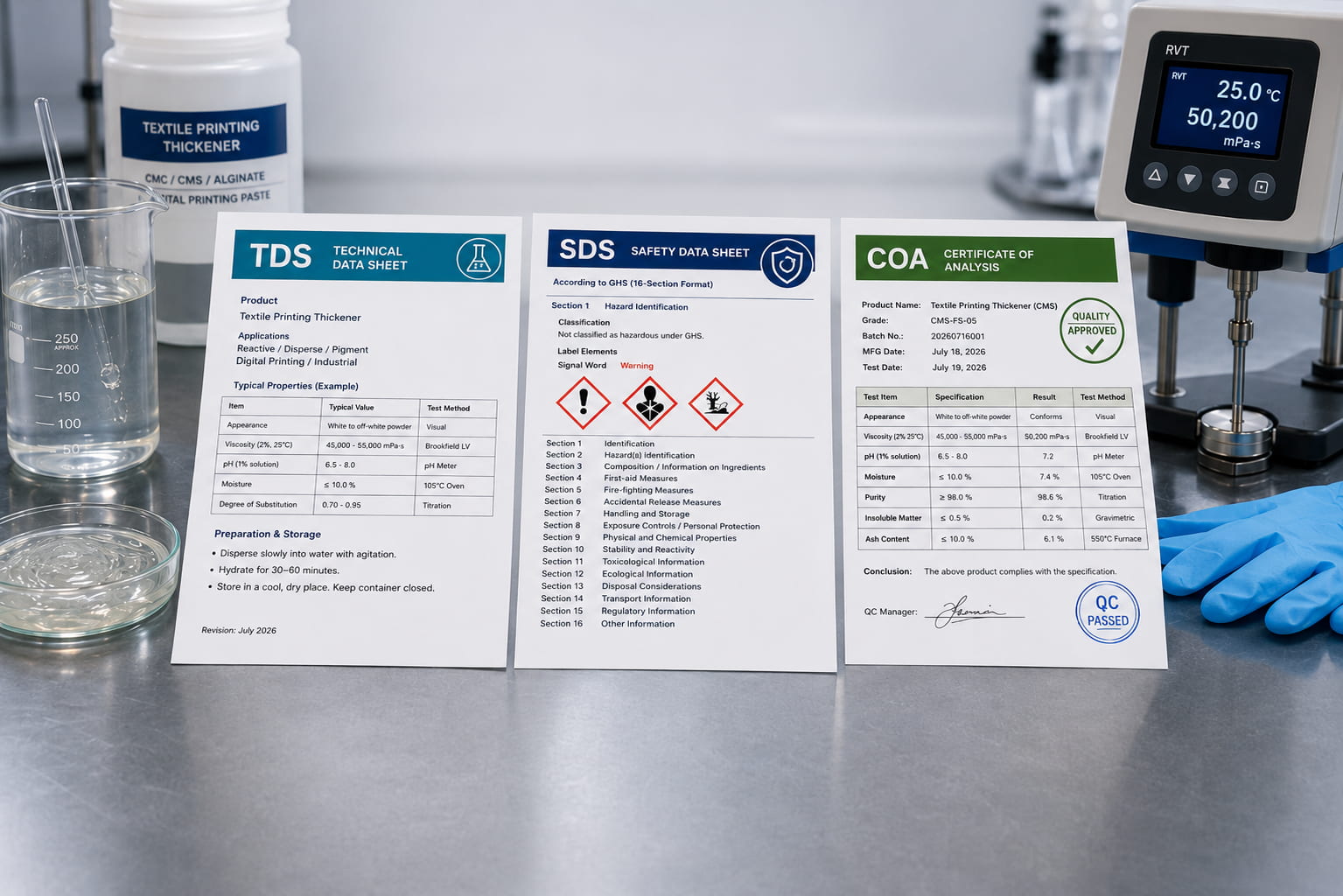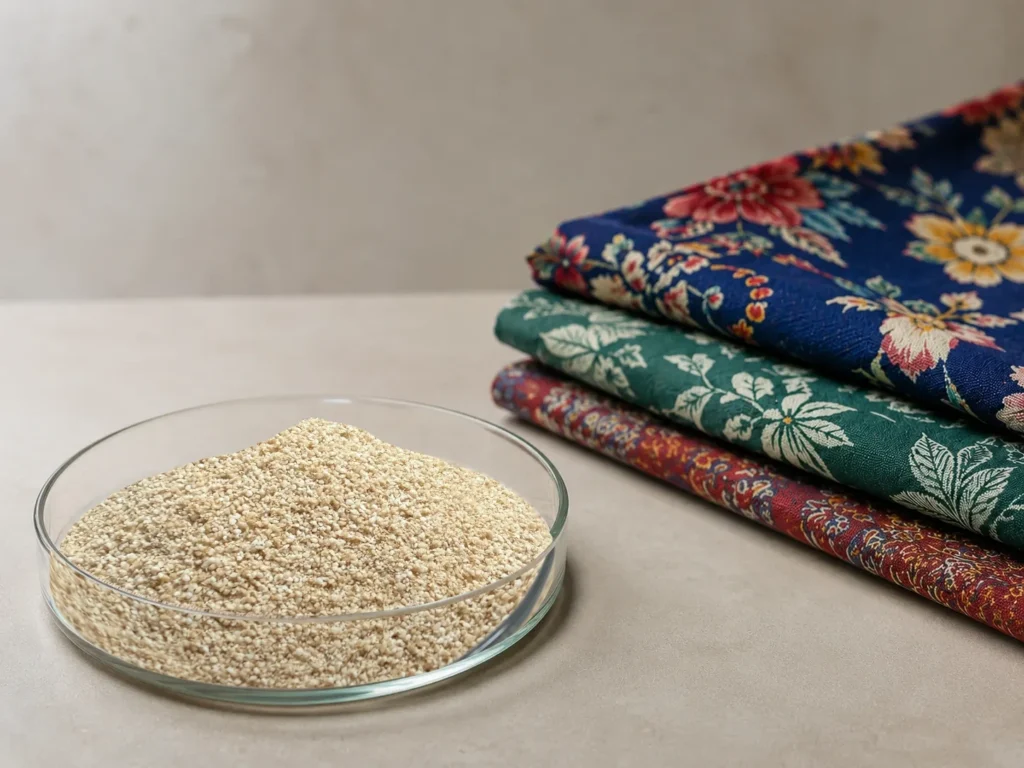
Sodium alginate printing paste can mean a hydrated stock thickener or the complete working color paste. Neither should be confused with the dry alginate grade being purchased. Record powder dose, stock concentration and stock addition separately: dilution with dye solutions and auxiliaries changes the final alginate concentration. Approve preparation and filtration first, then test the complete reactive-printing paste through the intended screen, fixation and wash-off process.
This guide explains how buyers can evaluate sodium alginate printing paste through technical specifications, application testing, document review, batch consistency, packaging, and export requirements.
What Is Sodium Alginate Printing Paste Used For?
Reactive Textile Printing Paste
The suitable grade depends on the buyer’s dye system, fabric type, printing method, target paste viscosity, preparation conditions, and production requirements.
Flat-Screen and Rotary-Screen Printing
For screen printing and rotary printing, buyers often focus on paste smoothness, screen passing, filtration, viscosity stability, and handling during production.
The sodium alginate grade should be tested under the buyer’s real preparation conditions, including water quality, stirring speed, addition method, preparation time, and paste concentration.
Digital Printing Pretreatment or Related Formulations
Some buyers may evaluate sodium alginate in digital printing pretreatment or related water-based textile formulations. In these cases, compatibility and stability testing are especially important.
A reactive screen-printing grade should not be assumed suitable for every pigment system or digital fabric-pretreatment process. Fabric pretreatment is applied to the textile; this discussion does not approve an ordinary alginate stock for addition to printhead ink.
Why Product Claims Need Practical Verification
“High Performance” Depends on the Buyer’s Formula
Performance in textile printing depends on the full system, including fabric type, dyes or pigments, auxiliaries, pH, water quality, preparation process, printing equipment, drying conditions, and washing process.
For this reason, buyers should test sodium alginate printing paste in their own formulation before confirming bulk purchase.
“Low Clogging” Should Be Checked by Filtration and Screen Passing
Low clogging performance cannot be confirmed by supplier wording alone. Buyers should check dissolution, paste smoothness, lump formation, filtration behavior, and screen passing under their own process conditions.
These observations are important for both laboratory testing and production-scale evaluation.
Compliance or Environmental Claims Need Documents
If a buyer needs restricted-substance statements, environmental documents, customer audit questionnaires, or third-party certification support, those requirements should be discussed before order confirmation.
A practical supplier should clearly explain which documents can be provided and which claims require formal third-party testing or certification.

Key Specifications Buyers Should Review
Viscosity Grade and Testing Method
A comparable viscosity result needs the concentration and its mass basis, water quality, preparation and hydration history, sample age, temperature, instrument model, spindle, speed, container and reading time. Record the value and unit together with a suitable instrument operating range. Use the same method for the reference and candidate; the supplier’s powder-grade test and the mill’s complete working-paste test are separate records.
Without a clear viscosity testing method, values from different suppliers may not be directly comparable.
Mesh Size and Dissolution Behavior
Mesh size can influence dispersion and hydration during paste preparation. However, actual dissolution behavior also depends on water quality, stirring speed, addition method, preparation time, and formulation conditions.
Buyers should test dissolution speed, lump formation, paste smoothness, and filtration behavior under their own production conditions.
Moisture, pH and Appearance
Moisture, pH, and appearance are basic but important quality indicators. They affect storage, handling, internal quality control, and repeat purchasing.
These parameters should be reviewed in the TDS and confirmed through COA data for each production batch.
Compatibility with Dyes, Pigments and Auxiliaries
Sodium alginate printing paste should be tested with the buyer’s actual dye or pigment system, auxiliaries, pH adjusters, water quality, and fabric type.
Compatibility issues may appear as viscosity drift, separation, poor leveling, filtration difficulty, uneven printing, or unstable color performance.
Keep a Powder, Stock and Working-Paste Concentration Ledger
Use a mass basis and state whether the powder is measured as supplied. For a simple stock made only from powder and water, stock concentration is powder mass divided by final stock mass. Final powder-equivalent concentration is stock mass added multiplied by its powder mass fraction, divided by final working-paste mass. This is not automatically active-polymer content.
Illustrative arithmetic only: 400 g of a 4% w/w powder-as-supplied stock contains 16 g powder equivalent. If the completed paste weighs 1,000 g, its powder-equivalent concentration is 1.6% w/w, not 4%. These values illustrate concentration arithmetic, not a recommended dose. Account separately for any additional thickener, dilution or material loss.
| Observation | Check before changing grade | Verification |
|---|---|---|
| Lumps or high filter residue | Powder feeding rate, wetting, mixing geometry, water quality and hydration history. | Repeat preparation with one controlled change; identify retained material rather than calling all residue insoluble alginate. |
| Stock is repeatable but working paste changes | Final concentration ledger, dye solutions, auxiliary additions, pH and paste age. | Compare the stock and complete paste separately at matched test conditions. |
| Viscosity readings disagree | Temperature, instrument, spindle, speed, container, immersion and measurement timing. | Repeat using an agreed method and suitable instrument operating range. |
The Brookfield DVE operating instructions identify measurement settings and sample history as relevant controls. A reproducible viscosity reading still requires a printing trial; it does not by itself prove screen release, pattern definition or wash-off.
How to Test Sodium Alginate Printing Paste
Test in the Actual Printing Formula
Sample testing should be done in the buyer’s own printing paste formulation whenever possible. Dyes, pigments, auxiliaries, water quality, pH, stirring method, paste concentration, and standing time can all affect final paste behavior.
Testing only in clean water may not be enough to confirm whether the sodium alginate grade is suitable for production.
Observe Preparation and Printing Behavior
During testing, buyers should observe dissolution speed, paste smoothness, lump formation, filtration behavior, viscosity stability, screen passing, leveling, penetration, and pattern edge control.
These practical observations are often as important as the specification data shown in the TDS.
Compare Against the Current Product
If the buyer is replacing an existing sodium alginate, printing paste, CMC, CMS, or blended thickener, the new sample should be tested against the current product under the same conditions.
This helps the buyer judge whether the recommended grade is technically suitable before discussing bulk supply.
Confirm Sample-to-Bulk Consistency
Before confirming a bulk order, buyers should check whether the approved sample and bulk shipment will follow the same viscosity range, mesh size, specification range, packaging format, batch traceability, and COA requirements.
This helps reduce the risk of sample approval but unstable bulk performance later.
Documents Buyers Should Request
TDS for Specification Review
The Technical Data Sheet helps buyers review the standard product specification. It should include appearance, viscosity, mesh size, moisture, pH, storage conditions, and testing method.
The TDS supports initial grade screening, but it should not replace sample testing in the buyer’s own printing formulation.
COA for Batch Confirmation
The Certificate of Analysis confirms the actual data of a specific production batch. It is important for bulk orders, repeat purchasing, distributor supply, and internal quality control.
Buyers can compare COA records across shipments to check whether key parameters remain within the agreed range.
SDS for Handling and Shipment Review
The Safety Data Sheet supports handling, storage, transport, and internal safety review. For international purchasing, SDS may also be needed for shipment and customs-related communication.
Buyers should make sure the SDS product name and supplier information match the order documents.
Additional Customer or Compliance Documents
If the buyer needs restricted-substance statements, environmental documents, customer audit questionnaires, certificate copies, or third-party testing support, those requirements should be discussed before order confirmation.
The supplier should explain which documents can be provided, which product or site they apply to, and which claims require formal third-party testing.
How to Compare Sodium Alginate Printing Paste Suppliers
Compare Equivalent Grades and Applications
Before comparing suppliers, buyers should confirm whether each quotation is based on the same application, viscosity range, testing method, packaging, order quantity, and trade terms.
A lower price may not be useful if it is based on a different grade or an unsuitable specification.
Review Batch Traceability
Batch traceability helps buyers manage quality control, repeat orders, and customer feedback. Buyers should confirm batch number, label information, COA availability, and packaging format before shipment.
Confirm Packaging and Export Documents
Packaging size, bag type, net weight, pallet requirements, labels, invoice, packing list, COA, SDS, and other export-related documents should be confirmed before shipment.
Document requirements may vary by destination country, product type, and the buyer’s internal purchasing process.
Avoid Broad Claims Without Test Results
Claims such as “high-performance,” “eco-friendly,” “low clogging,” “high color fastness,” or “stable for long-term storage” should be supported by documents, agreed test methods, or the buyer’s own evaluation results when they are important to purchasing decisions.
Common Issues and Troubleshooting Points
Lumps or Poor Dissolution
Lumps may be related to fast addition, insufficient dispersion, unsuitable stirring, water quality, or preparation method. Buyers should record preparation conditions during sample testing.
Screen Blocking or Poor Filtration
Screen blocking or filtration difficulty may come from poor dissolution, formulation incompatibility, particle contamination, unsuitable viscosity, or insufficient filtration before printing.
Unstable Viscosity
Viscosity drift may be caused by water quality, temperature, pH, standing time, formulation compatibility, or grade mismatch.
Buyers should compare production conditions with the supplier’s viscosity testing method.
Uneven Printing or Poor Pattern Control
The full printing system should be reviewed before changing only one raw material.
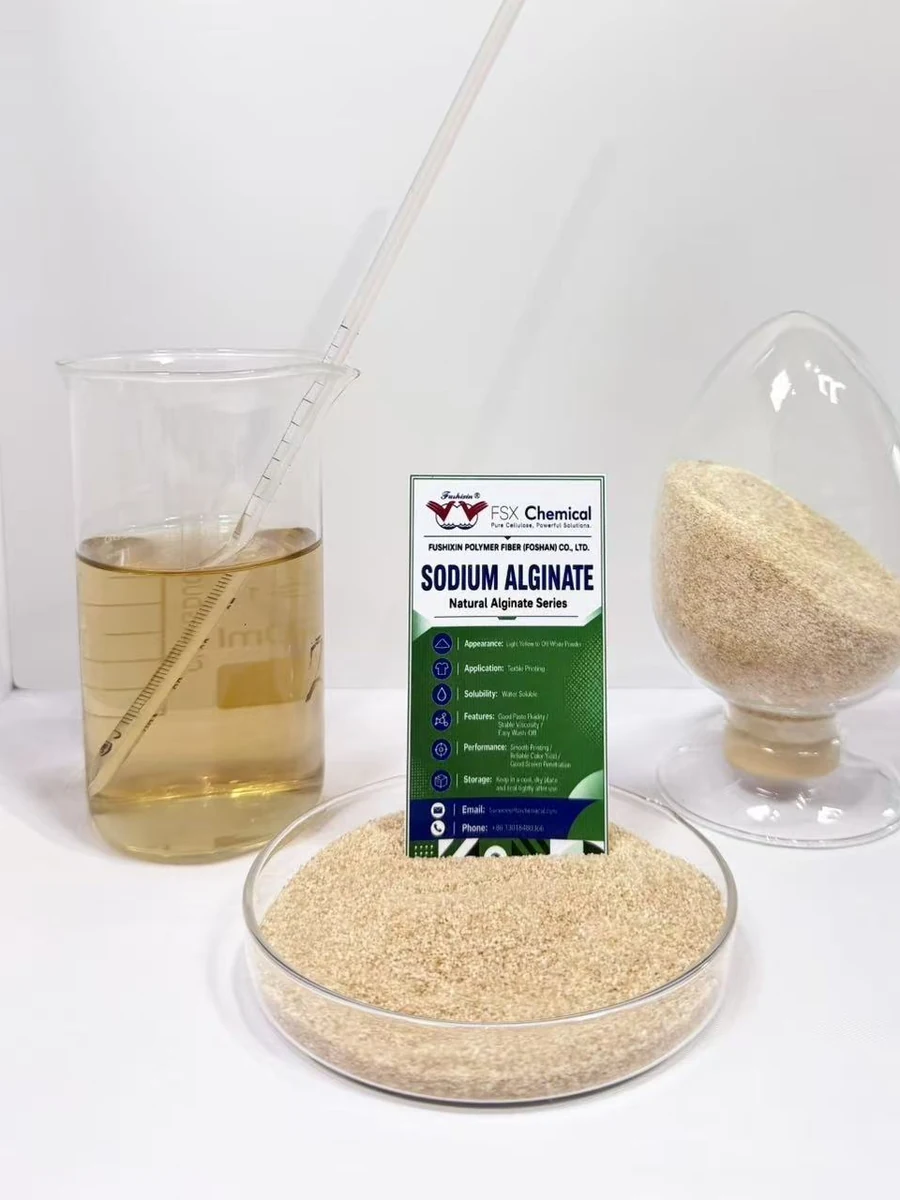
How FSX Chemical Supports Sodium Alginate Printing Paste Buyers
We do not suggest choosing sodium alginate printing paste only by product name, broad performance claims, compliance claims, or price. The recommended sodium alginate grade should be reviewed through technical documents and tested in the buyer’s own printing system before bulk purchase.
Next Steps
- Share Your Printing Process — tell us whether you use reactive printing, screen printing, rotary printing, digital pretreatment, pigment printing, or another process.
- Clarify Fabric and Formula Conditions — provide fabric type, dye or pigment system, auxiliaries, water quality, pH, and preparation method.
- Define Your Target Viscosity — provide viscosity range, test concentration, temperature, instrument method, and current product grade if available.
- Request Grade Matching — ask for a suitable sodium alginate printing paste grade based on your actual production conditions.
- TDSni so'rang — review viscosity, mesh size, pH, moisture, appearance, storage conditions, and testing method.
- Request a COA — confirm whether batch data matches the agreed specification range before shipment.
- Request an SDS — check handling, storage, transport, and product information.
- Namuna so'rang — test the recommended grade in your own printing formulation before confirming bulk orders.
- Confirm Packaging and Export Documents — check bag size, labels, batch traceability, invoice, packing list, COA, SDS, and other required documents before shipment.
- Request sample and grade matching — send the current grade, fabric, reactive-printing route, complete recipe basis and the specific trial result you need to improve. FSX Chemical bilan bog'laning to discuss the next evaluation step.