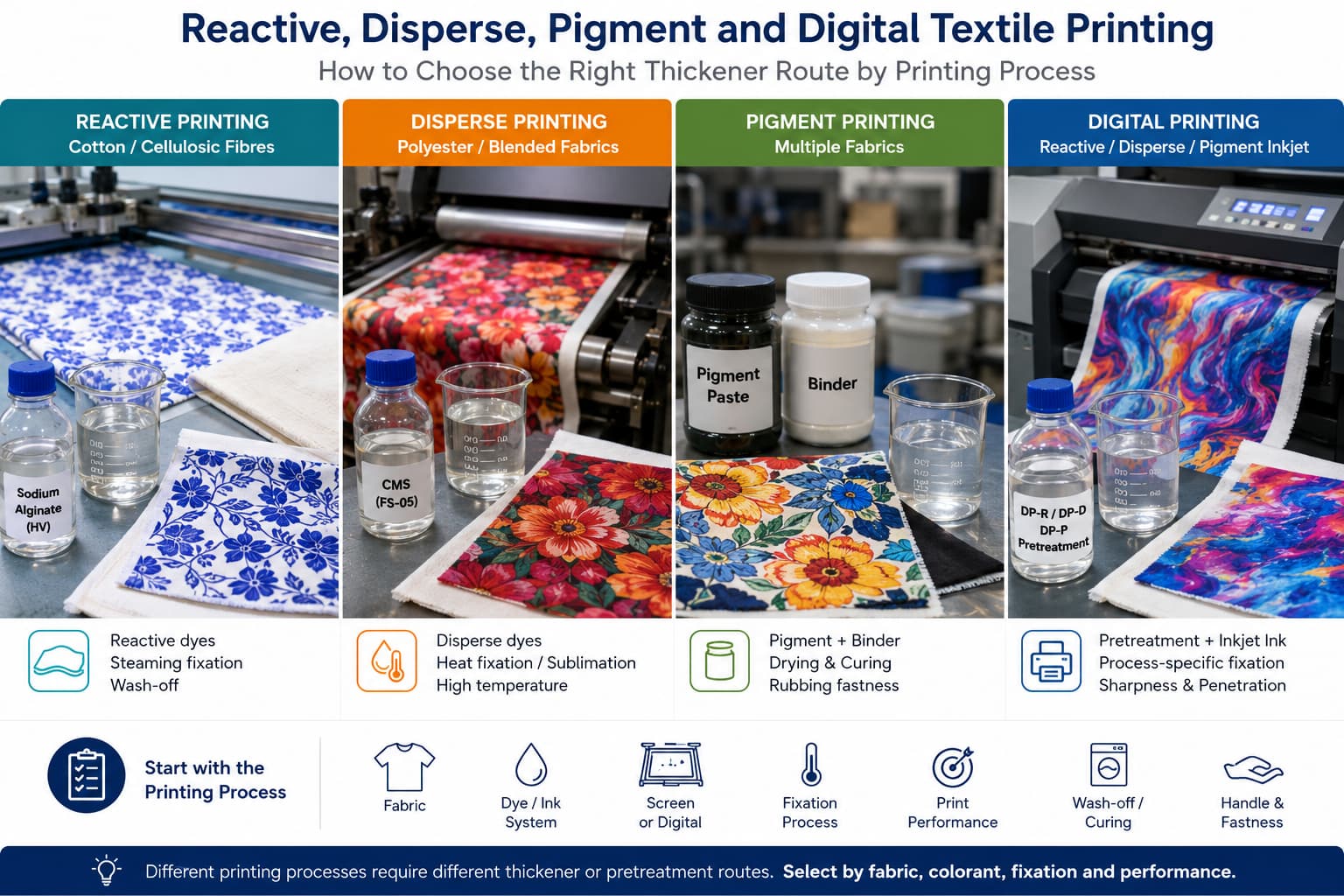















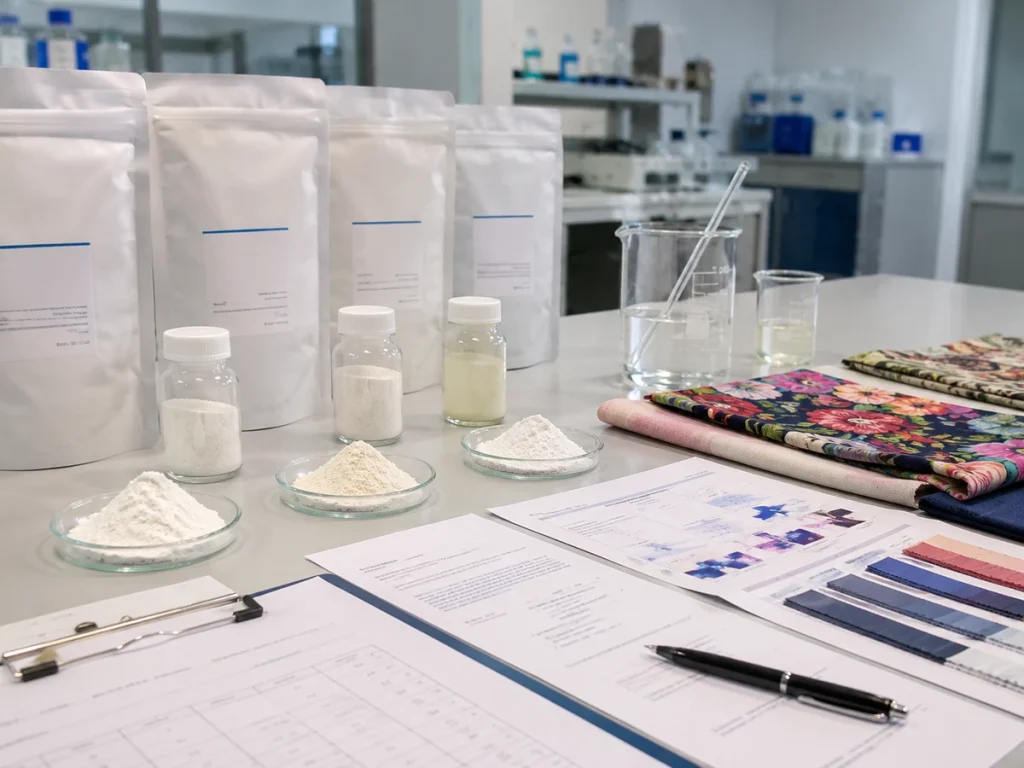
A useful supplier recommendation should therefore connect the fabric to the complete application. The correct question is not simply “Which thickener works on cotton?” It is “Which thickener should be tested for this cotton fabric, this colorant, this machine and this target print result?”
Start with the Printing System, Not the Product Name
Why fabric alone is not enough
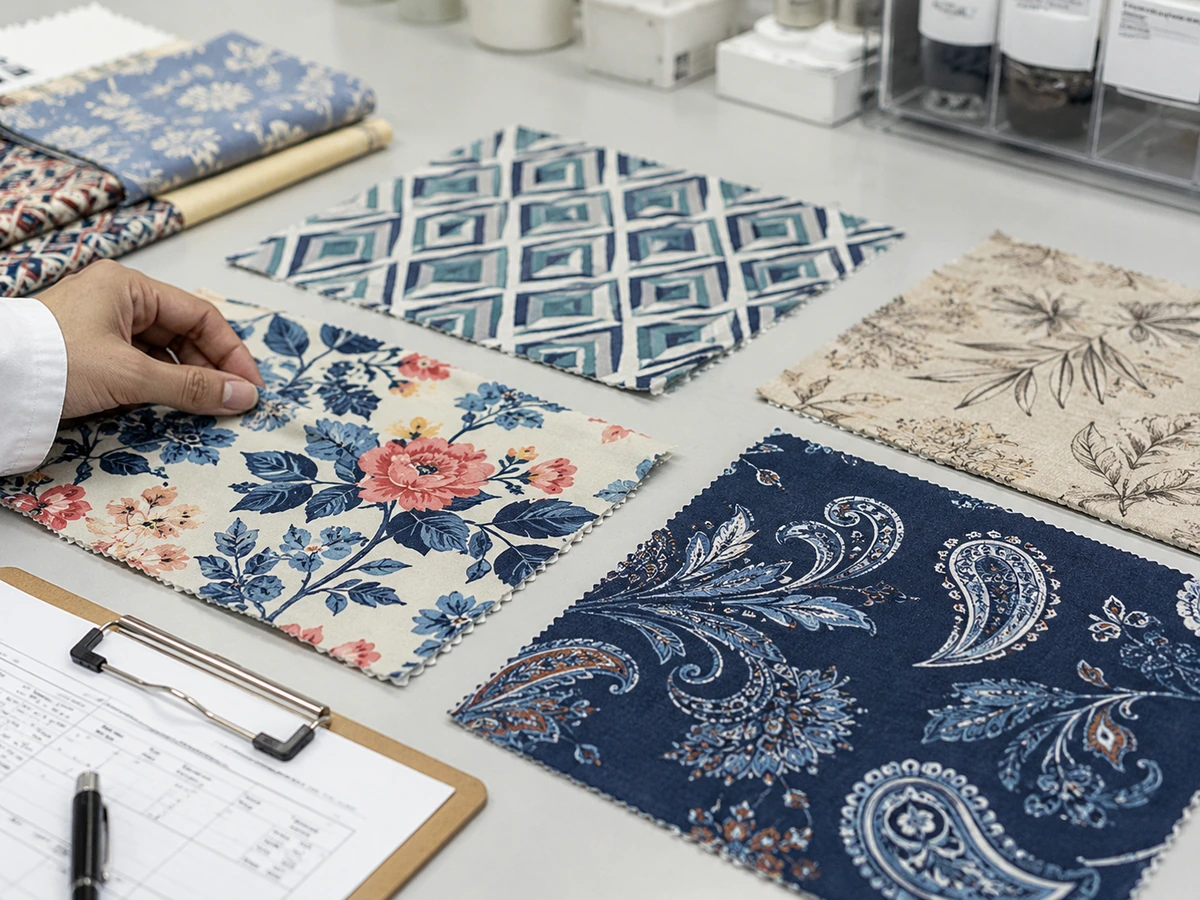
Fabric tells you how the substrate may absorb paste and respond to fixation, but it does not define the whole formulation. Reactive dye printing on cotton, pigment printing on cotton and digital pretreatment on cotton are three different chemical systems even though the fabric may be identical.
The dye or pigment system often has the strongest influence on thickener compatibility. Printing method, screen geometry, machine speed, water quality, auxiliaries and the required wash-off also affect the final choice.
Information to collect before comparing grades
- Fabric and fibre composition, including blend ratio when applicable
- Colorant system: reactive, disperse, acid, vat, discharge or pigment
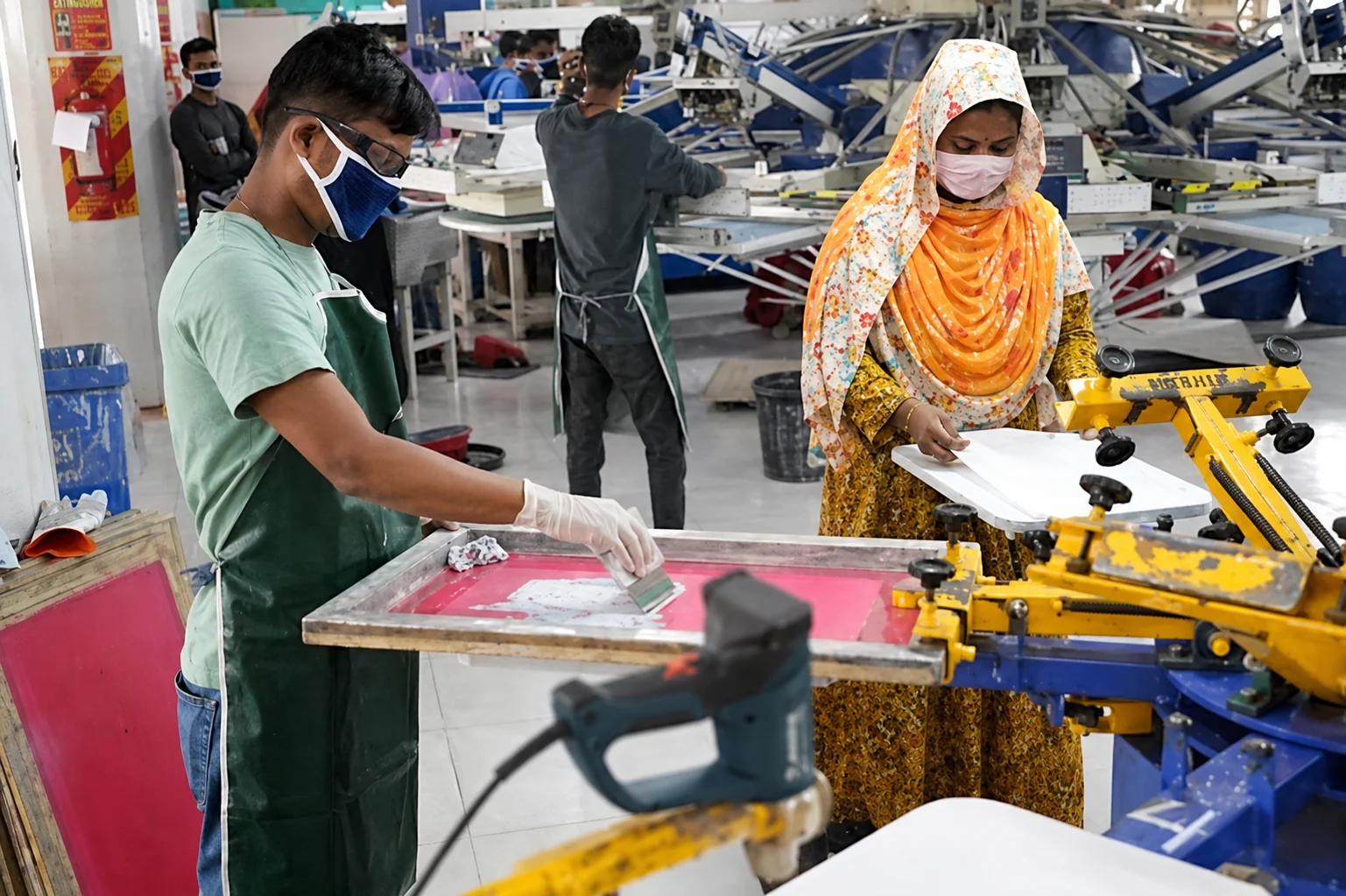
- Printing method: flat screen, rotary screen, roller, coating or digital pretreatment
- Current paste recipe or supplier TDS, if available
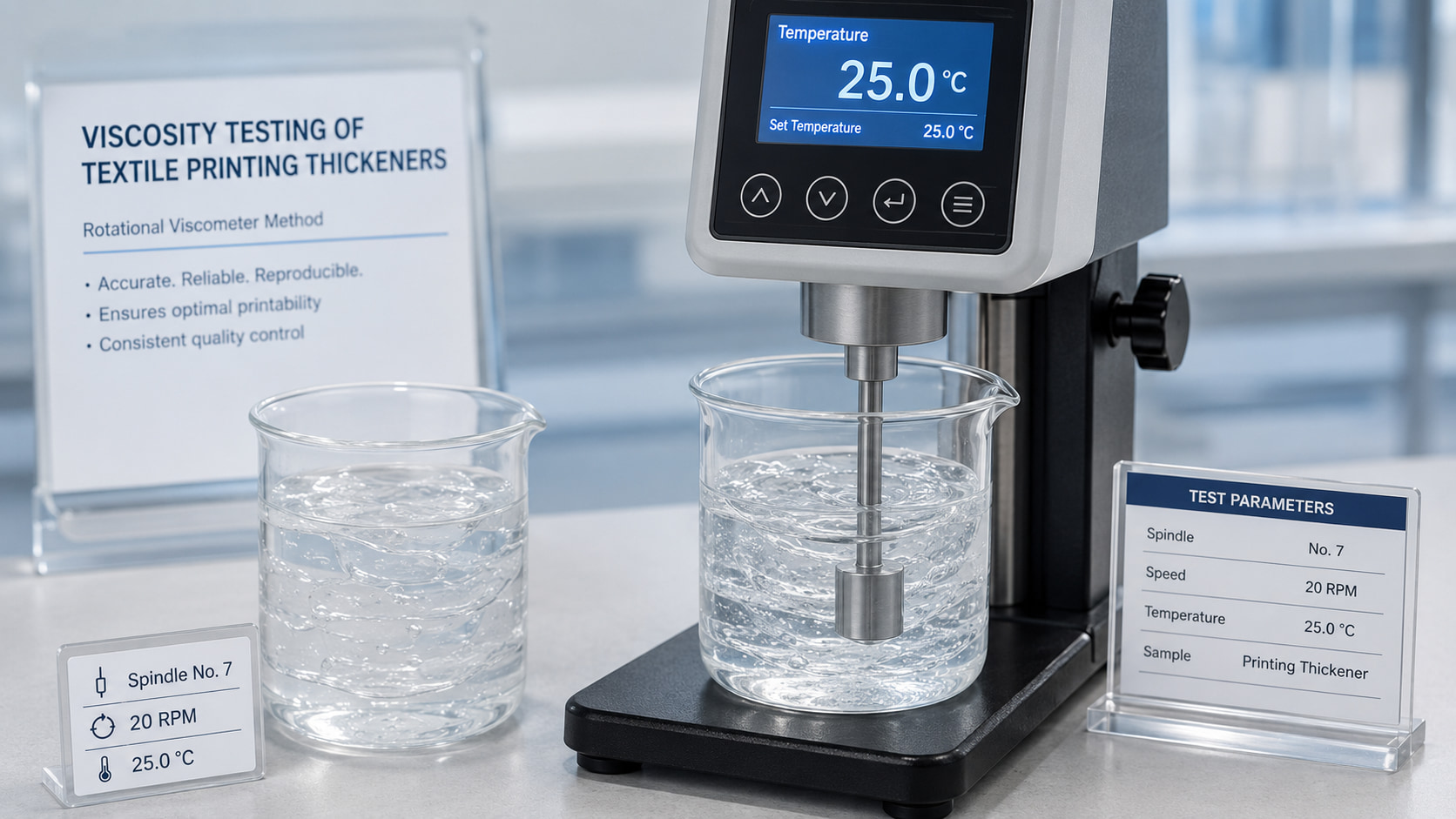
- Target viscosity with concentration, temperature, instrument or method and unit
- Main production issue, such as bleeding, screen blockage, slow dissolution, residue, poor wash-off or viscosity drift
Match the Thickener to Fabric and Coloration Route
Cotton and viscose with reactive dyes
ألجينات الصوديوم is a common benchmark thickener for reactive printing on cotton and viscose. A suitable grade can provide the paste body and flow needed for screen transfer while supporting practical wash-off after fixation.
Do not select the grade from an HV, MV or LV label alone. Compare viscosity under the stated test conditions, hydration behavior, insoluble matter, paste filtration, compatibility with alkali and auxiliaries, and the print result in the factory’s own formula.

Polyester with disperse dyes or pigments
Polyester printing may use disperse colorants, pigments or digital routes. Depending on the process, the starting thickener route may be a selected CMS, synthetic thickener, compound system or a dedicated digital pretreatment rather than a standard reactive-printing alginate.
The trial should examine paste stability, print penetration, outline definition, fixation conditions and residue after post-treatment. A grade that performs well in reactive cotton printing should not be assumed to work in a disperse polyester process.
Blended fabrics
For cotton-polyester and other blends, first confirm whether the mill uses one colorant route, a combined route or separate process stages. The thickener must remain compatible with the complete recipe and with the fixation conditions required by both fibre components.
Blends usually require a controlled lab trial because absorption, penetration and color balance can vary across the two fibres. Record results on the actual production fabric rather than relying on a generic blend description.
Silk, wool and nylon with acid or selected reactive systems
Protein and polyamide fibres may use acid dyes or other specialized printing routes. Sodium alginate or another dedicated thickener may be evaluated, but the choice should be confirmed against the dye class, pH, fixation method and fabric-handle requirement.
Ask for an application-specific recommendation and test the thickener with the exact dye and auxiliaries. Avoid extending a cotton-reactive recommendation to silk, wool or nylon without a separate trial.
How the Main Thickener Families Differ
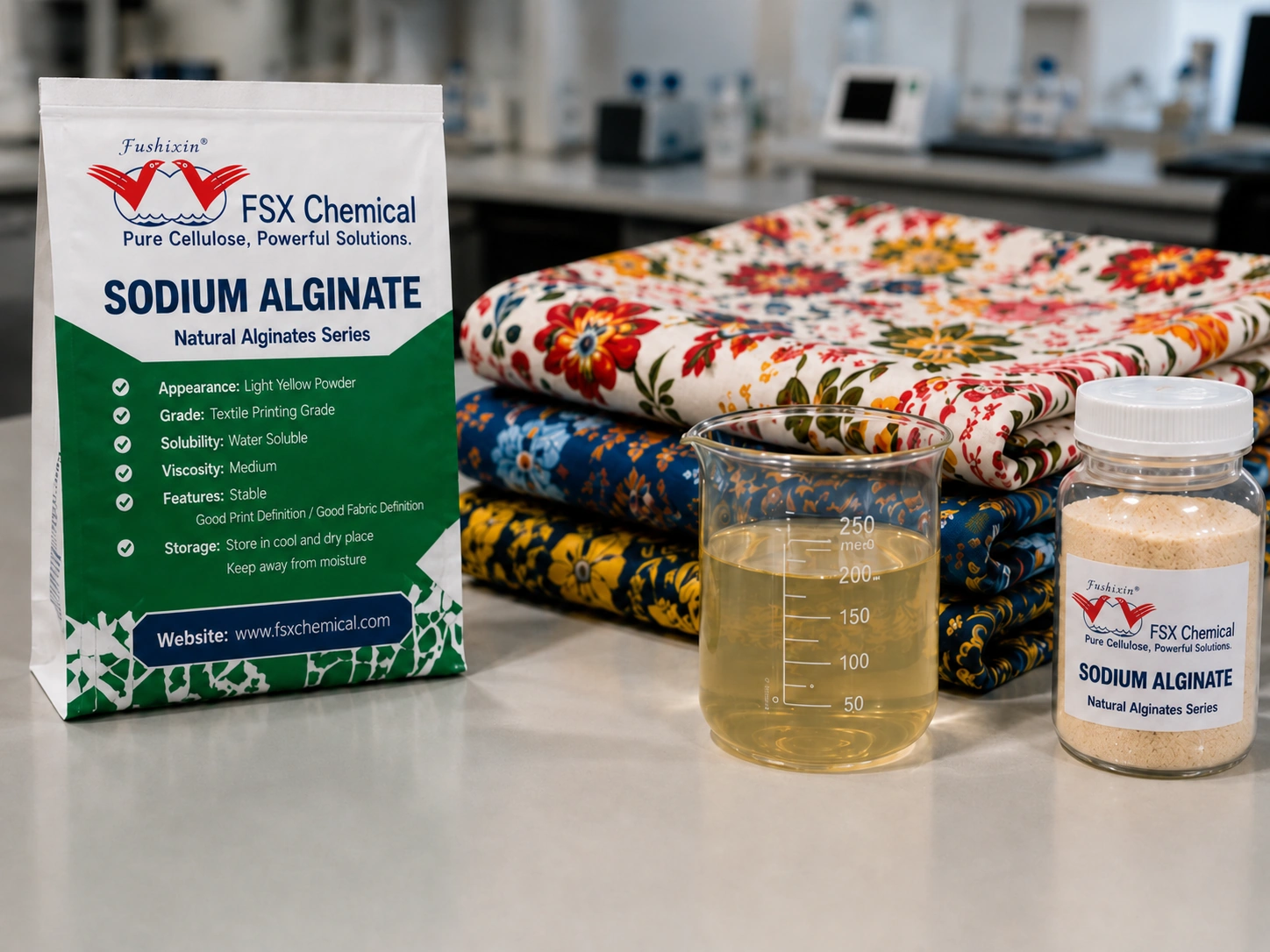
ألجينات الصوديوم
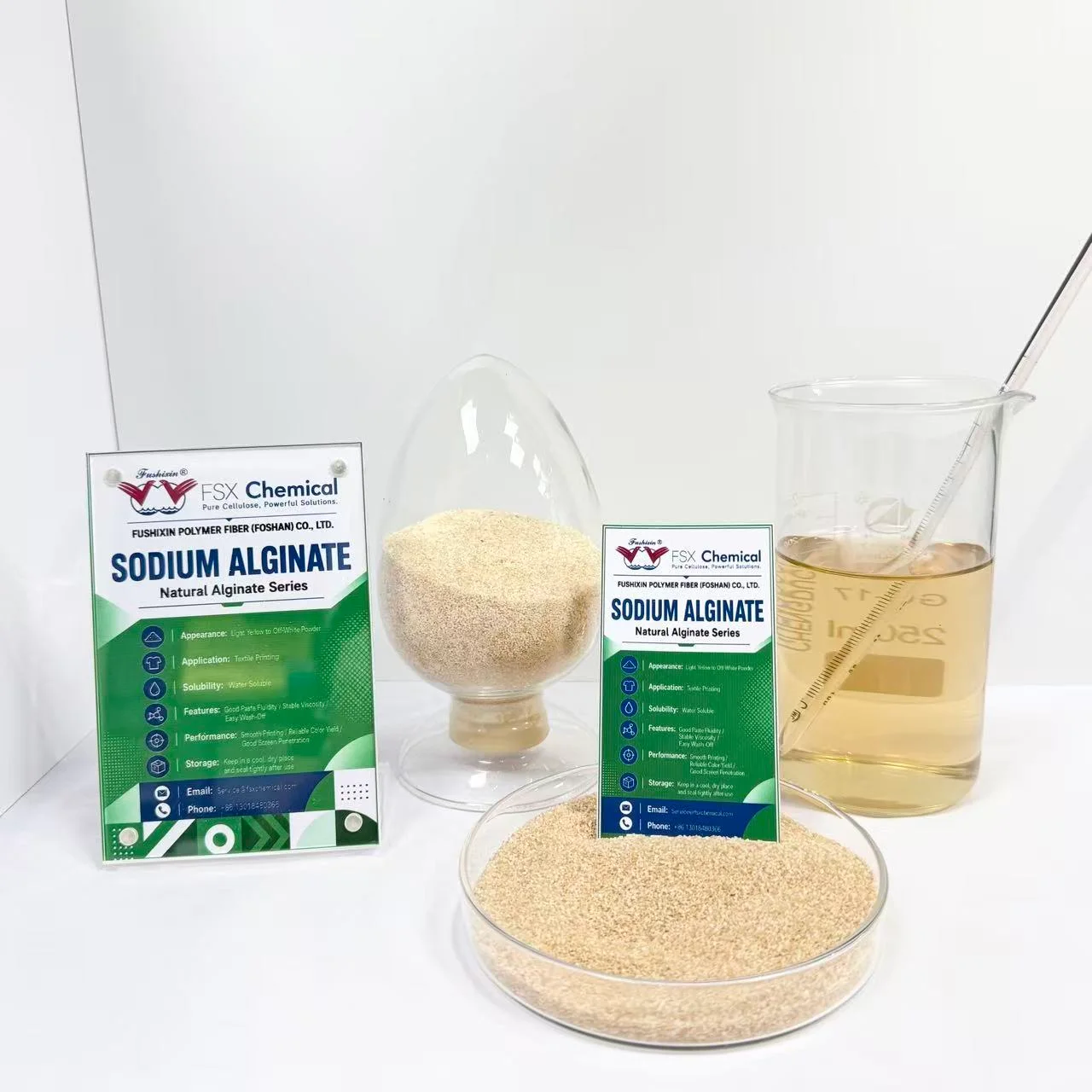
Best known as a thickener route for reactive textile printing, sodium alginate is selected around viscosity grade, dissolution, filtration, purity-related specifications, pH, moisture and batch consistency. Its suitability still depends on the complete formulation and process.
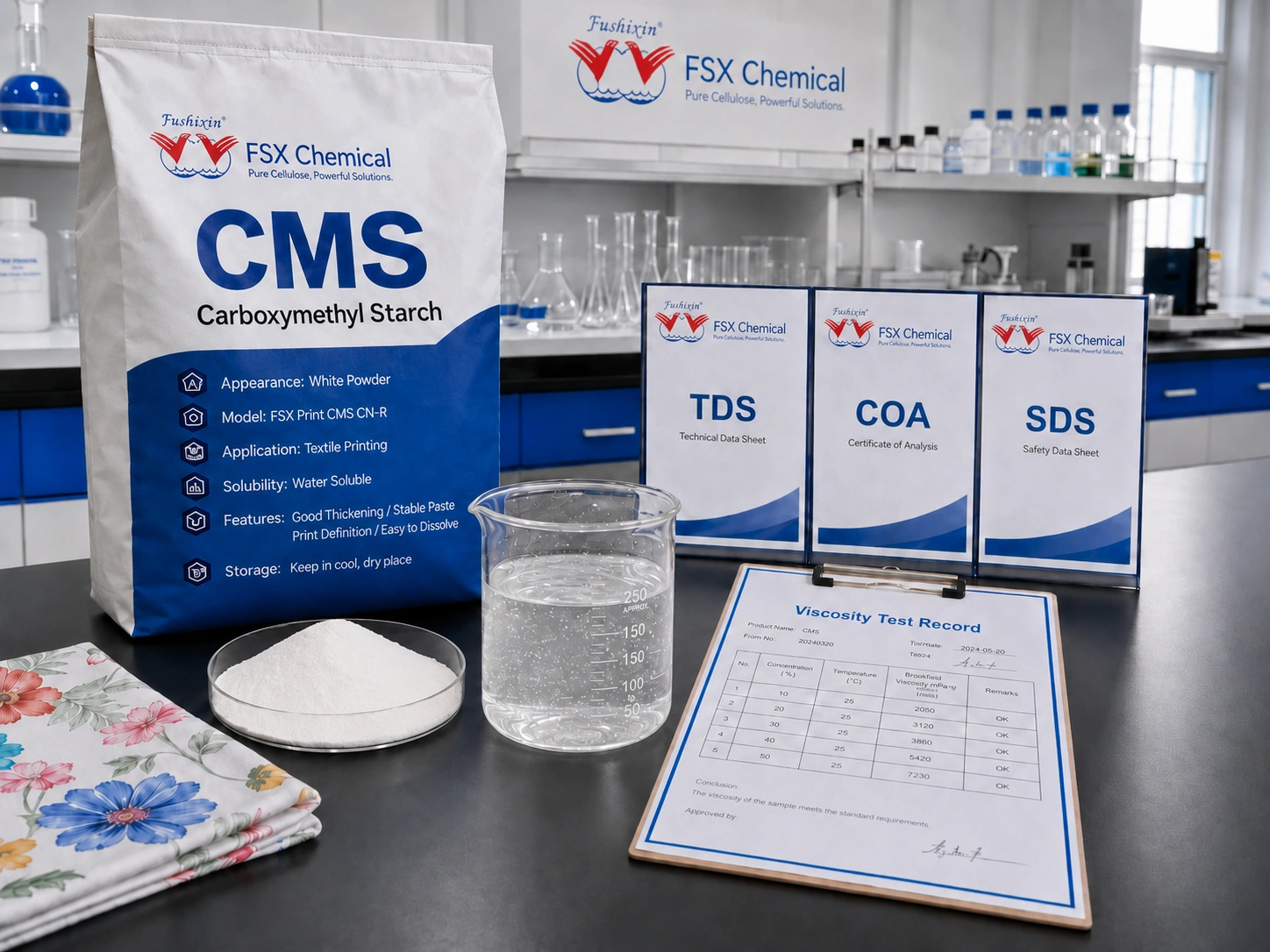
نشا الكربوكسي ميثيل (CMS)
Carboxymethyl starch grades can be evaluated for selected reactive, disperse, pigment, vat, discharge or compound printing systems, depending on the product design. Buyers should confirm the intended process on the TDS and run a direct comparison against the current paste.
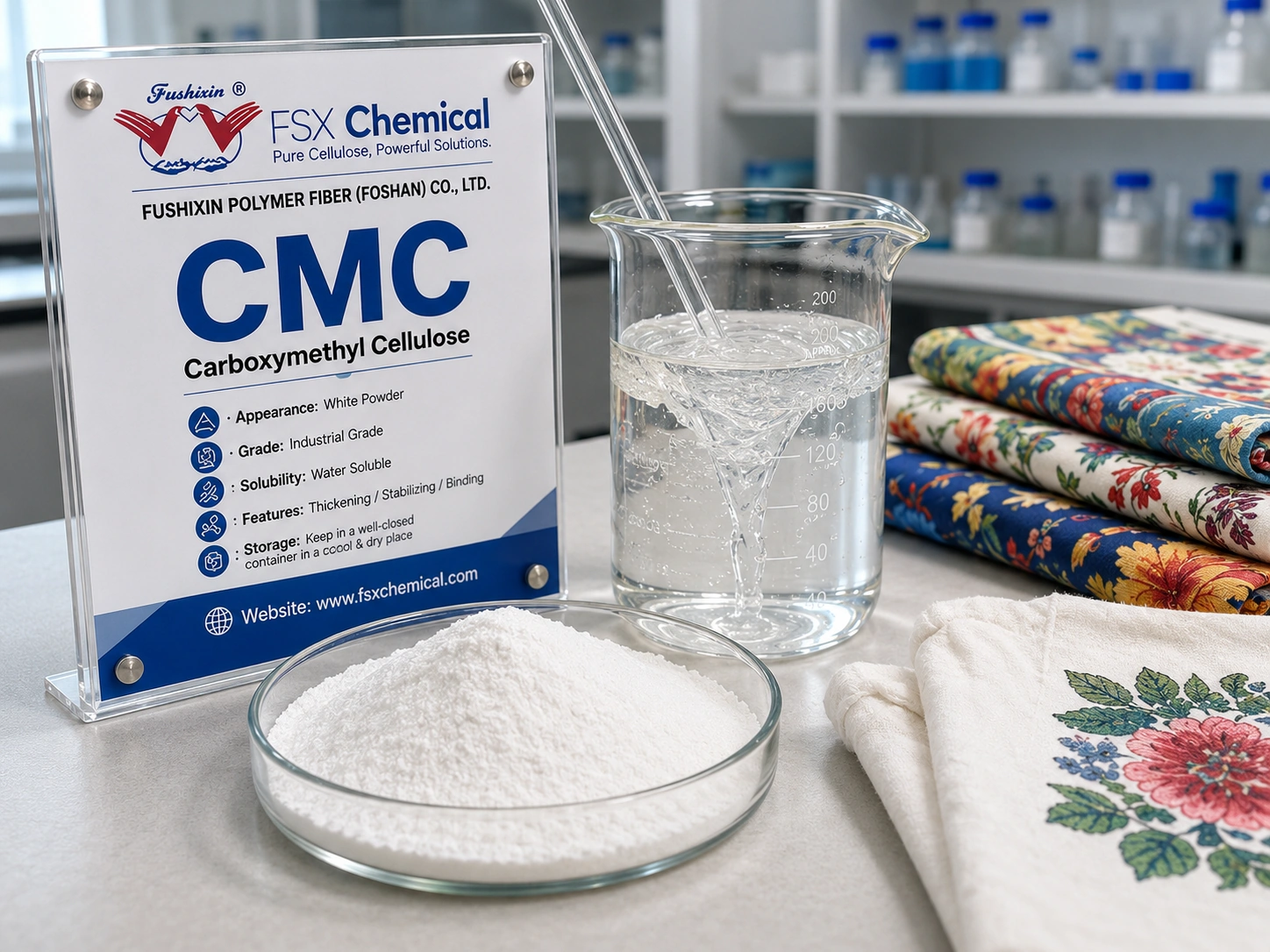
كاربوكسي ميثيل السليلوز (CMC)
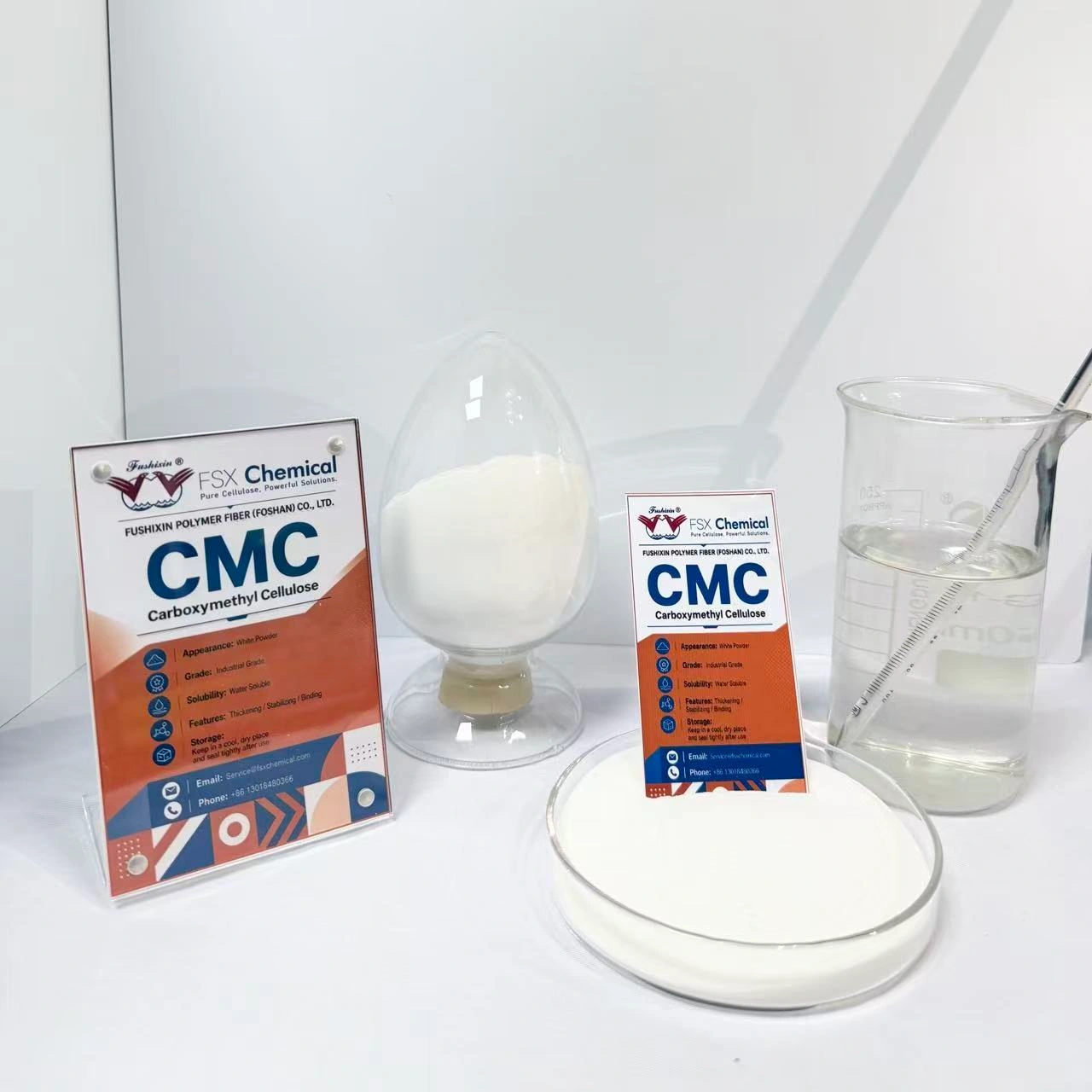
كاربوكسي ميثيل السليلوز is a cellulose-based rheology modifier used in selected pigment formulations, supporting thickener systems and other industrial applications. Degree of substitution, viscosity test conditions, purity, salt content, solubility and compatibility with binders or auxiliaries are important purchasing points.
CMC should not be treated as a universal substitute for sodium alginate in reactive dye printing. Use an application-specific grade recommendation and confirm compatibility by testing the full formula.
Synthetic and compound thickeners
Synthetic and compound systems may provide high thickening efficiency or process-specific rheology, especially in pigment printing and specialized paste routes. Their behavior can change in the presence of electrolytes, binders, defoamers and other auxiliaries, so the complete recipe matters.
Digital printing paste and pretreatment
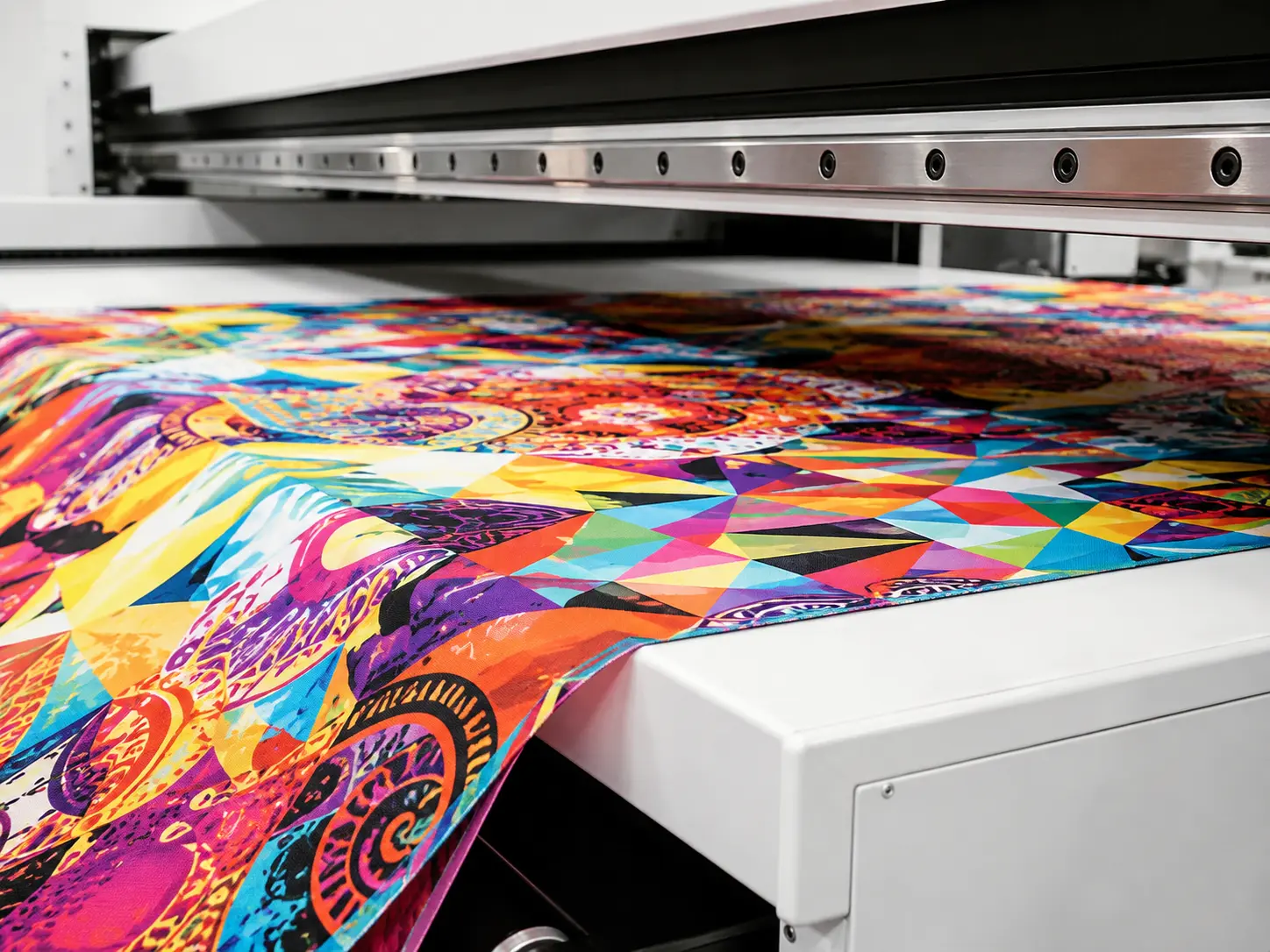
Digital textile printing requires a separate selection route. Pretreatment viscosity, filtration, coating uniformity, ink chemistry, storage stability and fabric response are usually more important than matching a screen-printing paste by name. Buyers can review the available معجون الطباعة الرقمية route before requesting a grade trial.
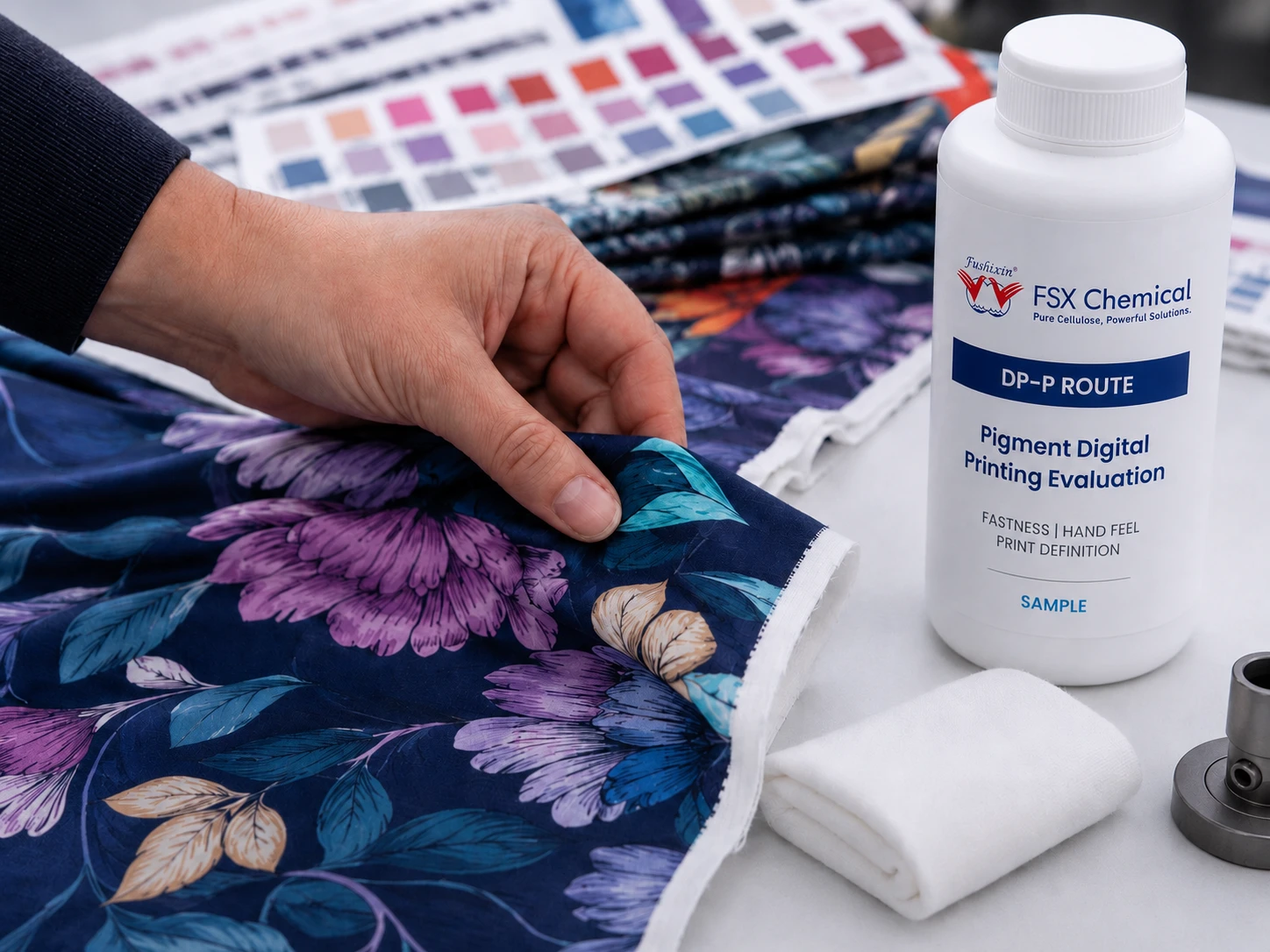
Quick Selection Matrix
| Printing route | Starting thickener direction | What the trial must verify |
|---|---|---|
| الطباعة التفاعلية على القطن أو الفسكوز | Sodium alginate as a common benchmark; selected CMS or compound route only after application review | Viscosity conditions, screen passing, outline, color response, wash-off and fabric handle |
| Pigment printing on multiple fabrics | Synthetic, CMC, CMS or compound system according to binder and recipe | Binder compatibility, storage stability, print definition, rubbing result and handle |
| الطباعة المتفرقة على البوليستر | Selected CMS, synthetic or compound thickener; dedicated pretreatment for digital routes | High-temperature process fit, penetration, residue, shade consistency and machine behavior |
| Acid printing on silk, wool or nylon | Application-specific alginate or specialized thickener | Dye compatibility, pH, fixation, wash-off and fabric handle |
| Digital textile pretreatment | Dedicated digital printing paste or pretreatment grade | Filtration, coating uniformity, storage, ink response, definition and penetration |
المواصفات التي ينبغي على المشترين مقارنتها
Viscosity with full test conditions
A viscosity number is not comparable unless the concentration, temperature, hydration time, instrument or method and unit are stated. Two suppliers can use the same “high viscosity” description while testing at different concentrations.
Rheology and recovery after shear
Printing paste must flow through the screen or coating system and then recover enough body to hold the pattern. A laboratory viscosity value is useful, but a real paste trial is needed to assess screen behavior, edge definition and spreading.
Dissolution, filtration and insoluble matter
Slow hydration, gel particles or insoluble residue can create filtration problems and screen blockage. Compare preparation time, mixing requirements, filtration behavior and the appearance of the prepared paste under the same conditions.
pH and compatibility with the full recipe
Alkali, salts, binders, fixatives, defoamers and other auxiliaries can change viscosity and stability. Test the candidate thickener in the complete formulation, not only as a solution in water.
Batch consistency and documentation
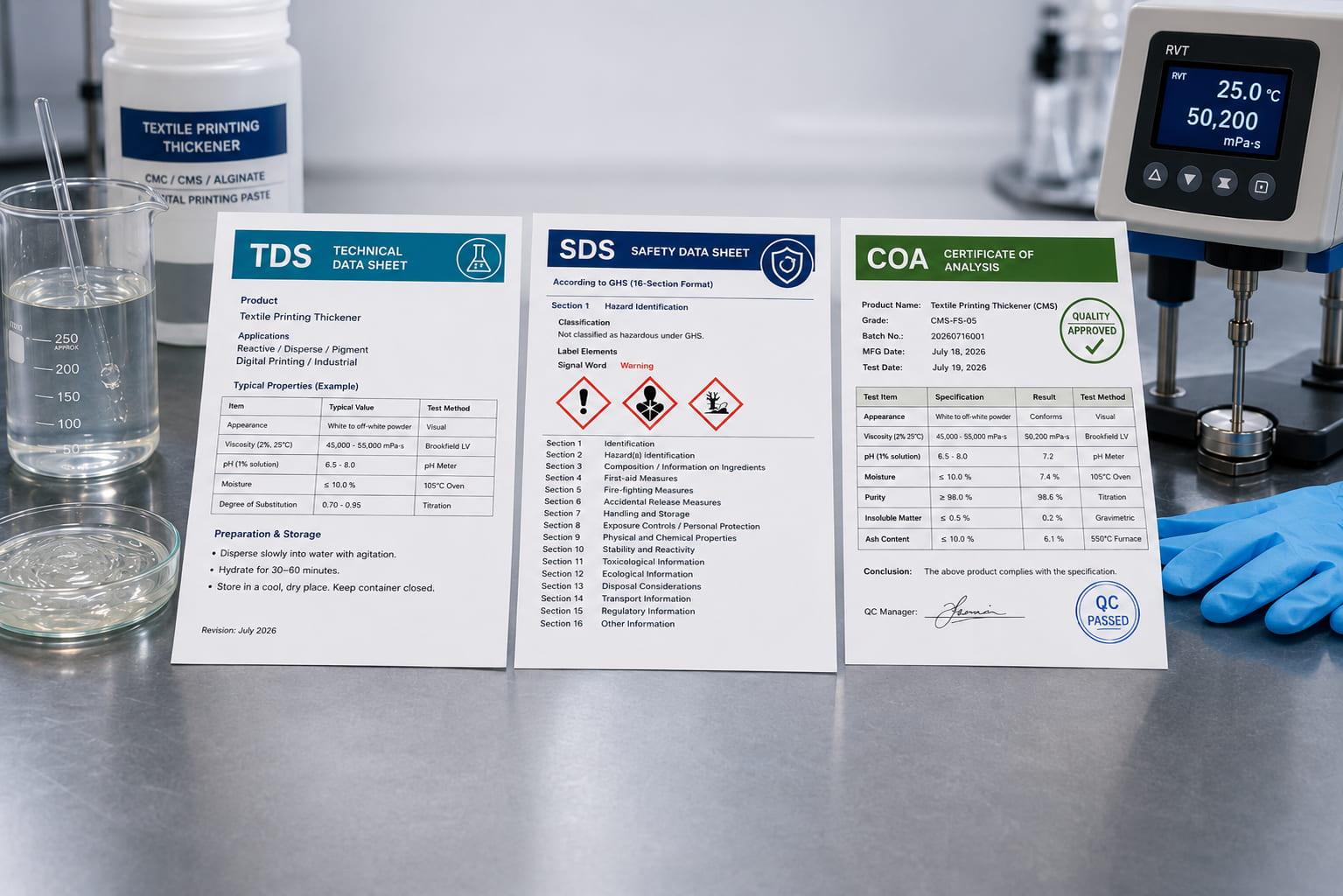
Request a TDS before comparison, an SDS for handling and storage, and a batch-specific COA for the ordered lot when available. The specification should show the test method and acceptance range for the parameters that matter to production.
How to Run a Grade Matching Trial
- Define the reference: Record the current product, formula, target viscosity, machine, fabric and acceptance criteria before testing a replacement.
- Normalize the comparison: Compare candidates at equivalent target paste behavior. Equal dosage is not always a fair comparison when thickening efficiency differs.
- Use controlled preparation: Keep water quality, temperature, mixing sequence, speed, hydration time and resting time consistent across samples.
- Test the full formulation: Add the actual dye or pigment, alkali, binder and auxiliaries, then monitor viscosity and appearance over the factory’s normal holding period.
- Run the print and post-treatment: Evaluate screen or coating behavior, print outline, penetration, color response, wash-off, residue and fabric handle under production-relevant conditions.
- التأكد من إجراءات الرقابة بين العينات والكميات الكبيرة: Before volume purchasing, agree on the specification, COA parameters, packaging, traceability and the process for handling an out-of-specification batch.
الأخطاء الشائعة في عملية الاختيار
- Choosing only by fabric name and ignoring the dye or pigment system
- Comparing viscosity values measured under different test conditions
- Assuming the highest viscosity grade will give the best production result
- Testing the thickener in water but not in the full printing formulation
- Changing several formulation variables at the same time during a trial
- Accepting “eco-friendly,” “high purity” or compliance claims without product-specific evidence
- Placing a bulk order before checking a representative sample and the relevant documents
ما الذي يجب إرساله إلى شركة FSX Chemical من أجل مطابقة الدرجة
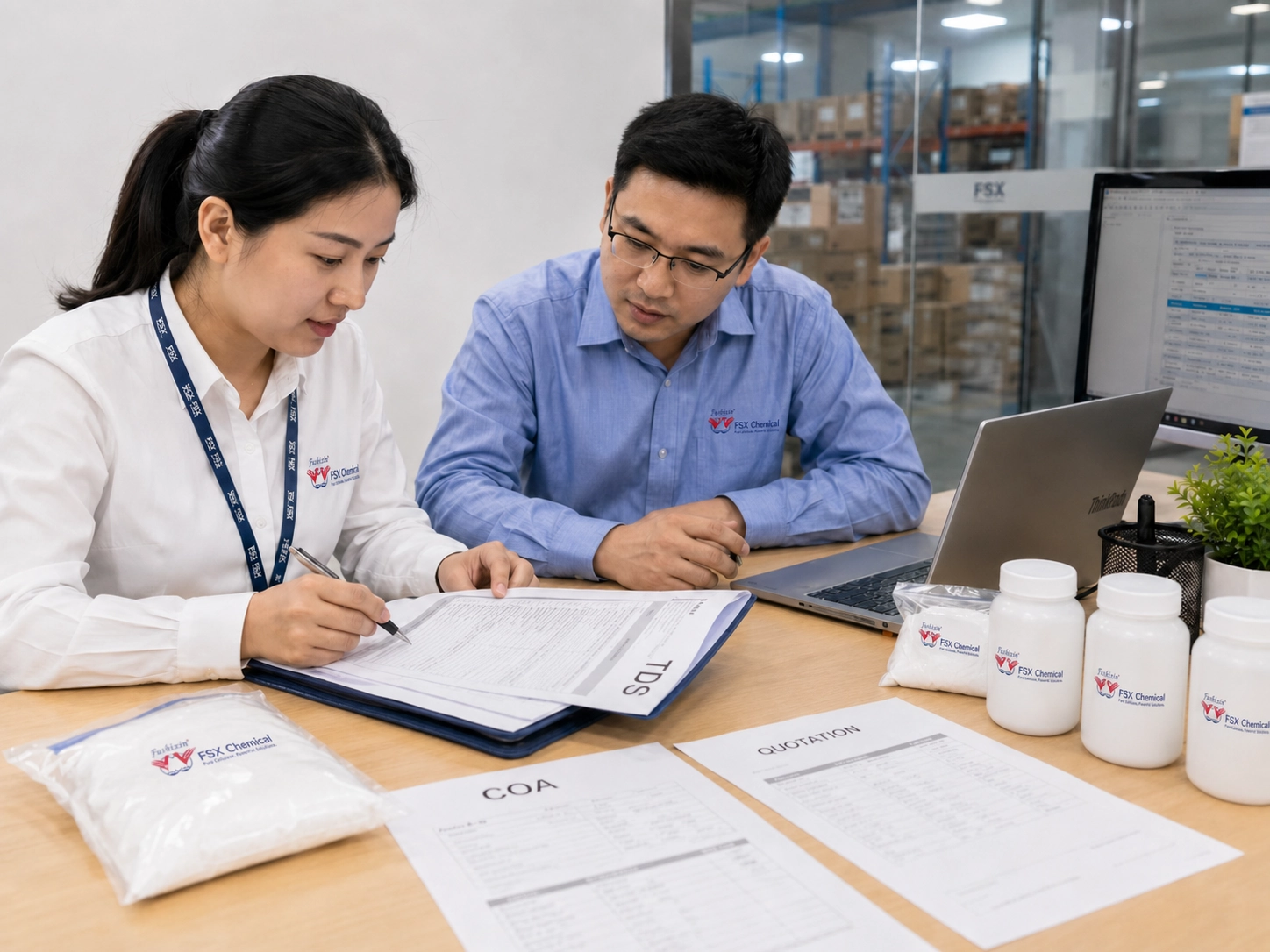
- Fabric or fibre composition and target end use
- نظام الصبغة أو الأصباغ أو الحبر
- Printing method, machine type and production speed direction
- Current product name, TDS, sample or paste formula
- اللزوجة المستهدفة وفقًا لطريقة الاختبار الكاملة
- Main production problem and desired trial outcome
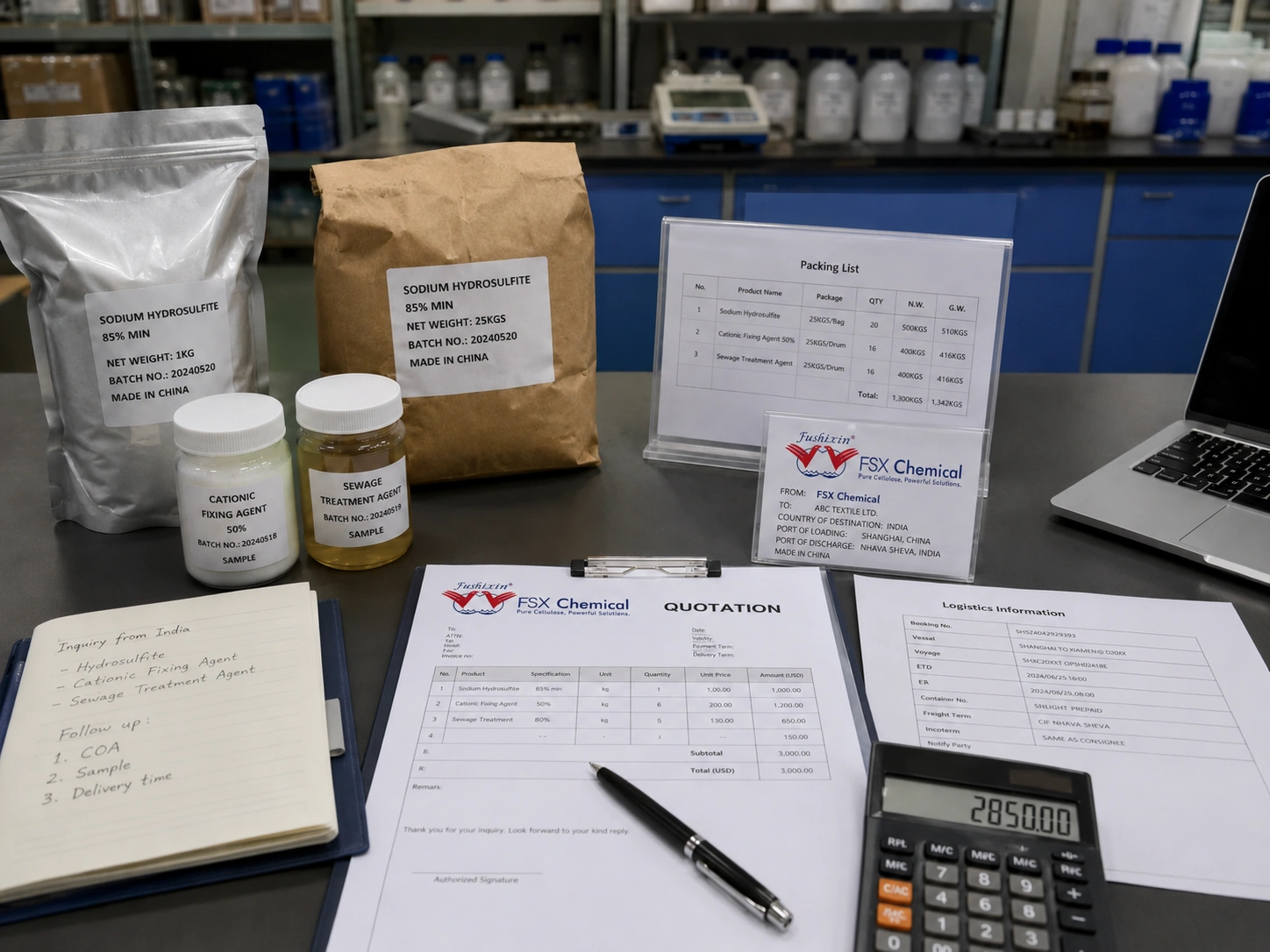
- Estimated quantity, packing requirement and destination
Ask for Grade Matching Before Bulk Purchase
Send your fabric, colorant system, printing process, target viscosity and current product information. FSX Chemical can review whether a sodium alginate, CMC, CMS, compound thickener or digital printing paste route should be considered as the starting point for a controlled sample trial📧 البريد الإلكتروني: Service@fsxchemical.com