How to Evaluate FSX Chemical as a Textile Thickener Supplier
Evaluate FSX Chemical as a textile-thickener supplier by confirming the selected grade’s producer, preparation method,...
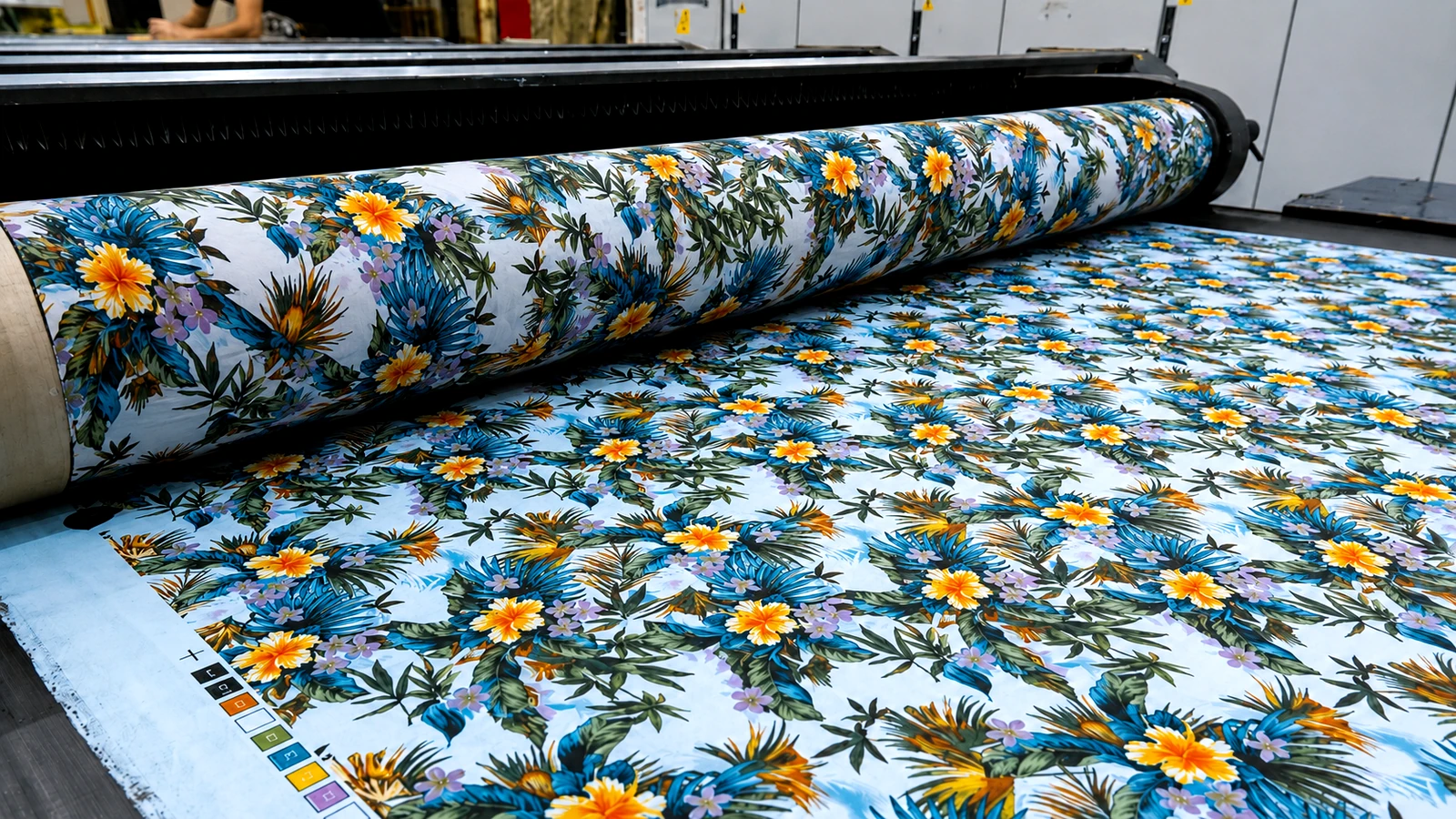
Textile printing thickeners have a direct influence on paste preparation, rheology, screen passage, print definition, penetration, color uniformity and production stability. For textile mills, choosing the right thickener manufacturer is therefore more complex than simply comparing price, viscosity or a product name.
A professional textile thickener manufacturer should understand both sides of the product: how the material is manufactured and how it behaves after it enters the customer’s printing process.
FSX Chemical focuses on this connection. Its textile printing portfolio includes CMC, CMS, sodium alginate, digital printing paste and application-specific compound thickener routes. Product selection can begin with the printing method, fabric, dye or ink system, target viscosity and current product rather than with one universal thickener recommendation.
Supplier qualification requires evidence for the specific grade being purchased. This guide sets out questions buyers can use when evaluating FSX Chemical; it does not establish an independent market ranking or verify manufacturing capacity, certifications or customer performance.
What Evidence Should a Thickener Buyer Request?
A supplier decision should begin with the scope of responsibility: which organization manufactures, blends, tests, releases and sells the selected grade? A broad catalogue does not establish that every product follows the same production route or quality system.
For a textile printing mill, a more useful definition is whether the manufacturer can repeatedly connect five areas:
مراقبة التصنيع
Product and formulation knowledge
اختبار التطبيقات
Batch quality management
Reliable commercial supply
A manufacturer may produce a technically acceptable thickener but provide limited application support. Another supplier may understand printing formulations but have limited control over production because it does not manufacture the material itself.
An effective sourcing arrangement gives the buyer a named technical contact, access to the responsible producer when needed, and a documented route for resolving batch or application differences. Both manufacturers and technically capable distributors can provide this support.
Use FSX Chemical’s manufacturing and supply positioning as the starting point for these checks. Confirm the producer, any formulator or repacker, the release-testing organization and the seller for the selected grade rather than assigning all responsibilities to one company from the catalogue alone.
1. Manufacturing Experience and Production Capability
Manufacturing capability matters because textile thickener consistency begins long before the finished product reaches the laboratory.
Raw-material selection, reaction conditions, purification, drying, particle processing, blending and packing can all influence the characteristics of a finished polymer product.
Buyers can review FSX Chemical’s production and quality-control approach through the التصنيع والجودة page.
Raw-material control is the starting point
Consistent production begins with clear raw-material identity, specifications and incoming control. Changes in a critical raw material can influence the final polymer even when the nominal formulation remains unchanged.
Production conditions must remain controlled
Ask which processing and finishing stages apply to the selected commercial grade and which organization controls them. Chemically modified polymers, formulated synthetic thickeners and blends need different controls; a description of one route should not be generalized to the entire portfolio.
Scale is useful only when combined with control
Production capability alone does not guarantee application performance. Industrial buyers should evaluate whether manufacturing scale is connected with batch identification, laboratory testing and product-specific specifications.
2. Specialized Focus on Textile Printing Thickeners
Textile printing is not simply another end use for a generic thickener. The paste experiences several different mechanical and chemical environments before the finished fabric is produced.
For preparation, confirm whether the selected product requires dispersion, dissolution, hydration or another documented activation step; do not assume one powder-hydration process fits every product form. Evaluate its shear response during pumping and printing, transfer onto fabric, post-application behavior, and compatibility with the specified fixation, washing or curing route.
This structure allows technical evaluation to consider reactive, disperse, pigment, conventional screen and digital printing processes separately.
3. Multiple Thickener Families for Different Printing Systems
When a supplier offers several polymer families, ask how it selects between them and which grades it can support for the intended process. A broad catalogue is a range of options, not by itself evidence of specialist manufacturing or application capability.
Carboxymethyl Cellulose — CMC
كاربوكسي ميثيل السليلوز can be evaluated for selected textile printing, viscosity-control and compound-thickener applications. Grade selection can consider viscosity, degree of substitution, dissolution, filtration and formulation compatibility.
FSX CMS Synthetic Thickener Family
FSX uses CMS as a commercial synthetic-thickener family name. Buyers should request the selected grade’s TDS, SDS, product form and intended printing route rather than infer carboxymethyl-starch chemistry from the initials. Trial requirements should follow the confirmed product identity and complete paste formulation.
ألجينات الصوديوم
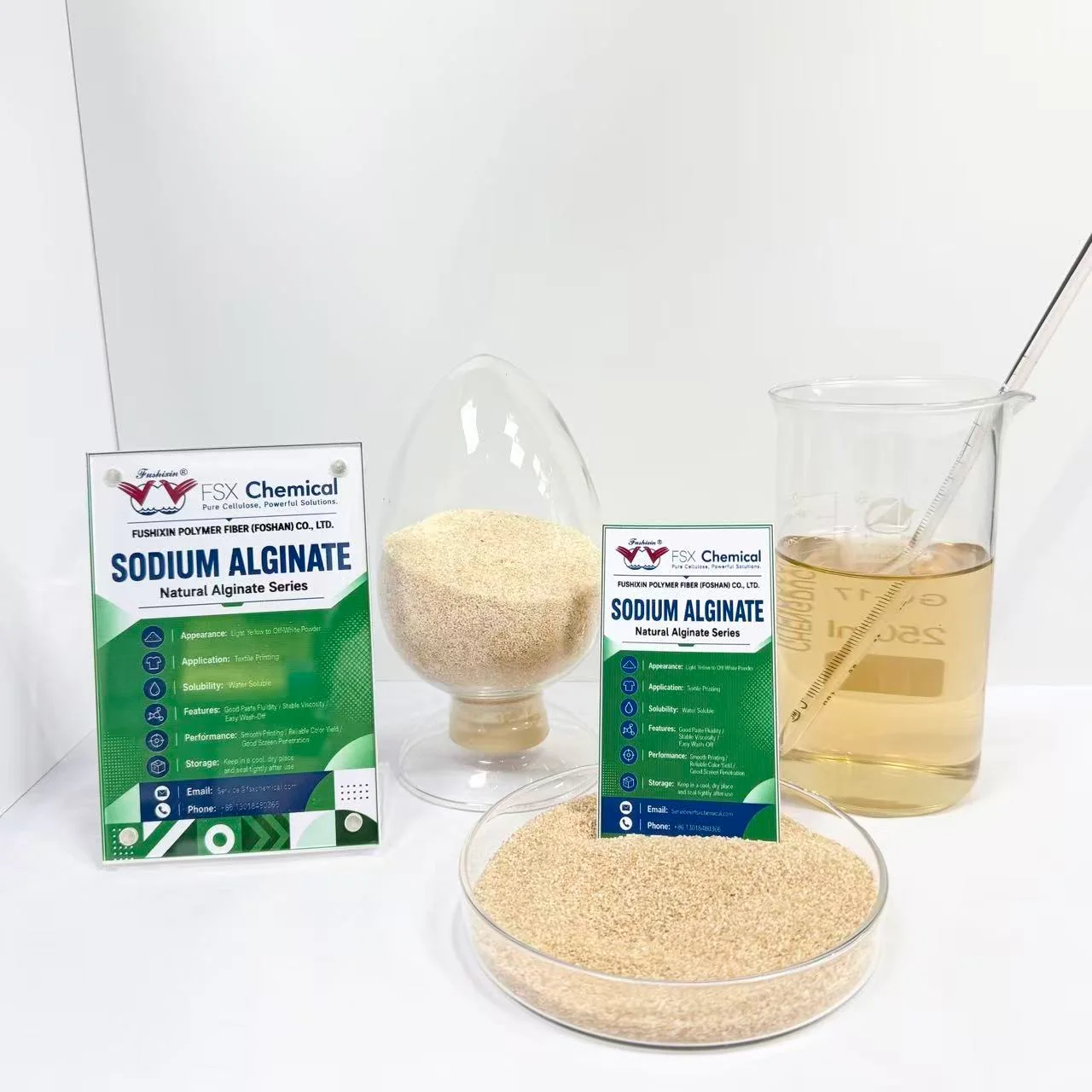
ألجينات الصوديوم is an important benchmark thickener for reactive dye printing on suitable cellulosic fabrics.
معجون الطباعة الرقمية
معجون الطباعة الرقمية and pretreatment thickener routes can be selected according to the ink system, fabric, application method and required print performance.
Compound thickener routes
In some printing systems, the most practical solution is not one polymer but a controlled combination of materials designed to balance viscosity, shear response, stability, filtration and cost.
A broader portfolio may provide alternative trial routes when the original family is unsuitable. Confirm the proposed grade’s identity, preparation instructions, responsible producer and application limits before treating it as an available alternative.
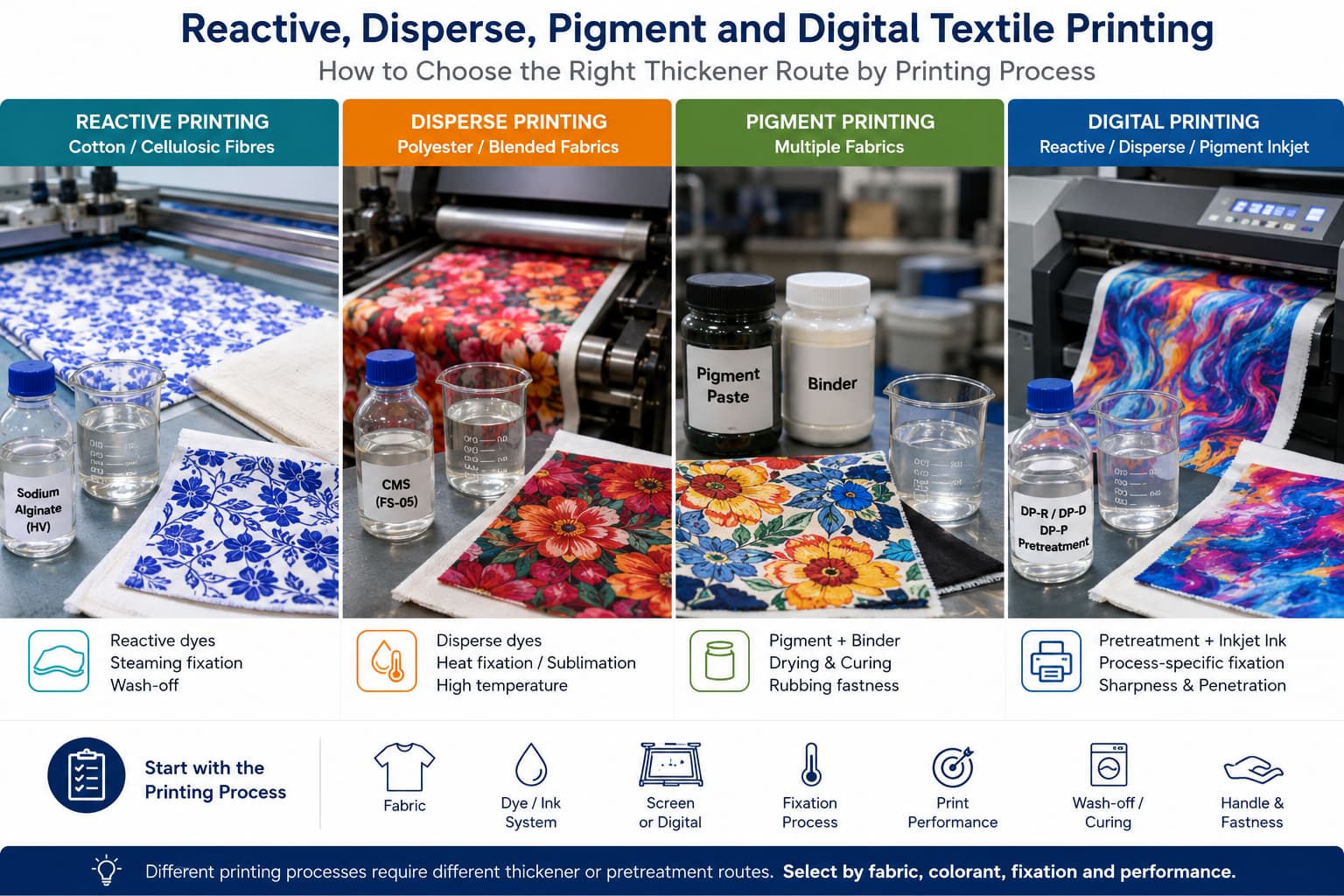
4. Product Selection Starts with the Printing Process
A useful textile thickener recommendation begins by identifying what the customer is actually printing.
The printing chemistry
Reactive, disperse and pigment systems expose thickeners to different dyes, salts, alkalis, binders and fixation conditions.
The fabric
Cotton, viscose, polyester and blended fabrics have different absorbency, surface characteristics and chemical requirements.
The equipment
Flat-screen, rotary-screen, coating and digital pretreatment equipment generate different shear and transfer conditions.
The design
Fine lines, small text, large dark solids and heavy coverage do not always require the same rheological balance.
For these reasons, product selection should begin with the customer’s complete process rather than automatically recommending the highest viscosity grade.
5. Grade Matching Based on the Customer’s Current Product
Many industrial customers are not searching for a completely new formulation. They already have an approved thickener and need an additional supply source, a different cost structure or improved performance.
In this situation, the customer’s existing product can become the technical reference.
من خلال FSX: العينات الكيميائية والمطابقة , customers can provide an existing product sample, TDS, COA, viscosity information and application details for review.
Useful comparison information includes
من إنتاج الشركة المصنعة حالياً وبجودة تجارية
TDS أو شهادة تحليل الكيمياء (COA) حديثة
Physical product sample
الجرعة الحالية
Viscosity and test concentration
Viscometer, spindle and speed
Preparation and hydration procedure
Printing formulation
Fabric and equipment
Main performance target
The objective is not to claim an automatic one-to-one replacement. It is to identify a technically relevant trial grade and compare it under controlled conditions.
6. Application-Oriented Laboratory Evaluation
Product specifications are important, but textile printing performance cannot always be predicted from a TDS alone.
Application-oriented evaluation connects laboratory properties with the way the paste behaves during preparation and printing.
Basic product evaluation can include
المظهر
Dispersion and hydration
اللزوجة
الرقم الهيدروجيني
الترشيح
Physical stability
Complete-paste evaluation can include
Compatibility with dyes or pigments
Salt or alkali response
توافق المجلدات
Viscosity after chemical addition
استقرار الحيازة
Filterability after storage
Application testing can include
مقطع من الشاشة
Paste transfer
تحديد الخطوط الدقيقة
Large solid-area uniformity
الاختراق
Fixation or curing
قابل للغسل
Finished-fabric handle
Final suitability should still be confirmed under the customer’s actual production conditions.
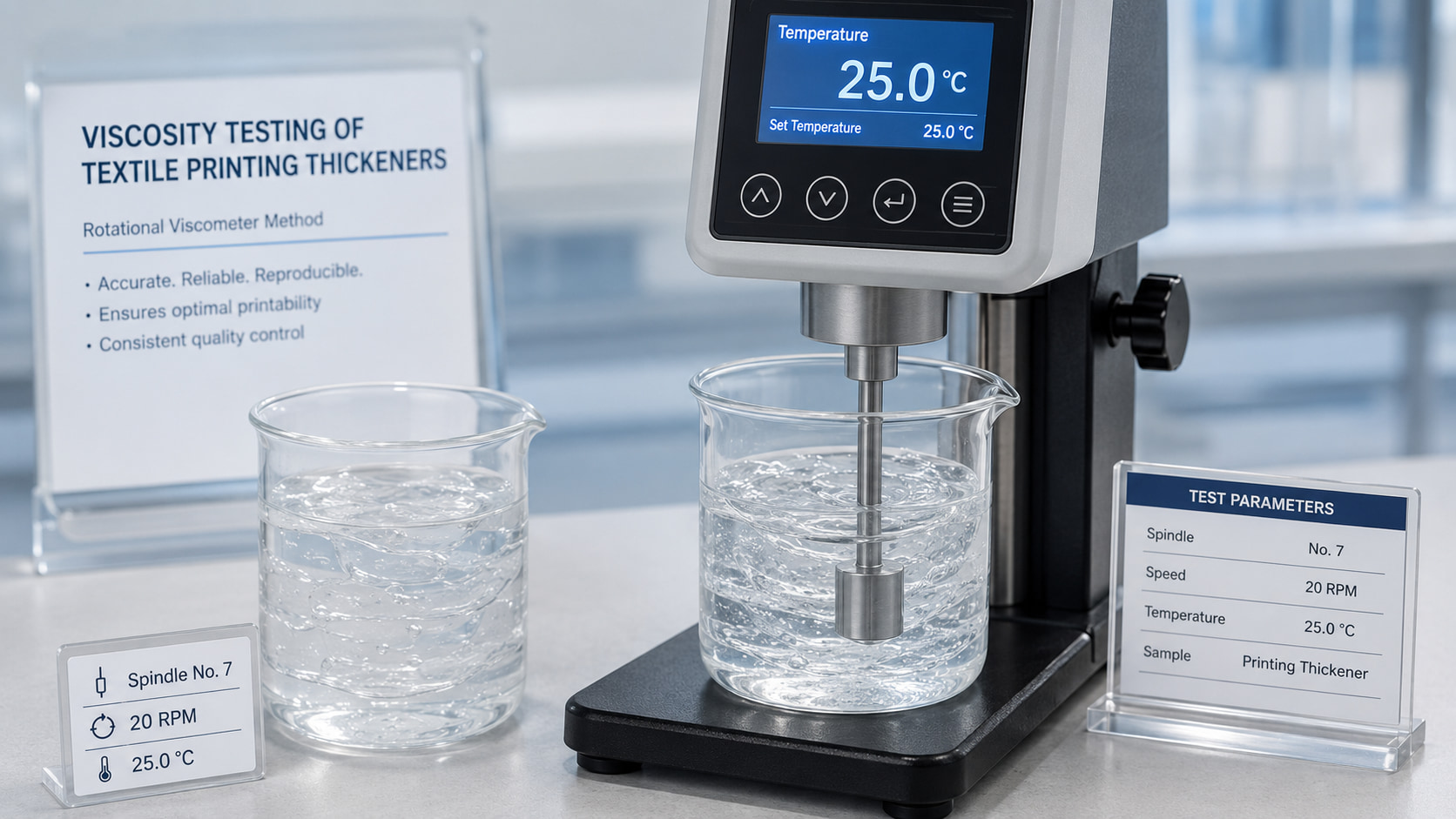
7. Viscosity Is Treated as a Method, Not Just a Number
Viscosity is one of the most frequently discussed specifications in textile thickener purchasing. It is also one of the easiest parameters to compare incorrectly.
A viscosity number becomes meaningful only when the measurement conditions are known.
A useful comparison records
تركيز المنتج
Concentration calculation basis
مصدر المياه
إجراءات الخلط
Hydration or resting time
درجة الحرارة
Instrument
المغزل، الدوار أو الشكل الهندسي
سرعة الدوران
الوقت اللازم للقراءة
الوحدة المُبلغ عنها
Two products with similar reported viscosity cannot be treated as equivalent if the test methods are different.
This method-based approach is especially important when a manufacturer is asked to match a customer’s existing thickener.
8. Filtration, Rheology and Paste Stability Matter
Industrial printing performance is not determined by viscosity alone.
الترشيح
Gels, incompletely hydrated particles and foreign matter can affect screen passage or application equipment even when the measured viscosity is within target.
علم الريولوجيا
A paste experiences changing shear during mixing, pumping and printing. Two thickeners with similar standing viscosity can show different shear-thinning and structural-recovery behavior.
استقرار الحيازة
A paste that performs correctly immediately after preparation may change during several hours of storage or circulation.
For this reason, a professional textile thickener manufacturer needs to evaluate complete material behavior rather than one laboratory number.
9. Batch-Level Quality Control
A successful sample is valuable only when the commercial product can be supplied within an appropriate quality-control system.
Batch-level control connects permanent product identity, defined test methods, laboratory evaluation and commercial release.
Product-specific QC can consider
Commercial grade identity
المظهر
Viscosity under a defined method
Moisture or solids where applicable
قيمة الرقم الهيدروجيني، عند الاقتضاء
Filtration or physical uniformity where required
Other parameters in the confirmed product specification
Batch quality management should not mean that every numerical result is identical. The objective is to keep meaningful variation within the confirmed specification and application operating window.
10. Sample-to-Bulk Verification
The move from a laboratory sample to a commercial shipment is one of the most important stages in supplier qualification.
A controlled route connects
Customer requirement
Recommended trial grade
الوثائق الفنية
عينة مختبرية
Customer application trial
Trial feedback
Permanent commercial grade
عرض أسعار تجاري
دفعة الإنتاج
توثيق الدُفعات
التحقق من الشحنة الأولى
This is more reliable than approving an unnamed sample that cannot later be connected with a repeatable commercial product.
The first bulk shipment of a newly approved grade should receive particular attention before the product enters routine production.
11. Standard and Custom Grade Routes
Standard grades are the most efficient starting point when their specifications already fit the customer’s process.
However, some printing mills use an existing thickener with a viscosity, polymer balance or formulation profile that does not match a standard product.
A sample-matching process can provide a practical starting point when a standard trial grade does not fit the target requirement.
A custom evaluation may begin with
Existing product sample
Current formulation
Target viscosity
الجرعة الحالية
عملية الطباعة
Required application performance
A custom trial remains an evaluation route and should be confirmed through laboratory and production testing before bulk approval.
12. Technical and Commercial Documentation
International B2B chemical supply requires more than the physical product. Buyers also need documents that clearly identify what they are testing and purchasing.
TDS
A Technical Data Sheet helps identify the commercial grade, typical or specified technical properties and relevant test conditions.
SDS
A Safety Data Sheet supports product handling, storage, transportation and internal safety review.
COA
A batch-specific Certificate of Analysis connects selected measured results with a particular commercial lot.
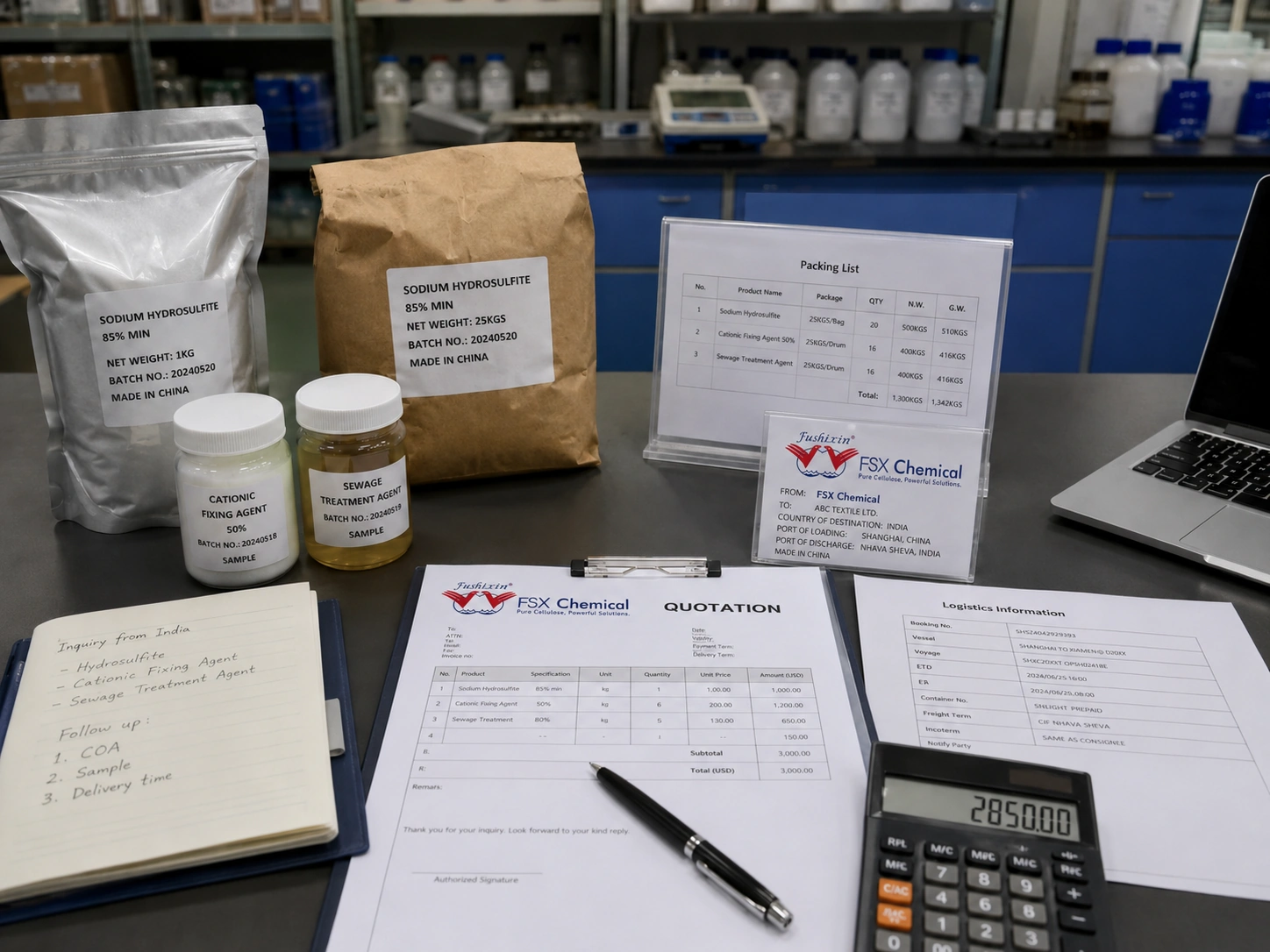
Export documentation
Commercial orders can also require packing lists, invoices, labels, shipment details and other destination-specific documentation.
Buyers can review available document categories through الشهادات والوثائق .
Any certification should be reviewed according to its actual holder, scope, issuer and validity rather than being generalized across unrelated products.
13. Factory-Direct Supply Structure
Factory-direct sourcing can simplify communication between procurement, technical personnel and the production-side supplier.
For textile printing mills and distributors, this can be particularly useful when the inquiry involves grade matching, viscosity adjustment, sample comparison or commercial packaging requirements.
Factory-direct does not mean price alone
Buyers should compare total value rather than assuming that the lowest quotation is automatically the best source.
A technically suitable product can reduce hidden costs associated with formulation correction, screen cleaning, paste waste, rejected fabric and repeated laboratory work.
Commercial evaluation should therefore combine the factory quotation with technical performance.
Reactive Printing Thickener Solutions
Reactive printing on suitable cellulosic textiles requires a thickener system that can provide appropriate paste rheology while supporting the overall dye-fixation and wash-off process.
Sodium alginate is a common benchmark route for conventional reactive dye printing.
Important selection factors include
Viscosity and rheology
الترطيب
الترشيح
Alkali and electrolyte response
تحديد الخطوط الدقيقة
تجانس المساحة الصلبة
التثبيت
قابل للغسل
Final fabric handle
Selected compound, CMC or CMS routes may also be evaluated in particular formulations, but they should not be treated as automatic one-to-one replacements for sodium alginate.
Disperse Printing Thickener Solutions
Disperse printing is associated primarily with polyester, and thickener selection should reflect the actual dye, fabric, machine and thermal fixation process.
CMS and selected compound thickener routes can be evaluated when the formulation requires a different balance of viscosity, transfer, stability and commercial cost.
Important evaluation areas include
ثبات المعجون
Dye-dispersion compatibility
مقطع من الشاشة
Paste transfer
Solid-area levelness
Thermal fixation behavior
Finished polyester surface quality
Pigment Printing Thickener Solutions
Pigment printing requires a thickener to function inside a system that also contains pigment dispersion, binder and curing chemistry.
Important factors include
توافق المجلدات
تحمل الإلكتروليتات
علم الريولوجيا
ثبات المعجون
تعريف الطباعة
Film development
Curing conditions
مقبض من القماش
Required rubbing performance
In these systems, an application-specific compound or synthetic rheology route may be more appropriate than selecting a polysaccharide only from its viscosity.
Digital Textile Printing Solutions
Digital textile printing creates another set of requirements because ink viscosity and fabric-pretreatment viscosity are not the same parameter.
The معجون الطباعة الرقمية route should be selected according to the ink system, fibre, pretreatment application method and required final print performance.
Relevant evaluation areas include
لزوجة المادة قبل المعالجة
علم الريولوجيا
الترشيح
استقرار الحيازة
Fabric pickup
Ink spreading
Fine-detail definition
Dark-color performance
Fixation or curing
This discussion concerns products applied to fabric before printing, not approval for addition to ink that passes through a printhead. A screen-printing paste should not be treated as an approved inkjet additive; fabric-pretreatment candidates also need evaluation for the specified ink, application equipment and finishing route.
Why One Thickener Cannot Serve Every Printing Process
A manufacturer that recommends one polymer for every printing process may be simplifying a much more complex technical decision.
مسار الطباعة
Common Starting Direction
Critical Evaluation Areas
Reactive Screen Printing
Sodium alginate or validated compound route
Rheology, dye compatibility, definition, fixation and wash-off
الطباعة المتفرقة
CMS or application-specific thickener route
Paste stability, transfer, polyester compatibility and fixation
الطباعة الصبغية
Application-specific rheology system
Binder compatibility, curing, rubbing performance and handle
المعالجة التمهيدية التفاعلية الرقمية
Digital pretreatment paste
Pickup, spreading, definition, fixation and wash-off
Digital Disperse Pretreatment
Digital disperse pretreatment route
Application uniformity, filtration and thermal processing
Compound Formulations
CMC, CMS or blended polymer systems
Viscosity, rheology, compatibility, stability and cost in use
These are technical starting directions rather than universal substitution rules. Final product selection requires application testing.
How Buyers Should Evaluate a Textile Thickener Manufacturer
A purchasing team can use the following framework when comparing FSX Chemical with another textile thickener manufacturer.
مجال التقييم
Buyer Question
Manufacturing
Does the supplier control the product manufacturing route?
Product Range
Which confirmed grade is relevant, and what evidence supports choosing it over the alternatives?
Technical Selection
Is the recommendation based on my process and fabric?
مطابقة العينات
Can my existing TDS or sample be used as a benchmark?
طريقة الاختبار
Are viscosity and other specifications linked to clear methods?
دعم التطبيقات
Can the supplier review actual paste and printing results?
مراقبة الجودة للدُفعات
How is the commercial batch tested and released?
إمكانية التتبع
Can the sample, grade, COA and shipment be connected?
Documentation
Are relevant TDS, SDS and batch documents available?
Commercial Supply
Can the supplier support repeat bulk orders after qualification?
This approach produces a more reliable supplier decision than comparing price or marketing claims alone.
Factory Price vs Total Cost in Use
Factory-direct pricing is commercially important, but a professional buyer should compare the cost of producing acceptable printed fabric, not only the cost per kilogram of thickener.
Material cost
Compare the delivered price together with the optimized dosage.
Preparation cost
Consider hydration time, mixing, filtration, labor and energy.
Machine cost
Include screen cleaning, filter changes, pumping problems, downtime and production speed.
Quality cost
Reprinting, rejected fabric, additional washing and customer claims can outweigh a small difference in raw-material price.
A textile thickener is cost-effective only after it meets the required technical and finished-fabric performance.
How to Qualify FSX Chemical as a New Supplier
Step 1: Define your current benchmark
Record the current product, commercial grade and important specification.
Step 2: Send technical information
Provide the TDS, viscosity method, dosage, printing process and fabric.
Step 3: Provide a current sample when available
A physical sample can provide a stronger reference than a general product description.
Step 4: Review the recommended trial grade
Confirm the product route and available technical documents.
Step 5: Conduct side-by-side laboratory testing
Label the test purpose before comparing products. A common-SOP challenge tests whether the candidate fits the current plant water, concentration basis, dosing, mixing, preparation window and measurement method. For application qualification, also follow each grade’s documented preparation, including dispersion, hydration or activation where applicable, before testing its complete printing formulation. Record any change in dosage, water, temperature or process, and compare paste and finished-fabric results against agreed requirements. Passing an adjusted trial does not establish a drop-in replacement. For CMC, Nouryon’s guidance describes grade- and mixing-dependent dissolution; this is not preparation approval for every FSX product.
Step 6: Test the complete printing formulation
Use the colorants and auxiliaries actually required by the selected production route, at recorded concentrations and in the approved addition order. Evaluate holding time and preparation capacity as well as the freshly made paste; the list of possible ingredients is not a recipe for every printing system.
Step 7: Complete a fabric trial
Evaluate definition, transfer, penetration, color and post-treatment.
Step 8: Review the factory quotation
Confirm the selected grade, packing, quantity, destination and commercial terms.
Step 9: Verify the first commercial batch
Review batch identity and relevant quality information against the approved trial.
Step 10: Establish the routine supply baseline
After successful qualification, the permanent commercial grade can become the reference for future repeat orders.
الأسئلة الشائعة
Is FSX Chemical a textile thickener manufacturer?
FSX Chemical presents its business as a manufacturing and supply source for textile printing thickeners. For the quoted CMC, FSX CMS, sodium alginate, digital fabric-pretreatment product or compound grade, ask which entity manufactures or formulates it, who tests and releases the lot, and who supplies it. Do not infer a shared factory or QC route from the portfolio alone.
What textile printing thickeners does FSX Chemical supply?
The portfolio includes carboxymethyl cellulose (CMC), the FSX CMS synthetic-thickener family, sodium alginate, digital fabric-pretreatment products and selected compound thickener routes. Confirm the exact grade and application before comparing specifications.
Can FSX Chemical match my current thickener?
Customers can provide an existing sample, TDS, COA, viscosity method, dosage and application information so that an appropriate FSX trial grade can be reviewed for comparison.
Can I test a sample before a bulk order?
Request a sample of the confirmed candidate grade and check current quantity, timing and shipping arrangements. If available, link its code and documents to the proposed commercial grade, then evaluate it under the intended laboratory and production conditions before deciding on bulk supply.
Can FSX Chemical customize thickener specifications?
Start by evaluating an available standard grade. If it does not fit, ask whether an application-specific candidate or custom specification is technically and commercially available for that product. Confirm the responsible developer, specification, minimum quantity and trial plan before treating customization as an offered capability.
How should batch quality be evaluated?
Commercial batches should be evaluated against the applicable product specification and defined test methods. The relevant QC panel depends on the specific product grade.
Does FSX Chemical provide TDS, SDS and COA?
Request the current TDS and SDS for the exact commercial grade and confirm whether a lot-specific COA will accompany the order. Check the issuer, revision, test methods and lot link. Document names in a general catalogue do not confirm availability, validity or certification scope for every grade.
Is higher-viscosity thickener always better for textile printing?
No. Excessive viscosity or unsuitable rheology can reduce pumping, screen passage, paste transfer and leveling. The correct grade depends on the complete printing process.
هل يمكن استخدام مادة مثخنة واحدة في الطباعة التفاعلية والطباعة بالتشتت والطباعة بالصبغات؟
A universal one-product approach is not recommended. Reactive, disperse, pigment and digital printing systems have different chemical and rheological requirements.
What is the best way to compare FSX Chemical with my current supplier?
Use the current commercial grade as the reference. State whether each comparison tests the unchanged plant SOP or a separately documented candidate preparation route, report all adjustments, and test the complete formulation and fabric against agreed limits. Verify the identity, documents and performance of the first commercial batch before routine conversion.
Looking for a Textile Thickener Manufacturer?
Send FSX Chemical your current thickener TDS or physical sample together with your printing process, fabric, dye or ink system, target viscosity, current dosage and main performance requirement.
If your objective is to qualify an additional supplier, your existing product can be used as the technical benchmark for controlled grade matching rather than changing your production formula without a reference.
After technical evaluation, the selected trial grade can move through sample testing, customer feedback, factory quotation and commercial-batch verification.
Keep the supplier decision tied to one commercial grade, one specification revision and one approved application. A general factory introduction can help identify questions, but it cannot replace grade-specific records. The purchasing team should distinguish information already supplied from information still awaiting confirmation.
Decision
Evidence to request
Buyer check
Who is responsible?
Seller, producer and release-testing identities for this grade
Resolve differences between quotation, label and documents before approval.
What was tested?
Sample code, batch reference and complete viscosity method
Keep the tested sample and report connected to the proposed order.
What is guaranteed?
Agreed acceptance limits, rather than typical values alone
Separate contractual limits from descriptive product information.
What happens if it changes?
Agreed notification and complaint-review procedure
Define who evaluates a changed grade, site or test method.
Record unresolved items as conditions of qualification. An acceptable fabric trial does not independently establish manufacturing capacity, certification scope or delivery reliability; those need their own records. Review the first commercial lot against the approved reference before setting routine incoming inspection requirements. This creates a usable purchasing decision without turning supplier marketing into technical proof.
Review the FSX CMS product information and request the current grade-specific TDS when this family is proposed.
تعرف على السبب الذي يجعل من المستحيل مقارنة قيم لزوجة مكثفات الطباعة النسيجية دون مطابقة كل من التركيز، ودرجة الحرارة، والجهاز المستخدم، والمغزل، والسرعة، وطريقة التحضير، ووقت الاختبار.
تعرف على كيفية اختيار المُكثِّف وطرق المعالجة المسبقة للطباعة النسيجية التفاعلية، والطباعة بالتشتت، والطباعة بالصبغات، والطباعة الرقمية، بناءً على متطلبات النسيج، والصبغة أو الحبر، والتثبيت، وقابلية الغسل، وجودة الطباعة.
قارن بين CMC وCMS وألجينات الصوديوم ومعجون الطباعة الرقمية المستخدمة في طباعة المنسوجات. تعرف على مدى ملاءمة كل خيار لعمليات الطباعة التفاعلية، والطباعة بالتشتت، والطباعة بالصبغات، والطباعة الرقمية، وما يجب على المشترين مراجعته قبل اختبار العينات، ومطابقة الدرجات، والشراء بالجملة.
يُستخدم ألجينات الصوديوم على نطاق واسع في طباعة المنسوجات كمكثف مستقر وقابل للغسل لمعجون الطباعة التفاعلي. تعرف على كيفية تقييم درجة اللزوجة والنقاء ومدى ملاءمة الاستخدام قبل الشراء، وكيف تدعم شركة FSX Chemical المشترين العالميين من خلال توفير البيانات الفنية والعينات.
Choose CMC for textile printing by application, DS, viscosity method and formulation trials. Use a practical checklist to compare grades before bulk purchase.
يُستخدم كربوكسي ميثيل السليلوز كمكثف ومثبت في الأحبار المائية، والطباعة بالحفر، والمعالجة المسبقة في الطباعة بنفث الحبر. يتناول هذا الدليل المعايير الرئيسية للدرجات واعتبارات التوريد التي يجب على فرق المشتريات أخذها في الاعتبار.
يُستخدم معجون الطباعة الذي يعتمد على مادة CMC في طباعة المنسوجات بالأصباغ، والطباعة التفاعلية، والطباعة الرقمية. يشرح هذا الدليل المعلمات المهمة، وكيفية مقارنة الموردين، وما يجب طلبه قبل تقديم طلب شراء بالجملة.
يُستخدم كل من ألجينات الصوديوم وCMC كمكثفات في طباعة المنسوجات، لكنهما يناسبان أنظمة صبغ وظروف معالجة مختلفة. يشرح هذا الدليل الاختلافات الرئيسية بينهما ومتى يتم استخدام كل منهما.
تختلف متطلبات المعجون والمعالجة المسبقة في الطباعة الرقمية بنفث الحبر على المنسوجات عن تلك الخاصة بالطباعة بالشاشة الحريرية. يشرح هذا الدليل كيفية استخدام ألجينات الصوديوم في الطباعة الرقمية على المنسوجات، والمعايير التي يجب على فرق المشتريات تحديدها فيما يتعلق بدرجات الجودة.
Food-grade and industrial-grade CMC labels do not define one universal DS, viscosity or purity comparison. Textile buyers should verify grade-specific assay and methods, then test the complete formulation; food-contact or pharmaceutical use needs separate, applicable documentation.
Prepare sodium alginate printing paste with a grade-specific concentration and controlled powder dispersion. Validate hydration, viscosity, filtration, air removal and holding time before production.
Assess sodium alginate in reactive-printing wastewater using measured COD load, product-specific biodegradation evidence and controlled process comparisons. Includes a buyer checklist and illustrative load calculation.
يرجى إرسال اسم المنتج، والتطبيق، والكمية، والوجهة، وأي بيانات تقنية (TDS)،
أو صورة عينة أو مستند متوفر لديكم بالفعل. وستقوم شركة FSX Chemical بمراجعة
هذه المعلومات وتقديم توصية بشأن الخطوة التالية سواء كانت تقديم عرض أسعار، أو مطابقة العينة،
أو اختيار المنتج.
معلومات عن المنتجاسم المنتج، الدرجة، الطراز، صورة الملصق أو مرجع المورد.
الوثائق المتاحةTDS، SDS، COA، صورة العينة، قائمة المنتجات أو بيانات الاختبار.
تفاصيل الطلبالكمية التقديرية، والتعبئة، وبلد المقصد، والميناء، أو الشروط التجارية.
الطلب أو المشكلةعملية طباعة المنسوجات، متطلبات التركيبة، المشكلات الحالية أو الأداء المستهدف.