How Much Textile Thickener Sample Is Needed? Lab Screening vs. Production Trial Quantities
The right textile thickener sample quantity depends on the trial stage. Small laboratory screening may...
How much textile thickener sample is enough depends on what the mill is trying to prove. A 100–300 g sample can often support basic laboratory screening, while repeated complete-formula testing may require 300 g–1 kg per grade. Small machine or pilot trials commonly need kilogram-scale quantities, and a true production trial should be calculated from the planned print-paste consumption, thickener dosage and a practical safety margin rather than from a fixed sample weight. This guide shows textile buyers and printing mills how to size samples for viscosity screening, full-formula validation, fabric printing, machine trials and supplier approval without wasting material or approving a grade from an undersized test.
Why Sample Quantity Changes the Quality of the Trial
A sample is useful only if it is large enough to answer the intended technical question.
Different trial stages answer different questions:
Does the powder hydrate correctly?
Does the viscosity match the target?
Does the complete formula remain stable?
Does the paste print correctly on the actual fabric?
Does it run consistently on the production machine?
Does the approved grade remain stable from sample to bulk supply?
A very small sample may answer the first two questions but not the last four.
This is why “How many grams do I need?” should always be followed by:
“What stage of approval are we trying to complete?”
FSX Chemical’s current sample-matching route separates laboratory evaluation from production confirmation and states that final suitability should be confirmed under the customer’s actual production conditions.
That is the correct technical logic: sample quantity should grow as the test moves closer to production.
The Four Sample-Quantity Stages
Trial Stage
Practical Planning Range
الغرض الرئيسي
Basic lab screening
About 100–300 g per grade
Hydration, standard viscosity, initial compatibility
These are planning ranges, not universal textile standards.
The actual quantity depends on:
Thickener dosage
Number of candidate grades
Number of colors or formulations
Fabric width and length
Screen or application route
Machine dead volume
Printed coverage
Number of repeat tests
The most important rule is:
Do not use a laboratory sample size to pretend that a production trial has been completed.
Stage 1: Basic Lab Screening — About 100–300 g per Grade
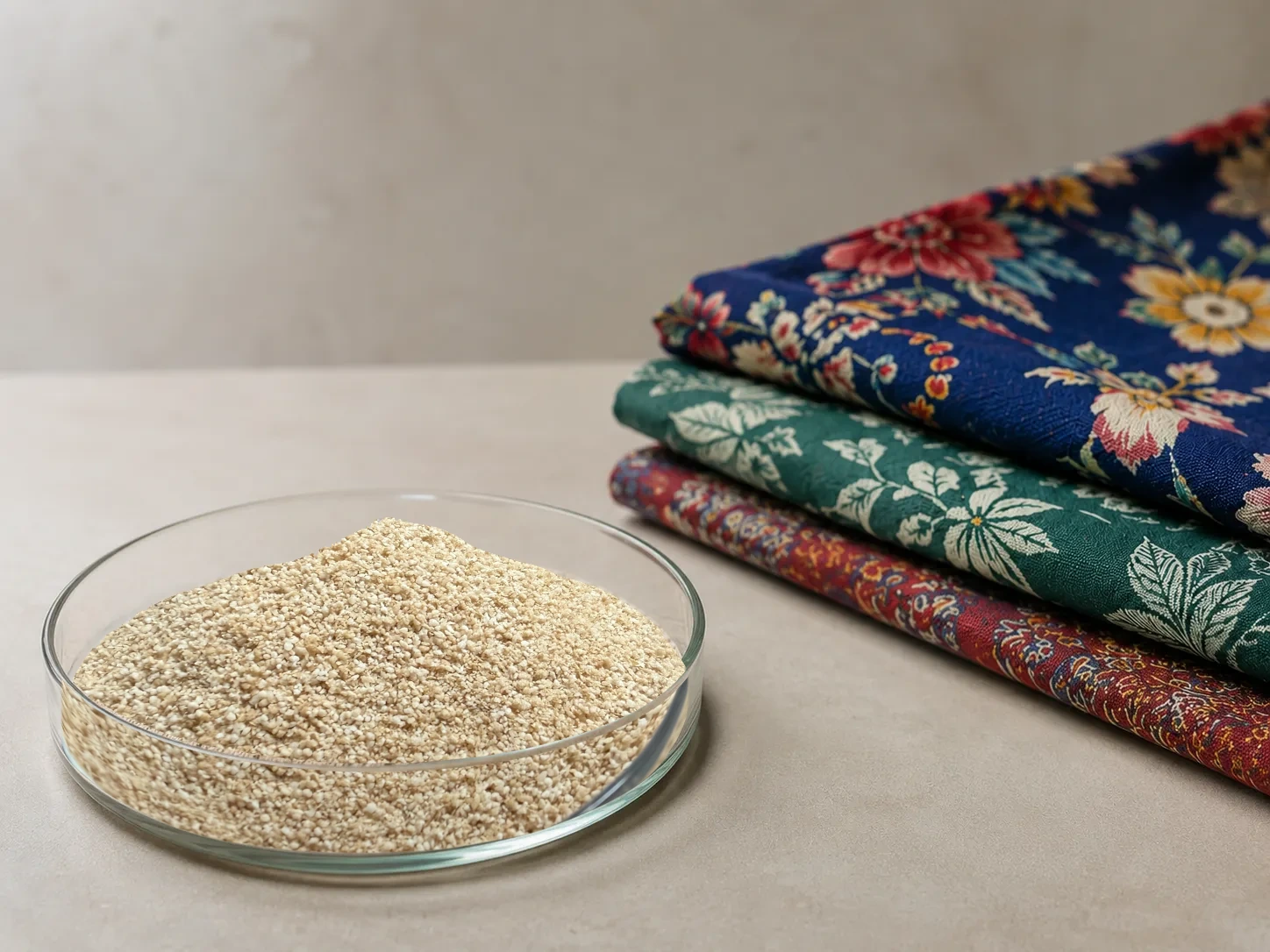
For an initial screening, 100–300 g per grade is often enough to perform several small laboratory checks when the thickener dosage is moderate.
This stage can include:
المظهر
Dispersion
الترطيب
Standard solution viscosity
الرقم الهيدروجيني
الترشيح
Small complete-paste compatibility check
For example, a 200 g sample can make:
10 kg of paste at 2% thickener dosage
6.7 kg of paste at 3% dosage
4 kg of paste at 5% dosage
That sounds like a large amount of laboratory paste, but real testing consumes material through:
Preparation losses
Viscometer samples
Filter tests
Several formula variants
Fabric print trials
Retained samples
Therefore, 200 g is useful for screening, but the number of tests must still be planned.
Stage 2: Complete Formula & Repeat Testing — About 300 g–1 kg per Grade
Once a candidate passes basic screening, the next stage should reproduce the complete printing formula.
Depending on the application, this can include:
Dye or pigment
Salt
Alkali
اليوريا
Binder
Fixer
Dispersant
Other auxiliaries
The mill should also test more than one time point or formulation where relevant.
A 300 g–1 kg quantity per grade gives more room for:
Fresh vs. aged paste comparison
Light vs. dark shade
Different thickener dosages
Repeat viscosity measurements
Multiple fabric print swatches
Steaming / thermofixation / curing
Wash-off / reduction clearing
This is often the stage where a buyer can decide whether the candidate deserves a machine trial.
It is still not the same as commercial production approval.
Stage 3: Small Machine / Pilot Trial — About 1–5 kg per Grade
A kilogram-scale sample becomes useful when the mill wants to move from hand/lab printing toward machine-relevant testing.
A small pilot trial may evaluate:
Large-batch mixing
Paste pumpability
الترشيح
Screen or coating transfer
Machine shear
Short-run pattern consistency
Pickup / deposit
A 1–5 kg planning range is practical for many pilot situations, but the actual requirement can be lower or much higher.
The key calculation is not the machine name.
It is:
How many kilograms of complete printing paste will the trial consume?
If the trial requires 100 kg of complete paste and the thickener dosage is 3%, the trial already needs 3 kg of thickener before allowing for losses or retained material.
Stage 4: Production Trial — Calculate from Paste Consumption
A true production trial should not be planned from a fixed sample weight.
Production paste consumption varies dramatically with:
Rotary vs. flat screen
Fabric width
Fabric weight
Printed length
Design coverage
Number of colors
Screen geometry
Squeegee conditions
Fabric absorbency
Historical textile-industry data show that printing-paste consumption per unit fabric area varies widely even within the same broad printing method, illustrating why one fixed kilogram recommendation cannot represent every machine trial.
Therefore, use the mill’s own historical paste consumption whenever possible.
The production trial should be large enough to evaluate:
Start-up behavior
Steady running
Mid-run stability
End-run viscosity
Beginning-to-end color consistency
Machine interruptions
Finished fabric
A Simple Formula for Calculating Required Thickener Quantity
Start with the amount of complete printing paste required.
This is a planning margin, not a required industry standard.
Example 1: 100 kg Printing Paste at 3% Thickener
Planned complete paste:
100 kg
Thickener dosage:
3%
Base thickener requirement:
100 × 0.03 = 3.0 kg
With a 20% trial margin:
3.0 × 1.20 = 3.6 kg
Therefore, a 2 kg sample would not be enough to prepare the full planned machine trial under these assumptions.
The mill could either:
Reduce the pilot paste quantity
Complete laboratory approval first and request a larger paid/trial quantity
Use a smaller machine or controlled short-run route
Example 2: 250 kg Printing Paste at 2% Thickener
Planned complete paste:
250 kg
Thickener dosage:
2%
Base thickener requirement:
250 × 0.02 = 5.0 kg
With a 20% margin:
5.0 × 1.20 = 6.0 kg
This is already beyond a normal courier sample.
At this point, the buyer and supplier should usually treat the requirement as a pilot or production trial quantity rather than a small free sample.
When Is a 200 g Sample Enough?
A 200 g sample can be sufficient when the objective is clearly limited.
Examples:
Verify standard viscosity
Check hydration
Compare one or two candidate concentrations
Prepare several small laboratory printing pastes
Print small fabric swatches
It is especially useful when the buyer already knows:
الجرعة الحالية
Target viscosity
Complete test method
Current formula
The sample can then be used efficiently instead of being consumed by exploratory tests.
When Is 200–500 g Not Enough?
Small samples become inadequate when the trial includes:
Several grades
Several dosage levels
Multiple dye shades
Holding-time testing
Repeated lab printing
Production-machine feed
Long-run stability
A common mistake is to request 200 g and then expect:
Lab QC + Formula Matching + Three Shades + Machine Trial + Retest
from the same sample.
This can force the laboratory to make very small batches that do not represent production mixing.
It can also leave no retained sample for investigation if the trial fails.
Testing Multiple Grades: Do Not Split the Sample Too Thinly
When comparing three grades, the total sample quantity should not simply be divided into tiny equal portions without considering dosage.
For example:
Grade A may be tested at 1.5%
Grade B at 3%
Grade C at 5%
Equal 200 g samples do not provide equal quantities of complete paste.
Instead, plan from:
Required Complete Paste × Candidate Dosage
This creates a fairer comparison.
It also prevents low-efficiency grades from running out before the test is finished.
Why the Current Thickener Should Be Tested Beside the Candidate
A candidate sample has little value without a reference.
Use the current approved thickener under the same:
الماء
Formula
القماش
طريقة اللزوجة
Screen / application method
التثبيت
Washing / curing
Then compare:
Required dosage
ثبات المعجون
Screen running
K/S / color
قابل للغسل
Hand
FSX Chemical’s current grade-matching guidance similarly recommends comparing candidates under matched process conditions rather than selecting from product names or one viscosity value.
Why Replicate Tests Matter
One successful beaker or fabric swatch is weak evidence.
Repeat testing helps reveal:
Mixing sensitivity
Viscosity variability
Color variation
Operator variation
Holding-time effects
For important purchasing decisions, keep enough sample for:
Initial test
Repeat confirmation
Retained reference
A sample plan that consumes 100% of the product in the first experiment leaves no way to investigate an unexpected result.
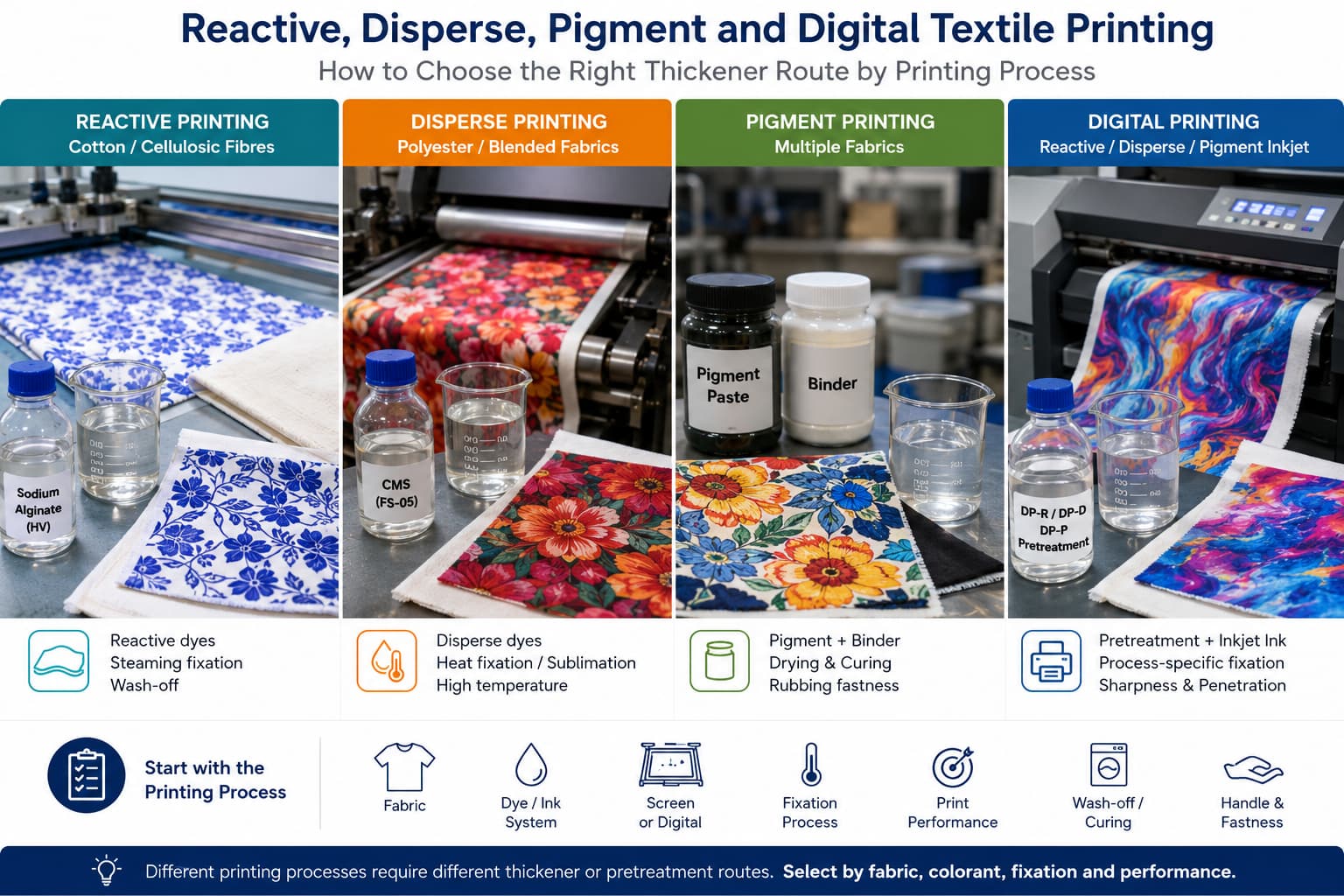
Reactive Printing Sample Planning
Reactive printing often requires testing:
Sodium alginate or alternative thickener
Reactive dye
Salt / anti-reducing auxiliaries where used
Alkali
الطهي بالبخار
الغسيل
Sample planning should allow:
Fresh paste
Held paste
At least one representative shade
Finished fabric after wash-off
If the mill wants to compare alkali timing or several shades, increase sample quantity before the trial starts.
Disperse Printing Sample Planning
Polyester disperse printing requires not only screen-running evaluation but also thermal fixation and dye release.
Plan enough sample for:
Complete color paste
استقرار الحيازة
Flat or rotary screen trial
Thermofixation / steaming
Reduction clearing / wash-off
A small viscosity-only test cannot confirm disperse-printing suitability.
If the candidate is a CMS or compound thickener, keep enough material to test repeatability and at least one production-relevant dye load.
Pigment Printing Sample Planning
Pigment printing must be evaluated as a binder system.
Allow sample for:
Pigment dispersion
توافق المجلدات
Thickener rheology
المعالجة
ثبات اللون عند الفرك
Fabric hand
Because binder and pigment solids affect paste rheology, one water-viscosity test is not enough.
A meaningful pigment trial usually consumes more sample than a simple polymer QC test.
Digital Pretreatment & Thickener Sample Planning
Digital textile routes can require:
الترشيح
Pretreatment preparation
Padding / coating / stenter application
التجفيف
Digital printing
Steaming / curing
الغسيل
Machine trial quantity depends strongly on:
Application pickup
Fabric width
Fabric length
Pretreatment concentration
Calculate from the intended application liquor or paste consumption rather than requesting an arbitrary number of kilograms.
Why Machine Trial Quantity Can Vary So Much
Two mills running the same thickener can require very different trial quantities.
Reasons include:
One uses a 50-meter short test; another needs 1,000 meters.
One machine has low dead volume; another needs substantial paste just to fill the system.
One design covers 20% of the fabric; another is a large solid print.
One mill prints one color; another uses six screens.
Historical industrial data for rotary and flat-screen printing show broad ranges in print-paste consumption per unit area and total paste used per run, reinforcing that production trial quantity is process-specific rather than fixed.
The mill’s own paste-consumption records are normally the best planning source.
Printed Coverage and Design Matter
A production trial should not be calculated from fabric length alone.
Also consider:
Percentage printed area
Fine pattern vs. solid coverage
Number of screens/colors
Double-sided penetration target
Fabric absorbency
A 500-meter fine-line design can consume less paste than a much shorter solid print.
If exact design consumption is unknown, use a recent similar production order as the reference.
Why You Need a Safety Margin
Exact theoretical quantity is rarely enough.
Trial losses can occur through:
Mixing tank residue
Hoses
Pumps
Screens
Filter residue
QC sampling
A 15–30% planning margin can be reasonable for many controlled trials, but the mill should use its actual equipment loss where known.
Do not over-order large quantities before the laboratory direction is technically justified.
What Each Sample Size Can and Cannot Prove
Sample Level
Can Usually Support
Cannot Reliably Prove
100–300 g
Basic lab screening
Long production stability
300 g–1 kg
Repeated complete-formula lab tests
Full machine scale-up
1–5 kg
Small pilot / machine-relevant trial
Every long-run commercial condition
Calculated production quantity
Production behavior under defined conditions
Future batch consistency by itself
Even a successful production trial does not prove every future batch.
Commercial approval also needs:
Agreed product grade
Specification
Test method
Batch COA / traceability
Sample-to-bulk consistency
From Sample Approval to Commercial Batch Approval
After the trial passes, confirm:
Which exact commercial grade was tested.
Which batch the sample came from.
Which viscosity and QC method will control bulk supply.
Which parameters belong in the agreed specification.
How the first production shipment will be checked.
FSX Chemical’s current sample process connects trial feedback with grade confirmation, technical documents and bulk-supply discussion rather than treating the sample as a disconnected giveaway.
This sample-to-bulk link is essential for procurement approval.
How to Avoid Wasting Free Samples
Before requesting several kilograms, provide the supplier with:
Current thickener
Target application
الجرعة الحالية
طريقة اللزوجة
القماش
Dye / pigment / ink system
Main problem
This can reduce unnecessary candidate grades.
FSX Chemical’s current public sample route supports multiple sample items in one request with a combined sample weight of up to 2 kg, subject to product availability and request review.
That quantity can be very useful for laboratory and selected pilot evaluation, but a larger production trial should be calculated and arranged according to actual consumption.
Production quantity requested before lab screening
Use staged approval
Dark shade trial uses much more paste
Shade/formula differences ignored
Plan representative shade consumption
Customer requests “2 kg for production trial”
No paste-consumption calculation
Calculate machine requirement before confirming
What Information Should You Send Before Requesting a Sample?
For useful sample planning, provide:
Product required: sodium alginate, CMC, CMS or digital printing paste
Printing route
القماش
Dye / pigment / ink system
Current thickener grade or TDS
الجرعة الحالية
Target viscosity and complete test method
Number of candidate grades required
Lab screening or machine trial
Planned complete paste quantity
Expected production trial length where known
Main performance target
With these details, FSX Chemical can review whether a standard sample quantity is sufficient or whether a larger pilot quantity should be planned.
How Much Textile Thickener Sample Should You Request?
A practical decision sequence is:
Define Trial Stage → Estimate Complete Paste Needed → Apply Thickener Dosage → Add Trial Margin → Reserve Repeat Sample → Run Test → Move to Next Stage Only If It Passes
The key principles are:
Sample quantity should be based on the decision you need to make.
100–300 g can often support initial lab screening but is not production approval.
Repeated complete-formula testing commonly benefits from 300 g–1 kg per grade.
Small machine trials often move into 1–5 kg quantities, depending on dosage and paste volume.
Production trial quantity should be calculated from actual paste consumption rather than a fixed kilogram number.
Keep enough material for repeat testing and sample-to-bulk traceability.
الأسئلة الشائعة
1. Is 200 g enough for a textile thickener sample?
It can be enough for basic viscosity, hydration and several small laboratory paste tests. It is usually not enough for a meaningful production-machine trial.
2. How much sample is useful for complete-formula testing?
About 300 g–1 kg per grade is a practical planning range when several formulations, repeats or fabric prints are required. Actual needs depend on dosage and test design.
3. How much thickener is needed for a machine trial?
Calculate the amount of complete paste the machine trial will consume, multiply by the thickener dosage, then add a practical loss/safety margin.
4. Is 2 kg enough for a production trial?
Sometimes, but not automatically. At 3% dosage, 2 kg can make about 66.7 kg of complete paste before losses. Whether that is enough depends on the machine and planned run.
5. Why do I need extra sample beyond the theoretical amount?
Mixing tanks, pumps, hoses, screens, filters and QC sampling consume material. A margin also allows one repeat if something unexpected happens.
6. Should every candidate grade receive the same sample weight?
Not necessarily. If the candidates use different dosages, equal sample weights produce different amounts of complete paste. Plan by the actual test requirement.
7. How much sample should be kept as a retained reference?
Keep enough for at least one repeat QC or investigation where practical. The exact amount depends on the test method and available sample.
8. Can a free sample be used for production approval?
A free sample can support laboratory or selected pilot testing, but production approval should be based on a quantity large enough to reproduce actual operating conditions.
9. Why should the current thickener be tested at the same time?
It provides a controlled reference and helps determine whether the candidate is truly better, equivalent or unsuitable under the same process.
10. Does dark shade testing require more sample?
It can. Dark shades may use different dye loading, auxiliaries or paste volume and should be included if they represent an important production condition.
11. What happens after the sample passes?
Confirm the exact commercial grade, specification, viscosity method, COA/traceability and first bulk-shipment verification route.
12. What should I send FSX Chemical before requesting a sample?
Send your process, fabric, current thickener or TDS, dosage, viscosity method, dye/pigment/ink system, intended trial stage and estimated paste or production quantity.
Request the Right Sample Quantity for the Trial Stage
If you are evaluating sodium alginate, CMC, CMS or digital printing paste, FSX Chemical can help match the sample size to the actual test plan instead of sending either too little for a useful trial or too much before the technical direction is confirmed.
For sample planning, send:
Your current thickener or TDS
عملية الطباعة
Fabric and colorant system
الجرعة الحالية
اللزوجة المستهدفة وطريقة الاختبار
Number of grades to compare
Lab, pilot or production-trial objective
Planned complete-paste quantity
Estimated trial length where available
Main target: viscosity, screen running, K/S, wash-off, hand or cost
ابدأ بـ العينات والمطابقة to identify a suitable trial grade and quantity.
The right sample quantity is not the largest quantity a supplier is willing to send. It is the smallest quantity that can answer the next technical question reliably—followed by a larger trial only after the previous stage passes.
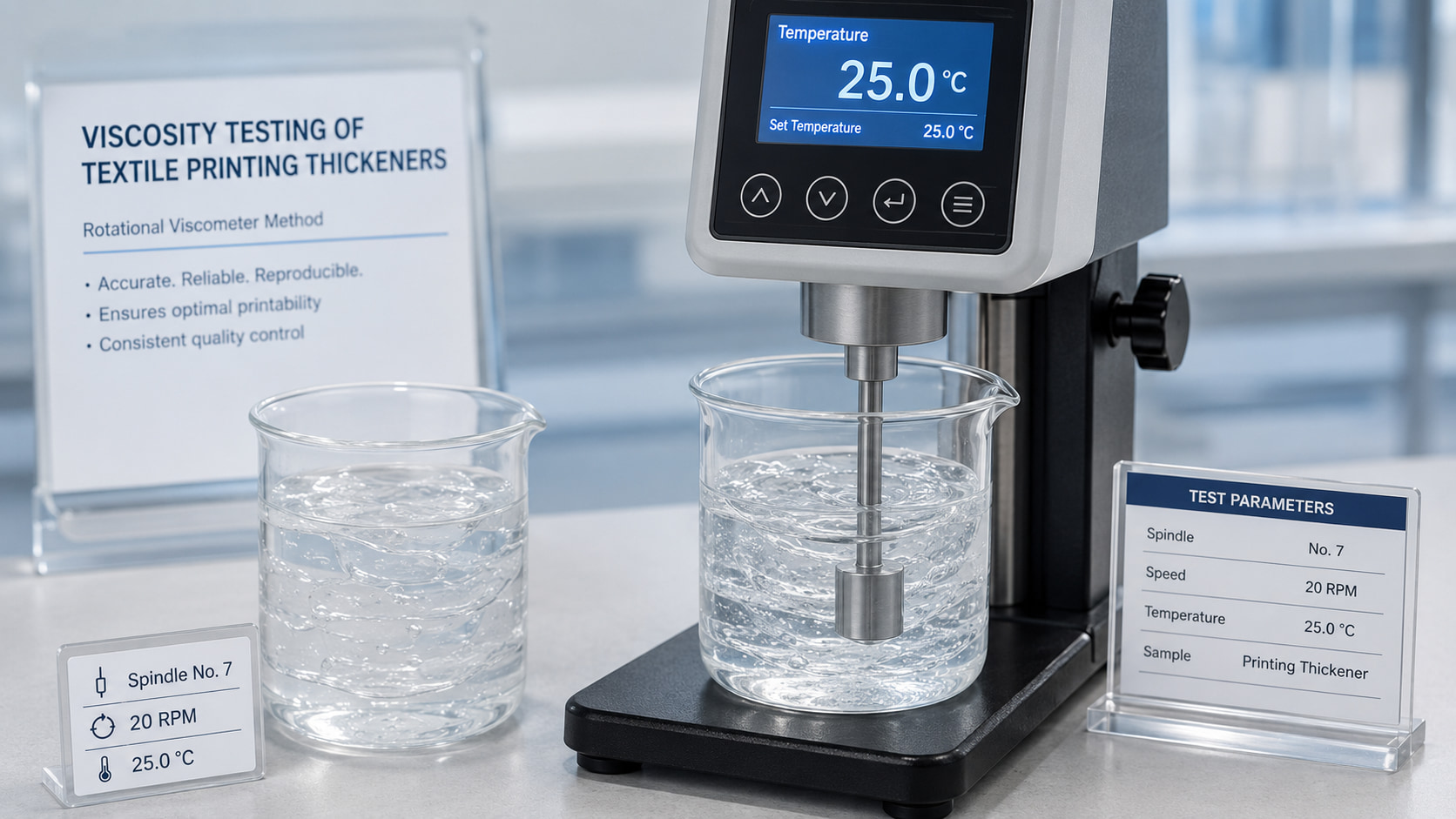
تعرف على السبب الذي يجعل من المستحيل مقارنة قيم لزوجة مكثفات الطباعة النسيجية دون مطابقة كل من التركيز، ودرجة الحرارة، والجهاز المستخدم، والمغزل، والسرعة، وطريقة التحضير، ووقت الاختبار.
تعرف على كيفية اختيار المُكثِّف وطرق المعالجة المسبقة للطباعة النسيجية التفاعلية، والطباعة بالتشتت، والطباعة بالصبغات، والطباعة الرقمية، بناءً على متطلبات النسيج، والصبغة أو الحبر، والتثبيت، وقابلية الغسل، وجودة الطباعة.
قارن بين CMC وCMS وألجينات الصوديوم ومعجون الطباعة الرقمية المستخدمة في طباعة المنسوجات. تعرف على مدى ملاءمة كل خيار لعمليات الطباعة التفاعلية، والطباعة بالتشتت، والطباعة بالصبغات، والطباعة الرقمية، وما يجب على المشترين مراجعته قبل اختبار العينات، ومطابقة الدرجات، والشراء بالجملة.
يُستخدم ألجينات الصوديوم على نطاق واسع في طباعة المنسوجات كمكثف مستقر وقابل للغسل لمعجون الطباعة التفاعلي. تعرف على كيفية تقييم درجة اللزوجة والنقاء ومدى ملاءمة الاستخدام قبل الشراء، وكيف تدعم شركة FSX Chemical المشترين العالميين من خلال توفير البيانات الفنية والعينات.
يُستخدم كربوكسي ميثيل السليلوز (CMC) على نطاق واسع في عمليات الطباعة والتحجيم والصباغة للمنسوجات. سيشرح هذا الدليل كيفية تقييم درجات جودة CMC، والمعايير الأكثر أهمية، وكيف يمكن لشركة FSX Chemical دعم قرارات الشراء.
يُستخدم كربوكسي ميثيل السليلوز كمكثف ومثبت في الأحبار المائية، والطباعة بالحفر، والمعالجة المسبقة في الطباعة بنفث الحبر. يتناول هذا الدليل المعايير الرئيسية للدرجات واعتبارات التوريد التي يجب على فرق المشتريات أخذها في الاعتبار.
يُستخدم معجون الطباعة الذي يعتمد على مادة CMC في طباعة المنسوجات بالأصباغ، والطباعة التفاعلية، والطباعة الرقمية. يشرح هذا الدليل المعلمات المهمة، وكيفية مقارنة الموردين، وما يجب طلبه قبل تقديم طلب شراء بالجملة.
يُستخدم كل من ألجينات الصوديوم وCMC كمكثفات في طباعة المنسوجات، لكنهما يناسبان أنظمة صبغ وظروف معالجة مختلفة. يشرح هذا الدليل الاختلافات الرئيسية بينهما ومتى يتم استخدام كل منهما.
تختلف متطلبات المعجون والمعالجة المسبقة في الطباعة الرقمية بنفث الحبر على المنسوجات عن تلك الخاصة بالطباعة بالشاشة الحريرية. يشرح هذا الدليل كيفية استخدام ألجينات الصوديوم في الطباعة الرقمية على المنسوجات، والمعايير التي يجب على فرق المشتريات تحديدها فيما يتعلق بدرجات الجودة.
يتشابه كل من CMC المخصص للاستخدام الغذائي وCMC المخصص للاستخدام الصناعي في التركيب الكيميائي الأساسي، لكنهما يختلفان بشكل كبير من حيث درجة النقاء ونطاق DS والمتطلبات التنظيمية. يشرح هذا الدليل الاختلافات الرئيسية وسبب تسبب استخدام الدرجة غير المناسبة في حدوث مشكلات في الإنتاج.
يُعد التحضير الصحيح للمادة اللزجة أمرًا لا يقل أهمية عن اختيار الدرجة في طباعة المنسوجات بالأصباغ التفاعلية. يتناول هذا الدليل طرق إذابة ألجينات الصوديوم، ونطاقات التركيز حسب الاستخدام، وظروف التخزين، وكيفية معالجة المشكلات الشائعة في عملية التحضير.
يُعد ألجينات الصوديوم بوليمرًا طبيعيًّا وقابلًا للتحلل البيولوجي، لكن استخدامه في طباعة المنسوجات ينتج عنه مياه صرف تحتاج إلى معالجة. يتناول هذا الدليل الملامح البيئية لألجينات الصوديوم، وخصائص مياه الصرف الناتجة عن عملية الغسل، وما يجب على فرق المشتريات فهمه بشأن اختيار المُكثِّف وتأثيره البيئي.
يرجى إرسال اسم المنتج، والتطبيق، والكمية، والوجهة، وأي بيانات تقنية (TDS)،
أو صورة عينة أو مستند متوفر لديكم بالفعل. وستقوم شركة FSX Chemical بمراجعة
هذه المعلومات وتقديم توصية بشأن الخطوة التالية سواء كانت تقديم عرض أسعار، أو مطابقة العينة،
أو اختيار المنتج.
معلومات عن المنتجاسم المنتج، الدرجة، الطراز، صورة الملصق أو مرجع المورد.
الوثائق المتاحةTDS، SDS، COA، صورة العينة، قائمة المنتجات أو بيانات الاختبار.
تفاصيل الطلبالكمية التقديرية، والتعبئة، وبلد المقصد، والميناء، أو الشروط التجارية.
الطلب أو المشكلةعملية طباعة المنسوجات، متطلبات التركيبة، المشكلات الحالية أو الأداء المستهدف.

 AR
AR  EN
EN  BN
BN  ES
ES  TR
TR  FR
FR  ID
ID  RU
RU  UR
UR  VI
VI  TL
TL  HI
HI  UK
UK  KK
KK  KA
KA  UZ
UZ