















Synthetic Printing Thickener

FSX Chemical suministra espesantes de alginato de sodio de alta tensión (HV), media tensión (MV) y baja tensión (LV), destinados principalmente a la impresión textil reactiva. Los grados se pueden seleccionar en función de la viscosidad, la solubilidad y las necesidades del proceso, lo que permite una preparación estable de la pasta, un rendimiento de impresión limpio y el uso en formulaciones específicas.

Synthetic Thickeners · Application Overview

How Synthetic Thickeners Support Textile Printing

Acrylic-based liquid thickeners control printing-paste viscosity and flow. Select the grade for pigment, reactive or disperse printing, then assess performance with your fabric and formulation.

Viscosity Build

Develops paste body and allows viscosity adjustment during preparation.

Paste Flow

Controls paste rheology for transfer through flat-screen and rotary-screen equipment.

Definición de «Imprimir»

Supports sharp outlines and controlled spreading in a matched printing formulation.

Funcionamiento de la pantalla

Supports smooth paste transfer with reduced mesh-clogging tendency under suitable conditions.

Electrolyte Tolerance

YS-3169 offers strong electrolyte tolerance for reactive dye printing pastes.

Wash-Off & Handle

YS-3169 and YS-816 support desizing and soft handle under suitable process conditions.
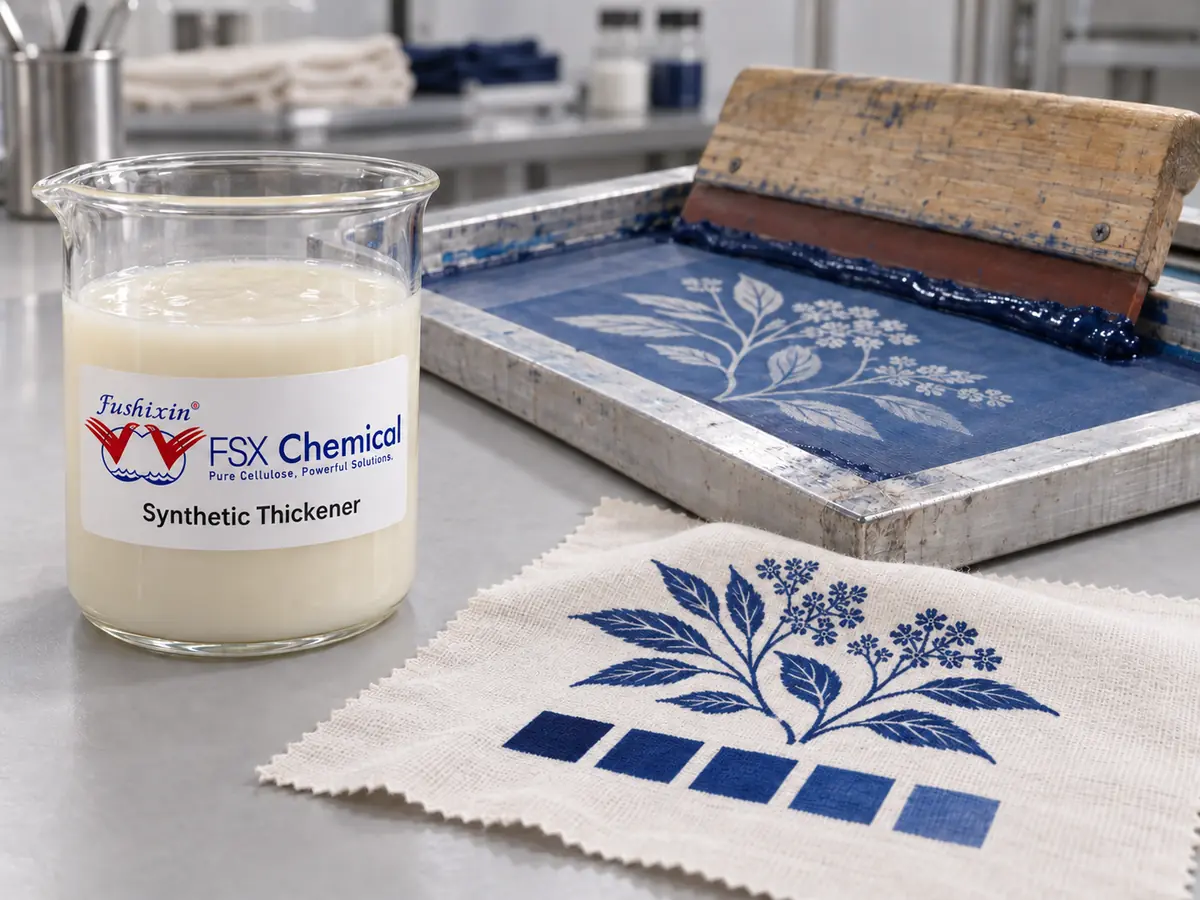
FSX synthetic thickener samples and textile printing paste

Three Grades · Three Printing Systems

FSX 5112

Impresión con pigmentos

For pigment and binder pastes; stock-paste preparation or direct viscosity adjustment.

FSX YS-3169

Impresión reactiva

For cotton and viscose; used as the main thickener or with sodium alginate.

FSX YS-816

Impresión por dispersión

For polyester with flat-screen and rotary-screen printing processes.

Application Guide · Printing Workflow

Synthetic Thickeners in the Printing Process

Follow the paste from preparation to the finished fabric. Mixing, fixation and washing requirements depend on the selected printing system.

  1. Prepare the Paste

    Stir the liquid thickener before use. Incorporate it under effective mixing, following the selected grade’s preparation sequence.

  2. Adjust the Formulation

    Mix the colorants and required auxiliaries. Adjust dosage to target paste viscosity and check uniformity before printing.

  3. Serigrafía

    Check paste transfer, screen running and pattern edges on the actual fabric at the intended machine speed.

  4. Dry & Fix

    Follow the binder’s curing conditions for pigment printing, or the dye system’s fixation conditions for reactive and disperse printing.

  5. Wash Where Required

    For reactive and disperse printing, follow the specified wash-off process. Conventional pigment printing generally does not require post-print washing.

  6. Review the Finished Print

    Check color yield, print definition and fabric handle after the required treatments. Record results for production approval.

Application Trials · Print Performance

Evaluate Synthetic Thickener Printing Performance

Compare paste behavior and finished fabric when evaluating synthetic thickeners for pigment, reactive or disperse printing. Record the formulation, working dosage and process conditions for each trial.
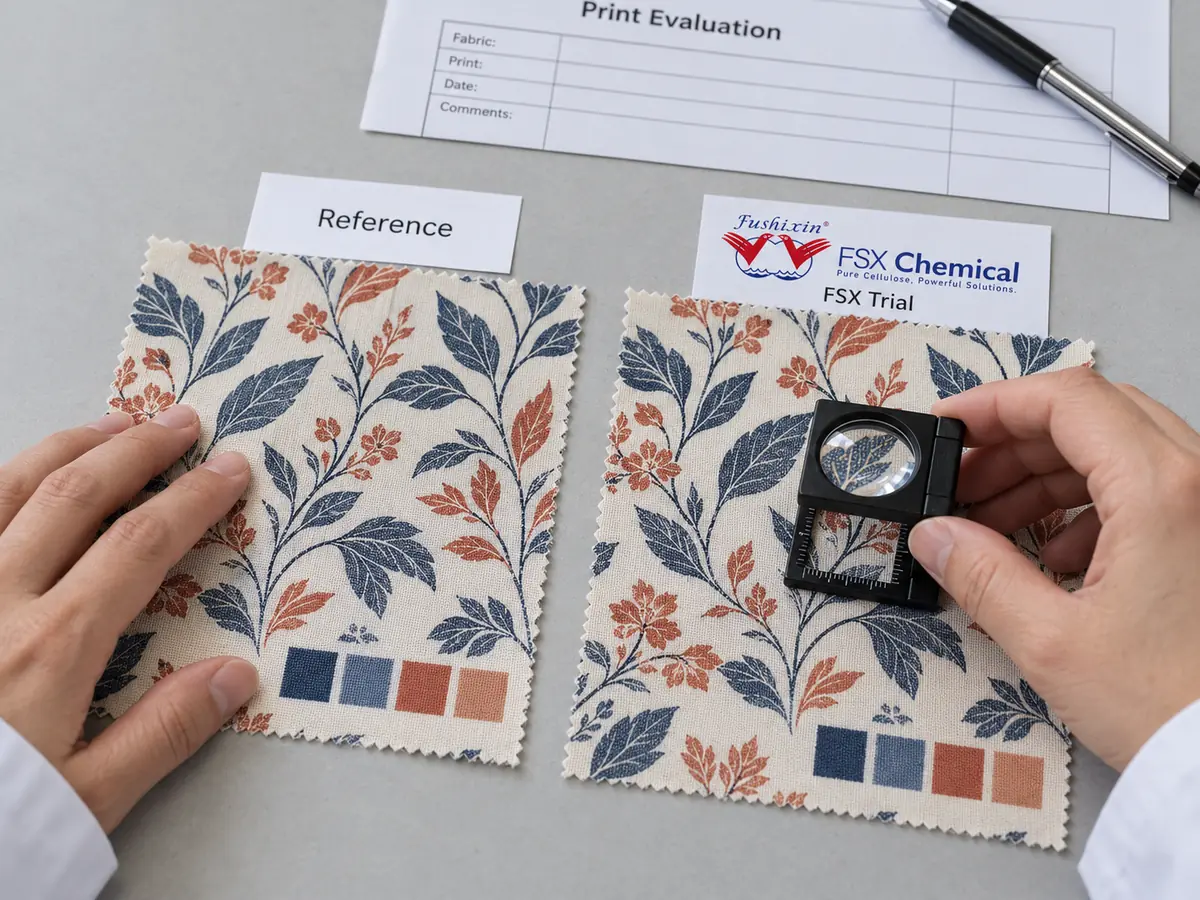
Textile printing trial swatches for comparing pattern definition and color consistency
Compare trial swatches on the same fabric after the intended fixation and after-treatment. Record any changes to dosage or processing.

Six Checks for Your Printing Trial

Use your current thickener as the reference and compare the following results under matched conditions.

Paste Stability & Compatibility

Measure viscosity at consistent intervals. Check for separation, particles or viscosity changes after adding colorants and auxiliaries.

Screen Transfer & Flow

Observe paste transfer, screen release and mesh build-up during flat-screen or rotary-screen printing at the trial speed.

Definición de «Imprimir»

Compare fine lines, sharp edges and solid areas. Check bleeding, uneven coverage and penetration on the selected fabric.

Color Yield & Uniformity

Compare shade depth and evenness at the same colorant level, fabric and fixation conditions, including any required washing.

After-Treatment & Handle

For reactive and disperse prints, assess wash-off and background clarity. For pigment prints, assess handle after binder curing.

Repeatability & Cost-in-Use

Repeat the trial to check consistency. Compare thickener cost at the dosage needed to achieve an acceptable print result.
Aplicación de pasta de impresión textil a base de CMC sobre tela impresa en un proceso industrial de serigrafía

Synthetic Thickeners · Paste Preparation

Preparing Synthetic Thickener Printing Paste

Preparation Checks from Product to Printing Paste

Bars indicate checklist order, not mixing time or performance scores.

  1. Product
    preparation

    Confirm the grade and batch. Stir the liquid thickener before weighing and use.

    Step 01 / 06
  2. Water &
    auxiliaries

    Prepare the water and required auxiliaries in the order specified for the selected grade.

    Step 02 / 06
  3. Espesante
    addition

    Incorporate the weighed thickener under effective mixing, following its TDS addition method.

    Step 03 / 06
  4. Mixing &
    standing

    Complete the grade-specific mixing stage and any prescribed standing time before evaluation.

    Step 04 / 06
  5. Viscosidad
    adjustment

    Check the complete paste under consistent test conditions and evaluate any dosage adjustment.

    Step 05 / 06
  6. Final paste
    check

    Review uniformity, stability and screen behavior. Record the formulation and preparation conditions.

    Step 06 / 06

Match the Preparation Method to the Grade

FSX synthetic thickeners are acrylic-based liquid grades for textile printing paste. Use the preparation method for the selected product; one mixing sequence does not cover every pigment, reactive and disperse formulation.

FSX 5112 · Pigment printing. For stock-paste preparation, add gradually to water under high-speed stirring. Direct viscosity adjustment is another TDS-listed route, with the addition level evaluated in the pigment and binder formulation.

FSX YS-3169 · Reactive printing. Follow the specified sequence for water and auxiliaries. Where sodium alginate is included, complete its prescribed mixing stage before adding YS-3169, then follow the TDS mixing and aging guidance.

FSX YS-816 · Disperse printing. Stir before use and follow its TDS for incorporation. Evaluate working dosage and paste viscosity for the intended flat-screen or rotary-screen polyester printing process.

Selector de grado

Choose a Starting Synthetic Thickener for Your Printing Trial

Select your printing system to review the corresponding FSX grade. Confirm formulation compatibility and working dosage through sample trials. Reference dosages below are starting points; check the calculation basis against the current TDS.

Impresión con pigmentos

FSX 5112

FSX Chemical Acrylic-Based Liquid Printing Thickener

Ionic nature Anionic
Solid content 70 ± 2.0%
Reference dosage* Approx. 1.4%
Ideal para Pigment and binder printing formulations
Consultas y soporte técnico sobre productos

Envíe los requisitos de su producto

Comparta el nombre del producto, su aplicación, la cantidad, el destino y cualquier ficha técnica (TDS), foto de muestra o documento que ya tenga. FSX Chemical revisará la información y le recomendará el siguiente paso para la cotización, la comparación de muestras o la selección del producto.

Información del producto Nombre del producto, categoría, modelo, foto de la etiqueta o referencia del proveedor.
Documentos disponibles TDS, SDS, COA, foto de muestra, lista de productos o datos de pruebas.
Detalles del pedido Cantidad estimada, embalaje, país de destino, puerto o término comercial.
Solicitud o problema Proceso de impresión textil, requisitos de formulación, problema actual o objetivo de rendimiento.