What Causes Acrylic Thickener Stringing and Poor Screen Release in Pigment Printing?
Stringing and poor screen release can reflect stretching behavior, wetting, complete-paste composition and machine separation...
A pigment printing paste can meet a rotational-viscosity target and still form filaments or release poorly from the screen. The symptom can reflect stretching behavior, wetting, paste composition and machine separation conditions; a visible string does not by itself prove excessive elasticity, HASE association or a particular molecular weight. Compare a reproducible filament screen with shear viscosity, controlled recovery and the actual screen trial, then verify selected changes in the complete pigment–binder paste.
What Causes Acrylic Thickener Stringing and Poor Screen Release?
Stringing usually appears when the printing paste stretches into a filament instead of separating cleanly after deformation.
Working hypotheses to investigate include:
Excess extensional elasticity
High thickener dosage
Long polymer chains / high effective molecular weight
Strong HASE associative networking
Binder–thickener interaction
Surfactant-induced association
Incorrect pH activation
Pigment / electrolyte effects
Machine settings that increase stretching during release
The useful troubleshooting logic is:
Confirm Stringing → Standardize Viscosity Method → Compare Shear Profile → Observe Filament Break-Up → Check Recovery / Elasticity → Change Formula or Machine Variable One at a Time
Do not assume:
Stringing = Viscosity Too High.
A paste can be relatively low in shear viscosity and still be highly elastic under stretching.
What Does “Stringing” Mean in Textile Printing?
Stringing describes a paste forming threads, tails or filaments when two surfaces separate.
In pigment printing, this may be observed when:
A spatula is lifted from the paste.
A screen lifts away from the fabric.
A squeegee leaves the paste bead.
Paste separates from a transfer surface.
A useful paste should normally break cleanly enough to avoid long filament dragging.
Excessive stringing can lead to:
Dragging
Smearing
Dirty screen release
Fine-detail loss
Uneven deposit
Stringing is a process symptom worth investigating. Paste rheology, contact and wetting, and separation mechanics can all contribute; the visible symptom alone does not identify a single material property.
What Is Poor Screen Release?
Poor screen release occurs when the paste does not separate cleanly from the screen / substrate interface after transfer.
Depending on the machine, it can appear as:
Paste filaments between screen and fabric
Trailing paste after squeegee movement
Mesh marks
Disturbed printed edges
Sticky screen behavior
Screen release depends on both:
Reología de las pastas
and:
Machine Separation Mechanics.
A strong elastic paste can resist filament break-up even when the low-shear viscosity appears normal.
Why Normal Viscosity Can Still Produce Stringing
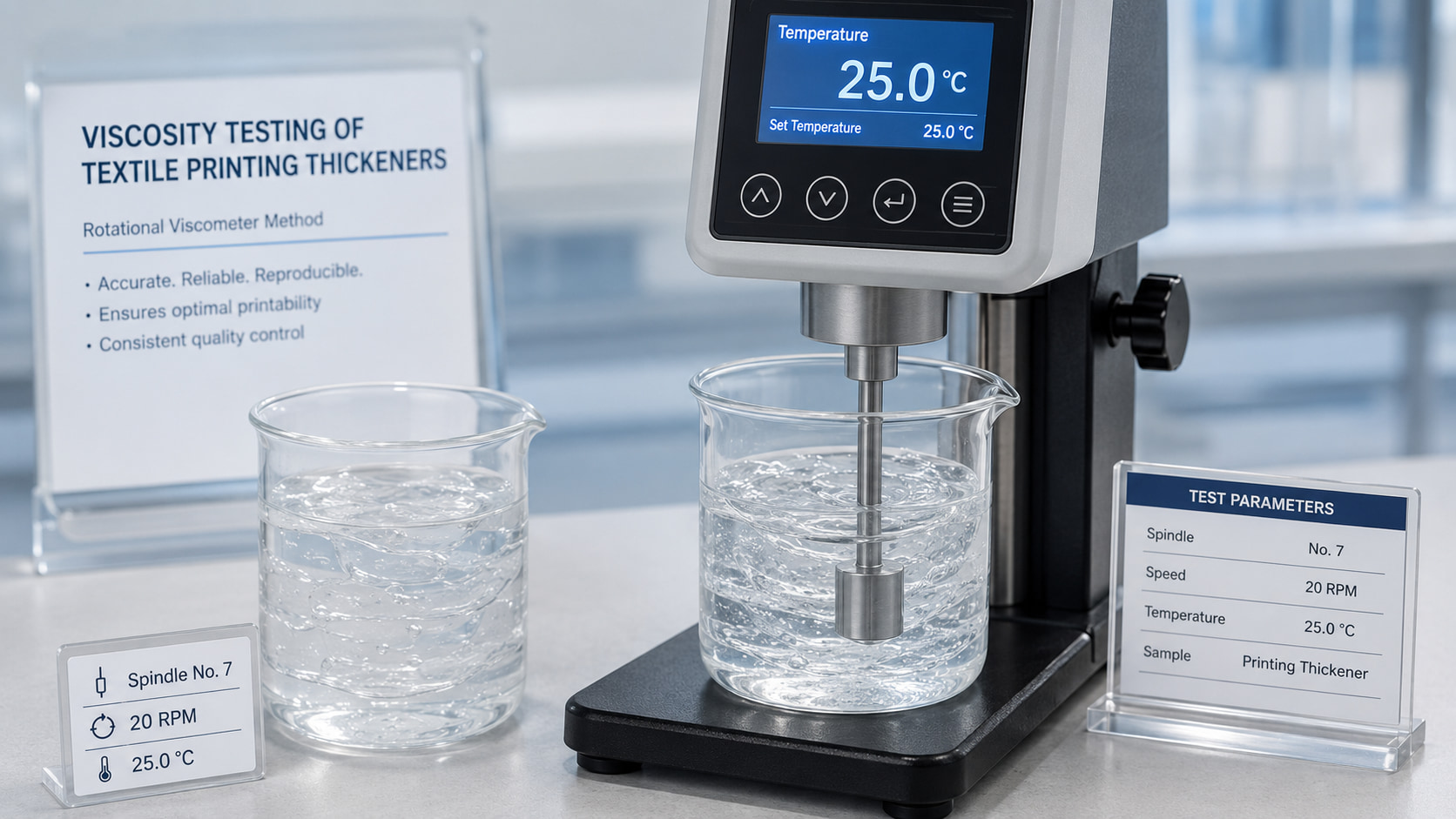
Brookfield or similar rotational viscosity mainly describes resistance to shear under a defined condition.
Stringing, however, occurs when the paste is stretched.
These are not the same deformation modes.
Two acrylic-thickened pastes can have:
Same Brookfield Viscosity
but different:
Elasticity
Extensional viscosity
Filament break-up time
Recuperación estructural
These differences can contribute to different release behavior at the same measured shear viscosity. Confirm the relevant property and machine conditions rather than assigning the difference to elasticity from appearance alone.
Shear Rheology vs. Extensional Rheology
During pumping and screen passage, shear rheology is critical.
During filament stretching and screen separation, extensional behavior becomes important.
A useful pigment paste needs:
Enough Shear Thinning for Transfer
but also:
Fast Enough Filament Break-Up for Clean Release.
Extensional and shear responses can differ. Use appropriate measurements to investigate this possibility instead of inferring extensional thickening from a rotational-viscosity number.
This is why the thickener’s network architecture can matter even when standard viscosity values are similar.
Elasticity and Filament Dragging
An elastic paste stores part of the applied deformation energy.
When stretched, it can resist breaking and instead form a longer filament.
Excess elasticity can therefore increase:
String length
String lifetime
Filament dragging
Snap-off difficulty
An internal filament observation can help screen application behavior when its procedure is controlled, but the ranking must be checked against release on the production screen.
For pigment printing, the ideal level is not zero elasticity.
Some structure helps:
Pattern hold
Anti-spreading
Recovery
The practical problem is unacceptable release in this machine and formulation. Elasticity may be one contributing property, but it requires appropriate measurement and cannot be isolated from a filament observation alone.
Polymer Molecular Weight and Chain Length
Higher molecular weight can increase thickening efficiency, but long chains can also increase:
Entanglement
Elasticity
Filament formation
This does not mean high-molecular-weight thickener is always stringy.
Polymer architecture also includes:
Crosslinking
Charge density
Hydrophobic modification
Molecular-weight distribution
The practical decision should be based on the complete rheology rather than molecular weight alone.
Thickener Dosage and Polymer Concentration
Increasing thickener dosage can increase more than low-shear viscosity.
At higher polymer concentration:
Chain overlap increases.
Entanglement can increase.
Associative junctions can become more numerous.
Elasticity can rise.
Therefore, correcting a thin-looking paste by adding more thickener can create:
HASE thickeners combine pH-driven acrylic swelling with hydrophobic associative interactions.
The hydrophobic groups can connect:
Thickener chains
Binder particles
Surfactant structures
Pigment-dispersion components
This transient network can give excellent rheology control.
But if association becomes too strong for the application, it can increase:
Elasticity
Stringiness
Slow filament break-up
Therefore:
More Associative Structure ≠ Automatically Better Screen Release.
Binder–Thickener Interaction
Binder chemistry can materially change associative-thickener rheology.
The same HASE thickener can show different:
Viscosidad
Elasticity
Recovery
Stringing
with different binder types or surfactant packages.
If stringing appears only after binder is added, treat that as a complete binder-package challenge. Document supplied binder dose, water contribution, pH, preparation and holding history, and compare:
Thickener Base
with:
Thickener + Production Binder.
Do not assume the thickener alone is responsible. Binder polymer, carrier water and accompanying ingredients can change together; the comparison prioritizes follow-up and does not identify a unique binder–thickener association.
Surfactants and Hydrophobic Association
Surfactants can interact with associative thickener hydrophobes.
Depending on type and concentration, they can:
Strengthen intermolecular association
Compete for hydrophobic sites
Change network size
Change viscosity and elasticity
Pigment and binder products already bring their own surfactants into the paste.
Changing:
Pigment supplier
Binder supplier
Wetting agent
Defoamer
can therefore change stringing even when thickener dosage remains unchanged.
Pigment Loading and Dispersant Effects
Higher pigment loading changes the complete formulation.
It can add more:
Agua
Dispersant
Surfactant
Electrolyte
Pigment solids
These components can weaken or strengthen an associative network.
Therefore, stringing may be:
Worse in dark shades
Better in dark shades
Unchanged but accompanied by different viscosity
Test representative light, medium and dark formulas where pigment loading varies widely.
pH and Neutralization
Many acrylic thickeners are pH-responsive.
Under-neutralization can produce poor thickening and unstable flow.
Over-adjustment or an unnecessarily high pH can change:
Polymer expansion
Ionic load
Compatibilidad con aglutinantes
For an associative grade, pH can also change the balance between:
Swelling + Association.
Record pH before changing dosage.
Do not solve stringing by changing neutralizer blindly.
Electrolytes and Ionic Strength
Electrolytes can screen charged polyacrylate groups and change polymer expansion.
In HASE systems, salt can also change the relative importance of hydrophobic association.
The result can be complex:
Viscosity can fall.
Elasticity can change.
Stringing can decrease or increase.
Therefore:
Lower Viscosity After Salt ≠ Automatically Better Release.
Evaluate the full rheology and actual screen behavior.
Temperature and Holding Time
Paste temperature changes viscosity and can alter associative interactions.
Holding time can also change network equilibration.
If stringing appears only after several hours, record:
Fresh temperature
Held temperature
Fresh viscosity
Held viscosity
pH
Stringing behavior
If visible filament behavior or release deteriorates during holding while shear viscosity stays within its limit, investigate the aged complete paste. Do not describe it as increasing elasticity unless an appropriate test measures that property.
Foam and Entrained Air
Entrained air can disturb the visual assessment of filament break-up.
Foam can also produce:
Interrupted filaments
Uneven transfer
Apparent stringiness
Pinholes
Deaerate or standardize foam before comparing candidate thickeners.
Do not confuse foam-related trailing with true polymer stringing.
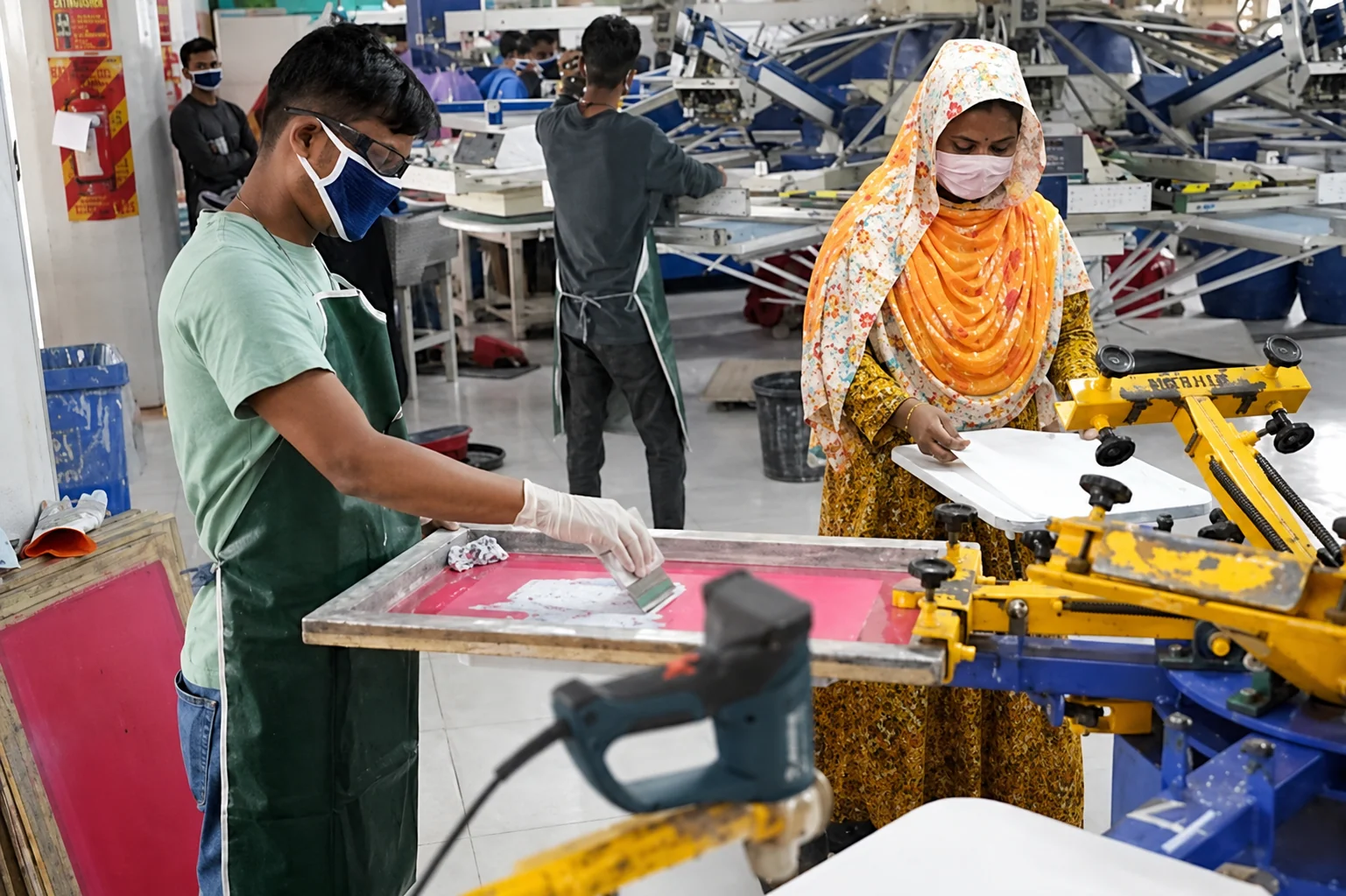
Flat-Screen Stringing and Lift-Off
Flat-screen printing includes a clear separation stage when the screen lifts or snaps away from the printed fabric.
Filaments may bridge the separating surfaces. Their persistence can depend on paste properties, wetting and the separation motion; the bridge alone does not establish excessive elasticity.
Check:
Off-contact / lift behavior
Screen tension
Squeegee pressure
Paste recovery
Filament break-up
A paste that transfers during the stroke but releases poorly during lift-off needs separate release testing. Check the complete paste and the lift or snap-off conditions; acceptable shear viscosity does not settle that diagnosis.
Rotary-Screen Release and Continuous Shear
Rotary-screen printing does not reproduce the same lift-off geometry as flat-screen printing, but the paste still experiences:
Continuous shear
Screen opening deformation
Transfer separation
Pumping and recirculation
A stringy associative paste can show:
Dirty release
Trailing
Unstable deposit
Long-run viscosity or observed filament-behavior drift
Rotary qualification should therefore include circulation time and end-run screen behavior.
Screen Mesh, Engraving and Open Area
Screen geometry changes how strongly the paste is deformed.
Finer openings can:
Increase local shear
Reduce paste deposit
Make release defects more visible
Coarser openings can increase deposit and create larger paste bridges during separation.
Do not select the thickener without considering:
Mesh
Open area
Engraving depth
Pattern type
One grade can release cleanly on one screen and string on another.
Squeegee Pressure, Speed and Angle
Machine settings change both shear and paste deformation.
Higher pressure or repeated strokes can increase:
Transferencia por pasta
Paste stretch during separation
Deposit weight
During a thickener comparison, keep:
Pressure
Speed
Angle
Stroke count
constant.
Otherwise machine changes can be mistaken for a polymer-rheology difference.
Fabric Surface and Paste Release
Fabric surface affects how the paste separates after transfer.
Relevant variables include:
Hairiness
Roughness
Capacidad de absorción
Knit / woven structure
Surface finish
A rough or hairy fabric can physically pull filaments differently from a smooth fabric.
If stringing occurs only on one substrate, do not change the thickener before checking the fabric effect.
Typical Production Symptoms
Stringing / poor release can appear as:
Long paste threads
Trailing after the squeegee
Smearing
Dirty fine lines
Mesh marks
Uneven solid areas
Higher screen-cleaning demand
Record where the symptom appears:
During mixing
At the squeegee
During screen separation
After long circulation
The location helps narrow the root cause.
Run a Reproducible Filament Screen Before the Machine Trial
A spatula or probe lift can rank visible filament behavior, but it is not an extensional-viscosity measurement, an elasticity measurement or a diagnosis of polymer molecular weight. Filament formation depends on the tool and lift history as well as the paste. Use a written internal method and compare with an approved production reference.
Control
Record before comparing
Why it matters
Paste preparation
Complete formula, batch mass, addition order, mixing procedure, rest or deaeration procedure and age
Comparing thickener in water with a held production paste changes several variables.
Sample and tool
Cup geometry, paste depth, tool material and dimensions, wetted area, immersion depth and contact time
Contact and wetting change the paste bridge from which the filament forms.
Lift
Start position, travel distance, vertical lift speed and any pause; use a repeatable fixture where available
A hand lift at an uncontrolled speed cannot establish a quantitative product specification.
Condition
Paste temperature, pH, age and recent shear history
Fresh, warm and rested samples are different test states.
Observation
Video with a scale, declared frame rate and camera position; visible length or time to break, residual tail and failed or irregular lifts
Define the endpoint consistently and retain the video rather than reporting only “good” or “stringy.”
Repeatability
Repeated lifts on fresh test portions and independent paste preparations, including the reference
Report individual results and variation; do not treat several lifts from one preparation as independent batch evidence.
Set test conditions from the mill’s tools and reproducibility study. There is no universal filament-length pass limit in this guide. Keep the production formula controlled for the first comparison, then change a selected dosage, binder or machine variable and repeat the reference. If a lift exceeds the camera field or travel limit, record it as beyond that limit rather than assigning an invented break length.
Confirm screened candidates on the production screen and fabric at controlled deposit and machine settings. Record release, trailing, edge definition, cleaning demand and held-paste behavior. If quantitative elastic or extensional properties are needed, use a suitable rheometer and validated method; do not rename a lift score as extensional viscosity.
Use Multi-Speed Viscosity, Not One Reading
Measure the paste at multiple controlled shear conditions.
A useful comparison can include:
Low-speed viscosity
Medium-speed viscosity
Higher-speed viscosity
This helps estimate:
Low-shear body
Shear-thinning strength
Flow through screen openings
But multi-speed shear viscosity still does not directly measure extensional stringing.
Combine it with a filament-dragging / release observation.
Measure Structural Recovery
After a defined high-shear step:
Measure immediate post-shear viscosity.
Measure after a short rest.
Measure after a longer rest.
Rapid recovery of measured shear viscosity can help pattern hold, but it does not quantify elastic modulus or extensional response. Evaluate spreading and release separately rather than diagnosing elasticity from viscosity recovery.
Slow recovery of shear viscosity can affect pattern hold or spreading, but its relationship to filament break-up must be checked for the actual paste and process.
The goal is:
Controlled Recovery, Not Maximum Recovery Speed.
Build a Thickener Candidate Map
Candidate
Low-Shear Body
Shear Thinning
Filament Dragging
Recovery
Screen Release
A
Récord
Récord
Récord
Récord
Récord
B
Récord
Récord
Récord
Récord
Récord
C
Récord
Récord
Récord
Récord
Récord
This prevents selection from becoming:
Highest Viscosity = Best Thickener.
The best grade should balance all five behaviors.
Build a Binder–Thickener Compatibility Map
If stringing changes after binder addition, test:
Ejemplo
Condition
Main Question
A
Thickener + water
Base polymer behavior
B
Thickener + equivalent water dilution
Dilution control
C
Thickener + binder
Complete binder-package response; mechanism not isolated
D
Complete pigment paste
Production behavior
Keep final batch mass and the stated thickener basis controlled, account for carrier water and record pH, addition order, temperature and age. A water-only control tests dilution under its defined conditions; it does not match all binder coingredients. Use an appropriate carrier-matched blank where available and controlled follow-up tests before attributing a response to association. Measure viscosity and filament behavior separately, then verify the complete paste on the screen.
A binder addition can change shear viscosity and release in different directions. Test the complete paste at controlled addition and aging conditions rather than using a viscosity increase as evidence of improved release.
Build a Thickener-Dosage Ladder
Test several dosage points around the production level.
For each point, record:
Viscosidad
Multi-speed profile
Filament length / break-up
Recovery
Screen transfer
Definición de impresión
Tejido artesanal
The optimum is:
A Validated Dosage Window for Stable Transfer, Definition and Clean Release.
Do not increase dosage simply to reproduce an old Brookfield number. Repeat near candidate limits and confirm the intended variation in formula, paste age, deposit and machine conditions; a lowest passing laboratory point is not a universal production minimum.
Connect Laboratory Stringing to Machine Release
Laboratory string tests are screening tools.
The real approval must use:
Production screen
Production squeegee
Actual fabric
Representative machine speed
Compara:
Paste release
Fine-line cleanliness
Uniformidad del área sólida
Screen contamination
Beginning-to-end consistency
A candidate with slightly more laboratory filament length can still print better if its machine shear profile is better matched.
Corrective Actions by Root Cause
If Thickener Dosage Is Too High
Reduce dosage carefully and rebuild the complete viscosity / print window.
If HASE Association Is Too Strong
Evaluate a different architecture or binder/surfactant combination rather than simply lowering pH.
If Binder Triggers Stringing
Run complete-paste compatibility and screen trials to compare filament behavior, release and finished-print quality. Describe a candidate as having lower elasticity only when a suitable measurement supports that conclusion.
If Surfactant / Defoamer Triggers the Problem
Recheck the additive package and addition sequence.
If Screen / Squeegee Conditions Trigger the Problem
Optimize pressure, speed, mesh or separation mechanics before changing the chemistry.
If Stringing Appears Only After Holding
Check temperature, pH, associative network equilibration and complete-paste stability.
Production Trial Approval
For the best candidate, record:
Thickener grade / batch
Dosificación del espesante
Pigment / binder formula
Final pH
Viscosity method
Low / medium / higher-shear readings
Filament-dragging observation
Tiempo de retención
Screen / engraving
Squeegee settings
Machine speed
Screen release
Definición de impresión
Uniformidad del área sólida
Curado
Dry / wet rubbing
Tejido artesanal
Approve a rheology window, not only a viscosity number.
Common Stringing Troubleshooting Mistakes
1. Assuming Stringing Means Viscosity Is Too High
Extensional elasticity can be excessive even when shear viscosity is normal.
2. Selecting by Brookfield Viscosity Only
Brookfield does not directly measure filament break-up.
3. Adding More Thickener to Improve Print Definition
More polymer can increase elasticity and worsen release.
4. Blaming HASE Chemistry Automatically
Binder, surfactant and dosage can determine how strong the associative network becomes.
5. Ignoring Machine Settings
Pressure, speed, mesh and separation geometry can amplify stringing.
6. Testing Only the Thickener in Water
Binder and pigment can change elasticity dramatically.
7. Ignoring Holding Time
Associative structure can change during storage or circulation.
8. Solving Release by Making the Paste Too Fluid
Stringing may improve while spreading and penetration become worse.
Tabla de resolución de problemas
Problema observado
Primeras variables que hay que revisar
No des nada por sentado
Long filaments but normal viscosity
Reproducible filament behavior, wetting, separation geometry and appropriate rheological measurements
Brookfield target proves rheology is correct
Stringing increases after binder
Binder-package dose, carrier water, pH, coingredients, preparation and age
More dilution alone will solve it
Stringing increases with thickener dosage
Polymer concentration / entanglement
Higher viscosity improves release
Release improves after salt but edges spread
Rheology balance, electrolyte sensitivity
Lower viscosity equals better formulation
Only fine mesh shows poor release
Mesh opening, high-shear profile, deposit
The thickener is universally unsuitable
Only flat screen shows stringing
Lift-off, screen tension, snap-off behavior
Rotary and flat requirements are identical
Stringing appears after long holding
Temperature, pH, associative equilibration
The fresh sample predicts end-run behavior
Paste stops stringing but spreads badly
Recovery / low-shear body
Eliminating stringing is the only objective
Costo total de uso
Stringing and poor release create hidden production cost through:
Lower machine speed
More screen cleaning
Pattern defects
Rework
Extra thickener correction
Rejected fabric
A useful model is:
Total cost per accepted printed meter = attributable monetary costs for paste materials, preparation, printing, cleaning and rework ÷ accepted printed meters. Use the same production period and cost boundary for each candidate. Keep finished width, design coverage and quality requirements comparable when reporting per metre; use accepted printed area if widths differ. Machine speed affects throughput and time-based costs; do not add speed as a cost or count the same lost time again as a separate efficiency penalty. Include rejected-production costs once and exclude rejected length from accepted output.
A higher-priced thickener can still be more economical if it provides:
Cleaner release
Lower dosage
Better long-run consistency
Less screen cleaning
Compare cost per acceptable printed meter, not thickener price per kilogram alone.
What Information Should You Send to a Supplier?
For useful stringing / screen-release troubleshooting, provide:
Current acrylic thickener / TDS
Dosificación del espesante
ASE / HASE information if known
Viscosidad y método de ensayo completo
Final pH
Pigment product and dosage
Binder grade and dosage
Wetting agent / defoamer / fixer
Tiempo de retención
Criba plana o rotativa
Mesh / engraving
Squeegee pressure / speed
Tela
Where stringing appears: mixing, squeegee, lift-off or long-run circulation
FSX Chemical puede utilizar esta información a través de Muestras y combinación to structure a controlled rheology and release comparison.
How Should a Mill Fix Acrylic-Thickener Stringing?
A practical control chain is:
Confirm Filament Dragging → Standardize Temperature / Viscosity Method → Compare Multi-Speed Rheology → Check Dosage → Add Binder / Pigment → Observe Recovery → Control Machine Settings → Run Screen Trial → Approve Complete Working Window
Los principios fundamentales son:
Stringing occurs during stretching and separation; shear viscosity alone cannot identify its cause. Investigate paste response, wetting and machine motion before assigning an elastic or associative mechanism.
Same Brookfield viscosity can produce very different filament break-up and screen release.
Higher thickener dosage can increase polymer entanglement and worsen stringing.
HASE associative networks can change significantly with binder, surfactants, pigment and defoamer chemistry.
Screen mesh, squeegee settings and fabric surface can amplify or reduce poor release.
The best synthetic thickener is the grade that balances low-shear body, shear thinning, recovery and clean filament break-up at the lowest practical Total Cost in Use.
Preguntas frecuentes
1. Why does acrylic thickener form long strings?
Possible causes include high polymer concentration, molecular entanglement, strong associative networking, binder/surfactant interaction or excessive elasticity under extensional deformation.
2. Does stringing mean the viscosity is too high?
No. A paste can meet a shear-viscosity target and still form persistent filaments. Investigate stretching behavior, wetting and machine separation independently; visible stringing alone does not identify excess elasticity.
3. Why does stringing become worse after binder is added?
Adding binder changes the complete formulation, including its polymer, water, pH and accompanying ingredients. An associative response is one possible explanation for a documented HASE grade, not a mechanism established by the appearance of strings after addition. Use the controlled compatibility comparison and confirm release and finished-print quality.
4. Can reducing thickener dosage improve screen release?
Yes, if excess polymer concentration is increasing entanglement or elasticity. Recheck print definition and penetration after dosage reduction.
5. Is HASE always more stringy than ASE?
No. HASE can provide excellent screen rheology, but its associative network is more formulation-dependent. Commercial grade, binder and dosage determine the result.
6. Can electrolytes reduce stringing?
They can change polyacrylate expansion and associative rheology, but they may also reduce viscosity too much or destabilize the paste. Do not use salt as a universal stringing correction.
7. Why does a paste string only on fine screens?
Fine screens change flow, deposit and separation conditions. Compare the same paste at controlled machine settings and measured deposit; a fine-screen symptom does not by itself establish the paste’s elasticity or recovery rate.
8. Why is poor release more obvious on flat-screen printing?
Flat-screen printing includes a distinct lift or snap-off step that can stretch a paste bridge. Its persistence depends on the paste, wetting and separation history; compare the actual lift conditions rather than assuming that the paste is excessively elastic.
9. Can fabric surface cause apparent stringing?
Yes. Hairy, rough or absorbent surfaces can change paste separation. Compare the same paste on a controlled reference fabric.
10. What laboratory test should I use?
Combine a standardized filament-dragging observation with multi-speed viscosity and a post-shear recovery test. Use these as internal comparative methods, not universal specifications.
11. What matters more: viscosity or screen release?
Both matter, but the production decision should be based on complete printing performance. A target viscosity that causes poor release is not a useful target.
12. What should I send FSX Chemical for stringing troubleshooting?
Send the current thickener/TDS, dosage, viscosity method, pH, pigment, binder, additives, screen/mesh, squeegee settings, fabric and a description or video of where the filament dragging occurs.
Match Acrylic Thickener for Clean Screen Release
If your pigment paste reaches the viscosity target but forms long strings, trails behind the squeegee or releases poorly from the screen, FSX Chemical can help structure a controlled rheology and filament-dragging comparison.
For a useful technical review, send:
Your current acrylic thickener sample, TDS or COA
Dosificación del espesante
Método completo de ensayo de viscosidad
Final paste pH
Pigment and binder system
Wetting / defoamer / fixer package
Tiempo de retención
Flat or rotary screen route
Screen mesh / engraving
Squeegee pressure / speed
Tela
Photo or video of the stringing / poor-release behavior if available
Clean screen release must be verified with the actual binder, pigment, screen, squeegee and fabric. Compare shear response, measured viscosity recovery, controlled filament observations and machine release together; no single result replaces the finished-print trial.
Descubre por qué no se pueden comparar los valores de viscosidad de los espesantes para la impresión textil sin tener en cuenta la concentración, la temperatura, el instrumento, el husillo, la velocidad, el método de preparación y el tiempo de prueba.
Aprende a elegir espesantes y métodos de pretratamiento para la impresión textil reactiva, dispersa, con pigmentos y digital, según los requisitos del tejido, el colorante o la tinta, la fijación, la resistencia al lavado y la calidad de impresión.
La pasta de impresión a base de CMC se utiliza en la impresión textil con pigmentos, reactiva y digital. Esta guía explica qué parámetros son importantes, cómo comparar proveedores y qué solicitar antes de realizar un pedido al por mayor.
Tanto el alginato de sodio como la CMC se utilizan como espesantes en la impresión textil, pero se adaptan a diferentes sistemas de tinte y condiciones de proceso. Esta guía explica las diferencias clave y cuándo utilizar cada uno.
La elección del espesante adecuado para la impresión textil no depende únicamente del tipo de tela. Los compradores deben seleccionar el espesante que mejor se adapte al sistema de tintes o pigmentos, al método de impresión, a la reología deseada, a los requisitos de lavado y a las condiciones reales de las pruebas en fábrica.
El rendimiento de la impresión textil depende de un sistema químico coordinado, no de un solo aditivo universal. Esta guía explica diez grupos químicos importantes, sus funciones, dónde se utilizan y qué deben verificar los compradores antes de realizar pruebas de producción.
Los espesantes para la impresión textil difieren en cuanto a su composición química, reología, compatibilidad con los tintes y comportamiento frente al lavado. Esta guía compara las principales familias de espesantes, sus instrucciones de aplicación más comunes y los parámetros que los compradores deben verificar antes de realizar pruebas de producción.
Las pastas para impresión digital deben seleccionarse en función de la composición química de la tinta, el tejido, el método de aplicación y el postratamiento. Esta guía compara las opciones de pretratamiento con alginato de sodio, CMC, CMS, polímeros sintéticos y compuestos para la impresión textil por inyección de tinta.
An FSX-authored guide to checking digital pretreatment fit, trial evidence, product documents and sample-to-bulk traceability before supplier approval.
Stable digital printing paste requires more than a target viscosity. This guide explains how product selection, water quality, addition sequence, mixing, pH, temperature, filtration, hygiene, storage and quality records influence pretreatment and production consistency.
Reliable textile printing thickener evaluation requires more than checking viscosity. This guide explains the essential raw-material, solution, paste, stability, application and finished-fabric testing parameters.
Evaluate FSX fabric pretreatment by confirmed grade, ink route, application architecture and measured add-on. Compare DG-20 or DP-P in a defined trial, and qualify any disperse candidate separately.
Comparta el nombre del producto, su aplicación, la cantidad, el destino y cualquier ficha técnica (TDS),
foto de muestra o documento que ya tenga. FSX Chemical revisará la
información y le recomendará el siguiente paso para la cotización, la comparación de muestras
o la selección del producto.
Información del productoNombre del producto, categoría, modelo, foto de la etiqueta o referencia del proveedor.
Documentos disponiblesTDS, SDS, COA, foto de muestra, lista de productos o datos de pruebas.
Detalles del pedidoCantidad estimada, embalaje, país de destino, puerto o término comercial.
Solicitud o problemaProceso de impresión textil, requisitos de formulación, problema actual o objetivo de rendimiento.