What Causes Acrylic Thickener Stringing and Poor Screen Release in Pigment Printing?
Stringing and poor screen release are often elasticity and extensional-flow problems rather than simple viscosity...
Stringing and poor screen release in pigment printing are not simply “high-viscosity” problems. A printing paste can show an acceptable Brookfield viscosity and still form filaments between the screen, squeegee and fabric because its extensional elasticity, associative network or post-shear recovery is too strong for the application. High acrylic-thickener dosage, high molecular weight, HASE-type hydrophobic association, binder/surfactant interaction, pH activation, pigment loading and low-electrolyte or high-electrolyte conditions can all change the balance between shear flow and filament break-up. The correct troubleshooting method is therefore to separate shear viscosity from stringing behavior, observe the paste during screen release, compare multi-speed rheology and recovery, and then adjust thickener grade, dosage or the complete pigment-binder formula rather than chasing one viscosity number.
What Causes Acrylic Thickener Stringing and Poor Screen Release?
Stringing usually appears when the printing paste stretches into a filament instead of separating cleanly after deformation.
Important causes can include:
Excess extensional elasticity
High thickener dosage
Long polymer chains / high effective molecular weight
Strong HASE associative networking
Binder–thickener interaction
Surfactant-induced association
Incorrect pH activation
Pigment / electrolyte effects
Machine settings that increase stretching during release
The useful troubleshooting logic is:
Confirm Stringing → Standardize Viscosity Method → Compare Shear Profile → Observe Filament Break-Up → Check Recovery / Elasticity → Change Formula or Machine Variable One at a Time
Не следует предполагать:
Stringing = Viscosity Too High.
A paste can be relatively low in shear viscosity and still be highly elastic under stretching.
What Does “Stringing” Mean in Textile Printing?
Stringing describes a paste forming threads, tails or filaments when two surfaces separate.
In pigment printing, this may be observed when:
A spatula is lifted from the paste.
A screen lifts away from the fabric.
A squeegee leaves the paste bead.
Paste separates from a transfer surface.
A useful paste should normally break cleanly enough to avoid long filament dragging.
Excessive stringing can lead to:
Dragging
Smearing
Dirty screen release
Fine-detail loss
Uneven deposit
Stringing is therefore a rheological problem, not only a visual nuisance.
What Is Poor Screen Release?
Poor screen release occurs when the paste does not separate cleanly from the screen / substrate interface after transfer.
Depending on the machine, it can appear as:
Paste filaments between screen and fabric
Trailing paste after squeegee movement
Сетчатые отметки
Disturbed printed edges
Sticky screen behavior
Screen release depends on both:
Реология пасты
and:
Machine Separation Mechanics.
A strong elastic paste can resist filament break-up even when the low-shear viscosity appears normal.
Why Normal Viscosity Can Still Produce Stringing
Brookfield or similar rotational viscosity mainly describes resistance to shear under a defined condition.
Stringing, however, occurs when the paste is stretched.
These are not the same deformation modes.
Two acrylic-thickened pastes can have:
Same Brookfield Viscosity
but different:
Эластичность
Extensional viscosity
Filament break-up time
Восстановление конструкции
This explains why one grade releases cleanly while another forms long threads at the same measured viscosity.
Shear Rheology vs. Extensional Rheology
During pumping and screen passage, shear rheology is critical.
During filament stretching and screen separation, extensional behavior becomes important.
A useful pigment paste needs:
Enough Shear Thinning for Transfer
but also:
Fast Enough Filament Break-Up for Clean Release.
Published associative-polymer research shows that hydrophobically modified polymers can show strong extensional thickening or elastic behavior at specific deformation rates.
This is why the thickener’s network architecture can matter even when standard viscosity values are similar.
Elasticity and Filament Dragging
An elastic paste stores part of the applied deformation energy.
When stretched, it can resist breaking and instead form a longer filament.
Excess elasticity can therefore increase:
String length
String lifetime
Filament dragging
Snap-off difficulty
Research on polyacrylate printing thickeners has used filament-dragging ability as a specific rheological evaluation parameter because it directly relates to application behavior.
For pigment printing, the ideal level is not zero elasticity.
Some structure helps:
Pattern hold
Предотвращение распространения
Восстановление
The problem is excessive elasticity relative to the machine and formulation.
Polymer Molecular Weight and Chain Length
Higher molecular weight can increase thickening efficiency, but long chains can also increase:
Entanglement
Эластичность
Filament formation
This does not mean high-molecular-weight thickener is always stringy.
Polymer architecture also includes:
Crosslinking
Плотность заряда
Hydrophobic modification
Molecular-weight distribution
The practical decision should be based on the complete rheology rather than molecular weight alone.
Thickener Dosage and Polymer Concentration
Increasing thickener dosage can increase more than low-shear viscosity.
At higher polymer concentration:
Chain overlap increases.
Entanglement can increase.
Associative junctions can become more numerous.
Elasticity can rise.
Therefore, correcting a thin-looking paste by adding more thickener can create:
HASE thickeners combine pH-driven acrylic swelling with hydrophobic associative interactions.
The hydrophobic groups can connect:
Thickener chains
Частицы связующего вещества
Surfactant structures
Компоненты пигментной дисперсии
This transient network can give excellent rheology control.
But if association becomes too strong for the application, it can increase:
Эластичность
Stringiness
Slow filament break-up
Следовательно:
More Associative Structure ≠ Automatically Better Screen Release.
Binder–Thickener Interaction
Binder chemistry can materially change associative-thickener rheology.
The same HASE thickener can show different:
Вязкость
Эластичность
Восстановление
Натяжка
with different binder types or surfactant packages.
If stringing appears only after binder is added, compare:
Thickener Base
с:
Thickener + Production Binder.
Do not assume the thickener alone is responsible.
Surfactants and Hydrophobic Association
Surfactants can interact with associative thickener hydrophobes.
Depending on type and concentration, they can:
Strengthen intermolecular association
Compete for hydrophobic sites
Change network size
Change viscosity and elasticity
Pigment and binder products already bring their own surfactants into the paste.
Changing:
Pigment supplier
Binder supplier
Wetting agent
Пеногаситель
can therefore change stringing even when thickener dosage remains unchanged.
Pigment Loading and Dispersant Effects
Higher pigment loading changes the complete formulation.
It can add more:
Вода
Диспергатор
Поверхностно-активное вещество
Electrolyte
Pigment solids
These components can weaken or strengthen an associative network.
Therefore, stringing may be:
Worse in dark shades
Better in dark shades
Unchanged but accompanied by different viscosity
Test representative light, medium and dark formulas where pigment loading varies widely.
pH and Neutralization
Many acrylic thickeners are pH-responsive.
Under-neutralization can produce poor thickening and unstable flow.
Over-adjustment or an unnecessarily high pH can change:
Polymer expansion
Ionic load
Совместимость связующих веществ
For an associative grade, pH can also change the balance between:
Swelling + Association.
Record pH before changing dosage.
Do not solve stringing by changing neutralizer blindly.
Electrolytes and Ionic Strength
Electrolytes can screen charged polyacrylate groups and change polymer expansion.
In HASE systems, salt can also change the relative importance of hydrophobic association.
The result can be complex:
Viscosity can fall.
Elasticity can change.
Stringing can decrease or increase.
Следовательно:
Lower Viscosity After Salt ≠ Automatically Better Release.
Evaluate the full rheology and actual screen behavior.
Temperature and Holding Time
Paste temperature changes viscosity and can alter associative interactions.
Holding time can also change network equilibration.
If stringing appears only after several hours, record:
Fresh temperature
Held temperature
Свежая вязкость
Held viscosity
pH
Stringing behavior
A paste that becomes more elastic during holding may need a different grade or complete-formula adjustment even if its Brookfield viscosity remains acceptable.
Foam and Entrained Air
Entrained air can disturb the visual assessment of filament break-up.
Foam can also produce:
Interrupted filaments
Uneven transfer
Apparent stringiness
Pinholes
Deaerate or standardize foam before comparing candidate thickeners.
Do not confuse foam-related trailing with true polymer stringing.
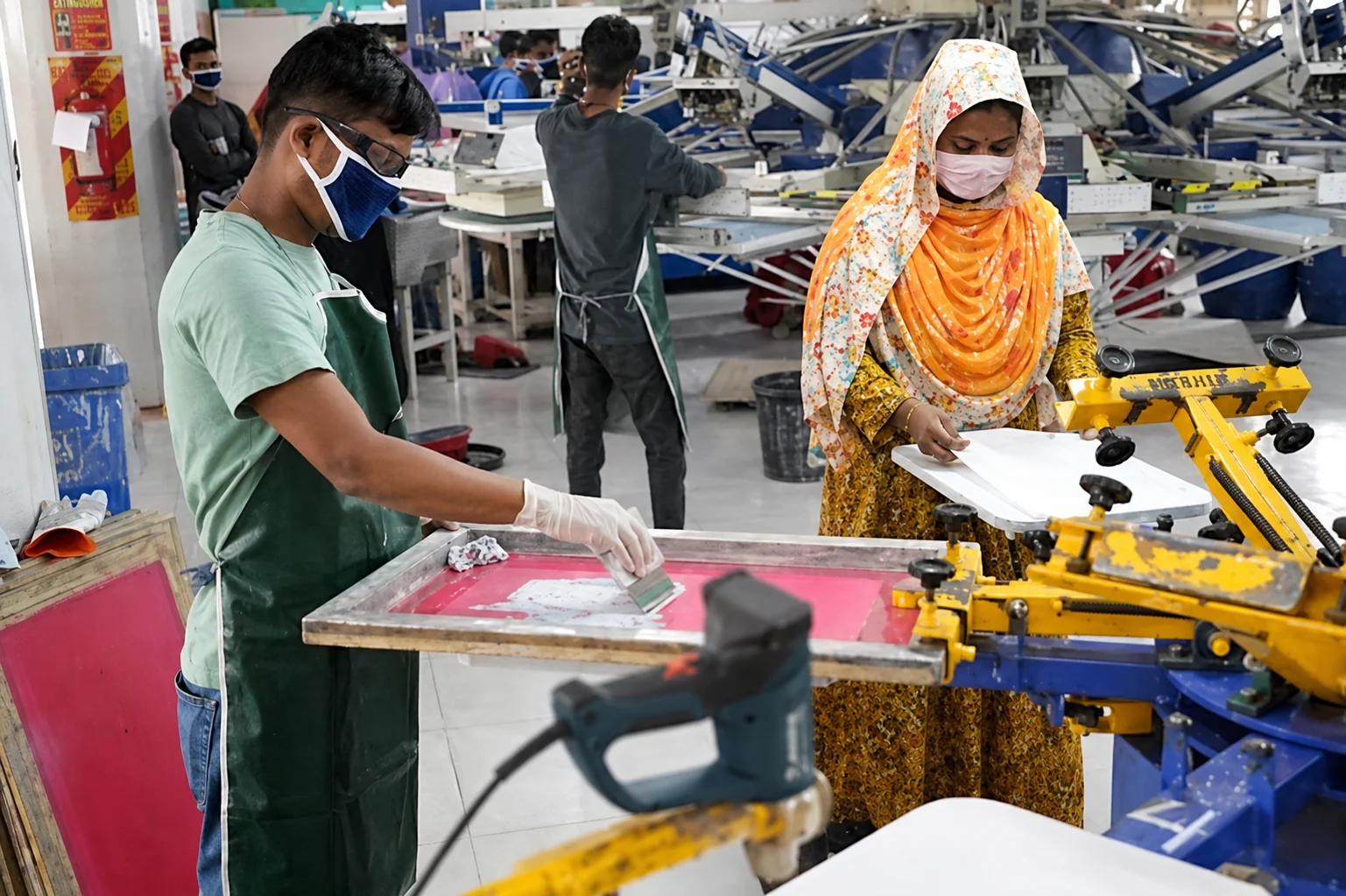
Flat-Screen Stringing and Lift-Off
Flat-screen printing includes a clear separation stage when the screen lifts or snaps away from the printed fabric.
If the paste is too elastic, filaments can bridge the separating surfaces.
Проверьте:
Off-contact / lift behavior
Screen tension
Давление скребка
Paste recovery
Filament break-up
A paste that transfers well during the stroke but releases poorly after the stroke may have acceptable shear viscosity but excessive extensional elasticity.
Rotary-Screen Release and Continuous Shear
Rotary-screen printing does not reproduce the same lift-off geometry as flat-screen printing, but the paste still experiences:
Continuous shear
Screen opening deformation
Transfer separation
Pumping and recirculation
A stringy associative paste can show:
Dirty release
Trailing
Unstable deposit
Long-run viscosity / elasticity drift
Rotary qualification should therefore include circulation time and end-run screen behavior.
Screen Mesh, Engraving and Open Area
Screen geometry changes how strongly the paste is deformed.
Finer openings can:
Increase local shear
Reduce paste deposit
Make release defects more visible
Coarser openings can increase deposit and create larger paste bridges during separation.
Do not select the thickener without considering:
Mesh
Open area
Engraving depth
Pattern type
One grade can release cleanly on one screen and string on another.
Squeegee Pressure, Speed and Angle
Machine settings change both shear and paste deformation.
Higher pressure or repeated strokes can increase:
Перенос с помощью наклейки
Paste stretch during separation
Deposit weight
During a thickener comparison, keep:
Pressure
Speed
Angle
Stroke count
константа.
Otherwise machine changes can be mistaken for a polymer-rheology difference.
Fabric Surface and Paste Release
Fabric surface affects how the paste separates after transfer.
Relevant variables include:
Hairiness
Roughness
Впитывающая способность
Knit / woven structure
Surface finish
A rough or hairy fabric can physically pull filaments differently from a smooth fabric.
If stringing occurs only on one substrate, do not change the thickener before checking the fabric effect.
Typical Production Symptoms
Stringing / poor release can appear as:
Long paste threads
Trailing after the squeegee
Smearing
Dirty fine lines
Сетчатые отметки
Неравномерные сплошные области
Higher screen-cleaning demand
Record where the symptom appears:
During mixing
At the squeegee
During screen separation
After long circulation
The location helps narrow the root cause.
Build a Simple Filament-Dragging Test
A simple internal comparison can standardize filament behavior.
For example, use the same tool, lifting speed and sample temperature for each candidate.
Запись:
Whether a filament forms
Approximate filament length before break
Whether the filament snaps cleanly or trails
Repeatability
This is not a universal industry specification.
It is an internal comparative test.
Use it to screen candidates before a machine trial.
Use Multi-Speed Viscosity, Not One Reading
Measure the paste at multiple controlled shear conditions.
A useful comparison can include:
Low-speed viscosity
Medium-speed viscosity
Higher-speed viscosity
This helps estimate:
Тело с низким сдвигом
Shear-thinning strength
Flow through screen openings
But multi-speed shear viscosity still does not directly measure extensional stringing.
Combine it with a filament-dragging / release observation.
Measure Structural Recovery
After a defined high-shear step:
Measure immediate post-shear viscosity.
Measure after a short rest.
Measure after a longer rest.
A very fast or highly elastic rebuild can preserve pattern edges but may also contribute to poor leveling or stringing.
A very slow recovery can reduce stringing but create spreading.
The goal is:
Controlled Recovery, Not Maximum Recovery Speed.
Build a Thickener Candidate Map
Candidate
Low-Shear Body
Shear Thinning
Filament Dragging
Восстановление
Screen Release
A
Запись
Запись
Запись
Запись
Запись
B
Запись
Запись
Запись
Запись
Запись
C
Запись
Запись
Запись
Запись
Запись
This prevents selection from becoming:
Highest Viscosity = Best Thickener.
The best grade should balance all five behaviors.
Build a Binder–Thickener Compatibility Map
If stringing changes after binder addition, test:
Пример
Condition
Основной вопрос
A
Thickener + water
Base polymer behavior
B
Thickener + equivalent water dilution
Dilution control
C
Thickener + binder
Binder-association effect
D
Complete pigment paste
Production behavior
Measure both viscosity and filament behavior.
A binder can improve viscosity while worsening screen release if elasticity becomes too high.
Build a Thickener-Dosage Ladder
Test several dosage points around the production level.
For each point, record:
Вязкость
Multi-speed profile
Filament length / break-up
Восстановление
Перенос изображения на экран
Определение термина «печать»
Тканевая ручка
The optimum is:
Lowest Dosage That Gives Stable Transfer and Clean Release.
Do not increase dosage simply to reproduce an old Brookfield number.
Connect Laboratory Stringing to Machine Release
Laboratory string tests are screening tools.
The real approval must use:
Production screen
Production squeegee
Actual fabric
Representative machine speed
Сравните:
Paste release
Fine-line cleanliness
Равномерность по площади твердой фазы
Screen contamination
Последовательность от начала до конца
A candidate with slightly more laboratory filament length can still print better if its machine shear profile is better matched.
Corrective Actions by Root Cause
If Thickener Dosage Is Too High
Reduce dosage carefully and rebuild the complete viscosity / print window.
If HASE Association Is Too Strong
Evaluate a different architecture or binder/surfactant combination rather than simply lowering pH.
If Binder Triggers Stringing
Run compatibility tests and check whether another binder or thickener grade produces lower elasticity at the same print performance.
If Surfactant / Defoamer Triggers the Problem
Recheck the additive package and addition sequence.
If Screen / Squeegee Conditions Trigger the Problem
Optimize pressure, speed, mesh or separation mechanics before changing the chemistry.
If Stringing Appears Only After Holding
Check temperature, pH, associative network equilibration and complete-paste stability.
Утверждение пробного производства
For the best candidate, record:
Марка загустителя / партия
Дозировка загустителя
Состав пигмента и связующего вещества
Конечный pH
Метод измерения вязкости
Low / medium / higher-shear readings
Filament-dragging observation
Время удержания
Screen / engraving
Настройки скребка
Скорость работы станка
Выпуск фильма
Определение термина «печать»
Равномерность по площади твердой фазы
Отверждение
Сухое / влажное протирание
Тканевая ручка
Approve a rheology window, not only a viscosity number.
Common Stringing Troubleshooting Mistakes
1. Assuming Stringing Means Viscosity Is Too High
Extensional elasticity can be excessive even when shear viscosity is normal.
2. Selecting by Brookfield Viscosity Only
Brookfield does not directly measure filament break-up.
3. Adding More Thickener to Improve Print Definition
More polymer can increase elasticity and worsen release.
4. Blaming HASE Chemistry Automatically
Binder, surfactant and dosage can determine how strong the associative network becomes.
5. Ignoring Machine Settings
Pressure, speed, mesh and separation geometry can amplify stringing.
6. Testing Only the Thickener in Water
Binder and pigment can change elasticity dramatically.
7. Ignoring Holding Time
Associative structure can change during storage or circulation.
8. Solving Release by Making the Paste Too Fluid
Stringing may improve while spreading and penetration become worse.
Таблица устранения неисправностей
Выявленная проблема
Первые переменные, которые следует проверить
Не делайте поспешных выводов
Long filaments but normal viscosity
Elasticity, extensional behavior, HASE association
Brookfield target proves rheology is correct
Stringing increases after binder
Binder-thickener association, surfactants
More dilution alone will solve it
Stringing increases with thickener dosage
Polymer concentration / entanglement
Higher viscosity improves release
Release improves after salt but edges spread
Rheology balance, electrolyte sensitivity
Lower viscosity equals better formulation
Only fine mesh shows poor release
Mesh opening, high-shear profile, deposit
The thickener is universally unsuitable
Only flat screen shows stringing
Lift-off, screen tension, snap-off behavior
Rotary and flat requirements are identical
Stringing appears after long holding
Temperature, pH, associative equilibration
The fresh sample predicts end-run behavior
Paste stops stringing but spreads badly
Recovery / low-shear body
Eliminating stringing is the only objective
Общая стоимость эксплуатации
Stringing and poor release create hidden production cost through:
Lower machine speed
More screen cleaning
Pattern defects
Переработка
Extra thickener correction
Бракованная ткань
Полезной моделью является:
Total Cost in Use = Thickener + Formula Adjustment + Machine Speed + Cleaning + Rework + Quality Loss
A higher-priced thickener can still be more economical if it provides:
Cleaner release
Lower dosage
Better long-run consistency
Less screen cleaning
Compare cost per acceptable printed meter, not thickener price per kilogram alone.
Какую информацию следует отправить поставщику?
For useful stringing / screen-release troubleshooting, provide:
Where stringing appears: mixing, squeegee, lift-off or long-run circulation
Компания FSX Chemical может использовать эту информацию посредством Образцы и подбор продукции to structure a controlled rheology and release comparison.
How Should a Mill Fix Acrylic-Thickener Stringing?
Практическая цепочка управления выглядит следующим образом:
Confirm Filament Dragging → Standardize Temperature / Viscosity Method → Compare Multi-Speed Rheology → Check Dosage → Add Binder / Pigment → Observe Recovery → Control Machine Settings → Run Screen Trial → Approve Complete Working Window
Основные принципы заключаются в следующем:
Stringing is often an elasticity / extensional-flow problem rather than a simple viscosity problem.
Same Brookfield viscosity can produce very different filament break-up and screen release.
Higher thickener dosage can increase polymer entanglement and worsen stringing.
HASE associative networks can change significantly with binder, surfactants, pigment and defoamer chemistry.
Screen mesh, squeegee settings and fabric surface can amplify or reduce poor release.
The best synthetic thickener is the grade that balances low-shear body, shear thinning, recovery and clean filament break-up at the lowest practical Total Cost in Use.
Часто задаваемые вопросы
1. Why does acrylic thickener form long strings?
Possible causes include high polymer concentration, molecular entanglement, strong associative networking, binder/surfactant interaction or excessive elasticity under extensional deformation.
2. Does stringing mean the viscosity is too high?
No. A paste can have acceptable shear viscosity but excessive extensional elasticity and poor filament break-up.
3. Why does stringing become worse after binder is added?
Binder particles and surfactants can strengthen or change the associative network of HASE-type thickeners.
4. Can reducing thickener dosage improve screen release?
Yes, if excess polymer concentration is increasing entanglement or elasticity. Recheck print definition and penetration after dosage reduction.
5. Is HASE always more stringy than ASE?
No. HASE can provide excellent screen rheology, but its associative network is more formulation-dependent. Commercial grade, binder and dosage determine the result.
6. Can electrolytes reduce stringing?
They can change polyacrylate expansion and associative rheology, but they may also reduce viscosity too much or destabilize the paste. Do not use salt as a universal stringing correction.
7. Why does a paste string only on fine screens?
Fine screens create different shear and separation conditions. Mesh opening and deposit interact with the paste’s elasticity and recovery.
8. Why is poor release more obvious on flat-screen printing?
Flat-screen printing includes a distinct screen lift / snap-off step, which can stretch elastic paste filaments between the screen and fabric.
9. Can fabric surface cause apparent stringing?
Yes. Hairy, rough or absorbent surfaces can change paste separation. Compare the same paste on a controlled reference fabric.
10. What laboratory test should I use?
Combine a standardized filament-dragging observation with multi-speed viscosity and a post-shear recovery test. Use these as internal comparative methods, not universal specifications.
11. What matters more: viscosity or screen release?
Both matter, but the production decision should be based on complete printing performance. A target viscosity that causes poor release is not a useful target.
12. What should I send FSX Chemical for stringing troubleshooting?
Send the current thickener/TDS, dosage, viscosity method, pH, pigment, binder, additives, screen/mesh, squeegee settings, fabric and a description or video of where the filament dragging occurs.
Match Acrylic Thickener for Clean Screen Release
If your pigment paste reaches the viscosity target but forms long strings, trails behind the squeegee or releases poorly from the screen, FSX Chemical can help structure a controlled rheology and filament-dragging comparison.
Чтобы получить полезный технический обзор, отправьте:
Ваш текущий образец акрилового загустителя, спецификация TDS или протокол анализа COA
Дозировка загустителя
Полный метод определения вязкости
Конечный уровень pH пасты
Pigment and binder system
Wetting / defoamer / fixer package
Время удержания
Flat or rotary screen route
Сетка экрана / гравировка
Squeegee pressure / speed
Ткань
Photo or video of the stringing / poor-release behavior if available
Clean screen release is not created by one viscosity number. It comes from balancing shear thinning, low-shear body, elastic recovery and filament break-up with the binder, pigment, screen, squeegee and fabric used in the real production process.
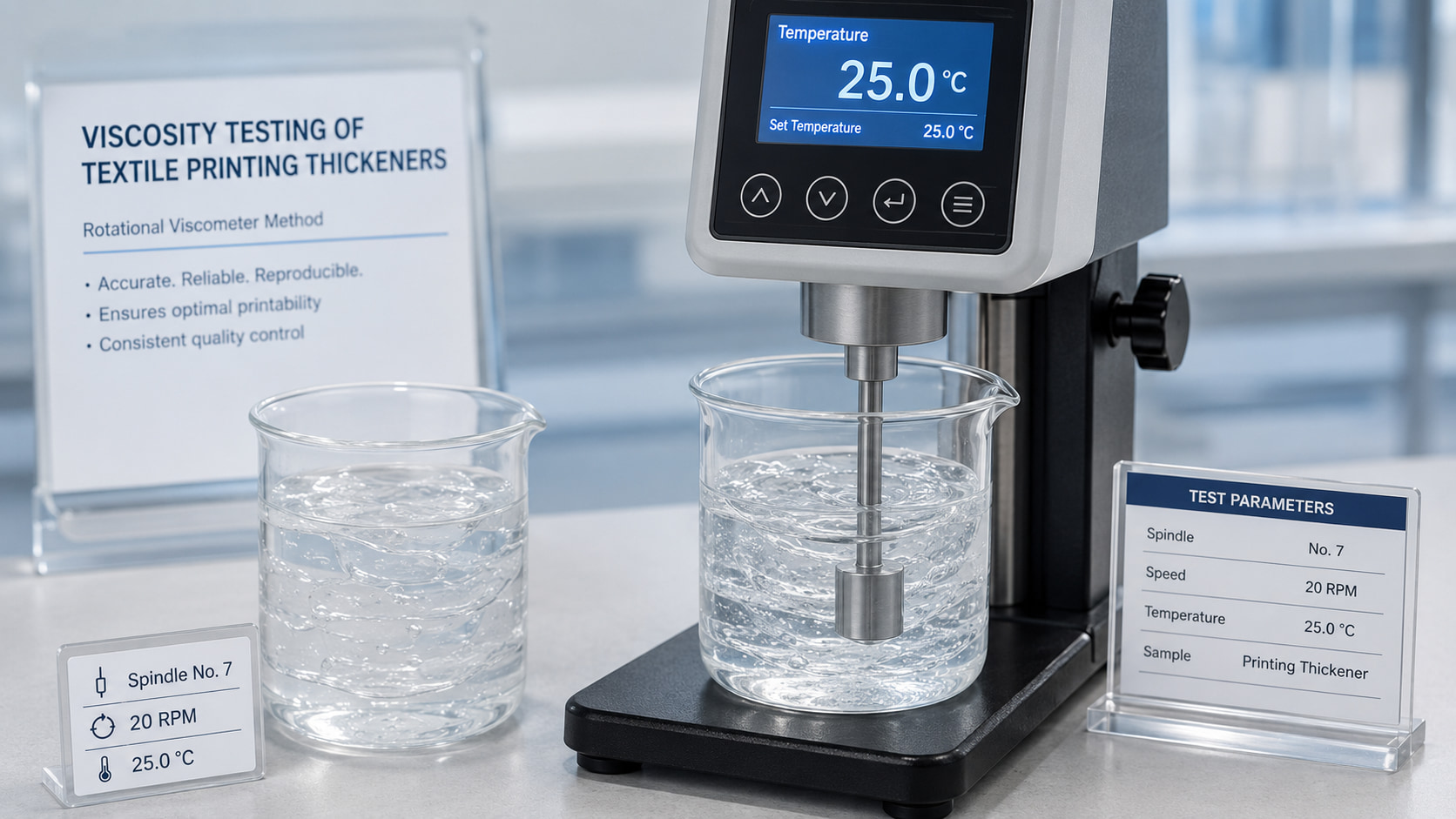
Узнайте, почему значения вязкости загустителей для текстильной печати нельзя сравнивать без учета таких факторов, как концентрация, температура, прибор, шпиндель, скорость, метод подготовки проб и время испытания.
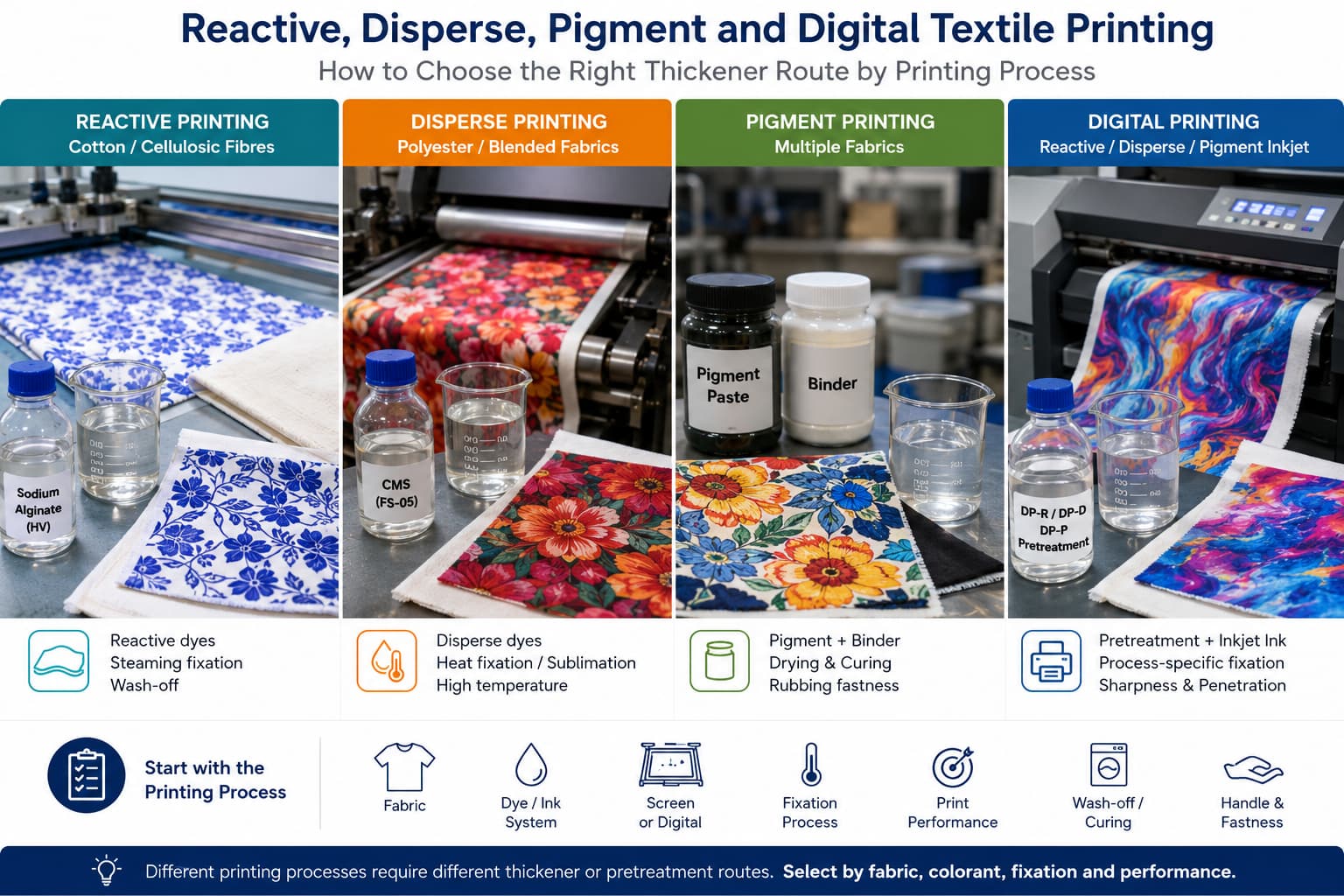
Узнайте, как выбирать загустители и способы предварительной обработки для реактивной, дисперсной, пигментной и цифровой печати на текстиле с учетом требований к ткани, красителю или чернилам, фиксации, вымываемости и качеству печати.
Печатная паста на основе CMC используется в пигментной, реактивной и цифровой текстильной печати. В данном руководстве объясняется, какие параметры имеют значение, как сравнивать поставщиков и что следует уточнить перед размещением оптового заказа.
И альгинат натрия, и CMC используются в качестве загустителей при печати на текстиле, однако они подходят для разных систем окрашивания и условий производства. В данном руководстве объясняются основные различия между ними и приводятся рекомендации по их применению.
Выбор подходящего загустителя для текстильной печати зависит не только от типа ткани. Покупателям следует подбирать загуститель с учетом системы красителей или пигментов, метода печати, требуемых реологических характеристик, требований к стойкости к стирке, а также фактических условий производственных испытаний.
Эффективность печати на текстиле зависит от сбалансированной химической системы, а не от одной универсальной добавки. В данном руководстве описаны десять важных групп химических веществ, их функции, сферу применения, а также то, что покупатели должны проверить перед проведением производственных испытаний.
Загустители для текстильной печати различаются по химическому составу, реологическим свойствам, совместимости с красителями и характеристикам вымывания. В данном руководстве сравниваются основные группы загустителей, их типичные области применения, а также параметры, которые покупатели должны проверить перед проведением производственных испытаний.
Выбор паст для цифровой печати следует осуществлять с учетом химического состава краски, типа ткани, метода нанесения и последующей обработки. В данном руководстве сравниваются методы предварительной обработки с использованием альгината натрия, CMC, CMS, синтетических полимеров и смешанных составов для струйной печати на текстиле.
Компания FSX Chemical предлагает отдельные технологические схемы нанесения пасты для цифровой печати, предназначенные для реактивных, дисперсных и пигментных систем, которые сопровождаются анализом условий применения, подбором образцов и технической документацией. В данном руководстве объясняется, как покупатели могут определить подходящую технологическую схему перед оптовой закупкой.
Для получения стабильной пасты для цифровой печати недостаточно просто соблюдать заданную вязкость. В данном руководстве объясняется, как выбор продукта, качество воды, последовательность добавления компонентов, перемешивание, уровень pH, температура, фильтрация, соблюдение гигиенических норм, условия хранения и ведение документации по качеству влияют на предварительную обработку и стабильность производственного процесса.
Для надёжной оценки загустителей для текстильной печати недостаточно просто проверить их вязкость. В данном руководстве описаны основные параметры испытаний сырья, раствора, пасты, стабильности, нанесения и готовой ткани.
В данном обзоре продукта рассматривается паста FSX Digital Printing Paste в качестве средства предварительной обработки текстиля для струйной печати и средства для увеличения вязкости, при этом особое внимание уделяется совместимости с системой чернил, реологическим свойствам, фильтрации, четкости печати, стабильности и испытаниям в реальных производственных условиях.
Сообщите название продукта, область применения, количество, пункт назначения, а также предоставьте техническое описание продукта (TDS),
фотографию образца или имеющиеся у вас документы. Компания FSX Chemical рассмотрит
эту информацию и порекомендует дальнейшие действия для подготовки коммерческого предложения, подбора образца
или выбора продукта.
Информация о продуктеНазвание товара, класс, модель, фотография этикетки или артикул поставщика.
Доступные документыTDS, SDS, COA, фотография образца, перечень продукции или данные испытаний.
Детали заказаПредполагаемый объем, упаковка, страна назначения, порт или условия торговли.
Область применения или проблемаПроцесс печати на текстиле, требования к составу, текущие проблемы или целевые показатели.