How to Distinguish a Thickener Problem from a Textile Printing Process Problem
Bleeding, low color yield, screen blockage, viscosity drift and harsh hand are not automatically thickener...
When a textile print shows bleeding, low color yield, screen blockage, viscosity drift, poor wash-off or harsh fabric hand, the thickener is often blamed first. But the same defect can also come from water quality, paste preparation, dye or auxiliary chemistry, screen and squeegee conditions, machine speed, drying, steaming, curing or washing. The most reliable diagnosis is therefore not “change the thickener and see what happens,” but a controlled root-cause process that separates raw-material behavior from formulation and production variables. This guide shows textile mills how to use reference samples, staged paste tests, 2×2 crossover trials and finished-fabric checks to distinguish a true thickener problem from a textile printing process problem.
Why Thickener Problems and Process Problems Are Easy to Confuse
A defect seen at the end of that chain can originate much earlier.
For example, blurred edges may come from:
Low thickener body
Excessive shear thinning
Too much paste deposit
High squeegee pressure
Very absorbent fabric
Slow drying
Likewise, poor color yield may come from:
Poor dye release from the thickener film
Insufficient paste deposit
Incorrect fixation
Penetración excesiva
Hidrólisis de colorantes reactivos
Inadequate steaming moisture
Published textile-printing research shows that thickener rheology is strongly connected to print quality, but it also shows that printing pastes experience changing shear conditions and interact with the fabric and printing process.
The correct diagnosis therefore asks:
Did the material change, did the process change, or did the interaction between them change?
The Four Levels of Textile Printing Diagnosis
A practical troubleshooting system can be divided into four levels.
Level
What You Test
Main Question
1. Incoming Product
Identity, appearance, moisture/solids, pH, standard viscosity/specification
Is the thickener batch itself inside specification?
Does the complete process produce the required result?
This four-level logic is consistent with FSX Chemical’s current thickener testing framework, which separates incoming material, stock paste, complete printing paste and finished-fabric evaluation.
If a product passes Level 1 but fails Level 3, the problem may be formula compatibility rather than raw-material quality.
If it passes Levels 1–3 but fails Level 4, the machine, fabric, fixation or washing process becomes a stronger suspect.
What Evidence Actually Points Toward a Thickener Problem?
Evidence becomes stronger when the process is controlled and the failure follows the thickener.
Examples include:
The same production process works with the approved reference thickener but repeatedly fails with the candidate.
The suspect batch fails the same standardized stock-paste test that previous approved batches pass.
Viscosity, filtration or hydration is outside the agreed specification under the same test method.
The candidate shows repeatable incompatibility with the same complete formula while the reference remains stable.
A retained sample from a good batch works, while the suspect batch fails under identical laboratory conditions.
Even then, describe the conclusion precisely.
There is a difference between:
“This batch is outside the agreed incoming specification.”
and:
“This thickener family is unsuitable for the application.”
A batch issue, a grade-matching issue and a process issue are three different diagnoses.
What Evidence Points Toward a Printing Process Problem?
Process evidence becomes stronger when different thickeners fail in the same operating condition.
Examples include:
The approved reference thickener and the new candidate both fail after a machine-speed increase.
Laboratory printing is acceptable but full-scale production fails after long circulation.
The same paste works with soft water but fails with plant water.
Printing is good, but color yield drops only after a changed steaming condition.
Fabric hand is acceptable after a controlled laboratory wash but harsh after the production wash line.
Defects appear only on one fabric construction.
These patterns do not prove the thickener is perfect.
They show that changing the thickener alone is unlikely to solve the entire root cause.
Start with a Reference: Do Not Troubleshoot Without a Baseline
A reference can be:
An approved thickener batch
A retained sample
The current supplier’s product
A previously accepted printed fabric
A validated formula and machine setting
Without a reference, the mill may compare today’s failed paste with memory rather than controlled data.
The reference should define:
Thickener grade and batch
Concentración
Viscosity method
Agua
Formula
Tela
Machine settings
Fijación
Lavado o curado
Finished result
FSX Chemical similarly recommends matched preparation and printing conditions when comparing a candidate grade with an existing system.
Level 1: Check the Incoming Thickener
Before investigating the entire production line, confirm the incoming material.
Check:
Product identity
Batch number
Packaging condition
Apariencia
Moisture or solids where applicable
pH where relevant
Standard solution viscosity
COA / specification
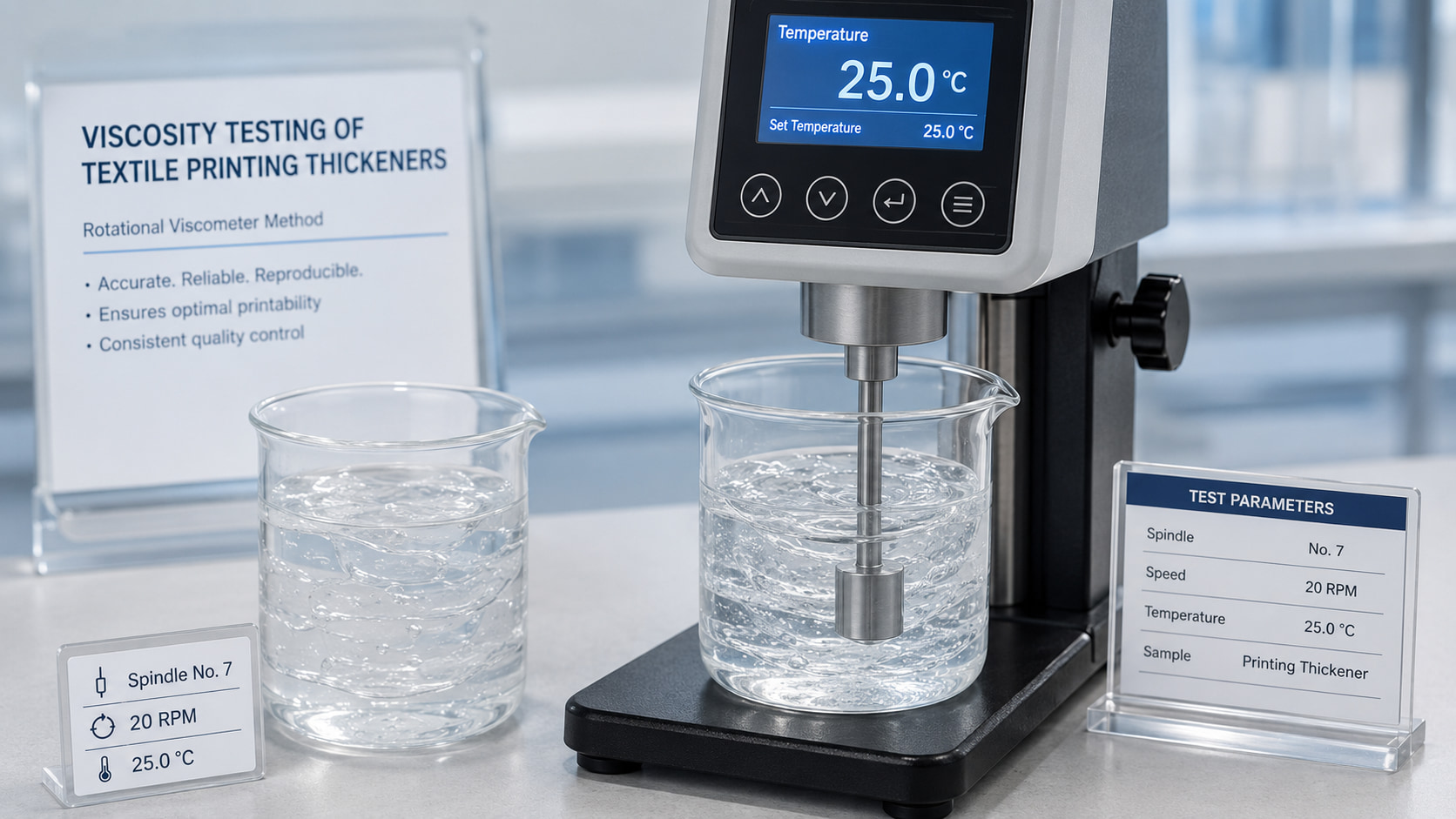
The viscosity result is meaningful only when concentration, temperature, instrument, spindle/rotor, speed, hydration and preparation are aligned.
FSX Chemical’s viscosity-test guidance explicitly notes that matching one viscosity number does not prove product equivalence, but inconsistent test conditions can also create false batch failures.
If the batch is clearly outside the agreed incoming specification under a matched test, investigate the material first.
If it passes, continue to the next level.
Level 2: Check Stock-Paste Preparation
A good thickener can look defective if it is prepared incorrectly.
Check:
Water quality
Powder addition rate
Mixing speed
Mixing time
Hora de hidratarse
Temperatura
Espuma
Residuo de filtración
Typical process-caused symptoms include:
Fish-Eyes or Lumps
Possible causes: powder added too quickly, insufficient agitation, local high concentration or hard-water interaction.
Baja viscosidad
Possible causes: under-dosage, incomplete hydration, wrong concentration basis, high temperature or incorrect measurement method.
Alta viscosidad
Possible causes: overdosing, lower measurement temperature, calcium interaction or concentration error.
Only after preparation is standardized can stock-paste behavior be used as evidence against the thickener.
Level 3: Check the Complete Printing Paste
The thickener may pass in water and fail after the real formula is added.
That does not necessarily mean the material is defective.
It may mean the selected grade is incompatible with:
Dye
Pigment dispersion
Salt
Alkali
Binder
Fixer
Dispersant
Reducing agent
Textile-printing research shows that colorants and other paste ingredients can change rheological behavior, while thickeners must still provide suitable high-shear flow and low-shear pattern control.
A staged test is useful:
Stock Paste → Dye/Pigment → Salt → Alkali → Remaining Auxiliaries → Holding Time
Measure after each important step.
This identifies whether the failure is:
Raw-material instability
Grade/formula incompatibility
Addition-order problem
Holding-time problem
Level 4: Check Machine, Fixation and Washing
If the complete paste is stable in the laboratory, move downstream.
Check:
Screen mesh / engraving
Squeegee pressure, speed and angle
Machine speed
Paste feed and circulation
Capacidad de absorción del tejido
Printed deposit
Secado
Steaming / thermal fixation / curing
Washing / soaping / reduction clearing
Screen-printing pastes experience very different shear rates before, during and after screen passage, and recovery after shear is important to leveling and definition.
A material that works in a beaker can therefore fail on a machine if the process places it outside its rheological window.
Likewise, a perfectly printable paste cannot compensate for incorrect fixation or insufficient washing.
The 2×2 Crossover Test: The Fastest Way to Separate Material from Process
When the root cause is unclear, use two thickeners and two process conditions.
Juicio
Espesante
Proceso
Purpose
A
Approved reference
Normal validated process
Positive control
B
Candidate / suspect
Normal validated process
Tests material under good process
C
Approved reference
Suspect current process
Tests process with proven material
D
Candidate / suspect
Suspect current process
Shows interaction under problem condition
If A Passes and B Fails
Evidence points more strongly toward candidate-grade compatibility or material behavior.
If A Passes but Both C and D Fail
Evidence points more strongly toward the suspect process condition.
If B Passes but D Fails
The candidate itself can work; the problem is likely a process interaction.
If All Four Fail
Recheck the reference, test method, fabric, dye system and definition of “pass.” The experiment may not have a true positive control.
This crossover method is more informative than replacing the thickener and changing machine settings at the same time.
Symptom 1: Viscosity Drift
Viscosity drift can come from either side.
Possible Thickener / Grade Causes
Salt or alkali sensitivity
Poor holding stability
Batch outside specification
Inadequate molecular/rheological profile for the formula
Possible Process Causes
Wrong concentration
Temperature change
Dureza del agua
Incorrect hydration
Dilution from dye solution
Evaporación
High shear / incomplete recovery
Do not diagnose the problem from one viscosity reading.
If a process problem is incorrectly blamed on the thickener, the mill may incur:
Unnecessary supplier changes
Repeated samples
Formula redevelopment
Higher dosage
More washing
Production downtime
If a genuine thickener problem is incorrectly treated as a machine problem, the mill may incur:
Repeated machine adjustments
Screen wear
Color correction
Rejected fabric
Operator time
A useful model is:
Total Cost of the Problem = Material Loss + Machine Downtime + Rework + Post-Treatment + Rejected Fabric + Troubleshooting Time
The fastest correction is not always the cheapest correction.
The lowest stable cost comes from identifying the real cause and preventing recurrence.
What Information Should You Send to a Thickener Supplier?
For meaningful troubleshooting, send:
Current thickener grade, TDS and batch
Approved reference thickener or retained sample
Concentration and viscosity method
Water source and hardness
Hydration / preparation method
Fórmula completa o simplificada
Dye / pigment / binder system
Salt / alkali / auxiliaries
Tiempo de retención
Machine type and speed
Screen / squeegee settings
Fabric composition and construction
Fixation conditions
Washing / curing conditions
Exact defect and when it first appears
FSX Chemical puede utilizar esta información a través de Muestras y combinación to recommend whether the next step should be a thickener-grade comparison, a formulation test or a controlled process trial.
How Should a Mill Separate Thickener Problems from Process Problems?
A finished-print defect is not automatically a thickener defect.
A thickener should first be checked under a standardized incoming and stock-paste method.
Formula compatibility must be separated from raw-material quality.
Machine, fabric, fixation and washing can reproduce the same defects as poor rheology.
A 2×2 reference/candidate × normal/suspect-process crossover is one of the strongest practical diagnostics.
Change one major variable at a time and approve the final correction through the finished fabric.
Preguntas frecuentes
1. How do I know whether a printing defect is caused by the thickener?
Repeat the same standardized preparation and printing process with an approved reference thickener. If the reference passes and the suspect product repeatedly fails under matched conditions, evidence for a thickener or grade-compatibility issue becomes stronger.
2. If viscosity is outside target, is the thickener defective?
Not necessarily. Check concentration, temperature, hydration, water quality and viscosity test method before judging the batch.
3. If two thickeners both fail on the same machine, what should I check?
Prioritize process variables such as screen, squeegee, speed, fabric, deposit, drying, fixation and washing.
4. Why does a thickener work in the lab but fail in production?
Production introduces scale-up mixing, pump shear, circulation, temperature, foam, evaporation and longer holding times that the laboratory may not reproduce.
5. Does bleeding always mean the viscosity is too low?
No. Bleeding can also come from excessive paste deposit, high pressure, absorbent fabric, slow drying or poor structural recovery.
6. Does low color strength mean the thickener is blocking dye release?
It can, but first check paste deposit, penetration, fixation, reactive dye hydrolysis or thermal conditions.
7. Can poor wash-off be a process problem?
Yes. Hard water, insufficient rinsing, low temperature, poor soaping and short residence time can all leave residue even with a suitable thickener.
8. What is a 2×2 crossover test?
It compares reference and candidate thickeners under both a validated process and the suspect process. The pattern of pass/fail results helps separate material from process effects.
9. Should I change thickener dosage while troubleshooting?
Not until the baseline is documented. Changing dosage too early removes an important control and can hide the original cause.
10. Why is a retained reference batch useful?
It lets the mill test a previously approved material under today’s process conditions and helps determine whether the process changed.
11. Can the problem be an interaction rather than only material or process?
Yes. A thickener can be inside specification but incompatible with a particular salt, alkali, binder, screen or high-shear production condition. That is a grade/process interaction rather than a simple quality failure.
12. What should I send FSX Chemical for root-cause troubleshooting?
Send the suspect and reference thickener information, viscosity method, formula, water, machine, fabric, fixation, washing and the exact stage where the defect first becomes visible.
Separate the Thickener from the Process Before Changing the Formula
If your textile printing line develops viscosity drift, bleeding, low color yield, screen blocking or poor wash-off, FSX Chemical can help structure a controlled comparison to identify whether the next trial should focus on the thickener, formula or process.
The right troubleshooting question is not “Which thickener should we replace?” It is “At which stage does the defect first appear, and does the defect follow the material, the process, or the interaction between them?”
Descubre por qué no se pueden comparar los valores de viscosidad de los espesantes para la impresión textil sin tener en cuenta la concentración, la temperatura, el instrumento, el husillo, la velocidad, el método de preparación y el tiempo de prueba.
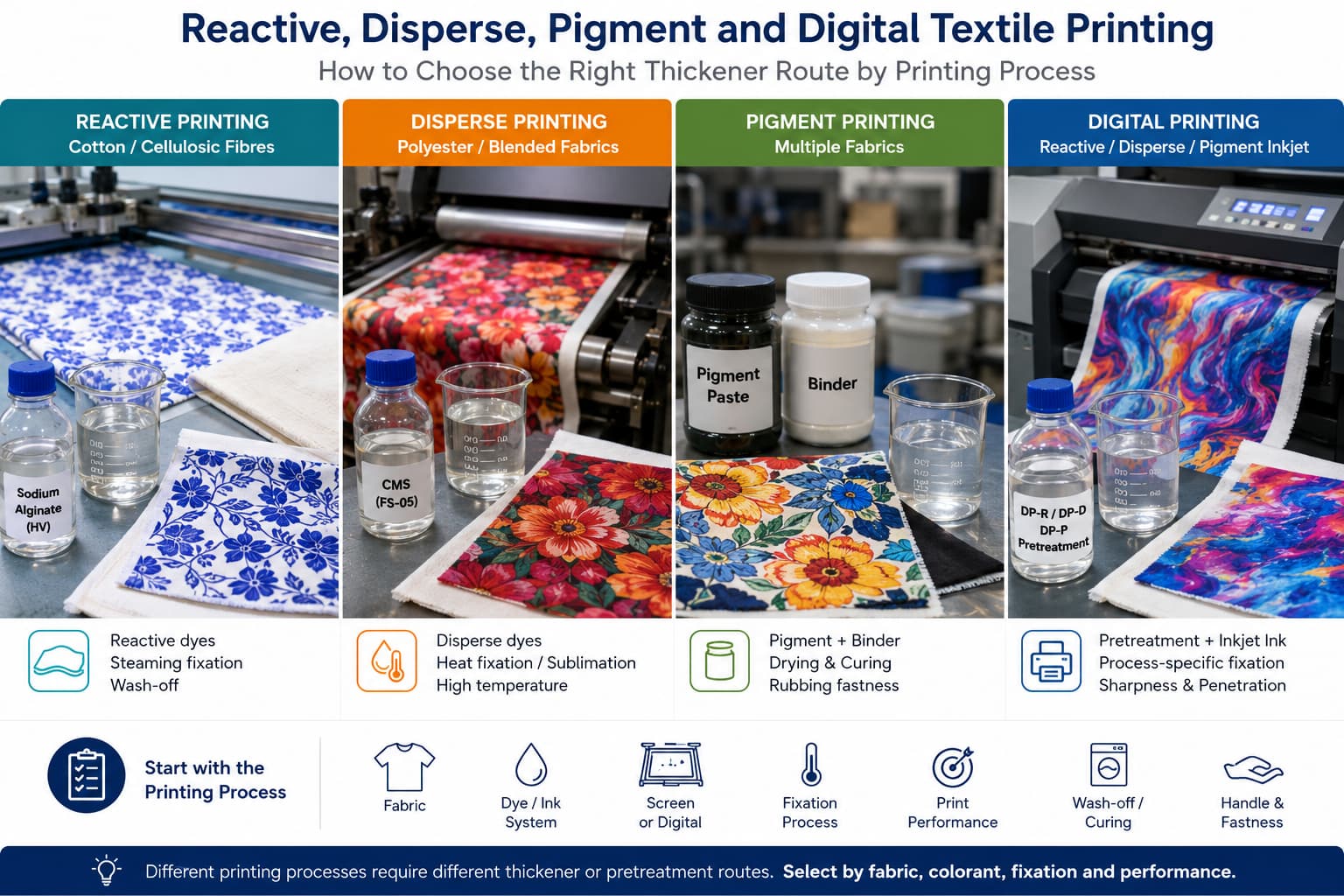
Aprende a elegir espesantes y métodos de pretratamiento para la impresión textil reactiva, dispersa, con pigmentos y digital, según los requisitos del tejido, el colorante o la tinta, la fijación, la resistencia al lavado y la calidad de impresión.
Compara CMC, CMS, alginato de sodio y pasta para impresión digital en la impresión textil. Descubre cómo cada opción se adapta a los procesos reactivos, dispersos, pigmentados y digitales, y qué deben tener en cuenta los compradores antes de realizar pruebas de muestras, comparar calidades y realizar compras a granel.
El alginato de sodio se utiliza ampliamente en la impresión textil como espesante estable y lavable para las pastas de impresión reactivas. Descubre cómo evaluar el grado de viscosidad, la pureza y la idoneidad para cada aplicación antes de comprar, y cómo FSX Chemical apoya a los compradores de todo el mundo con datos técnicos y muestras.
La carboximetilcelulosa (CMC) se utiliza ampliamente en los procesos de estampado, encolado y teñido de textiles. En esta guía se explica cómo evaluar los distintos grados de CMC, qué parámetros son los más importantes y cómo FSX Chemical puede ayudarte a tomar decisiones de compra.
La carboximetilcelulosa se utiliza como espesante y estabilizador en tintas a base de agua, impresión en huecograbado y pretratamiento para impresión de chorro de tinta. Esta guía aborda los parámetros clave de los grados y las consideraciones de abastecimiento para los equipos de compras.
La pasta de impresión a base de CMC se utiliza en la impresión textil con pigmentos, reactiva y digital. Esta guía explica qué parámetros son importantes, cómo comparar proveedores y qué solicitar antes de realizar un pedido al por mayor.
Tanto el alginato de sodio como la CMC se utilizan como espesantes en la impresión textil, pero se adaptan a diferentes sistemas de tinte y condiciones de proceso. Esta guía explica las diferencias clave y cuándo utilizar cada uno.
La impresión digital por inyección de tinta sobre textiles tiene requisitos distintos en cuanto a pastas y pretratamiento en comparación con la serigrafía. Esta guía explica cómo se utiliza el alginato de sodio en la impresión textil digital y qué parámetros de calidad deben especificar los equipos de compras.
El CMC de grado alimenticio y el de grado industrial comparten la misma composición química básica, pero difieren significativamente en cuanto a pureza, rango de DS y requisitos normativos. Esta guía explica las diferencias clave y por qué el uso de un grado incorrecto genera problemas de producción.
La preparación correcta de la pasta es tan importante como la selección del grado en la impresión textil con tintes reactivos. Esta guía aborda los métodos de disolución del alginato de sodio, los rangos de concentración según la aplicación, las condiciones de almacenamiento y cómo resolver problemas comunes en la preparación.
El alginato de sodio es un polímero natural y biodegradable, pero su uso en la impresión textil genera aguas residuales que requieren un tratamiento adecuado. Esta guía aborda el perfil ambiental del alginato de sodio, las características de los efluentes de lavado y lo que los equipos de compras deben saber sobre la elección de espesantes y el impacto ambiental.
Comparta el nombre del producto, su aplicación, la cantidad, el destino y cualquier ficha técnica (TDS),
foto de muestra o documento que ya tenga. FSX Chemical revisará la
información y le recomendará el siguiente paso para la cotización, la comparación de muestras
o la selección del producto.
Información del productoNombre del producto, categoría, modelo, foto de la etiqueta o referencia del proveedor.
Documentos disponiblesTDS, SDS, COA, foto de muestra, lista de productos o datos de pruebas.
Detalles del pedidoCantidad estimada, embalaje, país de destino, puerto o término comercial.
Solicitud o problemaProceso de impresión textil, requisitos de formulación, problema actual o objetivo de rendimiento.

 ES
ES  EN
EN  BN
BN  TR
TR  FR
FR  ID
ID  RU
RU  AR
AR  UR
UR  VI
VI  TL
TL  HI
HI  UK
UK  KK
KK  KA
KA  UZ
UZ