How to Distinguish a Thickener Problem from a Textile Printing Process Problem
Bleeding, low color yield, screen blockage, viscosity drift and harsh hand are not automatically thickener...
To distinguish a thickener problem from a textile printing process problem, reproduce the defect with a traceable reference and locate the first stage that differs: incoming material, stock preparation, complete paste, application or post-treatment. A controlled reference/candidate × validated/suspect-process comparison can guide the next test, but one four-run pass/fail pattern does not establish a unique cause. Confirm the correction on the finished fabric before changing the production standard.
Why Thickener Problems and Process Problems Are Easy to Confuse
A defect seen at the end of that chain can originate much earlier.
For example, blurred edges may come from:
Low thickener body
Excessive shear thinning
Too much paste deposit
High squeegee pressure
Very absorbent fabric
Slow drying
Likewise, poor color yield may come from:
Poor dye release from the thickener film
Insufficient paste deposit
Incorrect fixation
Excessive penetration
প্রতিক্রিয়াশীল রঞ্জক হাইড্রোলাইসিস
Inadequate steaming moisture
Published textile-printing research shows that thickener rheology is strongly connected to print quality, but it also shows that printing pastes experience changing shear conditions and interact with the fabric and printing process.
The correct diagnosis therefore asks:
Did the material change, did the process change, or did the interaction between them change?
The Four Levels of Textile Printing Diagnosis
A practical troubleshooting system can be divided into four levels.
Level
What You Test
মূল প্রশ্ন
1. Incoming Product
Identity, appearance, moisture/solids, pH, standard viscosity/specification
Is the thickener batch itself inside specification?
Does the complete process produce the required result?
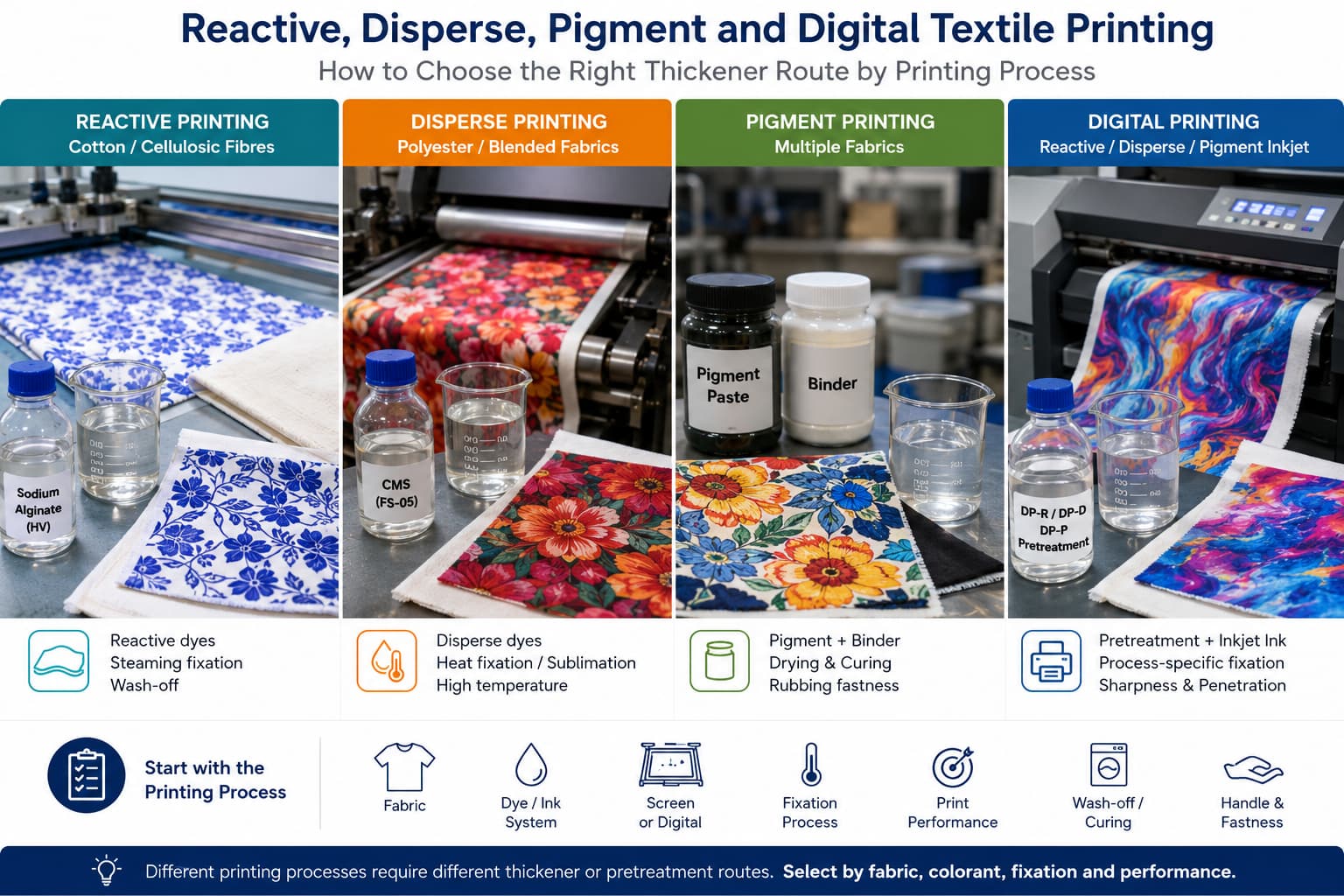
Use these four levels as a proposed investigation record. Name the printing route and where the product is added before testing: conventional reactive or disperse colour paste, pigment-binder paste, or a fabric-applied digital pretreatment. A fabric pretreatment is not an inkjet-ink additive.
If a product passes Level 1 but fails Level 3, the problem may be formula compatibility rather than raw-material quality.
If it passes Levels 1–3 but fails Level 4, the machine, fabric, fixation or washing process becomes a stronger suspect.
What Evidence Actually Points Toward a Thickener Problem?
Evidence becomes stronger when the process is controlled and the failure follows the thickener.
Examples include:
The same production process works with the approved reference thickener but repeatedly fails with the candidate.
The suspect batch fails the same standardized stock-paste test that previous approved batches pass.
Viscosity, filtration or hydration is outside the agreed specification under the same test method.
The candidate shows repeatable incompatibility with the same complete formula while the reference remains stable.
A retained sample from a good batch works, while the suspect batch fails under identical laboratory conditions.
Even then, describe the conclusion precisely.
There is a difference between:
“This batch is outside the agreed incoming specification.”
and:
“This thickener family is unsuitable for the application.”
A batch issue, a grade-matching issue and a process issue are three different diagnoses.
What Evidence Points Toward a Printing Process Problem?
Process evidence becomes stronger when different thickeners fail in the same operating condition.
Examples include:
The approved reference thickener and the new candidate both fail after a machine-speed increase.
Laboratory printing is acceptable but full-scale production fails after long circulation.
The same paste works with soft water but fails with plant water.
Printing is good, but color yield drops only after a changed steaming condition.
Fabric hand is acceptable after a controlled laboratory wash but harsh after the production wash line.
Defects appear only on one fabric construction.
These patterns do not prove the thickener is perfect.
They show that changing the thickener alone is unlikely to solve the entire root cause.
Start with a Reference: Do Not Troubleshoot Without a Baseline
A reference can be:
An approved thickener batch
A retained sample
The current supplier’s product
A previously accepted printed fabric
A validated formula and machine setting
Without a reference, the mill may compare today’s failed paste with memory rather than controlled data.
The reference should define:
Thickener grade and batch
সমন্বয়
সান্দ্রতা পদ্ধতি
জল
সূত্র
কাপড়
Machine settings
স্থিরীকরণ
Washing or curing
Finished result
FSX Chemical similarly recommends matched preparation and printing conditions when comparing a candidate grade with an existing system.
Level 1: Check the Incoming Thickener
Before investigating the entire production line, confirm the incoming material.
Check:
Product identity
Batch number
Packaging condition
দৃষ্টি
Moisture or solids where applicable
pH where relevant
মানক দ্রবণের সান্দ্রতা
COA / specification
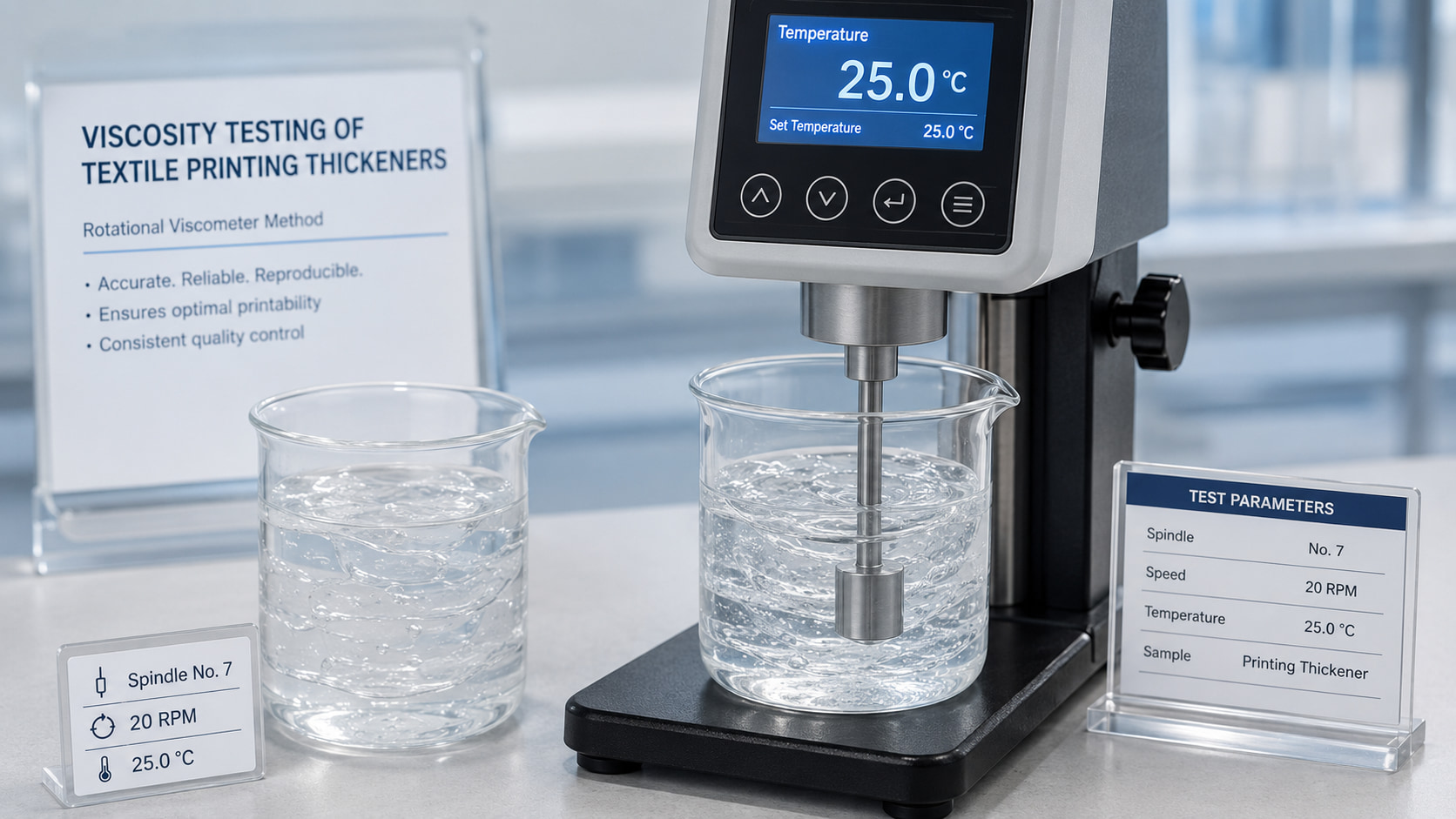
The viscosity result is meaningful only when concentration, temperature, instrument, spindle/rotor, speed, hydration and preparation are aligned.
FSX Chemical’s viscosity-test guidance explicitly notes that matching one viscosity number does not prove product equivalence, but inconsistent test conditions can also create false batch failures.
If the batch is clearly outside the agreed incoming specification under a matched test, investigate the material first.
If it passes, continue to the next level.
Level 2: Check Stock-Paste Preparation
A good thickener can look defective if it is prepared incorrectly.
Check:
Water quality
Powder addition rate
Mixing speed
Mixing time
Hydration time
তাপমাত্রা
ফেনা
ছাঁকন অবশিষ্টাংশ
Typical process-caused symptoms include:
Fish-Eyes or Lumps
Possible causes: powder added too quickly, insufficient agitation, local high concentration or hard-water interaction.
নিম্ন সান্দ্রতা
Possible causes: under-dosage, incomplete hydration, wrong concentration basis, high temperature or incorrect measurement method.
উচ্চ সান্দ্রতা
Possible causes: overdosing, lower measurement temperature, calcium interaction or concentration error.
Only after preparation is standardized can stock-paste behavior be used as evidence against the thickener.
Level 3: Check the Complete Printing Paste
The thickener may pass in water and fail after the real formula is added.
That does not necessarily mean the material is defective.
It may mean the selected grade is incompatible with:
Dye
রঞ্জক ছড়িয়ে পড়া
লবণ
ক্ষারক
বাইন্ডার
ফিক্সার
বিস্তারক
Reducing agent
Textile-printing research shows that colorants and other paste ingredients can change rheological behavior, while thickeners must still provide suitable high-shear flow and low-shear pattern control.
A staged test is useful:
Prepared Stock or Activated Product → Route-Specific Colourant and Auxiliary Additions in the Approved Order → Complete Formula → Agreed Holding Period
Measure after selected additions using the same final-mass basis, dilution, temperature, pH, mixing/rest history and viscosity method. Use a matched dilution or vehicle control where appropriate. The step at which a difference first appears narrows the investigation; it does not by itself identify which ingredient property caused it.
This identifies whether the failure is:
Raw-material instability
Grade/formula incompatibility
Addition-order problem
Holding-time problem
Level 4: Check Machine, Fixation and Washing
If the complete paste is stable in the laboratory, move downstream.
Check:
স্ক্রিন মেশ / খোদাই
Squeegee pressure, speed and angle
মেশিনের গতি
Paste feed and circulation
কাপড়ের শোষণক্ষমতা
Printed deposit
শুকানো
Steaming / thermal fixation / curing
Washing / soaping / reduction clearing
Screen-printing pastes experience very different shear rates before, during and after screen passage, and recovery after shear is important to leveling and definition.
A material that works in a beaker can therefore fail on a machine if the process places it outside its rheological window.
Likewise, a perfectly printable paste cannot compensate for incorrect fixation or insufficient washing.
The 2×2 Comparison: A Controlled Screen for Material and Process Effects
Before the four comparisons, define the reference and suspect grades/batches, the one nominated process factor and its two recorded settings, and the measured response with an agreed acceptance criterion. For each grade, keep its documented formula and dose fixed across the two settings. If a “suspect process” bundles changes in water, screen, speed and cure, the comparison evaluates that bundle; it cannot identify one variable within it.
পরীক্ষা
ঘনকারী
প্রক্রিয়া
Purpose
A
Approved reference
Normal validated process
Positive control
B
Candidate / suspect
Normal validated process
Tests material under good process
C
Approved reference
Suspect current process
Tests process with proven material
D
Candidate / suspect
Suspect current process
Shows interaction under problem condition
If A Passes and B Fails
This pattern supports investigating the candidate system under the validated process. Repeat independently prepared, matched comparisons and check identity, preparation and full-formula compatibility before calling the batch defective.
If A Passes but Both C and D Fail
This pattern supports investigating the nominated process setting because the reference also fails there. It does not exclude a material interaction; compare response size and variability for both grades, not only a pass/fail label.
If B Passes but D Fails
The candidate passed the tested validated setting and failed the tested suspect setting. Compare the same contrast for the reference. If the size of the process effect differs between grades beyond repeatability, investigate a grade-by-process interaction; do not infer it from B and D alone.
If All Four Fail
Recheck the reference, test method, fabric, dye system and definition of “pass.” The experiment may not have a true positive control.
Plan independent repeat preparations rather than treating repeated readings from one beaker as independent trials. Control or block fabric lot, paste age and run time; randomise within practical blocks and prevent carry-over where feasible. NIST experimental-design guidance explains why replication and run order matter. With one observation per cell, this is a screening comparison without an independent estimate of run-to-run error. Confirm the suspected cause in a focused follow-up trial and verify the correction against every critical finished-fabric requirement. A failed critical requirement keeps commercial release on hold; an authorised further test is not approval.
Symptom 1: Viscosity Drift
Viscosity drift can come from either side.
Possible Thickener / Grade Causes
Salt or alkali sensitivity
Poor holding stability
Batch outside specification
Inadequate molecular/rheological profile for the formula
Possible Process Causes
Wrong concentration
Temperature change
জলের কঠোরতা
Incorrect hydration
Dilution from dye solution
বাষ্পীভবন
High shear / incomplete recovery
Do not diagnose the problem from one viscosity reading.
These defects are often blamed on “low viscosity,” but several process variables can create the same appearance.
Thickener-Side Checks
Low-shear body
Shear thinning
পুনরুদ্ধার
Elasticity
সম্পূর্ণ-পেস্ট সামঞ্জস্য
Process-Side Checks
Too much paste deposit
High squeegee pressure
Open screen geometry
Highly absorbent fabric
Slow drying
Excessive fabric pickup
Research confirms that printing quality depends on both rheology and application conditions, not viscosity alone.
Symptom 3: Low Color Yield or Shade Change
Low K/S is not automatically a thickener problem.
Possible Thickener-Side Causes
Poor dye release
Excessive film retention
Unsuitable penetration control
Formula interaction
Possible Process Causes
Insufficient paste deposit
Excessive penetration
Incorrect steaming / thermofixation
প্রতিক্রিয়াশীল রঞ্জক হাইড্রোলাইসিস
Wrong alkali timing
Poor washing / reduction clearing
Compare final colour after the validated, matched post-treatment for that route. Reactive printing normally needs fixation followed by wash-off; disperse printing needs the approved fixation and any required after-treatment; conventional pigment printing depends on binder-film development and cure. Do not apply a dye-paste wash-off diagnosis to a pigment film intended to remain on the fabric.
A wet print that looks strong before steaming does not prove good final color yield.
Symptom 4: Screen Blocking or Poor Transfer
Possible Thickener-Side Causes
Excess elasticity / stringiness
জেল কণা
Poor filtration
Insufficient high-shear flow
Possible Process Causes
Fine mesh
Low squeegee pressure
Screen drying during pauses
Paste feed shortage
Contaminated screen
Machine alignment
Do not continuously increase pressure to compensate for a paste that does not shear or release correctly.
Likewise, do not lower viscosity until the screen and feed system are checked.
For a dye-printing route that requires wash-off, a controlled rewash can show that removable residue contributed to hand. It does not identify the residue as thickener alone. Keep a matched printed control without the additional rewash, and evaluate shade and fastness as well. For pigment printing, investigate the intended binder film and cure rather than assuming it should wash away.
Symptom 6: Good Lab Result but Poor Production Run
This is one of the strongest signs that scale-up variables need investigation.
Check:
বড় পরিমাণে মিশ্রণ
Tank dead zones
Pump shear
প্রচলন সময়
টেম্পারেচার পেস্ট করুন
ফেনা
বাষ্পীভবন
মেশিনের গতি
Beginning-to-end paste age
Rotary-screen and other continuous processes can expose the paste to long repeated shear that a short laboratory print does not reproduce.
A candidate should therefore be approved across a production window rather than from one successful swatch.
Reactive Printing: Thickener vs. Process Checks
For reactive printing, separate the thickener from the dye-fixation chemistry.
Check:
Possible Thickener Issue
Possible Process Issue
Alginate/CMC/CMS rheology unsuitable for the screen
Screen/squeegee deposit incorrect
Paste viscosity unstable after alkali
Alkali added too early or at wrong dosage
Poor wash-off
Hard water or insufficient washing
Low definition
Fabric pickup / drying too high or slow
Color loss
Steaming or dye hydrolysis problem
Do not change sodium alginate solely because an old alkaline paste gives low color yield.
Dye hydrolysis and thickener rheology are separate questions.
Disperse Printing: Thickener vs. Process Checks
For polyester disperse printing, thickener suitability includes dye release during thermal fixation.
Possible Thickener Issue
Poor screen rheology
Poor holding stability
Dried film restricts dye release
Wash-off difficulty
Possible Process Issue
Wrong paste deposit
Incorrect thermofixation / steaming
Uneven polyester preparation
Insufficient reduction clearing
The same paste should be compared under identical fixation conditions before the thickener is blamed for low color.
Pigment Printing: Thickener vs. Process Checks
Pigment printing is a complete binder system.
Possible Thickener Issue
Electrolyte sensitivity
Poor binder compatibility
Unsuitable rheology
Excess polymer solids
Possible Process Issue
Binder dosage
Curing temperature/time
Pigment dispersion quality
Paste deposit
Finishing / softener interaction
If rubbing fastness is poor, changing thickener alone may not solve an under-cured binder film.
Digital Pretreatment: Thickener vs. Process Checks
Digital textile pretreatment introduces additional application variables.
Possible Thickener / Pretreatment Issue
Wrong viscosity or film-forming behavior
ছাঁকন অবশিষ্টাংশ
Poor ink compatibility
Possible Process Issue
Pickup too high or too low
Uneven padding / stenter application
Drying inconsistency
Fabric preparation
Ink/pretreatment mismatch
Steaming/washing
A pretreatment that passes in one application method should be revalidated when pickup, machine or drying route changes.
Why You Should Change One Major Variable at a Time
A common troubleshooting mistake is:
Change thickener + change dosage + change screen pressure + change steaming at the same time.
If the result improves, the mill does not know which correction worked.
A better sequence is:
Hold Reference Conditions → Change One Variable → Record Result → Confirm → Move to Next Variable
When speed is important, use a structured small matrix rather than uncontrolled production changes.
The objective is not merely to make one batch pass.
It is to create a repeatable process standard.
Practical Decision Tree
Use this sequence when a print defect appears:
Confirm the defect. Is it viscosity, transfer, color, wash-off, hand or fastness?
Check the reference. Does the approved product/process still pass?
Check incoming thickener QC. Is the suspect batch inside specification under the same method?
Check stock preparation. Water, concentration, hydration and temperature.
Check complete-paste compatibility. Dye, salt, alkali, binder and holding.
Check machine variables. Screen, squeegee, speed, deposit and fabric.
Check fixation. Steaming, thermofixation or curing.
Check post-treatment. Washing, soaping or reduction clearing.
Run the 2×2 crossover test.
Only then change the thickener grade or dosage permanently.
ত্রুটি সমাধান সারণি
Observed Defect
Thickener-Side Checks
Process-Side Checks
Viscosity too low
Grade, batch, salt tolerance, concentration
Dilution, temperature, hydration, water
Viscosity too high
Grade / molecular weight
Overdose, low temperature, calcium, evaporation
Bleeding / spreading
Low-shear body, recovery
Deposit, pressure, pickup, drying
Poor screen passage
High-shear flow, elasticity, gels
Mesh, pressure, screen drying, feed
Low K/S
Dye release, rheology
Deposit, penetration, fixation, hydrolysis
কঠোর হাত
Polymer dosage, residue
Hard water, wash-off, salts, binder cure
Lab pass / production fail
দীর্ঘমেয়াদী স্থিতিশীলতা
Scale-up shear, temperature, foam, circulation
Only one batch fails
Incoming QC, retained-sample comparison
Confirm process truly unchanged
How to Build a Mill Troubleshooting Record
A useful record should include:
Date / shift
Thickener grade and batch
Reference batch
Water source / hardness
সমন্বয়
সান্দ্রতা পদ্ধতি
Hydration time
Formula version
Dye / pigment lot
Salt / alkali / binder
Holding time
মেশিন
Screen
স্কুইজি সেটিংস
গতি
Fabric lot
স্থিরীকরণ
ধোয়া / নিরাময়
Observed defect
Corrective action
Result
This record turns troubleshooting into accumulated process knowledge.
It also helps a supplier distinguish an actual grade issue from a process variable without guessing.
Total Cost in Use: Why Wrong Diagnosis Is Expensive
If a process problem is incorrectly blamed on the thickener, the mill may incur:
Unnecessary supplier changes
Repeated samples
Formula redevelopment
Higher dosage
More washing
Production downtime
If a genuine thickener problem is incorrectly treated as a machine problem, the mill may incur:
Repeated machine adjustments
Screen wear
Color correction
বাতিল করা কাপড়
Operator time
একটি উপকারী মডেল হল:
Total Cost of the Problem = Material Loss + Machine Downtime + Rework + Post-Treatment + Rejected Fabric + Troubleshooting Time
The fastest correction is not always the cheapest correction.
The lowest stable cost comes from identifying the real cause and preventing recurrence.
What Information Should You Send to a Thickener Supplier?
For meaningful troubleshooting, send the information below. For symptom-by-symptom checks after the route and first divergent stage are identified, use the related textile printing paste troubleshooting guide.
Current thickener grade, TDS and batch
Approved reference thickener or retained sample
Concentration and viscosity method
Water source and hardness
Hydration / preparation method
সম্পূর্ণ বা সরলীকৃত সূত্র
Dye / pigment / binder system
Salt / alkali / auxiliaries
Holding time
Machine type and speed
Screen / squeegee settings
বস্ত্রের গঠন ও নির্মাণ
Fixation conditions
Washing / curing conditions
Exact defect and when it first appears
FSX কেমিক্যাল এই তথ্যটি ব্যবহার করতে পারে মাধ্যমে নমুনা ও মিলान to recommend whether the next step should be a thickener-grade comparison, a formulation test or a controlled process trial.
How Should a Mill Separate Thickener Problems from Process Problems?
A finished-print defect is not automatically a thickener defect.
A thickener should first be checked under a standardized incoming and stock-paste method.
Formula compatibility must be separated from raw-material quality.
Machine, fabric, fixation and washing can reproduce the same defects as poor rheology.
A reference/candidate × validated/suspect-setting comparison is a useful screen when variables are defined and repeatability is checked; it is not unique proof of cause.
Change one major variable at a time and approve the final correction through the finished fabric.
প্রায়শই জিজ্ঞাসিত প্রশ্নাবলী
1. How do I know whether a printing defect is caused by the thickener?
Repeat the same standardized preparation and printing process with an approved reference thickener. If the reference passes and the suspect product repeatedly fails under matched conditions, evidence for a thickener or grade-compatibility issue becomes stronger.
2. If viscosity is outside target, is the thickener defective?
Not necessarily. Check concentration, temperature, hydration, water quality and viscosity test method before judging the batch.
3. If two thickeners both fail on the same machine, what should I check?
Prioritize process variables such as screen, squeegee, speed, fabric, deposit, drying, fixation and washing.
4. Why does a thickener work in the lab but fail in production?
Production introduces scale-up mixing, pump shear, circulation, temperature, foam, evaporation and longer holding times that the laboratory may not reproduce.
5. Does bleeding always mean the viscosity is too low?
No. Bleeding can also come from excessive paste deposit, high pressure, absorbent fabric, slow drying or poor structural recovery.
6. Does low color strength mean the thickener is blocking dye release?
It can, but first check paste deposit, penetration, fixation, reactive dye hydrolysis or thermal conditions.
7. Can poor wash-off be a process problem?
Yes. Hard water, insufficient rinsing, low temperature, poor soaping and short residence time can all leave residue even with a suitable thickener.
8. What is a 2×2 crossover test?
It compares reference and candidate systems at two documented process settings. Record quantitative responses as well as pass/fail, repeat independent preparations and compare both grades across settings. One unreplicated four-run pattern only directs follow-up testing.
9. Should I change thickener dosage while troubleshooting?
Not until the baseline is documented. Changing dosage too early removes an important control and can hide the original cause.
10. Why is a retained reference batch useful?
It lets the mill test a previously approved material under today’s process conditions and helps determine whether the process changed.
11. Can the problem be an interaction rather than only material or process?
Yes. A thickener can be inside specification but incompatible with a particular salt, alkali, binder, screen or high-shear production condition. That is a grade/process interaction rather than a simple quality failure.
12. What should I send FSX Chemical for root-cause troubleshooting?
Send the suspect and reference thickener information, viscosity method, formula, water, machine, fabric, fixation, washing and the exact stage where the defect first becomes visible.
Separate the Thickener from the Process Before Changing the Formula
If your textile printing line develops viscosity drift, bleeding, low color yield, screen blocking or poor wash-off, FSX Chemical can help structure a controlled comparison to identify whether the next trial should focus on the thickener, formula or process.
একটি কার্যকর প্রযুক্তিগত পর্যালোচনার জন্য পাঠান:
Your current thickener sample, TDS or COA
A retained approved sample where available
Concentration and complete viscosity test method
Water source / hardness
Hydration and addition order
Complete or simplified printing formula
Dye / pigment / binder system
Machine, screen and squeegee conditions
Fabric construction
Fixation and washing / curing route
The exact defect and when it first appears
দিয়ে শুরু করুন নমুনা ও মিলान for a reference-vs-candidate comparison.
The right troubleshooting question is not “Which thickener should we replace?” It is “At which stage does the defect first appear, and does the defect follow the material, the process, or the interaction between them?”
জানুন কেন টেক্সটাইল প্রিন্টিং থিকেনার সান্দ্রতা (ভিসকোসিটি) মানগুলো তুলনা করা যায় না যদি না সেগুলোর ঘনত্ব, তাপমাত্রা, যন্ত্র, স্পিন্ডল, গতি, প্রস্তুতি পদ্ধতি এবং পরীক্ষার সময় মিল থাকে।.
কাপড়, রঞ্জক বা কালি, স্থিরীকরণ, ধুয়ে ফেলার এবং মুদ্রণ-মানের প্রয়োজনীয়তার ভিত্তিতে প্রতিক্রিয়াশীল, বিচ্ছুরিত, পিগমেন্ট এবং ডিজিটাল টেক্সটাইল প্রিন্টিংয়ের জন্য ঘনকারী ও প্রিট্রিটমেন্ট পদ্ধতি কীভাবে নির্বাচন করবেন তা শিখুন।.
টেক্সটাইল প্রিন্টিংয়ের জন্য CMC, CMS, সোডিয়াম অ্যালজিনেট এবং ডিজিটাল প্রিন্টিং পেষ্টের তুলনা করুন। প্রতিটি পদ্ধতি কীভাবে রিয়্যাক্টিভ, ডিসপার্স, পিগমেন্ট এবং ডিজিটাল প্রক্রিয়ার সঙ্গে খাপ খায় এবং নমুনা পরীক্ষা, গ্রেড মিলान ও বৃহৎ পরিমাণে ক্রয়ের আগে ক্রেতাদের কী কী বিষয় পর্যালোচনা করা উচিত তা শিখুন।.
সোডিয়াম অ্যালজিনেট টেক্সটাইল প্রিন্টিং-এ রিঅ্যাক্টিভ প্রিন্টিং পেষ্টের জন্য একটি স্থিতিশীল ও ধোয়াযোগ্য ঘনকারী হিসেবে ব্যাপকভাবে ব্যবহৃত হয়। কেনার আগে সান্দ্রতা গ্রেড, বিশুদ্ধতা এবং প্রয়োগের উপযোগিতা কীভাবে মূল্যায়ন করবেন এবং FSX কেমিক্যাল কীভাবে প্রযুক্তিগত তথ্য ও নমুনা দিয়ে বিশ্বব্যাপী ক্রেতাদের সহায়তা করে তা জানুন।.
Choose CMC for textile printing by application, DS, viscosity method and formulation trials. Use a practical checklist to compare grades before bulk purchase.
কার্বক্সিমেথাইল সেলুলোজ জল-ভিত্তিক ইঙ্ক, গ্র্যাভুর প্রিন্টিং এবং ইঙ্কজেট প্রি-ট্রিটমেন্টে ঘনকারী ও স্থিতিশীলকারী হিসেবে ব্যবহৃত হয়। এই গাইডে ক্রয় দলের জন্য মূল গ্রেড পরামিতি এবং উৎস নির্ধারণ সংক্রান্ত বিবেচনাসমূহ অন্তর্ভুক্ত রয়েছে।.
CMC-ভিত্তিক প্রিন্টিং পেষ্ট পিগমেন্ট, রিঅ্যাক্টিভ এবং ডিজিটাল টেক্সটাইল প্রিন্টিংয়ে ব্যবহৃত হয়। এই গাইডে কোন প্যারামিটারগুলো গুরুত্বপূর্ণ, সরবরাহকারীদের কীভাবে তুলনা করবেন এবং বড় অর্ডার দেওয়ার আগে কী জানতে হবে তা ব্যাখ্যা করা হয়েছে।.
টেক্সটাইল প্রিন্টিং-এ ঘনকারী হিসেবে সোডিয়াম অ্যালজিনেট এবং CMC উভয়ই ব্যবহৃত হয়, তবে এগুলো ভিন্ন রঞ্জক ব্যবস্থা ও প্রক্রিয়া শর্তের জন্য উপযুক্ত। এই গাইডে মূল পার্থক্যগুলো এবং কখন কোনটি ব্যবহার করতে হবে তা ব্যাখ্যা করা হয়েছে।.
টেক্সটাইল ডিজিটাল ইঙ্কজেট প্রিন্টিং-এ স্ক্রিন প্রিন্টিং-এর তুলনায় ভিন্ন ধরনের পেস্ট এবং পূর্ব-প্রক্রিয়াকরণ প্রয়োজন। এই গাইডে ব্যাখ্যা করা হয়েছে কীভাবে সোডিয়াম অ্যালজিনেট ডিজিটাল টেক্সটাইল প্রিন্টিং-এ ব্যবহৃত হয় এবং ক্রয় দলগুলিকে কোন গ্রেড পরামিতি নির্ধারণ করা উচিত।.
Food-grade and industrial-grade CMC labels do not define one universal DS, viscosity or purity comparison. Textile buyers should verify grade-specific assay and methods, then test the complete formulation; food-contact or pharmaceutical use needs separate, applicable documentation.
Prepare sodium alginate printing paste with a grade-specific concentration and controlled powder dispersion. Validate hydration, viscosity, filtration, air removal and holding time before production.
Assess sodium alginate in reactive-printing wastewater using measured COD load, product-specific biodegradation evidence and controlled process comparisons. Includes a buyer checklist and illustrative load calculation.
পণ্যের নাম, ব্যবহার, পরিমাণ, গন্তব্য এবং আপনার কাছে থাকা যেকোনো TDS, নমুনা ছবি বা ডকুমেন্ট শেয়ার করুন। FSX Chemical এই তথ্য পর্যালোচনা করবে এবং কোটেশন, নমুনা মিলানো বা পণ্য নির্বাচনের পরবর্তী ধাপের জন্য পরামর্শ দেবে।.
পণ্যের তথ্যপণ্যের নাম, গ্রেড, মডেল, লেবেলের ছবি বা সরবরাহকারীর রেফারেন্স।.