Cách phân biệt sự cố liên quan đến chất làm đặc với sự cố trong quy trình in trên vải
Bleeding, low color yield, screen blockage, viscosity drift and harsh hand are not automatically thickener...
To distinguish a thickener problem from a textile printing process problem, reproduce the defect with a traceable reference and locate the first stage that differs: incoming material, stock preparation, complete paste, application or post-treatment. A controlled reference/candidate × validated/suspect-process comparison can guide the next test, but one four-run pass/fail pattern does not establish a unique cause. Confirm the correction on the finished fabric before changing the production standard.
Why Thickener Problems and Process Problems Are Easy to Confuse
A defect seen at the end of that chain can originate much earlier.
For example, blurred edges may come from:
Low thickener body
Excessive shear thinning
Too much paste deposit
High squeegee pressure
Very absorbent fabric
Slow drying
Likewise, poor color yield may come from:
Poor dye release from the thickener film
Insufficient paste deposit
Incorrect fixation
Excessive penetration
Reactive dye hydrolysis
Inadequate steaming moisture
Published textile-printing research shows that thickener rheology is strongly connected to print quality, but it also shows that printing pastes experience changing shear conditions and interact with the fabric and printing process.
The correct diagnosis therefore asks:
Did the material change, did the process change, or did the interaction between them change?
The Four Levels of Textile Printing Diagnosis
A practical troubleshooting system can be divided into four levels.
Level
What You Test
Câu hỏi chính
1. Incoming Product
Identity, appearance, moisture/solids, pH, standard viscosity/specification
Is the thickener batch itself inside specification?
Does the complete process produce the required result?
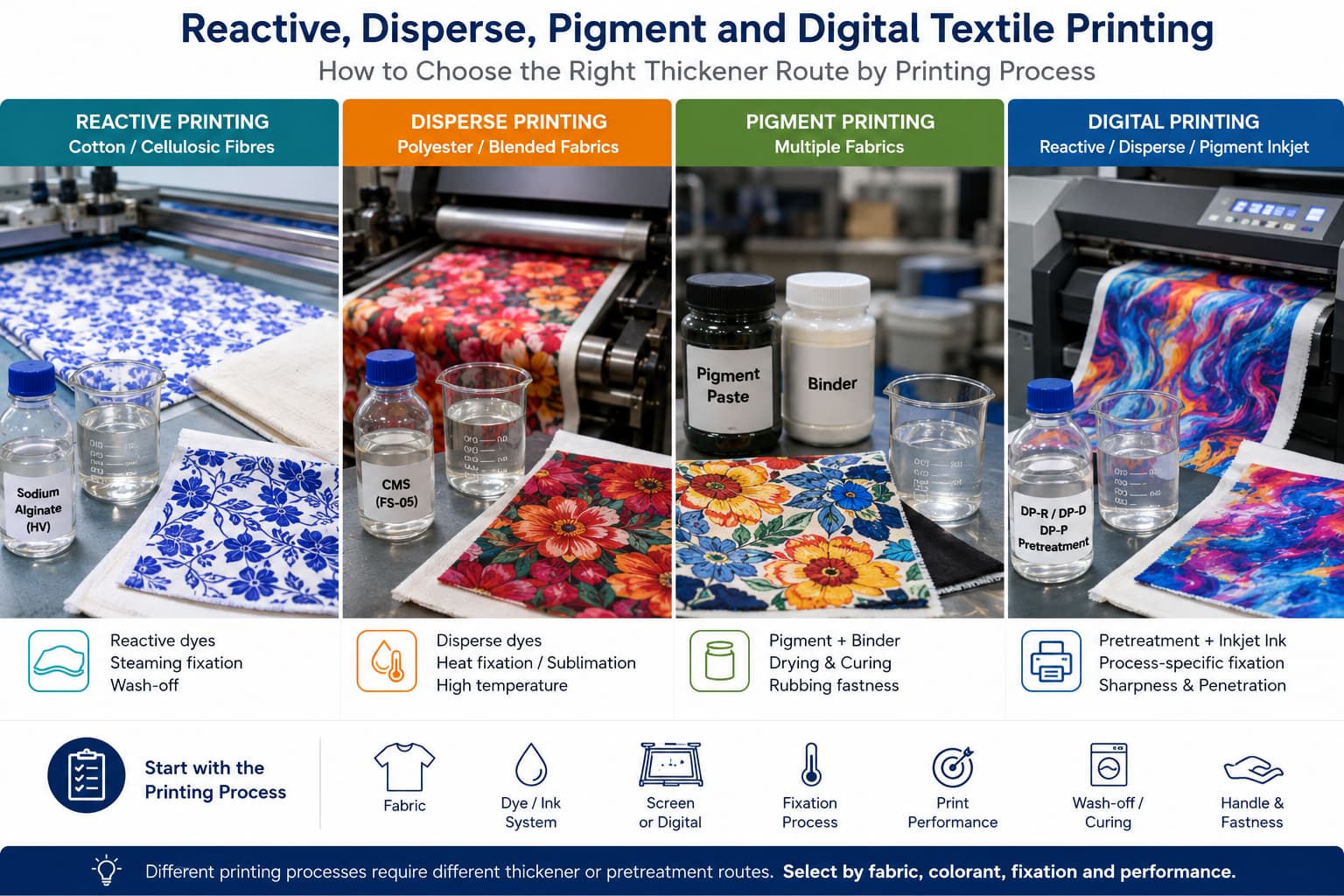
Use these four levels as a proposed investigation record. Name the printing route and where the product is added before testing: conventional reactive or disperse colour paste, pigment-binder paste, or a fabric-applied digital pretreatment. A fabric pretreatment is not an inkjet-ink additive.
If a product passes Level 1 but fails Level 3, the problem may be formula compatibility rather than raw-material quality.
If it passes Levels 1–3 but fails Level 4, the machine, fabric, fixation or washing process becomes a stronger suspect.
What Evidence Actually Points Toward a Thickener Problem?
Evidence becomes stronger when the process is controlled and the failure follows the thickener.
Examples include:
The same production process works with the approved reference thickener but repeatedly fails with the candidate.
The suspect batch fails the same standardized stock-paste test that previous approved batches pass.
Viscosity, filtration or hydration is outside the agreed specification under the same test method.
The candidate shows repeatable incompatibility with the same complete formula while the reference remains stable.
A retained sample from a good batch works, while the suspect batch fails under identical laboratory conditions.
Even then, describe the conclusion precisely.
There is a difference between:
“This batch is outside the agreed incoming specification.”
và:
“This thickener family is unsuitable for the application.”
A batch issue, a grade-matching issue and a process issue are three different diagnoses.
What Evidence Points Toward a Printing Process Problem?
Process evidence becomes stronger when different thickeners fail in the same operating condition.
Examples include:
The approved reference thickener and the new candidate both fail after a machine-speed increase.
Laboratory printing is acceptable but full-scale production fails after long circulation.
The same paste works with soft water but fails with plant water.
Printing is good, but color yield drops only after a changed steaming condition.
Fabric hand is acceptable after a controlled laboratory wash but harsh after the production wash line.
Defects appear only on one fabric construction.
These patterns do not prove the thickener is perfect.
They show that changing the thickener alone is unlikely to solve the entire root cause.
Start with a Reference: Do Not Troubleshoot Without a Baseline
A reference can be:
An approved thickener batch
A retained sample
The current supplier’s product
A previously accepted printed fabric
A validated formula and machine setting
Without a reference, the mill may compare today’s failed paste with memory rather than controlled data.
The reference should define:
Thickener grade and batch
Nồng độ
Viscosity method
Nước
Formula
Vải
Machine settings
Sự cố định
Washing or curing
Finished result
FSX Chemical similarly recommends matched preparation and printing conditions when comparing a candidate grade with an existing system.
Level 1: Check the Incoming Thickener
Before investigating the entire production line, confirm the incoming material.
Kiểm tra:
Product identity
Batch number
Packaging condition
Hình thức
Moisture or solids where applicable
pH where relevant
Standard solution viscosity
COA / specification
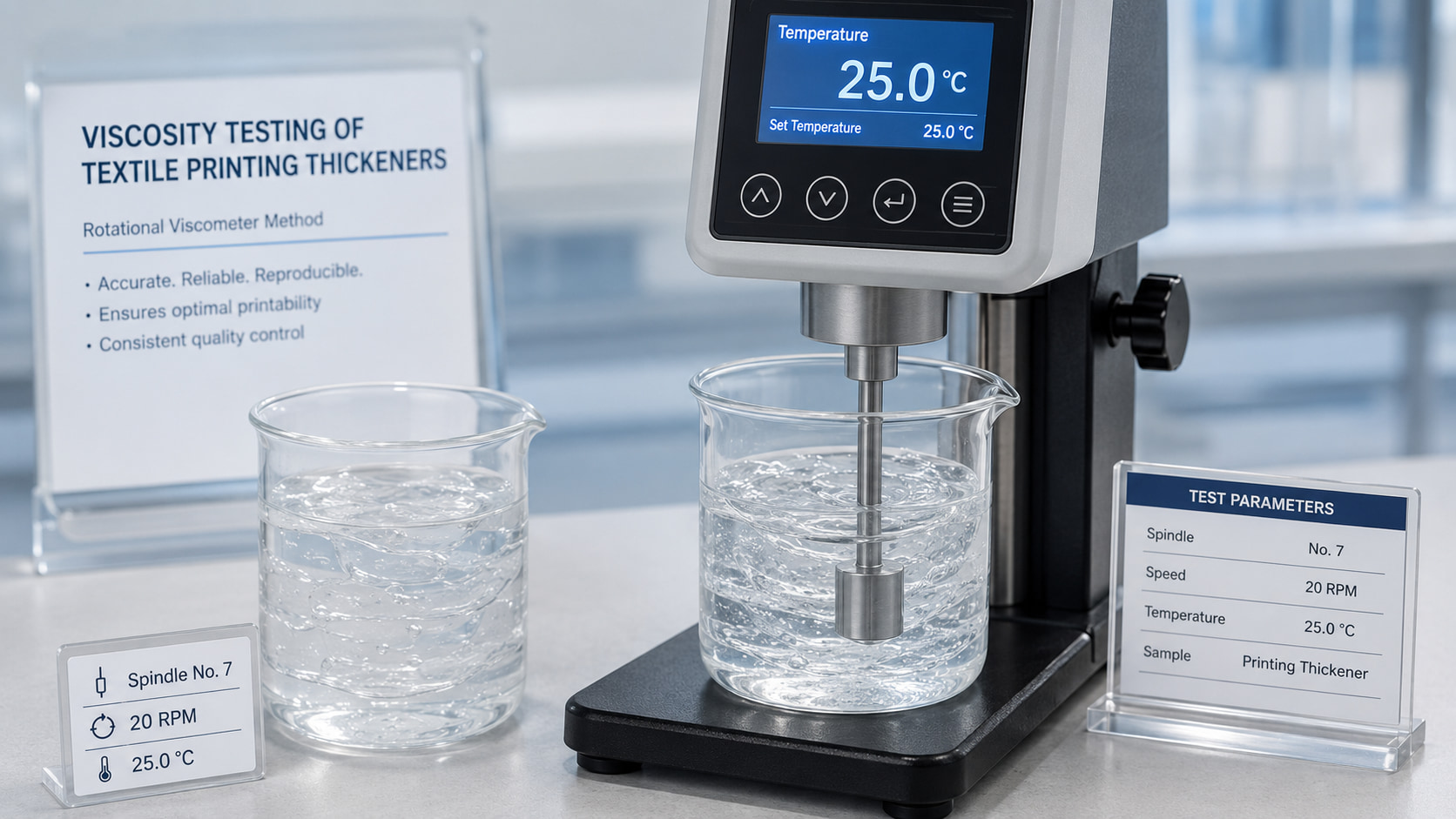
The viscosity result is meaningful only when concentration, temperature, instrument, spindle/rotor, speed, hydration and preparation are aligned.
FSX Chemical’s viscosity-test guidance explicitly notes that matching one viscosity number does not prove product equivalence, but inconsistent test conditions can also create false batch failures.
If the batch is clearly outside the agreed incoming specification under a matched test, investigate the material first.
If it passes, continue to the next level.
Level 2: Check Stock-Paste Preparation
A good thickener can look defective if it is prepared incorrectly.
Kiểm tra:
Chất lượng nước
Powder addition rate
Tốc độ trộn
Thời gian trộn
Thời gian bù nước
Nhiệt độ
Bọt
Filtration residue
Typical process-caused symptoms include:
Fish-Eyes or Lumps
Possible causes: powder added too quickly, insufficient agitation, local high concentration or hard-water interaction.
Độ nhớt thấp
Possible causes: under-dosage, incomplete hydration, wrong concentration basis, high temperature or incorrect measurement method.
Độ nhớt cao
Possible causes: overdosing, lower measurement temperature, calcium interaction or concentration error.
Only after preparation is standardized can stock-paste behavior be used as evidence against the thickener.
Level 3: Check the Complete Printing Paste
The thickener may pass in water and fail after the real formula is added.
That does not necessarily mean the material is defective.
It may mean the selected grade is incompatible with:
Dye
Dung dịch phân tán sắc tố
Salt
Alkali
Binder
Fixer
Dispersant
Reducing agent
Textile-printing research shows that colorants and other paste ingredients can change rheological behavior, while thickeners must still provide suitable high-shear flow and low-shear pattern control.
A staged test is useful:
Prepared Stock or Activated Product → Route-Specific Colourant and Auxiliary Additions in the Approved Order → Complete Formula → Agreed Holding Period
Measure after selected additions using the same final-mass basis, dilution, temperature, pH, mixing/rest history and viscosity method. Use a matched dilution or vehicle control where appropriate. The step at which a difference first appears narrows the investigation; it does not by itself identify which ingredient property caused it.
This identifies whether the failure is:
Raw-material instability
Grade/formula incompatibility
Addition-order problem
Holding-time problem
Level 4: Check Machine, Fixation and Washing
If the complete paste is stable in the laboratory, move downstream.
Kiểm tra:
Screen mesh / engraving
Squeegee pressure, speed and angle
Tốc độ máy
Paste feed and circulation
Fabric absorbency
Printed deposit
Sấy khô
Steaming / thermal fixation / curing
Washing / soaping / reduction clearing
Screen-printing pastes experience very different shear rates before, during and after screen passage, and recovery after shear is important to leveling and definition.
A material that works in a beaker can therefore fail on a machine if the process places it outside its rheological window.
Likewise, a perfectly printable paste cannot compensate for incorrect fixation or insufficient washing.
The 2×2 Comparison: A Controlled Screen for Material and Process Effects
Before the four comparisons, define the reference and suspect grades/batches, the one nominated process factor and its two recorded settings, and the measured response with an agreed acceptance criterion. For each grade, keep its documented formula and dose fixed across the two settings. If a “suspect process” bundles changes in water, screen, speed and cure, the comparison evaluates that bundle; it cannot identify one variable within it.
Phiên tòa
Chất làm đặc
Quy trình
Purpose
A
Approved reference
Normal validated process
Positive control
B
Candidate / suspect
Normal validated process
Tests material under good process
C
Approved reference
Suspect current process
Tests process with proven material
D
Candidate / suspect
Suspect current process
Shows interaction under problem condition
If A Passes and B Fails
This pattern supports investigating the candidate system under the validated process. Repeat independently prepared, matched comparisons and check identity, preparation and full-formula compatibility before calling the batch defective.
If A Passes but Both C and D Fail
This pattern supports investigating the nominated process setting because the reference also fails there. It does not exclude a material interaction; compare response size and variability for both grades, not only a pass/fail label.
If B Passes but D Fails
The candidate passed the tested validated setting and failed the tested suspect setting. Compare the same contrast for the reference. If the size of the process effect differs between grades beyond repeatability, investigate a grade-by-process interaction; do not infer it from B and D alone.
If All Four Fail
Recheck the reference, test method, fabric, dye system and definition of “pass.” The experiment may not have a true positive control.
Plan independent repeat preparations rather than treating repeated readings from one beaker as independent trials. Control or block fabric lot, paste age and run time; randomise within practical blocks and prevent carry-over where feasible. NIST experimental-design guidance explains why replication and run order matter. With one observation per cell, this is a screening comparison without an independent estimate of run-to-run error. Confirm the suspected cause in a focused follow-up trial and verify the correction against every critical finished-fabric requirement. A failed critical requirement keeps commercial release on hold; an authorised further test is not approval.
Symptom 1: Viscosity Drift
Viscosity drift can come from either side.
Possible Thickener / Grade Causes
Salt or alkali sensitivity
Poor holding stability
Batch outside specification
Inadequate molecular/rheological profile for the formula
Possible Process Causes
Wrong concentration
Temperature change
Độ cứng của nước
Incorrect hydration
Dilution from dye solution
Evaporation
High shear / incomplete recovery
Do not diagnose the problem from one viscosity reading.
These defects are often blamed on “low viscosity,” but several process variables can create the same appearance.
Thickener-Side Checks
Low-shear body
Shear thinning
Phục hồi
Độ đàn hồi
Tương thích hoàn toàn với tính năng dán
Process-Side Checks
Too much paste deposit
High squeegee pressure
Open screen geometry
Highly absorbent fabric
Slow drying
Excessive fabric pickup
Research confirms that printing quality depends on both rheology and application conditions, not viscosity alone.
Symptom 3: Low Color Yield or Shade Change
Low K/S is not automatically a thickener problem.
Possible Thickener-Side Causes
Poor dye release
Excessive film retention
Unsuitable penetration control
Formula interaction
Possible Process Causes
Insufficient paste deposit
Excessive penetration
Incorrect steaming / thermofixation
Reactive dye hydrolysis
Wrong alkali timing
Poor washing / reduction clearing
Compare final colour after the validated, matched post-treatment for that route. Reactive printing normally needs fixation followed by wash-off; disperse printing needs the approved fixation and any required after-treatment; conventional pigment printing depends on binder-film development and cure. Do not apply a dye-paste wash-off diagnosis to a pigment film intended to remain on the fabric.
A wet print that looks strong before steaming does not prove good final color yield.
Symptom 4: Screen Blocking or Poor Transfer
Possible Thickener-Side Causes
Excess elasticity / stringiness
Gel particles
Poor filtration
Insufficient high-shear flow
Possible Process Causes
Fine mesh
Low squeegee pressure
Screen drying during pauses
Paste feed shortage
Contaminated screen
Machine alignment
Do not continuously increase pressure to compensate for a paste that does not shear or release correctly.
Likewise, do not lower viscosity until the screen and feed system are checked.
For a dye-printing route that requires wash-off, a controlled rewash can show that removable residue contributed to hand. It does not identify the residue as thickener alone. Keep a matched printed control without the additional rewash, and evaluate shade and fastness as well. For pigment printing, investigate the intended binder film and cure rather than assuming it should wash away.
Symptom 6: Good Lab Result but Poor Production Run
This is one of the strongest signs that scale-up variables need investigation.
Kiểm tra:
Large-batch mixing
Tank dead zones
Pump shear
Circulation time
Paste temperature
Bọt
Evaporation
Tốc độ máy
Beginning-to-end paste age
Rotary-screen and other continuous processes can expose the paste to long repeated shear that a short laboratory print does not reproduce.
A candidate should therefore be approved across a production window rather than from one successful swatch.
Reactive Printing: Thickener vs. Process Checks
For reactive printing, separate the thickener from the dye-fixation chemistry.
Kiểm tra:
Possible Thickener Issue
Possible Process Issue
Alginate/CMC/CMS rheology unsuitable for the screen
Screen/squeegee deposit incorrect
Paste viscosity unstable after alkali
Alkali added too early or at wrong dosage
Poor wash-off
Hard water or insufficient washing
Low definition
Fabric pickup / drying too high or slow
Color loss
Steaming or dye hydrolysis problem
Do not change sodium alginate solely because an old alkaline paste gives low color yield.
Dye hydrolysis and thickener rheology are separate questions.
Disperse Printing: Thickener vs. Process Checks
For polyester disperse printing, thickener suitability includes dye release during thermal fixation.
Possible Thickener Issue
Poor screen rheology
Poor holding stability
Dried film restricts dye release
Wash-off difficulty
Possible Process Issue
Wrong paste deposit
Incorrect thermofixation / steaming
Uneven polyester preparation
Insufficient reduction clearing
The same paste should be compared under identical fixation conditions before the thickener is blamed for low color.
Pigment Printing: Thickener vs. Process Checks
Pigment printing is a complete binder system.
Possible Thickener Issue
Electrolyte sensitivity
Poor binder compatibility
Unsuitable rheology
Excess polymer solids
Possible Process Issue
Binder dosage
Curing temperature/time
Pigment dispersion quality
Lớp lắng đọng dạng bột nhão
Finishing / softener interaction
If rubbing fastness is poor, changing thickener alone may not solve an under-cured binder film.
Digital Pretreatment: Thickener vs. Process Checks
Digital textile pretreatment introduces additional application variables.
Possible Thickener / Pretreatment Issue
Wrong viscosity or film-forming behavior
Filtration residue
Poor ink compatibility
Possible Process Issue
Pickup too high or too low
Uneven padding / stenter application
Drying inconsistency
Fabric preparation
Ink/pretreatment mismatch
Steaming/washing
A pretreatment that passes in one application method should be revalidated when pickup, machine or drying route changes.
Why You Should Change One Major Variable at a Time
A common troubleshooting mistake is:
Change thickener + change dosage + change screen pressure + change steaming at the same time.
If the result improves, the mill does not know which correction worked.
A better sequence is:
Hold Reference Conditions → Change One Variable → Record Result → Confirm → Move to Next Variable
When speed is important, use a structured small matrix rather than uncontrolled production changes.
The objective is not merely to make one batch pass.
It is to create a repeatable process standard.
Practical Decision Tree
Use this sequence when a print defect appears:
Confirm the defect. Is it viscosity, transfer, color, wash-off, hand or fastness?
Check the reference. Does the approved product/process still pass?
Check incoming thickener QC. Is the suspect batch inside specification under the same method?
Check stock preparation. Water, concentration, hydration and temperature.
Check complete-paste compatibility. Dye, salt, alkali, binder and holding.
Check machine variables. Screen, squeegee, speed, deposit and fabric.
Check fixation. Steaming, thermofixation or curing.
Check post-treatment. Washing, soaping or reduction clearing.
Run the 2×2 crossover test.
Only then change the thickener grade or dosage permanently.
Bảng khắc phục sự cố
Observed Defect
Thickener-Side Checks
Process-Side Checks
Viscosity too low
Grade, batch, salt tolerance, concentration
Dilution, temperature, hydration, water
Viscosity too high
Grade / molecular weight
Overdose, low temperature, calcium, evaporation
Bleeding / spreading
Low-shear body, recovery
Deposit, pressure, pickup, drying
Poor screen passage
High-shear flow, elasticity, gels
Mesh, pressure, screen drying, feed
Low K/S
Dye release, rheology
Deposit, penetration, fixation, hydrolysis
Harsh hand
Polymer dosage, residue
Hard water, wash-off, salts, binder cure
Lab pass / production fail
Long-run stability
Scale-up shear, temperature, foam, circulation
Only one batch fails
Incoming QC, retained-sample comparison
Confirm process truly unchanged
How to Build a Mill Troubleshooting Record
A useful record should include:
Date / shift
Thickener grade and batch
Reference batch
Water source / hardness
Nồng độ
Viscosity method
Thời gian bù nước
Formula version
Dye / pigment lot
Salt / alkali / binder
Thời gian giữ
Máy móc
Screen
Squeegee settings
Speed
Fabric lot
Sự cố định
Washing / curing
Observed defect
Corrective action
Result
This record turns troubleshooting into accumulated process knowledge.
It also helps a supplier distinguish an actual grade issue from a process variable without guessing.
Total Cost in Use: Why Wrong Diagnosis Is Expensive
If a process problem is incorrectly blamed on the thickener, the mill may incur:
Unnecessary supplier changes
Repeated samples
Formula redevelopment
Higher dosage
More washing
Production downtime
If a genuine thickener problem is incorrectly treated as a machine problem, the mill may incur:
Repeated machine adjustments
Screen wear
Chỉnh màu
Vải bị loại
Operator time
Một mô hình hữu ích là:
Total Cost of the Problem = Material Loss + Machine Downtime + Rework + Post-Treatment + Rejected Fabric + Troubleshooting Time
The fastest correction is not always the cheapest correction.
The lowest stable cost comes from identifying the real cause and preventing recurrence.
Bạn nên cung cấp những thông tin nào cho nhà cung cấp chất làm đặc?
For meaningful troubleshooting, send the information below. For symptom-by-symptom checks after the route and first divergent stage are identified, use the related textile printing paste troubleshooting guide.
Current thickener grade, TDS and batch
Approved reference thickener or retained sample
Concentration and viscosity method
Water source and hardness
Hydration / preparation method
Complete or simplified formula
Dye / pigment / binder system
Salt / alkali / auxiliaries
Thời gian giữ
Machine type and speed
Cài đặt màn hình / lưỡi gạt
Fabric composition and construction
Fixation conditions
Washing / curing conditions
Exact defect and when it first appears
FSX Chemical có thể sử dụng thông tin này thông qua Mẫu và việc kết hợp to recommend whether the next step should be a thickener-grade comparison, a formulation test or a controlled process trial.
How Should a Mill Separate Thickener Problems from Process Problems?
A finished-print defect is not automatically a thickener defect.
A thickener should first be checked under a standardized incoming and stock-paste method.
Formula compatibility must be separated from raw-material quality.
Machine, fabric, fixation and washing can reproduce the same defects as poor rheology.
A reference/candidate × validated/suspect-setting comparison is a useful screen when variables are defined and repeatability is checked; it is not unique proof of cause.
Change one major variable at a time and approve the final correction through the finished fabric.
Các câu hỏi thường gặp
1. How do I know whether a printing defect is caused by the thickener?
Repeat the same standardized preparation and printing process with an approved reference thickener. If the reference passes and the suspect product repeatedly fails under matched conditions, evidence for a thickener or grade-compatibility issue becomes stronger.
2. If viscosity is outside target, is the thickener defective?
Not necessarily. Check concentration, temperature, hydration, water quality and viscosity test method before judging the batch.
3. If two thickeners both fail on the same machine, what should I check?
Prioritize process variables such as screen, squeegee, speed, fabric, deposit, drying, fixation and washing.
4. Why does a thickener work in the lab but fail in production?
Production introduces scale-up mixing, pump shear, circulation, temperature, foam, evaporation and longer holding times that the laboratory may not reproduce.
5. Does bleeding always mean the viscosity is too low?
No. Bleeding can also come from excessive paste deposit, high pressure, absorbent fabric, slow drying or poor structural recovery.
6. Does low color strength mean the thickener is blocking dye release?
It can, but first check paste deposit, penetration, fixation, reactive dye hydrolysis or thermal conditions.
7. Can poor wash-off be a process problem?
Yes. Hard water, insufficient rinsing, low temperature, poor soaping and short residence time can all leave residue even with a suitable thickener.
8. What is a 2×2 crossover test?
It compares reference and candidate systems at two documented process settings. Record quantitative responses as well as pass/fail, repeat independent preparations and compare both grades across settings. One unreplicated four-run pattern only directs follow-up testing.
9. Should I change thickener dosage while troubleshooting?
Not until the baseline is documented. Changing dosage too early removes an important control and can hide the original cause.
10. Why is a retained reference batch useful?
It lets the mill test a previously approved material under today’s process conditions and helps determine whether the process changed.
11. Can the problem be an interaction rather than only material or process?
Yes. A thickener can be inside specification but incompatible with a particular salt, alkali, binder, screen or high-shear production condition. That is a grade/process interaction rather than a simple quality failure.
12. What should I send FSX Chemical for root-cause troubleshooting?
Send the suspect and reference thickener information, viscosity method, formula, water, machine, fabric, fixation, washing and the exact stage where the defect first becomes visible.
Separate the Thickener from the Process Before Changing the Formula
If your textile printing line develops viscosity drift, bleeding, low color yield, screen blocking or poor wash-off, FSX Chemical can help structure a controlled comparison to identify whether the next trial should focus on the thickener, formula or process.
Để nhận được bài đánh giá kỹ thuật hữu ích, vui lòng gửi:
The right troubleshooting question is not “Which thickener should we replace?” It is “At which stage does the defect first appear, and does the defect follow the material, the process, or the interaction between them?”
Tìm hiểu lý do tại sao không thể so sánh các giá trị độ nhớt của chất làm đặc trong in ấn dệt may nếu không đảm bảo các yếu tố như nồng độ, nhiệt độ, thiết bị, trục quay, tốc độ, phương pháp chuẩn bị và thời gian thử nghiệm đều giống nhau.
Tìm hiểu cách lựa chọn chất làm đặc và quy trình tiền xử lý cho các phương pháp in dệt phản ứng, in phân tán, in sắc tố và in kỹ thuật số, dựa trên các yêu cầu về vải, thuốc nhuộm hoặc mực in, quá trình cố định màu, khả năng rửa trôi và chất lượng in.
So sánh CMC, CMS, natri alginat và mực in kỹ thuật số trong in ấn dệt may. Tìm hiểu cách thức từng loại nguyên liệu phù hợp với các quy trình in phản ứng, in phân tán, in sắc tố và in kỹ thuật số, cũng như những yếu tố mà người mua cần xem xét trước khi thử mẫu, đối chiếu chất lượng và mua số lượng lớn.
Natri alginat được sử dụng rộng rãi trong in ấn dệt may với vai trò là chất làm đặc ổn định và có thể giặt được cho hỗn hợp in phản ứng. Tìm hiểu cách đánh giá cấp độ độ nhớt, độ tinh khiết và tính phù hợp trong ứng dụng trước khi mua hàng, cũng như cách FSX Chemical hỗ trợ người mua trên toàn cầu thông qua dữ liệu kỹ thuật và mẫu sản phẩm.
Choose CMC for textile printing by application, DS, viscosity method and formulation trials. Use a practical checklist to compare grades before bulk purchase.
Carboxymethyl cellulose được sử dụng làm chất làm đặc và chất ổn định trong mực in gốc nước, in ống đồng và quá trình tiền xử lý cho in phun. Hướng dẫn này trình bày các thông số kỹ thuật chính của sản phẩm và các yếu tố cần xem xét khi lựa chọn nhà cung cấp dành cho các đội ngũ mua hàng.
Hỗn hợp in dựa trên CMC được sử dụng rộng rãi trong in vải bằng bột màu, in phản ứng và in kỹ thuật số. Hướng dẫn này giải thích các thông số quan trọng, cách so sánh các nhà cung cấp và những yêu cầu cần đưa ra trước khi đặt hàng số lượng lớn.
Cả natri alginat và CMC đều được sử dụng làm chất làm đặc trong in vải, nhưng chúng phù hợp với các hệ thống thuốc nhuộm và điều kiện quy trình khác nhau. Hướng dẫn này giải thích những điểm khác biệt chính và thời điểm nên sử dụng từng loại.
In phun kỹ thuật số trên vải có các yêu cầu về hỗn hợp mực và xử lý sơ bộ khác so với in lụa. Hướng dẫn này giải thích cách sử dụng natri alginat trong in kỹ thuật số trên vải cũng như các thông số về cấp độ chất lượng mà các đội ngũ mua hàng cần quy định.
CMC loại thực phẩm và loại công nghiệp có cùng cơ sở hóa học nhưng lại khác biệt đáng kể về độ tinh khiết, dải DS và các yêu cầu quy định. Hướng dẫn này giải thích những điểm khác biệt chính và lý do tại sao việc sử dụng loại không phù hợp lại gây ra các vấn đề trong sản xuất.
Prepare sodium alginate printing paste with a grade-specific concentration and controlled powder dispersion. Validate hydration, viscosity, filtration, air removal and holding time before production.
Assess sodium alginate in reactive-printing wastewater using measured COD load, product-specific biodegradation evidence and controlled process comparisons. Includes a buyer checklist and illustrative load calculation.
Vui lòng cung cấp tên sản phẩm, ứng dụng, số lượng, điểm đến và bất kỳ tài liệu kỹ thuật (TDS),
hình ảnh mẫu hoặc tài liệu nào mà quý khách đã có. FSX Chemical sẽ xem xét
thông tin này và đề xuất bước tiếp theo liên quan đến báo giá, đối chiếu mẫu
hoặc lựa chọn sản phẩm.
Thông tin sản phẩmTên sản phẩm, cấp loại, mẫu mã, ảnh nhãn mác hoặc mã tham chiếu của nhà cung cấp.
Các tài liệu có sẵnTDS, SDS, COA, ảnh mẫu, danh mục sản phẩm hoặc dữ liệu thử nghiệm.
Chi tiết đơn hàngSố lượng dự kiến, hình thức đóng gói, nước nhập khẩu, cảng hoặc điều kiện thương mại.
Yêu cầu hoặc Vấn đềQuy trình in trên vải, yêu cầu về công thức, vấn đề hiện tại hoặc chỉ tiêu hiệu suất.