Urea, Alkali, dan Garam Anti-Reduksi dalam Pretreatment Digital Reaktif: Apa Fungsi Masing-Masing Komponen?
Urea, alkali and anti-reducing salt perform different functions in reactive digital pretreatment. Urea supports moisture...
Urea, alkali and anti-reducing salt perform different jobs in reactive digital textile pretreatment. Urea helps create a moist and dye-mobile environment during fixation, alkali creates the alkaline conditions required for reactive dye–cellulose bonding, and anti-reducing salt is commonly used as a mild oxidizing agent to reduce the risk of dye reduction during steaming. These components should not be treated as a fixed universal recipe. Their required type and dosage depend on the reactive ink, fabric, pretreatment polymer, wet pick-up, drying or wet-on-wet route, steaming and washing conditions.
Why These Three Components Matter in Reactive Digital Pretreatment
Reactive inkjet printing on cotton, viscose and other suitable cellulosic fabrics normally separates the ink formulation from some of the chemicals needed for fixation.
This is because an inkjet ink must maintain tightly controlled:
Viskositas
Surface tension
Conductivity
Nozzle stability
Stabilitas penyimpanan
Strongly alkaline or highly loaded conventional printing auxiliaries are therefore often applied to the fabric through pretreatment rather than placed directly into the reactive ink.
A typical reactive digital pretreatment may contain:
Thickener or polymeric surface-control agent
Urea or another moisture-management component
Alkali
Anti-reducing salt where required
Other wetting, migration-control or process auxiliaries
Published reactive inkjet studies frequently use combinations of sodium alginate, urea, sodium bicarbonate and sodium m-nitrobenzene sulfonate on cotton before digital printing. These published recipes demonstrate how the chemistry can be structured, but they should not be treated as universal production formulas.
For research context, see the cotton reactive inkjet study using a sodium alginate-based pretreatment containing urea, sodium bicarbonate and sodium m-nitrobenzene sulfonate: reactive digital inkjet printing on mercerized cotton.
The three components discussed in this article have different primary roles:
Komponen
Primary Function
Main Process Stage
Urea
Supports dye solubility, moisture retention and fiber swelling
Printing and especially steaming/fixation
Alkali
Creates conditions for reactive dye–cellulose bonding
Primarily fixation during steaming
Anti-reducing salt
Reduces the risk of dye reduction/decolorization in the steamer
Primarily steaming/fixation
1. What Does Urea Do?
Urea has been used for decades in reactive printing because it performs several related functions.
Dye Solubilization
Reactive dyes are water-soluble, but concentrated color systems can still benefit from an environment that keeps the dye adequately dissolved and distributed.
Urea can act as a dye solubilizer and disaggregating aid in reactive printing systems.
Moisture Retention
During steaming, reactive dye fixation requires heat and moisture.
Urea is hygroscopic and can help the printed area retain moisture, supporting dye mobility during fixation.
Fiber Swelling
Urea can also support swelling of cellulosic fibers during steaming, making it easier for dye molecules to move into the fiber structure.
Published reactive-printing literature describes urea as a solubilizing, disaggregating and cellulose-swelling component during steaming.
Urea is not the primary alkali responsible for covalent fixation.
It also does not replace the thickener.
The thickener controls the localization and rheology of the pretreatment or printing system, while urea mainly supports the moisture/dye-transfer environment.
Does More Urea Always Increase Color?
No.
Once the process has sufficient moisture and dye mobility, additional urea may provide limited extra benefit while increasing:
Chemical consumption
Nitrogen load in wastewater
Drying or moisture-management complexity
Wash-off load
This is why urea dosage should be optimized rather than maximized.
2. What Does Alkali Do?
Alkali is the component that creates the chemical conditions needed for reactive dye fixation on cellulose.
Under suitable alkaline conditions, cellulose hydroxyl groups become more reactive, allowing the reactive group of the dye to form a covalent bond with the fiber.
In reactive inkjet printing, alkali is commonly placed in the pretreatment rather than in the ink because high alkalinity can reduce reactive ink storage stability.
Common Alkali Directions
Depending on the reactive dye/ink system, conventional pretreatments may use:
Natrium bikarbonat
Sodium carbonate
Other buffered or process-specific alkali systems
These alkalis should not be treated as direct equivalents based only on pH.
Sodium bicarbonate is commonly selected where a milder pre-print alkaline condition and stronger fixation conditions during heating are useful.
Sodium carbonate provides stronger alkalinity and can be suitable in selected systems, but pretreatment stability, polymer behavior and dye hydrolysis must be evaluated.
Why Stronger Alkali Is Not Automatically Better
Reactive dyes can also react with water under alkaline conditions.
This competing reaction is dye hydrolysis.
Hydrolyzed dye can no longer fix to cellulose in the intended way and must be removed during wash-off.
Published reactive-printing research shows that color yield and fixation can improve with increasing alkali only to an application-specific range; beyond that range, stronger alkaline conditions can increase hydrolysis and reduce useful fixation performance.
Use enough alkalinity to support fixation, but not more than the process can use effectively.
3. What Does Anti-Reducing Salt Do?
In many conventional reactive printing formulations, the term “anti-reducing salt” refers to sodium m-nitrobenzene sulfonate, also known as sodium 3-nitrobenzenesulfonate and historically sold under trade names such as Ludigol.
This material is not used because the process needs an ordinary salt electrolyte.
It is used because it acts as a mild oxidizing agent.
Why Is a Mild Oxidizing Agent Useful?
During steaming, reducing conditions can sometimes develop due to:
Steam contamination
Organic decomposition products
Machine conditions
Interactions with fabric residues or auxiliaries
Some dyes can be sensitive to reduction.
If the dye is reduced during steaming, possible symptoms include:
Loss of brightness
Shade change
Lower color strength
Uneven fixation
Sodium m-nitrobenzene sulfonate acts as an oxidizing reserve that helps reduce this risk.
Textile literature describes sodium m-nitrobenzene sulfonate as a mild oxidizing agent included in reactive pretreatment or printing liquor to avoid dye reduction and decolorization during steaming.
A modern reactive ink system may have a different tolerance to reducing conditions than an older dye formulation.
Therefore, anti-reducing salt should be treated as an application variable, not as a component that must automatically be maximized.
Anti-Reducing Salt Is Not the Same as Sodium Chloride or Sodium Sulfate
The word “salt” creates confusion in textile chemistry because several chemically unrelated materials are called salts.
Baku
Typical Chemical Identity
Main Role
Common salt
Sodium chloride
Electrolyte commonly used in reactive dyeing to promote exhaustion
Glauber’s salt
Sodium sulfate
Electrolyte used in dyeing and some formulation systems
Anti-reducing / resist salt
Sodium m-nitrobenzene sulfonate
Mild oxidizing agent used to reduce dye-reduction risk during steaming
These materials should not be substituted for one another.
In reactive inkjet pretreatment, high electrolyte loading can also affect thickener viscosity and fabric behavior, so ordinary salts should not be added simply because “salt is used in reactive dyeing.”
Digital printing is not the same as exhaust dyeing.
How Urea, Alkali and Anti-Reducing Salt Work Together
These three components support different parts of the same fixation environment.
A simplified process logic is:
Urea → Moisture & Dye Mobility
Alkali → Reactive Dye–Cellulose Reaction
Anti-Reducing Salt → Protection Against Reducing Conditions During Steaming
They interact because changing one component can alter the conditions experienced by the others.
Example: More Urea
More moisture retention can improve dye mobility, but it may also change:
Permintaan pengeringan
Residual moisture
Penyebaran tinta
Wash-off load
Example: More Alkali
Higher alkalinity can promote fixation up to a useful range, but can also increase:
Dye hydrolysis
Polymer instability
Shade sensitivity
Example: More Anti-Reducing Salt
A sufficient anti-reducing level may protect sensitive dyes in a problematic steaming environment, but unnecessary overdosing adds cost and chemical load without proving additional benefit.
The correct formulation should therefore be optimized as a complete system.
How These Additives Affect the Pretreatment Thickener
The thickener or surface-control polymer must remain functional after urea, alkali and anti-reducing salt are added.
This is particularly important for:
Sodium alginat
CMC-based systems
CMS-based systems
HEC-containing systems
Compound digital pretreatments
Depending on polymer chemistry, the additives can influence:
Hidrasi
Viskositas
Toleransi elektrolit
Reologi
Penyaringan
Stabilitas penyimpanan
Same viscosity before additives does not mean the same viscosity after the complete pretreatment is prepared.
A meaningful comparison should therefore measure the complete pretreatment after all intended components have been added.
The test method should record:
Konsentrasi
Kualitas air
Mixing sequence
Waktu hidrasi
Suhu
Viskosimeter
Poros atau rotor
Kecepatan putaran
Why Fabric Pick-Up Changes Their Real Add-On
The formulation concentration in the pretreatment tank does not tell the mill how much urea, alkali or anti-reducing salt reaches the fabric.
Urea and other soluble chemicals can redistribute during drying if the process is not uniform.
Alkali distribution can also change across the fabric.
A good dry-route pretreatment should therefore be evaluated after drying, not only while it is still in the tank.
Wet-on-Wet Route: What Changes?
In wet-on-wet or controlled wet-state printing, the fabric still contains pretreatment moisture when printing begins.
This changes the environment experienced by urea, alkali and the polymer.
Variabel-variabel penting antara lain:
Wet pick-up
Residual moisture at printing
Time between pretreatment and printing
Fabric transport
Penyebaran tinta
Polymer swelling
A wet-on-wet formula should therefore not be created by simply taking a dry-route formula and removing the dryer.
Urea requirements may change because the fabric already contains more moisture.
Alkali behavior may change because it is present in a hydrated environment when the ink arrives.
The anti-reducing requirement may still depend primarily on the later steaming environment.
Wet-on-wet development should be validated as a separate process.
Cotton vs. Viscose: Should the Same Formula Be Used?
Cotton and viscose are both cellulosic fibers, but they do not necessarily require the same pretreatment balance.
Viscose can differ from cotton in:
Kemampuan menyerap
Swelling
Liquid penetration
Wet-state dimensional stability
Pretreatment distribution
This can change the effective behavior of:
Urea
Alkali
Polymer
Kelembapan
The anti-reducing requirement is also influenced by the ink and steaming conditions rather than by fiber name alone.
Therefore, a cotton recipe can be used as a starting reference for viscose, but the finished fabric should be validated separately.
What Happens When Each Component Is Too Low or Too High?
Komponen
If Too Low
If Too High
Urea
Insufficient dye solubilization/moisture support in some systems; reduced color development possible
Higher nitrogen load, more chemical consumption, possible excess moisture and wash-off burden
Alkali
Insufficient cellulose activation and lower fixation
Greater dye hydrolysis risk, possible pretreatment instability and shade change
Anti-reducing salt
Some dye systems may be more vulnerable to reduction/decolorization during steaming
Additional chemical load and cost without guaranteed extra benefit
This table is a troubleshooting framework, not a dosage specification.
The optimum range depends on the complete production system.
Laboratory Evaluation Workflow
Langkah 1: Menentukan Tolok Ukur Saat Ini
Catatan:
Ink system
Kain
Polymer/thickener
Urea dosage
Alkali type and dosage
Anti-reducing salt type and dosage
Wet pick-up
Dry or wet-on-wet route
Pengukusan
Pencucian
Step 2: Change One Component at a Time
Do not change urea, alkali, anti-reducing salt and polymer simultaneously during the first screening round.
Step 3: Measure the Complete Pretreatment
Catatan:
pH
Viskositas
Penampilan
Busa
Penyaringan
Stabilitas selama waktu tunggu
Step 4: Apply at a Measured Pick-Up
Control actual fabric add-on.
Step 5: Dry or Maintain the Defined Wet State
Keep the process route constant.
Step 6: Print with the Same Ink and Settings
Use the same printer, ink lot, passes and image.
Step 7: Steam Under the Same Conditions
This is especially important when evaluating alkali and anti-reducing salt.
Step 8: Wash Identically
Reactive printing performance should be judged after removal of unfixed/hydrolyzed dye.
Step 9: Compare Finished Fabric
Evaluasi:
Color strength
Hue
Ketajaman
Pendarahan
Penetrasi
Kebersihan latar belakang
Penghilangan Residu melalui Pencucian
Ketahanan warna jika berlaku
Step 10: Approve a Working Window
A stable range is more useful than one theoretical optimum point.
How to Run a Production Trial
Once the laboratory identifies a suitable direction, production should verify:
Batch preparation consistency
Pretreatment holding time
Pick-up uniformity
Drying or wet-state consistency
Printer transport
Steamer consistency
Kinerja pembilasan
The trial should run long enough to observe whether the pretreatment remains stable over a realistic production window.
Do not approve the formula from the first few meters only.
Retain reference samples and record the complete formulation so the result can be reproduced.
Urea and Alkali Reduction: What Does “Eco-Friendly” Actually Mean?
Urea and inorganic alkali can contribute to environmental load.
Urea adds nitrogen to wastewater, while inorganic alkali can contribute to dissolved solids and washing demand.
For this reason, low-urea, urea-free and alternative fixation strategies are active areas of textile research.
However, removing urea or reducing alkali is environmentally useful only if the replacement process still delivers:
Acceptable color yield
Fiksasi
Ketajaman
Production stability
Reasonable washing
Tingkat penolakan yang rendah
If a low-urea formula increases reprinting or rejected fabric, the total environmental result may not improve.
The correct sustainability question is:
Can the component be reduced without increasing total production loss?
Published reactive-printing research has specifically investigated lower-urea and alternative alkali systems because of nitrogen and dissolved-solids concerns, reinforcing the value of controlled optimization rather than fixed traditional recipes.
What Information Should You Send to a Pretreatment Supplier?
For useful reactive digital pretreatment matching, provide:
Reactive ink brand or chemistry
Cotton, viscose or other cellulosic fabric
Konstruksi tenun atau rajut
Berat kain
Produk prapengolahan saat ini atau TDS
Current thickener/polymer dosage
Urea dosage
Alkali type and dosage
Anti-reducing salt type and dosage where used
Pretreatment pH and test method
Viskositas dan metode pengujian
Measured fabric pick-up
Dry or wet-on-wet route
Kondisi pengeringan
Printer type
Steaming conditions
Washing process
Current color, bleeding, fixation or environmental target
FSX Chemical can use this information through its Sampel & Pencocokan Grade process to identify a relevant reactive digital pretreatment candidate.
How Should a Mill Optimize Urea, Alkali and Anti-Reducing Salt?
The most reliable sequence is:
Current Formula → Defined Test Method → Measured Pick-Up → Controlled Component Trial → Printing → Steaming → Washing → Finished Fabric Evaluation
The key principles are:
Urea mainly supports dye solubility, moisture and fiber swelling; it is not the fixation alkali.
Alkali creates the reactive dye fixation environment, but excessive alkalinity can increase dye hydrolysis.
Anti-reducing salt is a mild oxidizing agent, not ordinary sodium chloride or sodium sulfate.
The same recipe should not automatically be transferred between cotton, viscose, dry pretreatment and wet-on-wet printing.
Final approval should be based on the finished textile after steaming and washing.
Pertanyaan yang Sering Diajukan
1. What does urea do in reactive digital printing pretreatment?
Urea supports dye solubility, moisture retention and cellulose swelling during fixation. It helps create a suitable environment for reactive dye mobility during steaming.
2. What does alkali do?
Alkali creates the alkaline conditions needed for reactive dyes to form covalent bonds with cellulose during fixation.
3. What is anti-reducing salt?
In many reactive printing formulations, anti-reducing or resist salt refers to sodium m-nitrobenzene sulfonate, a mild oxidizing agent used to reduce dye-reduction risk during steaming.
4. Is anti-reducing salt the same as sodium chloride?
No. Sodium chloride is an electrolyte commonly used in dyeing. Sodium m-nitrobenzene sulfonate has a different chemical identity and acts mainly as a mild oxidizing/anti-reduction agent.
5. Is sodium sulfate the same as anti-reducing salt?
No. Sodium sulfate and sodium m-nitrobenzene sulfonate are chemically and functionally different materials.
6. Does more urea always increase color yield?
No. Urea can support dye mobility and fixation conditions, but excessive use adds cost and nitrogen load and may not provide additional color benefit.
7. Does higher alkali always improve fixation?
No. Fixation improves only within a suitable alkaline range. Excessive alkalinity can increase reactive dye hydrolysis.
8. Is anti-reducing salt always necessary?
Not necessarily. The need depends on dye chemistry, ink, steam quality, equipment and pretreatment formulation.
9. Can cotton and viscose use the same urea and alkali recipe?
They can use the same formula as a starting reference, but absorbency, swelling and penetration differ, so separate validation is recommended.
10. Do wet-on-wet processes need the same urea level as dry pretreatment?
Not automatically. Wet-on-wet fabric already contains more moisture, so urea and polymer requirements may need to be re-optimized.
11. Why does pretreatment viscosity change after adding alkali or salts?
Electrolytes and pH can change polymer hydration and rheology. Measure viscosity on the complete formulation under a standardized method.
12. What should I send FSX Chemical for pretreatment matching?
Send your ink system, fabric, current formula, polymer dosage, urea, alkali, anti-reducing salt if used, pH, viscosity, pick-up, drying or wet route, steaming and washing conditions.
Optimize Reactive Digital Pretreatment Chemistry with FSX Chemical
If you are adjusting urea, alkali, anti-reducing salt or thickener in a reactive digital printing pretreatment, FSX Chemical can help identify a technically relevant candidate and test direction.
For a more useful comparison, send:
Your current pretreatment product or TDS
Reactive ink system
Cotton or viscose fabric details
Current thickener/polymer dosage
Urea dosage
Alkali type and dosage
Anti-reducing salt type and dosage where used
Pretreatment pH and method
Viscosity and method
Measured wet pick-up
Dry or wet-on-wet route
Kondisi pengeringan
Steaming and washing conditions
Current color, fixation, bleeding, cost or environmental target
Urea, alkali and anti-reducing salt are not interchangeable additives. Each solves a different part of the reactive printing process, and the correct balance should be established through complete pretreatment, printing, steaming and wash-off validation.
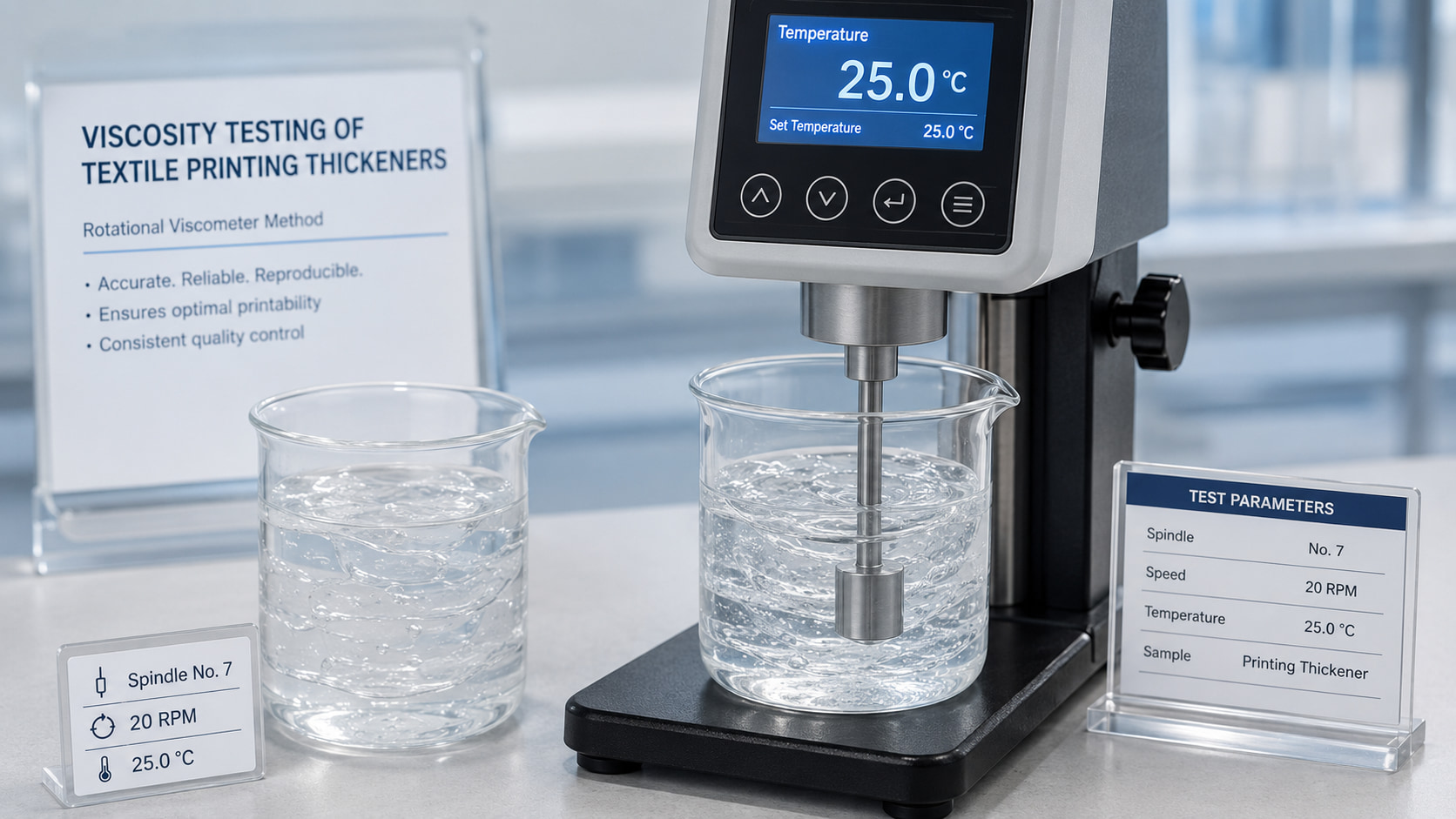
Ketahui mengapa nilai viskositas pengental dalam pencetakan tekstil tidak dapat dibandingkan tanpa menyesuaikan konsentrasi, suhu, alat ukur, spindel, kecepatan, metode persiapan, dan waktu pengujian.
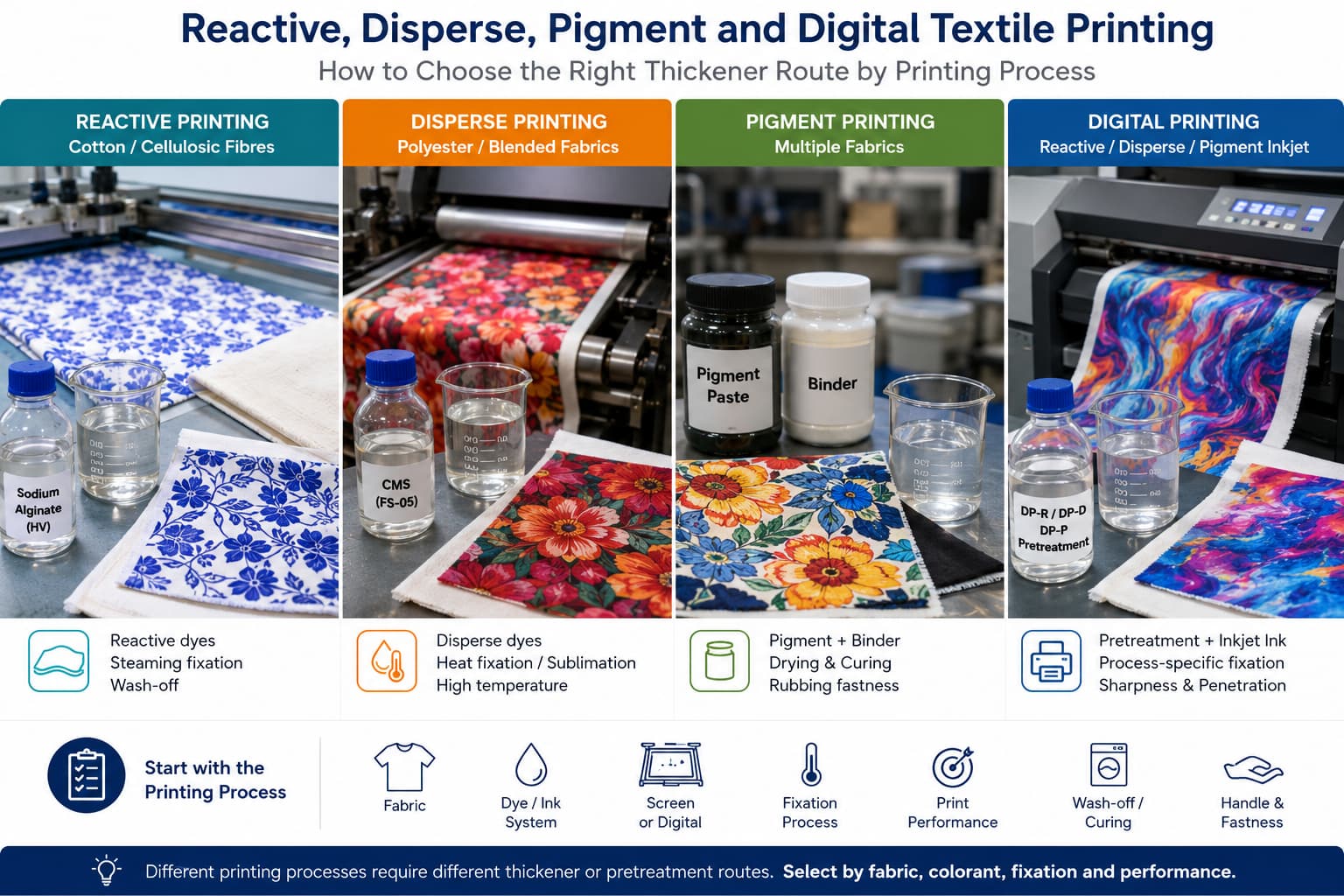
Pelajari cara memilih bahan pengental dan metode pra-perlakuan untuk pencetakan tekstil reaktif, disperse, pigmen, dan digital berdasarkan jenis kain, pewarna atau tinta, proses fiksasi, daya lepas saat pencucian, serta persyaratan kualitas cetakan.
Bandingkan CMC, CMS, natrium alginat, dan pasta cetak digital untuk pencetakan tekstil. Pelajari bagaimana masing-masing bahan tersebut sesuai dengan proses pencetakan reaktif, dispersi, pigmen, dan digital, serta hal-hal apa saja yang perlu diperhatikan pembeli sebelum melakukan pengujian sampel, penyesuaian kualitas, dan pembelian dalam jumlah besar.
Natrium alginat banyak digunakan dalam pencetakan tekstil sebagai pengental yang stabil dan mudah dihilangkan saat pencucian untuk pasta cetak reaktif. Pelajari cara mengevaluasi grade viskositas, kemurnian, dan kesesuaian aplikasi sebelum membeli, serta cara FSX Chemical mendukung pembeli global dengan data teknis dan sampel.
Baik natrium alginat maupun CMC digunakan sebagai pengental dalam pencetakan tekstil, namun keduanya cocok untuk sistem pewarnaan dan kondisi proses yang berbeda. Panduan ini menjelaskan perbedaan utama di antara keduanya serta kapan masing-masing harus digunakan.
Pencetakan inkjet digital pada tekstil memiliki persyaratan pasta dan pra-perlakuan yang berbeda dibandingkan dengan pencetakan sablon. Panduan ini menjelaskan bagaimana natrium alginat digunakan dalam pencetakan tekstil digital serta parameter kualitas apa saja yang harus ditentukan oleh tim pengadaan.
Persiapan pasta yang tepat sama pentingnya dengan pemilihan grade dalam pencetakan tekstil dengan zat warna reaktif. Panduan ini membahas metode pelarutan natrium alginat, rentang konsentrasi berdasarkan aplikasi, kondisi penyimpanan, dan pemecahan masalah persiapan yang umum.
Assess sodium alginate in reactive-printing wastewater using measured COD load, product-specific biodegradation evidence and controlled process comparisons. Includes a buyer checklist and illustrative load calculation.
Tingkat fiksasi pewarna secara langsung memengaruhi hasil warna, ketahanan luntur saat dicuci, dan beban limbah cair dalam proses pencetakan dengan pewarna reaktif. Panduan ini menjelaskan bagaimana natrium alginat mendukung proses fiksasi pewarna, parameter pasta apa saja yang memengaruhi tingkat fiksasi, serta cara mengatasi masalah fiksasi rendah dalam proses produksi.
Ukuran partikel natrium alginat (mesh) memengaruhi seberapa cepat bubuk tersebut larut, seberapa merata proses hidrasinya, serta bagaimana kinerja pasta yang dihasilkan dalam proses sablon. Panduan ini menjelaskan implikasi praktis dari spesifikasi mesh untuk aplikasi pasta cetak tekstil.
Evaluate sodium alginate for warp sizing through grade-specific bath, yarn and desizing trials. Compare dry size add-on, yarn protection and removal using appropriate residue methods and downstream fabric checks.
Spesifikasi kemurnian natrium alginat tidak hanya mencakup satu angka saja. Panduan ini menjelaskan arti dari kandungan aktif, NaCl, zat tak larut, dan data logam berat bagi kinerja pasta cetak tekstil — serta kapan kemurnian yang lebih tinggi layak ditentukan daripada tingkat kemurnian standar industri.
Berikan nama produk, kegunaan, jumlah, tujuan pengiriman, serta TDS,
foto sampel, atau dokumen lain yang sudah Anda miliki. FSX Chemical akan meninjau
informasi tersebut dan merekomendasikan langkah selanjutnya terkait penawaran harga, pencocokan sampel,
atau pemilihan produk.
Informasi ProdukNama produk, grade, model, foto label, atau referensi pemasok.
Dokumen yang TersediaTDS, SDS, COA, foto sampel, daftar produk, atau data pengujian.
Rincian PesananPerkiraan jumlah, kemasan, negara tujuan, pelabuhan, atau syarat perdagangan.
Aplikasi atau KendalaProses pencetakan tekstil, kebutuhan formulasi, masalah terkini, atau target kinerja.