Select an FSX CMS printing thickener by the exact commercial grade, dye system and printing route. Confirm preparation, complete-paste rheology, application and finished-fabric results before comparing cost. FSX CMS is a commercial synthetic printing-thickener family; generic carboxymethyl-starch chemistry does not define its composition or authorize sizing, finishing or digital uses.
Generic CMS Chemistry and FSX Commercial Grades
Carboxymethyl starch is a chemically modified starch described in technical literature. Its degree of substitution belongs to that identified chemistry and a stated measurement method. It should not be used as a default composition or DS specification for the FSX CMS synthetic printing-thickener family.
Use the quoted commercial code, current grade-specific TDS, applicable SDS and sample identifier to establish which material is under review. Confirm its intended printing route and preparation method before selecting test conditions. A shared abbreviation is not an application approval.
Reference: original research on carboxymethyl-starch substitution measurements; the research concerns defined starch derivatives and does not identify an FSX commercial grade.
Commercial printing grades can differ in supplied form, preparation, viscosity response and formulation compatibility. A label such as CMS does not establish equivalent polymer chemistry, active content or performance. Keep the current product document and sample record together when comparing candidates.
Start with one intended printing process. Record whether the candidate is supplied as a powder or liquid and whether dosage is stated as supplied product, stock paste or final working-paste concentration. Use the grade-specific preparation and test method rather than borrowing a starch or CMC specification.
The practical decision is whether a candidate meets the same agreed finished-print requirements as the reference at an acceptable total cost in use. Keep technical acceptance, dosage optimization and commercial approval as separate recorded decisions.
Match the Candidate to One Printing Route
| Route under evaluation | Check before the trial | Finished-result gate |
|---|
| რეაქტიული სკრინპრინტი | Exact grade, dye, alkali and electrolyte compatibility in the complete working paste. | Definition, penetration, color response, required fixation, wash-off and handle. |
| Pigment screen printing | Exact grade, pigment dispersion, binder, auxiliaries and complete-paste stability. | Transfer, cure under the binder system’s specified conditions, dry and wet rubbing and handle. |
| Other screen-printing route or fabric pretreatment | Written grade-specific intended-use information and a process-specific trial plan. | Approval in that actual route; a screen-paste trial does not approve an inkjet ink ingredient. |
These are proposed approval gates, not a statement that every FSX CMS grade is suitable for every route. Obtain the specific candidate recommendation before testing.
Application 1: Reactive Textile Printing
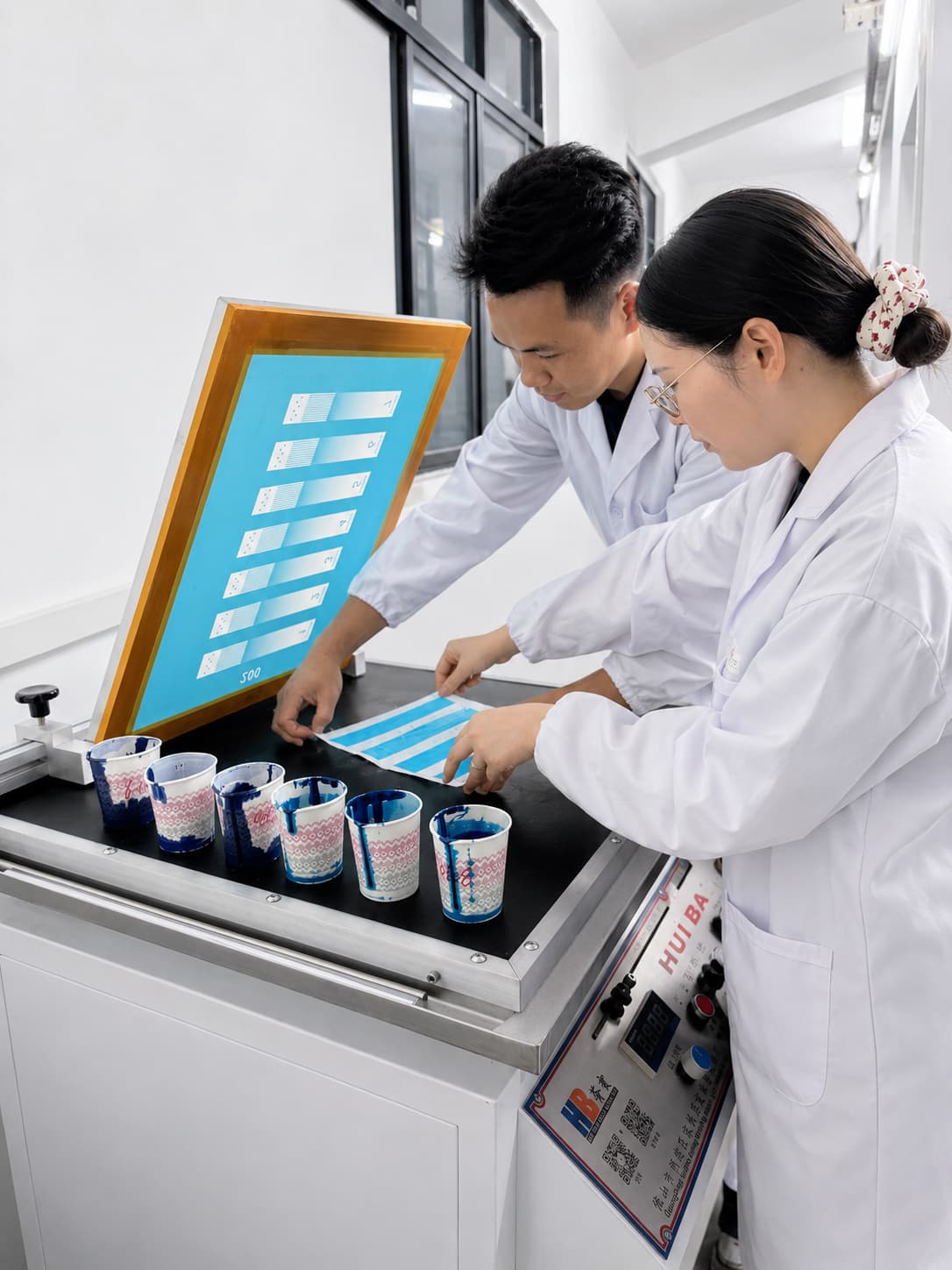
For a grade specifically proposed for reactive screen printing, evaluate the thickener in the complete dye-and-auxiliary paste through preparation, screen transfer, fixation and wash-off. The commercial range name alone does not qualify the candidate for this route.
A suitable printing thickener must do more than create a high viscosity. It must provide appropriate flow under printing shear, support design definition, remain compatible with the dye and alkali system and be removable during post-treatment.
CMS as a primary thickener
Selected CMS grades can be evaluated as the primary thickening material in a reactive printing formulation. Their performance depends on the identified grade, preparation, supplied-product dose, complete-paste rheology, electrolyte response and interaction with the dye system.
A grade that gives an acceptable viscosity in water may still behave differently after reactive dye, alkali, urea, salt or other auxiliaries are added. Final selection must therefore be based on the complete printing formulation.
Important reactive-printing checks
- Powder dispersion and hydration time, where applicable to the supplied form
- Viscosity before and after all auxiliaries are added
- Response to salts, alkali and process-water hardness
- Flow through the selected rotary or flat screen
- Outline definition and penetration
- Color response after fixation
- Wash-off and residual thickener behavior
- Fabric handle after post-treatment
CMS should not be treated as a universal alginate replacement
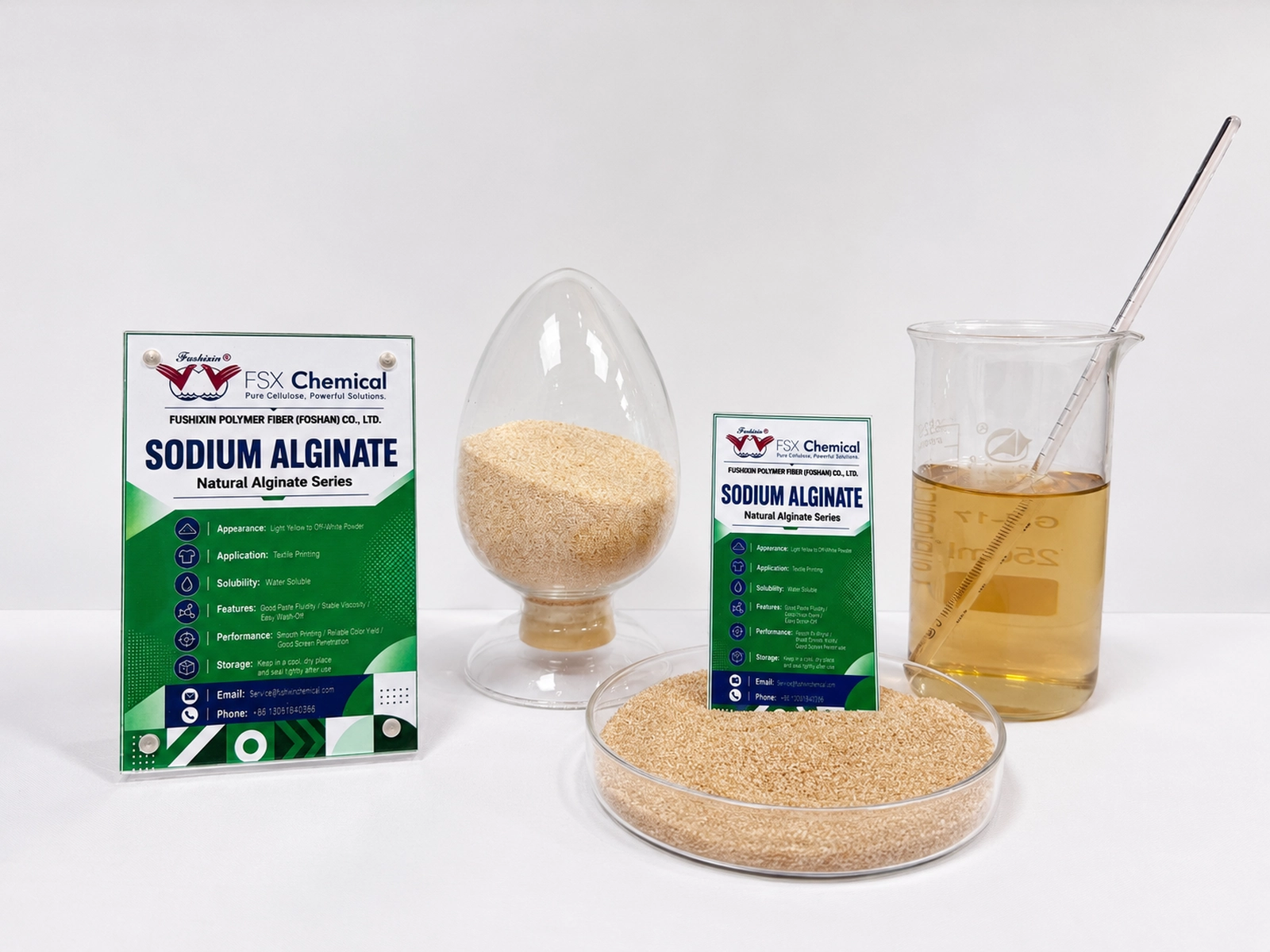
Sodium alginate remains an important reference thickener for many reactive printing systems. CMS may be suitable as an alternative or formulation component in selected processes, but it should not be described as a universal one-to-one replacement.
Buyers comparing CMS with ნატრიუმის ალგინატი should test equal and optimized dosages, rheology, color response, wash-off and cost in use before making a commercial decision.
Application 2: Pigment Printing
Pigment printing paste normally contains pigment dispersion, binder, thickener and selected auxiliaries. In this system, CMS may be evaluated as a rheology-control component rather than simply as a viscosity builder.
The printing paste must transfer consistently, maintain pattern definition and allow the binder system to form an acceptable film after curing. Thickener selection can influence machine behavior, print surface and fabric handle.
Compatibility with the binder system
Pigment binders, crosslinkers, defoamers and wetting agents may interact with the thickener. A CMS grade that performs well in water should therefore be tested again in the full binder-containing formulation.
Observe whether the paste shows delayed thickening, thinning, separation, excessive foam or instability after storage.
Film and handle considerations
A pigment-printing thickener should support the application process without creating unnecessary residue or an excessively rigid surface. Final fabric handle depends on the thickener, binder level, curing process, pigment concentration and finishing conditions.
Application-specific evaluation
- Paste stability with the selected binder
- Rheology at printing-machine shear conditions
- Screen release and transfer
- Pattern edge definition
- Surface uniformity
- Dry and wet rubbing performance
- Fabric handle after curing
- Cleaning and paste-removal requirements
Application 3: Blended Thickener Systems
An important modern use of CMS is as one component of a blended thickener system. Blending allows formulators to combine different polymer characteristics instead of expecting one material to provide every required property.
An identified CMS candidate may be evaluated with a starch derivative, cellulose ether, natural gum, alginate or another rheology modifier. The purpose of the blend should be defined clearly before laboratory development begins.
- Adjust low-shear and high-shear viscosity
- Improve paste body without excessive solids
- Modify screen passage and structural recovery
- Balance hydration speed and storage stability
- Improve compatibility with dyes, pigments or binders
- Adjust wash-off or film behavior
- Optimize total formulation cost
Blending is not simple dilution
The performance of a polymer blend cannot always be calculated by averaging the properties of its individual components. Interactions between polymers, salts, surfactants and other ingredients can change viscosity and rheology.
Each blend ratio should therefore be prepared and evaluated under the same concentration, water, mixing, temperature and resting conditions.
CMS and CMC combinations
An identified FSX CMS grade may be evaluated with CMC when the formulator has a defined blend objective. Record the exact grades, addition sequence, ratio and final concentration; compare the complete blend against its intended reference. Do not infer starch-based film properties from the FSX range name.
The result depends on the grades selected and their ratio. A CMS range name and a CMC chemical name do not establish equivalent chemistry or interchangeability.
Application 4: Digital Fabric Pretreatment Requires Separate Approval
Digital textile printing often uses a pretreatment layer to control how ink interacts with the fabric. Depending on the ink chemistry and application route, the pretreatment may need to manage wetting, penetration, fixation chemicals and coating uniformity.
Evaluate a digital fabric-pretreatment candidate only after the supplier identifies the exact product and its intended application method. A commercial screen-printing thickener is not automatically the right candidate. Compare it with a dedicated pretreatment product where appropriate.
Possible roles in digital pretreatment
- Adjustment of pretreatment viscosity
- Control of coating or padding uniformity
- Reduction of uncontrolled liquid penetration
- Support for fixation chemicals in the pretreatment layer
- Modification of the dried pretreatment film
Match Filtration to Fabric-Application Equipment
A product used near inkjet systems may require tighter control of insoluble particles, gel residues and contamination than a conventional screen-printing paste. Define filtration against the fabric-application equipment and residue risk for the approved pretreatment route.
CMS should not be placed directly into an ink formulation unless the complete ink and printhead system has been specifically developed and validated for that use.
Digital pretreatment tests
- Solution or dispersion uniformity
- ფილტრაცია და ნარჩენი
- Coating or padding stability
- Fabric wetting and penetration
- Drying behavior
- Compatibility with fixation chemicals
- Printed outline and color response
- Fabric handle after printing and washing
- Storage stability of the pretreatment
Buyers developing digital pretreatments may also compare CMS with a dedicated ციფრული ბეჭდვის პასტა designed for the intended fabric and printing route.
Key CMS Parameters That Affect Textile Performance
A CMS grade should be evaluated through both specification data and application testing. Select the relevant parameters for the exact printing grade, supplied form and intended application.
Grade Identity and Applicable Structural Parameters
For generic carboxymethyl starch, DS describes substitution on the starch structure and requires a defined measurement method. This chemistry does not provide a DS specification for an unspecified FSX CMS printing grade.
For the FSX synthetic CMS family, first request the exact grade identity and its applicable specifications. Assess a structural parameter only when that parameter is defined for the supplied material.
Viscosity and test method
Viscosity should always be reported together with the product concentration, water source, preparation method, hydration time, temperature, instrument, spindle and rotational speed.
Two viscosity values should not be treated as equivalent when their test methods are different.
Rheological behavior
Printing and coating systems experience changing shear conditions. Apparent viscosity at one speed does not fully describe screen passage, pumping, coating or recovery after application.
Where rheology is critical, compare the reference and candidate at multiple test speeds and in an actual application trial.
Purity and residual salts
Residual salts and by-products may affect solution clarity, electrolyte level and compatibility with dyes or other ingredients. The required purity should be based on application performance rather than an unsupported absolute claim.
Moisture and active-product basis
For a powder, moisture changes the relationship between as-supplied product mass and dry matter. A liquid may need a grade-specific non-volatile-content check. Dry matter is not automatically active polymer; state the supplied-product, dry-matter or declared active-content basis used for dose and cost.
Particle size and hydration
Particle size can influence dusting, wetting, lump formation and hydration speed. A fast-hydrating powder still requires a suitable addition rate and mixing pattern.
pH and chemical compatibility
The pH of the CMS solution and the complete formulation should be checked. Alkali, salts, binders, surfactants and other auxiliaries may change the final viscosity or stability.
Filtration and insoluble residue
Filtration is important for fine screens, coating equipment and digital pretreatment systems. The acceptable residue level depends on the process and equipment sensitivity.
How to Select a CMS Grade for Textile Applications
Grade selection should begin with the application rather than a supplier’s general product list. A clear technical request helps the supplier select a suitable starting grade and reduces unnecessary sample testing.
Step 1: Define the textile process
- Reactive, pigment or another printing system
- Exact printing or fabric-pretreatment route under evaluation
- Digital pretreatment or specialty printing
- Fabric, fibre or yarn composition
- Laboratory, pilot or production-scale equipment
Step 2: Define the required function
- Primary viscosity development
- Rheology adjustment within a blend
- Complete-paste application and finished-print requirements
- Coating uniformity
- Improved preparation or hydration behavior
- Cost-in-use optimization
Step 3: Provide the current reference
Where possible, provide the current product name, TDS, viscosity method, dosage, preparation procedure and representative sample. Explain which performance must remain unchanged and which problem should be improved.
Step 4: Request grade-specific documents
- მიმდინარე TDS
- მიმდინარე SDS
- Permanent product and grade code
- Viscosity range and complete method
- Applicable grade-specific structural or composition information
- Moisture and pH specification
- Recommended preparation procedure
- Recommended application scope
- Batch COA parameters
Step 5: Compare cost in use
Do not compare CMS grades by price per kilogram alone. Include the dosage required, grade-specific preparation, mixing energy, filtration, machine behavior, required post-treatment and production consistency.
Recommended Laboratory and Production Tests
CMS approval should move from simple screening to the complete application. A product should not be approved from a TDS or water-viscosity test alone.
Basic laboratory screening
- Powder appearance and package condition
- დისპერსია და გროვების წარმოქმნა
- ჰიდრატაციის დრო
- Viscosity under the agreed method
- pH and solution appearance
- Filtration or screen residue
- Stability after the normal resting period
Printing-paste evaluation
- Full-formulation viscosity
- Electrolyte and alkali tolerance
- Paste stability over time
- Screen passage and transfer
- Print definition and penetration
- Color response after fixation
- Wash-off and final fabric handle
Sample-to-bulk verification
Once a sample is approved, confirm that the commercial order uses the same permanent grade code and agreed specification. Test the first commercial batch before releasing the entire shipment to production.
Common CMS Selection Mistakes
Selecting by chemical name alone
A generic chemical name or commercial range label does not identify all grade-specific preparation, rheology or application-performance requirements.
Assuming the highest viscosity grade is best
Excessive viscosity can create mixing, filtration, pumping, screen or coating problems. The target should be application performance rather than the highest possible number.
Comparing viscosity values from different methods
Concentration, temperature, hydration time, instrument and speed must be the same before two viscosity results can be compared meaningfully.
Testing only in water
Dyes, pigments, binders, salts, alkalis and auxiliaries can change CMS viscosity and stability. The complete formulation must be tested.
Treating CMS as a universal replacement
CMS cannot be assumed to replace sodium alginate, CMC, PVA or a synthetic thickener at the same dosage without application testing.
Transferring Approval Between Different Processes
Printing paste and warp sizing require different rheological and film properties. A grade approved for one process may be unsuitable for the other.
Approving the sample without locking the grade code
The sample, TDS, quotation, purchase order, package label and COA should refer to the same permanent commercial grade.
CMS Paste Preparation: A Controlled Starting Method
- Confirm whether the candidate is supplied as a powder or liquid, its dosage basis and the water conditions specified for preparation.
- Follow the grade-specific powder dispersion or liquid dilution/activation instructions. For a powder, control the feeding point and addition rate to avoid lumps.
- Keep mixing speed, shear and temperature consistent between samples; excessive shear or heat can make grade comparisons unreliable.
- Allow the specified preparation or hydration stage to finish before final adjustment; record the elapsed time before measurement.
- Measure viscosity after a defined rest using the same instrument, spindle, speed and temperature, then check filtration and the complete printing formulation.
This is a comparison framework rather than a universal recipe. Actual concentration, mixing time and order of addition must be confirmed for the commercial grade, water system and factory equipment.
CMS for Textile Printing FAQ
Can CMS replace sodium alginate at the same dosage?
Not as a universal 1:1 replacement. CMS and sodium alginate differ in polymer structure, dye interaction, electrolyte response, rheology and wash-off. Compare them in the complete paste and printed fabric before changing the production dosage.
Which CMS specifications matter for grade selection?
Review the exact grade, product form, complete viscosity method, preparation, compatibility and filtration. Use powder moisture or particle size, liquid solids or other supplied-form checks only where defined for that grade. Request structural parameters only when applicable to the identified material; approve the candidate in the actual printing process.
Can one CMS grade be used for reactive, disperse and pigment printing?
Do not assume universal compatibility. Each route uses different dyes or pigments, auxiliaries, alkali or binder chemistry, fixation and washing conditions. A grade should be approved separately for the intended application.
How should CMS be qualified from sample to bulk order?
Lock the grade code and test method, compare the sample with the approved reference, run the complete formulation and fabric trial, then verify the first commercial batch against the same acceptance criteria. FSX can support a sample matching review using the buyer’s current product and process data.
How FSX Chemical Supports CMS Grade Matching
FSX Chemical lists process-specific grades on its printing thickener product page. Request documents for the exact commercial grade rather than assuming that every route has the same composition or specification.
Because CMS performance depends on the product grade and application, technical matching should begin with the customer’s process information rather than a general request for the lowest price or highest viscosity.
- Current product name, TDS or representative sample
- Dye or ink system, printing route and intended product application stage
- Fabric, fibre or yarn composition
- Dye, pigment, binder or auxiliary system
- Current dosage and preparation method
- Target viscosity and complete test procedure
- Water quality and working temperature
- Main production issue
- Required packaging and order volume
Technical support may include
- Review of the customer’s existing TDS or sample
- Selection of a suitable candidate CMS grade
- Provision of relevant TDS and SDS documents
- Representative samples for laboratory evaluation
- Guidance for side-by-side preparation and testing
- Review of trial observations
- Batch documentation for the selected commercial grade📧 ელფოსტა: Service@fsxchemical.com
A proposed grade should be considered a starting point for evaluation, not an automatically approved replacement. Final approval should be based on the customer’s own controlled laboratory and production-relevant trials.