Disperse Direct Printing vs. Sublimation Transfer: What Changes in Textile Pretreatment?
Direct disperse printing and sublimation transfer use related dye chemistry but control the image on...
In direct disperse printing, liquid ink first reaches polyester fabric; in sublimation transfer it first reaches coated paper. This changes where spreading is controlled and which material or process should be investigated when a defect appears. Direct fabric pretreatment is selected where the ink system requires it; it should not automatically be added to a paper-transfer route. Compare the finished textile after each route’s specified heat treatment and any required cleaning.
Direct Disperse vs. Sublimation Transfer: What Is the Fundamental Difference?
Both routes are used to color polyester with disperse dyes, but the ink reaches the polyester in different ways.
Disperse Direct Printing
The disperse ink is jetted directly onto the polyester fabric.
A typical route may be:
Fabric Preparation → Pretreatment Where Required → Drying → Direct Inkjet Printing → Drying → Thermal Fixation → Cleaning/Washing Where Required → Finishing
The fabric itself receives the liquid ink droplets. Therefore, the fabric surface, pretreatment, absorbency, wetting and ink penetration directly influence image definition before fixation.
Paglilipat sa pamamagitan ng sublimasyon
The ink is first printed onto transfer paper, usually as a mirror image. The printed paper and polyester are then brought together under controlled heat and pressure.
A simplified route is:
Transfer Paper Printing → Drying → Paper/Fabric Contact → Heat Transfer / Sublimation → Separation → Finished Polyester
The liquid ink is controlled on the coated paper before the dye is transferred in vapor form into the polyester. This means the fabric does not normally require the same thickener-type pretreatment used to control aqueous ink droplets in direct disperse printing.
Why the Printing Route Changes the Pretreatment Requirement
Textile pretreatment should solve a specific process problem.
In direct printing, the immediate question is:
How do we stop a low-viscosity aqueous ink droplet from spreading too far across or through the polyester before fixation?
In sublimation transfer, the immediate question is different:
How do we hold the printed image accurately on transfer paper and then move the disperse dye efficiently into polyester under heat?
As a result, the key control surface changes:
Direct route: polyester fabric surface
Transfer route: coated transfer paper first, polyester during heat transfer second
This is why a request for “disperse digital printing paste” is incomplete unless the buyer states whether the process is direct-to-fabric or transfer printing.
What Pretreatment Does in Direct Disperse Printing
Polyester is relatively hydrophobic compared with cellulosic fibers. When an aqueous disperse ink is printed directly onto polyester, uncontrolled surface wetting and capillary movement can reduce image definition.
A direct-printing pretreatment may therefore be used to improve:
Ink localization
Talas ng gilid
Bleeding resistance
Penetration control
Solid-area uniformity
Pag-unlad ng kulay pagkatapos ng pagfi-fix
The pretreatment can create a temporary surface environment that changes how liquid ink behaves before the disperse dye is thermally fixed into the polyester.
Commercial systems may use polymeric thickener or film-forming components, wetting-control auxiliaries, dispersing or compatibility aids, and other process-specific additives.
The exact chemistry depends on ink type, polyester construction, printing machine and fixation route. It should not be assumed that one reactive digital pretreatment can simply be reused for disperse direct printing.
What Replaces Fabric Pretreatment in Sublimation Transfer?
In sublimation transfer, much of the image-control function moves from the fabric to the transfer paper.
The paper coating must manage:
Ink absorption
Pagpatuyo
Dot definition
Ink hold-out
Release during heat transfer
Therefore, transfer paper quality becomes a major part of the printing system.
The polyester itself still requires good preparation, but the requirements are different. Important fabric conditions include:
Clean surface
Low oil or silicone contamination
Stable dimensions under heat
Suitable whiteness/base shade
Consistent construction
No finish that interferes with dye transfer
In a conventional polyester sublimation-transfer route, a thickener pretreatment designed to stop aqueous ink bleeding on fabric is usually unnecessary because the liquid ink never contacts the textile during printing.
However, specialty coatings, unusual blends or nonstandard end uses may introduce additional fabric-treatment requirements.
Direct vs. Transfer: Practical Pretreatment Comparison
Process Area
Direct Disperse Printing
Paglilipat sa pamamagitan ng sublimasyon
Where ink is first printed
Polyester fabric
Coated transfer paper
Main image-control surface
Pretreated or engineered fabric surface
Transfer-paper coating
Fabric thickener pretreatment
Commonly evaluated in conventional direct routes
Normally not required for conventional transfer printing
Heat and pressure transfer dye from paper into polyester
Post-fixation washing
May be required depending on ink, pretreatment and process
Often reduced or unnecessary in conventional transfer sublimation
Main bleeding-control variable
Fabric/pretreatment/ink interaction
Paper coating/ink interaction
Waste stream
Pretreatment and possible wash/clearing load
Used transfer paper
The table describes typical industrial logic, not a universal rule for every ink or machine.
Fabric Preparation Before Each Route
Direct Disperse Printing
Before pretreatment or printing, polyester should be sufficiently clean and uniform. Residual spinning oil, knitting oil, silicone, finishing agents, dust or previous process residues can alter wetting and create local differences in ink spreading.
Because the liquid ink contacts the textile directly, surface cleanliness can strongly affect printing uniformity.
Paglilipat sa pamamagitan ng sublimasyon
Fabric cleanliness is still important, but the primary concern is often thermal-transfer consistency rather than liquid wetting.
Oil, silicone or unstable finishing chemicals can create uneven color transfer, staining, smoke or deposits during heat transfer, yellowing or local shade variation.
Thus, transfer printing does not eliminate fabric preparation; it changes what the preparation must accomplish.
Ink Spreading, Wicking and Image Sharpness
Direct disperse printing must control liquid ink on a textile structure before the dye is fixed.
Important variables include ink surface tension, ink viscosity, fabric wetting, pretreatment add-on, pretreatment rheology, fabric construction and residual moisture.
If the fabric cannot localize the droplet, possible defects include bleeding, soft fine lines, uneven solids and excess penetration.
This is one reason conventional direct disperse processes frequently evaluate a fabric pretreatment.
By contrast, sublimation transfer controls the liquid droplet on paper. The paper coating is therefore responsible for preserving dot shape, fine detail, color boundaries and drying behavior before the image is transferred to polyester.
Drying Requirements Before Fixation
Direct Printing
If a chemical pretreatment is used, the fabric normally requires controlled drying before printing unless the system is specifically designed for a wet-state route. After printing, additional drying may also be needed before thermal fixation.
Important controls include pretreatment pick-up, drying temperature, line speed, residual moisture and migration.
Paglilipat sa pamamagitan ng sublimasyon
The textile does not usually require a pretreatment drying step for image control. Instead, the printed transfer paper must be sufficiently dry and stable for handling and transfer.
Excess residual moisture in the paper can contribute to image instability, transfer variation, paper deformation and color inconsistency.
The drying burden therefore shifts from pretreated fabric to printed paper.
Thermal Fixation: What Changes Between the Routes?
Heat enables disperse dye transfer and diffusion into polyester, but the route by which the dye reaches and enters the fibre differs. Follow the ink and equipment supplier’s specified thermal process.
Direct Disperse Printing
After inkjet printing, the dye is fixed directly from the printed textile using an appropriate thermal process.
Depending on the ink system and equipment, this may involve dry heat, high-temperature steaming, thermosol-type processing or another supplier-specified fixation method.
The pretreatment must tolerate that heat without creating yellowing, residue, sticky deposits or fabric-hand problems.
Paglilipat sa pamamagitan ng sublimasyon
The printed paper and polyester are heated together under controlled contact and pressure. The disperse dye sublimates from the paper and diffuses into the polyester.
Critical variables include transfer temperature, dwell time, pressure/contact, paper/fabric alignment and polyester thermal stability.
The fixation step is therefore also the image-transfer step.
Washing and Clearing: Why the Requirement Can Differ
Direct disperse printing can leave surface dye, pretreatment polymer, auxiliary residue or unfixed disperse particles.
Depending on the ink and fixation process, washing or reduction clearing may be needed to achieve the required rubbing fastness, surface cleanliness, fabric hand and shade quality.
However, not every direct-disperse process uses the same post-treatment, so the requirement should be confirmed with the ink supplier and actual end use.
Conventional sublimation transfer often has a simpler post-transfer route because the carrier paper is separated after transfer and much of the non-transferred ink remains on the paper.
This is one reason transfer printing can be attractive for polyester products where a wash-free or low-wash route is commercially useful.
It should still not be described as universally “no wastewater” because fabric preparation, equipment cleaning and upstream processes remain relevant.
Why Transfer Paper Becomes a Critical Process Material
In sublimation transfer, paper quality is not a secondary packaging detail. It is a functional part of the print system.
Important paper properties include coating uniformity, ink absorption, drying speed, dimensional stability, release efficiency, cockling resistance and compatibility with the ink loading.
A low-quality or mismatched paper can create blurred printed dots, uneven transfer, color loss, ghosting and registration problems.
In practical terms, the transfer-paper coating performs part of the surface-control job that a fabric pretreatment performs in direct printing.
Which Pretreatment Properties Matter Most in Direct Printing?
A direct disperse pretreatment should be evaluated beyond one viscosity number.
Important properties include:
Dissolution or dispersion behavior
Natirang materyal sa pagsala
Wetting
Coating/padding uniformity
Rheolohiya
Drying behavior
Thermal stability
Bleeding control
Fabric hand
Same viscosity does not mean the same direct-printing performance.
A pretreatment that controls wet ink well but yellows during fixation is not acceptable. A pretreatment that gives sharp edges but leaves difficult residue after washing may also be unsuitable.
Final approval should therefore be based on the complete direct-printing process.
Polyester Construction, Weight and Finish
Not all polyester fabrics behave the same.
Direct printing should be validated separately when there are large changes in fabric weight, weave or knit structure, yarn type, surface texture, brushing or raising, stretch content or finishing treatment.
A pretreatment optimized for smooth woven polyester may not produce the same result on sports knit, flag fabric, velour, brushed polyester or highly open constructions.
In sublimation transfer, these construction differences can also change heat contact and transfer efficiency even if chemical pretreatment is not used.
What About Polyester Blends?
Disperse dyes have affinity for polyester, not for untreated cotton or other cellulosic fibers in the same way.
With sublimation transfer, the polyester component receives the disperse dye while the non-polyester component may remain lighter or uncolored unless additional chemistry or a specialty coating is used.
With direct disperse printing, the same fiber-affinity limitation still applies.
Before recommending a pretreatment, provide the exact fiber composition, desired appearance, whether both fiber components must be colored, fixation equipment and required fastness.
A polyester/cotton blend should not automatically be treated as “polyester fabric” for product selection.
Can Direct Disperse Printing Work Without Chemical Pretreatment?
Yes, under selected technologies.
Recent research has developed direct disperse inks that change their rheological behavior on the polyester surface and suppress bleeding without a conventional fabric pretreatment.
A 2024 study reported a thermosensitive disperse ink for direct printing on untreated polyester under its stated conditions. It is evidence for that engineered ink system, not approval to remove pretreatment from a conventional production ink.
This is important because it shows that the function traditionally assigned to fabric pretreatment can, in some systems, be engineered into the ink.
However, this does not mean conventional mills should simply remove their existing pretreatment.
The correct interpretation is:
Conventional direct disperse route → fabric/pretreatment controls ink
Special pretreatment-free route → engineered ink controls more of its own spreading behavior
These are different ink technologies and must be qualified separately.
How to Compare Direct and Transfer Routes in a Controlled Trial
Step 1: Define the End Product
Record polyester composition, fabric construction, end use, required color strength, required fastness and fabric hand.
Step 2: Define the Direct Route
Record disperse ink type, pretreatment where used, pretreatment pick-up, drying, thermal fixation and washing/clearing where required.
Step 3: Define the Transfer Route
Record sublimation ink, transfer paper, paper coating/type, heat-transfer equipment, temperature, dwell time and pressure/contact.
Step 4: Use Comparable Image Data
Use the same artwork and similar color targets where practical.
Step 5: Evaluate Finished Fabric
Compare color strength, fine-line definition, solid-area uniformity, penetration, face/back difference, rubbing fastness, wash fastness and fabric hand.
Step 6: Compare Production Stability
Record machine speed, drying or transfer bottlenecks, cleaning, paper handling, pretreatment preparation and rejected fabric.
Step 7: Compare Total Cost in Use
Only after both routes are technically optimized should the mill compare commercial cost.
Find the First Surface on Which the Defect Appears
Retain labeled samples at the route’s actual inspection points. The sequence below narrows an investigation; it does not establish a root cause by appearance alone.
Inspection point
Observation
Next controlled comparison
Transfer paper before heat transfer
Lines or solids are already defective.
Check paper/ink compatibility, ink loading, drying and printer condition before blaming a fabric pretreatment.
Transfer paper is acceptable, but the transferred image changes
Ghosting, uneven shade or local transfer loss first appears on fabric.
Compare contact, paper/fabric movement, heat uniformity and fabric finish with unchanged image and materials. Assess used-paper appearance only as supporting evidence.
Direct print before fixation
Spreading or uneven coverage is already visible on the fabric.
Align fabric lot, ink and printing conditions; compare the documented pretreatment route where required, including add-on and drying.
Direct print changes only after fixation or required clearing
Edges, shade or rubbing result fail later in the route.
Separate the thermal step from cleaning using companion swatches. Check the specified post-treatment rather than assuming a liquid-wetting failure.
Keep transfer-paper and fabric-side chemicals at their documented application points. A coating intended for paper, a fabric pretreatment and a printhead ink are not interchangeable. Mimaki’s workflow comparison illustrates the different first-receiving surfaces; it does not qualify any FSX formulation or justify a universal no-wash rule.
Route-Specific Troubleshooting
Napansin na Problema
Direct Printing: First Checks
Transfer Printing: First Checks
Blurred edges
Pretreatment, fabric wetting, ink load, drying
Paper coating, paper drying, transfer movement
Low color strength
Ink load, fixation, pretreatment, fabric
Paper release, transfer temperature/time, polyester content
Uneven solids
Pretreatment uniformity, fabric surface, printer
Paper coating, heat/contact uniformity
Fabric yellowing
Pretreatment thermal stability, fixation temperature
Fabric finish, transfer heat exposure
Poor rubbing fastness
Surface dye, fixation, clearing/washing
Transfer conditions, polyester compatibility, contamination
Ghosting/double image
Fabric movement during fixation if applicable
Paper/fabric movement during heat transfer
Paano Ihambing ang Kabuuang Gastos sa Paggamit
Do not compare direct and transfer routes from ink price alone.
Direct Printing Cost Variables
Fabric pretreatment
Pretreatment labor
Enerhiya sa pagpapatuyo
Ink
Thermal fixation
Washing/clearing where required
Wastewater where relevant
Rejected fabric
Transfer Printing Cost Variables
Sublimation ink
Transfer paper
Paper printing/drying
Heat-transfer energy
Paper waste handling
Rejected transfer paper
Rejected fabric
Define the accounting boundary and compare cost per accepted fabric area. Use one currency; allocate paper, ink and pretreatment to mutually exclusive material categories rather than counting them again under a general consumables total.
Route cost per accepted m² = total in-scope route cost ÷ accepted finished-fabric area. Include each material, energy, labour, post-treatment and waste-handling cost once. Record rejected paper and fabric in the appropriate cost total; do not add their original material cost again if already counted. Compare equivalent fabric and finished-print acceptance requirements.
Neither route is universally cheaper or more sustainable.
Transfer consumes paper but can simplify fabric chemistry and post-treatment. Direct printing can remove transfer paper but may require fabric pretreatment and additional cleaning or washing.
The best route depends on the product mix, equipment, quality requirement and production scale.
What Information Should You Send to a Chemical Supplier?
If you are looking for a disperse digital printing pretreatment, first identify the route.
For direct printing, send:
Polyester fiber composition
Fabric construction and weight
Disperse ink type or brand
Current pretreatment or TDS
Current dosage or pick-up
Viscosity and test method
Application method
Drying conditions
Printer type
Thermal fixation method
Washing/clearing route where used
Current bleeding, color, hand or residue problem
For sublimation transfer, the more relevant information is polyester composition, transfer ink, transfer paper, heat-transfer equipment, temperature/time/pressure conditions and the current color or transfer problem.
FSX Chemical can use the direct-printing information through Mga Halimbawa at Pagtutugma to determine whether a disperse pretreatment candidate is technically relevant.
Which Route Should You Choose?
The correct decision chain is:
Fabric → End Use → Ink Chemistry → Direct or Transfer Route → Pretreatment/Paper System → Thermal Process → Finished Fabric → Total Cost in Use
Direct disperse and sublimation transfer use related dye chemistry but different image-control surfaces.
Direct printing commonly evaluates fabric pretreatment because liquid ink contacts the textile.
Sublimation transfer moves much of the image-control function to coated transfer paper.
Fabric cleanliness and thermal stability remain important in both routes.
Special pretreatment-free direct inks exist, but they are separate engineered ink technologies.
Compare routes by finished-fabric quality and Total Cost in Use, not by one consumable price.
Madalas Itanong na Mga Tanong
1. What is the difference between direct disperse printing and sublimation transfer?
Direct disperse printing jets ink directly onto polyester fabric. Sublimation transfer prints the image onto transfer paper first and then transfers the dye into polyester using heat and pressure.
2. Does direct disperse printing need fabric pretreatment?
Many conventional direct routes evaluate pretreatment to control ink spreading and penetration. However, specialty pretreatment-free inks have also been developed, so the requirement depends on the ink technology.
3. Does sublimation transfer need the same fabric pretreatment?
Normally no. The liquid ink is controlled on coated transfer paper rather than on the fabric. Fabric cleanliness, heat stability and finish compatibility still matter.
4. Why is transfer paper important?
Its coating controls ink absorption, dot definition, drying and dye release during heat transfer. It performs part of the image-control function that fabric pretreatment performs in direct printing.
5. Can I use a reactive digital pretreatment for direct disperse printing?
It should not be assumed. Reactive and disperse systems use different fabrics, ink chemistry and fixation conditions. A candidate should be validated specifically for polyester direct printing.
6. Why does direct disperse printing bleed?
Possible causes include insufficient pretreatment control, unsuitable fabric wetting, excessive ink loading, residual moisture or an ink/fabric mismatch.
7. Does sublimation transfer require washing?
Conventional transfer sublimation often avoids the same wash-off route needed in some direct disperse processes, but the exact process depends on fabric preparation and end-use requirements.
8. Does direct disperse printing require washing?
Some direct routes require washing or clearing to remove surface dye, pretreatment or unfixed material, while others use different post-treatment strategies. Confirm the route with the ink and process supplier.
9. Which route gives sharper printing?
Either route can produce high-definition results when optimized. Direct printing depends strongly on fabric/pretreatment/ink interaction, while transfer depends strongly on paper, ink and heat-transfer control.
10. Which route is more sustainable?
There is no universal answer. Transfer uses disposable paper but may simplify fabric pretreatment and washing. Direct removes transfer paper but may add pretreatment, drying and post-treatment.
11. Can sublimation transfer print polyester/cotton blends?
The disperse dye primarily colors the polyester component. If the non-polyester component also needs color, a different or combined technology may be required.
12. What information should I send FSX Chemical for a disperse pretreatment recommendation?
State clearly that the process is direct-to-fabric, then send the polyester construction, disperse ink, current pretreatment, pick-up, drying, fixation and current printing problem.
Match the Correct Disperse Digital Printing Route with FSX Chemical
If you are evaluating a disperse digital printing pretreatment, the first question should be whether your process is direct-to-fabric or sublimation transfer.
For direct disperse printing, send:
Polyester composition and construction
Timbang ng tela
Disperse ink brand or type
Current pretreatment or TDS
Pretreatment dosage and pick-up
Viscosity and test method
Application and drying conditions
Printer type
Thermal fixation process
Washing/clearing conditions where used
Current bleeding, color, hand or residue target
Magsimula sa Mga Halimbawa at Pagtutugma to determine whether a direct-disperse pretreatment candidate is relevant to your production route.
Direct disperse printing and sublimation transfer should not be treated as two versions of the same pretreatment process. The printing route determines where liquid ink is controlled, what material performs the image-control function, and which chemical or paper system should be evaluated.
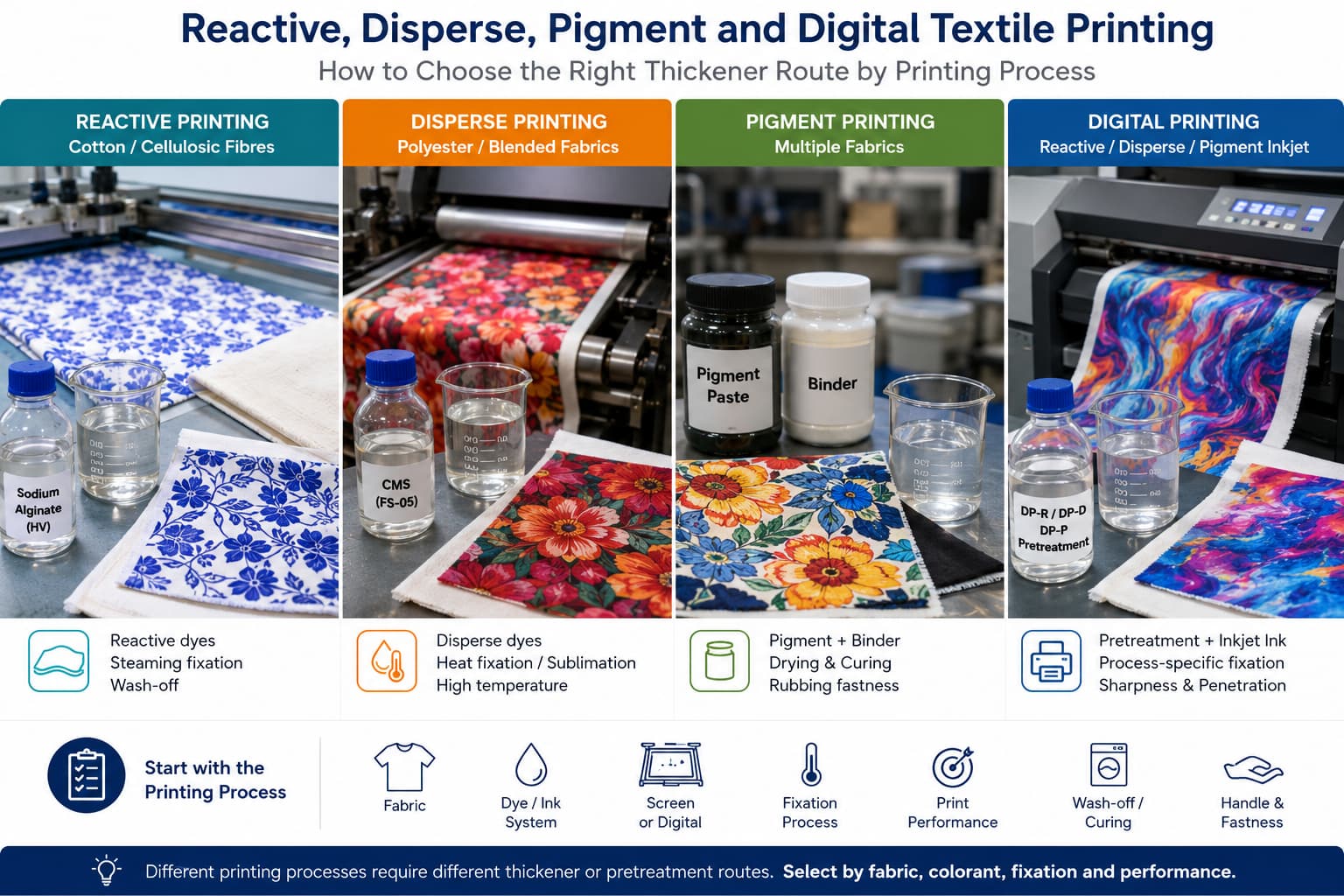
Matutong pumili ng pampatigas at mga paraan ng paunang paggamot para sa reaktibo, disperse, pigment, at digital na pagpi-print sa tela batay sa tela, tina o tinta, fiksasyon, paghuhugas, at mga kinakailangan sa kalidad ng pagpi-print.
The best digital printing paste is the one matched to the ink chemistry, fabric and fixation route. This guide compares pretreatment requirements for reactive inkjet on cellulosic fabrics and direct disperse inkjet on polyester, then explains how buyers should evaluate samples before bulk purchasing.
An FSX-authored guide to checking digital pretreatment fit, trial evidence, product documents and sample-to-bulk traceability before supplier approval.
Viscosity control in digital textile printing is not about reaching one number. Reliable performance requires the right pretreatment rheology, test method, temperature, chemical compatibility, filtration, fabric pickup and holding stability.
Carboxymethyl starch can play an important role in cost-effective textile printing when viscosity efficiency, formulation compatibility, preparation, machine performance and finished-fabric quality are evaluated together.
Evaluate FSX fabric pretreatment by confirmed grade, ink route, application architecture and measured add-on. Compare DG-20 or DP-P in a defined trial, and qualify any disperse candidate separately.
Digital textile printing requires more than advanced ink and printheads. Explore process-specific chemical solutions for reactive, disperse and pigment inkjet printing, from pretreatment and rheology to filtration, fixation and production validation.
CMC, CMS and sodium alginate can all thicken textile printing systems, but their chemistry, rheology, hydration, dye compatibility and application behavior differ significantly.
The cheapest textile printing thickener is not necessarily the lowest-cost option in production. This guide compares sodium alginate, CMC and CMS through effective dosage, rheology, print quality, process compatibility and total cost in use.
A top-performing digital printing paste is not defined by viscosity alone. Reactive, disperse and pigment textile inks require different pretreatment chemistry, rheology and post-treatment conditions. This guide explains how to select digital printing pastes by ink system, fabric, print definition, color performance, fixation and total production performance.
Five illustrative workflows for evaluating textile thickeners and digital pretreatments, with controlled trials, acceptance criteria, total cost and sample-to-bulk traceability. These are not documented customer case studies.
Choosing a digital printing paste for eco-friendly textile printing requires more than selecting a product described as natural or low dosage. The correct comparison should include effective dosage, waste, printing stability, drying, fixation, washing and finished-fabric quality.
Ibahagi ang pangalan ng produkto, aplikasyon, dami, destinasyon, at anumang TDS, larawan ng sample o dokumento na mayroon ka na. Susuriin ng FSX Chemical ang impormasyon at irekomenda ang susunod na hakbang para sa quotation, pagtutugma ng sample, o pagpili ng produkto.
Impormasyon ng ProduktoPangalan ng produkto, grado, modelo, larawan sa etiketa o sanggunian ng tagapagtustos.
Magagamit na mga dokumentoTDS, SDS, COA, larawan ng sample, listahan ng produkto o datos ng pagsubok.
Mga Detalye ng OrderTinatayang dami, pag-iimpake, bansang patutunguhan, pantalan o termino sa kalakalan.
Aplikasyon o IsyuProseso ng pagpi-print sa tela, pangangailangan sa pormulasyon, kasalukuyang isyu o target na pagganap.