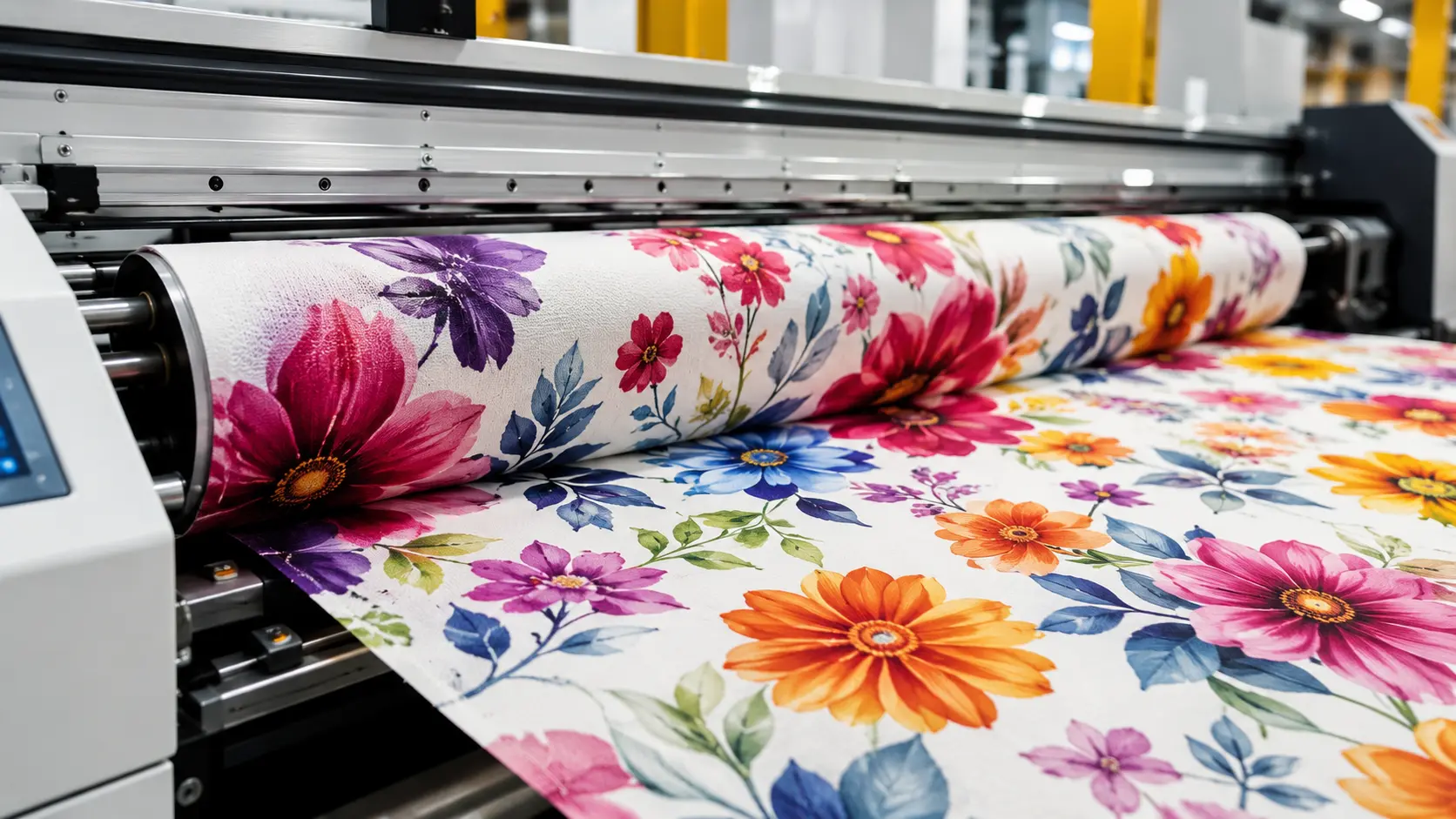
Pag-aalis at Paglilinis ng Residu Pagkatapos ng Direktang Pagkakalat sa Digital na Pagpi-print: Paano Nakakaapekto ang Residu ng Paunang Pagproseso sa Paghuhugas at Panghuling Kalidad ng Ibabaw
Reduction clearing after direct disperse digital printing does more than remove visible surface dye. The...
Ang paglilinis sa pamamagitan ng pagbabawas pagkatapos ng direktang digital na pagpi-print ng disperse ay hindi lamang nag-aalis ng nakikitang kulay sa ibabaw. Maaaring naglalaman din ang huling ibabaw ng polyester ng pretreatment polymer, mga ahenteng nagpapakalat, mga sangkap na nagpapabasa, mga asin, at iba pang mga pantulong na inilapat bago mag-print o dala ng tinta. Hindi pareho ang tugon ng mga natitirang ito sa iisang mekanismo ng paghuhugas. Ang tradisyunal na alkaline reduction clearing ay partikular na epektibo sa pagwasak o paglusaw ng hindi nakapirming disperse na tina sa ibabaw, samantalang ang mga pretreatment polymer ay karaniwang kailangang alisin sa pamamagitan ng kanilang sariling solubilidad sa tubig, pag-iigting, dispersiyon, at mekanikal na paghuhugas. Kung masyadong mataas ang idinagdag na pretreatment, na-termally change, mahirap tanggalin sa tubig, o hindi pantay ang pagkakatapak, maaaring manatili sa tapos na tela ang makapal na pakiramdam, kalabuan, paghila sa ibabaw, o hindi pantay na pagkiskis kahit na mukhang katanggap-tanggap ang lakas ng kulay. Kaya naman, ang huling pag-apruba sa proseso ay dapat na tasahin nang hiwalay ang pagtanggal ng kulay sa ibabaw at ang pagtanggal ng mga natirang sangkap ng pretreatment.
Why Does Pretreatment Residue Matter During Reduction Clearing?
After direct disperse inkjet printing and thermofixation, the polyester surface can contain more than disperse dye.
Possible residual materials include:
Unfixed / surface disperse dye
Pretreatment polymer
Dispersing agents
Mga ahente ng pagbabad
Salts or ionic auxiliaries
Other formulation residues
These materials affect the final fabric in different ways.
This distinction should guide both troubleshooting and process design.
1. Unfixed / Surface Disperse Dye
Disperse dye that successfully diffuses into polyester is relatively protected inside the hydrophobic polymer matrix.
Excess dye can remain:
On the fiber surface
Inside the pretreatment film
In oligomer / surface deposits
This surface dye can cause:
Low rubbing fastness
Staining
Dull or dirty shade
High wash-off load
Reduction clearing is particularly useful for removing this fraction.
2. Pretreatment Polymer Residue
Pretreatment polymer plays an important role before fixation:
Controls ink spreading
Improves edge definition
Changes surface localization
After fixation, however, a large part of this polymer is no longer needed on the final commercial surface.
Residual polymer can contribute to:
Coated hand
Surface drag
Haze
Reduced softness
Greater soil / lint retention in some systems
How easily it is removed depends on its chemistry and what happened to it during thermofixation.
3. Salts, Surfactants and Other Auxiliaries
Pretreatment and ink systems can also leave:
Dispersants
Surfactants
Mga asin
Humectant residue
Other water-soluble components
These materials can alter:
Surface feel
Wettability
Foaming during wash-off
Effluent load
They should be considered when the fabric feels different after one pretreatment even though dye fixation is similar.
Why Dye Removal and Polymer Removal Are Different Mechanisms
Surface disperse dye can be chemically changed by reduction clearing.
Pretreatment polymer usually relies more on:
Water penetration
Swelling
Pagkakalas
Dispersion
Mechanical removal
Therefore, a reduction bath that removes dye effectively may still leave polymer film if:
The polymer is poorly water-soluble.
The film is very thick.
The polymer has changed during heat fixation.
Liquor exchange is insufficient.
Likewise, a strong hot wash can remove much polymer but still leave enough surface dye to reduce rubbing fastness if the dye itself requires stronger reduction clearing.
How Traditional Reduction Clearing Works
Traditional reduction clearing uses alkaline reducing conditions to alter surface disperse dye so it becomes easier to remove from polyester.
Literature commonly describes alkaline sodium dithionite / sodium hydrosulfite systems with detergent or surfactant.
The exact:
Chemical concentration
Temperatura
Time
Liquor ratio
should be selected for the dye class, shade depth, equipment and environmental / safety requirements.
Do not copy one literature recipe as a universal direct-digital-printing wash-off condition.
Azo Disperse Dyes
Under conventional reduction-clearing conditions, azo disperse dyes at the surface can undergo reductive cleavage of the azo chromophore.
This destroys the original color-forming structure and produces more removable products.
The exact response depends on dye chemistry.
Anthraquinone-Type Disperse Dyes
Anthraquinone disperse dyes respond differently from azo dyes.
Reduction can generate low-substantivity / more water-removable reduced forms.
This is another reason reduction-clearing response can differ between colors or ink sets.
Do not assume that every CMYK color loses surface dye at the same rate.
Pretreatment Polymer Solubility Controls Wash-Off
For the polymer fraction, a critical question is:
What Happens When the Fixed Fabric Re-enters Water?
The polymer may:
Dissolve readily
Swell first and dissolve slowly
Disperse as fragments
Remain as a relatively persistent film
Therefore, polymer selection affects not only printing sharpness but also the post-fixation washing burden.
Sodium Alginate Residue
Sodium alginate is water-soluble and can be removed through hydration, swelling and washing when it remains in a soluble sodium form.
But washability can change if the alginate interacts strongly with multivalent ions or forms a less-soluble structure.
For alginate-containing disperse pretreatments, check:
Water hardness
Calcium / magnesium contamination
Film thickness
Thermal history
when wash-off becomes unexpectedly difficult.
CMC / CMS and Other Water-Soluble Polysaccharides
CMC, CMS and related water-soluble polysaccharides can provide migration control in selected textile pretreatment systems.
Their wash-off depends on:
Degree of substitution / polymer grade
Molecular weight
Electrolytes
Film concentration
Kalidad ng tubig
Do not assume that equal Brookfield viscosity means equal washability.
A polymer that provides strong surface hold can also require more efficient hydration and liquor exchange during washing.
PVA and Film-Forming Polymer Residue
PVA is used in some disperse inkjet research because of its film-forming and water-borne polymer properties.
Its final wash behavior depends strongly on:
Polymer grade
Hydrolysis level
Film thickness
Wash temperature
A continuous PVA-rich film can behave differently from a readily dissolving polysaccharide layer.
Therefore, a pretreatment that improves sharpness through stronger film formation should also be qualified for final washability and hand.
Synthetic / Compound Pretreatment Residue
Compound disperse pretreatments can contain:
Synthetic polymers
Cellulose derivatives
Polysaccharides
Surface-active components
The wash-off mechanism is therefore formulation-specific.
For a new product, evaluate:
Dry film after thermofixation
Water swelling
Detergent response
Final fabric hand
rather than assuming washability from the supplied-product viscosity.
Crosslinked or Thermally Changed Films
Some pretreatments contain reactive or crosslinkable components, or can undergo structural changes at fixation temperature.
These systems may become less water-removable after heat treatment.
If the same pretreatment washes easily before thermofixation but becomes difficult to remove afterward, check whether heat has:
Crosslinked the film
Changed polymer solubility
Increased adhesion to polyester
This behavior is product-specific and should be confirmed with the supplier.
Pretreatment Add-On: Why More Surface Polymer Means More Washing Load
Higher polymer add-on can improve pre-fixation print sharpness.
But it also means more polymer must be removed or tolerated after fixation.
Excessive add-on can increase:
Wash time
Water demand
Detergent demand
Residual film risk
Effluent solids / COD load
The preferred target is:
Minimum Stable Pretreatment Add-On That Delivers the Required Printing Accuracy.
Surface-Localized vs. Deeply Penetrated Pretreatment
Where the polymer sits in the fabric matters.
A surface-localized film can:
Be highly effective for sharpness.
Be relatively accessible to washing.
Create a high local residue burden if applied too heavily.
A deeply penetrated polymer can:
Be less visible on the surface.
Be more difficult to remove completely from yarn interiors.
Therefore, equal total add-on does not guarantee equal wash-off behavior.
How Thermofixation Changes Washability
Thermofixation drives disperse dye into polyester, but it also exposes pretreatment residue to high temperature.
Heat can alter:
Film continuity
Polymer adhesion
Residual moisture
Dye–polymer association
A wash-off method should therefore be validated on thermofixed fabric—not only on dried pretreatment before printing.
Temperature / Time Interaction with Pretreatment Residue
Higher thermal severity can:
Increase disperse-dye fixation
Reduce the amount of removable surface dye
Change pretreatment-film structure
These effects can act in opposite directions.
For example, stronger fixation can lower surface dye load while a heat-changed polymer film becomes harder to remove.
Therefore:
More Complete Dye Fixation ≠ Automatically Easier Pretreatment Wash-Off.
Reduction Clearing Is a Sequence, Not One Chemical Bath
Production reduction clearing usually includes several functional stages.
A generic sequence can include:
Pre-Rinse → Reduction / Detergent Stage → Rinse → Neutralize Where Required → Final Rinse
Actual sequence depends on:
Ink / dye class
Shade depth
Pretreatment chemistry
Kagamitan
Wastewater strategy
Do not optimize only the reducing bath while ignoring rinsing and liquor exchange.
Pre-Rinse / Initial Removal
An initial rinse can remove readily soluble:
Mga asin
Surfactants
Loose polymer
Other auxiliaries
This can reduce the load entering the reduction stage.
Whether a pre-rinse is beneficial depends on the process design and should be evaluated against water / energy use.
Reduction-Clearing Stage
The reduction stage targets removable surface disperse dye under alkaline reducing conditions.
Its effectiveness depends on:
Dye class
Shade depth
Temperatura
Time
Fresh reducing capacity
Heavy pretreatment residue can interfere indirectly by increasing the organic / solids burden in the bath or shielding surface dye from efficient liquor exchange.
Detergent / Surfactant Function
Detergent helps:
Wet the printed surface
Disperse removed dye fragments
Keep hydrophobic contamination from redepositing
Assist removal of selected auxiliaries
Detergent selection should be compatible with:
Alkaline reducing conditions
Foam control
Wash equipment
More detergent is not automatically better.
Rinsing and Carryover Control
Effective reduction clearing requires removed material to leave the fabric and the machine.
If rinsing is weak:
Reduced dye products can remain.
Polymer fragments can remain.
Alkali / reducing-agent residues can carry over.
Fresh-water exchange, counter-current washing and appropriate mechanical extraction can be as important as the reduction bath itself.
Neutralization Where Required
Traditional alkaline reduction clearing can leave the fabric and wash system at elevated pH.
Where the validated process requires neutralization, control:
Residual alkalinity
Final rinse pH
Carryover
Do not use one universal neutralization dose without measuring the actual process.
Water Quality and Wash-Off
Water hardness can affect:
Polymer swelling / solubility
Surfactant efficiency
Mineral deposits
For alginate- or carboxylate-containing residues, multivalent ions can be especially important.
If washability changes after a water-source change, compare:
Total hardness
Conductivity
pH
before changing the pretreatment formula.
Mechanical Action and Liquor Exchange
Polymer removal requires fresh wash liquor to reach the film and carry dissolved / dispersed material away.
Useful mechanical factors can include:
Fabric movement
Spray impact
Overflow
Liquor turbulence
Squeezing between stages
A chemically strong bath with poor liquor exchange can leave more residue than a well-designed multi-stage wash.
Washing Temperature
Temperature can improve:
Polymer swelling / dissolution
Detergency
Removal kinetics
But the correct temperature depends on:
Polymer chemistry
Dye class
Reducing agent
Kagamitan
Do not increase temperature without checking color, polymer behavior and process safety.
Washing Time
Time allows:
Water to penetrate polymer film
Polymer to swell / dissolve
Surface dye to be chemically reduced / dispersed
If time is too short, residue can remain.
If time is much longer than needed, productivity and water / energy use increase without proportional quality improvement.
Build a time window around measured final surface quality.
Liquor Ratio / Fresh-Water Exchange
Removal depends not only on chemistry but also on the capacity of the bath to receive removed material.
If the liquor becomes heavily loaded with:
Dye fragments
Polymer
Surfactant / auxiliaries
the concentration driving force for further removal falls and redeposition risk can increase.
Production should therefore control bath renewal or counter-current flow where appropriate.
Redeposition: When Removed Material Returns to the Fabric
Removed material is not truly removed until it leaves the fabric / liquor system.
Poor suspension, overloaded bath or insufficient rinsing can allow:
Dye fragments
Polymer fragments
Oligomer / hydrophobic contaminants
to redeposit.
Possible symptoms include:
Dirty handle
Dull shade
Reduced white-ground cleanliness
When more aggressive clearing does not improve the final surface, inspect bath loading and rinse efficiency.
How Residue Changes Final Surface Quality
Pretreatment residue can change the final surface even when K/S remains similar.
Evaluate:
Hand
Surface friction
Gloss / haze
Rubbing fastness
White-ground cleanliness
These properties can be more sensitive to residue than color strength itself.
Fabric Hand and Surface Drag
Residual polymer can make polyester feel:
Stiffer
Coated
Draggy
Less smooth
If the hand improves strongly after an extended water wash but K/S changes little, pretreatment residue is a strong suspect.
Surface Haze / Dullness
A residual film can scatter light differently from clean polyester.
Possible effects include:
Lower apparent brilliance
Hazy surface
Dull dark shades
Compare fabric:
After fixation
After standard clearing
After extended polymer-removal wash
to separate surface film from dye fixation.
Rubbing Fastness
Poor rubbing fastness can result from:
Surface disperse dye
Dye trapped in removable pretreatment residue
Incomplete wash-off
Reduction clearing can improve fastness by removing surface dye, but a persistent polymer film can still retain loosely bound colored material.
Test both dry and wet rubbing where required.
Washing Fastness
Washing fastness depends mainly on the dye retained inside polyester and the amount of removable surface color remaining.
Incomplete clearing can increase staining during later laundering.
Evaluate after the complete production wash sequence rather than after thermofixation alone.
White-Ground Cleanliness
For designs with white areas, reduction clearing should not cause removed dye or residue to redeposit into unprinted areas.
Monitor:
White-ground reflectance / whiteness
Visible staining
Color transfer between adjacent areas
This is especially important for dark / high-coverage designs.
Post-Clearing K/S and Shade
K/S should be measured after the validated clearing / wash-off process.
A high pre-wash K/S can include:
Fixed dye
Surface dye
If K/S falls sharply during clearing, investigate:
Thermofixation
Pretreatment polymer add-on
Dye class
before increasing ink load.
Does Reduction Clearing Change Print Sharpness?
Reduction clearing should not ideally destroy geometric definition that has already been fixed.
But apparent sharpness can change because washing removes:
Loose edge dye
Surface polymer haze
Unfixed color outside the intended boundary
Edges may become cleaner after washing.
If edges become dramatically weaker or broader, investigate fixation quality, mechanical wash damage or redeposition rather than assuming the pretreatment is the only cause.
Build a Before / After Clearing Surface Map
Property
After Thermofixation
After Standard Clearing
After Extended Diagnostic Wash
K/S
Measure
Measure
Measure
Line width / edge
Measure
Measure
Measure
Hand / drag
Marka
Marka
Marka
Rubbing fastness
Optional
Measure
Compare if needed
Surface residue
Observe
Observe
Observe
This helps separate:
Dye removal
Polymer removal
Final surface stabilization
How to Test Pretreatment Residue
No single mill test measures every type of polymer residue.
Useful comparative approaches include:
Weight loss
Water-extract observation
Hand / friction comparison
Surface microscopy where available
Chemical analysis for critical development work
Use the same fabric, fixation and conditioning method for comparisons.
Gravimetric Weight-Loss Screening
A controlled gravimetric screen can compare the conditioned weight:
Before Wash → After Standard Wash → After Extended Diagnostic Wash
But weight loss includes more than pretreatment polymer.
It can include:
Surface dye
Auxiliaries
Moisture differences
Therefore, use gravimetry as a comparative screen—not a polymer-specific analytical method.
Extract / Rinse-Water Observation
During development, monitor the wash liquor for:
Kulay
Turbidity
Bula
Visible gel / film fragments
This can help identify whether the system is dominated by:
Surface dye removal
Polymer dissolution
Poor dispersion / redeposition
For quantitative work, instrumented COD, TOC or polymer-specific methods can be considered.
Standardize Hand / Surface Evaluation
Do not rely only on one operator’s finger feel.
A practical internal comparison can use:
Blind sample coding
Several trained evaluators
Reference fabric
Defined scoring scale
Where available, surface-friction or bending measurements can provide more objective support.
Build a Wash-Off Severity Ladder
Keep the printed / fixed fabric constant and compare several controlled wash-off conditions around the current production baseline.
For example:
Lower washing severity
Current production condition
Higher diagnostic washing severity
Compare:
Post-wash K/S
Rubbing fastness
Hand
Surface haze
Water / energy demand
This shows whether additional washing improves final quality or only adds cost.
Build a Pretreatment Add-On × Clearing Matrix
Pretreatment Add-On
Lower Wash Severity
Reference Clearing
Higher Diagnostic Clearing
Lower
Pagsusulit
Pagsusulit
Diagnostic
Reference
Pagsusulit
Pamagat: Kontrol
Pagsusulit
Higher
Diagnostic
Pagsusulit
Pagsusulit
For each condition, evaluate:
Pre-fixation sharpness
Post-clearing K/S
Rubbing fastness
Hand
Residue
This identifies whether a difficult wash-off problem is being created upstream by excessive pretreatment add-on.
Recommended Root-Cause Diagnostic Sequence
Confirm thermofixation before changing wash chemistry.
Measure K/S and sharpness before clearing.
Run the current clearing process.
Measure post-clearing K/S, hand and rubbing fastness.
If hand remains coated but fastness is acceptable, investigate polymer residue.
If rubbing remains poor and wash liquor is strongly colored, investigate surface dye / fixation.
Run an extended diagnostic wash without changing printing.
If the extended wash mainly improves hand, optimize pretreatment add-on / polymer washability.
If the extended wash mainly improves fastness, optimize dye clearing / fixation.
Then reduce the process to the lowest stable washing severity that meets final quality.
Recommended Laboratory Workflow
Use one representative polyester fabric and disperse ink.
Reduction clearing can be a significant part of the total direct-disperse process cost.
A practical model is:
Total Cost in Use = Pretreatment + Printing + Thermofixation + Reduction Chemistry + Water + Heating + Rinsing + Wastewater + Rework + Quality Loss
Higher pretreatment add-on can increase:
Wash load
Water use
COD / organic load
Cycle time
Overly severe clearing can increase:
Chemical use
Energy
Wastewater burden
The optimum process is the lowest pretreatment add-on and lowest clearing severity that still delivers:
Final K/S
Fastness
Clean surface
Acceptable hand
What Information Should You Send to a Supplier?
For useful pretreatment-residue / clearing troubleshooting, provide:
Polyester fabric construction / GSM
Disperse ink supplier / grade / shade
Current pretreatment product / TDS
Pretreatment dry add-on
Thermofixation conditions
Current reduction-clearing chemistry
Clearing temperature / time
Detergent / surfactant
Rinse / neutralization sequence
Water hardness / conductivity if available
Pre- and post-clearing K/S
Rubbing / washing fastness
Surface hand / residue issue
White-ground staining if present
Main target: lower residue, better hand, higher fastness, lower water use or shorter wash cycle
FSX Chemical can use this information through Mga Halimbawa at Pagtutugma to separate pretreatment washability from dye-fixation and reduction-clearing causes.
How Should a Mill Optimize Reduction Clearing After Direct Disperse Printing?
A practical workflow is:
Confirm Fixation → Measure Pre-Clearing Surface → Run Standard Clearing → Measure K/S / Fastness / Hand → Diagnose Dye vs. Polymer Residue → Adjust Pretreatment or Washing → Verify Final Surface → Minimize Water / Chemical Severity
The key principles are:
Reduction clearing primarily targets removable surface disperse dye, while pretreatment polymer removal depends on polymer-specific swelling, dissolution and wash-off behavior.
High pretreatment add-on can improve printing sharpness but increase washing load and final residue risk.
Thermofixation can improve dye fixation while simultaneously changing pretreatment-film washability.
Rinsing and liquor exchange are essential because removed material can redeposit if it is not carried away from the fabric.
Post-clearing K/S, rubbing fastness and fabric hand should be evaluated separately because they reflect different aspects of final quality.
The best process is the pretreatment–fixation–clearing combination that gives clean surface quality, stable fastness and acceptable hand at the lowest practical Total Cost in Use.
Madalas Itanong na Mga Tanong
1. What is reduction clearing after direct disperse digital printing?
It is the post-fixation wash-off process used to remove surplus surface disperse dye and other removable residues from polyester, commonly using alkaline reducing chemistry plus detergent and rinsing.
2. Does reduction clearing remove pretreatment polymer?
Not by the same mechanism as disperse dye. Polymer removal usually depends on water penetration, swelling, dissolution, dispersion and liquor exchange.
3. Why does fabric still feel coated after reduction clearing?
Possible causes include excessive pretreatment add-on, poor polymer solubility, thermally changed film, insufficient wash temperature/time or weak liquor exchange.
4. Why does K/S drop after reduction clearing?
Clearing removes surface / unfixed dye. A large K/S loss can indicate significant floating dye, insufficient thermofixation or excessive dye retained in the pretreatment film.
5. Can too much pretreatment thickener make reduction clearing harder?
Yes. Higher polymer add-on creates more material to hydrate and remove and can trap more surface dye, depending on the polymer system.
6. Does better rubbing fastness mean pretreatment residue is fully removed?
Not necessarily. Rubbing fastness mainly reflects loose surface color; polymer film can remain and still affect hand or surface appearance.
7. Why can two pretreatments with the same viscosity wash differently?
They can differ in polymer chemistry, molecular weight, film formation, water solubility, thermal response and add-on.
8. Why is water hardness important during wash-off?
Hardness can influence surfactant efficiency and the solubility / association of selected pretreatment polymers, especially carboxylate-containing systems.
9. Can simple hot washing replace reduction clearing?
Some published polyester dyeing studies have demonstrated detergent-based alternatives for selected dyeings, but suitability depends on dye class, shade depth, fixation and required fastness. Validate the actual direct-printing system.
10. Why do white areas become stained during clearing?
Removed dye or hydrophobic contaminants can redeposit when the bath is overloaded or detergent / rinsing / liquor exchange is insufficient.
11. Should final print sharpness be judged before or after clearing?
The finished commercial evaluation should be made after clearing because removable edge dye and pretreatment residue can change the final appearance.
12. What should I send FSX Chemical for reduction-clearing troubleshooting?
Send the polyester, disperse ink/TDS, pretreatment/TDS and add-on, thermofixation conditions, clearing chemistry and sequence, water quality, pre-/post-clearing K/S, fastness and the exact hand or residue problem.
Separate Surface Dye Removal from Pretreatment Residue Removal
If direct disperse printing on polyester has good color after fixation but the finished fabric remains coated, dull, draggy, poorly washable or inconsistent in rubbing fastness, FSX Chemical can help separate surface-dye clearing from pretreatment-polymer wash-off.
Magsimula sa Mga Halimbawa at Pagtutugma and provide the current polyester, disperse ink, pretreatment, thermofixation and wash-off conditions.
The correct reduction-clearing process is not simply the strongest alkaline reducing bath. It is the complete washing sequence that removes unfixed surface dye, reduces unnecessary pretreatment residue, prevents redeposition and delivers the required post-clearing color, fastness, hand and surface cleanliness with the lowest practical water, chemical and energy burden.
Sodium alginate is the standard thickener for reactive dye printing on cotton, but it is not suitable for disperse dye printing on polyester. This guide explains why, what dye chemistry differences are involved, and what thickener types are appropriate for polyester and polyester-blend printing.
Choosing a textile printing thickener starts with more than viscosity. Learn how fiber type, fabric construction, absorbency, dye chemistry and printing technology determine the most suitable thickener route.
Pigment pretreatment and binder perform different functions. Pretreatment controls how pigment ink interacts with the fabric before curing, while binder forms the polymer film responsible for durable pigment fixation. The correct system must balance color strength, sharpness, rubbing fastness and fabric hand.
CMS can be evaluated as a thickener or compound-thickener component in selected polyester disperse printing systems, but performance depends on complete-paste stability, screen rheology, dye release during thermal fixation and finished print quality—not stock-paste viscosity alone.
CMS and tamarind-derived thickeners can both work in polyester disperse printing, but they differ in hydration, rheology, screen running, dye release, wash-off and batch behavior. The correct choice should be made from controlled printing trials rather than viscosity or price alone.
Ang sintetikong acrylic thickener, CMC at CMS ay maaaring lumikha ng iba't ibang rheolohiya, kinakailangang dosis, pagiging tugma ng binder, pag-uugali ng natitirang bahagi, at pakiramdam sa tela sa pagpi-print ng pigment. Ihambing ang mga ito sa loob ng parehong kumpletong pormula ng pigment-binder sa halip na batay lamang sa lapot ng tubig o presyo.
Ang pampalapot na acrylic ay nakakaapekto sa ani ng kulay sa pigment printing, sa pagganap ng pag-alis ng sobra (rubbing), at sa pakiramdam ng tela sa kamay, pangunahin sa pamamagitan ng rheolohiya, deposito ng pasta, distribusyon ng pigment at binder, at mga solidong polymer. Dapat kontrolin nang hiwalay ang binder at ang curing bago husgahan ang pampalapot.
Low-solids pigment printing should reduce unnecessary nonvolatile deposit while preserving the binder film and rheology needed for fastness. Thickener efficiency, binder level, paste add-on and curing must be optimized together.
High-pigment and opaque white pastes need more than high viscosity. Acrylic thickener must balance low-shear stability, shear thinning, recovery, opacity, binder compatibility, screenability and fabric hand.
Pretreatment solids affect ink localization, fixation chemistry, drying and wash-off, but bath concentration alone is not enough. The actual chemical load on fabric depends on both solids concentration and wet pick-up.
Disperse digital printing pretreatment on polyester is primarily a surface-control process. The pretreatment must apply enough migration-control polymer to slow uncontrolled ink spreading without creating an uneven, overly heavy or difficult-to-dry film. Viscosity controls how the pretreatment wets, penetrates and remains near the polyester surface; wet pick-up controls how much liquid and chemistry the fabric actually receives; drying determines where that chemistry finally remains before inkjet printing. If any one of these variables drifts, print sharpness can change even when the disperse ink, printer and artwork remain unchanged. The correct target is therefore a validated viscosity–pick-up–drying window that gives repeatable droplet localization, color yield, fixation and wash-off on the actual polyester fabric.
Ibahagi ang pangalan ng produkto, aplikasyon, dami, destinasyon, at anumang TDS, larawan ng sample o dokumento na mayroon ka na. Susuriin ng FSX Chemical ang impormasyon at irekomenda ang susunod na hakbang para sa quotation, pagtutugma ng sample, o pagpili ng produkto.
Impormasyon ng ProduktoPangalan ng produkto, grado, modelo, larawan sa etiketa o sanggunian ng tagapagtustos.
Magagamit na mga dokumentoTDS, SDS, COA, larawan ng sample, listahan ng produkto o datos ng pagsubok.
Mga Detalye ng OrderTinatayang dami, pag-iimpake, bansang patutunguhan, pantalan o termino sa kalakalan.
Aplikasyon o IsyuProseso ng pagpi-print sa tela, pangangailangan sa pormulasyon, kasalukuyang isyu o target na pagganap.