How to Scale Digital Textile Pretreatment from a Lab Trial to a Production Stenter or Padding Line
Scaling digital textile pretreatment from a laboratory trial to a production padding line or stenter...
Scaling digital textile pretreatment from a laboratory trial to a production padding line or stenter is not a matter of copying the laboratory bath recipe, padder pressure, oven temperature and drying time. Laboratory equipment and production machines create different wet pick-up, shear history, fabric tension, airflow, heat transfer, moisture removal and widthwise uniformity. A successful scale-up preserves the fabric result rather than the machine setting: controlled chemical add-on, uniform application, defined residual moisture, stable ink spreading, adequate fixation and consistent post-wash color. The practical scale-up method is to freeze the chemistry first, measure the real production wet pick-up or coating add-on, adjust bath concentration only when necessary to preserve the target dry add-on, then rebuild the drying and stenter window around the production fabric speed, airflow and moisture profile.
How Should Digital Textile Pretreatment Be Scaled from Lab to Production?
The safest method is to scale the fabric condition and final printing result, not the laboratory machine settings.
Практичний алгоритм дій такий:
Freeze Formula → Measure Lab Wet Pick-Up / Add-On → Define Target Dry Add-On → Run Production Application → Measure Actual Production Pick-Up → Adjust Bath Concentration if Needed → Build Stenter Drying Window → Measure Residual Moisture → Print → Steam / Fix → Wash → Compare Final Result
The production trial should reproduce the laboratory targets that actually matter:
Chemical add-on
Application uniformity
Residual moisture
Ink spreading / penetration
Post-wash color
Fixation / fastness
Тканина ручної роботи
Do not assume that the same padder pressure, oven temperature or drying time will create the same fabric on full-scale equipment.
Why a Successful Lab Trial Can Fail on the Production Line
Laboratory and production systems differ in several ways simultaneously.
Scale-Up Variable
Laboratory
Виробництво
Fabric width
Narrow sample
Full working width
Wet pick-up
Small padder / hand application
Production nip / coating / spray system
Bath volume
Small, quickly mixed
Large tank with circulation and longer holding
Сушіння
Static / small oven
Moving web in multi-zone stenter
Airflow
Limited geometry
High-volume impingement across width
Fabric tension
Often low / manual
Controlled but continuous tension
Process time
Discrete samples
Start-up, steady state and end-of-run drift
Any one of these differences can change pretreatment distribution.
Scale-up failure therefore does not automatically mean the laboratory formulation was wrong.
Scale the Fabric Result, Not the Machine Setting
A laboratory trial may use one specific:
Padder pressure
Wet pick-up
Oven temperature
Drying time
Those settings describe the lab machine.
What should be transferred to production is:
Actual wet pick-up
Target dry active add-on
Residual moisture condition
Print-quality response
This distinction is essential.
Equivalent Machine Number ≠ Equivalent Fabric Condition.
A production stenter has different airflow, heat transfer and moving-web dynamics from a laboratory oven, so temperature and time should be rebuilt from the target fabric result.
Freeze the Chemistry Before Scaling the Mechanics
The first production trial should not simultaneously change:
Pretreatment grade
Polymer dosage
Alkali
Urea / moisture-management chemistry
Wet pick-up
Dryer settings
Freeze the lab-approved chemistry first.
Then adjust production mechanics to reproduce the lab fabric condition as closely as practical.
If chemistry and machine variables are changed together, the cause of any production difference becomes difficult to identify.
Use the Same or Equivalent Production Fabric
A scale-up trial is only meaningful if the fabric is representative.
Запис:
Fiber composition
Knit / woven construction
GSM
Width
Scouring / mercerization
Finishing history
Incoming moisture
Absorbency
A laboratory result on mercerized woven cotton should not be treated as a direct production specification for high-absorbency viscose knit.
Fabric variation can change wet pick-up, drying and ink penetration even when the pretreatment formula is identical.
Control Water Quality Before Comparing Scale
Laboratories often use deionized or softened water while the production plant may use treated municipal or well water.
This can change:
Polymer hydration
В’язкість
Gel / residue formation
Alkali chemistry
Before the production trial, record:
Total hardness
Conductivity
pH
Water-treatment route
If lab and plant water differ significantly, prepare a lab comparison with the real plant water before blaming production equipment.
Scale Pretreatment Mixing and Hydration Correctly
A small laboratory beaker and a production tank do not create the same mixing history.
Production scale can change:
Powder wet-out
Vortex formation
Local high concentration
Час гідратації
Air entrainment
Піна
Keep the validated addition sequence unless a production-specific change is required.
Запис:
Water temperature
Mixer type / speed
Addition order
Час гідратації
Final holding time before use
Do not compare production viscosity with the laboratory value before both products have reached equivalent hydration.
Control Bath Temperature and Viscosity
Pretreatment viscosity depends on temperature.
A bath prepared and measured in a cool laboratory can behave differently in a warm production tank or circulation loop.
For scale-up, standardize or record:
Bath temperature
Viscosity instrument
Шпиндель / ротор
Швидкість
Час читання
Sample conditioning
Same viscosity number measured under different conditions is not a valid scale comparison.
Confirm the Application Route Is Really the Same
Moving from a lab padder to a production padder is a scale-up.
Moving from a laboratory coating bar to a production padder is a route change.
Likewise:
Lab padding → production spray
Lab coating → production padding
Lab spray → production coating
should not be treated as simple scale-up.
Different application routes change:
Проникнення
Surface localization
Water load
Drying response
If the route changes, requalify the process on a dry-add-on and final-print basis.
Laboratory Padding vs. Production Padding
Reactive inkjet studies often use small laboratory padders to reach a defined pickup before oven drying.
That proves the chemistry under the study conditions; it does not define the production padder settings.
Production padding adds:
Full-width roll deflection
Roll crown / hardness effects
Continuous fabric tension
Bath circulation
Temperature drift
Longer run time
The correct production target is actual measured wet pick-up and widthwise uniformity.
Do Not Scale by Nip Pressure Alone
Padding is defined by the fabric passing through a treatment bath and then through squeeze rolls that remove excess liquor.
The pressure setting is only an input.
Actual wet pick-up depends on:
Nip load
Roll hardness
Roll crown / deflection
Fabric thickness
Поглинаюча здатність тканини
Швидкість
Bath rheology
Отже:
Lab Nip Pressure ≠ Production Nip Pressure Target.
Adjust the production padder until the measured fabric pick-up reaches the intended process window.
Match Actual Wet Pick-Up
Wet pick-up is calculated as:
Wet Pick-Up (%) = (Wet Fabric Mass − Dry Fabric Mass) ÷ Dry Fabric Mass × 100
Measure it immediately after application to minimize evaporation error.
For production trials, measure:
Beginning of trial
Steady state
End of trial
and across the fabric width.
A production average that matches the lab value can still hide an unacceptable left-center-right difference.
Preserve the Target Dry Chemical Add-On
The lab-approved fabric performance is more directly connected to how much chemistry actually reaches the textile.
This means that if production wet pick-up differs from laboratory wet pick-up, the bath concentration may need adjustment.
But do not change concentration before measuring the real production pick-up.
When Should Production Bath Concentration Be Adjusted?
If the same pretreatment product and solids basis are used, a useful first mass-balance relationship is:
Cproduction ≈ Clab × WPUlab ÷ WPUproduction
where concentration and wet pick-up are expressed on compatible mass bases.
Example:
If the lab achieved the target result at:
80% wet pick-up
5% active bath concentration
and production delivers:
70% wet pick-up
then an initial theoretical concentration to preserve the same dry active add-on is approximately:
5 × 80 ÷ 70 ≈ 5.7%
This is a mass-balance starting point, not an automatic production recipe.
Higher concentration can change:
В’язкість
Wetting
Polymer distribution
Сушіння
so the adjusted condition must be retested.
Move from One Lab Sample to a Full-Width Production Profile
Laboratory samples are often too narrow to reveal cross-width problems.
Production should map at least several fixed positions such as:
Left → Left-Middle → Center → Right-Middle → Right
Useful measurements include:
Wet pick-up
Dry add-on where practical
Residual moisture
Post-wash K/S
Bleeding / line width
Full-width uniformity is one of the most important scale-up acceptance criteria.
Fabric Tension, Width and Overfeed
Production fabric moves continuously under controlled mechanical conditions.
Tension can change:
Fabric width
Thickness
Porosity
Wet pick-up
Сушіння
Stenter width and overfeed can also change final GSM and fabric geometry.
For knits especially, record:
Entry width
Stenter width
Overfeed
Fabric tension
Final GSM
during the scale-up trial.
Bath Circulation, Foam and Concentration Drift
A lab bath may be used for minutes.
A production bath may circulate for hours.
During that time:
Water can evaporate.
Temperature can change.
Foam can build.
Polymer can experience continuous shear.
Fabric carryout can change bath level / concentration.
Measure bath condition at:
Start
Steady production
End
when scale-up consistency matters.
Laboratory Oven vs. Production Stenter
A laboratory oven usually treats a small, relatively static sample.
A production stenter moves a full-width web through multiple zones with high-velocity air impingement.
The two systems differ in:
Air velocity
Heat transfer coefficient
Moisture removal
Fabric tension
Exhaust
Temperature profile
Отже:
Lab Oven Temperature + Time Should Not Be Copied Directly as a Production Stenter Recipe.
Use them only as an initial severity reference.
Which Stenter Variables Must Be Recorded?
At minimum, record:
Zone temperature settings
Line speed
Effective drying path / chamber configuration
Airflow / fan settings where accessible
Exhaust settings
Fabric width
Overfeed
Tension
Incoming wet pick-up
Exit residual moisture
Fabric exit temperature where useful
The final scale-up specification should connect these machine inputs to the actual fabric output.
Calculate Nominal Residence Time, but Do Not Treat It as Equivalent Drying
Where effective fabric path length is known:
Nominal Residence Time (min) = Effective Path Length (m) ÷ Line Speed (m/min)
This is useful for production comparison.
But two machines with the same nominal residence time can still dry differently because airflow, chamber temperature, humidity and fabric loading differ.
Use residence time as one process input—not as proof of equivalent heat / moisture history.
Airflow Uniformity Matters as Much as Temperature
Modern stenter research shows that uniform airflow across the textile is fundamental to uniform drying.
Poor airflow distribution can create:
Widthwise moisture differences
Different thermal history
Different chemical migration
A production stenter can therefore show a correct average chamber temperature but still create an uneven pretreatment surface.
Inspect:
Nozzles
Fans
Blocked flow paths
Top / bottom balance
when scale-up produces widthwise variation.
Exhaust and Humidity Control
Drying requires removal of evaporated water vapor.
If exhaust is insufficient:
Chamber humidity can rise.
Drying rate can fall.
Residual moisture can increase.
If drying is excessively aggressive:
Surface layers can dry very rapidly.
Chemical migration patterns can change.
Production drying should therefore balance:
Heat Input + Airflow + Exhaust + Residence Time.
Scale to Residual Moisture, Not Maximum Dryness
Reactive digital pretreatment does not require the driest possible fabric.
Residual moisture affects:
Ink wetting
Проникнення
Polymer swelling
Later steaming / fixation
After the first stenter trial, measure residual moisture and connect it to the print result.
Build a range:
Lower acceptable condition
Reference condition
Upper acceptable condition
rather than optimizing only dryer temperature.
Calculate the Production Water Load
Wet pick-up determines the water entering the dryer.
For example, 1,000 kg of dry fabric at 80% wet pick-up carries approximately 800 kg of pretreatment liquor before drying.
The actual water portion depends on bath solids.
This water load influences:
Dryer energy
Line speed
Exhaust demand
A production line that cannot remove the laboratory-equivalent water load at the intended speed may need:
Lower wet pick-up
Higher bath concentration at matched dry add-on
More drying capacity
Any change must be revalidated for application uniformity and print quality.
Watch for Chemical Migration During Production Drying
As water moves and evaporates, dissolved or suspended pretreatment components can redistribute.
Production drying can create different migration from a laboratory oven because:
Air velocity is higher.
Fabric is moving.
Drying is zoned.
Widthwise airflow can vary.
Equal total dry add-on therefore does not guarantee equal surface distribution.
If production gives lower surface color despite matched add-on, investigate polymer / chemical distribution and penetration.
Start-Up Fabric Is Not Steady-State Fabric
At production start-up:
Stenter temperature may still be stabilizing.
Bath temperature may still be changing.
Fabric tension / width may still be settling.
Pick-up can drift.
Do not approve the entire process from the first meters alone.
Приклад:
Start-up
Steady state
Later in the run
and separate warm-up material from steady-production qualification.
Use a Width × Length Sampling Grid
Roll Position
Left
Left-Middle
Center
Right-Middle
Right
Start / after stabilization
Приклад
Приклад
Приклад
Приклад
Приклад
Middle
Приклад
Приклад
Приклад
Приклад
Приклад
End
Приклад
Приклад
Приклад
Приклад
Приклад
Possible measurements include:
Wet pick-up
Residual moisture
Post-wash K/S
Line width / bleeding
Проникнення
This grid reveals both widthwise and time-dependent scale-up instability.
Keep the Printing Conditions Fixed During Scale-Up
When evaluating pretreatment scale-up, keep the printer side constant first.
Freeze:
Ink batch
Printer / printhead
Resolution
Pass mode
Total ink load
Test image
Use a diagnostic pattern containing:
Fine lines
Small text
Gradients
High-ink-load blocks
This makes pretreatment differences easier to identify.
Keep Steaming and Wash-Off Standardized First
During the first production pretreatment comparison, keep downstream fixation and washing fixed.
If color changes after scale-up, first determine whether the pretreatment fabric entering the printer is equivalent.
Only after the best production pretreatment condition is identified should the steaming window be re-optimized if needed.
How Should a Mill Scale Digital Textile Pretreatment to Production?
The practical scale-up chain is:
Freeze Chemistry → Match Fabric → Match Water → Measure Production Pick-Up → Preserve Target Dry Add-On → Map Width Uniformity → Rebuild Stenter Drying Window → Measure Residual Moisture → Print / Fix / Wash → Confirm Long-Run Stability
Основними принципами є:
Scale the fabric result rather than copying laboratory machine settings.
Measure actual production wet pick-up before adjusting the pretreatment concentration.
Use dry chemical add-on as the mass-balance bridge between lab and production, while remembering that equal add-on does not guarantee equal chemical distribution.
Laboratory oven conditions should be translated into a production residual-moisture and print-performance window, not copied directly to the stenter.
Full-width and start-to-end sampling are essential because production introduces widthwise and time-dependent variation that small laboratory samples cannot reveal.
The successful scale-up is the widest stable process window that gives repeatable color, definition, fixation, hand and production cost—not the closest numerical copy of the laboratory settings.
Поширені запитання
1. Should I use the same padder pressure in production as in the laboratory?
No. Padder pressure is equipment-specific. Match actual wet pick-up and widthwise uniformity rather than copying the laboratory pressure setting.
2. Should I use the same stenter temperature as the laboratory oven?
Not automatically. Laboratory ovens and production stenters have different airflow, heat transfer and fabric movement. Build the production condition from residual moisture and final print results.
3. What is the most important number to transfer from lab to production?
There is no single number. Target dry chemical add-on, wet pick-up, residual moisture and final printing performance should be transferred together.
4. What if production wet pick-up is lower than the lab?
First confirm the measurement and machine condition. If lower pick-up is unavoidable, bath concentration can be adjusted theoretically to preserve dry add-on, then the new condition must be revalidated.
5. Can I calculate the required production concentration from lab pickup?
As a first mass-balance estimate, yes: Cproduction ≈ Clab × WPUlab ÷ WPUproduction, using compatible mass bases. It is a starting point, not a final recipe.
6. Why can equal dry add-on still produce a different production print?
Because water load, penetration, drying rate, chemical migration and surface distribution can differ even when total retained dry chemistry is similar.
7. Why is widthwise sampling necessary?
A laboratory sample cannot reveal full-width nip, airflow or moisture differences. Production quality can vary left-to-right even when the average value is correct.
8. Why should start-up fabric be separated from steady-state fabric?
Bath temperature, stenter conditions, fabric tension and width can still be stabilizing during start-up.
9. How do I calculate nominal stenter residence time?
Nominal residence time is effective fabric path length divided by line speed. It is useful for comparison but does not by itself define equivalent drying.
10. Should cotton, viscose and lyocell use the same production scale-up settings?
Not automatically. Their wet pick-up, swelling, water retention and drying behavior can differ substantially.
11. When should I change the pretreatment formula during scale-up?
Only after application, water quality, pick-up, drying and moisture differences have been measured. Change chemistry when the production mechanics cannot reproduce the required fabric result within a practical window.
12. What should I send FSX Chemical for scale-up troubleshooting?
Send the fabric, lab formula / TDS, lab pickup and drying data, production application equipment, production pickup, stenter temperatures / speed / moisture data, ink / fixation conditions and the exact lab-to-production difference.
Scale the Fabric Condition, Not the Laboratory Machine Number
If a digital textile pretreatment performs well in the laboratory but loses color, develops bleeding, dries differently or becomes uneven on the production padding / stenter line, FSX Chemical can help build a controlled lab-to-production scale-up comparison.
Почніть з Зразки та підбір and provide the laboratory wet pick-up, target dry add-on, production pick-up and stenter conditions.
The most reliable production scale-up does not copy laboratory pressure, temperature and time. It reproduces the functional fabric condition: the correct chemistry add-on, uniform distribution, controlled residual moisture and stable digital-printing response across the full production width and run length.
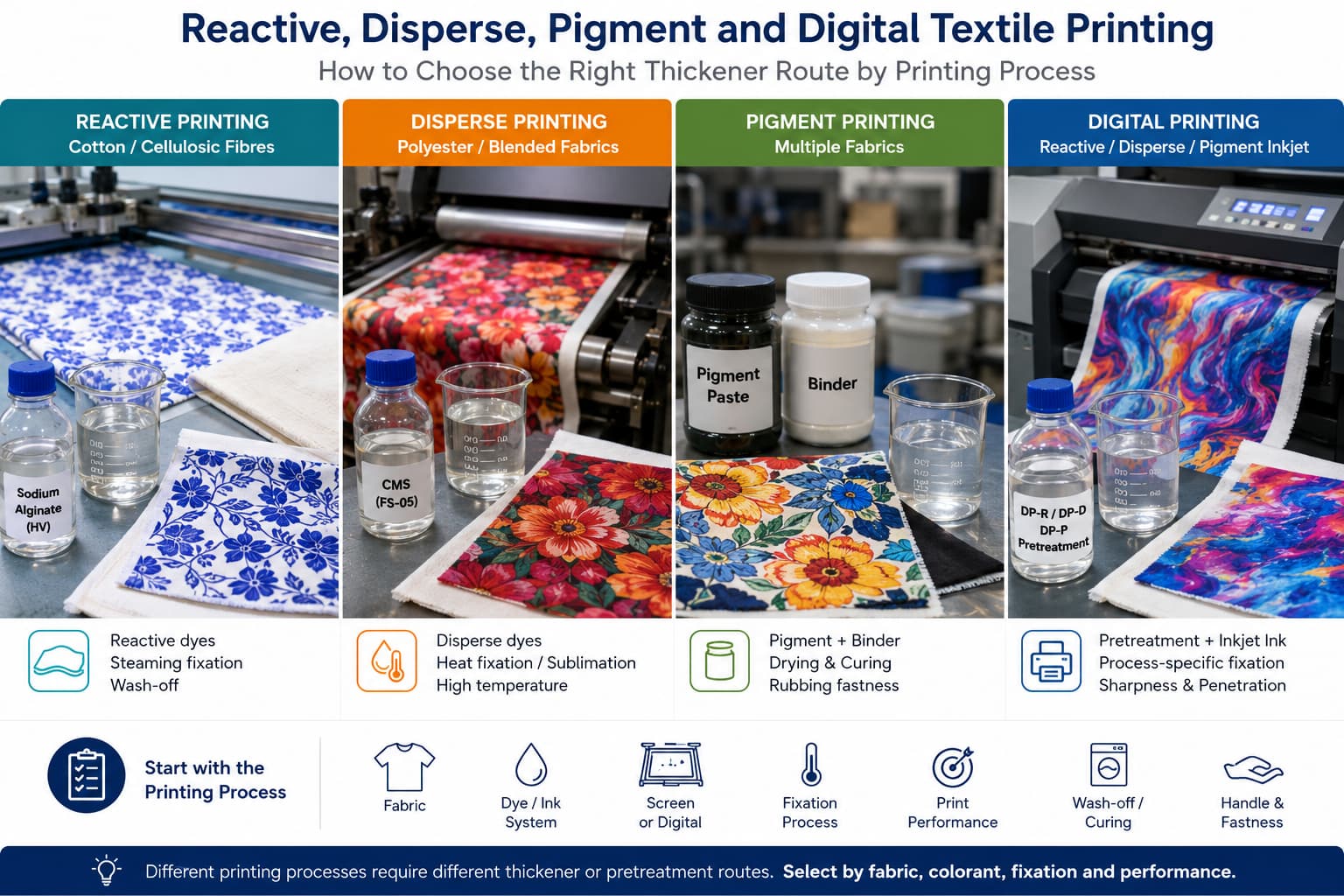
Дізнайтеся, як підібрати загущувач та методи попередньої обробки для реактивного, дисперсного, пігментного та цифрового друку на текстилі з урахуванням вимог до тканини, барвника або чорнила, фіксації, змивання та якості друку.
Цифровий струменевий друк на текстилі має інші вимоги до пасти та попередньої обробки, ніж трафаретний друк. У цьому посібнику пояснюється, як альгінат натрію використовується в цифровому текстильному друці та які параметри якості повинні вказувати фахівці з закупівель.
Sodium alginate is commonly used as a thickener in reactive textile printing paste, but other textile uses require application-specific validation. This guide compares printing, digital pretreatment, warp sizing, dyeing-related formulations, coating, and finishing by function, technical requirements, risks, documents, and sample tests.
Viscosity control in digital textile printing involves two different systems: the jetting ink and the fabric pretreatment formulation. This guide explains how temperature, formulation, measurement methods and process conditions affect jetting stability and print quality.
The best digital printing paste is the one matched to the ink chemistry, fabric and fixation route. This guide compares pretreatment requirements for reactive inkjet on cellulosic fabrics and direct disperse inkjet on polyester, then explains how buyers should evaluate samples before bulk purchasing.
The future of textile printing thickeners will be shaped by application-specific rheology, digital pretreatment, bio-based materials, hybrid formulations, faster preparation and data-driven process control. This guide explains which trends are commercially relevant and which still require industrial validation.
FSX Chemical offers separate digital printing paste routes for reactive, disperse and pigment systems, supported by application review, sample matching and technical documentation. This guide explains how buyers can evaluate the right route before bulk purchasing.
Stable digital printing paste requires more than a target viscosity. This guide explains how product selection, water quality, addition sequence, mixing, pH, temperature, filtration, hygiene, storage and quality records influence pretreatment and production consistency.
Textile printing chemical innovation in 2026 is moving beyond higher viscosity and stronger color. The leading developments focus on safer inputs, renewable polymers, waterborne nano-binders, stable pigment dispersions, lower-energy fixation and multifunctional printing systems.
Viscosity control in digital textile printing is not about reaching one number. Reliable performance requires the right pretreatment rheology, test method, temperature, chemical compatibility, filtration, fabric pickup and holding stability.
Digital textile printing requires more than advanced ink and printheads. Explore process-specific chemical solutions for reactive, disperse and pigment inkjet printing, from pretreatment and rheology to filtration, fixation and production validation.
A top-performing digital printing paste is not defined by viscosity alone. Reactive, disperse and pigment textile inks require different pretreatment chemistry, rheology and post-treatment conditions. This guide explains how to select digital printing pastes by ink system, fabric, print definition, color performance, fixation and total production performance.
Надайте назву продукту, сферу застосування, кількість, місце призначення, а також будь-які технічні специфікації (TDS),
зразки фотографій або документів, які у вас вже є. Компанія FSX Chemical розгляне цю
інформацію та надасть рекомендації щодо подальших кроків: підготовки комерційної пропозиції, підбору зразків
або вибору продукту.
Інформація про товарНазва товару, сорт, модель, фото етикетки або код постачальника.
Доступні документиTDS, SDS, COA, фото зразка, перелік продукції або дані випробувань.
Деталі замовленняОрієнтовна кількість, упаковка, країна призначення, порт або умови торгівлі.
Заявка чи проблемаПроцес друку на текстилі, вимоги до складу, поточні проблеми або цільові показники ефективності.