Synthetic Thickener vs. CMC and CMS for Pigment Printing: What Changes in Rheology, Wash-Off and Fabric Hand?
Synthetic acrylic thickener, CMC and CMS can create different rheology, dosage requirements, binder compatibility, residue...
Synthetic acrylic thickeners, CMC and CMS can all be evaluated in selected pigment-printing systems, but they do not create the same rheology, solids load, binder interaction or finished-fabric feel. Synthetic thickeners are commonly favored where high thickening efficiency, tailored shear thinning and low addition levels are required, while CMC and CMS can provide useful pseudoplastic flow and may be considered in selected formulations or compound-thickener systems. The correct comparison should therefore be made in the complete pigment-binder paste and on the cured fabric—not from water viscosity alone. This guide compares the three routes through rheology, binder compatibility, post-cure washability or residue behavior, fabric hand, dosage and Total Cost in Use.
Which Thickener Route Is Best for Pigment Printing?
There is no universal winner.
For many conventional pigment-printing systems, synthetic acrylic or polyacrylate thickeners are a common starting route because they can deliver strong thickening efficiency at relatively low dosage and can be designed for useful shear-thinning and recovery behavior.
CMC and CMS can still be evaluated in selected pigment systems, especially when the mill is exploring:
Different rheological profiles
Higher water retention
Compound-thickener systems
Cost optimization
Specific binder / pigment combinations
The correct selection sequence is:
Complete Paste Compatibility → Rheology → Screen Transfer → Curing → Fastness → Post-Cure Residue / Washability → Fabric Hand → Total Cost in Use
Do not select by viscosity, raw-material name or price per kilogram alone.
Important Comparison Boundary: Pigment Printing Is Binder-Film Printing
Pigment printing differs fundamentally from reactive printing.
Pigment particles do not chemically react with the fiber in the same way reactive dyes do.
The binder forms a film that holds pigment on the textile surface after drying and curing.
Therefore, the thickener should be evaluated as a rheology-control component inside the binder system.
This changes how “wash-off” should be interpreted.
In conventional pigment printing:
The binder film is intended to remain.
The process may not include the same intensive wash-off used after reactive printing.
Residual thickener, surface cleanliness and hand still matter.
If a post-cure wash is used, the thickener’s removability and interaction with the binder film should be checked.
Do not apply reactive-printing wash-off rules directly to pigment printing.
The Three Thickener Routes at a Glance
Yo'nalish
Typical Strength
Main Risk to Check
Synthetic acrylic / polyacrylate
High thickening efficiency, tunable rheology, low dosage potential
Electrolyte / pH / binder sensitivity
CMC
Pseudoplastic flow, water retention, broad availability
These are route-level tendencies, not product guarantees.
Commercial grades can behave very differently inside each category.
Synthetic Acrylic / Polyacrylate Thickener
Synthetic acrylic thickeners are widely used in pigment-printing systems because the chemistry can be designed for:
High thickening efficiency
Low addition level
Kuchli kesishli suyultirish
Boshqariladigan tiklanish
Easy liquid dosing
Many grades are pH-responsive and may require correct neutralization.
Their most important technical checks are:
Activation pH
Binder mosligi
Elektrolit toleranti
Holding stability
Complete-paste rheology
A synthetic grade that gives very high water viscosity can still fail in the real pigment formula if binder or pigment salts collapse the polymer structure.
CMC for Selected Pigment-Printing Systems
CMC is an anionic cellulose derivative with well-known pseudoplastic behavior.
Its performance depends strongly on:
O'rnini bosish darajasi
Molecular weight
Soflik
Diqqatni jamlash
Salt / binder environment
CMC can be worth evaluating when the mill wants:
A polysaccharide-based rheology route
Strong water retention
A different low-shear / high-shear balance
A compound-thickener component
However, CMC should not be assumed to be a direct one-for-one substitute for a synthetic pigment-printing thickener.
It may require a different dosage and can create different:
Paste solids
Elastiklik
Screen transfer
Post-cure residue
Mato qo'li
Grade selection should be based on the complete binder-containing formula.
CMS for Selected Pigment-Printing Systems
CMS is a carboxymethylated starch derivative with pseudoplastic rheology.
Selected CMS grades can be evaluated as:
Primary rheology-control components in specific pigment systems
Compound-thickener components
Cost-optimization routes
Published pigment-printing work has compared carboxymethylated starch with carboxymethyl cellulose in cotton pigment printing and found that performance depended on the formulation and binder conditions rather than polymer identity alone.
This is important because CMS should not be treated as “cheap CMC.”
Its:
Substitution
Starch structure
Molecular weight
Soflik
Namlanish
can produce a distinctly different rheological profile.
Rheology Comparison: Shear Thinning, Recovery and Elasticity
All three routes can show pseudoplastic behavior, but the degree and recovery profile can differ.
Synthetic Acrylic
Often provides strong, designable shear thinning and can be formulated for rapid recovery.
CMC
Typically shows non-Newtonian pseudoplastic behavior, with flow strongly influenced by DS, molecular weight and concentration.
CMS
Also commonly shows pseudoplastic behavior, but the exact profile depends on starch source, substitution and modification route.
For screen printing, the key comparison is:
Low-Shear Body → High-Shear Flow → Recovery → Elasticity
emas:
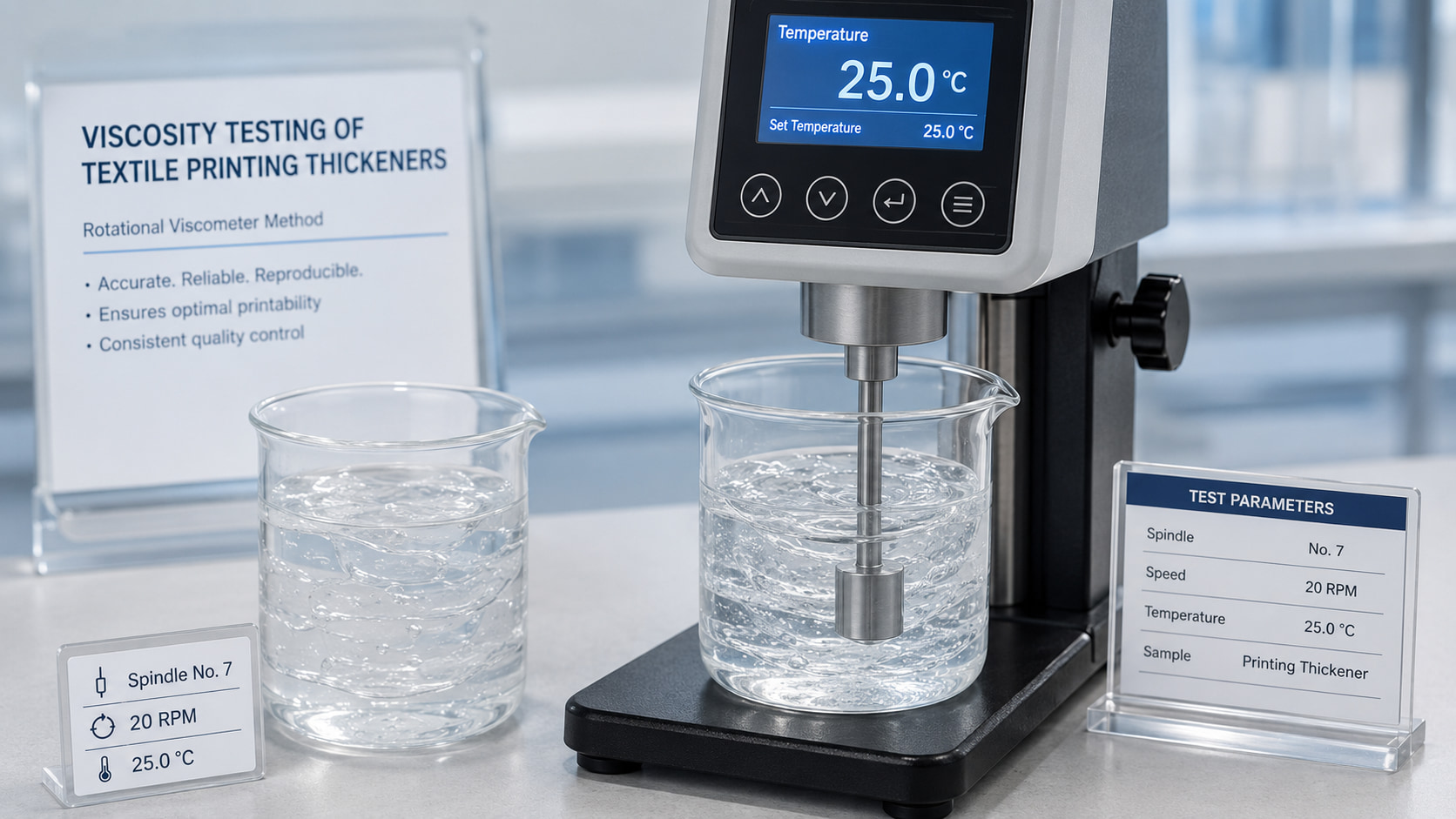
Which sample has the highest Brookfield number?
Why the Same Viscosity Does Not Mean the Same Printing Behavior
Two pastes can both measure 30,000 mPa·s under one viscometer condition and still differ in:
Flow through the screen
Squeegee pressure requirement
Kirish
Structural recovery
Stringiness
Leveling
One-point viscosity should therefore be treated as a QC value, not a complete rheological description.
When possible, compare:
Multi-speed viscosity
Boshqarilgan kesishdan keyingi tiklanish
Machine screenability
Binder mosligi
Binder compatibility is critical in pigment printing.
Binder quyidagicha o'zgarishi mumkin:
pH
Elektrolit darajasi
Surfaktantlar muvozanati
Total solids
Viscoelasticity
Sintetik qalinlashtiruvchi
Can be highly efficient but may be sensitive to the specific binder chemistry or ionic load.
CMC
Can respond to binder salts and ionic conditions and should be checked for viscosity drift or flocculation.
CMS
Can also interact with binder / auxiliaries and should be evaluated for delayed thickening, thinning, separation or foam.
Use the same binder and pigment package for all three comparisons.
Electrolyte and pH Sensitivity
All three routes can respond to ionic conditions, but not in the same way.
Synthetic Polyacrylate
Often sensitive to charge screening, especially in conventional highly ionic systems, although hydrophobically modified grades can show improved tolerance.
CMC
Salt tolerance depends strongly on DS, molecular weight and substitution uniformity.
CMS
Salt / alkali response depends on substitution, starch backbone and grade design.
Therefore, compare:
Water Viscosity
va:
Complete Pigment-Paste Viscosity
for every route.
Dosage and Polymer Solids
Synthetic thickeners are often attractive because relatively low addition levels can create strong viscosity.
CMC and CMS may require higher as-supplied dosage depending on grade.
Higher dosage can increase:
Polymer solids in the paste
Dry surface residue
Viscosity sensitivity
Potential impact on fabric hand
But dosage alone is not enough.
For liquid synthetic thickeners, calculate active polymer solids.
For CMC / CMS, account for moisture and active dry material.
The fair comparison is:
Required Dosage → Actual Polymer Solids → Printing Performance → Finished Hand → Cost
Screen Transfer and Print Definition
Good print definition requires:
Clean screen passage
Controlled paste deposit
Limited lateral spreading
Appropriate structural recovery
Synthetic thickener can offer a strong balance where high-shear flow and rapid recovery are required.
CMC or CMS can also provide useful definition when the grade and dosage create the right pseudoplastic profile.
Do not compare print sharpness at unmatched viscosity or unmatched paste deposit.
Penetration and Surface Color
Thickener route changes how the pigment-binder paste moves into the textile.
Too much penetration can reduce:
Surface color concentration
Chegara o'tkirligi
Too little penetration can create:
Surface-heavy deposits
Uneven coverage in some constructions
Compare penetration on the same:
Mato
Screen
Squeegee
Binder level
Otherwise, process variation can be mistaken for thickener behavior.
Wash-Off, Residue and Post-Cure Cleanliness
Wash-off must be interpreted carefully in pigment printing.
Conventional pigment printing is designed around a cured binder film, so the objective is not to remove the entire printed film after curing.
Instead, evaluate:
Loose surface residue
Hydrophilic thickener residue
Post-cure washing response if the process includes washing
Fabric cleanliness
Hand after any post-treatment
Sintetik qalinlashtiruvchi
Low dosage can reduce total thickener solids, but the polymer may remain partly associated with the cured binder film. “Easy wash-off” should not be assumed without testing.
CMC
CMC is water-soluble before curing, but in a pigment system some polymer can become physically trapped in the binder film or remain as surface residue. Post-cure washability must therefore be measured on the actual binder system.
CMS
CMS is also hydrophilic and can be removable in water before film formation, but final residue depends on formulation, binder cure and dosage.
Do not transfer reactive-printing wash-off assumptions directly into pigment printing.
Fabric Hand
Fabric hand is often where the thickener routes become commercially different.
Hand depends on:
Binder film
Thickener solids
Yopishtirish omonati
Qotirish
Matoning tuzilishi
A lower-dose synthetic thickener can reduce added polymer solids and may help support a softer hand if binder and curing are also optimized.
CMC or CMS may require higher solids depending on the grade, which can increase the risk of a heavier or stiffer surface.
But this is not universal.
A well-optimized CMC or CMS compound system can still produce acceptable hand, while an over-bindered synthetic-thickener system can become very stiff.
The final comparison must be made after curing.
Rubbing Fastness and Curing
Rubbing fastness is primarily controlled by the pigment binder and curing process.
The thickener contributes indirectly by affecting:
Pigment tarqalishi
Binder taqsimoti
Yopishtirish omonati
Kirish
Higher binder concentration can improve rubbing fastness but may also increase stiffness.
Therefore, do not select a thickener route only because it produces a deeper wet print.
Solishtiring:
Quruq ishqalash
Nam ishqalash
Wash fastness where relevant
Mato qo'li
after identical curing.
Barqarorlikni saqlash
Compare fresh paste with held paste.
Yozuv:
Yopishqoqlik
pH
Harorat
Köpük
Ajralish
Gel / floc
Synthetic
Watch for pH or electrolyte-related viscosity drift.
CMC
Watch for hydration completion, salt response and delayed viscosity change.
CMS
Watch for hydration, formulation interaction and storage stability.
A paste that is stable only when fresh is not suitable for a long production holding window.
Tekis ekran vs. aylanuvchi ekran
The thickener route should be evaluated on the intended machine.
Tekis ekran
Important factors include:
Past kesishli ushlab turish
Pause / restart behavior
Recovery after squeegee stroke
Rotar skirina
Important factors include:
Nasoslanish qobiliyati
Uzluksiz kesish
Circulation stability
Mid-run and end-run viscosity
A route that works in flat screen may need dosage or grade adjustment in rotary screen.
Can Synthetic Thickener Be Blended with CMC or CMS?
Yes, compound-thickener systems can be evaluated.
The purpose of blending is not simply to reduce cost.
A blend can be designed to change:
Low-shear body
Shear-thinning profile
Qayta tiklanish
Suvni ushlab qolish
Electrolyte response
Polymer solids
Published textile-printing research has shown that mixtures of modified polyacrylic acid with small amounts of CMS can create useful rheological behavior in selected systems.
However, there is no universal synthetic/CMC or synthetic/CMS ratio.
Compound systems must be tested for:
Moslik
Holding stability
Screen transfer
Qotirish
Hand
Practical Selection Matrix
Tanlov maydoni
Synthetic Acrylic
CMC
CMS
Typical thickening efficiency
Often high
Darajaga bog'liq
Darajaga bog'liq
Shear-thinning design flexibility
Yuqori
Moderate / grade-dependent
Moderate / grade-dependent
pH activation requirement
Common in some grades
Normally no acrylic-style activation
Normally no acrylic-style activation
Electrolyte sensitivity
Can be significant
Depends on DS / grade
Depends on substitution / grade
Typical dosage level
Ko'pincha pastroq
Often higher
Often higher
Binder mosligi
Tasdiqlash kerak
Tasdiqlash kerak
Tasdiqlash kerak
Post-cure residue / hand
Often benefits from low solids if optimized
Depends on dosage / binder trapping
Depends on dosage / binder trapping
Compound-thickener potential
Yuqori
Possible
Possible
This table is a route-selection aid, not a product specification.
How to Compare the Three Routes in the Laboratory
Use the same:
Pigment
Binder
Fixer
Auxiliaries
Mato
Qotirish
Then:
Step 1: Build Each Grade to a Useful Rheology Window
Do not force equal dosage.
Step 2: Measure Fresh Complete-Paste Viscosity
Use the same instrument and method.
Step 3: Run Multi-Speed / Recovery Comparison
Compare screen-relevant rheology.
Step 4: Hold the Paste
Check end-of-shift stability.
Step 5: Print the Same Fabric
Keep screen and squeegee conditions constant.
Step 6: Cure Identically
Keyin solishtiring:
K/S / shade
Ta'rifni chop etish
Kirish
Quruq / nam ishqalash
Post-cure residue or wash response
Hand
For a controlled grade comparison, FSX Chemical can review current products or TDS through Namuna va moslik.
Ishlab chiqarish sinovini tasdiqlash
Only the best laboratory candidates should move to production.
Yozuv:
Thickener route and grade
Doza
To'liq formulasi
Boshlang'ich / o'rta / yakuniy oqish viskozligi
Mashina tezligi
Screen behavior
Boshidan oxirigacha soyasi
Curing result
Rubbing fastness
Mato qo'li
Approve a route only if it remains stable across the intended production window.
When Does Synthetic Thickener Usually Make More Sense?
Synthetic acrylic thickener is often worth prioritizing when the mill needs:
High thickening efficiency
Low dosage
Tailored shear thinning
Fast liquid incorporation
Low added polymer solids
It is especially attractive when the binder / pigment system has already been optimized for synthetic rheology modifiers.
But electrolyte tolerance and pH activation must be checked.
When Can CMC Be Worth Evaluating?
CMC may be worth testing when the mill wants:
A polysaccharide rheology route
Strong water retention
A different screen-transfer profile
A compound formulation
An alternative supply route
Selection should focus on:
DS
Molecular weight
Soflik
Binder mosligi
Required dosage
Do not assume one generic CMC grade represents all textile CMC products.
When Can CMS Be Worth Evaluating?
CMS may be worth evaluating when the mill wants:
Cost optimization
Compound-thickener flexibility
Pseudoplastic flow
Alternative rheology
Selection should focus on:
Substitution
Soflik
Namlanish
Binder mosligi
Holding stability
Selected CMS grades can be technically useful, but the result is formulation-specific.
Common Comparison Mistakes
1. Comparing Equal Dosage Only
Different grades have different thickening efficiency.
2. Comparing Water Viscosity Only
Pigment and binder can change the complete paste substantially.
3. Assuming Synthetic Always Gives Softer Hand
Binder solids, dosage and curing can dominate hand.
4. Assuming CMC / CMS Must Wash Out Completely
In pigment printing, binder film can retain or trap part of the hydrophilic thickener.
5. Treating CMS as Cheap CMC
The polymer backbone and rheology are different.
6. Using Reactive-Printing Wash-Off Logic
Pigment printing is binder-film printing and must be evaluated differently.
7. Selecting by Price per Kilogram
Working dosage and finished-fabric result determine real cost.
Muammolarni bartaraf etish jadvali
Observed Difference
Tekshirilishi kerak bo'lgan birinchi o'zgaruvchilar
Faraz qilmang
Synthetic paste is thinner after binder
pH, electrolytes, binder compatibility
Synthetic route is unsuitable
CMC needs higher dosage
Grade, DS, molecular weight, target rheology
Higher dosage means worse overall cost
CMS gives different screen feel
Shear thinning, recovery, hydration
Same viscosity means same rheology
Synthetic gives softer hand
Polymer solids, binder film, paste deposit
All synthetic grades will do the same
CMC/CMS leaves more residue
Dosage, curing, post-cure wash, binder trapping
Polysaccharide route is automatically poor
Rubbing fastness differs
Binder distribution, curing, paste deposit
Thickener chemistry alone controls fastness
Lab result good, rotary run drifts
Continuous shear, holding time, temperature
Lab viscosity predicts long-run stability
Compound system outperforms single polymer
Blend rheology and compatibility
One polymer must always be best
Foydalanishdagi umumiy xarajat
Compare the three routes using:
Total Cost in Use = Thickener Cost + Dosage + Preparation + Binder / Formula Adjustment + Machine Efficiency + Curing + Rework + Quality Loss
A synthetic thickener can have a higher price per kilogram but lower working dosage.
CMC or CMS can have a lower raw-material cost but require more solids or different preparation.
A compound system may reduce cost only if it also maintains:
Paste stability
Screen performance
Fastness
Hand
Compare cost per acceptable printed meter—not cost per kilogram of thickener.
Qalinlashtiruvchi yetkazib beruvchiga qanday ma'lumotlarni yuborishingiz kerak?
For a useful synthetic-vs-CMC-vs-CMS comparison, provide:
Current thickener product / TDS
Joriy dozasi
Viskozlik va to'liq sinov usuli
Pigment tarqalishi
Binder and dosage
Fixer / auxiliaries
Oxirgi xamir pH
Mato
Tekis yoki aylanuvchi ekran
Ekran to'ri / gravirovka
Vaqtni ushlab turish
Curing condition
Main target: rheology, hand, residue, fastness or cost
FSX Chemical ushbu ma'lumotlardan orqali foydalanishi mumkin Namuna va moslik to identify whether a synthetic, CMC, CMS or compound route deserves the next controlled trial.
How Should a Mill Compare Synthetic Thickener, CMC and CMS for Pigment Printing?
Amaliy ketma-ketlik quyidagicha:
Match Complete-Paste Rheology → Compare Dosage & Solids → Hold → Screen Print → Cure → Check Fastness → Check Residue / Wash Response → Check Hand → Calculate Total Cost in Use
Asosiy tamoyillar quyidagilardan iborat:
Synthetic thickener, CMC and CMS should not be compared at equal dosage alone.
Same viscosity does not mean same shear thinning, recovery or print definition.
Binder compatibility must be checked for all three routes.
Wash-off in pigment printing means post-cure residue and cleanliness, not reactive-style removal of the printed film.
Fabric hand depends on binder film, thickener solids, paste deposit and curing together.
The best route is the one that delivers the required production window at the lowest Total Cost in Use.
Ko'p beriladigan savollar
1. Is synthetic thickener better than CMC or CMS for pigment printing?
Not universally. Synthetic acrylic thickeners are a common starting route because of high efficiency and tailored rheology, while selected CMC, CMS or compound systems can be useful in specific formulations.
2. Why do synthetic thickeners often use lower dosage?
Many acrylic/polyacrylate products are designed for high thickening efficiency, but actual dosage still depends on solids, pH, electrolyte load and formula.
3. Can CMC be used in pigment printing?
Selected CMC grades can be evaluated, especially where a polysaccharide rheology route or compound system is desired. Binder compatibility and dosage must be verified.
4. Can CMS be used in pigment printing?
Yes, selected CMS grades have been studied in pigment-printing systems, but the result depends on grade, binder, pigment and formulation.
5. Which route gives the best shear thinning?
It depends on the commercial grade. Synthetic acrylic systems often offer more rheology-design flexibility, but CMC and CMS are also pseudoplastic and can provide useful screen behavior.
6. Which route gives the softest fabric hand?
There is no universal answer. Lower polymer solids can help, but binder dosage, curing and paste deposit often dominate final hand.
7. Does CMC wash off better than synthetic thickener?
Not automatically in pigment printing. CMC is water-soluble before curing, but part of it can be retained in or under the cured binder film. Test the real post-cure process.
8. Does CMS leave more residue?
Residue depends on grade, dosage, hydration, binder film and post-treatment. Do not assume residue from polymer family alone.
9. Can synthetic thickener be blended with CMC or CMS?
Yes. Compound systems can be evaluated to tune rheology, solids, water retention or cost, but the blend must be tested for compatibility and curing performance.
10. Should the three routes be compared at the same viscosity?
Compare them inside the same useful complete-paste rheology window, then evaluate screen transfer, definition, curing, hand and cost.
11. Which route is cheapest?
Compare Total Cost in Use. A lower raw-material price can be offset by higher dosage, longer preparation, lower machine efficiency or poorer hand.
12. What should I send FSX Chemical for comparison testing?
Send your current thickener or TDS, dosage, viscosity method, pigment, binder, fabric, machine route, curing conditions and main target so the most relevant route can be selected for trial.
Compare Synthetic Thickener, CMC and CMS Under the Same Pigment Formula
If your mill is deciding between synthetic acrylic thickener, CMC, CMS or a compound-thickener route, FSX Chemical can help structure a controlled comparison based on complete-paste rheology and finished-fabric performance rather than water viscosity alone.
Foydali texnik ko'rib chiqish uchun yuboring:
Your current thickener sample, TDS or COA
Joriy dozasi
Viskozlik va to'liq sinov usuli
Pigment tarqalishi
Binder and fixer system
Oxirgi xamir pH
Fabric and screen route
Vaqtni ushlab turish
Curing condition
Current rheology, wash/residue, hand or cost target
Bilan boshlang Namuna va moslik for a controlled current-vs-candidate trial.
The best pigment-printing thickener is not determined by polymer family alone. It is the route that gives the required rheology, binder compatibility, cured fastness, acceptable residue and hand, and the lowest practical Total Cost in Use.
To'qimachilik bosib chiqarish uchun qalinlashtiruvchining viskozitet qiymatlari konsentratsiya, harorat, asbob, mil, tezlik, tayyorlash usuli va sinov vaqti mos kelmasa solishtirilmasligini o'rganing.
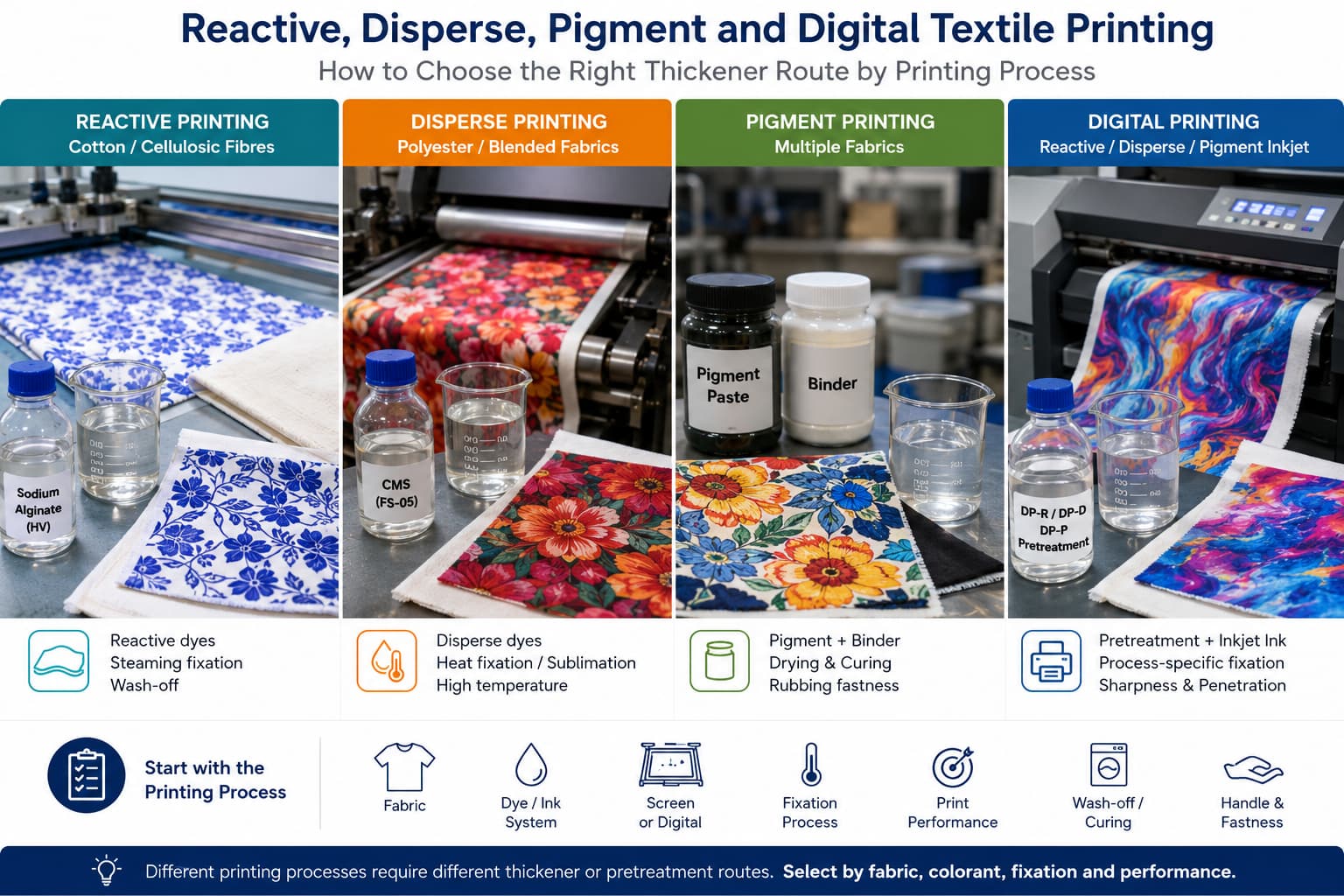
Mato, bo'yoq yoki siyoh, fiksatsiya, yuvib tashlash va bosib chiqarish sifati talablariga asoslanib reaktiv, dispergatsion, pigment va raqamli to'qimachilik bosib chiqarish uchun qalinlashtiruvchi va oldindan ishlov berish usullarini qanday tanlashni o'rganing.
To'qimachilik bosish uchun CMC, CMS, natriy alginat va raqamli bosish pastalarini solishtiring. Har bir usul reaktiv, dispers, pigment va raqamli jarayonlarga qanday mos kelishini hamda xaridorlar namuna sinovi, toifa mosligi va katta miqdorda xarid qilishdan oldin nima tekshirishlari kerakligini o'rganing.
Karboksimetil sellyuloza (CMC) matolarni bosish, o'lchamlash va bo'yash jarayonlarida keng qo'llaniladi. Ushbu qo'llanma CMC navlarini qanday baholash, qaysi parametrlar eng muhim ekanligi va FSX Chemical xarid qarorlarini qanday qo'llab-quvvatlashi mumkinligini tushuntiradi.
Karboksimetil sellyuloza suv asosidagi siyohlar, gravür bosib chiqarish va inkjet oldindan ishlov berishda qalinlashtiruvchi va barqarorlashtiruvchi sifatida ishlatiladi. Ushbu qo'llanma xarid guruhlari uchun asosiy toifa parametrlari va ta'minot manbalarini tanlash bo'yicha masalalarni o'z ichiga oladi.
CMC asosidagi bosma xamir pigmentli, reaktiv va raqamli to'qimachilik bosishda ishlatiladi. Ushbu qo'llanma qaysi parametrlar muhimligini, yetkazib beruvchilarni qanday solishtirishni va katta miqdordagi buyurtma berishdan oldin nima so'rashni tushuntiradi.
Natriy alginat hamda CMC mato bosishda qalinlashtiruvchi moddalar sifatida ishlatiladi, ammo ular turli bo'yoq tizimlari va jarayon sharoitlariga mos keladi. Ushbu qo'llanma asosiy farqlarni va har birini qachon qo'llashni tushuntiradi.
Oziq-ovqat va sanoat darajasidagi CMC asosiy kimyoviy tarkib jihatidan bir xil bo'lsa-da, ularning tozaligi, DS diapazoni va tartibga soluvchi talablari jihatidan sezilarli farqlarga ega. Ushbu qo'llanma asosiy farqlarni va noto'g'ri darajadagi mahsulotni ishlatish ishlab chiqarishda qanday muammolarni keltirib chiqarishini tushuntiradi.
CMS for textile printing paste can help adjust viscosity, improve paste handling, and support stable formulation performance. This guide explains how buyers can evaluate CMS grades by viscosity, DS, solubility, pH, moisture, and sample testing before bulk purchase.
Cellulose-based raw materials are used in textile printing, printing paste preparation, thickening, and formulation support. This guide explains how buyers can evaluate CMC, CMS, sodium alginate, textile printing thickeners, and printing paste products by specification, documentation, sample testing, and supplier support.
Cellulose derivatives are widely used in textile printing, printing paste preparation, thickening, and formulation support. This guide explains how overseas buyers can source CMC, CMS, sodium alginate, textile printing thickeners, and printing paste products from FSX Chemical with TDS, COA, sample testing, grade matching, and export document support.
Choosing textile industry chemicals requires more than comparing product names. This guide explains how textile printing buyers can match CMC, CMS, sodium alginate, textile printing thickeners, and printing paste products by application, specification, TDS, COA, sample testing, and batch consistency.
Mahsulot nomi, qo'llanilishi, miqdori, manzili hamda mavjud bo'lsa har qanday TDS, namuna fotosurati yoki hujjatni taqdim eting. FSX Chemical ushbu ma'lumotlarni ko'rib chiqib, narx taklifi, namuna mosligi yoki mahsulot tanlovi bo'yicha keyingi bosqichni tavsiya qiladi.
Mahsulot haqida ma'lumotMahsulot nomi, toifasi, modeli, yorliqdagi rasm yoki yetkazib beruvchining ma'lumotnomasiga havola.
Mavjud hujjatlarTDS, SDS, COA, namuna fotosurati, mahsulotlar ro'yxati yoki sinov ma'lumotlari.
Buyurtma tafsilotlariTaxminiy miqdor, qadoqlash, manzil davlati, port yoki savdo sharti.
Ariza yoki muammoTo'qimachilik bosib chiqarish jarayoni, formulatsiya ehtiyoji, joriy muammo yoki maqsadli ko'rsatkich.