Synthetic Thickener vs. CMC and CMS for Pigment Printing: What Changes in Rheology, Wash-Off and Fabric Hand?
Define the exact grade before comparing pigment-printing thickeners. Distinguish acrylic, CMC and documented carboxymethyl-starch chemistry...
Define the product identity before comparing pigment-printing thickeners. The chemical-route comparison below distinguishes acrylic rheology modifiers, CMC and documented carboxymethyl-starch candidates. FSX CMS is a commercial synthetic printing-thickener family, so its trade name is not a third, mutually exclusive chemistry category and does not place a grade in the starch column. Confirm the exact grade and intended pigment-printing use, then compare complete-paste rheology, binder interaction, dose and cured-fabric results. Water viscosity or the family name alone cannot approve the candidate.
Which Thickener Route Is Best for Pigment Printing?
There is no universal winner.
For many conventional pigment-printing systems, synthetic acrylic or polyacrylate thickeners are a common starting route because they can deliver strong thickening efficiency at relatively low dosage and can be designed for useful shear-thinning and recovery behavior.
CMC and CMS can still be evaluated in selected pigment systems, especially when the mill is exploring:
Different rheological profiles
Higher water retention
Compound-thickener systems
Cost optimization
Specific binder / pigment combinations
The correct selection sequence is:
Complete Paste Compatibility → Rheology → Screen Transfer → Curing → Fastness → Post-Cure Residue / Washability → Fabric Hand → Total Cost in Use
Do not select by viscosity, raw-material name or price per kilogram alone.
Important Comparison Boundary: Pigment Printing Is Binder-Film Printing
Pigment printing differs fundamentally from reactive printing.
Pigment particles do not chemically react with the fiber in the same way reactive dyes do.
The binder forms a film that holds pigment on the textile surface after drying and curing.
Therefore, the thickener should be evaluated as a rheology-control component inside the binder system.
This changes how “wash-off” should be interpreted.
In conventional pigment printing:
The binder film is intended to remain.
The process may not include the same intensive wash-off used after reactive printing.
Residual thickener, surface cleanliness and hand still matter.
If a post-cure wash is used, the thickener’s removability and interaction with the binder film should be checked.
Do not apply reactive-printing wash-off rules directly to pigment printing.
The Three Thickener Routes at a Glance
Route
Typical Strength
Main Risk to Check
Synthetic acrylic / polyacrylate
High thickening efficiency, tunable rheology, low dosage potential
Electrolyte / pH / binder sensitivity
CMC
Pseudoplastic flow, water retention, broad availability
These are route-level tendencies, not product guarantees.
Commercial grades can behave very differently inside each category.
Synthetic Acrylic / Polyacrylate Thickener
Synthetic acrylic thickeners are widely used in pigment-printing systems because the chemistry can be designed for:
High thickening efficiency
Low addition level
Strong shear thinning
Controlled recovery
Easy liquid dosing
Many grades are pH-responsive and may require correct neutralization.
Their most important technical checks are:
Activation pH
Binder compatibility
Electrolyte tolerance
Holding stability
Complete-paste rheology
A synthetic grade that gives very high water viscosity can still fail in the real pigment formula if binder or pigment salts collapse the polymer structure.
CMC for Selected Pigment-Printing Systems
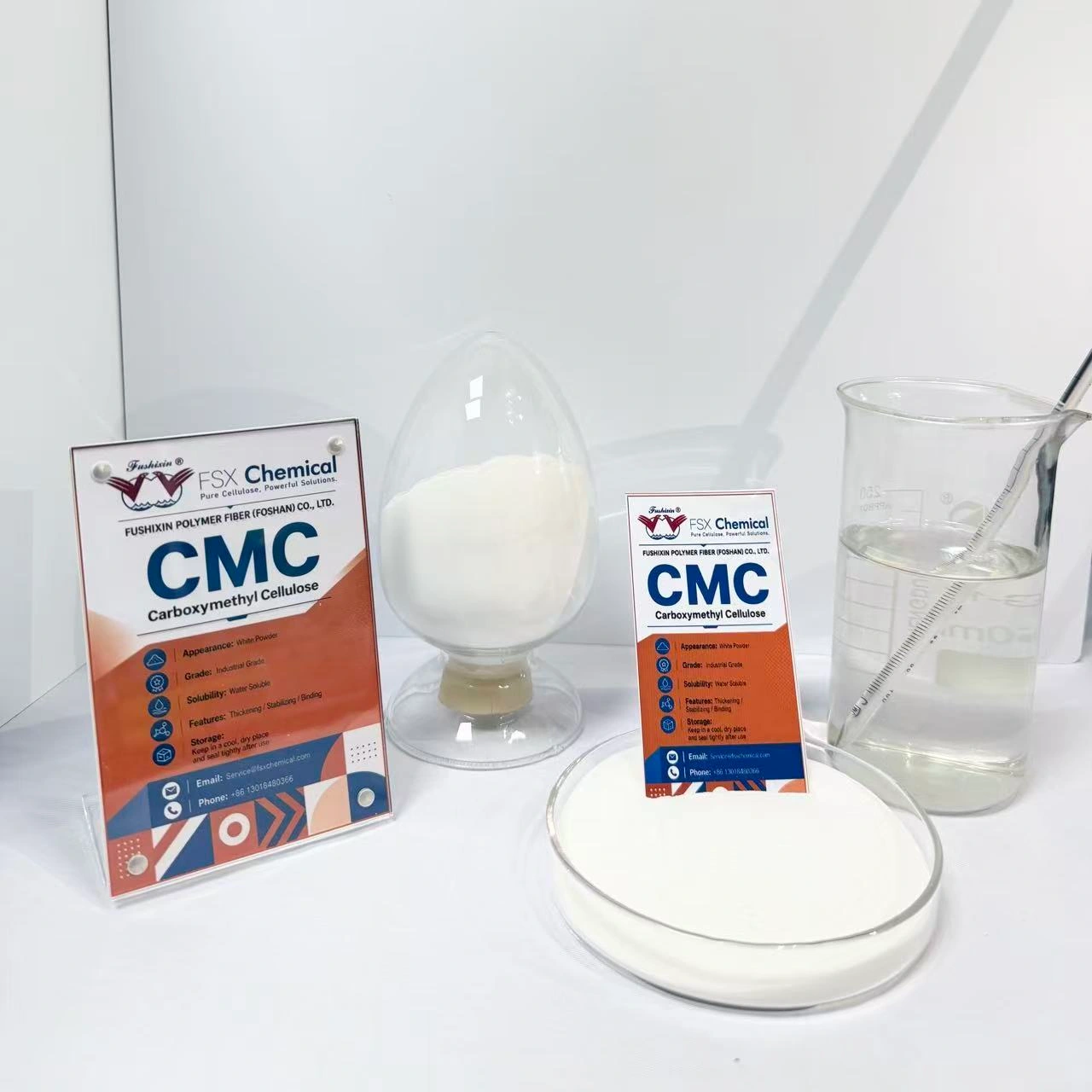
CMC is an anionic cellulose derivative with well-known pseudoplastic behavior.
Its performance depends strongly on:
Degree of substitution
Molecular weight
Purity
Concentration
Salt / binder environment
CMC can be worth evaluating when the mill wants:
A polysaccharide-based rheology route
Strong water retention
A different low-shear / high-shear balance
A compound-thickener component
However, CMC should not be assumed to be a direct one-for-one substitute for a synthetic pigment-printing thickener.
It may require a different dosage and can create different:
Paste solids
Elasticity
Screen transfer
Post-cure residue
Fabric hand
Grade selection should be based on the complete binder-containing formula.
Confirmed Carboxymethyl Starch (CMS) for Pigment Systems
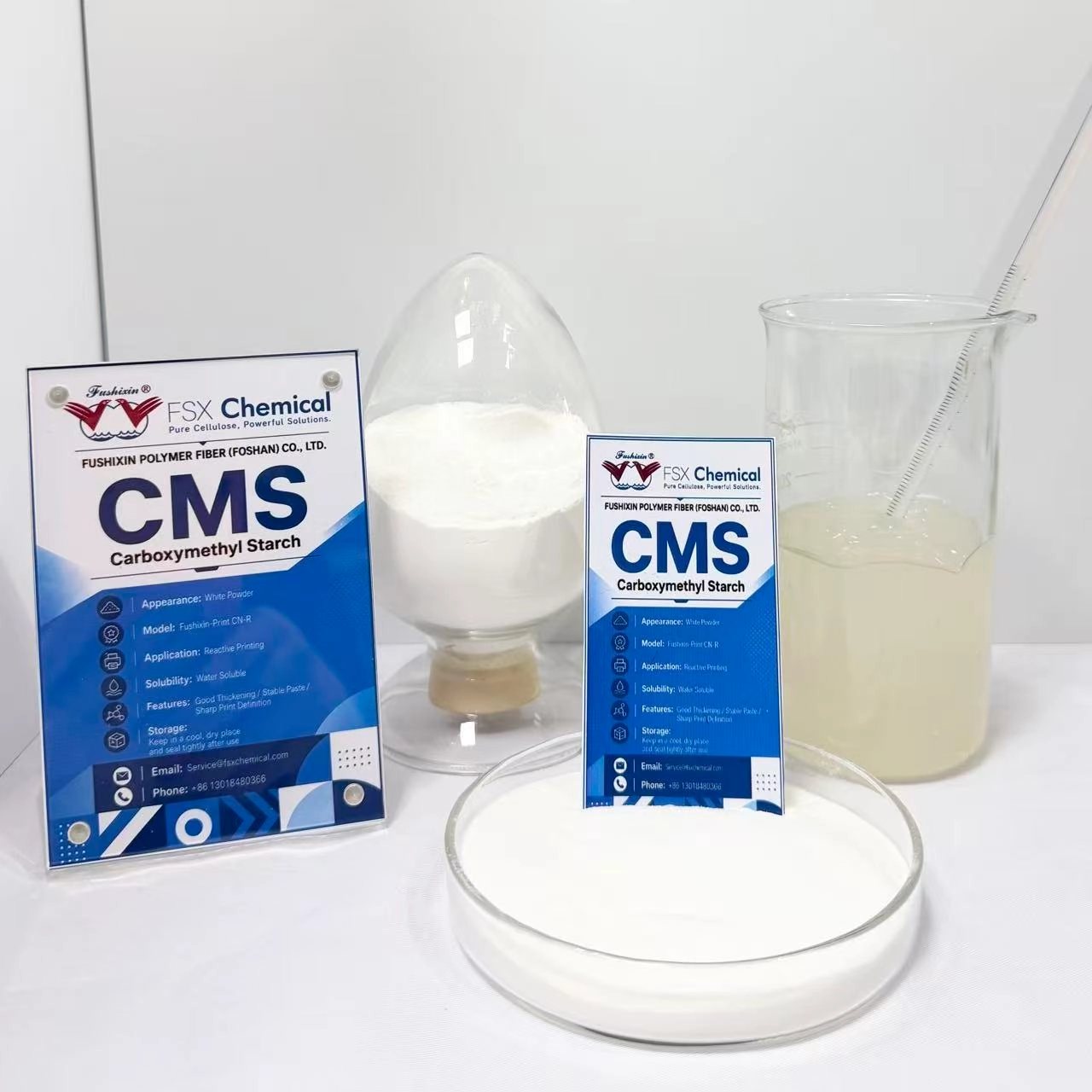
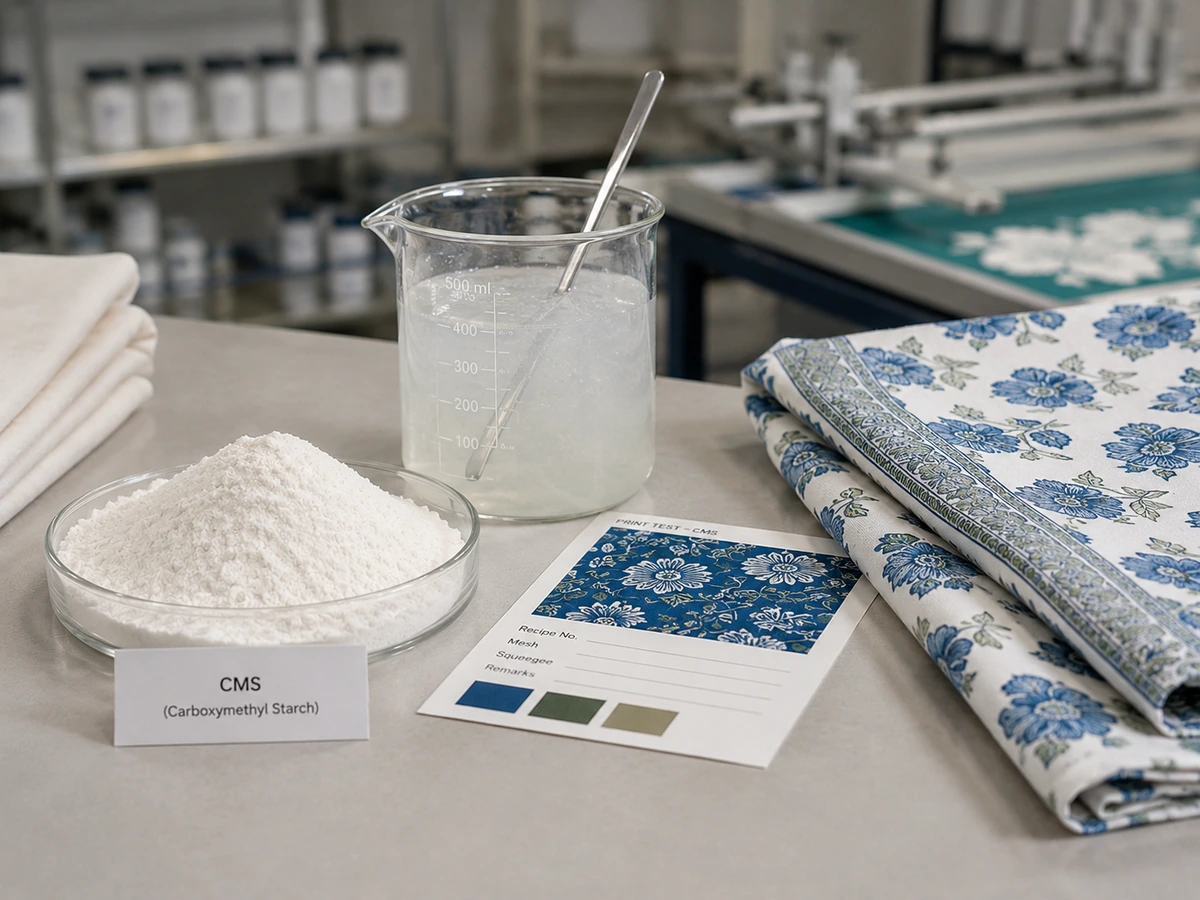
In the generic chemistry comparison, CMS means confirmed carboxymethyl starch, a starch derivative. Apply starch-backbone and substitution statements only to a candidate whose grade documentation establishes that identity. The FSX CMS commercial synthetic printing-thickener family is a separate naming context: obtain its current grade-specific TDS, composition information and application recommendation rather than importing starch or CMC specifications. Classify the identified material before choosing the relevant comparison column.
Selected CMS grades can be evaluated as:
Primary rheology-control components in specific pigment systems
Compound-thickener components
Cost-optimization routes
For a proposed carboxymethyl-starch versus CMC trial, record the exact grades and compare the same pigment, binder, complete-paste conditions, deposit and curing route. The results qualify those identified formulations; they do not establish the performance of an unrelated FSX commercial grade.
This is important because CMS should not be treated as “cheap CMC.”
Its:
Substitution
Starch structure
Molecular weight
Purity
Hydration
can produce a distinctly different rheological profile.
Rheology Comparison: Shear Thinning, Recovery and Elasticity
All three routes can show pseudoplastic behavior, but the degree and recovery profile can differ.
Synthetic Acrylic
Often provides strong, designable shear thinning and can be formulated for rapid recovery.
CMC
Typically shows non-Newtonian pseudoplastic behavior, with flow strongly influenced by DS, molecular weight and concentration.
Confirmed Carboxymethyl-Starch Candidate
Also commonly shows pseudoplastic behavior, but the exact profile depends on starch source, substitution and modification route.
For screen printing, the key comparison is:
Low-Shear Body → High-Shear Flow → Recovery → Elasticity
not:
Which sample has the highest Brookfield number?
Why the Same Viscosity Does Not Mean the Same Printing Behavior
Two pastes can both measure 30,000 mPa·s under one viscometer condition and still differ in:
Flow through the screen
Squeegee pressure requirement
Penetration
Structural recovery
Stringiness
Leveling
One-point viscosity should therefore be treated as a QC value, not a complete rheological description.
When possible, compare:
Multi-speed viscosity
Recovery after controlled shear
Machine screenability
Binder Compatibility
Binder compatibility is critical in pigment printing.
Binder can change:
pH
Electrolyte level
Surfactant balance
Total solids
Viscoelasticity
Synthetic Thickener
Can be highly efficient but may be sensitive to the specific binder chemistry or ionic load.
CMC
Can respond to binder salts and ionic conditions and should be checked for viscosity drift or flocculation.
Confirmed Carboxymethyl-Starch Candidate
Can also interact with binder / auxiliaries and should be evaluated for delayed thickening, thinning, separation or foam.
Use the same binder and pigment package for all three comparisons.
Electrolyte and pH Sensitivity
All three routes can respond to ionic conditions, but not in the same way.
Synthetic Polyacrylate
Often sensitive to charge screening, especially in conventional highly ionic systems, although hydrophobically modified grades can show improved tolerance.
CMC
Salt tolerance depends strongly on DS, molecular weight and substitution uniformity.
Confirmed Carboxymethyl-Starch Candidate
Salt / alkali response depends on substitution, starch backbone and grade design.
Therefore, compare:
Water Viscosity
and:
Complete Pigment-Paste Viscosity
for every route.
Dosage and Polymer Solids
Compare each candidate at the dose needed to reach the agreed complete-paste printing window. Record as-supplied dose in g/kg of final paste first; equal dose is not necessarily a useful performance comparison.
Quantity
How to report it
What not to assume
As-supplied product dose
Weighed commercial product per final paste mass, including formulation water corrections.
Liquid and powder dosages contain equal functional polymer.
Measured nonvolatile contribution
Product dose × nonvolatile mass fraction from an agreed test; state time, temperature and sample handling.
Dry residue is automatically active acrylic polymer, CMC or starch.
Functional polymer contribution
Calculate only from confirmed grade composition or an applicable validated assay.
Moisture correction alone establishes purity, or SDS identification supplies an active-content assay.
Retained printed-system deposit
Compare measured deposit and finished-fabric performance under matched printing and curing.
Calculated bath solids alone predict residue, softness or fastness.
If active polymer content is undisclosed, mark it as unknown and compare documented as-supplied dose, measured nonvolatile contribution and finished performance. Nonvolatile testing, such as the applicable approach described in ASTM D2369, is a method-dependent residue measurement; confirm suitability for the particular product rather than imposing one drying method on every grade.
Hypothetical comparison: 10 g/kg of a liquid product with 30% measured nonvolatile content contributes 3 g/kg measured residue. This does not establish 3 g/kg active thickener. A powder containing moisture and salts requires its own composition evidence. Keep binder and pigment contributions separate when assessing fabric hand.
Screen Transfer and Print Definition
Good print definition requires:
Clean screen passage
Controlled paste deposit
Limited lateral spreading
Appropriate structural recovery
Synthetic thickener can offer a strong balance where high-shear flow and rapid recovery are required.
CMC or CMS can also provide useful definition when the grade and dosage create the right pseudoplastic profile.
Do not compare print sharpness at unmatched viscosity or unmatched paste deposit.
Penetration and Surface Color
Thickener route changes how the pigment-binder paste moves into the textile.
Too much penetration can reduce:
Surface color concentration
Edge sharpness
Too little penetration can create:
Surface-heavy deposits
Uneven coverage in some constructions
Compare penetration on the same:
Fabric
Screen
Squeegee
Binder level
Otherwise, process variation can be mistaken for thickener behavior.
Wash-Off, Residue and Post-Cure Cleanliness
Conventional pigment printing normally ends with drying and binder curing, without the reactive-dye process of removing unfixed dye and thickener after steaming. The useful endpoint is an intact, durable pigment–binder print with acceptable hand. Cotton Incorporated explains this process distinction.
A specified finishing wash and an end-use laundering test are separate operations. Record which is being evaluated, including detergent or bath chemistry, temperature, time, mechanical action and drying. If your approved production route has no post-cure wash, compare candidates in that route first.
Observed after washing
Verify before interpreting it
Softer fabric
Did surface friction or bending change while shade, rubbing and film integrity remain acceptable? Softness alone does not prove selective thickener removal.
Lower specimen mass or visible residue in the bath
Were conditioning, fabric controls and test handling matched? The lost material may include additives, loose pigment or damaged binder; mass loss alone does not identify it.
Shade loss, staining or cracking
Check pigment retention, binder cure and film damage, rather than calling the outcome good wash-off.
Water solubility of an uncured CMC or confirmed carboxymethyl-starch solution does not establish removal from a cured pigment print. Polymer may remain associated with or trapped by the film. Selective removal claims require appropriate analytical evidence; until then report only the measured wash response.
Fabric Hand
Fabric hand is often where the thickener routes become commercially different.
Hand depends on:
Binder film
Thickener solids
Paste deposit
Curing
Fabric construction
A lower-dose synthetic thickener can reduce added polymer solids and may help support a softer hand if binder and curing are also optimized.
CMC or CMS may require higher solids depending on the grade, which can increase the risk of a heavier or stiffer surface.
But this is not universal.
A well-optimized CMC or CMS compound system can still produce acceptable hand, while an over-bindered synthetic-thickener system can become very stiff.
The final comparison must be made after curing.
Rubbing Fastness and Curing
Rubbing fastness is primarily controlled by the pigment binder and curing process.
The thickener contributes indirectly by affecting:
Pigment distribution
Binder distribution
Paste deposit
Penetration
Higher binder concentration can improve rubbing fastness but may also increase stiffness.
Therefore, do not select a thickener route only because it produces a deeper wet print.
Compare:
Dry rubbing
Wet rubbing
Wash fastness where relevant
Fabric hand
after identical curing.
Holding Stability
Compare fresh paste with held paste.
Record:
Viscosity
pH
Temperature
Foam
Separation
Gel / floc
Synthetic
Watch for pH or electrolyte-related viscosity drift.
CMC
Watch for hydration completion, salt response and delayed viscosity change.
Confirmed Carboxymethyl-Starch Candidate
Watch for hydration, formulation interaction and storage stability.
A paste that is stable only when fresh is not suitable for a long production holding window.
Flat Screen vs. Rotary Screen
The thickener route should be evaluated on the intended machine.
Flat Screen
Important factors include:
Low-shear hold
Pause / restart behavior
Recovery after squeegee stroke
Rotary Screen
Important factors include:
Pumpability
Continuous shear
Circulation stability
Mid-run and end-run viscosity
A route that works in flat screen may need dosage or grade adjustment in rotary screen.
Can Synthetic Thickener Be Blended with CMC or CMS?
Yes, compound-thickener systems can be evaluated.
The purpose of blending is not simply to reduce cost.
A blend can be designed to change:
Low-shear body
Shear-thinning profile
Recovery
Water retention
Electrolyte response
Polymer solids
A published mixed-thickener study examined modified polyacrylic acid and CMS in reactive-dye printing on viscose, with dye-dependent results. It provides a reason to study mixture rheology, not proof that the same blend is compatible with a pigment binder or meets pigment-printing fastness requirements. Read the original study and its application scope.
However, there is no universal synthetic/CMC or synthetic/CMS ratio.
Compound systems must be tested for:
Compatibility
Holding stability
Screen transfer
Curing
Hand
Practical Selection Matrix
Selection Area
Synthetic Acrylic
CMC
Confirmed Carboxymethyl Starch
Typical thickening efficiency
Often high
Grade-dependent
Grade-dependent
Shear-thinning design flexibility
High
Moderate / grade-dependent
Moderate / grade-dependent
pH activation requirement
Common in some grades
Normally no acrylic-style activation
Normally no acrylic-style activation
Electrolyte sensitivity
Can be significant
Depends on DS / grade
Depends on substitution / grade
Typical dosage level
Often lower
Often higher
Often higher
Binder compatibility
Must verify
Must verify
Must verify
Post-cure residue / hand
Often benefits from low solids if optimized
Depends on dosage / binder trapping
Depends on dosage / binder trapping
Compound-thickener potential
High
Possible
Possible
This table is a route-selection aid, not a product specification.
How to Compare the Three Routes in the Laboratory
Use the same:
Pigment
Binder
Fixer
Auxiliaries
Fabric
Curing
Then:
Step 1: Build Each Grade to a Useful Rheology Window
Do not force equal dosage.
Step 2: Measure Fresh Complete-Paste Viscosity
Use the same instrument and method.
Step 3: Run Multi-Speed / Recovery Comparison
Compare screen-relevant rheology.
Step 4: Hold the Paste
Check end-of-shift stability.
Step 5: Print the Same Fabric
Keep screen and squeegee conditions constant.
Step 6: Cure Identically
Then compare:
K/S / shade
Print definition
Penetration
Dry / wet rubbing
Post-cure residue or wash response
Hand
For a controlled grade comparison, FSX Chemical can review current products or TDS through Samples & Matching.
Production Trial Approval
Only the best laboratory candidates should move to production.
Record:
Thickener route and grade
Dosage
Complete formula
Start / mid / end-run viscosity
Machine speed
Screen behavior
Beginning-to-end shade
Curing result
Rubbing fastness
Fabric hand
Approve a route only if it remains stable across the intended production window.
When Does Synthetic Thickener Usually Make More Sense?
Synthetic acrylic thickener is often worth prioritizing when the mill needs:
High thickening efficiency
Low dosage
Tailored shear thinning
Fast liquid incorporation
Low added polymer solids
It is especially attractive when the binder / pigment system has already been optimized for synthetic rheology modifiers.
But electrolyte tolerance and pH activation must be checked.
When Can CMC Be Worth Evaluating?
CMC may be worth testing when the mill wants:
A polysaccharide rheology route
Strong water retention
A different screen-transfer profile
A compound formulation
An alternative supply route
Selection should focus on:
DS
Molecular weight
Purity
Binder compatibility
Required dosage
Do not assume one generic CMC grade represents all textile CMC products.
When Can CMS Be Worth Evaluating?
CMS may be worth evaluating when the mill wants:
Cost optimization
Compound-thickener flexibility
Pseudoplastic flow
Alternative rheology
Selection should focus on:
Substitution
Purity
Hydration
Binder compatibility
Holding stability
Selected CMS grades can be technically useful, but the result is formulation-specific.
Common Comparison Mistakes
1. Comparing Equal Dosage Only
Different grades have different thickening efficiency.
2. Comparing Water Viscosity Only
Pigment and binder can change the complete paste substantially.
3. Assuming Synthetic Always Gives Softer Hand
Binder solids, dosage and curing can dominate hand.
4. Assuming CMC / CMS Must Wash Out Completely
In pigment printing, binder film can retain or trap part of the hydrophilic thickener.
5. Treating CMS as Cheap CMC
The polymer backbone and rheology are different.
6. Using Reactive-Printing Wash-Off Logic
Pigment printing is binder-film printing and must be evaluated differently.
7. Selecting by Price per Kilogram
Working dosage and finished-fabric result determine real cost.
Troubleshooting Table
Observed Difference
First Variables to Check
Do Not Assume
Synthetic paste is thinner after binder
pH, electrolytes, binder compatibility
Synthetic route is unsuitable
CMC needs higher dosage
Grade, DS, molecular weight, target rheology
Higher dosage means worse overall cost
CMS gives different screen feel
Shear thinning, recovery, hydration
Same viscosity means same rheology
Synthetic gives softer hand
Polymer solids, binder film, paste deposit
All synthetic grades will do the same
CMC/CMS leaves more residue
Dosage, curing, post-cure wash, binder trapping
Polysaccharide route is automatically poor
Rubbing fastness differs
Binder distribution, curing, paste deposit
Thickener chemistry alone controls fastness
Lab result good, rotary run drifts
Continuous shear, holding time, temperature
Lab viscosity predicts long-run stability
Compound system outperforms single polymer
Blend rheology and compatibility
One polymer must always be best
Total Cost in Use
Compare the three routes using:
Cost per Saleable Unit = Total Attributable Production Cost ÷ Accepted Printed Output
Choose one denominator before comparing trials: accepted printed area in m² or accepted fabric mass in kg. Use the same fabric, design, quality criteria and costing boundary. Linear meters are comparable only when fabric width is also matched.
Cost component
Calculate in currency for the same trial or production run
Materials
Sum actual consumed quantity × unit price for pigment, binder, thickener and other auxiliaries. For a recipe estimate, thickener g/kg paste ÷ 1,000 × paste kg × supplied-product price/kg gives thickener cost. Reconcile actual use with returned or reusable paste.
Preparation and machine time
Recorded preparation, printing, cleaning and occupied equipment hours × the applicable cost rate. Lower speed or downtime changes these costs; efficiency is not a currency amount that can be added directly.
Energy, water and curing
Recorded consumption × unit tariff, including the relevant drying, curing and any approved washing route.
Additional rework or disposal
Include extra material, time, energy and documented disposal costs attributable to the failed output.
Accepted output
Use only printed area or fabric mass meeting the agreed color, fastness, definition and hand criteria as the denominator.
Dosage is an input to material cost, not an additional cost term. Avoid double counting: if an equipment rate already includes labor or energy, do not add them again. Material and processing spent on rejected output are already included in the run’s numerator and its lower accepted-output denominator; add only separate losses not yet counted. This is a proposed comparison worksheet, not an FSX measured cost-saving result.
A synthetic thickener can have a higher price per kilogram but lower working dosage.
CMC or CMS can have a lower raw-material cost but require more solids or different preparation.
A compound system may reduce cost only if it also maintains:
Paste stability
Screen performance
Fastness
Hand
Compare cost per acceptable printed meter—not cost per kilogram of thickener.
What Information Should You Send to a Thickener Supplier?
For a useful synthetic-vs-CMC-vs-CMS comparison, provide:
Current thickener product / TDS
Current dosage
Viscosity and complete test method
Pigment dispersion
Binder and dosage
Fixer / auxiliaries
Final paste pH
Fabric
Flat or rotary screen
Screen mesh / engraving
Holding time
Curing condition
Main target: rheology, hand, residue, fastness or cost
FSX Chemical can review the exact current product and TDS through Samples & Matching to identify a candidate and the relevant trial route. Establish the identity of any proposed FSX CMS grade before applying a generic starch comparison or selecting blend components.
How Should a Mill Compare Synthetic Thickener, CMC and CMS for Pigment Printing?
A practical sequence is:
Match Complete-Paste Rheology → Compare Dosage & Solids → Hold → Screen Print → Cure → Check Fastness → Check Residue / Wash Response → Check Hand → Calculate Total Cost in Use
The key principles are:
Synthetic thickener, CMC and CMS should not be compared at equal dosage alone.
Same viscosity does not mean same shear thinning, recovery or print definition.
Binder compatibility must be checked for all three routes.
Wash-off in pigment printing means post-cure residue and cleanliness, not reactive-style removal of the printed film.
Fabric hand depends on binder film, thickener solids, paste deposit and curing together.
The best route is the one that delivers the required production window at the lowest Total Cost in Use.
Frequently Asked Questions
1. Is synthetic thickener better than CMC or CMS for pigment printing?
Not universally. Synthetic acrylic thickeners are a common starting route because of high efficiency and tailored rheology, while selected CMC, CMS or compound systems can be useful in specific formulations.
2. Why do synthetic thickeners often use lower dosage?
Many acrylic/polyacrylate products are designed for high thickening efficiency, but actual dosage still depends on solids, pH, electrolyte load and formula.
3. Can CMC be used in pigment printing?
Selected CMC grades can be evaluated, especially where a polysaccharide rheology route or compound system is desired. Binder compatibility and dosage must be verified.
4. Can CMS be used in pigment printing?
Selected, identified carboxymethyl-starch grades can be evaluated in pigment-printing systems, with results dependent on the binder, pigment, dose and process. For an FSX CMS commercial grade, request its intended-use information and run a separate complete-paste and cured-fabric trial; the acronym alone does not transfer a generic starch result.
5. Which route gives the best shear thinning?
It depends on the commercial grade. Synthetic acrylic systems often offer more rheology-design flexibility, but CMC and CMS are also pseudoplastic and can provide useful screen behavior.
6. Which route gives the softest fabric hand?
There is no universal answer. Lower polymer solids can help, but binder dosage, curing and paste deposit often dominate final hand.
7. Does CMC wash off better than synthetic thickener?
Not automatically in pigment printing. CMC is water-soluble before curing, but part of it can be retained in or under the cured binder film. Test the real post-cure process.
8. Does CMS leave more residue?
Residue depends on grade, dosage, hydration, binder film and post-treatment. Do not assume residue from polymer family alone.
9. Can synthetic thickener be blended with CMC or CMS?
Yes. Compound systems can be evaluated to tune rheology, solids, water retention or cost, but the blend must be tested for compatibility and curing performance.
10. Should the three routes be compared at the same viscosity?
Compare them inside the same useful complete-paste rheology window, then evaluate screen transfer, definition, curing, hand and cost.
11. Which route is cheapest?
Compare Total Cost in Use. A lower raw-material price can be offset by higher dosage, longer preparation, lower machine efficiency or poorer hand.
12. What should I send FSX Chemical for comparison testing?
Send your current thickener or TDS, dosage, viscosity method, pigment, binder, fabric, machine route, curing conditions and main target so the most relevant route can be selected for trial.
Compare Synthetic Thickener, CMC and CMS Under the Same Pigment Formula
If your mill is deciding between synthetic acrylic thickener, CMC, CMS or a compound-thickener route, FSX Chemical can help structure a controlled comparison based on complete-paste rheology and finished-fabric performance rather than water viscosity alone.
For a useful technical review, send:
Your current thickener sample, TDS or COA
Current dosage
Viscosity and complete test method
Pigment dispersion
Binder and fixer system
Final paste pH
Fabric and screen route
Holding time
Curing condition
Current rheology, wash/residue, hand or cost target
Start with Samples & Matching for a controlled current-vs-candidate trial.
The best pigment-printing thickener is not determined by polymer family alone. It is the route that gives the required rheology, binder compatibility, cured fastness, acceptable residue and hand, and the lowest practical Total Cost in Use.
Learn how to choose thickener and pretreatment routes for reactive, disperse, pigment and digital textile printing based on fabric, dye or ink, fixation, wash-off and print-quality requirements.
Compare CMC, CMS, sodium alginate and digital printing paste for textile printing. Learn how each route fits reactive, disperse, pigment and digital processes, and what buyers should review before sample testing, grade matching and bulk purchase.
Choose CMC for textile printing by application, DS, viscosity method and formulation trials. Use a practical checklist to compare grades before bulk purchase.
Carboxymethyl cellulose is used as a thickener and stabilizer in water-based inks, gravure printing, and inkjet pre-treatment. This guide covers the key grade parameters and sourcing considerations for procurement teams.
CMC-based printing paste is used across pigment, reactive, and digital textile printing. This guide explains what parameters matter, how to compare suppliers, and what to request before placing a bulk order.
Both sodium alginate and CMC are used as thickeners in textile printing, but they suit different dye systems and process conditions. This guide explains the key differences and when to use each.
Food-grade and industrial-grade CMC labels do not define one universal DS, viscosity or purity comparison. Textile buyers should verify grade-specific assay and methods, then test the complete formulation; food-contact or pharmaceutical use needs separate, applicable documentation.
Match an FSX CMS printing thickener by exact grade, product form, preparation method and printing route. Compare complete-paste stability, filtration and finished-print results before approving sample-to-bulk supply.
Cellulose derivatives are widely used in textile printing, printing paste preparation, thickening, and formulation support. This guide explains how overseas buyers can source CMC, CMS, sodium alginate, textile printing thickeners, and printing paste products from FSX Chemical with TDS, COA, sample testing, grade matching, and export document support.
Choosing textile industry chemicals requires more than comparing product names. This guide explains how textile printing buyers can match CMC, CMS, sodium alginate, textile printing thickeners, and printing paste products by application, specification, TDS, COA, sample testing, and batch consistency.
Share the product name, application, quantity, destination and any TDS,
sample photo or document you already have. FSX Chemical will review the
information and recommend the next step for quotation, sample matching
or product selection.
Product InformationProduct name, grade, model, label photo or supplier reference.
Available DocumentsTDS, SDS, COA, sample photo, product list or test data.
Order DetailsEstimated quantity, packaging, destination country, port or trade term.
Application or IssueTextile printing process, formulation need, current issue or target performance.