Chất làm đặc tổng hợp so với CMC và CMS trong in màu: Những thay đổi nào về tính lưu biến, khả năng phai màu và cảm giác khi chạm vào vải?
Synthetic acrylic thickener, CMC and CMS can create different rheology, dosage requirements, binder compatibility, residue...
Synthetic acrylic thickeners, CMC and CMS can all be evaluated in selected pigment-printing systems, but they do not create the same rheology, solids load, binder interaction or finished-fabric feel. Synthetic thickeners are commonly favored where high thickening efficiency, tailored shear thinning and low addition levels are required, while CMC and CMS can provide useful pseudoplastic flow and may be considered in selected formulations or compound-thickener systems. The correct comparison should therefore be made in the complete pigment-binder paste and on the cured fabric—not from water viscosity alone. This guide compares the three routes through rheology, binder compatibility, post-cure washability or residue behavior, fabric hand, dosage and Total Cost in Use.
Which Thickener Route Is Best for Pigment Printing?
There is no universal winner.
For many conventional pigment-printing systems, synthetic acrylic or polyacrylate thickeners are a common starting route because they can deliver strong thickening efficiency at relatively low dosage and can be designed for useful shear-thinning and recovery behavior.
CMC and CMS can still be evaluated in selected pigment systems, especially when the mill is exploring:
Different rheological profiles
Higher water retention
Compound-thickener systems
Cost optimization
Specific binder / pigment combinations
The correct selection sequence is:
Complete Paste Compatibility → Rheology → Screen Transfer → Curing → Fastness → Post-Cure Residue / Washability → Fabric Hand → Total Cost in Use
Do not select by viscosity, raw-material name or price per kilogram alone.
Important Comparison Boundary: Pigment Printing Is Binder-Film Printing
Pigment printing differs fundamentally from reactive printing.
Pigment particles do not chemically react with the fiber in the same way reactive dyes do.
The binder forms a film that holds pigment on the textile surface after drying and curing.
Therefore, the thickener should be evaluated as a rheology-control component inside the binder system.
This changes how “wash-off” should be interpreted.
In conventional pigment printing:
The binder film is intended to remain.
The process may not include the same intensive wash-off used after reactive printing.
Residual thickener, surface cleanliness and hand still matter.
If a post-cure wash is used, the thickener’s removability and interaction with the binder film should be checked.
Do not apply reactive-printing wash-off rules directly to pigment printing.
The Three Thickener Routes at a Glance
Tuyến đường
Typical Strength
Main Risk to Check
Synthetic acrylic / polyacrylate
High thickening efficiency, tunable rheology, low dosage potential
Electrolyte / pH / binder sensitivity
CMC
Pseudoplastic flow, water retention, broad availability
These are route-level tendencies, not product guarantees.
Commercial grades can behave very differently inside each category.
Synthetic Acrylic / Polyacrylate Thickener
Synthetic acrylic thickeners are widely used in pigment-printing systems because the chemistry can be designed for:
High thickening efficiency
Low addition level
Strong shear thinning
Controlled recovery
Easy liquid dosing
Many grades are pH-responsive and may require correct neutralization.
Their most important technical checks are:
Activation pH
Khả năng tương thích của chất kết dính
Khả năng dung nạp chất điện giải
Duy trì sự ổn định
Complete-paste rheology
A synthetic grade that gives very high water viscosity can still fail in the real pigment formula if binder or pigment salts collapse the polymer structure.
CMC for Selected Pigment-Printing Systems
CMC is an anionic cellulose derivative with well-known pseudoplastic behavior.
Its performance depends strongly on:
Mức độ thay thế
Trọng lượng phân tử
Độ tinh khiết
Nồng độ
Salt / binder environment
CMC can be worth evaluating when the mill wants:
A polysaccharide-based rheology route
Strong water retention
A different low-shear / high-shear balance
A compound-thickener component
However, CMC should not be assumed to be a direct one-for-one substitute for a synthetic pigment-printing thickener.
It may require a different dosage and can create different:
Paste solids
Độ đàn hồi
Chuyển hình ảnh lên màn hình
Post-cure residue
Vải dệt tay
Grade selection should be based on the complete binder-containing formula.
CMS for Selected Pigment-Printing Systems
CMS is a carboxymethylated starch derivative with pseudoplastic rheology.
Selected CMS grades can be evaluated as:
Primary rheology-control components in specific pigment systems
Compound-thickener components
Cost-optimization routes
Published pigment-printing work has compared carboxymethylated starch with carboxymethyl cellulose in cotton pigment printing and found that performance depended on the formulation and binder conditions rather than polymer identity alone.
This is important because CMS should not be treated as “cheap CMC.”
Its:
Substitution
Starch structure
Trọng lượng phân tử
Độ tinh khiết
Bổ sung nước
can produce a distinctly different rheological profile.
Rheology Comparison: Shear Thinning, Recovery and Elasticity
All three routes can show pseudoplastic behavior, but the degree and recovery profile can differ.
Synthetic Acrylic
Often provides strong, designable shear thinning and can be formulated for rapid recovery.
CMC
Typically shows non-Newtonian pseudoplastic behavior, with flow strongly influenced by DS, molecular weight and concentration.
CMS
Also commonly shows pseudoplastic behavior, but the exact profile depends on starch source, substitution and modification route.
For screen printing, the key comparison is:
Low-Shear Body → High-Shear Flow → Recovery → Elasticity
không:
Which sample has the highest Brookfield number?
Why the Same Viscosity Does Not Mean the Same Printing Behavior
Two pastes can both measure 30,000 mPa·s under one viscometer condition and still differ in:
Flow through the screen
Squeegee pressure requirement
Độ thâm nhập
Structural recovery
Stringiness
Leveling
One-point viscosity should therefore be treated as a QC value, not a complete rheological description.
When possible, compare:
Multi-speed viscosity
Quá trình phục hồi sau khi chịu lực cắt có kiểm soát
Machine screenability
Khả năng tương thích với máy đóng bìa
Binder compatibility is critical in pigment printing.
Chất kết dính có thể thay đổi:
pH
Electrolyte level
Cân bằng chất hoạt động bề mặt
Total solids
Viscoelasticity
Chất làm đặc tổng hợp
Can be highly efficient but may be sensitive to the specific binder chemistry or ionic load.
CMC
Can respond to binder salts and ionic conditions and should be checked for viscosity drift or flocculation.
CMS
Can also interact with binder / auxiliaries and should be evaluated for delayed thickening, thinning, separation or foam.
Use the same binder and pigment package for all three comparisons.
Electrolyte and pH Sensitivity
All three routes can respond to ionic conditions, but not in the same way.
Synthetic Polyacrylate
Often sensitive to charge screening, especially in conventional highly ionic systems, although hydrophobically modified grades can show improved tolerance.
CMC
Salt tolerance depends strongly on DS, molecular weight and substitution uniformity.
CMS
Salt / alkali response depends on substitution, starch backbone and grade design.
Therefore, compare:
Water Viscosity
và:
Complete Pigment-Paste Viscosity
for every route.
Dosage and Polymer Solids
Synthetic thickeners are often attractive because relatively low addition levels can create strong viscosity.
CMC and CMS may require higher as-supplied dosage depending on grade.
Higher dosage can increase:
Polymer solids in the paste
Dry surface residue
Viscosity sensitivity
Potential impact on fabric hand
But dosage alone is not enough.
For liquid synthetic thickeners, calculate active polymer solids.
For CMC / CMS, account for moisture and active dry material.
The fair comparison is:
Required Dosage → Actual Polymer Solids → Printing Performance → Finished Hand → Cost
Screen Transfer and Print Definition
Good print definition requires:
Clean screen passage
Controlled paste deposit
Limited lateral spreading
Appropriate structural recovery
Synthetic thickener can offer a strong balance where high-shear flow and rapid recovery are required.
CMC or CMS can also provide useful definition when the grade and dosage create the right pseudoplastic profile.
Do not compare print sharpness at unmatched viscosity or unmatched paste deposit.
Penetration and Surface Color
Thickener route changes how the pigment-binder paste moves into the textile.
Too much penetration can reduce:
Surface color concentration
Độ sắc nét của cạnh
Too little penetration can create:
Surface-heavy deposits
Uneven coverage in some constructions
Compare penetration on the same:
Vải
Screen
Squeegee
Binder level
Otherwise, process variation can be mistaken for thickener behavior.
Wash-Off, Residue and Post-Cure Cleanliness
Wash-off must be interpreted carefully in pigment printing.
Conventional pigment printing is designed around a cured binder film, so the objective is not to remove the entire printed film after curing.
Instead, evaluate:
Loose surface residue
Hydrophilic thickener residue
Post-cure washing response if the process includes washing
Fabric cleanliness
Hand after any post-treatment
Chất làm đặc tổng hợp
Low dosage can reduce total thickener solids, but the polymer may remain partly associated with the cured binder film. “Easy wash-off” should not be assumed without testing.
CMC
CMC is water-soluble before curing, but in a pigment system some polymer can become physically trapped in the binder film or remain as surface residue. Post-cure washability must therefore be measured on the actual binder system.
CMS
CMS is also hydrophilic and can be removable in water before film formation, but final residue depends on formulation, binder cure and dosage.
Do not transfer reactive-printing wash-off assumptions directly into pigment printing.
Fabric Hand
Fabric hand is often where the thickener routes become commercially different.
Hand depends on:
Binder film
Thickener solids
Lớp lắng đọng dạng bột nhão
Quá trình làm cứng
Fabric construction
A lower-dose synthetic thickener can reduce added polymer solids and may help support a softer hand if binder and curing are also optimized.
CMC or CMS may require higher solids depending on the grade, which can increase the risk of a heavier or stiffer surface.
But this is not universal.
A well-optimized CMC or CMS compound system can still produce acceptable hand, while an over-bindered synthetic-thickener system can become very stiff.
The final comparison must be made after curing.
Rubbing Fastness and Curing
Rubbing fastness is primarily controlled by the pigment binder and curing process.
The thickener contributes indirectly by affecting:
Pigment distribution
Phân phối bìa hồ sơ
Lớp lắng đọng dạng bột nhão
Độ thâm nhập
Higher binder concentration can improve rubbing fastness but may also increase stiffness.
Therefore, do not select a thickener route only because it produces a deeper wet print.
So sánh:
Xoa khô
Chà ướt
Wash fastness where relevant
Vải dệt tay
after identical curing.
Duy trì sự ổn định
Compare fresh paste with held paste.
Bản ghi:
Độ nhớt
pH
Nhiệt độ
Bọt
Sự tách biệt
Gel / floc
Synthetic
Watch for pH or electrolyte-related viscosity drift.
CMC
Watch for hydration completion, salt response and delayed viscosity change.
CMS
Watch for hydration, formulation interaction and storage stability.
A paste that is stable only when fresh is not suitable for a long production holding window.
Màn hình phẳng so với màn hình xoay
The thickener route should be evaluated on the intended machine.
Màn hình phẳng
Important factors include:
Độ bám dính ở điều kiện ma sát thấp
Pause / restart behavior
Recovery after squeegee stroke
Máy sàng quay
Important factors include:
Khả năng bơm
Lực cắt liên tục
Circulation stability
Mid-run and end-run viscosity
A route that works in flat screen may need dosage or grade adjustment in rotary screen.
Can Synthetic Thickener Be Blended with CMC or CMS?
Yes, compound-thickener systems can be evaluated.
The purpose of blending is not simply to reduce cost.
A blend can be designed to change:
Low-shear body
Shear-thinning profile
Phục hồi
Water retention
Phản ứng điện giải
Polymer solids
Published textile-printing research has shown that mixtures of modified polyacrylic acid with small amounts of CMS can create useful rheological behavior in selected systems.
However, there is no universal synthetic/CMC or synthetic/CMS ratio.
Compound systems must be tested for:
Khả năng tương thích
Duy trì sự ổn định
Chuyển hình ảnh lên màn hình
Quá trình làm cứng
Tay
Practical Selection Matrix
Khu vực lựa chọn
Synthetic Acrylic
CMC
CMS
Typical thickening efficiency
Often high
Tùy thuộc vào cấp lớp
Tùy thuộc vào cấp lớp
Shear-thinning design flexibility
Cao
Moderate / grade-dependent
Moderate / grade-dependent
pH activation requirement
Common in some grades
Normally no acrylic-style activation
Normally no acrylic-style activation
Electrolyte sensitivity
Có thể có ý nghĩa quan trọng
Depends on DS / grade
Depends on substitution / grade
Typical dosage level
Thường thấp hơn
Often higher
Often higher
Khả năng tương thích của chất kết dính
Phải xác minh
Phải xác minh
Phải xác minh
Post-cure residue / hand
Often benefits from low solids if optimized
Depends on dosage / binder trapping
Depends on dosage / binder trapping
Compound-thickener potential
Cao
Possible
Possible
This table is a route-selection aid, not a product specification.
How to Compare the Three Routes in the Laboratory
Use the same:
Chất màu
Binder
Fixer
Auxiliaries
Vải
Quá trình làm cứng
Then:
Step 1: Build Each Grade to a Useful Rheology Window
Do not force equal dosage.
Step 2: Measure Fresh Complete-Paste Viscosity
Use the same instrument and method.
Step 3: Run Multi-Speed / Recovery Comparison
Compare screen-relevant rheology.
Step 4: Hold the Paste
Check end-of-shift stability.
Step 5: Print the Same Fabric
Keep screen and squeegee conditions constant.
Step 6: Cure Identically
Sau đó, hãy so sánh:
K/S / màu
Định nghĩa về in ấn
Độ thâm nhập
Chà khô / chà ướt
Post-cure residue or wash response
Tay
For a controlled grade comparison, FSX Chemical can review current products or TDS through Mẫu và việc kết hợp.
Phê duyệt thử nghiệm sản xuất
Only the best laboratory candidates should move to production.
Bản ghi:
Thickener route and grade
Liều lượng
Công thức đầy đủ
Độ nhớt khi bắt đầu / giữa / kết thúc quá trình chạy
Tốc độ máy
Hành vi trên màn hình
Beginning-to-end shade
Curing result
Độ bền khi cọ xát
Vải dệt tay
Approve a route only if it remains stable across the intended production window.
When Does Synthetic Thickener Usually Make More Sense?
Synthetic acrylic thickener is often worth prioritizing when the mill needs:
High thickening efficiency
Low dosage
Tailored shear thinning
Fast liquid incorporation
Low added polymer solids
It is especially attractive when the binder / pigment system has already been optimized for synthetic rheology modifiers.
But electrolyte tolerance and pH activation must be checked.
When Can CMC Be Worth Evaluating?
CMC may be worth testing when the mill wants:
A polysaccharide rheology route
Strong water retention
A different screen-transfer profile
A compound formulation
An alternative supply route
Selection should focus on:
DS
Trọng lượng phân tử
Độ tinh khiết
Khả năng tương thích của chất kết dính
Required dosage
Do not assume one generic CMC grade represents all textile CMC products.
When Can CMS Be Worth Evaluating?
CMS may be worth evaluating when the mill wants:
Cost optimization
Compound-thickener flexibility
Pseudoplastic flow
Alternative rheology
Selection should focus on:
Substitution
Độ tinh khiết
Bổ sung nước
Khả năng tương thích của chất kết dính
Duy trì sự ổn định
Selected CMS grades can be technically useful, but the result is formulation-specific.
Common Comparison Mistakes
1. Comparing Equal Dosage Only
Different grades have different thickening efficiency.
2. Comparing Water Viscosity Only
Pigment and binder can change the complete paste substantially.
3. Assuming Synthetic Always Gives Softer Hand
Binder solids, dosage and curing can dominate hand.
4. Assuming CMC / CMS Must Wash Out Completely
In pigment printing, binder film can retain or trap part of the hydrophilic thickener.
5. Treating CMS as Cheap CMC
The polymer backbone and rheology are different.
6. Using Reactive-Printing Wash-Off Logic
Pigment printing is binder-film printing and must be evaluated differently.
7. Selecting by Price per Kilogram
Working dosage and finished-fabric result determine real cost.
Bảng khắc phục sự cố
Observed Difference
Các biến cần kiểm tra trước tiên
Đừng vội kết luận
Synthetic paste is thinner after binder
pH, electrolytes, binder compatibility
Synthetic route is unsuitable
CMC needs higher dosage
Grade, DS, molecular weight, target rheology
Higher dosage means worse overall cost
CMS gives different screen feel
Shear thinning, recovery, hydration
Same viscosity means same rheology
Synthetic gives softer hand
Polymer solids, binder film, paste deposit
All synthetic grades will do the same
CMC/CMS leaves more residue
Dosage, curing, post-cure wash, binder trapping
Polysaccharide route is automatically poor
Rubbing fastness differs
Binder distribution, curing, paste deposit
Thickener chemistry alone controls fastness
Lab result good, rotary run drifts
Continuous shear, holding time, temperature
Lab viscosity predicts long-run stability
Compound system outperforms single polymer
Blend rheology and compatibility
One polymer must always be best
Tổng chi phí trong quá trình sử dụng
Compare the three routes using:
Total Cost in Use = Thickener Cost + Dosage + Preparation + Binder / Formula Adjustment + Machine Efficiency + Curing + Rework + Quality Loss
A synthetic thickener can have a higher price per kilogram but lower working dosage.
CMC or CMS can have a lower raw-material cost but require more solids or different preparation.
A compound system may reduce cost only if it also maintains:
Độ ổn định của hỗn hợp dán
Screen performance
Fastness
Tay
Compare cost per acceptable printed meter—not cost per kilogram of thickener.
Bạn nên cung cấp những thông tin nào cho nhà cung cấp chất làm đặc?
For a useful synthetic-vs-CMC-vs-CMS comparison, provide:
Current thickener product / TDS
Liều lượng hiện tại
Độ nhớt và phương pháp thử nghiệm toàn diện
Dung dịch phân tán sắc tố
Binder and dosage
Thiết bị cố định / thiết bị phụ trợ
Final paste pH
Vải
Rây phẳng hoặc rây quay
Screen mesh / engraving
Thời gian giữ
Curing condition
Main target: rheology, hand, residue, fastness or cost
FSX Chemical có thể sử dụng thông tin này thông qua Mẫu và việc kết hợp to identify whether a synthetic, CMC, CMS or compound route deserves the next controlled trial.
How Should a Mill Compare Synthetic Thickener, CMC and CMS for Pigment Printing?
A practical sequence is:
Match Complete-Paste Rheology → Compare Dosage & Solids → Hold → Screen Print → Cure → Check Fastness → Check Residue / Wash Response → Check Hand → Calculate Total Cost in Use
Các nguyên tắc chính là:
Synthetic thickener, CMC and CMS should not be compared at equal dosage alone.
Same viscosity does not mean same shear thinning, recovery or print definition.
Binder compatibility must be checked for all three routes.
Wash-off in pigment printing means post-cure residue and cleanliness, not reactive-style removal of the printed film.
Fabric hand depends on binder film, thickener solids, paste deposit and curing together.
The best route is the one that delivers the required production window at the lowest Total Cost in Use.
Các câu hỏi thường gặp
1. Is synthetic thickener better than CMC or CMS for pigment printing?
Not universally. Synthetic acrylic thickeners are a common starting route because of high efficiency and tailored rheology, while selected CMC, CMS or compound systems can be useful in specific formulations.
2. Why do synthetic thickeners often use lower dosage?
Many acrylic/polyacrylate products are designed for high thickening efficiency, but actual dosage still depends on solids, pH, electrolyte load and formula.
3. Can CMC be used in pigment printing?
Selected CMC grades can be evaluated, especially where a polysaccharide rheology route or compound system is desired. Binder compatibility and dosage must be verified.
4. Can CMS be used in pigment printing?
Yes, selected CMS grades have been studied in pigment-printing systems, but the result depends on grade, binder, pigment and formulation.
5. Which route gives the best shear thinning?
It depends on the commercial grade. Synthetic acrylic systems often offer more rheology-design flexibility, but CMC and CMS are also pseudoplastic and can provide useful screen behavior.
6. Which route gives the softest fabric hand?
There is no universal answer. Lower polymer solids can help, but binder dosage, curing and paste deposit often dominate final hand.
7. Does CMC wash off better than synthetic thickener?
Not automatically in pigment printing. CMC is water-soluble before curing, but part of it can be retained in or under the cured binder film. Test the real post-cure process.
8. Does CMS leave more residue?
Residue depends on grade, dosage, hydration, binder film and post-treatment. Do not assume residue from polymer family alone.
9. Can synthetic thickener be blended with CMC or CMS?
Yes. Compound systems can be evaluated to tune rheology, solids, water retention or cost, but the blend must be tested for compatibility and curing performance.
10. Should the three routes be compared at the same viscosity?
Compare them inside the same useful complete-paste rheology window, then evaluate screen transfer, definition, curing, hand and cost.
11. Which route is cheapest?
Compare Total Cost in Use. A lower raw-material price can be offset by higher dosage, longer preparation, lower machine efficiency or poorer hand.
12. What should I send FSX Chemical for comparison testing?
Send your current thickener or TDS, dosage, viscosity method, pigment, binder, fabric, machine route, curing conditions and main target so the most relevant route can be selected for trial.
Compare Synthetic Thickener, CMC and CMS Under the Same Pigment Formula
If your mill is deciding between synthetic acrylic thickener, CMC, CMS or a compound-thickener route, FSX Chemical can help structure a controlled comparison based on complete-paste rheology and finished-fabric performance rather than water viscosity alone.
Để nhận được bài đánh giá kỹ thuật hữu ích, vui lòng gửi:
Your current thickener sample, TDS or COA
Liều lượng hiện tại
Độ nhớt và phương pháp thử nghiệm toàn diện
Dung dịch phân tán sắc tố
Binder and fixer system
Final paste pH
Fabric and screen route
Thời gian giữ
Curing condition
Current rheology, wash/residue, hand or cost target
Bắt đầu bằng Mẫu và việc kết hợp để tiến hành một thử nghiệm có đối chứng so sánh giữa nhóm đối chứng và nhóm thí nghiệm.
The best pigment-printing thickener is not determined by polymer family alone. It is the route that gives the required rheology, binder compatibility, cured fastness, acceptable residue and hand, and the lowest practical Total Cost in Use.
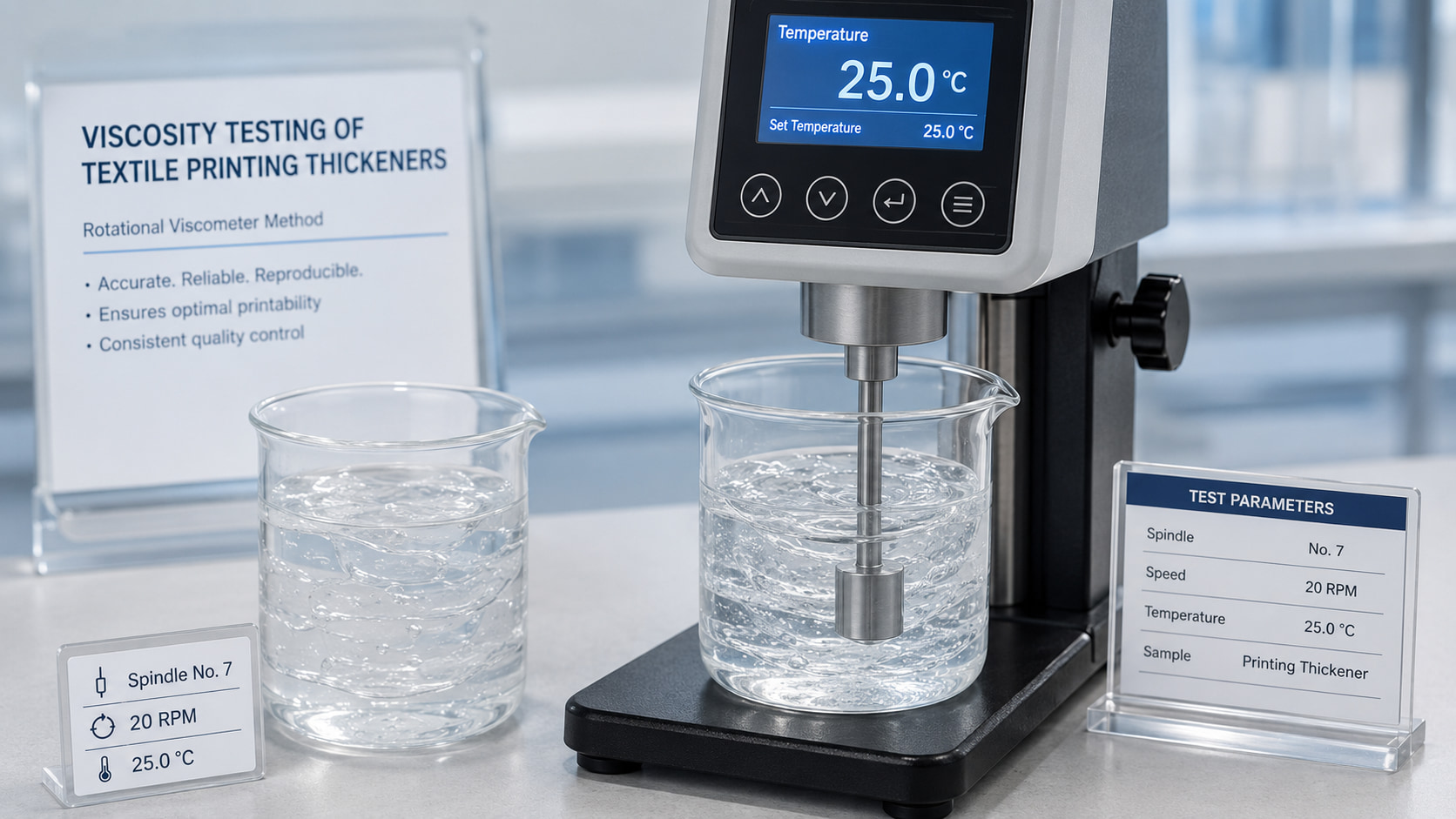
Tìm hiểu lý do tại sao không thể so sánh các giá trị độ nhớt của chất làm đặc trong in ấn dệt may nếu không đảm bảo các yếu tố như nồng độ, nhiệt độ, thiết bị, trục quay, tốc độ, phương pháp chuẩn bị và thời gian thử nghiệm đều giống nhau.
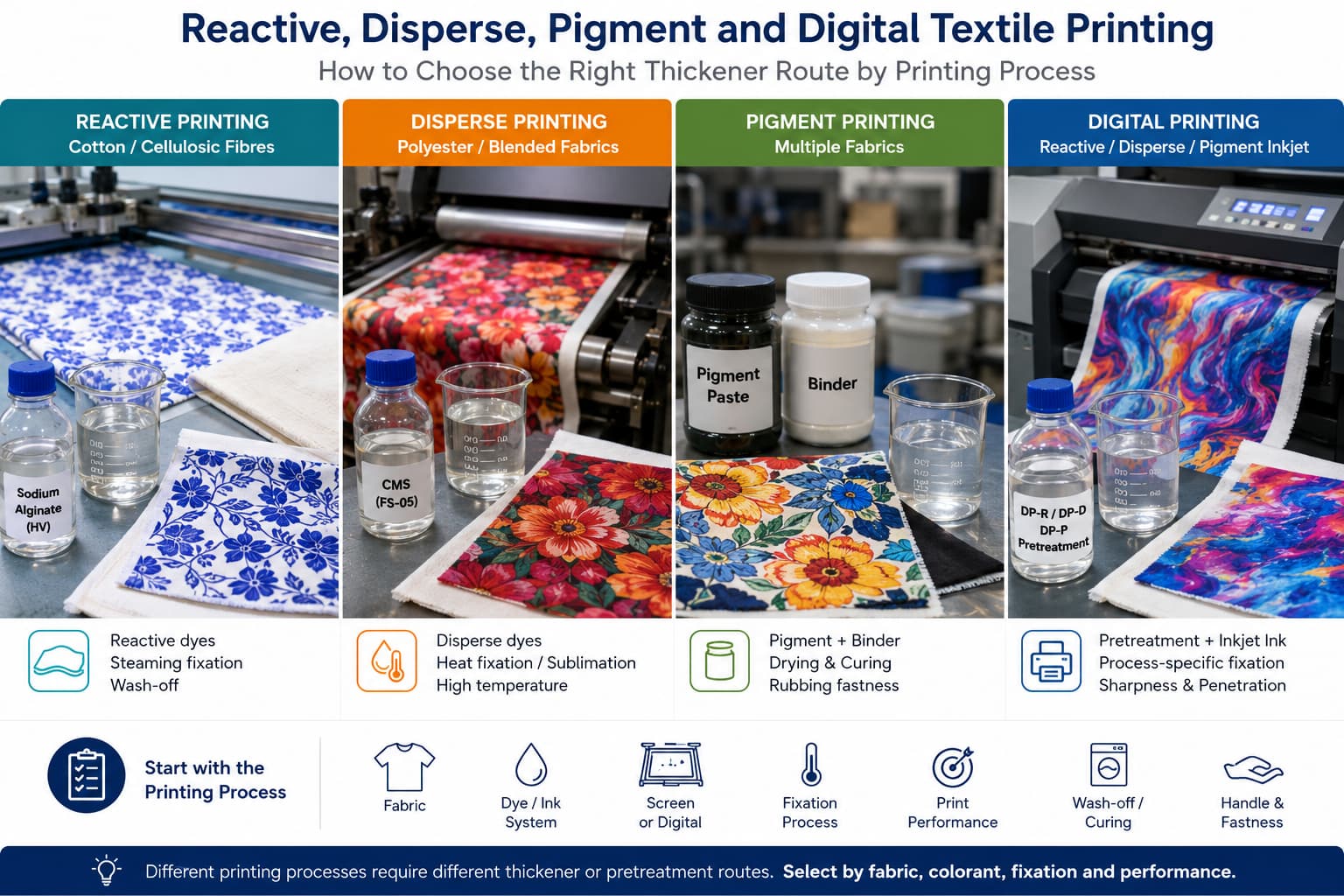
Tìm hiểu cách lựa chọn chất làm đặc và quy trình tiền xử lý cho các phương pháp in dệt phản ứng, in phân tán, in sắc tố và in kỹ thuật số, dựa trên các yêu cầu về vải, thuốc nhuộm hoặc mực in, quá trình cố định màu, khả năng rửa trôi và chất lượng in.
So sánh CMC, CMS, natri alginat và mực in kỹ thuật số trong in ấn dệt may. Tìm hiểu cách thức từng loại nguyên liệu phù hợp với các quy trình in phản ứng, in phân tán, in sắc tố và in kỹ thuật số, cũng như những yếu tố mà người mua cần xem xét trước khi thử mẫu, đối chiếu chất lượng và mua số lượng lớn.
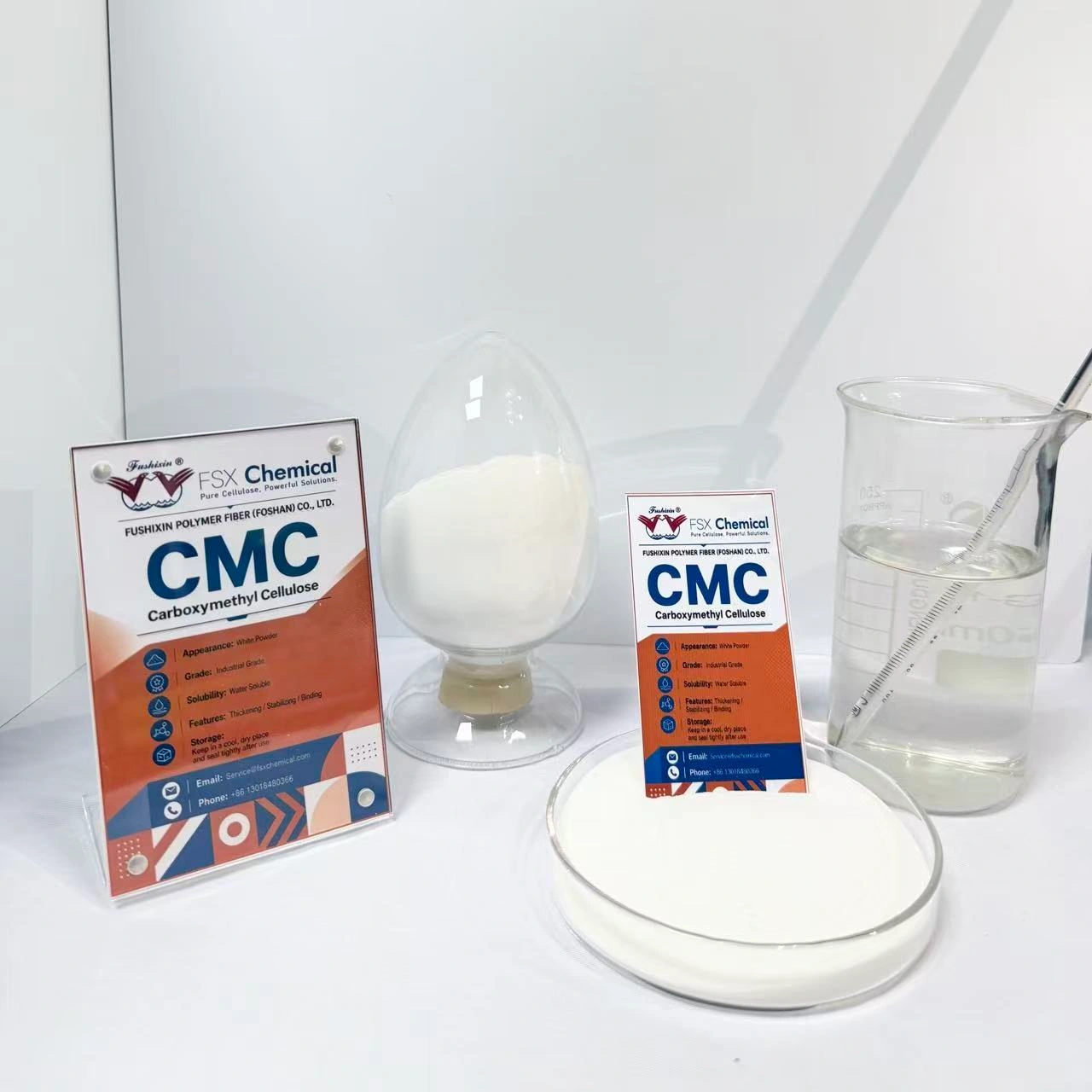
Carboxymethyl cellulose (CMC) được sử dụng rộng rãi trong các quy trình in ấn, xử lý chất làm cứng và nhuộm vải. Hướng dẫn này sẽ giải thích cách đánh giá các loại CMC, những thông số nào là quan trọng nhất, cũng như cách FSX Chemical có thể hỗ trợ các quyết định mua hàng.
Carboxymethyl cellulose được sử dụng làm chất làm đặc và chất ổn định trong mực in gốc nước, in ống đồng và quá trình tiền xử lý cho in phun. Hướng dẫn này trình bày các thông số kỹ thuật chính của sản phẩm và các yếu tố cần xem xét khi lựa chọn nhà cung cấp dành cho các đội ngũ mua hàng.
Hỗn hợp in dựa trên CMC được sử dụng rộng rãi trong in vải bằng bột màu, in phản ứng và in kỹ thuật số. Hướng dẫn này giải thích các thông số quan trọng, cách so sánh các nhà cung cấp và những yêu cầu cần đưa ra trước khi đặt hàng số lượng lớn.
Cả natri alginat và CMC đều được sử dụng làm chất làm đặc trong in vải, nhưng chúng phù hợp với các hệ thống thuốc nhuộm và điều kiện quy trình khác nhau. Hướng dẫn này giải thích những điểm khác biệt chính và thời điểm nên sử dụng từng loại.
CMC loại thực phẩm và loại công nghiệp có cùng cơ sở hóa học nhưng lại khác biệt đáng kể về độ tinh khiết, dải DS và các yêu cầu quy định. Hướng dẫn này giải thích những điểm khác biệt chính và lý do tại sao việc sử dụng loại không phù hợp lại gây ra các vấn đề trong sản xuất.
Chất điều chỉnh độ nhớt (CMS) dành cho mực in dệt may có thể giúp điều chỉnh độ nhớt, cải thiện khả năng thao tác với mực in và đảm bảo hiệu suất ổn định của công thức. Hướng dẫn này giải thích cách người mua có thể đánh giá các loại CMS dựa trên các tiêu chí như độ nhớt, DS, độ hòa tan, pH, độ ẩm và thử nghiệm mẫu trước khi mua số lượng lớn.
Nguyên liệu thô có nguồn gốc từ cellulose được sử dụng trong in ấn dệt may, pha chế hỗn hợp in, làm đặc và hỗ trợ công thức. Hướng dẫn này giải thích cách người mua có thể đánh giá các sản phẩm như CMC, CMS, alginat natri, chất làm đặc trong in ấn dệt may và các sản phẩm hỗn hợp in thông qua thông số kỹ thuật, tài liệu kỹ thuật, thử nghiệm mẫu và sự hỗ trợ từ nhà cung cấp.
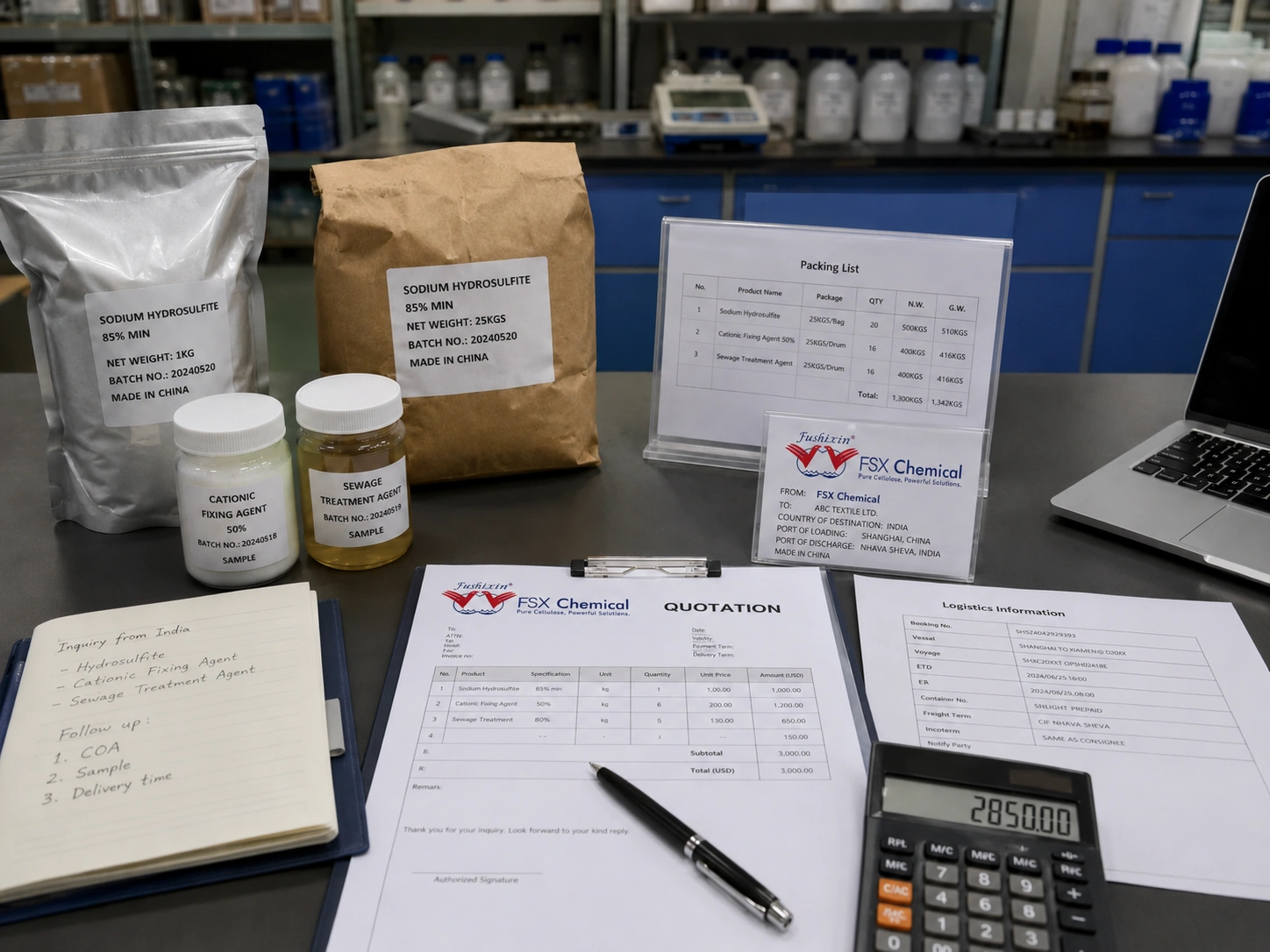
Các dẫn xuất cellulose được ứng dụng rộng rãi trong in ấn dệt may, pha chế bột in, làm đặc và hỗ trợ công thức. Hướng dẫn này giải thích cách các nhà mua hàng nước ngoài có thể nhập khẩu CMC, CMS, natri alginat, chất làm đặc dùng trong in ấn dệt may và các sản phẩm bột in từ FSX Chemical, kèm theo các dịch vụ hỗ trợ như bảng dữ liệu kỹ thuật (TDS), chứng nhận phân tích (COA), thử nghiệm mẫu, đối chiếu tiêu chuẩn chất lượng và hỗ trợ thủ tục xuất khẩu.
Việc lựa chọn hóa chất trong ngành dệt may không chỉ đơn thuần là so sánh tên sản phẩm. Hướng dẫn này giải thích cách người mua hóa chất in dệt may có thể lựa chọn các sản phẩm như CMC, CMS, natri alginat, chất làm đặc trong in dệt may và bột in phù hợp dựa trên ứng dụng, thông số kỹ thuật, TDS, COA, thử nghiệm mẫu và tính đồng nhất giữa các lô sản phẩm.
Vui lòng cung cấp tên sản phẩm, ứng dụng, số lượng, điểm đến và bất kỳ tài liệu kỹ thuật (TDS),
hình ảnh mẫu hoặc tài liệu nào mà quý khách đã có. FSX Chemical sẽ xem xét
thông tin này và đề xuất bước tiếp theo liên quan đến báo giá, đối chiếu mẫu
hoặc lựa chọn sản phẩm.
Thông tin sản phẩmTên sản phẩm, cấp loại, mẫu mã, ảnh nhãn mác hoặc mã tham chiếu của nhà cung cấp.
Các tài liệu có sẵnTDS, SDS, COA, ảnh mẫu, danh mục sản phẩm hoặc dữ liệu thử nghiệm.
Chi tiết đơn hàngSố lượng dự kiến, hình thức đóng gói, nước nhập khẩu, cảng hoặc điều kiện thương mại.
Yêu cầu hoặc Vấn đềQuy trình in trên vải, yêu cầu về công thức, vấn đề hiện tại hoặc chỉ tiêu hiệu suất.