 AR
AR  EN
EN  BN
BN  ES
ES  TR
TR  FR
FR  ID
ID  RU
RU  UR
UR 
For technical buyers, the objective is not to identify a product with the closest name or headline specification. The objective is to find a grade that can meet the required paste behavior and final fabric performance under the factory’s actual production conditions.
What Grade Matching for Textile Printing Pastes Actually Means
Grade matching is a structured comparison between a current product and one or more candidate grades. The comparison should cover the complete application, from paste preparation through printing, fixation and post-treatment.
A candidate should not be described as a direct equivalent until it has been tested with the relevant fabric, colorant, auxiliaries, machine conditions and quality requirements. Even products in the same chemical family can differ in hydration behavior, rheology, filtration, electrolyte tolerance and batch specifications.
When grade matching may be required
- Replacing a current printing thickener or prepared paste
- Qualifying a second supplier for supply continuity
- Moving from laboratory production to a larger printing line
- Changing the fabric, dye class, pigment system or printing method
- Addressing screen blockage, bleeding, poor wash-off or viscosity drift
- Reviewing cost-in-use rather than purchasing only by unit price
- Developing a new reactive, disperse, pigment or digital printing route
Step 1: Define the Printing Application
The first step is to describe where and how the paste will be used. A supplier cannot recommend a suitable starting grade from the product name or fabric type alone.
For example, cotton printed with reactive dyes, cotton printed with pigments and cotton treated for digital inkjet printing are three different chemical systems. They may require different thickener families, rheology and post-treatment behavior.
Application information to record
- Fabric or fibre composition, including blend ratio
- Dye, pigment or ink system
- Printing method, such as flat screen, rotary screen, coating or digital pretreatment
- Machine type and normal production speed
- Fixation and post-treatment process
- Required print definition, penetration, shade response and fabric handle
- Main production problem that the new grade should address
If several fabrics or printing systems are involved, separate them into individual matching projects. One grade should not be assumed to cover every process without independent testing.
Step 2: Build a Clear Reference Benchmark
The current product should be treated as the reference benchmark. Record how it is prepared, tested and used before introducing a candidate grade.
If the current TDS is available, share it with the supplier. A sample of the current powder, stock paste or ready-to-use paste can also help clarify the reference, subject to the buyer’s confidentiality policy.
Reference information to collect
- Current product name and supplier
- Current TDS and relevant specification limits
- Dosage or concentration in the working formula
- Water quality and preparation temperature
- Mixing sequence, mixing speed and hydration time
- Viscosity result with the complete test method
- Normal paste holding time before printing
- Current printing result and known production limitations
A benchmark should include both strengths and weaknesses. If the current product produces good outline definition but creates difficult wash-off, both observations should be included in the matching target.
Step 3: Normalize the Test Conditions
Viscosity values cannot be compared unless the test conditions are the same. Concentration, temperature, hydration time, spindle or instrument, rotational speed, test method and unit can all affect the reported result.
Two grades described as “high viscosity” may have been tested at different concentrations or by different methods. Comparing the numbers without reviewing the test conditions can lead to an incorrect shortlist.
Use one documented test method
Before preparing samples, define one test method for both the reference and candidate grades. Record at least:
- Product concentration
- Water temperature and water quality
- Mixing equipment and mixing speed
- Mixing and hydration time
- Resting time before measurement
- Measurement temperature
- Viscometer, spindle, speed or alternative test method
- Result and measurement unit
Use the same preparation procedure for every sample. If the candidate requires a different preparation method, document the change and evaluate whether it is practical for factory production.
Step 4: Shortlist the Product Family and Starting Grade
The application should determine the product family to be evaluated. Chemical family is a starting point, not proof of final suitability.
Carboxymethyl cellulose can be evaluated in selected pigment formulations, supporting thickener systems and other relevant applications. It should not be treated as a universal replacement for sodium alginate in reactive dye printing.
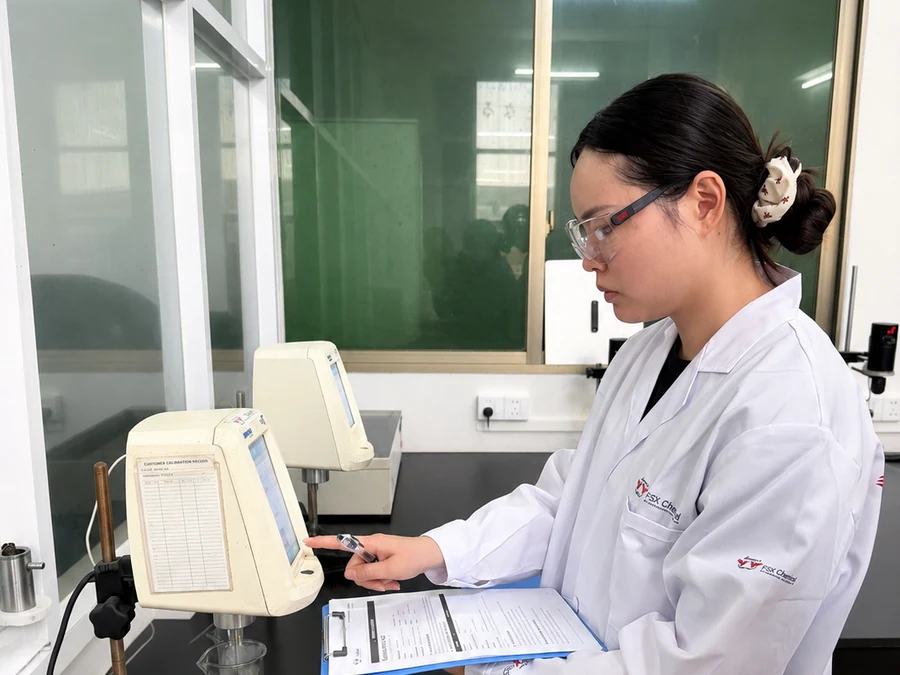
Specifications to review before requesting a sample
- Intended application stated on the TDS
- Viscosity range and complete test conditions
- Moisture and pH specifications
- Degree of substitution where relevant
- Purity-related specifications and residual salts where relevant
- Solubility, hydration or dispersion behavior
- Filtration and insoluble matter requirements
- Compatibility guidance for dyes, pigments, binders, alkalis and auxiliaries
Do not request a sample solely because one specification appears similar. Ask the supplier to explain why the proposed grade is a reasonable starting point for the stated process.
Step 5: Prepare Reference and Candidate Samples Under Controlled Conditions
Prepare the reference product and candidate grades under controlled laboratory conditions. Change one variable at a time so that differences can be connected to the product rather than to inconsistent preparation.
Keep these conditions consistent
- Water source and water temperature
- Sample size and container geometry
- Order of addition
- Mixing equipment, speed and time
- Hydration and resting time
- Testing temperature
- Storage container and holding period
Equal dosage is not always a fair comparison. If two grades have different thickening efficiency, first compare them at equivalent target paste behavior. The dosage required to reach that behavior can then be included in the cost-in-use calculation.
Step 6: Evaluate the Paste Before Printing
A candidate that reaches the target viscosity may still fail during preparation or storage. Evaluate the physical behavior of the paste before moving to the printing trial.
Immediate preparation checks
- Wetting and dispersion behavior
- Hydration time
- Presence of lumps, gel particles or insoluble residue
- Filtration behavior
- Foam generation
- Paste smoothness and visual uniformity
Holding and stability checks
- Viscosity immediately after preparation
- Viscosity after the normal factory holding period
- Separation, settling or skin formation
- Response after adding the complete auxiliaries
- Effect of salts, alkali, binder or other formulation components
The candidate should be tested in the complete printing formulation, not only as a solution in water. Auxiliaries can change viscosity, rheology and storage stability.
Step 7: Run a Controlled Printing Trial
After the paste passes the laboratory preparation checks, run a controlled print trial. Use the same fabric, colorant concentration, screen or coating conditions, fixation process and post-treatment sequence for the reference and candidate.
Printing behavior to observe
- Screen passing and release
- Paste transfer and machine behavior
- Outline definition and bleeding
- Penetration and surface coverage
- Screen blockage or deposit formation
- Foam and paste stability during the run
- Consistency between the beginning and end of the trial
A laboratory drawdown or hand-screen test can be useful for the first comparison, but it does not replace a production-relevant machine trial.
Step 8: Evaluate Fixation, Wash-Off and Final Fabric Performance
The grade-matching decision should be based on the final printed fabric, not only on paste viscosity or on-machine behavior.
Apply the same fixation and post-treatment conditions to the reference and candidate samples. Record any change in washing demand, residue or fabric handle.
Final result to evaluate
- Shade response and visual consistency
- Print sharpness and edge definition
- Penetration and coverage
- Wash-off behavior and residual paste
- Fabric handle
- Relevant rubbing or fastness results
- Post-treatment efficiency
Any numerical performance claim should be supported by a documented test method and a comparable control. Avoid using isolated percentages without clearly defined trial conditions.
Step 9: Compare Cost-in-Use and Production Practicality
Unit price alone does not show the actual operating cost of a printing paste grade. A fair comparison should consider the dosage required to reach the target paste behavior and the effect on preparation, printing and post-treatment.
Cost-in-use factors may include
- Dosage required for the target paste performance
- Mixing time and energy demand
- Filtration or screen-cleaning requirements
- Paste loss during preparation and production
- Machine interruptions or screen blockage
- Wash-off and rinsing requirements
- Rejected fabric or reprocessing risk
- Packaging, storage and inventory handling
The lowest-priced grade may not be the lowest-cost production option. The final decision should balance technical performance, process reliability, documentation and commercial conditions.
Step 10: Confirm Sample-to-Bulk Controls
Before approving a bulk order, confirm that the purchasing specification reflects the parameters evaluated during the trial.
Documents and controls to request
- TDS with application scope and test methods
- SDS with handling, storage and transport information
- Agreed product specification
- Batch-specific COA for the ordered lot when available
- Packaging and shelf-life information
- Batch code and traceability procedure
- Sample retention or pre-shipment sample procedure where agreed
- Process for handling an out-of-specification batch
Confirm which documents and sample services are available for the selected grade and destination. Do not assume fixed sample quantities, response times or delivery schedules without checking the supplier’s current policy.
Grade-Matching Evaluation Record
| Evaluation stage | Information to record | Main approval question |
|---|---|---|
| Application definition | Fabric, colorant, printing method, fixation and quality target | Is the candidate intended for this complete printing process? |
| Reference benchmark | Current product, formula, TDS, dosage and production issue | Is the matching target clearly defined? |
| Laboratory preparation | Water, concentration, mixing, hydration, viscosity and filtration | Can the candidate be prepared consistently under factory-relevant conditions? |
| Paste stability | Holding viscosity, separation, foam and auxiliary compatibility | Does the paste remain usable during the normal holding period? |
| Printing trial | Screen behavior, transfer, definition, penetration and machine stability | Does the candidate perform reliably during printing? |
| Final fabric | Shade, wash-off, residue, handle and relevant fastness results | Does the final fabric meet the acceptance criteria? |
| Commercial approval | Cost-in-use, documents, packaging, traceability and batch controls | Can the approved sample be translated into a controlled bulk purchase? |
Common Grade-Matching Mistakes
- Comparing products only by viscosity grade or product name
- Using viscosity values measured under different test conditions
- Changing dosage, auxiliaries and preparation method at the same time
- Testing the product in water but not in the complete printing formula
- Skipping the holding-stability check
- Approving a product from a laboratory viscosity result without printing it
- Comparing unit price without calculating dosage and process cost
- Placing a bulk order before confirming the sample-to-bulk specification
- Accepting purity, compliance or environmental claims without grade-specific documentation
What to Send FSX Chemical for Grade Matching
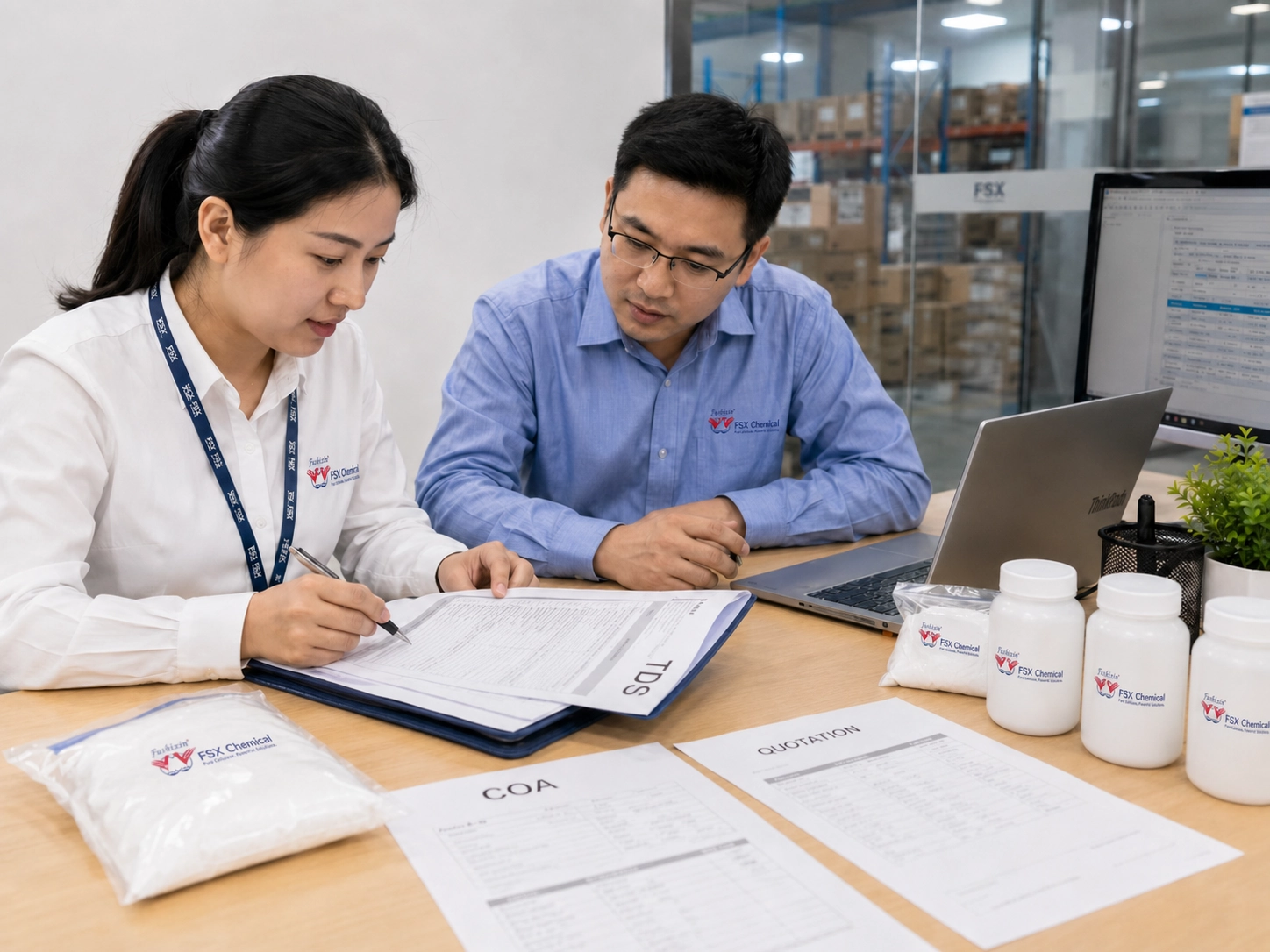
Share as much of the following information as your confidentiality rules allow:
- Fabric or fibre composition
- Dye, pigment or ink system
- Printing method and machine type
- Current product name, TDS or representative sample
- Current paste formula or relevant formulation information
- Target viscosity with the complete test method
- Required print and post-treatment performance
- Main production problem
- Estimated order quantity, packaging requirement and destination
Start with a Controlled Grade-Matching Trial
Send your current TDS, printing process, fabric, colorant system, target viscosity and main production issue. Our team can review the application and help identify a suitable starting grade for sample evaluation📧 البريد الإلكتروني: Service@fsxchemical.com