Matching CMC, CMS or sodium alginate requires more than finding the same viscosity. A reliable grade-matching process compares the test method, polymer behavior, hydration, rheology, filtration, chemical compatibility and actual textile printing performance before a new commercial grade is approved.
Textile printing mills frequently need to qualify an alternative thickener supplier. The reason may be cost, supply security, technical improvement, regional availability or the need for a second approved source.
At first, grade matching appears simple. A buyer checks the current product’s viscosity, asks another supplier for a similar value and tests the new sample. In practice, this approach often produces misleading results.
CMC, CMS and sodium alginate are polymer families rather than single standardized products. Commercial grades can differ in viscosity, substitution, molecular characteristics, particle profile, hydration, filtration, rheology, chemical response and effective dosage.
Even two samples that produce the same single-point viscosity can behave differently during pumping, screen passage, printing, fixation and washing.
The central rule of professional grade matching is therefore simple: match the function and application performance, not just the product name or viscosity number.
What Does Grade Matching Really Mean?
Grade matching is the process of identifying a candidate commercial product that can perform within the required operating window of an existing material or defined manufacturing process.
This definition is deliberately different from saying that two products are chemically identical.
In industrial textile printing, a matched grade normally means that the candidate has passed the technical criteria considered important for the customer’s application.
A complete match may consider
هوية المنتج
كفاءة اللزوجة
Test method
Hydration or dissolution
علم الريولوجيا
الترشيح
Chemical compatibility
استقرار الحيازة
Printing performance
Post-treatment performance
الجرعة الفعالة
اتساق الدُفعات
التكلفة الإجمالية أثناء الاستخدام
A candidate does not need to reproduce every laboratory number identically if it achieves the required production and finished-fabric performance inside the approved specification.
Why Matching by Product Name Often Fails
Commercial terminology is useful for organizing products, but it does not create universal specifications.
Terms such as high viscosity, medium viscosity, textile grade, printing grade or premium grade can mean different things to different manufacturers.
Supplier grade names are internal systems
One manufacturer’s HV sodium alginate may fall into another manufacturer’s MV range. The same problem can occur with high-, medium- and low-viscosity CMC or CMS descriptions.
Product family is not enough
Knowing that both products are CMC does not prove that they have the same degree of substitution, viscosity profile, purity, hydration or rheology.
Application names are also broad
Two products described as textile printing grade may have been optimized for different printing systems, fabric types or paste formulations.
The permanent commercial grade and its actual technical data are therefore more useful than a general marketing description.
The Golden Rule: Match the Test Method Before the Number
The most important first step in grade matching is to align the measurement method.
A viscosity value without test conditions is incomplete information.
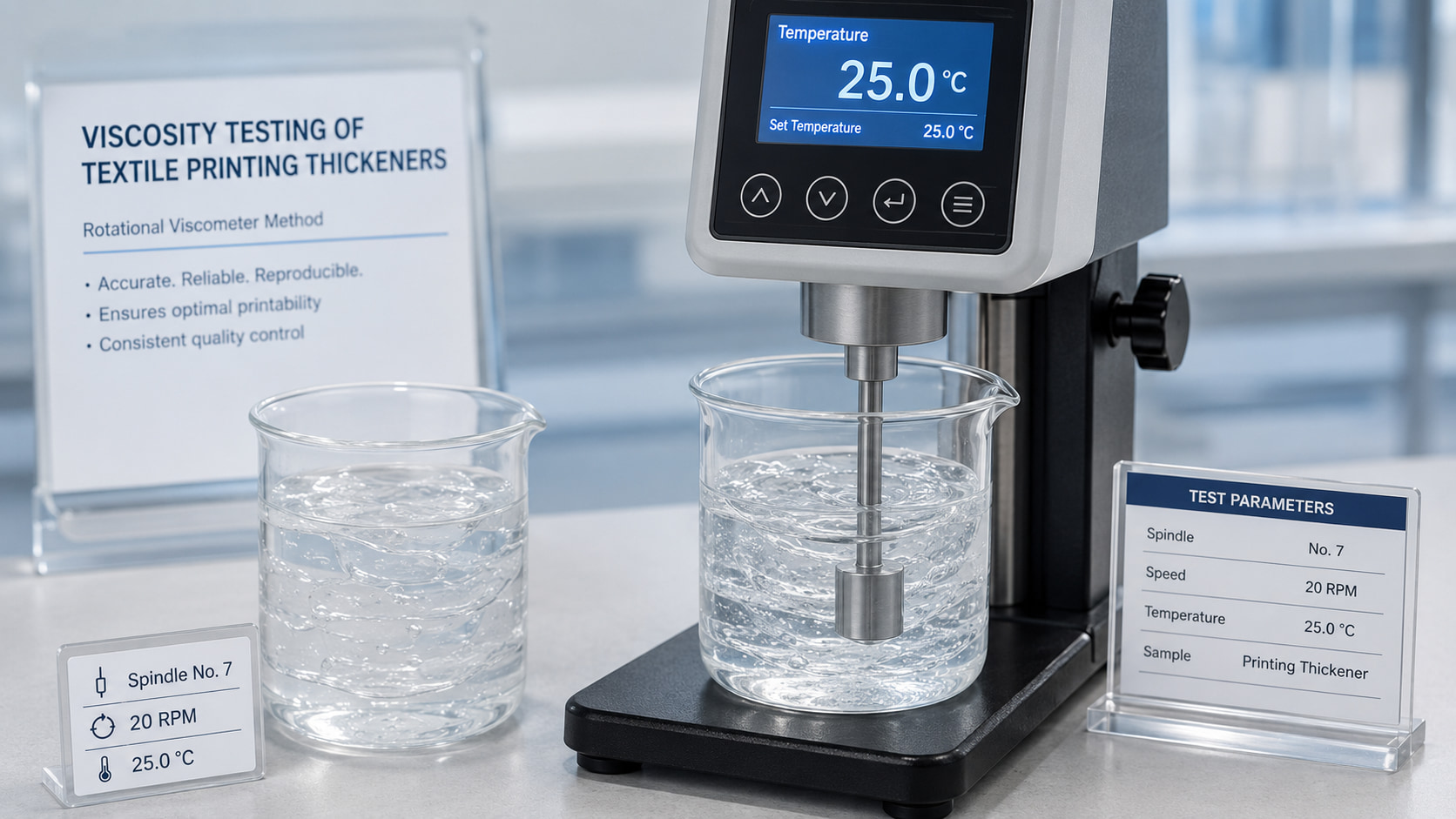
For viscosity comparison, record
تركيز المنتج
Concentration calculation basis
جودة المياه
Powder addition method
Mixing time and speed
Hydration or resting time
درجة حرارة القياس
مقياس اللزوجة
المغزل، الدوار أو الشكل الهندسي
سرعة الدوران
الوقت اللازم للقراءة
الوحدة المُبلغ عنها
If Supplier A reports 5,000 mPa·s using one concentration and Supplier B reports 5,000 mPa·s using another, the numbers should not be treated as equivalent.
The same principle applies when the spindle, speed or temperature differs.
Before asking whether two grades have the same viscosity, first ask whether they were measured using the same method.
Tip 1: Start with the Current Approved Product
When the customer already has a successful product, that material is the most useful benchmark.
Do not begin by asking the new supplier to recommend a product from only a broad description such as “high-viscosity CMC.”
Build a current-product profile
الشركة المصنعة
درجة تجارية دقيقة
TDS
Recent COA
Physical sample
الجرعة الحالية
Current viscosity method
صيغة الطباعة
القماش
آلة الطباعة
Current strengths and weaknesses
This creates a technical target instead of asking the new supplier to guess what “similar” means.
Tip 2: Define the Application Before Selecting a Polymer
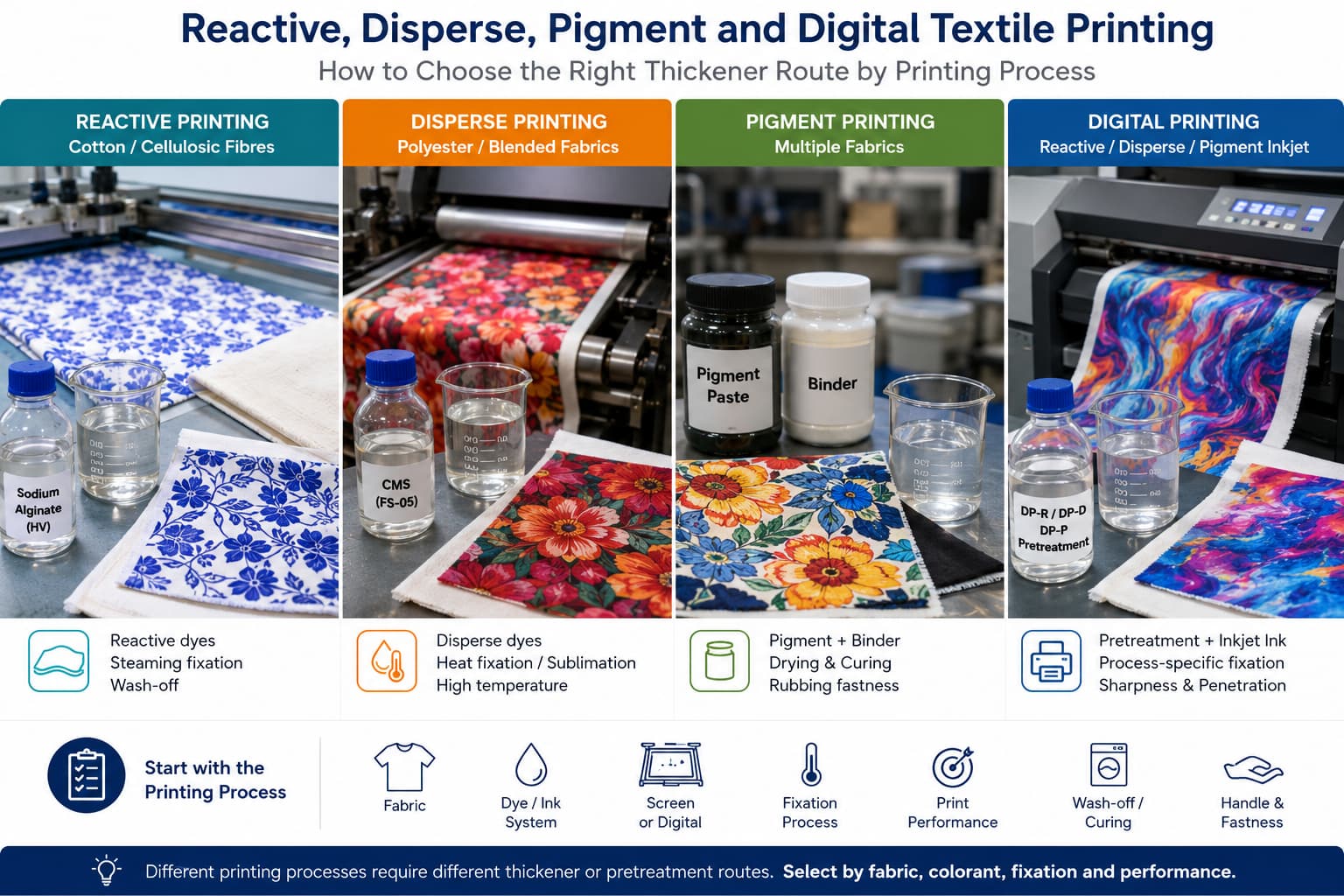
Grade matching should begin with the printing process because CMC, CMS and sodium alginate are not universally interchangeable.
الطباعة التفاعلية
Sodium alginate is a common benchmark thickener for conventional reactive dye printing on suitable cellulosic textiles.
الطباعة المتفرقة
CMS and other application-specific thickener systems may be evaluated for selected disperse printing processes depending on the dye, polyester fabric and fixation route.
أنظمة المكثفات المركبة
CMC and CMS may be used as components of selected blended systems when viscosity, rheology, stability and cost need to be balanced.
A cross-family substitution should therefore be treated as formulation development, not simple grade matching.
Two CMC grades with similar viscosity can still differ significantly in solution behavior and textile performance.
Important CMC comparison factors include
درجة الاستبدال
Viscosity and test concentration
Purity-related specification where relevant
الرقم الهيدروجيني
الرطوبة
Particle characteristics
Dissolution and hydration
الترشيح
استجابة الشوارد
علم الريولوجيا
Do not match CMC only at one concentration
First compare the products at the same standardized concentration. After understanding the baseline, optimize each candidate separately to find its practical operating concentration.
Evaluate the complete formulation
A CMC that looks excellent in clean water may change after salts, dyes, pigments or other auxiliaries are added.
Tip 4: Understand Degree of Substitution in CMC Matching
Degree of substitution, commonly abbreviated as DS, is an important structural characteristic of CMC.
It describes the average substitution of hydroxyl groups on the cellulose structure with carboxymethyl groups.
DS can influence solubility, ionic behavior and formulation compatibility.
Higher DS does not automatically mean better CMC
A higher value represents a different chemical structure, not a universal quality ranking.
Similar DS does not prove equivalence
Two CMC products with comparable DS may still differ in molecular characteristics, viscosity, purity, particle profile and rheology.
Use DS as one matching parameter
When the current CMC performs successfully, its DS range can provide useful guidance for selecting the candidate, but final approval should still depend on application testing.
Tip 5: Match CMS by Application Behavior
نشا الكربوكسي ميثيل is another modified polysaccharide route used in selected textile applications.
CMS matching should not be reduced to finding the same viscosity number.
Important CMS comparison factors can include
Commercial grade identity
طريقة اللزوجة
Substitution characteristics where specified
الرطوبة
الرقم الهيدروجيني
الترطيب
الترشيح
ثبات المعجون
علم الريولوجيا
Application performance
CMS grades can behave differently at the same viscosity
Different starch sources, modification routes and manufacturing conditions can influence how a CMS grade hydrates and responds in the complete printing formulation.
Evaluate cost only after performance
CMS is sometimes evaluated as part of a cost-optimization strategy, but a lower raw-material price does not prove lower production cost. Effective dosage, screen behavior, waste and final fabric quality should also be considered.
Tip 6: Do Not Treat HV, MV and LV as Universal Standards
ألجينات الصوديوم is frequently sold in high-viscosity, medium-viscosity and low-viscosity grades.
These classifications are useful within a supplier’s own product system, but they should not be treated as universal viscosity standards.
Supplier A’s HV may not equal Supplier B’s HV
Manufacturers can use different internal viscosity ranges and different test methods.
Ask for the actual viscosity specification
Confirm concentration, temperature, instrument, spindle and speed rather than matching only the letters HV, MV or LV.
Higher viscosity does not mean higher quality
A high-viscosity alginate may provide greater thickening efficiency under specified conditions, but printing performance also depends on rheology, filtration, hydration, chemical compatibility and dosage.
Test after complete reactive processing
For conventional reactive printing, candidate sodium alginate should be evaluated after color-paste preparation, printing, fixation and washing.
Tip 7: Compare Hydration and Dissolution
Preparation behavior has direct influence on both laboratory results and production efficiency.
Compare powder addition behavior
Observe whether the sample wets evenly or forms persistent lumps when introduced using the standard preparation procedure.
Compare hydration time
Measure viscosity at defined intervals to understand whether the polymer reaches equilibrium quickly or continues developing over time.
Inspect solution uniformity
Undissolved or incompletely hydrated particles can distort viscosity readings and later create filtration problems.
Do not change the preparation method between candidates
If one sample is mixed for longer or at a different temperature, the comparison no longer isolates the product difference.
Tip 8: Compare Rheology, Not Just Standing Viscosity
A single viscosity value describes paste resistance under one defined measurement condition. Textile printing exposes the paste to changing shear.
In the storage tank
The system experiences relatively low shear and needs sufficient physical stability.
During pumping
The paste experiences greater shear and must flow through pipelines and circulation systems.
During screen passage
Shear increases further as the paste is forced through the screen.
After transfer to the fabric
Structural recovery helps influence spreading, definition and penetration.
Two CMC, CMS or sodium alginate products adjusted to the same standing viscosity can therefore give different printing results.
Tip 9: Standardize Filtration Testing
Filtration is especially important when candidate grades will be used in textile printing.
A meaningful comparison requires a controlled method.
تعريف
تركيز البوليمر
Preparation method
وقت الترطيب
Filter material
Opening or mesh size
كمية العينة
Pressure or gravity conditions
Evaluation of retained residue
Do not only count residue
Inspect what the residue actually is. It may be incompletely hydrated polymer, gel, fibre, contamination or precipitation created by another component.
Test stock solution and complete paste separately
This helps identify whether a filtration issue comes from the polymer itself or from chemical compatibility.
Tip 10: Test Chemical Compatibility
Water-solution testing is a useful QC starting point, but it is not sufficient for final grade approval.
Add formulation components in stages
A staged addition test can help identify whether viscosity, appearance or filtration changes after a particular chemical is introduced.
Depending on the printing system, test interaction with
Dyes
Pigments
Salts
Alkalis
Binders
Humectants
عوامل الترطيب
مزيلات الرغوة
Other polymer thickeners
If the stock solution matches but the complete paste behaves differently, the problem is likely more complex than basic viscosity.
Cross-Family Matching: CMC vs CMS vs Sodium Alginate
Changing from one supplier’s CMC to another CMC can be considered same-family grade matching.
Changing from sodium alginate to CMS or from CMC to another polymer family is a different technical exercise.
It should be treated as formulation development because the chemistry and polymer behavior are changing.
Selected disperse, compound and specialty formulations
Viscosity, hydration, filtration, stability and total cost
These are technical starting directions rather than universal application rules.
Why Same Viscosity Does Not Mean Same Grade
This is one of the most important concepts in textile thickener matching.
Imagine that the current product and candidate both measure the same viscosity under one laboratory condition.
The products can still differ in:
Polymer concentration required
درجة الاستبدال
الخصائص الجزيئية
Particle profile
معدل الترطيب
الريولوجيا متعددة السرعات
التعافي الهيكلي
تحمل الإلكتروليتات
الترشيح
استقرار الحيازة
The same single-point viscosity is therefore evidence of similarity in one parameter, not proof of grade equivalence.
Recommended Side-by-Side Laboratory Workflow
Step 1: Select the reference product
Use material from a known commercial batch that performs successfully in production.
Step 2: Record the complete product specification
Collect the TDS, relevant COA and current internal QC requirements.
Step 3: Align the laboratory method
Define concentration, water, mixer, hydration, temperature, instrument, spindle and speed.
Step 4: Prepare reference and candidate together
Use the same laboratory equipment and preparation conditions.
Step 5: Compare basic solution properties
المظهر
الترطيب
اللزوجة
الرقم الهيدروجيني
الترشيح
الرغوة
الخطوة 6: مقارنة الخصائص الريولوجية حيثما أمكن ذلك
Use multi-speed measurements or another controlled method to observe how flow changes with shear.
الخطوة 7: تحضير معجون الطباعة الكامل
Use the actual dyes, pigments, salts, alkalis, binders and auxiliaries required by the application.
الخطوة 8: اختبار ثبات التثبيت
Repeat important measurements after the normal production holding period.
Step 9: Print the same fabric
Use the same design and application conditions for reference and candidate.
Step 10: Complete fixation and post-treatment
Evaluate the final textile rather than approving the product from paste data alone.
Printing Trial and Finished-Fabric Evaluation
The final purpose of a textile thickener is to perform in textile production. A grade match therefore requires a printing trial.
Use a diagnostic design
Fine lines
Small text
Sharp corners
Fine dots
Large solid areas
Dark shades where relevant
Evaluate wet printing behavior
Observe screen passage, transfer, spreading, penetration and uniformity.
Evaluate after fixation
Color development can change significantly after steaming, thermal fixation or curing.
Evaluate after washing where required
Final definition, color, surface cleanliness and fabric handle are more meaningful than the appearance of the unwashed print.
How to Optimize Dosage After Matching
A candidate grade should normally be compared at equal concentration first to establish a controlled baseline.
After basic suitability has been confirmed, its dosage can be optimized.
Do not assume weight-for-weight replacement
Different grades can provide different thickening efficiency and rheology.
Adjust gradually
Test a small range around the successful baseline rather than making a large dosage change immediately.
Recheck complete performance
Every significant dosage change can influence viscosity, transfer, definition, penetration and total polymer solids.
Calculate cost after dosage optimization
Commercial cost should be compared using the approved operating dosage, not equal kilograms of two different grades.
التحقق من العينة إلى الكمية الإجمالية
A successful laboratory sample is not the end of the qualification process.
The approved material should be connected to a permanent commercial grade.
The chain should ideally connect
عينة مختبرية
Commercial product code
TDS
Approved test result
الاقتباس
Purchase order
دفعة الإنتاج
Package label
COA or relevant batch documentation
Verify the first commercial batch
Repeat critical incoming tests and, where appropriate, a controlled application trial before releasing a new supplier’s first shipment into unrestricted production.
Troubleshooting a Poor Grade Match
Observed Difference
السبب المحتمل
What to Check
Candidate viscosity is too low
Different viscosity efficiency or incomplete hydration
Concentration, preparation, temperature and hydration time
Viscosity matches but printing spreads
Different rheological recovery
Multi-speed behavior, fabric pickup and application pressure
Viscosity matches but screen passage is poor
Filtration or shear-flow difference
Residue, hydration, screen condition and rheology
Stock solution matches but complete paste changes
Chemical compatibility
Stage-added dyes, salts, alkalis, binders or auxiliaries
Lab trial passes but production fails
Scale-up difference
Batch size, mixer geometry, pump shear and holding time
First bulk batch differs from sample
Sample-to-bulk or method issue
Grade code, batch identity, COA and retained reference
Candidate costs less but total usage rises
Lower thickening efficiency
Optimized dosage and cost in use
What Information to Send Your Supplier
The quality of a grade-matching recommendation depends heavily on the quality of the information supplied by the customer.
Current product information
Product family: CMC, CMS or sodium alginate
الشركة المصنعة
Exact grade
TDS
COA where available
Physical sample
Laboratory information
اللزوجة
تركيز الاختبار
الماء
Preparation method
وقت الترطيب
درجة الحرارة
Instrument
Spindle and speed
Production information
الجرعة الحالية
Complete printing formulation
Printing route
تركيبة النسيج
Printing equipment
مدة الانتظار
Fixation or curing method
Washing process where applicable
معلومات تجارية
Estimated order quantity
متطلبات التغليف
Destination country or port
Current cost target where relevant
Providing this information allows a supplier to select a much more relevant starting grade.
How to Compare Commercial Cost
Grade matching should end with a cost comparison, but price per kilogram alone is not sufficient.
Compare delivered material cost
Use the same trade-term basis and include relevant freight and packaging.
Compare effective dosage
Calculate cost using the amount of product required to achieve the approved production result.
Compare preparation
Hydration time, filtration and operator corrections can influence real manufacturing cost.
Compare machine performance
Screen cleaning, downtime, paste transfer and printing speed should be considered.
Compare finished-fabric quality
Rework, rejected material or additional post-treatment can eliminate an apparent raw-material saving.
The preferred alternative is therefore not necessarily the cheapest product. It is the product that achieves the required production performance at an acceptable total cost in use.
كيف يدعم برنامج FSX Chemical عملية مطابقة الدرجات
FSX Chemical provides several textile thickener routes, including CMC, CMS, sodium alginate and application-specific printing paste solutions.
Customers who already use an approved thickener can begin with their existing product rather than selecting a replacement from a generic viscosity table.
من خلال العينات والمطابقة , buyers can provide the current TDS, physical sample, viscosity method and textile printing information for technical review📧 البريد الإلكتروني: Service@fsxchemical.com
The matching process can include
Review of the current commercial grade
Review of TDS and available batch information
Alignment of viscosity test methods
Selection of a candidate polymer route
Selection of a trial grade
Side-by-side laboratory comparison
Customer printing evaluation
Dosage optimization
عرض أسعار تجاري
First-batch verification planning
The purpose of grade matching is not to claim that the candidate is chemically identical to the customer’s existing product. It is to identify a technically relevant alternative and confirm whether it meets the customer’s real production requirements.
الأسئلة الشائعة
What is the most important parameter when matching CMC grades?
There is no single sufficient parameter. Viscosity and degree of substitution are important, but hydration, filtration, rheology, chemical compatibility and application performance should also be compared.
Can two CMC grades with the same viscosity replace each other directly?
Not automatically. They can differ in degree of substitution, molecular characteristics, hydration, rheology, purity-related properties and electrolyte response.
Is the degree of substitution enough to match CMC?
No. DS is a useful structural parameter, but similar DS does not prove equivalent viscosity or application behavior.
How should CMS grades be matched?
Compare the commercial specification, viscosity method, hydration, filtration, rheology, paste stability and performance in the intended printing system.
Are HV, MV and LV sodium alginate grades standardized?
Universal numerical ranges should not be assumed. Each supplier can define its own high-, medium- and low-viscosity categories, so the actual viscosity method and specification should be reviewed.
هل يمكن أن يحل CMC محل ألجينات الصوديوم؟
A universal one-to-one replacement should not be assumed. Changing polymer families changes the formulation chemistry and should be treated as a controlled application-development project.
هل يمكن أن يحل مركب CMS محل ألجينات الصوديوم؟
CMS may be evaluated in selected formulations, including compound thickener systems, but suitability depends on the printing chemistry, fabric, fixation and finished-fabric requirements.
Why can two products with the same viscosity print differently?
They may have different shear-thinning behavior, structural recovery, polymer concentration, filtration, hydration and response to the chemicals in the complete printing paste.
Should candidate thickeners be compared at the same dosage?
Equal concentration is useful for the initial technical baseline. Afterward, each candidate should be optimized separately to determine its practical production dosage.
When is a grade match complete?
A technically strong grade-matching process includes standardized laboratory testing, complete-formula evaluation, fabric printing, post-treatment, dosage optimization and verification of the first commercial batch.
Need to Match a CMC, CMS or Sodium Alginate Grade?
Send FSX Chemical the TDS or physical sample of the thickener you currently use together with its viscosity, test concentration, preparation method, current dosage and textile printing application.
For CMC, include the degree of substitution where available. For sodium alginate, include the actual viscosity method rather than only an HV, MV or LV designation. For CMS, include the current application and complete paste formulation where possible.
The objective is to select a technically relevant candidate for controlled side-by-side testing before any commercial supplier conversion.
تعرف على السبب الذي يجعل من المستحيل مقارنة قيم لزوجة مكثفات الطباعة النسيجية دون مطابقة كل من التركيز، ودرجة الحرارة، والجهاز المستخدم، والمغزل، والسرعة، وطريقة التحضير، ووقت الاختبار.
تعرف على كيفية اختيار المُكثِّف وطرق المعالجة المسبقة للطباعة النسيجية التفاعلية، والطباعة بالتشتت، والطباعة بالصبغات، والطباعة الرقمية، بناءً على متطلبات النسيج، والصبغة أو الحبر، والتثبيت، وقابلية الغسل، وجودة الطباعة.
قارن بين CMC وCMS وألجينات الصوديوم ومعجون الطباعة الرقمية المستخدمة في طباعة المنسوجات. تعرف على مدى ملاءمة كل خيار لعمليات الطباعة التفاعلية، والطباعة بالتشتت، والطباعة بالصبغات، والطباعة الرقمية، وما يجب على المشترين مراجعته قبل اختبار العينات، ومطابقة الدرجات، والشراء بالجملة.
يُستخدم ألجينات الصوديوم على نطاق واسع في طباعة المنسوجات كمكثف مستقر وقابل للغسل لمعجون الطباعة التفاعلي. تعرف على كيفية تقييم درجة اللزوجة والنقاء ومدى ملاءمة الاستخدام قبل الشراء، وكيف تدعم شركة FSX Chemical المشترين العالميين من خلال توفير البيانات الفنية والعينات.
يُستخدم كربوكسي ميثيل السليلوز (CMC) على نطاق واسع في عمليات الطباعة والتحجيم والصباغة للمنسوجات. سيشرح هذا الدليل كيفية تقييم درجات جودة CMC، والمعايير الأكثر أهمية، وكيف يمكن لشركة FSX Chemical دعم قرارات الشراء.
يُستخدم كربوكسي ميثيل السليلوز كمكثف ومثبت في الأحبار المائية، والطباعة بالحفر، والمعالجة المسبقة في الطباعة بنفث الحبر. يتناول هذا الدليل المعايير الرئيسية للدرجات واعتبارات التوريد التي يجب على فرق المشتريات أخذها في الاعتبار.
يُستخدم معجون الطباعة الذي يعتمد على مادة CMC في طباعة المنسوجات بالأصباغ، والطباعة التفاعلية، والطباعة الرقمية. يشرح هذا الدليل المعلمات المهمة، وكيفية مقارنة الموردين، وما يجب طلبه قبل تقديم طلب شراء بالجملة.
يُستخدم كل من ألجينات الصوديوم وCMC كمكثفات في طباعة المنسوجات، لكنهما يناسبان أنظمة صبغ وظروف معالجة مختلفة. يشرح هذا الدليل الاختلافات الرئيسية بينهما ومتى يتم استخدام كل منهما.
تختلف متطلبات المعجون والمعالجة المسبقة في الطباعة الرقمية بنفث الحبر على المنسوجات عن تلك الخاصة بالطباعة بالشاشة الحريرية. يشرح هذا الدليل كيفية استخدام ألجينات الصوديوم في الطباعة الرقمية على المنسوجات، والمعايير التي يجب على فرق المشتريات تحديدها فيما يتعلق بدرجات الجودة.
يتشابه كل من CMC المخصص للاستخدام الغذائي وCMC المخصص للاستخدام الصناعي في التركيب الكيميائي الأساسي، لكنهما يختلفان بشكل كبير من حيث درجة النقاء ونطاق DS والمتطلبات التنظيمية. يشرح هذا الدليل الاختلافات الرئيسية وسبب تسبب استخدام الدرجة غير المناسبة في حدوث مشكلات في الإنتاج.
يُعد التحضير الصحيح للمادة اللزجة أمرًا لا يقل أهمية عن اختيار الدرجة في طباعة المنسوجات بالأصباغ التفاعلية. يتناول هذا الدليل طرق إذابة ألجينات الصوديوم، ونطاقات التركيز حسب الاستخدام، وظروف التخزين، وكيفية معالجة المشكلات الشائعة في عملية التحضير.
يُعد ألجينات الصوديوم بوليمرًا طبيعيًّا وقابلًا للتحلل البيولوجي، لكن استخدامه في طباعة المنسوجات ينتج عنه مياه صرف تحتاج إلى معالجة. يتناول هذا الدليل الملامح البيئية لألجينات الصوديوم، وخصائص مياه الصرف الناتجة عن عملية الغسل، وما يجب على فرق المشتريات فهمه بشأن اختيار المُكثِّف وتأثيره البيئي.
يرجى إرسال اسم المنتج، والتطبيق، والكمية، والوجهة، وأي بيانات تقنية (TDS)،
أو صورة عينة أو مستند متوفر لديكم بالفعل. وستقوم شركة FSX Chemical بمراجعة
هذه المعلومات وتقديم توصية بشأن الخطوة التالية سواء كانت تقديم عرض أسعار، أو مطابقة العينة،
أو اختيار المنتج.
معلومات عن المنتجاسم المنتج، الدرجة، الطراز، صورة الملصق أو مرجع المورد.
الوثائق المتاحةTDS، SDS، COA، صورة العينة، قائمة المنتجات أو بيانات الاختبار.
تفاصيل الطلبالكمية التقديرية، والتعبئة، وبلد المقصد، والميناء، أو الشروط التجارية.
الطلب أو المشكلةعملية طباعة المنسوجات، متطلبات التركيبة، المشكلات الحالية أو الأداء المستهدف.