















Customer Success: Case Studies Using FSX Chemical Textile Agents

These anonymized FSX Chemical application cases show how textile chemicals can be evaluated through grade...

Customer success in textile chemical supply is not defined by a product name alone. A successful result comes from matching the chemical grade to the ink or dye system, fabric, equipment, formulation and production target, then verifying that the approved laboratory result can be repeated in commercial supply. The anonymized application case studies below show how FSX Chemical approaches sodium alginate, CMC, CMS and digital printing paste projects through controlled testing, dosage optimization, sample-to-bulk verification and production feedback.

Case-study note: The examples below are anonymized application cases presented for technical education and supplier-evaluation purposes. Customer identities, confidential formulations and commercially sensitive details are intentionally omitted. Results are process-specific and should not be interpreted as guaranteed performance for every textile mill, ink system, fabric or machine.

What Customer Success Means in Textile Chemical Supply

In B2B textile chemicals, a successful customer result should not be reduced to a statement such as “the customer liked the sample” or “the viscosity was higher.”

A technically meaningful success case should connect:

Customer Requirement → Candidate Grade → Standardized Laboratory Test → Complete Formulation → Fabric Trial → Fixation or Curing → Finished Textile Evaluation → Production Trial → Commercial Supply

This is especially important for application-sensitive products such as:

The same product can perform differently when the dye chemistry, fabric construction, salt level, machine conditions or post-treatment process changes.

For this reason, FSX Chemical approaches customer success as an application-matching process rather than as a universal product claim.

The most useful question is:

Did the selected commercial grade solve the customer’s defined technical or commercial problem under controlled production conditions?

Case Study 1: Reactive Printing Thickener Matching for a Conventional Printing Mill

Customer Situation

A conventional textile printing mill was evaluating an additional thickener supply route for reactive printing on cellulosic fabric. The factory already had an established printing recipe and did not want to redesign the entire process simply to qualify a new supplier.

The customer therefore needed a candidate that could be compared with the current benchmark under the same preparation, printing, steaming and washing conditions.

Initial Technical Risk

The easiest but least reliable approach would have been to compare only the quoted viscosity.

That would have ignored differences in:

  • Viscosity test concentration
  • Hidratación
  • Reología
  • Respuesta electrolítica
  • Fragmento de la pantalla
  • Compatibilidad con los colorantes reactivos
  • Fijación
  • Se enjuaga

The project therefore started by aligning the current grade, dosage and viscosity method as closely as practical.

FSX Evaluation Approach

A suitable alginato de sodio route was selected as the comparison candidate because sodium alginate is a common benchmark for conventional reactive printing on suitable cellulosic fabrics.

The laboratory comparison included:

  1. Standardized hydration and viscosity preparation.
  2. Stock-paste appearance and filtration review.
  3. Complete reactive printing paste preparation.
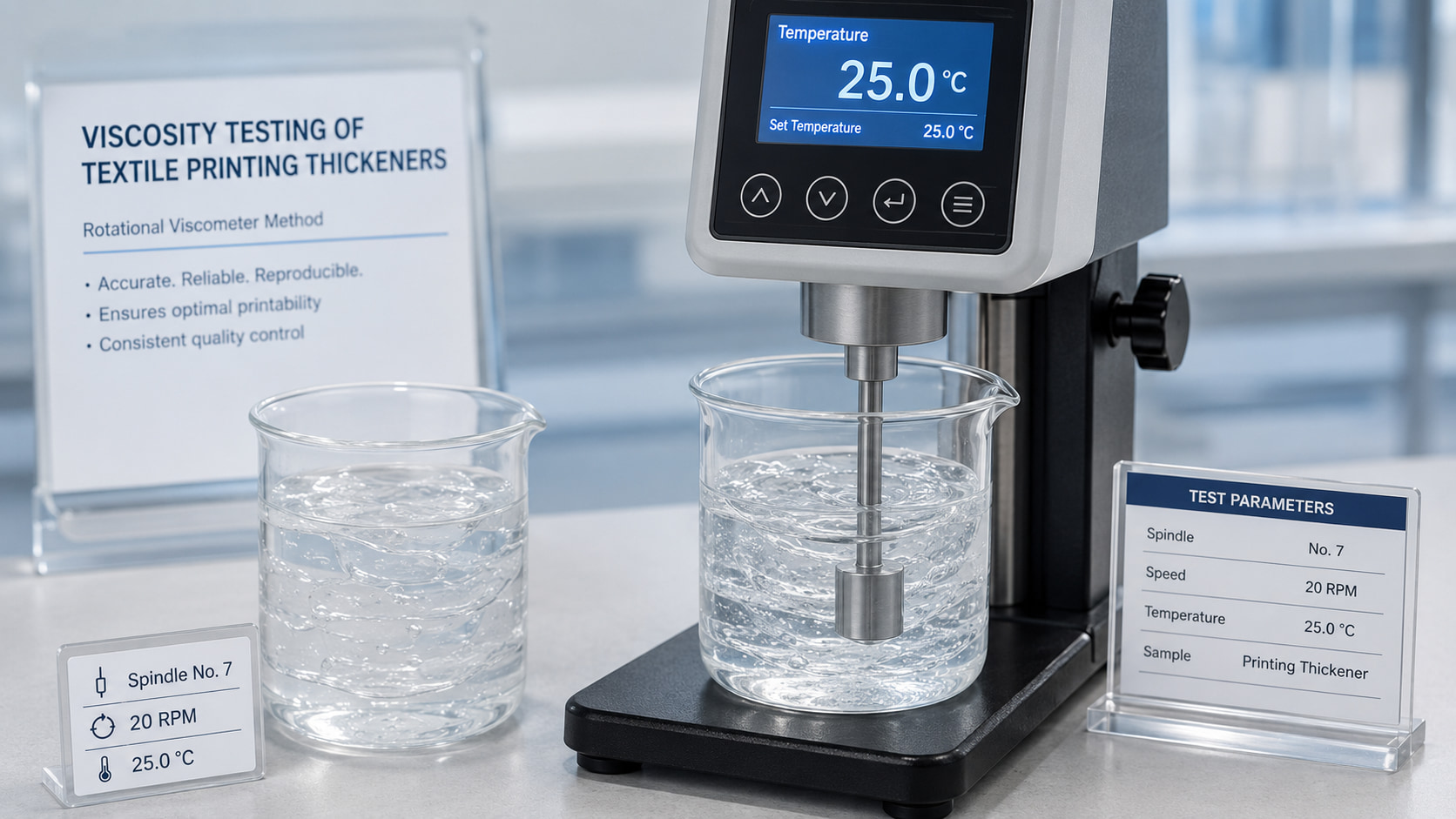
  4. Printing on the customer’s relevant fabric.
  5. Evaluation of fine lines and solid areas.
  6. Steaming under the normal process.
  7. Washing and finished-fabric comparison.

What Defined Success?

The candidate was not considered successful simply because the stock viscosity was close to the benchmark.

Approval depended on whether the final printed fabric showed an acceptable balance of:

  • Definición de impresión
  • Penetración
  • Color development
  • Background cleanliness
  • Fijación
  • Wash-off behavior

Customer-Success Lesson

The case demonstrated a core principle:

For reactive printing, a comparable viscosity is only the beginning of supplier matching. The real decision should be made after printing, fixation and washing.

This protects the mill from approving a material that appears equivalent on a data sheet but behaves differently in production.

Case Study 2: Evaluating a CMC/CMS-Based Alternative Route for Cost and Process Balance

Customer Situation

A textile chemical buyer was reviewing alternative thickener routes because the current system was commercially acceptable but the buyer wanted greater supply flexibility and a better understanding of cost-performance options.

Instead of asking whether one polymer was “better” than another, the project focused on whether selected CMC, CMS or compound routes could provide the required balance under the customer’s actual formulation.

Why a Direct 1:1 Replacement Was Avoided

CMC, CMS and sodium alginate belong to different polymer families.

Even if two grades show similar viscosity, they can differ in:

  • Hidratación
  • Respuesta al corte
  • Recuperación estructural
  • Salt response
  • Filtración
  • Paste holding stability
  • Definición de impresión

Therefore, the technical objective was not to force a one-to-one replacement.

The objective was to identify a candidate grade and then determine its technically appropriate dosage.

Comparación entre laboratorios

The comparison was structured around:

  • Defined concentration and water conditions
  • Controlled mixing and hydration
  • Viscosity under the same method
  • Filtración
  • Complete-paste stability
  • Actual printing behavior
  • Finished-fabric performance

Where more than one candidate remained technically acceptable, dosage optimization was performed before the commercial comparison.

Commercial Evaluation

The buyer compared:

  • Delivered price
  • Dosis eficaz
  • Preparation time
  • Pérdida por filtración
  • Machine stability
  • Paste waste
  • Finished quality

This shifted the discussion from product price to Costo total de uso.

Customer-Success Lesson

The strongest outcome was not that one polymer was declared universally superior.

Instead, the customer gained a controlled method for comparing alternative grades and could make a sourcing decision based on actual production performance.

A technically suitable alternative should be optimized as its own system rather than judged only by whether it copies the current product at the same dosage.

Case Study 3: Reactive Digital Pretreatment Matching for Ink Control and Color Development

Customer Situation

A digital textile printing customer needed a pretreatment route for reactive inkjet printing on cellulosic fabric.

The key challenge was not simply increasing fabric viscosity. The pretreatment needed to support controlled ink deposition while remaining compatible with the customer’s printing, steaming and washing process.

Technical Priorities

The evaluation focused on:

  • Uniformidad del pretratamiento
  • Ink spreading
  • Bleeding control
  • Fine-line sharpness
  • Uniformidad del área sólida
  • Color development
  • Fijación
  • Se enjuaga

The customer also needed to consider whether the process used a conventional dried pretreatment or a wet/partially wet printing route because the rheological and moisture requirements can differ substantially.

FSX Matching Approach

A relevant reactive digital printing paste candidate was selected based on the customer’s ink system, fabric and pretreatment method.

The trial sequence included:

  1. Prepare the pretreatment under controlled conditions.
  2. Apply it uniformly to the same fabric.
  3. Control wet pick-up or application amount where relevant.
  4. Dry or maintain the defined wet state according to the process.
  5. Print using the same ink and printer settings.
  6. Complete steaming.
  7. Wash under the normal process.
  8. Evaluate the finished fabric.

Why Water Viscosity Was Not Enough

A digital pretreatment creates the surface environment into which ink droplets are deposited.

Therefore, two pretreatments with similar water viscosity can still differ in:

  • Fabric penetration
  • Surface retention
  • Ink spreading
  • Drying behavior
  • Color response

The customer therefore evaluated printed output rather than selecting the candidate from a viscosity specification alone.

Customer-Success Lesson

Reactive digital printing paste should be matched to the complete ink-fabric-pretreatment-fixation system.

The right product is not the one with the highest viscosity. It is the one that provides the required ink control and finished-fabric result at a practical production dosage.

Case Study 4: Disperse Digital Pretreatment Evaluation for Polyester Printing

Customer Situation

A customer working with polyester digital printing needed to evaluate a disperse-compatible pretreatment route.

A common technical mistake in this type of project is to transfer reactive-printing logic directly to polyester.

The project instead started from the disperse ink and polyester process.

Application Variables

The customer and supplier needed to define:

  • Polyester fabric construction
  • Preparación de la tela
  • Disperse ink system
  • Método de aplicación del pretratamiento
  • Condiciones de secado
  • Configuración de la impresora
  • Thermal fixation process

Evaluation Criteria

The candidate pretreatment was assessed for:

  • Uniform application
  • Estabilidad
  • Ink spreading control
  • Nitidez
  • Uniformidad del área sólida
  • Color development
  • Drying behavior
  • Thermal fixation compatibility

Why Process-Specific Matching Matters

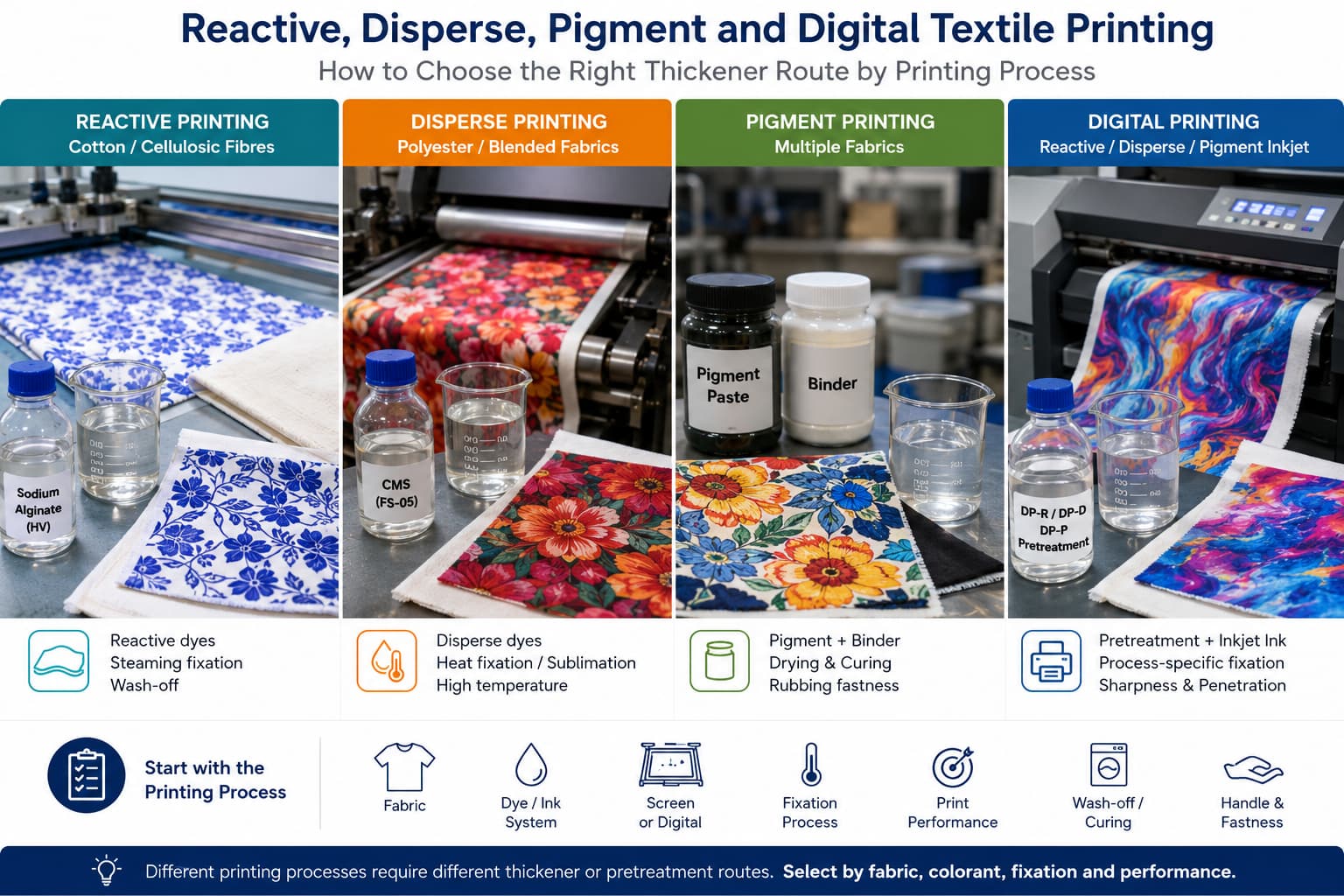
Reactive cotton printing and disperse polyester printing use different dye chemistry and fixation mechanisms.

A product that works well in a reactive route should therefore not automatically be assumed to work in disperse digital printing.

Customer-Success Lesson

The value of the matching process was that the customer could compare a disperse-specific candidate under the actual polyester production route instead of evaluating a generic “digital printing paste.”

The printing chemistry must be defined before the thickener or pretreatment route is selected.

Case Study 5: Improving Repeat-Order Confidence Through Batch and Sample Control

Customer Situation

A textile chemical buyer had already identified a technically suitable product but needed confidence that routine commercial shipments would remain connected to the approved sample.

This is a different problem from grade selection.

It is a supply-control problem.

Control Process

The customer established a simple chain:

Approved Sample → Commercial Grade → Agreed TDS → Production Batch → Batch-Specific Quality Data → Incoming QC → Production Feedback

Important controls included:

  • Recording the exact commercial grade
  • Retaining an approved reference sample
  • Confirming the viscosity test method
  • Recording the first commercial batch number
  • Repeating key incoming QC tests
  • Comparing production feedback across repeat shipments

Why This Matters

A successful laboratory trial is only valuable when it can be repeated commercially.

Without sample-to-bulk control, the buyer may not know whether later variation comes from:

  • The supplied product
  • Water quality
  • Mixing conditions
  • Dye or auxiliary changes
  • Fabric variation
  • Machine conditions

Retained reference samples and standardized incoming tests make future investigations more objective.

Customer-Success Lesson

Customer success should include repeatability after the first order, not only a successful sample trial.

This is particularly important for printing mills where a small batch variation can affect multiple paste tanks or fabric lots.

What These Textile Chemical Case Studies Have in Common

Although the applications differ, the successful evaluation process follows several common principles.

1. The Application Is Defined First

The supplier needs to know whether the customer is working with reactive, disperse, pigment or digital printing before selecting the grade.

2. The Current Benchmark Is Documented

A current TDS, commercial grade, dosage and physical sample can make the comparison more relevant.

3. Test Methods Are Aligned

Concentration, water, hydration, temperature and viscometer conditions should be controlled before comparing viscosity.

4. Complete Formulations Are Tested

The candidate is tested with the real dyes, pigments, binders, salts, alkalis and auxiliaries rather than only in water.

5. Finished Fabric Is Evaluated

Approval comes after the appropriate steaming, thermal fixation, curing or washing process.

6. Dosage Is Optimized

The new product is not automatically forced into the same dosage as the old one.

7. Sample-to-Bulk Continuity Is Controlled

The approved sample remains connected to an identifiable commercial grade and routine supply.

These principles are more important than any single polymer name.

Which Performance Metrics Should Be Recorded?

Customer success becomes more useful when the result is documented rather than described only as “good” or “bad.”

Evaluation StageUseful Metrics or Observations
PreparaciónHydration time, mixing behavior, foam, appearance and ease of preparation
Stock propertiesViscosity, pH where relevant, filtration and short-term stability
Complete pasteViscosity change, rheology, separation, filtration and holding stability
ImpresiónScreen passage or pretreatment uniformity, edge definition, penetration and solid-area uniformity
Fixation/post-treatmentColor development, fixation, washing or curing behavior
Finished textileColor, sharpness, background cleanliness, fastness and fabric hand feel where relevant
CommercialEffective dosage, preparation loss, downtime, reject rate and Total Cost in Use

Where objective laboratory instruments are available, the customer can add color measurement, rheology curves or fastness test data.

Where they are not available, standardized visual and process observations are still more useful than uncontrolled impressions.

Why Sample-to-Bulk Verification Matters

Many textile chemical projects focus heavily on obtaining a sample but not enough on what happens after sample approval.

A robust supply process should include:

  1. Identify the candidate commercial grade.
  2. Confirm the applicable TDS and test method.
  3. Obtain a representative sample.
  4. Complete laboratory evaluation.
  5. Run a production trial where appropriate.
  6. Approve the working dosage and application conditions.
  7. Place the commercial order using the same grade identity.
  8. Review batch-specific quality information where appropriate.
  9. Retain an incoming sample.
  10. Repeat selected QC tests.
  11. Monitor repeat-order performance.

This process creates a traceable relationship between the sample the customer approved and the commercial product supplied later.

Usos de FSX Chemical Muestras y combinación as the starting point for this type of controlled evaluation.

How Customer Success Should Be Evaluated Commercially

A technically successful product should also make commercial sense.

However, price per kilogram is not enough to determine value.

A more useful model includes:

  • Delivered product price
  • Dosis eficaz
  • Tiempo de mezcla e hidratación
  • Pérdida por filtración
  • Paste waste
  • Machine cleaning
  • Downtime
  • Fixation or curing impact
  • Washing requirements
  • Rejected fabric
  • Reprinting or reprocessing

The practical concept is:

Total Cost in Use = Delivered Chemical Cost + Effective Dosage + Preparation Cost + Process Loss + Downtime + Post-Treatment Impact + Quality Loss

This is important in customer-success projects because a lower chemical price does not automatically create a lower production cost.

Similarly, a higher-priced candidate should not be assumed to provide better value unless its production performance justifies the difference.

The commercial comparison should therefore be finalized only after the technically suitable dosage has been established.

What a Textile Chemical Supplier Should Contribute

A supplier cannot control every part of a customer’s printing process, but it should contribute useful technical structure.

A capable supplier should be able to:

  • Ask application-specific questions
  • Identify a relevant commercial grade
  • Explain important QC test methods
  • Provide a representative sample
  • Supply TDS and SDS documentation
  • Discuss complete-formulation compatibility
  • Review customer laboratory feedback
  • Support dosage optimization
  • Connect the approved sample to commercial supply
  • Investigate repeat-batch questions with traceable information

The supplier should also be clear about application limits.

For example:

  • CMC should not be promoted as a universal sodium alginate replacement.
  • CMS should not be assumed to work in every reactive printing formulation.
  • A reactive digital pretreatment should not automatically be transferred to disperse polyester printing.
  • A pigment digital system must consider binder chemistry and curing.

This type of claim control helps create more reliable customer results.

What Buyers Should Provide for a Relevant Technical Match

The more complete the technical information, the more relevant the first candidate can be.

Useful information includes:

  • Current supplier and commercial grade
  • TDS actual
  • Physical reference sample where available
  • Current viscosity value and test method
  • Dosis actual
  • Printing route
  • Ink, dye or pigment system
  • Fabric composition and construction
  • Complete or simplified formulation
  • Machine type
  • Pretreatment or printing method
  • Condiciones de secado
  • Fixation, steaming or curing conditions
  • Washing conditions
  • Current technical problem
  • Commercial target

A supplier should not need every confidential formulation detail to begin screening, but enough process information is required to avoid an irrelevant recommendation.

If the customer’s formula is confidential, the initial discussion can begin with product type, dosage, fabric, process and key performance target.

What These FSX Chemical Customer Cases Demonstrate

The most important lesson across these application examples is that customer success comes from technical alignment rather than a universal product claim.

The successful sequence is:

Understand the Existing Process → Select a Relevant Candidate → Standardize the Test → Evaluate the Complete Formulation → Print the Real Fabric → Complete Post-Treatment → Optimize Dosage → Verify Commercial Supply

For some customers, the best route may remain sodium alginate.

For others, a selected CMC, CMS or compound thickener may provide a useful alternative after validation.

Digital printing customers may require a completely different pretreatment route depending on whether they use reactive, disperse or pigment ink.

There is therefore no responsible single statement such as:

“One FSX textile agent is best for every customer.”

The more useful promise is:

FSX Chemical can help identify and test a technically relevant candidate based on the customer’s actual printing process.

Preguntas frecuentes

1. Are these FSX Chemical customer case studies based on named customers?

No customer names or confidential formulations are published in these examples. The cases are anonymized application examples designed to show the technical evaluation process while protecting customer confidentiality.

2. Does a successful case study guarantee the same result in another factory?

No. Textile chemical performance depends on the fabric, formula, dye or ink system, water, machine, fixation and other production conditions. Each customer should complete controlled laboratory and production validation.

3. Can sodium alginate be replaced by CMC or CMS in every reactive printing process?

No. Sodium alginate is a common benchmark in conventional reactive printing, while selected CMC, CMS or compound systems can be evaluated for suitable applications. A universal one-to-one replacement should not be assumed.

4. Why does FSX Chemical ask for the customer’s current TDS?

The TDS can provide information about the current grade, viscosity method and product positioning. It helps identify a technically relevant starting candidate, although laboratory and production testing are still required.

5. Why is a physical sample useful for grade matching?

A physical sample allows side-by-side comparison under the same laboratory method and can reveal differences that are not obvious from a TDS alone.

6. Does the same viscosity mean two thickeners will print the same?

No. Similar viscosity does not guarantee similar rheology, filtration, salt response, penetration, color performance or formulation compatibility.

7. How is a new digital printing paste evaluated?

Define the ink type and fabric first, then compare the pretreatment under the same application, printing, fixation and post-treatment conditions. Finished textile performance is more important than water viscosity alone.

8. How should a customer compare two textile chemical suppliers?

Compare exact commercial grades, test methods, representative samples, complete-formulation performance, batch consistency, technical support, supply reliability and Total Cost in Use.

9. What is sample-to-bulk verification?

It is the process of keeping the approved laboratory sample connected to the commercial grade and verifying that the first bulk shipment remains within the agreed technical range.

10. How should cost savings be evaluated?

Use optimized dosage and Total Cost in Use rather than price per kilogram alone. Include preparation, filtration, downtime, post-treatment and quality loss where relevant.

11. Can FSX Chemical match a customer’s existing thickener grade?

FSX Chemical can select a technically relevant candidate for controlled comparison when sufficient information is available. Exact equivalence or universal replacement should not be assumed before testing.

12. What information should I send to start a matching project?

Send your current grade or TDS, viscosity method, dosage, printing route, fabric, formulation information, machine conditions, fixation process and current technical or commercial target. A physical sample can also be useful.

Start a Controlled Textile Chemical Comparison with FSX Chemical

If you are evaluating a textile printing thickener, sodium alginate, CMC, CMS or digital printing paste, FSX Chemical can help identify a technically relevant candidate for controlled testing.

For more accurate matching, provide:

  • Your current commercial grade or TDS
  • Physical sample where available
  • Current viscosity and test method
  • Dosis actual
  • Printing process
  • Tipo de tela
  • Ink, dye or pigment system
  • Current formula or key formulation conditions
  • Machine and fixation process
  • Current technical problem or cost target

Empieza con Muestras y combinación to define a relevant test direction.

You can also review Alginato de sodio, CMC y CMS product routes before selecting the first candidate.

When the technical direction and purchasing requirement are clear, Solicita una cotización directamente del fabricante o Póngase en contacto con FSX Chemical to discuss the next-stage evaluation📧 Correo electrónico: Service@fsxchemical.com

Customer success should be measured by a repeatable production result—not by a product name, a viscosity number or a single successful laboratory sample.

Contacto rápido

Envíe sus requisitos

o

Muestras gratuitas · Respuesta en 24 horas

Consultas y soporte técnico sobre productos

Envíe los requisitos de su producto

Comparta el nombre del producto, su aplicación, la cantidad, el destino y cualquier ficha técnica (TDS), foto de muestra o documento que ya tenga. FSX Chemical revisará la información y le recomendará el siguiente paso para la cotización, la comparación de muestras o la selección del producto.

Información del producto Nombre del producto, categoría, modelo, foto de la etiqueta o referencia del proveedor.
Documentos disponibles TDS, SDS, COA, foto de muestra, lista de productos o datos de pruebas.
Detalles del pedido Cantidad estimada, embalaje, país de destino, puerto o término comercial.
Solicitud o problema Proceso de impresión textil, requisitos de formulación, problema actual o objetivo de rendimiento.