Sodium Alginate for High-Speed Reactive Printing: Viscosity, Filtration and Paste Stability
High-speed reactive printing requires more than high viscosity. FSX Chemical sodium alginate grades can be...
Sodium alginate is an important thickener route for reactive dye printing on cotton, viscose and other suitable cellulosic textiles. However, not every sodium alginate grade provides the same hydration, filtration, rheology, chemical compatibility or long-run stability.
FSX Chemical supplies sodium alginate grades that can be reviewed according to the customer’s printing speed, viscosity method, reactive dye system, fabric, screen conditions and final quality target.
In this article, “high-speed matched” refers to a product route that deserves priority evaluation for a defined high-speed printing application. It does not represent an independent award, universal ranking or guarantee that one grade will suit every factory.
Final approval should come from controlled laboratory comparison, a production-relevant rotary-screen trial and verification of the first commercial batch.
What High-Speed Textile Printing Requires
Increasing rotary-screen speed changes the mechanical conditions applied to the printing paste. The material experiences mixing, pumping, circulation, squeegee pressure and rapid passage through the screen.
A paste that performs acceptably during a small laboratory print may behave differently during a long industrial run. High-speed operation can reveal weaknesses in flow, recovery, filtration, foam control and viscosity stability.
Efficient movement through the system
The paste must circulate and transfer without creating excessive pumping resistance. Poor flow can reduce screen filling, produce uneven transfer or limit the practical machine speed.
Controlled screen passage
The paste must pass through the selected screen geometry under production shear. Persistent particles, gels or unsuitable rheology can increase the risk of partial blockage and missing print details.
Rapid but balanced structural recovery
After leaving the screen, the paste should recover sufficient structure to help retain the intended pattern. Recovery that is too slow may contribute to spreading, while excessive recovery can affect leveling and transfer.
Stable behavior throughout the run
Viscosity, temperature, evaporation, circulation and chemical interaction can change during production. A high-speed grade should be evaluated over the normal run length rather than during only the first few metres.
Repeatable final textile quality
Production speed has value only when print definition, shade, penetration, wash-off and fabric handle remain within the required quality range.
Why Sodium Alginate Is a Strong Starting Route
Alginato de sodio is widely evaluated as a thickener for reactive dye printing on cellulosic textiles. It can provide a useful balance between paste body, flow under printing shear, colorant placement and post-print removal.
Suitable starting route for reactive systems
Sodium alginate is commonly selected when the formulation contains reactive dyes and requires controlled paste transfer with suitable wash-off after fixation.
Multiple viscosity and application grades
Sodium alginate should not be treated as one universal product. Commercial grades may differ in viscosity, composition, purity, particle profile, hydration, filtration and rheological behavior.
Useful balance of flow and structure
A correctly matched grade may provide sufficient low-shear structure while becoming easier to move under the higher shear generated by rotary-screen equipment.
Application performance still requires verification
Sodium alginate is not automatically suitable for every reactive dye, fabric, salt level, alkali system or machine speed. The complete printing formulation must be tested.
What “High-Speed Matched” Should Mean in Industrial Purchasing
Industrial buyers should not evaluate a textile chemical through a consumer-style star rating alone. A product becomes a leading candidate when its technical performance, documentation and commercial supply route match the application.
Application fit
The grade should be suitable for the intended reactive printing process, fabric, formulation and rotary-screen conditions.
Repeatable laboratory performance
The sample should produce consistent results when prepared several times under one recorded method.
Production-relevant performance
The grade should maintain acceptable transfer, definition and stability during a representative machine trial.
Commercial product identity
The approved sample should be connected to a permanent product code, specification, quotation, package label and batch documentation.
Total value
The product should provide a suitable balance of dosage, preparation, machine reliability, final quality, batch control and delivered cost.
1. Rheology Designed for High-Speed Movement
Rheology describes how a paste flows and changes structure under different mechanical conditions. It is more informative than one viscosity number measured at a single rotational speed.
Low-shear structure
While standing or moving slowly, the paste needs enough structure to limit uncontrolled flow, separation and penetration.
Flow under high shear
Under pumping, circulation and screen pressure, the paste should become sufficiently mobile to move through the system and transfer to the fabric.
Why one viscosity value is insufficient
Two sodium alginate grades may show similar viscosity at one concentration and rotational speed but behave differently under high-speed machine conditions.
Differences may appear in pumping resistance, screen passage, paste transfer and print-edge control.
Recommended technical comparison
Where practical, compare viscosity at more than one rotational speed and observe the change after defined mixing or shear. The result should then be confirmed through printing.
2. Structural Recovery and Print Definition
After the paste passes through the rotary screen, it should recover enough structure to help maintain the design on the fabric.
Recovery that is too slow
Slow recovery may contribute to spreading, reduced edge definition, merging of closely spaced design elements or excessive penetration.
Recovery that is too strong
Excessively rapid or rigid recovery may contribute to poor leveling, incomplete transfer, uneven solid areas or visible screen-related marks.
The target depends on the design
Fine lines, small text and sharp geometric patterns may require a different rheological balance from large solid areas or designs that need deeper penetration.
The target also depends on the fabric
Lightweight, loose, absorbent and densely woven fabrics respond differently to the same paste. The production fabric should be used during approval.
3. Filtration and Screen-Passage Performance
Filtration is a critical requirement for stable high-speed printing. Undissolved powder, coarse particles, gels and contamination can interfere with screen passage.
Evaluate stock-paste filtration
The sodium alginate solution should be checked after the recommended hydration period using a defined filter method.
Evaluate the complete printing paste
A stock paste may filter well but develop particles after dyes, salts, alkalis or other auxiliaries are added.
Use a production-relevant method
The filter opening, sample quantity and procedure should relate to the actual screen and circulation system. A coarse laboratory filter may not reveal a production problem.
Inspect the residue
Determine whether retained material consists of incompletely hydrated alginate, gel, foreign matter or another formulation component.
Record machine cleaning and interruption
During the production trial, record screen cleaning, blocked areas, pressure changes and interruptions rather than relying only on the appearance of the prepared paste.
4. Controlled Hydration and Paste Preparation
Even a suitable high-speed grade can perform poorly when it is prepared incorrectly. Powder addition, water, mixing and hydration should be standardized.
Establish liquid movement before powder addition
Start the mixer and create stable circulation before adding sodium alginate. Avoid excessive air intake.
Add powder gradually
Introduce the product in a controlled stream. Dumping the full quantity into one location can create surface-hydrated lumps with dry material trapped inside.
Use the recommended mixing condition
Record mixer type, impeller, speed, batch volume, water temperature, powder-addition time and total mixing time.
Allow complete hydration
Visible dispersion does not always indicate complete hydration. Follow the current grade instructions and measure viscosity only after the defined preparation period.
Keep comparison containers covered
Evaporation can increase apparent viscosity and make one sample appear stronger than another.
5. Stability During Long Production Runs
High-speed rotary printing may require the paste to remain in preparation tanks, circulation systems and machine reservoirs for an extended period.
Viscosity stability
Measure the paste after preparation, after the normal holding period and, where practical, during or after the production trial.
Temperature influence
Mechanical circulation and workshop conditions may change paste temperature. Viscosity results should be interpreted with temperature records.
Evaporation and concentration change
Open tanks or long circulation can increase concentration. Unrecorded water correction can then make production results difficult to compare.
Estabilidad física
Separación
Settling
Surface skin formation
Foam retention
Gel development
Filterability after storage
Production consistency
Compare fabric printed at the beginning, middle and end of the run. A candidate should not be approved only from the first acceptable section.
6. Compatibility with Reactive Printing Formulations
Sodium alginate is selected as part of a complete reactive printing paste. Dyes, salts, alkalis, humectants and other auxiliaries may change its apparent viscosity and application behavior.
Dye compatibility
Test representative reactive dyes and shades. A formulation that performs well with one color may behave differently at another dye concentration.
Salt and electrolyte response
Electrolytes can influence polymer structure and viscosity. Use realistic production concentrations during testing.
Alkali stability
Measure the complete paste immediately after alkali addition and after the normal holding period.
Orden de suma
Use a consistent preparation sequence for the reference and candidate. Changing both the grade and order of addition makes the comparison less reliable.
More than one shade should be tested
Where practical, include a light shade, a dark shade and a formulation representing the normal upper chemical load.
7. Wash-Off and Final Fabric Quality
High-speed printing performance is not complete until the textile has been fixed and washed using the normal production process.
Print definition after washing
Evaluate whether fine details and edges remain acceptable after fixation and wash-off.
Shade and levelness
Compare the candidate and reference after identical steaming, rinsing and washing conditions.
Residual paste
Inadequate removal may affect fabric handle, surface appearance or later processing.
Mango de tela
A sharp print is not sufficient if the finished fabric becomes unacceptably stiff or carries excessive residue.
Wash-off depends on the complete system
Dye, alkali, fixation and washing conditions also influence removal. Differences should not automatically be attributed to sodium alginate alone.
8. Batch-to-Batch Consistency
A successful high-speed trial has limited value if later commercial batches require repeated recipe adjustment.
Permanent grade identity
The approved sample, TDS, quotation, order, package label and COA should refer to the same commercial grade.
Defined viscosity method
Concentration, water, hydration, temperature, instrument, spindle and rotational speed should remain connected to the commercial specification.
Other grade-relevant parameters
Depending on the selected grade, buyers may also review moisture, pH, purity, particle profile, appearance or filtration-related properties.
Batch-specific documentation
The buyer should confirm which parameters will appear on the batch COA before ordering.
Incoming verification
Review packaging and batch identity, then repeat the approved laboratory or application method before releasing the first commercial batch.
Technical documents support product comparison, safety review, incoming inspection and batch traceability.
Ficha técnica
The TDS should identify the sodium alginate grade, intended application, relevant product properties and recommended preparation direction.
Ficha de datos de seguridad
The SDS supports workplace handling, storage, transport and internal safety review.
Certificate of Analysis
The batch COA provides selected results for the confirmed product and production batch. It does not replace the customer’s printing trial.
Product and batch labels
Packages should provide sufficient product and batch information for warehouse control and later technical investigation.
Certification claims
Where a particular chemical-management or compliance document is required, buyers should verify that it applies to the exact grade, certificate holder, scope and validity period.
High-speed printing applications can differ in screen geometry, machine speed, fabric, dye system and factory preparation. Direct grade review helps narrow the selection before testing.
Current-product review
Buyers can provide the existing sodium alginate TDS, COA, package label, viscosity result or representative sample.
Process-information review
Machine type, approximate production speed, screen conditions, fabric, formulation and current problem can be used to identify a more relevant starting grade.
Test-method alignment
Buyer and supplier can compare their viscosity concentration, preparation, temperature and instrument settings before interpreting the results.
Sample before bulk purchasing
A representative candidate can be evaluated in the buyer’s laboratory and printing process before commercial approval.
General reactive printing under established conditions
Rotary-screen printing with defined speed, screen and formulation
Viscosidad
Standard grade range under the specified method
Selected according to machine flow and paste-transfer requirement
Reología
May be suitable for normal production speeds
Evaluated for flow under shear and recovery after screen passage
Filtración
Standard quality-control requirement
Evaluated using the buyer’s screen and circulation requirements
Estabilidad de sujeción
Suitable for the normal stated preparation procedure
Checked over the actual production holding and circulation period
Prueba de impresión
General laboratory or application evaluation
Representative rotary-screen speed and long-run evaluation
Selection basis
Product specification and general application
Specification, formulation, equipment and production performance
A high-speed matched candidate is not automatically a higher-viscosity or higher-priced product. It is a grade selected and verified for the relevant process conditions.
How to Select the Correct FSX Sodium Alginate Grade
Define the printing system
Reactive dye printing process
Flat-screen or rotary-screen equipment
Fabric and fibre composition
Normal production speed
Screen mesh or design characteristics
Define the current formulation
Current sodium alginate grade and dosage
Dye type and representative shade range
Salt and alkali level
Humectants and other auxiliaries
Stock-paste and color-paste preparation sequence
Define the viscosity method
Concentración del producto
Water source
Procedimiento de mezcla e hidratación
Temperatura de medición
Instrument, spindle and rotational speed
Define the main production target
Improved screen passage
Reduced uncontrolled spreading
Better fine-line definition
More stable viscosity during long runs
Reduced preparation or filtration difficulty
Improved total cost in use
Select a candidate rather than assume direct replacement
The recommended FSX grade should be treated as a starting candidate for controlled testing. Final suitability depends on the buyer’s complete process.
Recommended Laboratory Evaluation
Step 1: Select the reference
Use a representative sample of the current approved sodium alginate grade.
Step 2: Standardize preparation
Use the same water
Use the same concentration basis
Use identical containers and mixers
Control powder-addition time
Control mixing and hydration time
Condition samples to the same temperature
Step 3: Record dispersion and hydration
Powder wetting
Lump formation
Hora de hidratarse
Foam development
Uniformity throughout the container
Step 4: Measure viscosity
Use the agreed instrument, spindle, speed, temperature and reading procedure. Where practical, compare more than one rotational speed.
Step 5: Test filtration
Use a defined, production-relevant filter and inspect the retained material.
Step 6: Prepare the complete reactive paste
Add the actual dye, salt, alkali and auxiliaries using the production sequence.
Step 7: Test holding stability
Measure and inspect the paste immediately and after the normal production holding period.
Step 8: Produce a laboratory print
Include fine lines, small text, sharp corners, solid areas and representative production designs.
Step 9: Fix and wash identically
Compare both samples after the same steaming and washing process.
Step 10: Record the complete result
Definición
Difusión
Penetración
Shade and levelness
Se enjuaga
Mango de tela
Recommended Rotary-Screen Production Trial
Begin with a controlled quantity
Use a limited candidate batch before converting the full production volume.
Keep the reference conditions visible
Record the current product settings and avoid changing multiple machine and formulation variables simultaneously.
Monitor paste temperature and viscosity
Record the initial values and any changes during circulation and printing.
Increase speed in controlled stages
Where practical, confirm stable performance at the normal speed before evaluating a higher production speed.
Observe machine behavior
Pumping and circulation
Screen filling and passage
Transferencia por pasta
Espuma
Screen cleaning
Machine interruptions
Corrective water or thickener additions
Compare the full production length
Review fabric from the beginning, middle and end of the run for definition, shade, penetration and levelness.
Complete fixation and washing
Final approval should be based on finished fabric rather than the wet print alone.
How to Compare Total Cost in Use
The lowest sodium alginate price per kilogram does not automatically produce the lowest cost per acceptable metre of printed fabric.
Material dosage
Use the actual optimized quantity required to reach acceptable printing performance.
Preparation cost
Include powder addition, mixing, hydration, labor, heating or cooling and filtration.
Machine cost
Include screen cleaning, interruptions, reduced speed and corrective paste adjustment.
Paste-loss cost
Include filter residue, rejected paste, tank residue and unused material.
Final-quality cost
Include reprinting, additional washing, off-quality fabric and customer claims.
Supply cost
Include packaging, freight, import expenses, inventory and batch verification.
Compare candidates only after they meet the same print-definition, shade, wash-off and fabric-quality requirements.
Common High-Speed Printing Problems
Problema observado
Posibles causas
Revisiones recomendadas
Poor screen passage
Excessive viscosity, incomplete hydration, gels, coarse residue or unsuitable flow under shear
Review preparation, filtration, concentration and multi-speed viscosity
Fine details disappear
Screen blockage, poor transfer, excessive recovery or unsuitable paste distribution
Inspect screen condition, residue, transfer and design-specific rheology
Print edges spread
Slow structural recovery, low paste body, high fabric absorbency or excessive penetration
Review dosage, fabric, shear recovery and application quantity
Uneven solid areas
Poor leveling, incomplete transfer, foam, nonuniform viscosity or screen condition
Review paste uniformity, foam, screen filling and machine settings
Viscosity rises during production
Evaporation, temperature change, continued hydration or concentration correction
Record temperature, tank closure, water additions and time
Viscosity falls after formulation
Salt, alkali, dye or auxiliary interaction
Test each addition separately under controlled conditions
Frequent screen cleaning
Residue, contamination, gel formation or unsuitable complete-paste stability
Test stock paste and complete paste filtration separately
Shade changes during the run
Paste drift, pickup variation, machine condition, dye distribution or process-temperature change
Compare beginning, middle and end samples with process records
Poor wash-off or stiff handle
Excess dosage, fixation conditions, washing process or formulation interaction
Review dosage, steaming, washing and complete chemical system
Troubleshooting should begin by confirming the product code, batch number, preparation, water, temperature and viscosity method before changing several formulation variables.
Important Application Boundaries
Not every sodium alginate grade is designed for high-speed printing
General industrial or low-speed printing grades may have different filtration, hydration and rheological characteristics.
High-speed suitability is process-specific
A grade that performs well on one rotary-screen line may require adjustment on another machine with different screens, pumps or production speed.
Higher viscosity does not guarantee better performance
Excessive viscosity can reduce transfer and increase pumping or screen resistance.
Laboratory approval does not replace production testing
The machine trial is needed to evaluate circulation, screen passage and long-run stability.
Sodium alginate is not a universal pigment or digital product
Pigment printing and digital textile pretreatment may require different thickener or formulation routes.
No grade guarantees zero defects
Machine condition, screen preparation, fabric, dyes, auxiliaries, operator practice and post-treatment all affect the result.
How FSX Chemical Supports High-Speed Printing Projects
FSX Chemical supplies sodium alginate grades for reactive textile printing and supports product selection through application review, current-product comparison and sample testing📧 Correo electrónico: Service@fsxchemical.com
Buyers can provide
Current sodium alginate TDS or representative sample
Current viscosity value and complete test method
Reactive dye system and representative shades
Fabric and fibre composition
Current formulation and dosage
Rotary-screen machine and normal production speed
Screen or filtration requirement
Main printing, stability or cost problem
Estimated quantity, packaging and destination
Technical review may include
Review of the current product specification
Selection of a suitable sodium alginate starting grade
Comparison of viscosity and preparation methods
Provision of relevant TDS and SDS information
Representative samples for laboratory evaluation
Guidance for side-by-side paste preparation
Review of laboratory and machine-trial feedback
Batch documentation for the confirmed commercial grade
A recommended grade is a candidate for controlled evaluation rather than a guaranteed direct replacement. Final approval depends on the customer’s formulation, equipment and finished-textile requirements.
Preguntas frecuentes
Is FSX Chemical sodium alginate independently high-speed matched?
“High-speed matched” means a candidate grade selected for defined machine, screen, paste and process conditions. It does not represent an award, independent ranking or universal performance claim.
Is sodium alginate suitable for high-speed rotary printing?
Selected sodium alginate grades can be evaluated for high-speed reactive rotary printing. Suitability depends on rheology, filtration, formulation, fabric and machine conditions.
Does higher sodium alginate viscosity allow higher machine speed?
Not automatically. Excessive viscosity may reduce circulation, transfer and screen passage. The complete rheological profile is more important.
What is the most important property for high-speed printing?
No single property is sufficient. Flow under shear, structural recovery, filtration, paste stability and reactive-formulation compatibility must be evaluated together.
How should sodium alginate viscosity be compared?
Use the same concentration, water, mixing, hydration time, temperature, instrument, spindle and rotational speed.
Can FSX Chemical match my current sodium alginate?
Buyers can provide the current TDS, sample, dosage, viscosity method and printing conditions for candidate-grade review.
Can a laboratory sample prove high-speed suitability?
A laboratory test is the first stage. A representative rotary-screen production trial is needed to evaluate machine flow and long-run stability.
What should be checked during a rotary-screen trial?
Check circulation, screen passage, paste transfer, foam, cleaning frequency, viscosity drift, definition, penetration, shade and final wash-off.
Does sodium alginate guarantee clean wash-off?
No single product can guarantee the final result. Dosage, dye, alkali, fixation and washing conditions also affect wash-off.
What documents should buyers request?
Buyers should request the permanent grade code, current TDS, SDS, viscosity method, representative sample and proposed batch COA information.
Request a High-Speed Printing Sodium Alginate Sample
Send FSX Chemical your current sodium alginate TDS or sample together with the reactive dye system, fabric, formulation, dosage, viscosity method, rotary-screen conditions and main production problem.
The technical team can review a suitable starting grade for controlled laboratory comparison and production-relevant testing.
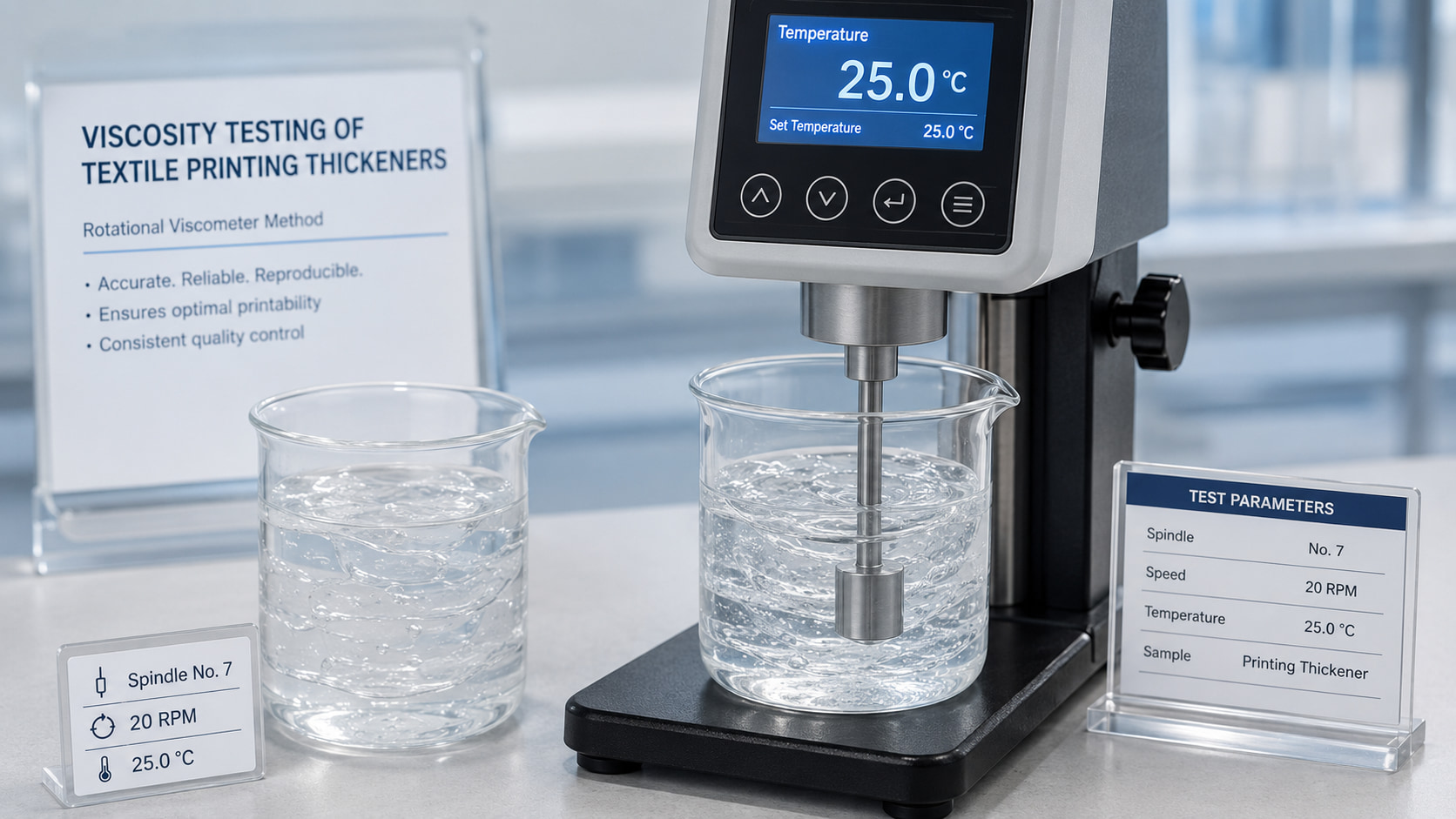
Descubre por qué no se pueden comparar los valores de viscosidad de los espesantes para la impresión textil sin tener en cuenta la concentración, la temperatura, el instrumento, el husillo, la velocidad, el método de preparación y el tiempo de prueba.
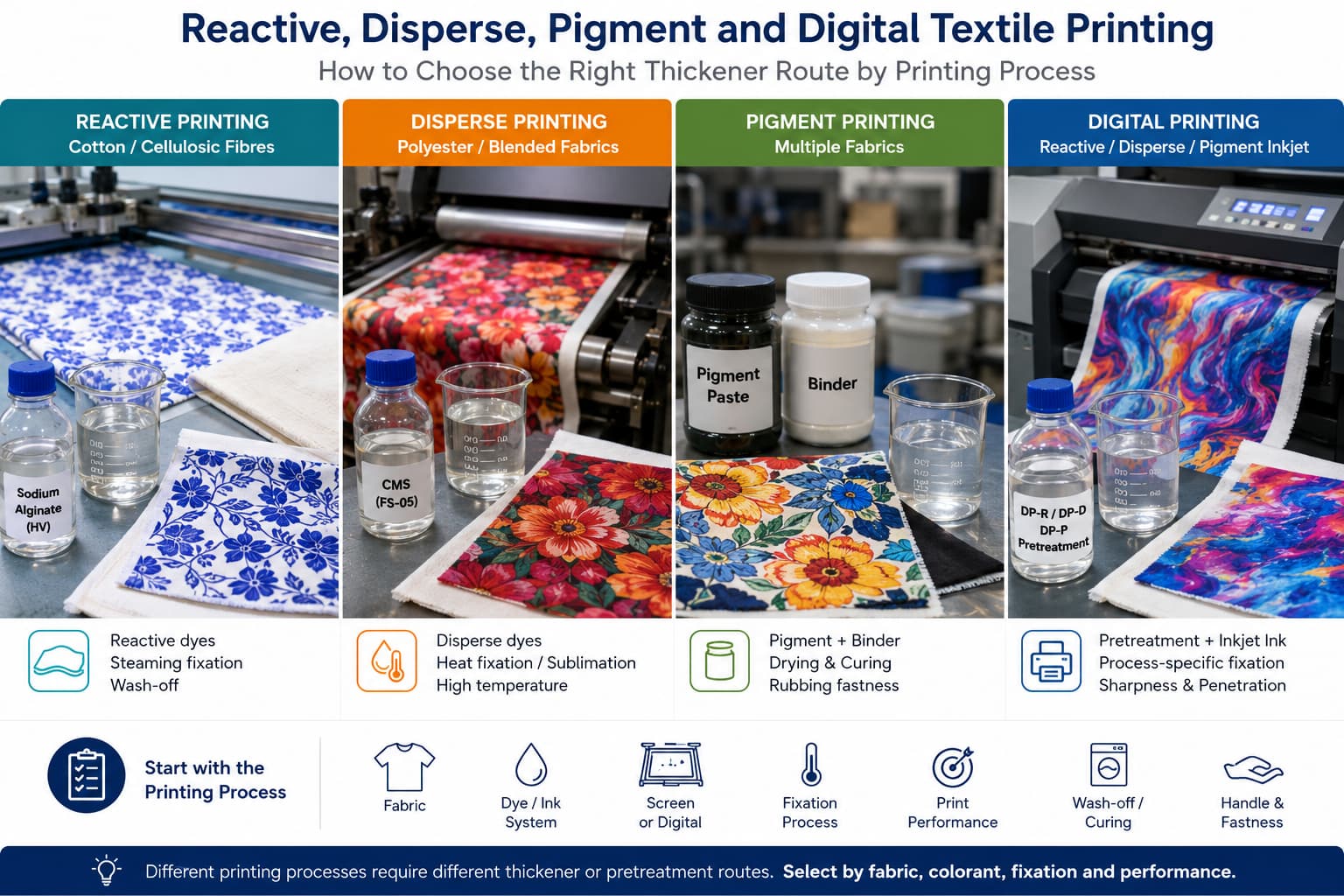
Aprende a elegir espesantes y métodos de pretratamiento para la impresión textil reactiva, dispersa, con pigmentos y digital, según los requisitos del tejido, el colorante o la tinta, la fijación, la resistencia al lavado y la calidad de impresión.
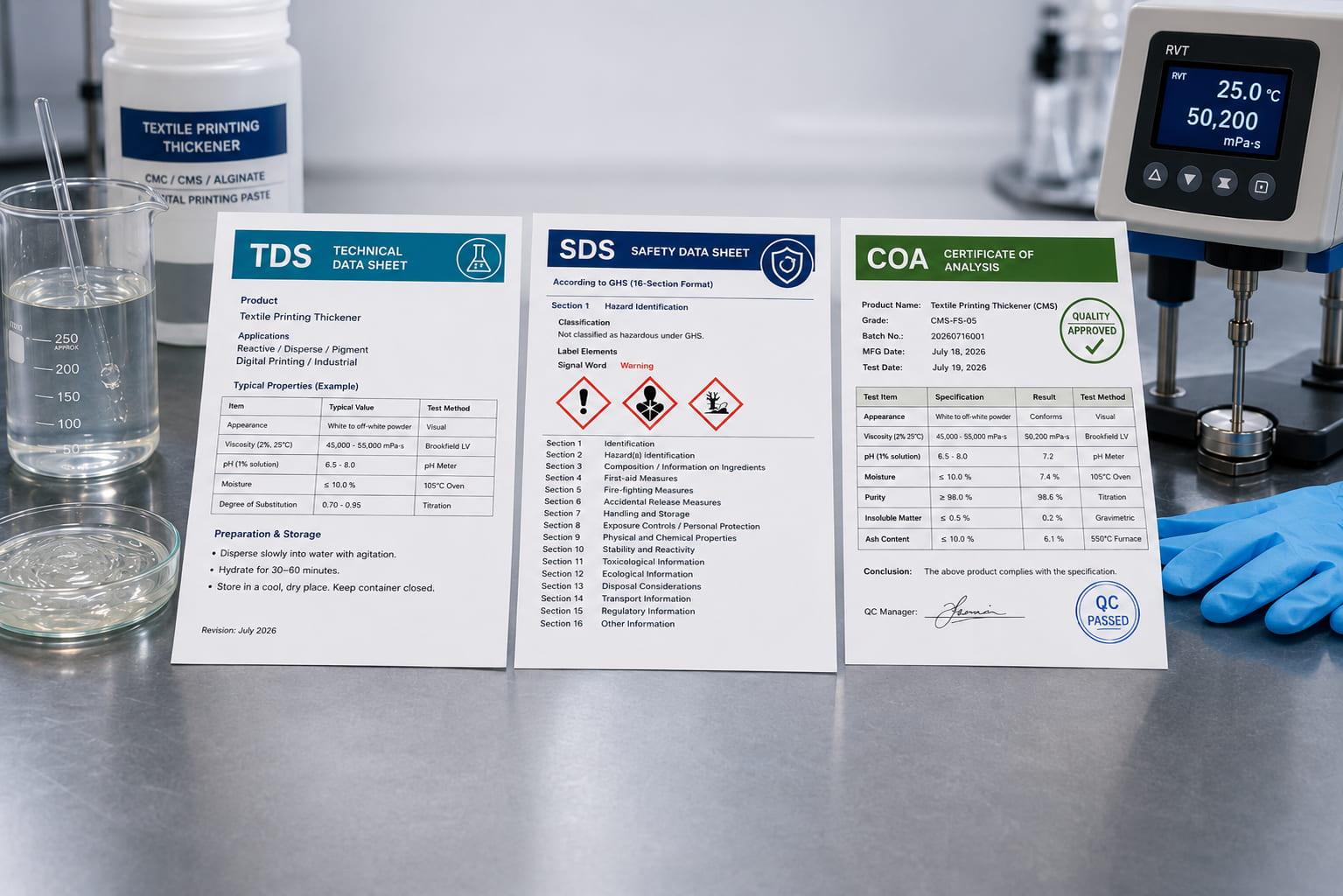
Aprende la diferencia entre los documentos TDS, SDS y COA, qué deben verificar los compradores de productos de impresión textil y cómo revisar las especificaciones, la información de seguridad, los métodos de prueba, los resultados de los lotes y los emisores de los documentos.
Compara CMC, CMS, alginato de sodio y pasta para impresión digital en la impresión textil. Descubre cómo cada opción se adapta a los procesos reactivos, dispersos, pigmentados y digitales, y qué deben tener en cuenta los compradores antes de realizar pruebas de muestras, comparar calidades y realizar compras a granel.
El alginato de sodio se utiliza ampliamente en la impresión textil como espesante estable y lavable para las pastas de impresión reactivas. Descubre cómo evaluar el grado de viscosidad, la pureza y la idoneidad para cada aplicación antes de comprar, y cómo FSX Chemical apoya a los compradores de todo el mundo con datos técnicos y muestras.
La carboximetilcelulosa (CMC) se utiliza ampliamente en los procesos de estampado, encolado y teñido de textiles. En esta guía se explica cómo evaluar los distintos grados de CMC, qué parámetros son los más importantes y cómo FSX Chemical puede ayudarte a tomar decisiones de compra.
Tanto el alginato de sodio como la CMC se utilizan como espesantes en la impresión textil, pero se adaptan a diferentes sistemas de tinte y condiciones de proceso. Esta guía explica las diferencias clave y cuándo utilizar cada uno.
La impresión digital por inyección de tinta sobre textiles tiene requisitos distintos en cuanto a pastas y pretratamiento en comparación con la serigrafía. Esta guía explica cómo se utiliza el alginato de sodio en la impresión textil digital y qué parámetros de calidad deben especificar los equipos de compras.
La preparación correcta de la pasta es tan importante como la selección del grado en la impresión textil con tintes reactivos. Esta guía aborda los métodos de disolución del alginato de sodio, los rangos de concentración según la aplicación, las condiciones de almacenamiento y cómo resolver problemas comunes en la preparación.
El alginato de sodio es un polímero natural y biodegradable, pero su uso en la impresión textil genera aguas residuales que requieren un tratamiento adecuado. Esta guía aborda el perfil ambiental del alginato de sodio, las características de los efluentes de lavado y lo que los equipos de compras deben saber sobre la elección de espesantes y el impacto ambiental.
La tasa de fijación del colorante afecta directamente al rendimiento del color, a la solidez al lavado y a la carga de aguas residuales en la estampación con colorantes reactivos. Esta guía explica cómo el alginato de sodio favorece la fijación del colorante, qué parámetros de la pasta influyen en la tasa de fijación y cómo resolver los problemas de baja fijación en la producción.
El tamaño de partícula (malla) del alginato de sodio influye en la rapidez con la que se disuelve el polvo, en la uniformidad con la que se hidrata y en el desempeño de la pasta resultante en la serigrafía. Esta guía explica las implicaciones prácticas de la especificación de la malla para aplicaciones de pastas de impresión textil.
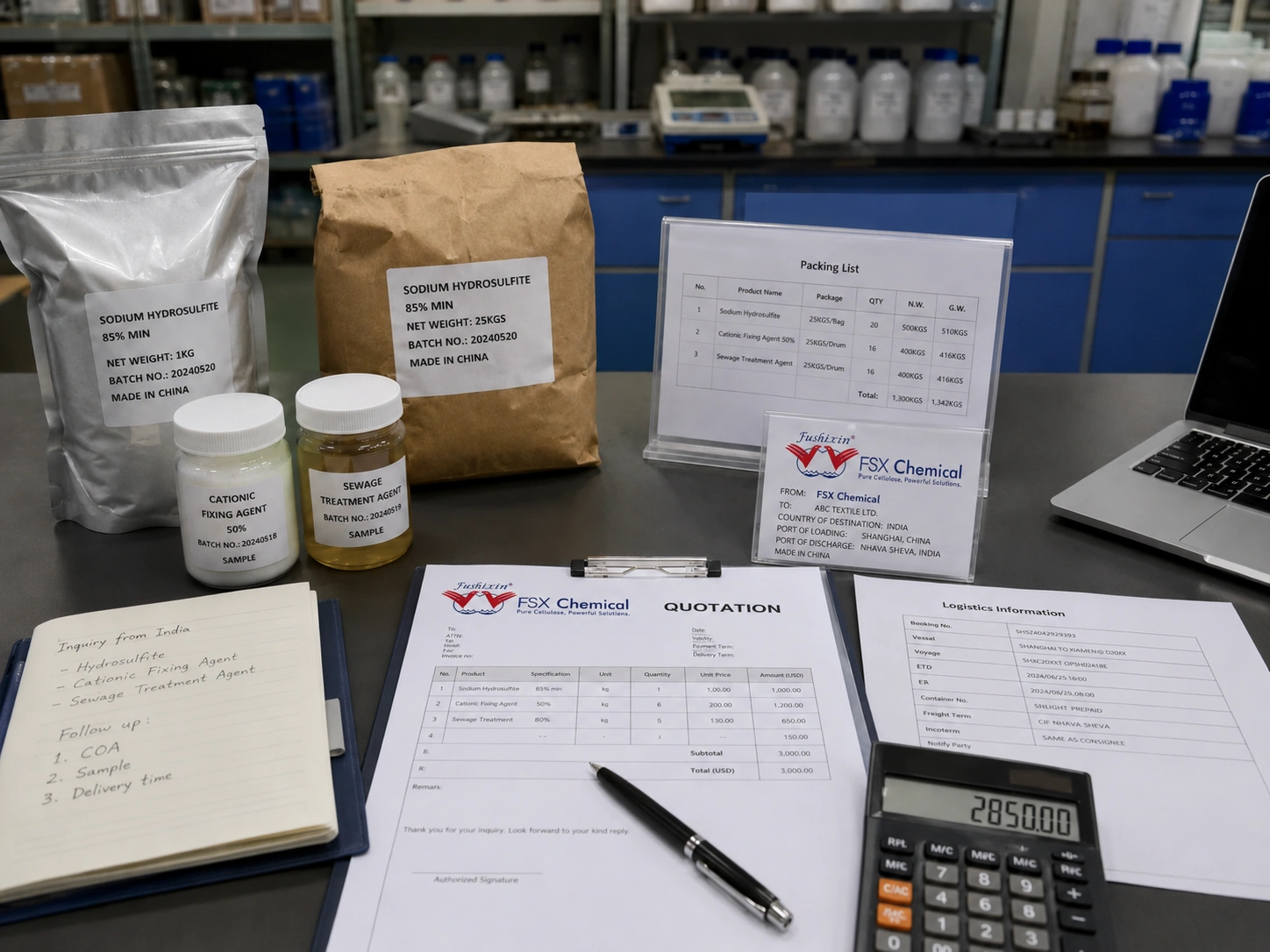
Comparta el nombre del producto, su aplicación, la cantidad, el destino y cualquier ficha técnica (TDS),
foto de muestra o documento que ya tenga. FSX Chemical revisará la
información y le recomendará el siguiente paso para la cotización, la comparación de muestras
o la selección del producto.
Información del productoNombre del producto, categoría, modelo, foto de la etiqueta o referencia del proveedor.
Documentos disponiblesTDS, SDS, COA, foto de muestra, lista de productos o datos de pruebas.
Detalles del pedidoCantidad estimada, embalaje, país de destino, puerto o término comercial.
Solicitud o problemaProceso de impresión textil, requisitos de formulación, problema actual o objetivo de rendimiento.

 ES
ES  EN
EN  BN
BN  TR
TR  FR
FR  ID
ID  RU
RU  AR
AR  UR
UR  VI
VI  TL
TL  HI
HI  UK
UK  KK
KK  KA
KA  UZ
UZ