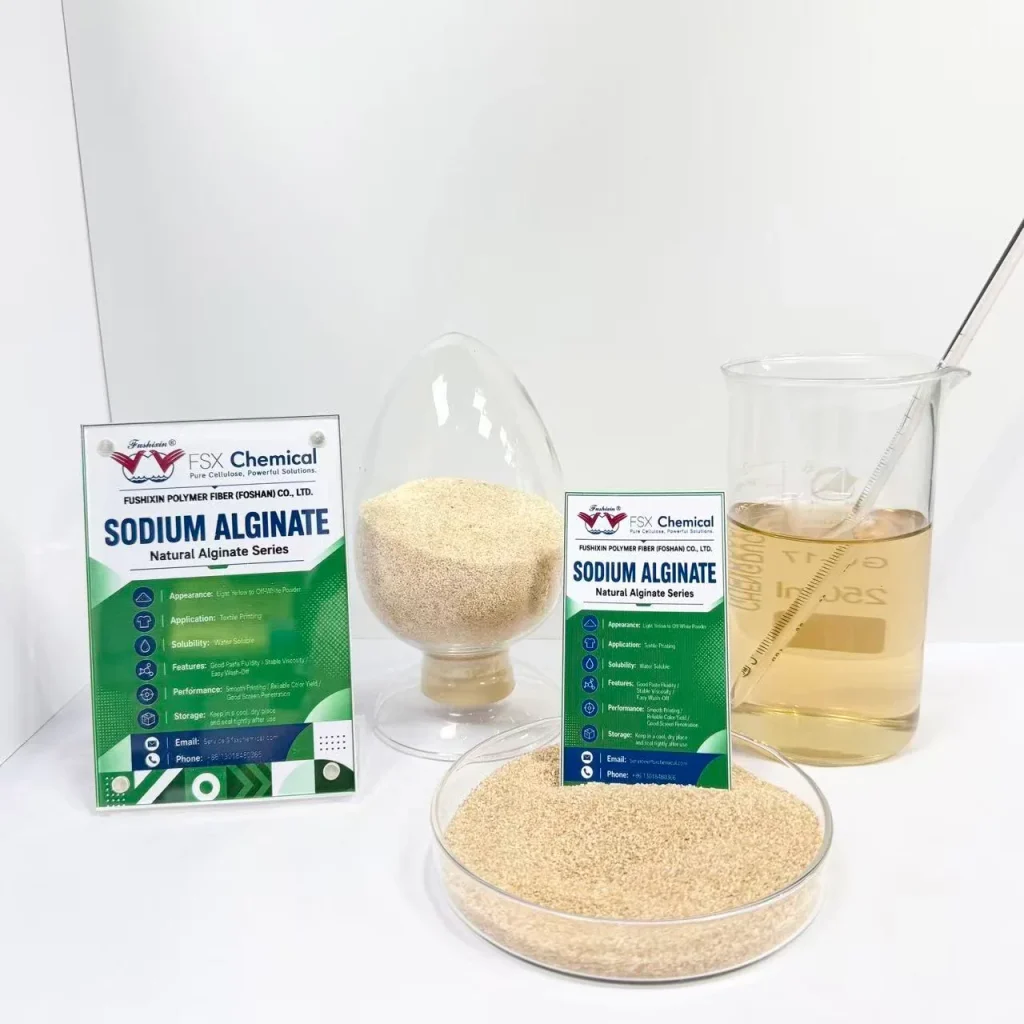
Sodium alginate prices for textile printing are mainly driven by grade performance, viscosity test method, purity and insoluble matter, raw-material and process consistency, order size, packaging, freight and Incoterm. A lower USD/kg quote is not automatically cheaper in production: compare use concentration, color yield, wash-off, filtration, batch consistency and rework risk under the same test conditions.
To compare quotations fairly, normalize the application, viscosity method, concentration, packaging, Incoterm and destination. Then evaluate total cost in use rather than powder price alone, and confirm the selected grade through a laboratory print and sample-to-bulk approval.
Sodium Alginate Quote Comparison Table
| Factor | Why the quote changes | What the buyer should compare |
|---|---|---|
| Grade and viscosity | Different molecular-weight ranges and process control | Same concentration, temperature, instrument, spindle, speed and hydration time |
| Purity and insoluble matter | Additional washing, filtration and quality control | COA limits plus dissolution and filtration results |
| Raw material and consistency | Seaweed source, seasonal variation and manufacturing control | Multi-batch viscosity, paste behavior and print performance |
| Order and packaging | MOQ, packing material and production scheduling | Net weight, bag specification, palletization and sample policy |
| Freight and Incoterm | Route, season, port charges and responsibility split | Compare FOB, CFR or CIF quotations on the same destination and shipment size |
| Costo total de uso | Use level and production stability affect real cost | Cost per kilogram of workable paste plus color yield, wash-off and rework |
For a like-for-like technical baseline, review the textile thickener viscosity test-method guide and the sodium alginate grade-selection guide.
Raw Material Cost: One Part of the Quotation
Seaweed Species and Harvest Region
Seaweed sourcing can affect a producer’s costs, but its share of the finished grade’s price requires current supplier evidence. Do not infer a premium, molecular-weight level or lower contaminant content from a region or species name alone. Ask which sourcing factors are relevant to the quoted grade, then compare the agreed finished-product specification and application result.
Country of manufacture and cultivated or wild-harvested feedstock are sourcing context, not proof of year-round availability or batch consistency. Confirm lead time, origin information where available and recent results for the exact commercial grade. Evaluate the supplier’s control of source changes rather than assuming one harvesting model always produces more stable prices.
Seaweed Market Price Fluctuation
A raw-material change does not imply a fixed timing or percentage change in an alginate quotation. Ask how long the quoted price remains valid and whether an agreed adjustment mechanism applies. If the seller cites a raw-material benchmark, require its identity, review dates and calculation basis; no universal one-to-two-quarter lag is assumed here.
When evaluating long-term supply agreements or bulk purchase pricing, ask suppliers how they handle raw material price fluctuations in their pricing structure — whether they offer fixed pricing for a defined period, price escalation clauses tied to seaweed market indices, or purely spot pricing. Understanding this helps you anticipate how quoted prices may change over the duration of a supply relationship.

Product Grade and Specification: The Specification Premium
Grado de viscosidad
Do not rank quotation prices from a high-, medium- or low-viscosity label alone. Compare actual quotations with the same viscosity method, quantity and delivery basis, then examine any different specification or processing requirement. A lower-viscosity grade is not automatically cheaper, and a higher-viscosity grade is not automatically more efficient at the required print result.
When comparing prices between suppliers for nominally the same viscosity grade, confirm that the viscosity specifications are comparable — the same measurement concentration, temperature, and method. A grade specified as “high viscosity” by one supplier may have a different actual viscosity range than “high viscosity” from another supplier if measurement conditions differ.
Purity Grade
A purity claim is meaningful only when the measured substance, assay and reporting basis are defined. Ask whether the figure is as supplied or dry basis and which residual salts and insoluble material are covered. Compare the quoted specification and actual batch results; this guide does not assign universal purity bands or price premiums to industrial alginate.
Test whether a specification difference changes hydration, complete-paste compatibility, filtration or finished-print quality in the intended process. Neither “highest purity is always best” nor “higher purity offers no advantage” is a sound purchasing rule. Specify the quality needed for an acceptable result, using a defined test and approved reference.
Composition, Purity and Process Consistency
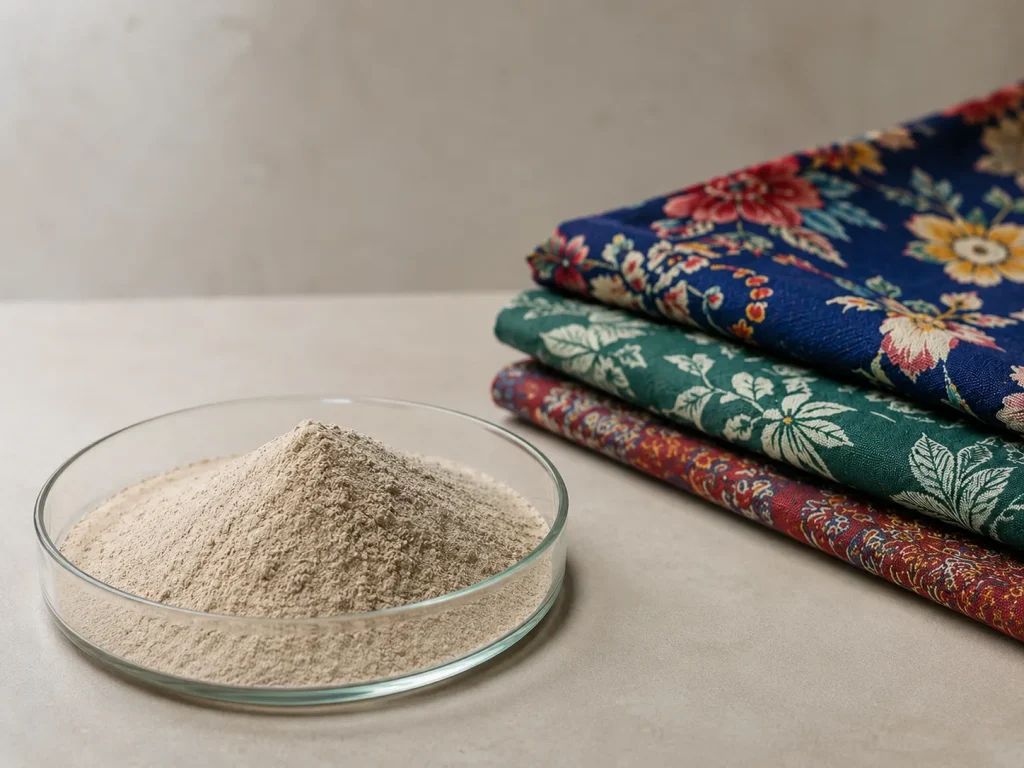
Degree of substitution is a parameter used for cellulose ethers such as CMC, not for sodium alginate. For sodium alginate, compare declared purity, insoluble matter, moisture, pH, particle size and viscosity under a defined method, together with multi-batch process consistency. A supplier should not use a CMC-style DS value to describe sodium alginate.
Mesh Size (Particle Size)
Compare the declared particle-size method and distribution, not only a mesh number. Ask whether the quoted particle specification changes price, packing or preparation requirements. Do not assume that a stated 40-mesh versus 80-mesh difference has one universal processing surcharge.
Verify preparation time, lump formation and filtration with the actual addition and mixing method. A finer classification does not by itself establish faster trouble-free hydration or a lower cost in use. Choose a particle specification that passes the preparation and printing trial.
Order Quantity: Volume Pricing and MOQ
How Volume Affects Unit Price
Request quantity-break quotations for the same grade, packing and delivery basis. Any discount depends on the actual offer; this article does not set a one-ton threshold or promise that every larger order receives a lower unit price. Include financing, storage and usable shelf life when comparing order sizes.
Compare consolidated shipments, scheduled call-offs and separate smaller orders using actual delivered costs. Increasing order frequency alone does not prove a unit-price saving. Check how each option affects inventory, freight, cash flow and continuity before selecting a purchasing schedule.
Minimum Order Quantity (MOQ) and Its Implications
Confirm the quoted MOQ and the reason for it with the supplier. An MOQ below manufacturing batch size does not prove that material is old or less suitable. Check lot identity, manufacture date, declared shelf life, storage and package condition separately.
For initial orders or trials, many suppliers offer sample quantities below their standard MOQ at a higher unit price or at cost. If a supplier requires full MOQ commitment before any sample evaluation is possible, this is worth noting in your evaluation — it increases the procurement risk of switching to a new supplier or grade.
Logistics and Delivery Terms: A Significant Variable in Total Cost
Incoterms and What They Include
Sodium alginate quotes may be expressed under different Incoterms — EXW (ex-works), FOB (free on board), CIF (cost, insurance, and freight), or DDP (delivered duty paid) — and comparing quotes under different terms is not a like-for-like price comparison.
State the named place or port and Incoterms® edition on every quotation. Under DDP, the seller handles import clearance and delivers at the agreed destination ready for unloading; unloading is not automatically the seller’s duty. Under CIF, the seller pays freight and insurance to the named destination port, while risk passes when goods are on board at shipment. A destination label alone does not mean the same cost and risk allocation. Check the agreed charges and the ICC explanation of delivery and risk; there is no universal percentage spread between terms.
When comparing quotes from multiple suppliers, convert all prices to the same Incoterm basis before comparison. If suppliers quote on different terms, ask each supplier to provide a full landed cost estimate to your destination port or facility so you are comparing total cost of ownership rather than headline price.
Freight Rate Volatility
International freight rates — particularly container shipping from China — are subject to significant volatility. Quotes that include freight (CIF or similar) should specify the validity period of the freight component, as freight rates can change substantially between quotation and order placement.
For regular procurement, establishing a freight cost baseline at the time of supplier evaluation and updating it periodically gives a more accurate picture of total landed cost than relying on a single quoted CIF price.
Certifications and Documentation: When They Add Cost
Standard Documentation vs. Premium Certification
Request the applicable TDS, SDS and batch COA, and confirm which documents the quotation includes. Additional testing, certification or special reporting may have separate arrangements. Document availability and fees must be agreed with the supplier; they are not assumed identical for every order.
Check whether a certification is required by the application, destination rules or customer specification, and whether it covers the actual product or manufacturing site. Verify the issuer, certificate scope and current status. Ask which testing or document charges the quotation includes; a certification name alone does not prove a price premium is necessary or justified. Industrial buyers may still require environmental or supply-chain documentation.
Be cautious of suppliers who claim certifications but cannot provide certificate numbers, issuing bodies, and validity dates. A claimed certification that cannot be verified does not justify a price premium and may indicate misleading marketing rather than genuine compliance.
How to Evaluate Sodium Alginate Quotes Effectively
Creating a Like-for-Like Comparison Framework
To compare quotes from multiple sodium alginate suppliers meaningfully, establish a comparison framework that normalizes for the variables above. For each quote, confirm and document:
- Grade specification: exact grade, viscosity method, relevant purity or assay basis, insoluble matter, moisture and particle-size method. Do not add a CMC-style DS requirement for ordinary sodium alginate.
- Delivery basis: named place or port, Incoterms® edition, responsibility split and comparable delivered-cost calculation.
- Quantity and packing: same order mass and packaging; request actual quantity-break prices.
- Documents: applicable TDS, SDS, lot COA and any additional reports, including availability and charges.
- Timing and payment: lead time, quotation validity, payment and the treatment of changing freight costs.
- Sample: grade identity, representative lot, amount, cost and agreed approval process.
Total Cost of Ownership vs. Unit Price
Unit price is the most visible element of a sodium alginate quote, but it is not the only cost relevant to your procurement decision. Total cost of ownership includes:
- Landed unit cost (including freight, duties, and handling)
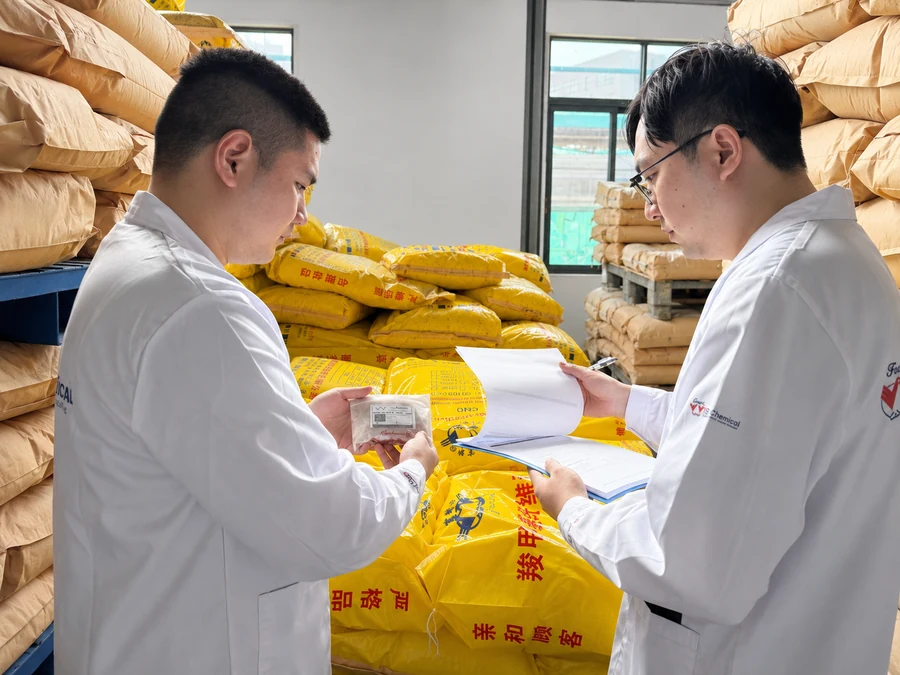
- Quality control and incoming inspection cost
- Paste preparation efficiency (dissolution time, waste from substandard batches)
- Production impact of quality variation (rework, color inconsistency, screen blockage)
- Supplier management cost (communication, documentation, dispute resolution)
A supplier offering a lower unit price but with inconsistent batch quality, slow documentation response, or unreliable delivery may have a higher total cost of ownership than a supplier with a higher unit price but reliable performance. Factoring these elements into your evaluation — even qualitatively — gives a more complete picture than unit price comparison alone.
Worked Example: Cost per Accepted Printing Metre
The figures below are hypothetical arithmetic, not FSX prices, recommended dosages or factory results. Assume both trials use 100 kg of final working paste and produce 800 accepted linear metres of the same-width fabric. Keep fibre, construction, fabric weight, design coverage, colour target, fixation, wash-off and acceptance criteria comparable. The amounts refer to as-supplied powder in the final paste, not stock-paste percentage or active-polymer assay.
| Recorded item | Candidate A | Candidate B |
|---|---|---|
| Illustrative delivered powder price | USD 2.00/kg | USD 2.40/kg |
| Powder used per 100 kg final paste | 4.0 kg (4.0% w/w) | 3.0 kg (3.0% w/w) |
| Thickener material cost for that paste | 4.0 × 2.00 = USD 8.00 | 3.0 × 2.40 = USD 7.20 |
| Actual accepted printing length assumed | 800 m | 800 m |
| Thickener cost per accepted metre | 8.00 ÷ 800 = USD 0.010/m | 7.20 ÷ 800 = USD 0.009/m |
In this example, B has a higher powder price and a lower thickener component cost. That does not establish a total-production saving: add the measured preparation, chemicals, utilities, labour, downtime and rework costs for the same trial, then divide by its actual accepted output. Exclude rejected metres from the denominator; if widths differ, compare accepted square metres. Do not estimate printable length from paste mass alone.
Red Flags in Sodium Alginate Quotes
The following characteristics in a quote or supplier interaction are worth treating with caution:
- Incomplete basis: grade identity, viscosity method, relevant quality limits or delivery basis is missing.
- Unexplained difference: a much lower quote merits clarification of grade, quantity and inclusions; price alone does not prove inferior quality or unreliable supply.
- Missing qualification evidence: clarify document and sample availability before accepting a new grade.
- Unverifiable certification: check issuer, scope, status and covered product or site.
- Unclear fulfilment: confirm stock or production plan, lot identity, testing and shipment timing.
Frequently Asked Questions About Sodium Alginate Pricing
Is the lowest sodium alginate price usually the lowest production cost?
No. Compare the workable use concentration, print result, filtration, wash-off, batch consistency and rework risk. A cheaper powder can create a higher total cost if more product or more process correction is required.
Can two quotations be compared from viscosity alone?
No. The concentration, temperature, instrument, spindle, speed, hydration time and water quality must match. The same reported viscosity under different methods is not a like-for-like specification.
Which supplier documents should be requested?
Request the current TDS, SDS, batch COA, packing specification, shelf-life statement and a quotation that clearly states quantity, Incoterm, destination and validity period. Ask for a representative sample before bulk approval.
How should a new quotation be qualified?
Run the supplier sample and current product in the same paste and printing procedure, record the complete viscosity method, then compare color yield, outline sharpness, penetration, wash-off and paste stability before confirming a bulk trial.
How FSX Chemical Approaches Pricing Transparency
When requesting an FSX sodium alginate quotation, identify the application, current grade or TDS, complete viscosity method, quantity, packing and destination. Confirm the applicable specification, available batch documentation, delivery basis and any document charges in the actual offer. Ordinary sodium alginate should not be quoted using a CMC degree-of-substitution requirement.
Sample quantities are available for evaluation before bulk ordering. If you are comparing our pricing against other quotes and want to verify that the specifications are comparable, our technical team can assist with a specification-by-specification review.
Próximos pasos:
- Solicitar una cotización — provide your target grade specification and order quantity for a fully detailed price proposal
- Solicitar un TDS — confirm full specification detail before comparing against other supplier quotes
- Solicitar una muestra — evaluate performance before committing to bulk volume
- CPóngase en contacto con nuestro equipo técnico — for help interpreting specification differences between competing quotes📧 Correo electrónico: Service@fsxchemical.com