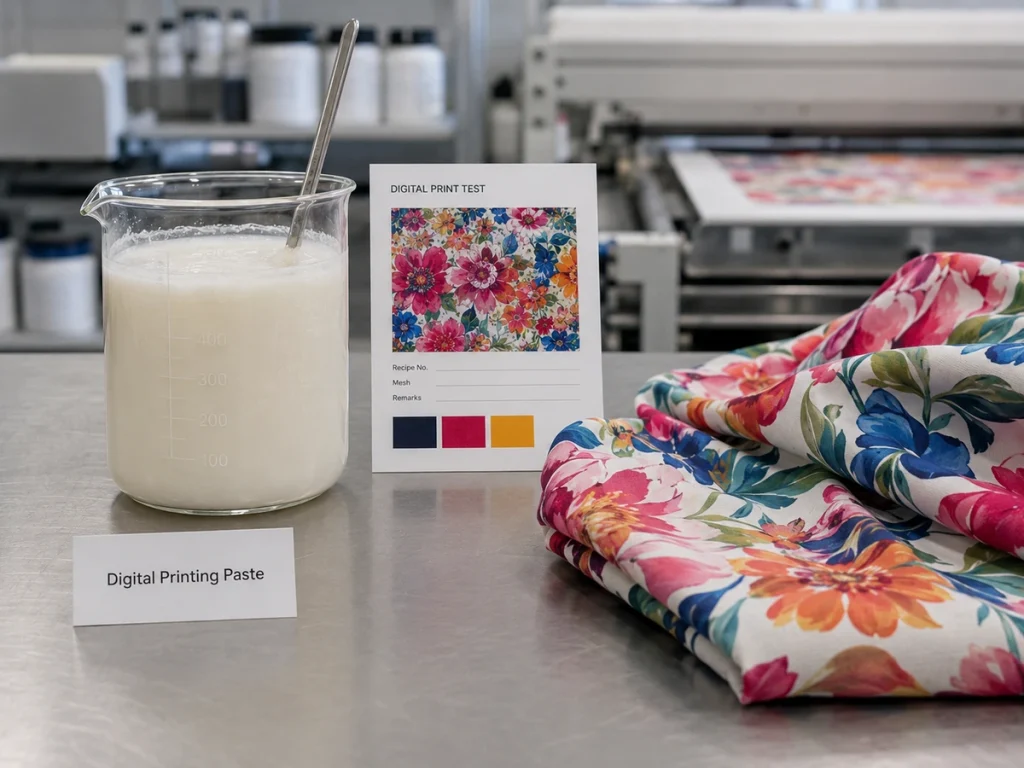
Evaluate a sodium alginate claim by identifying the exact commercial grade, the claimed outcome, the evidence and its limits. A seaweed origin or an “eco-friendly” label does not establish the environmental performance of a finished printing process. Performance claims also need a defined reference recipe, test conditions and finished-fabric results.
For a proposed process improvement, agree what will be measured before requesting a sample. Keep supplier statements, independent reports and results from your own printing trial distinct; none automatically establishes the other.
Use the review below to decide whether a claim is sufficiently supported to influence grade selection, or whether a specific document or controlled comparison is still needed.
Why Sodium Alginate Remains Important in Textile Printing
Reactive Printing Paste Requires Controlled Viscosity
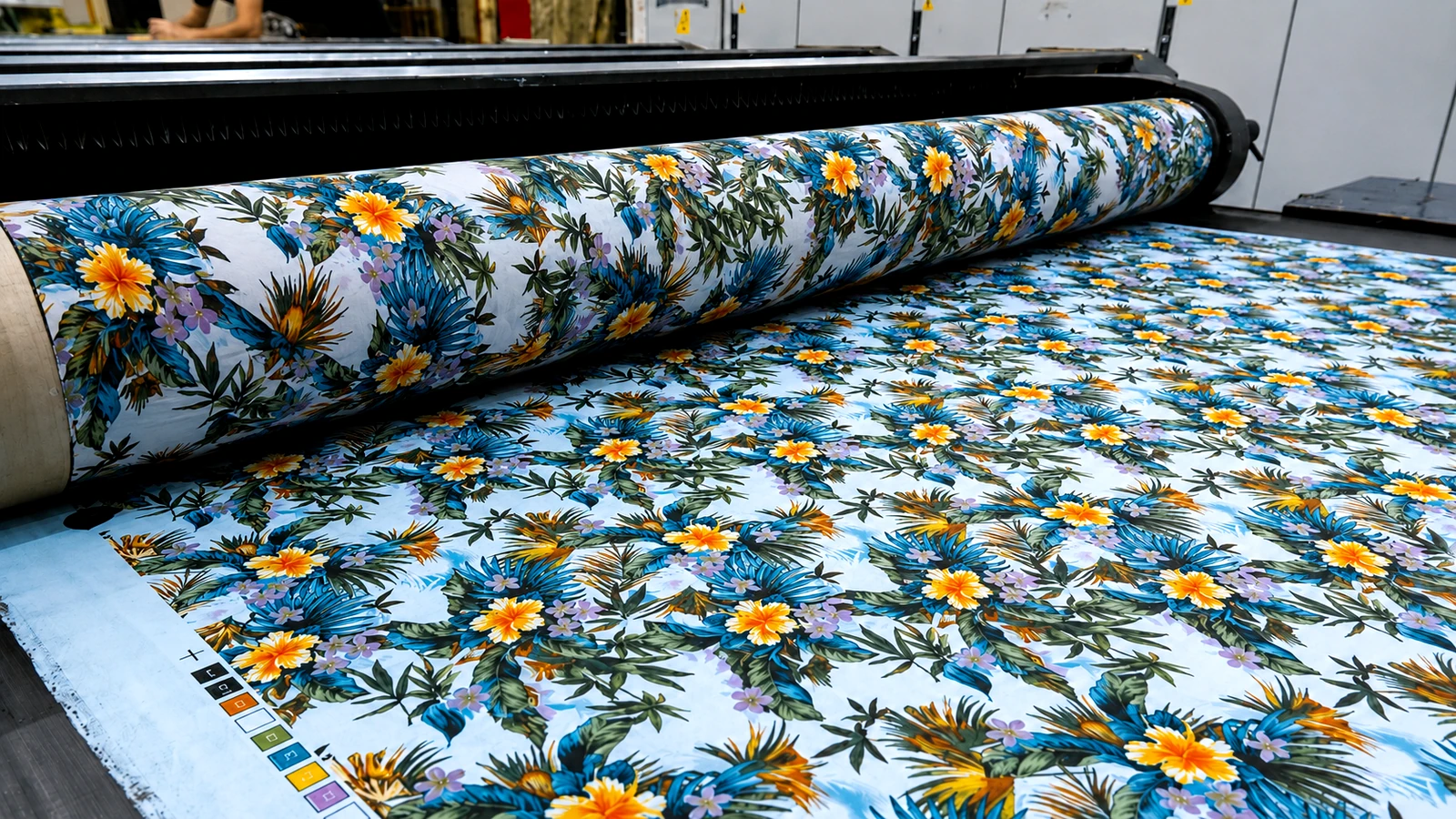
The suitable grade depends on the target paste viscosity, printing method, fabric type, dye system, water quality, and preparation process.
Dissolution and Paste Smoothness Affect Production Handling
Besides viscosity, dissolution behavior is also important. If sodium alginate hydrates unevenly, the paste may contain lumps, show poor smoothness, or create filtration difficulty.
Buyers should evaluate dissolution behavior under their own water quality, stirring method, addition sequence, preparation time, and formulation conditions.
Different Printing Processes May Need Different Grades
There is no single sodium alginate grade that fits every textile printing process. A grade suitable for one formulation may not perform the same in another production system.
For this reason, grade selection should be based on actual application data and sample testing rather than broad supplier claims.
How Buyers Should Treat Eco-Friendly and Performance Claims
Environmental Claims Need Supporting Documents
Terms such as “eco-friendly,” “biodegradable,” “non-toxic,” or “compliant” should be reviewed carefully in B2B chemical sourcing. If these claims matter to the buyer’s internal approval or customer audit, supporting documents should be requested before order confirmation.
Depending on the buyer’s requirement, this may include SDS, supplier statements, restricted-substance information, customer questionnaires, or third-party testing documents where applicable.
Build a Claim-to-Evidence Record
Use this proposed review record before comparing claims across suppliers. A document should identify the product it covers and explain the measurement or assessment behind the statement.
| Claim | Evidence to request | Limit to record |
|---|---|---|
| “Lower dosage” or “higher color yield” | Reference grade, complete recipe, dose basis, fabric, printing and post-treatment conditions, and finished-fabric results. | An optimized recipe is a separate comparison from a replacement at unchanged dosage. Record both where relevant. |
| “Biodegradable” | Exact tested material, method, conditions, duration and result in the underlying report. | A result for one material or test environment does not establish removal or environmental impact in the mill’s wastewater system. |
| “Restricted-substance compliant” | Applicable requirement, exact grade, document issuer, scope, version and date; obtain product-specific evidence as required by the buyer. | A general supplier declaration or SDS is not interchangeable with a requested analytical report or certification. |
| “Less washing” or “lower wastewater load” | Comparable accepted fabric output, wash recipe and measured water or pollutant load on the same stated basis. | Do not infer a lower total load from a single concentration reading or from polymer origin. |
Record an unresolved claim as “not yet substantiated for this decision.” This keeps it out of the purchasing score until the relevant evidence is supplied. ISO 14021 provides a framework for evaluating self-declared environmental claims. Use this checklist to organize evidence; a reference to the standard does not establish certification for a product.
Reference: ISO 14021: self-declared environmental claims.
Performance Claims Should Be Tested in the Buyer’s Formulation
Claims about color performance, printing sharpness, paste stability, or production efficiency should not be accepted only as marketing language. Final performance depends on the buyer’s formulation and production process.
Buyers should test the recommended sodium alginate grade in their own paste preparation and printing conditions before bulk purchase.
Regulatory or Certification Requirements Should Be Clarified Early
If the buyer needs specific certification, restricted-substance confirmation, or customer compliance documents, those requirements should be discussed before quotation or shipment.
एक व्यावहारिक आपूर्तिकर्ता को स्पष्ट रूप से बताना चाहिए कि कौन से दस्तावेज़ प्रदान किए जा सकते हैं और किन दावों के लिए औपचारिक तृतीय-पक्ष परीक्षण या प्रमाणन आवश्यक है।.
Key Specifications Buyers Should Review
Viscosity Grade and Test Method
Viscosity is one of the most important parameters for sodium alginate used in textile printing paste. Buyers should review the viscosity range together with the test concentration, temperature, instrument method, and unit.
Without a clear test method, viscosity values from different suppliers may not be directly comparable.
जाली का आकार और घुलन व्यवहार
Mesh size can influence dispersion and hydration during paste preparation. However, actual dissolution behavior also depends on water quality, stirring speed, addition method, and preparation time.
Buyers should test the product under their own preparation conditions instead of relying only on mesh size data.
नमी, पीएच और उपस्थिति
नमी, pH और दिखावट बुनियादी लेकिन महत्वपूर्ण गुणवत्ता संकेतक हैं। ये भंडारण, हैंडलिंग, गुणवत्ता नियंत्रण और पुनः खरीद को प्रभावित करते हैं।.
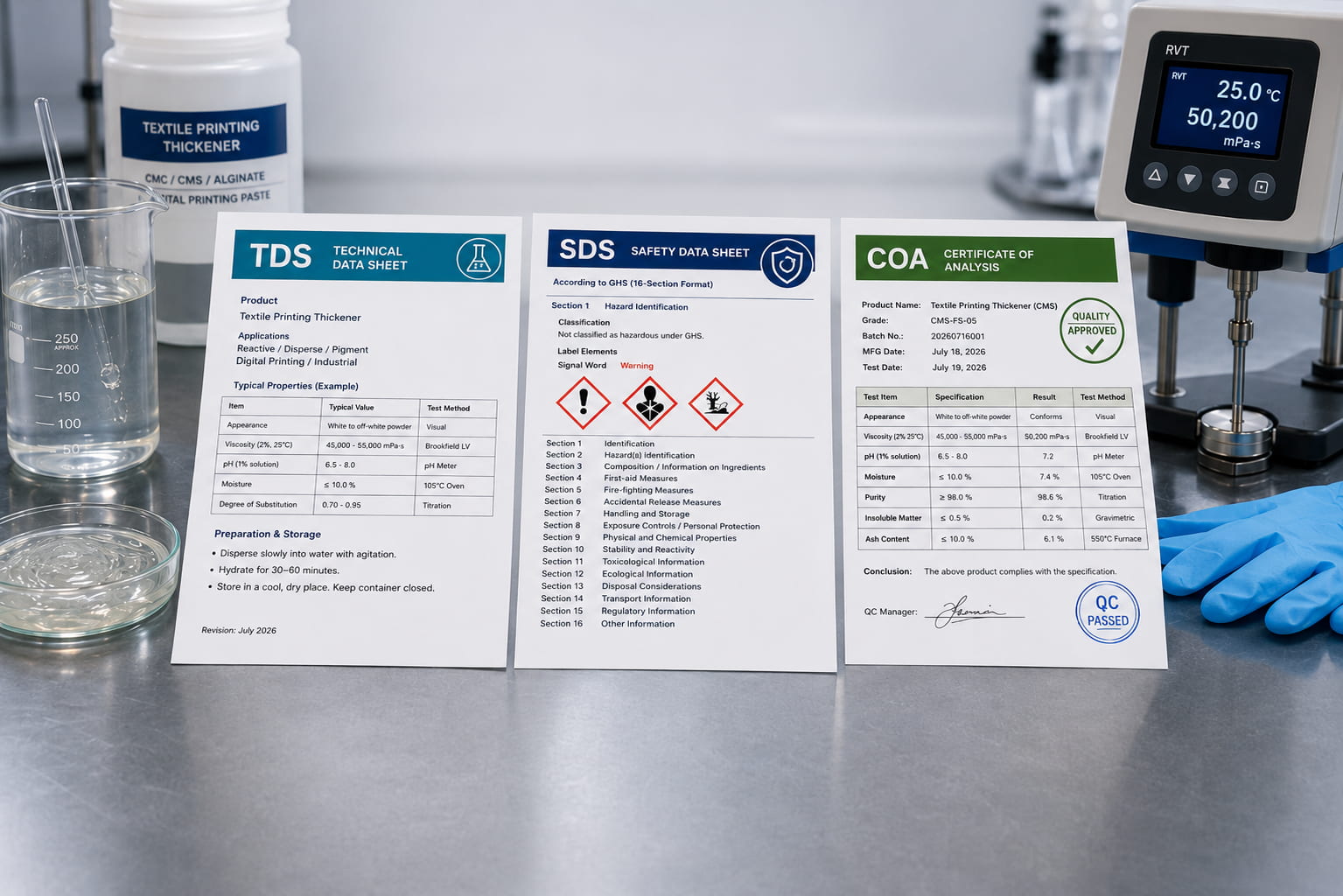
These parameters should be reviewed in the TDS and confirmed through COA data for each batch.
बैच स्थिरता
For repeat orders, batch consistency matters. If viscosity, moisture, pH, or dissolution behavior changes significantly between batches, the buyer may need to adjust the formulation again.
COA review helps buyers confirm whether batch data remains within the agreed specification range.
Documents Buyers Should Request Before Purchase
विनिर्देश समीक्षा के लिए टीडीएस
The Technical Data Sheet helps buyers review the standard product specification. It should include key parameters such as appearance, viscosity, mesh size, moisture, pH, storage conditions, and testing method.
The TDS is useful for technical comparison, but it should not replace sample testing in the buyer’s own formulation.
बैच पुष्टि के लिए सीओए
विश्लेषण प्रमाणपत्र एक विशिष्ट उत्पादन बैच के वास्तविक डेटा की पुष्टि करता है। यह थोक ऑर्डर, पुनः खरीद, वितरक आपूर्ति और आंतरिक गुणवत्ता नियंत्रण के लिए महत्वपूर्ण है।.
Buyers can compare COA records across shipments to check whether key parameters remain stable over time.
हैंडलिंग और परिवहन के लिए एसडीएस समीक्षा
सुरक्षा डेटा शीट हैंडलिंग, भंडारण, परिवहन और आंतरिक सुरक्षा समीक्षा में सहायता करती है। अंतरराष्ट्रीय खरीद के लिए शिपमेंट और सीमा शुल्क संबंधी संचार के लिए भी एसडीएस की आवश्यकता हो सकती है।.
खरीदारों को यह सुनिश्चित करना चाहिए कि SDS उत्पाद का नाम और आपूर्तिकर्ता की जानकारी ऑर्डर दस्तावेज़ों से मेल खाती हो।.
Additional Environmental or Restricted-Substance Documents
If the buyer needs environmental statements, restricted-substance information, customer audit documents, or certification support, these requirements should be clearly requested before order confirmation.
Suppliers should explain which documents can be provided and which claims require third-party testing or formal certification.
थोक खरीद से पहले सोडियम अल्गीनेट का परीक्षण कैसे करें
वास्तविक मुद्रण पेस्ट निर्माण में परीक्षण
जब भी संभव हो, नमूना परीक्षण खरीदार की अपनी फॉर्मूलेशन में ही किया जाना चाहिए। रंग, सहायक पदार्थ, जल की गुणवत्ता, pH, हिलाने की विधि, पेस्ट की सांद्रता और भंडारण समय सभी अंतिम पेस्ट के व्यवहार को प्रभावित कर सकते हैं।.
केवल स्वच्छ पानी में परीक्षण करना यह पुष्टि करने के लिए पर्याप्त नहीं हो सकता कि सोडियम अल्गीनेट ग्रेड उत्पादन के लिए उपयुक्त है या नहीं।.
पेस्ट की चिकनाई और छानन का अवलोकन करें
During testing, buyers should observe dissolution speed, paste smoothness, lump formation, filtration behavior, viscosity stability, and application handling.
टेक्सटाइल प्रिंटिंग पेस्ट के लिए, ये व्यावहारिक अवलोकन अक्सर TDS में दिखाए गए मूल विनिर्देश डेटा जितने ही महत्वपूर्ण होते हैं।.
अनुमोदित नमूने की थोक शिपमेंट से तुलना करें
थोक ऑर्डर की पुष्टि करने से पहले, खरीदारों को यह जांचना चाहिए कि स्वीकृत नमूना और थोक शिपमेंट एक ही चिपचिपापन सीमा, जाल आकार, पैकेजिंग प्रारूप, बैच ट्रेसबिलिटी और COA आवश्यकताओं का पालन करेंगे।.
यह नमूने और कुल के बीच असंगति के जोखिम को कम करने में मदद करता है।.
Common Mistakes When Following Sodium Alginate Trends
Choosing by Trend Words Instead of Application Needs
Words such as “green,” “high-performance,” or “advanced” do not define whether a sodium alginate grade is suitable for a specific printing process.
Buyers should start with application requirements, not marketing descriptions.
Ignoring the Viscosity Test Method
Viscosity values measured under different concentrations, temperatures, or instruments may show different results.
Before comparing suppliers, buyers should check whether the test method is clearly stated.
Overlooking Sample-to-Bulk Consistency
This is especially important for distributors and factories that require stable repeat supply.

FSX केमिकल सोडियम अल्गीनेट खरीदारों का कैसे समर्थन करता है
अगले कदम
- अपनी आवेदन साझा करें — हमें अपनी मुद्रण प्रक्रिया, कपड़े का प्रकार, रंग प्रणाली, लक्षित चिपचिपाहट, और वर्तमान पेस्ट सूत्रीकरण बताएं।.
- Clarify Document Requirements — explain whether you need SDS, restricted-substance statements, customer questionnaires, or third-party certification documents.
- टीडीएस का अनुरोध करें — चिपचिपापन सीमा, जाल आकार, पीएच, नमी, उपस्थिति, भंडारण की स्थिति, और परीक्षण विधि की समीक्षा करें।.
- COA का अनुरोध करें — शिपमेंट से पहले यह पुष्टि करें कि बैच डेटा सहमत विनिर्देश सीमा से मेल खाता है।.
- नमूना अनुरोध करें थोक ऑर्डर की पुष्टि करने से पहले, अपने स्वयं के पेस्ट मिश्रण और मुद्रण परिस्थितियों में अनुशंसित सोडियम अल्जीनेट ग्रेड का परीक्षण करें।.
- पैकेजिंग और निर्यात दस्तावेज़ों की पुष्टि करें — शिपमेंट से पहले बैग का आकार, लेबल, बैच की ट्रेसबिलिटी, एसडीएस, इनवॉइस, पैकिंग लिस्ट और अन्य आवश्यक दस्तावेज़ों की जाँच करें।.
- Request Grade and Evidence Review — share the exact claim, current TDS and printing conditions so that the required documents and comparison trial can be identified.📧 ईमेल: Service@fsxchemical.com