Pasta Cetak Digital dengan Peringkat Terbaik untuk Tinta Tekstil Modern
A top-performing digital printing paste is not defined by viscosity alone. Reactive, disperse and pigment...
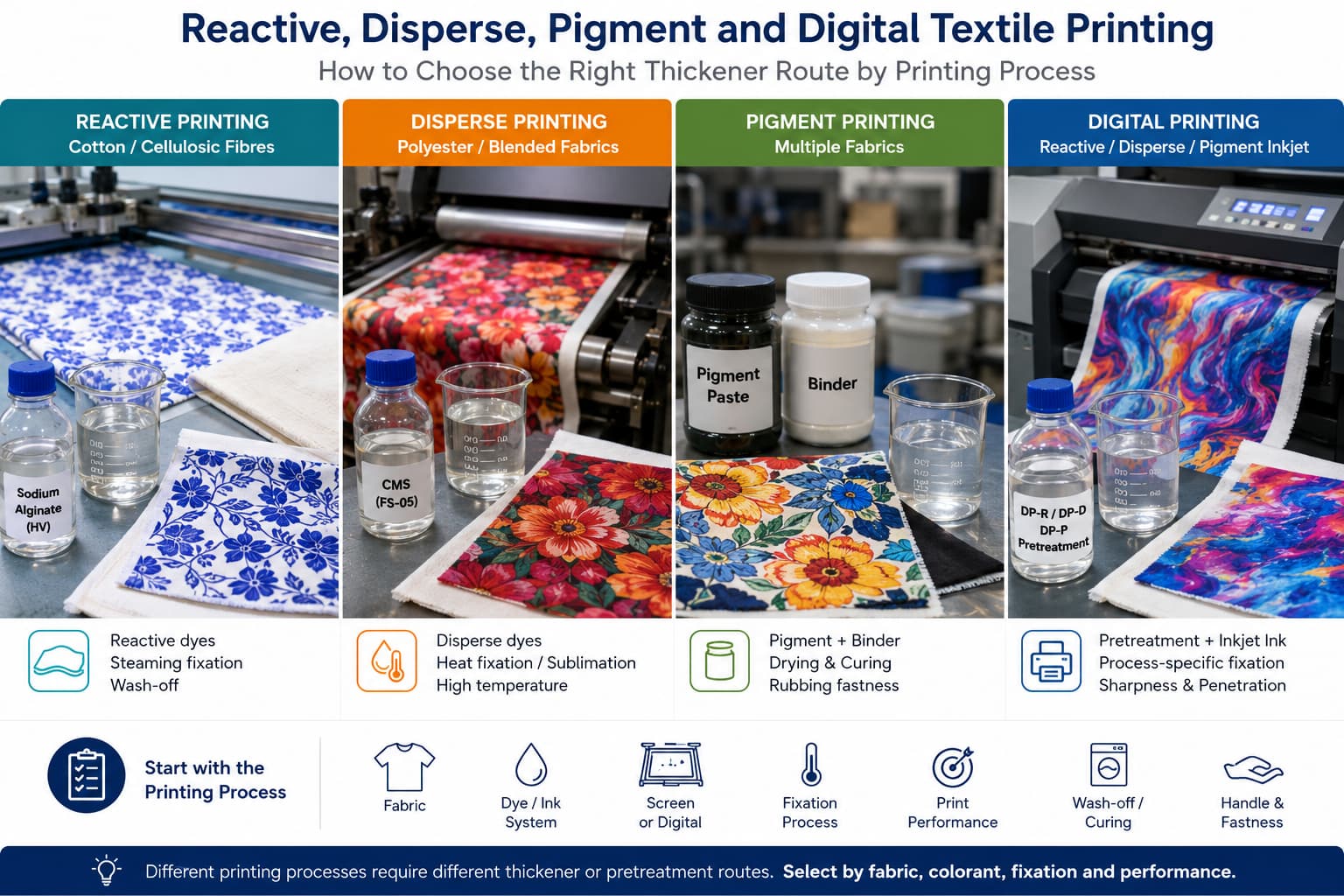
A top-performing digital printing paste is not simply the product with the highest viscosity or the strongest marketing claim. Reactive, disperse and pigment textile inks interact differently with fibers, pretreatment chemicals and post-treatment processes. The right digital printing paste must therefore be selected by ink chemistry, fabric, pretreatment route, rheology, print definition, color performance, fixation and production stability. This guide explains how textile printing factories can compare digital printing paste systems through controlled laboratory and production testing.
What Does “Top-Rated” Mean for a Digital Printing Paste?
In consumer products, “top-rated” may refer to reviews, rankings or popularity. Industrial textile chemicals require a different definition.
For a digital printing factory, a top-performing paste should be the product that delivers the required result consistently under the actual:
Ink chemistry
Fiber type
Fabric construction
Pretreatment method
Application equipment
Kondisi pengeringan
Digital printer
Ink loading
Fixation process
Washing or curing process
This means there is no technically responsible universal ranking where one digital printing paste is always number one.
A product that performs well with reactive ink on cotton may be completely unsuitable for disperse ink on polyester. A pigment ink system introduces another set of requirements because binder chemistry, curing and fabric hand feel become important.
A more useful definition is therefore:
A top-rated digital printing paste is a process-matched product that delivers stable pretreatment, controlled ink behavior, required color performance and reliable post-treatment results at an acceptable total production cost.
What Does Digital Printing Paste Actually Do?
Digital printing paste is sometimes described simply as a “thickener.” That description can be incomplete.
In digital textile printing, the functional chemical system is often applied to the fabric before inkjet printing rather than being used in exactly the same way as a conventional screen-printing color paste.
Depending on the printing route, the pretreatment or functional paste may help control:
Fabric surface behavior
Moisture retention
Penyebaran tinta
Dye migration
Penetrasi
Edge definition
Perkembangan warna
Fixation chemistry
Other chemicals may also be included or applied separately depending on the process.
The technical selection chain should therefore begin with:
This distinction is essential when evaluating modern textile inkjet processes.
The Three Main Digital Textile Ink Routes
Reactive, disperse and pigment inks require substantially different application logic.
Digital Ink Route
Typical Fabric Direction
Main Pretreatment Questions
Important Final Evaluation
Reaktif
Cotton, viscose and other suitable cellulosic fibers
Rheology, moisture, alkali/salt compatibility, ink spreading and penetration
Color yield, sharpness, fixation, wash-off and background cleanliness
Dispersi
Polyester and suitable polyester blends
Fabric surface control, uniformity, ink migration, drying and process compatibility
Color development, definition, thermal fixation and uniformity
Pigmen
Multiple fiber types depending on the complete system
Pigment/binder compatibility, rheology, surface control and pretreatment uniformity
Color, sharpness, curing, rubbing fastness and fabric hand feel
This is why a digital printing paste should not be purchased as a generic product without identifying the ink route first.
1. Reactive Digital Printing Paste
Reactive inkjet printing is widely evaluated on cotton, viscose and other suitable cellulosic substrates.
The pretreatment system plays an important role because reactive dye printing requires more than controlling ink spreading.
The full process may include:
Fabric Pretreatment → Drying or Controlled Wet State → Digital Printing → Drying → Steaming → Washing → Finishing
The exact sequence depends on the production process and equipment.
What Should a Reactive Digital Printing Paste Control?
Beberapa bidang kinerja penting antara lain:
Uniform fabric pretreatment
Penyebaran tinta yang terkendali
Definisi garis halus
Keseragaman area padat
Penetrasi
Kompatibilitas pewarna reaktif
Perkembangan warna
Fixation efficiency
Wash-off behavior
Kebersihan latar belakang
Why More Viscosity Is Not Automatically Better
Excessively high paste viscosity may create application difficulties without necessarily improving the printed result.
Depending on the application method, an overly heavy pretreatment can potentially affect:
Padding or coating uniformity
Penetrasi kain
Pengeringan
Surface film formation
Pegangan dari kain
Ink interaction
Conversely, insufficient control may allow excessive lateral ink migration and reduced edge definition.
The objective is therefore not maximum viscosity. It is the appropriate rheological and surface-control behavior for the selected process.
Wet Reactive Digital Printing
Some reactive digital processes use a wet or partially wet fabric route rather than a conventional fully dried pretreatment before printing.
This changes the technical requirement significantly.
The paste or pretreatment must be evaluated together with:
Fabric moisture level
Wet-state uniformity
Ink-to-fabric interaction
Pengendalian perdarahan
Machine conditions
Steaming and washing
A product developed for a conventional dried pretreatment route should not automatically be transferred to a wet-printing process.
2. Disperse Digital Printing Paste
Disperse digital printing is primarily associated with polyester and suitable polyester-containing fabrics.
The chemistry and fixation conditions are very different from reactive printing.
Therefore, a successful reactive digital pretreatment should not automatically be considered suitable for disperse digital printing.
Main Selection Factors for Disperse Digital Printing
Evaluasi:
Kompatibilitas bahan
Keseragaman prapengolahan
Solution or dispersion stability
Filtration where relevant
Penyebaran tinta
Definisi pola
Keseragaman area padat
Pola pengeringan
Thermal fixation performance
Final color development
Polyester constructions can also behave differently depending on weight, weave or knit structure, surface preparation and absorbency.
For this reason, laboratory evaluation should use the customer’s actual production fabric whenever possible.
Do Not Transfer Reactive Printing Formulas Directly
One of the most common technical mistakes is to treat all digital printing pretreatments as variants of the same thickener system.
The thickener route proven with reactive ink on cotton should not automatically be used with disperse ink on polyester.
The ink chemistry, fiber interaction and fixation mechanism are different.
The correct candidate should therefore be selected specifically for the disperse process and verified through the complete printing and fixation sequence.
3. Pigment Digital Printing Paste
Pigment digital printing requires another technical approach.
Unlike dyes that interact with the fiber through a dye-specific fixation mechanism, pigment particles require a binder system to remain attached to the textile substrate.
For this reason, pigment digital printing cannot be evaluated by thickener performance alone.
Critical Pigment Digital Printing Factors
Kompatibilitas dispersi pigmen
Kompatibilitas pengikat
Pretreatment stability
Reologi
Penyebaran tinta
Ketajaman tepi
Kondisi pengeringan
Dry rubbing fastness
Wet rubbing fastness
Tekstur kain saat disentuh
A formulation that produces strong color but leaves an unacceptable fabric handle may not be commercially suitable.
Similarly, increasing binder concentration may improve one performance property while creating disadvantages elsewhere.
This means pigment digital printing should be evaluated as a complete system:
Eight Performance Factors That Matter More Than Product Name
1. Pretreatment Uniformity
A digital pretreatment should be distributed uniformly across the fabric.
Uneven application can produce local differences in ink absorption, color yield and sharpness even if the ink and printer settings remain unchanged.
2. Rheology
The product should provide appropriate flow and recovery for the selected application method.
Padding, coating, sizing and other pretreatment methods can impose different shear conditions.
3. Stability
The prepared system should remain sufficiently stable during the intended production period.
Check:
Viscosity change
Separation
Busa
Sedimentation where relevant
Penampilan
Application uniformity
4. Pengendalian Penyebaran Tinta
The pretreatment should help prevent excessive lateral migration while still allowing the required penetration and color development.
Very low spreading is not automatically the objective if it creates poor penetration or an undesirable fabric surface.
5. Print Definition
Use a test image that includes:
Fine lines
Small text
Sharp edges
Color transitions
Solid areas
High ink-coverage regions
A simple color block cannot fully evaluate digital printing performance.
6. Color Performance
Color should be evaluated after the full fixation and post-treatment sequence.
Do not judge a pretreatment only from the appearance of freshly printed fabric.
7. Post-Treatment Performance
The relevant process may include:
Pengukusan
Fiksasi termal
Pengeringan
Pencucian
Penyempurnaan Kain
The final evaluation must correspond to the actual ink chemistry.
8. Production Stability
A laboratory result is valuable only if it can be reproduced on production equipment.
Evaluate whether the pretreatment continues to perform after changes in:
Machine speed
Fabric batch
Production time
Ink coverage
Ambient conditions
Why Viscosity Alone Cannot Select a Digital Printing Paste
A viscosity value is meaningful only when the measurement method is clearly defined.
Before comparing two digital printing paste products, align:
Konsentrasi produk
Calculation basis
Sumber air
Prosedur pencampuran
Waktu hidrasi
Suhu
Viskosimeter
Poros, rotor, atau geometri
Kecepatan putaran
Waktu membaca
Even after these variables have been standardized, equal viscosity does not mean equal digital printing performance.
Viskositas yang sama tidak berarti kinerja pencetakan yang sama.
Two products with similar apparent viscosity can behave differently in:
Penurunan viskositas akibat geseran
Pemulihan struktural
Penetrasi kain
Retensi permukaan
Respon elektrolit
Kompatibilitas tinta
Pengeringan
Final print definition
This is especially important in digital textile printing because the pretreatment controls the fabric environment into which very small ink droplets are deposited.
A single viscosity number cannot describe this entire interaction.
Why Pretreatment Is Critical in Digital Textile Printing
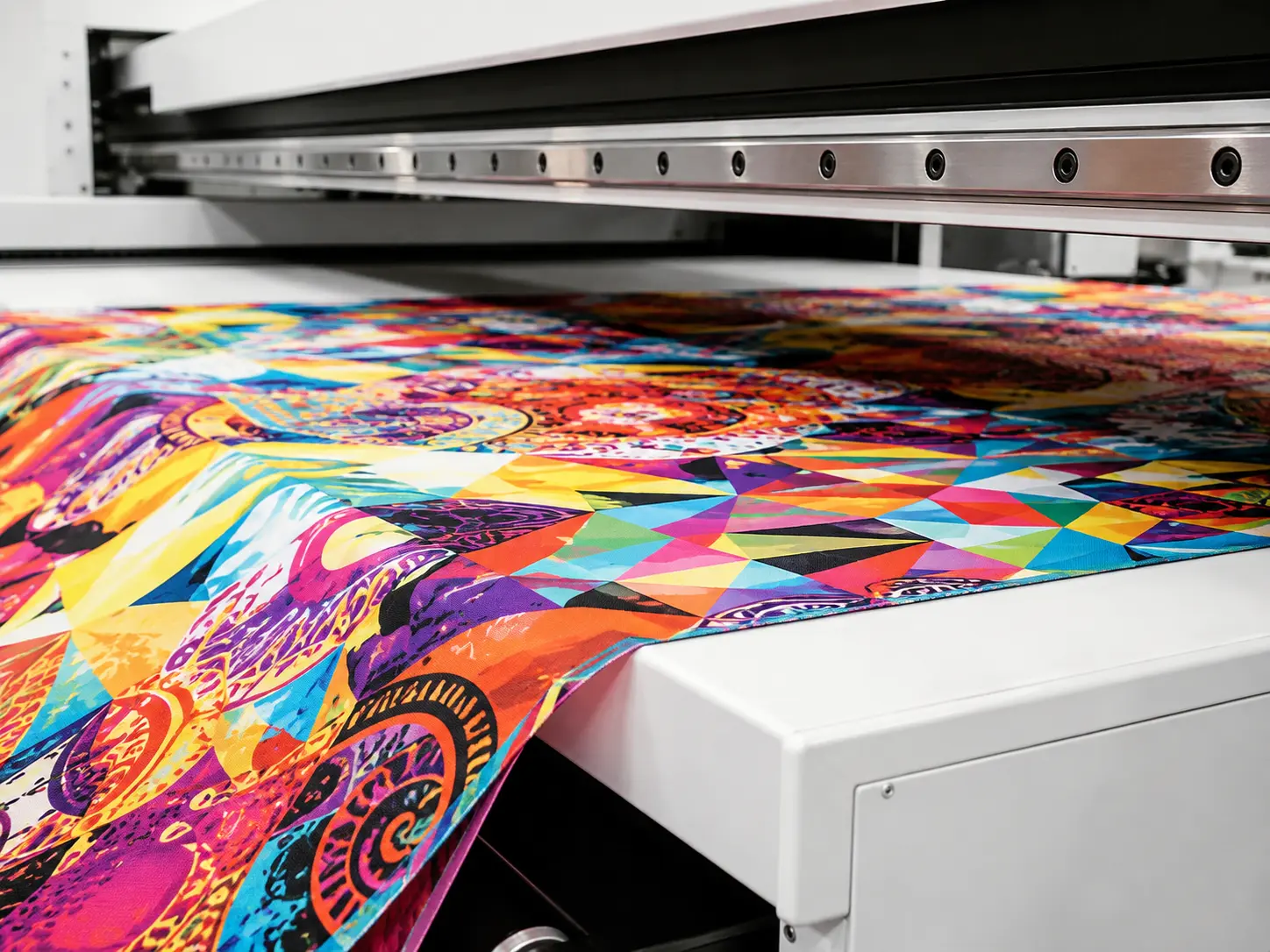
Digital printing places the colorant onto the textile through controlled ink droplets rather than forcing a conventional printing paste through a screen.
This creates a different requirement at the fabric surface.
If the untreated fabric absorbs or spreads the ink too rapidly, possible results can include:
Reduced sharpness
Color bleeding
Lower apparent color strength
Area padat yang tidak merata
Reduced small-detail definition
If the pretreatment holds too much material on the surface, different problems may occur.
The correct balance depends on:
Ink chemistry
Fiber
Fabric construction
Pretreatment concentration
Application pick-up
Pengeringan
Printer settings
Fiksasi
This is why digital printing paste selection should always be connected to the complete pretreatment process.
Why Screen-Printing Thickener Logic Cannot Be Copied Directly to Digital Printing
Conventional screen printing and digital textile printing both use rheology-control chemistry, but their application mechanisms are different.
Factor
Conventional Screen Printing
Pencetakan Tekstil Digital
Where thickener is mainly used
Typically in the printing color paste
Often in fabric pretreatment or a process-specific functional system
Color application
Paste transferred through a screen
Controlled ink droplets deposited by printheads
Critical rheology
Screen transfer, shear thinning, recovery and penetration
Pretreatment application, surface control, wetting and ink spreading
This means a conventional screen-printing sodium alginate, CMC or CMS grade should not automatically be transferred to a digital pretreatment system simply because it produces the required water viscosity.
The product needs to be evaluated for the specific digital process.
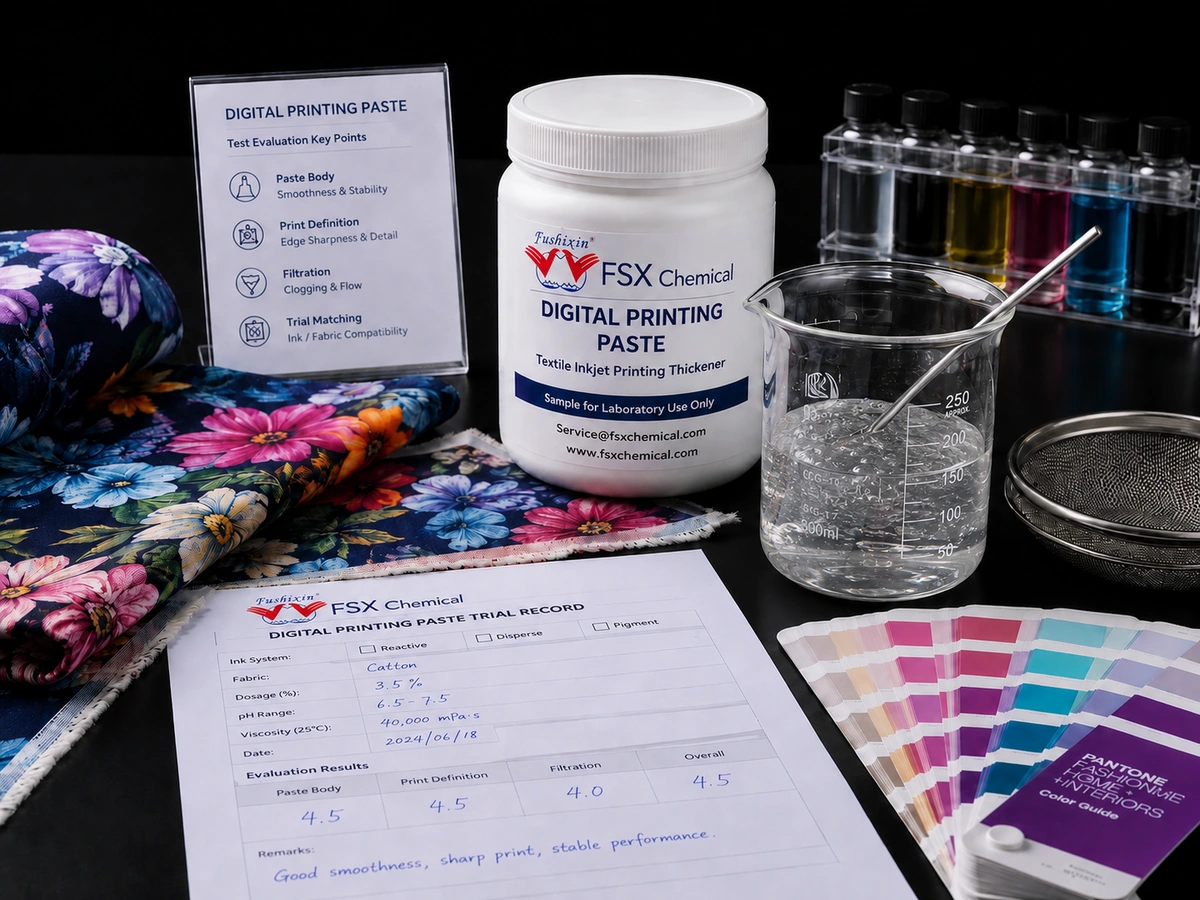
How to Compare Digital Printing Pastes in the Laboratory
A controlled testing workflow helps prevent misleading comparisons.
Step 1: Define the Ink Chemistry
Confirm whether the process uses:
Tinta reaktif
Tinta dispersi
Tinta pigmen
Another specialty digital ink system
Langkah 2: Menentukan Jenis Kain
Catatan:
Fiber composition
Berat kain
Construction
Previous preparation
Absorbency where relevant
Step 3: Record the Current Pretreatment
Dokumen:
Current supplier
Commercial grade
TDS
Dosis
Preparation formula
Cara penggunaan
Wet pick-up where applicable
Step 4: Align the Paste Preparation Method
Use controlled:
Kualitas air
Konsentrasi produk
Mixing speed
Addition sequence
Waktu hidrasi
Suhu
Step 5: Measure the Prepared Pretreatment
Bandingkan:
Penampilan
Viskositas
nilai pH jika berlaku
Stabilitas
Busa
Filtration where relevant
Step 6: Apply to the Same Fabric
Keep the application method and target pick-up as consistent as possible.
Step 7: Dry Under Controlled Conditions
If the process requires drying, differences in drying temperature and residual moisture should be controlled.
If testing a wet-printing route, the wet-state conditions should instead be defined and recorded.
Step 8: Print with the Same Ink and Printer Settings
Do not change both pretreatment and printer parameters at the same time unless the purpose of the test is process optimization.
Step 9: Complete the Correct Fixation
Use the appropriate:
Pengukusan
Fiksasi termal
Pengeringan
for the actual ink system.
Step 10: Complete Washing Where Required
Reactive printing in particular should be evaluated after the relevant wash-off process rather than from unwashed fabric alone.
Step 11: Evaluate Finished Fabric
Bandingkan:
Color depth
Ketajaman cetakan
Pendarahan
Keseragaman area padat
Penetrasi
Kebersihan latar belakang
Ketahanan warna jika berlaku
Pegangan dari kain
Step 12: Optimize Dosage
Do not assume that the new digital printing paste must use exactly the same dosage as the current product.
The commercially meaningful comparison should be made after each technically suitable candidate has been optimized.
Cara Membandingkan Total Biaya Penggunaan
Digital printing paste should not be selected by price per kilogram alone.
Consider:
Delivered chemical price
Dosis yang efektif
Pengambilan sampel prapengolahan
Mixing and preparation time
Kerugian akibat penyaringan
Energi pengeringan
Printing stability
Ink consumption
Fixation requirements
Persyaratan pencucian
Kain yang ditolak
Pencetakan ulang
Machine downtime
The practical formula is:
Total Cost in Use = Chemical Cost + Effective Dosage + Preparation Cost + Application Cost + Printing Impact + Post-Treatment Cost + Quality Loss
A lower-priced product can become expensive if it requires greater dosage or causes inconsistent printing.
Likewise, a higher-priced product should not be assumed to provide better value unless its production performance justifies the difference.
The correct commercial comparison should therefore be made after:
What Information Should You Send to a Digital Printing Paste Supplier?
The phrase “I need digital printing paste” is usually not enough to select a technically relevant product.
For more accurate matching, provide:
Ink type: reactive, disperse or pigment
Fiber composition
Fabric construction
Current pretreatment product
Current TDS if available
Dosis saat ini
Current preparation formula
Cara penggunaan
Proses pencetakan kering atau basah
Printer type where relevant
Fixation process
Washing or curing conditions
Current technical problem
Commercial cost target
A physical sample of the current product can also help when the objective is to identify a comparable candidate.
A responsible supplier should use this information to select a testing direction rather than promise an identical universal replacement immediately.
How FSX Chemical Approaches Digital Paste Matching
FSX Chemical evaluates digital printing paste according to the ink system and printing process rather than treating all digital applications as one product category.
The current product structure includes different candidate routes for reactive, wet reactive, disperse and pigment digital printing.
Process Direction
FSX Candidate Route
Main Trial Focus
Pencetakan digital reaktif
Reactive pretreatment grade confirmed by the current TDS
Pretreatment uniformity, ink control, color, fixation and wash-off
Selected wet reactive printing
Grade approved for the specified wet-on-wet process
Wet-state stability, ink interaction, definition and process compatibility
Pencetakan digital disperse
Direct-disperse pretreatment route; confirm the exact commercial grade
Polyester compatibility, surface control, definition, drying and thermal fixation
Pencetakan digital berpigmen
Pigment pretreatment grade matched to the ink and binder system
Binder/pigment compatibility, curing, rubbing fastness, sharpness and hand feel
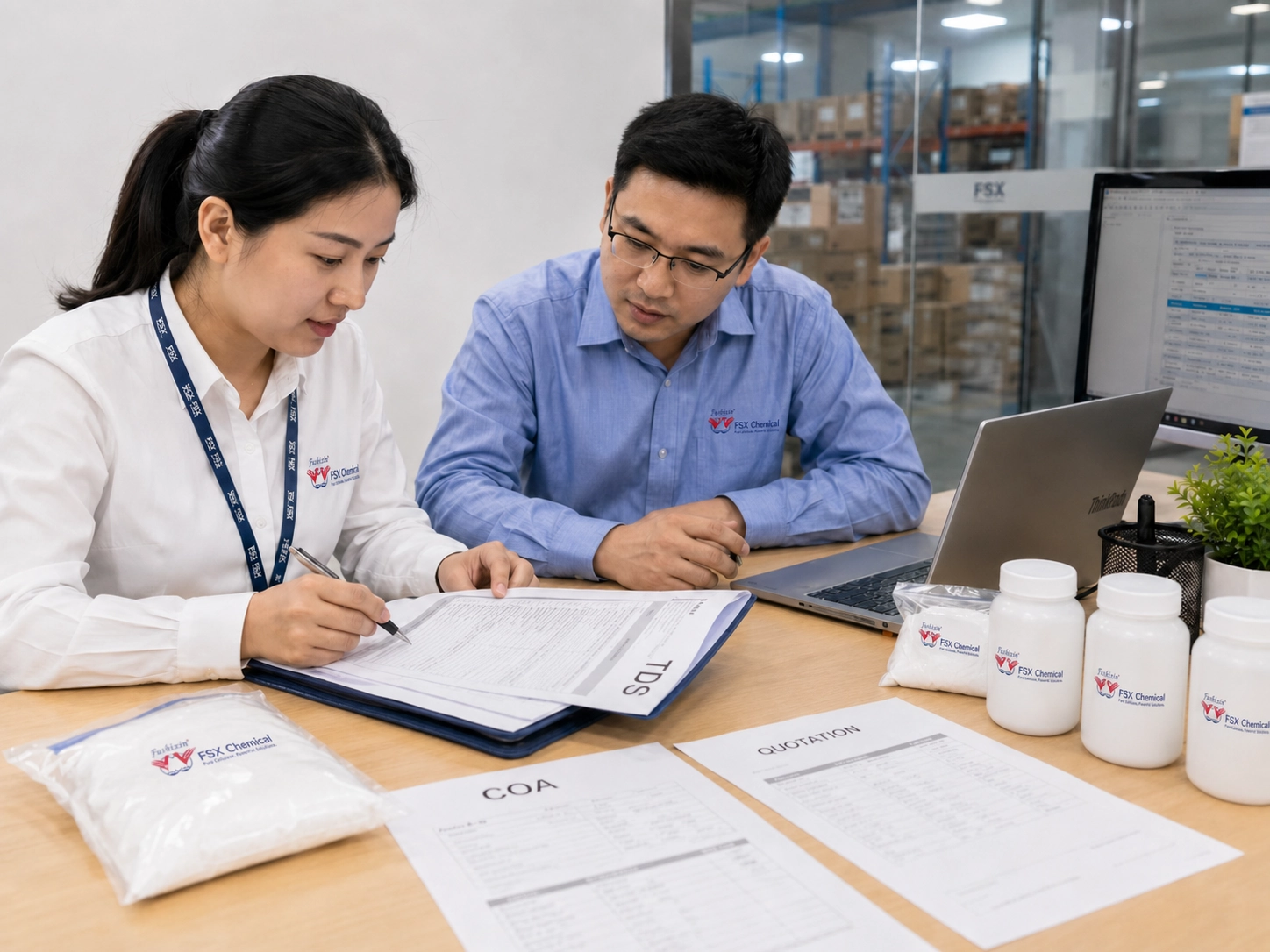
Yang current FSX digital pretreatment page separates reactive, disperse and pigment routes. Confirm the exact commercial grade and current TDS before a trial; do not infer a disperse application from an older product code or a similar number. Match the sample label, TDS and quotation to the same grade and revision.
For customers already using another digital pretreatment, the most useful starting point is a controlled side-by-side test.
The objective is not simply to reach the same laboratory viscosity.
It is to identify a candidate that delivers the required complete printing result.
How Should Textile Mills Choose a Top-Performing Digital Printing Paste?
The decision can be summarized in one technical sequence:
Ink System → Fiber → Pretreatment Route → Candidate Grade → Standardized Laboratory Test → Fabric Application → Digital Printing → Fixation → Washing/Curing → Finished Fabric → Cost Optimization
Three principles are particularly important.
First: Select by Ink Chemistry
Reactive, disperse and pigment digital printing are not interchangeable systems.
Second: Do Not Select by Viscosity Alone
A viscosity number is useful for QC only when the method is defined, and equal viscosity does not guarantee equal printing behavior.
Third: Evaluate the Finished Textile
A successful paste should not merely look good in the mixing tank.
It should deliver acceptable:
Definisi cetak
Color
Penetrasi
Fiksasi
Ketahanan
Pegangan dari kain
Production consistency
under the actual factory process.
This is a more meaningful definition of a top-rated digital printing paste than any generic product ranking.
Pertanyaan yang Sering Diajukan
1. What is digital printing paste for textiles?
Digital printing paste is a process-specific textile auxiliary used in pretreatment or related functional systems for digital textile printing. Depending on the application, it can help control rheology, fabric surface behavior, ink spreading, penetration and print definition before fixation and post-treatment.
2. Which digital printing paste is best for reactive ink?
There is no universal best grade. A reactive digital paste should be evaluated according to the fabric, pretreatment method, ink chemistry, dosage, drying or wet-printing route, steaming and washing conditions. The final selection should be based on controlled printing trials.
3. Can the same digital printing paste be used for reactive and disperse ink?
It should not be assumed. Reactive and disperse printing use different fibers, dye chemistry and fixation mechanisms. A product suitable for reactive cotton printing should be separately validated before use in disperse polyester printing.
4. What is the best pretreatment for polyester digital printing?
The correct pretreatment depends on the disperse ink system, polyester fabric, printing process, drying conditions and fixation route. Compare candidates through actual polyester printing and thermal fixation rather than viscosity alone.
5. Does pigment digital printing need a binder?
Pigment systems normally require binder chemistry to attach pigment particles to the textile substrate. Pretreatment selection should therefore consider pigment dispersion, binder compatibility, curing, rubbing fastness and fabric hand feel as a complete system.
6. Does higher digital printing paste viscosity produce sharper printing?
Not automatically. Sharpness depends on rheology, fabric absorbency, pretreatment pick-up, ink volume, penetration, printer settings and other factors. Increasing viscosity alone can introduce different application problems.
7. Why do two products with the same viscosity print differently?
Equal apparent viscosity does not mean equal shear behavior, structural recovery, hydration, surface retention or chemical compatibility. The complete pretreatment and printing result should therefore be compared.
8. How should I test a new digital printing paste?
Use the same water, preparation method, fabric, pretreatment application, ink, printer settings and fixation process. Compare the finished printed fabric after the appropriate washing or curing stage, then optimize dosage before making a commercial decision.
9. Can conventional screen-printing thickener be used for digital textile printing?
It should not be assumed. Conventional screen printing and digital pretreatment have different application mechanisms. A screen-printing thickener must be specifically validated for the intended digital process before use.
10. How can I improve color yield in digital textile printing?
Evaluate the complete process rather than only increasing thickener dosage. Fabric preparation, pretreatment uniformity, ink spreading, ink loading, fixation and washing can all influence final color performance.
11. How do I compare two digital printing paste suppliers?
Request the exact commercial grade, TDS, preparation method, viscosity test conditions and representative samples. Run controlled side-by-side trials using the same ink, fabric and production process, and compare effective dosage and Total Cost in Use after optimization.
12. What information does FSX Chemical need for digital paste matching?
Provide your ink type, fabric, current pretreatment product or TDS, dosage, application method, fixation process and current technical problem. If available, a physical sample and existing formula can make candidate selection more relevant.
Match a Digital Printing Paste to Your Ink and Fabric
If you are evaluating a reactive, disperse or pigment digital printing paste, FSX Chemical can help identify a technically relevant candidate for controlled testing.
Agar pencocokan lebih akurat, kirimkan kepada kami:
Sistem tinta Anda
Komposisi kain
Current digital pretreatment or TDS
Dosis saat ini
Preparation formula
Pretreatment application method
Dry or wet process
Fixation and washing or curing conditions
Current printing problem or cost target
Mulailah dengan Sampel & Pencocokan Grade to compare the candidate under your own digital printing conditions.
The goal is not to select the highest-viscosity paste or the strongest marketing claim. The goal is to match the ink, fabric and pretreatment chemistry so the complete digital printing process delivers stable color, definition and production performance.
Pelajari cara memilih bahan pengental dan metode pra-perlakuan untuk pencetakan tekstil reaktif, disperse, pigmen, dan digital berdasarkan jenis kain, pewarna atau tinta, proses fiksasi, daya lepas saat pencucian, serta persyaratan kualitas cetakan.
Bandingkan CMC, CMS, natrium alginat, dan pasta cetak digital untuk pencetakan tekstil. Pelajari bagaimana masing-masing bahan tersebut sesuai dengan proses pencetakan reaktif, dispersi, pigmen, dan digital, serta hal-hal apa saja yang perlu diperhatikan pembeli sebelum melakukan pengujian sampel, penyesuaian kualitas, dan pembelian dalam jumlah besar.
Karboximetil selulosa digunakan sebagai pengental dan penstabil dalam tinta berbasis air, pencetakan gravure, serta pra-perlakuan pencetakan inkjet. Panduan ini membahas parameter utama setiap jenis produk serta pertimbangan dalam pemilihan pemasok bagi tim pengadaan.
Pasta cetak berbasis CMC digunakan dalam pencetakan tekstil pigmen, reaktif, dan digital. Panduan ini menjelaskan parameter apa saja yang penting, cara membandingkan pemasok, serta hal-hal yang perlu diminta sebelum melakukan pemesanan dalam jumlah besar.
Baik natrium alginat maupun CMC digunakan sebagai pengental dalam pencetakan tekstil, namun keduanya cocok untuk sistem pewarnaan dan kondisi proses yang berbeda. Panduan ini menjelaskan perbedaan utama di antara keduanya serta kapan masing-masing harus digunakan.
Pencetakan inkjet digital pada tekstil memiliki persyaratan pasta dan pra-perlakuan yang berbeda dibandingkan dengan pencetakan sablon. Panduan ini menjelaskan bagaimana natrium alginat digunakan dalam pencetakan tekstil digital serta parameter kualitas apa saja yang harus ditentukan oleh tim pengadaan.
Karboximetil Pati (CMS) dapat dievaluasi untuk aplikasi tertentu seperti pelapis tekstil, pasta cetak, dan sistem formulasi pencetakan digital. Panduan ini menjelaskan bagaimana pembeli sebaiknya meninjau tingkat viskositas, perilaku pelarutan, pH, kadar air, perilaku lapisan film, kompatibilitas formulasi, TDS, COA, SDS, pengujian sampel, dan konsistensi antar-batch sebelum melakukan pembelian dalam jumlah besar.
Pemilihan pengental yang tepat untuk pencetakan tekstil tidak hanya bergantung pada jenis kain saja. Pembeli sebaiknya menyesuaikan pengental tersebut dengan sistem pewarna atau pigmen, metode pencetakan, sifat reologi yang diinginkan, persyaratan ketahanan terhadap pencucian, serta kondisi uji coba aktual di pabrik.
Sodium alginat umumnya digunakan sebagai pengental dalam pasta pencetakan tekstil reaktif, namun penggunaan tekstil lainnya memerlukan validasi khusus sesuai aplikasi. Panduan ini membandingkan pencetakan, pra-perlakuan digital, pelapisan benang lungsin, formulasi terkait pewarnaan, pelapisan, dan penyelesaian akhir berdasarkan fungsi, persyaratan teknis, risiko, dokumen, serta uji sampel.
Kinerja pencetakan tekstil bergantung pada sistem kimia yang terkoordinasi, bukan pada satu bahan tambahan yang bersifat universal. Panduan ini menjelaskan sepuluh kelompok bahan kimia penting, fungsinya masing-masing, peran yang dimainkannya, serta hal-hal yang perlu diverifikasi oleh pembeli sebelum melakukan uji coba produksi.
Bahan pengental untuk pencetakan tekstil memiliki perbedaan dalam hal komposisi kimia, reologi, kompatibilitas dengan pewarna, dan perilaku pelepasan saat pencucian. Panduan ini membandingkan kelompok-kelompok utama bahan pengental, petunjuk penggunaannya yang umum, serta parameter-parameter yang perlu diverifikasi oleh pembeli sebelum melakukan uji coba produksi.
Pengendalian viskositas dalam pencetakan tekstil digital melibatkan dua sistem yang berbeda: sistem penyemprotan tinta dan formulasi pra-perlakuan kain. Panduan ini menjelaskan bagaimana suhu, formulasi, metode pengukuran, dan kondisi proses memengaruhi stabilitas penyemprotan serta kualitas cetakan.
Berikan nama produk, kegunaan, jumlah, tujuan pengiriman, serta TDS,
foto sampel, atau dokumen lain yang sudah Anda miliki. FSX Chemical akan meninjau
informasi tersebut dan merekomendasikan langkah selanjutnya terkait penawaran harga, pencocokan sampel,
atau pemilihan produk.
Informasi ProdukNama produk, grade, model, foto label, atau referensi pemasok.
Dokumen yang TersediaTDS, SDS, COA, foto sampel, daftar produk, atau data pengujian.
Rincian PesananPerkiraan jumlah, kemasan, negara tujuan, pelabuhan, atau syarat perdagangan.
Aplikasi atau KendalaProses pencetakan tekstil, kebutuhan formulasi, masalah terkini, atau target kinerja.