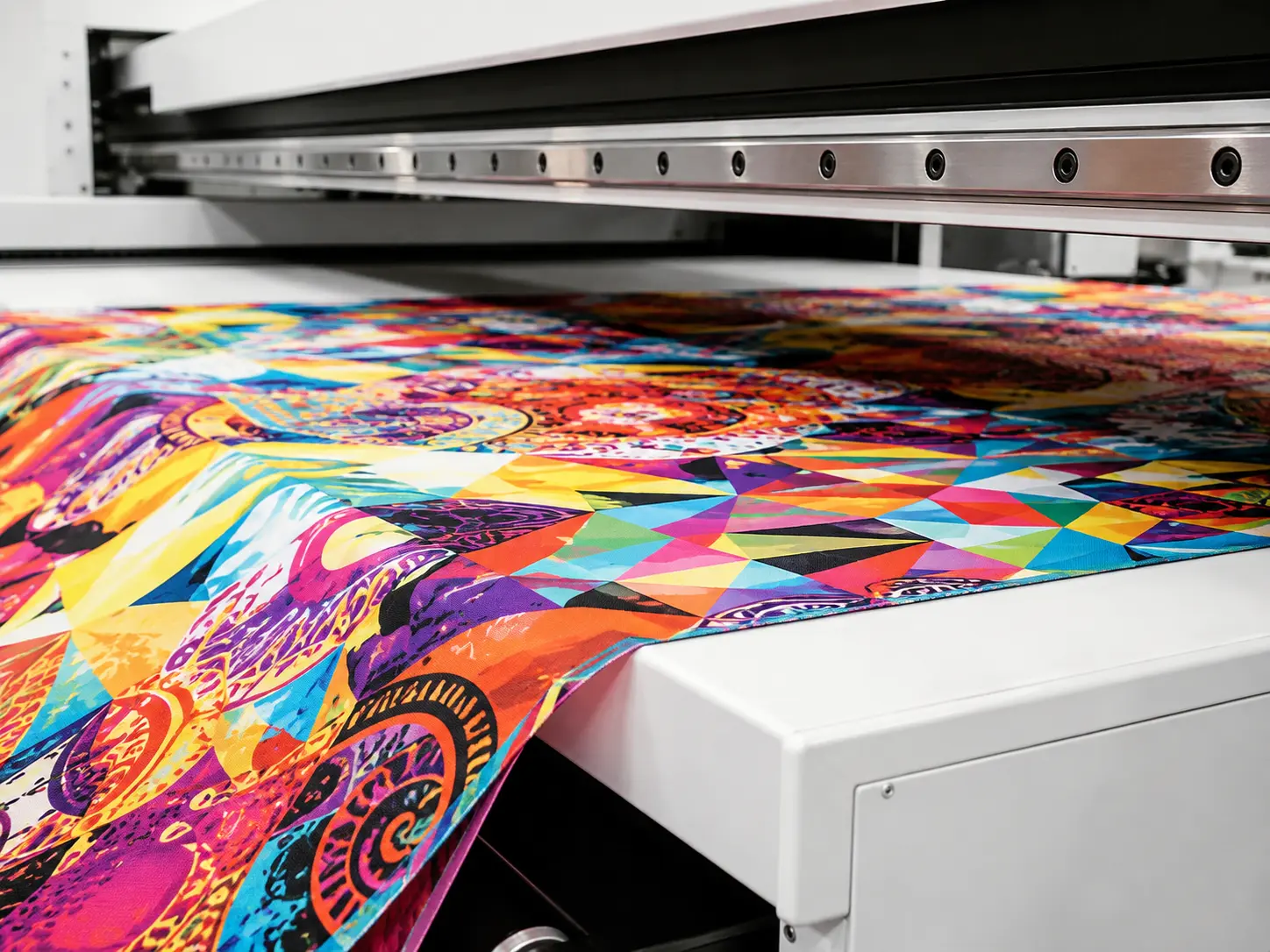















Viscosity is one of the most important process variables in digital textile printing, but it is often discussed as if every ink, printhead and pretreatment system should use the same target value. In practice, an acceptable viscosity range is always connected to the ink chemistry, printhead design, operating temperature, measurement method and fabric preparation process.
Printing mills therefore need to control two separate viscosity problems. The first is the viscosity of the ink moving through the supply system and printhead. The second is the viscosity and flow behavior of the pretreatment liquid or digital printing paste applied to the fabric.
Separating these two areas helps production and purchasing teams identify the correct parameters, communicate more accurately with suppliers and troubleshoot print defects without relying on a single laboratory number.
Two Different Viscosity Problems in Digital Textile Printing
Ink viscosity and pretreatment viscosity influence different parts of the printing process. They should not be measured, specified or adjusted in exactly the same way.
| Sistem | Main Function | Typical Process Concern | Measurement Priority |
|---|---|---|---|
| Jetting ink | Stable flow and controlled droplet formation inside the printhead | Nozzle reliability, droplet velocity, satellites and jetting consistency | Low-viscosity measurement at a strictly controlled temperature |
| Fabric pretreatment | Uniform chemical application and controlled interaction between ink and fabric | Pickup, penetration, line definition, coating uniformity and fabric handle | Flow behavior under the actual padding, coating or spraying conditions |
Ink viscosity inside the jetting system
The printhead must generate and separate droplets at high frequency. The ink must flow through narrow channels and nozzles while responding consistently to the printhead waveform.
If viscosity is outside the range established for the printhead and ink formulation, droplet formation may become unstable. However, viscosity should not be evaluated alone because surface tension, density, elasticity, nozzle geometry and waveform settings also influence jetting behavior.
Pretreatment viscosity on the fabric
A fabric pretreatment has a different purpose. It must distribute functional chemicals evenly while helping control ink penetration, colorant migration and print definition.
The required flow behavior depends on whether the formulation is applied by padding, coating, spraying or another process. A viscosity suitable for one application method may not provide the same pickup or uniformity in another.
Why Ink Viscosity Matters to Droplet Formation
Viscosity represents a liquid’s resistance to flow. In a digital printhead, this resistance affects how the ink responds when energy is applied to form and eject a droplet.
An ink that is too viscous for the selected printhead and operating temperature may show slower fluid response, reduced droplet velocity or incomplete droplet separation. Depending on the equipment and ink supply system, excessive viscosity can also contribute to flow limitations and nozzle instability.
If viscosity is too low, the liquid may form longer ligaments or unwanted satellite droplets under certain jetting conditions. These small secondary droplets can contribute to misting, inaccurate dot placement or reduced edge definition.
These symptoms are not caused by viscosity alone. Surface tension, viscoelasticity, waveform settings, nozzle condition and ink temperature must be reviewed together before changing the formulation.
Penting: There is no universal viscosity specification for every digital textile ink. The approved operating window should be confirmed with the ink and printhead suppliers and should always state the measurement temperature and method.
Temperature Is a Central Part of Viscosity Control
For most liquid ink systems, viscosity decreases as temperature increases. This means a sample measured in a cool laboratory may produce a different result from the same ink circulating inside a warmed printing machine.
Recording a viscosity result without recording the sample temperature makes the result difficult to compare. Even when two operators use the same instrument, different conditioning temperatures can create an apparent batch difference.
Temperatures that should be monitored
- Laboratory measurement temperature
- Ink storage and make-up temperature
- Room temperature near the printing machine
- Ink supply and recirculation temperature
- Printhead operating temperature
- Pretreatment preparation and application temperature
Production teams should establish a defined temperature for quality-control measurements. Samples should be allowed to reach that temperature before testing, and the result should be recorded together with the instrument, test method and sample identification.
Formulation Factors That Can Change Ink Viscosity
Digital textile ink is a balanced formulation rather than a simple dye or pigment solution. Changing one component may influence viscosity, surface tension, drying behavior, storage stability and jetting performance at the same time.
Colorant concentration and structure
Dye concentration and molecular structure can affect interactions within the liquid phase. Pigment systems add further variables, including particle dispersion, particle-size distribution and the behavior of the dispersing system.
A viscosity difference between two colors does not automatically indicate a manufacturing problem. The formulation and approved specification for each color should be reviewed before the batches are compared.
Humectants and co-solvents
Humectants and polyol-type solvents help manage evaporation and nozzle drying, but they also influence viscosity and dynamic surface tension. Substituting one solvent for another should therefore be supported by formulation testing and jetting evaluation.
Binders, polymers and rheology modifiers
Pigment inks and specialized ink systems may contain polymeric materials that influence viscosity and viscoelastic behavior. Their effect may vary with shear rate, concentration, temperature and storage history.
A single viscosity measurement may not fully describe a non-Newtonian or viscoelastic formulation. In these cases, a rheological test may provide more useful information than one viscosity value.
Evaporation, contamination and aging
Water or solvent loss can gradually increase viscosity during storage or machine operation. Contamination, incompatible residues and microbial activity can also change the appearance or flow behavior of water-based formulations.
Corrective additions should not be made solely from a viscosity reading. The batch should first be checked for weight loss, pH, conductivity, filtration condition, appearance and possible contamination.
How Pretreatment Viscosity Affects Fabric Printing
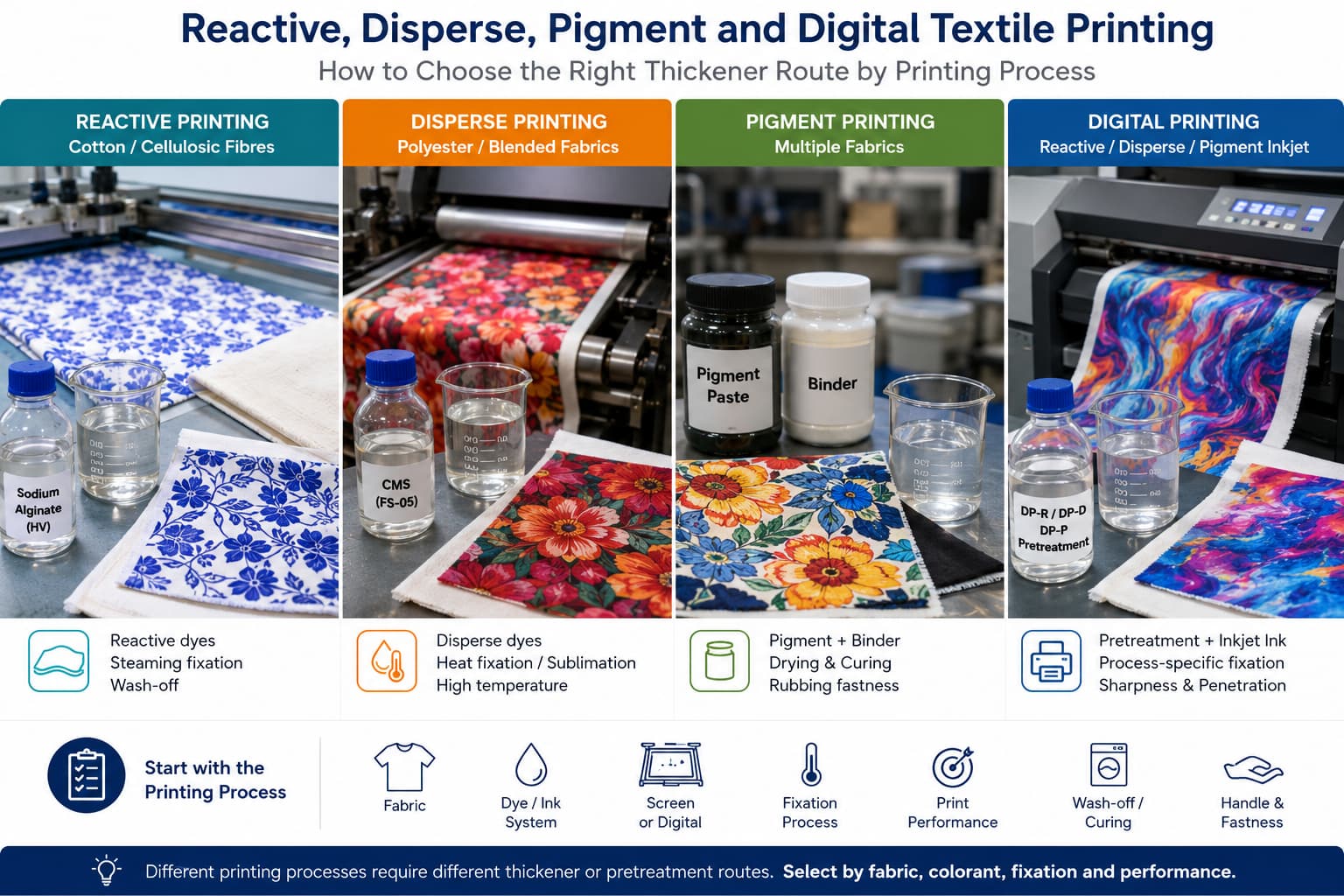
Pretreatment is used to prepare the textile surface for controlled ink deposition and subsequent fixation. Depending on the ink and fiber system, the formulation may contain a thickener, alkali, humectant, wetting agent or other functional components.
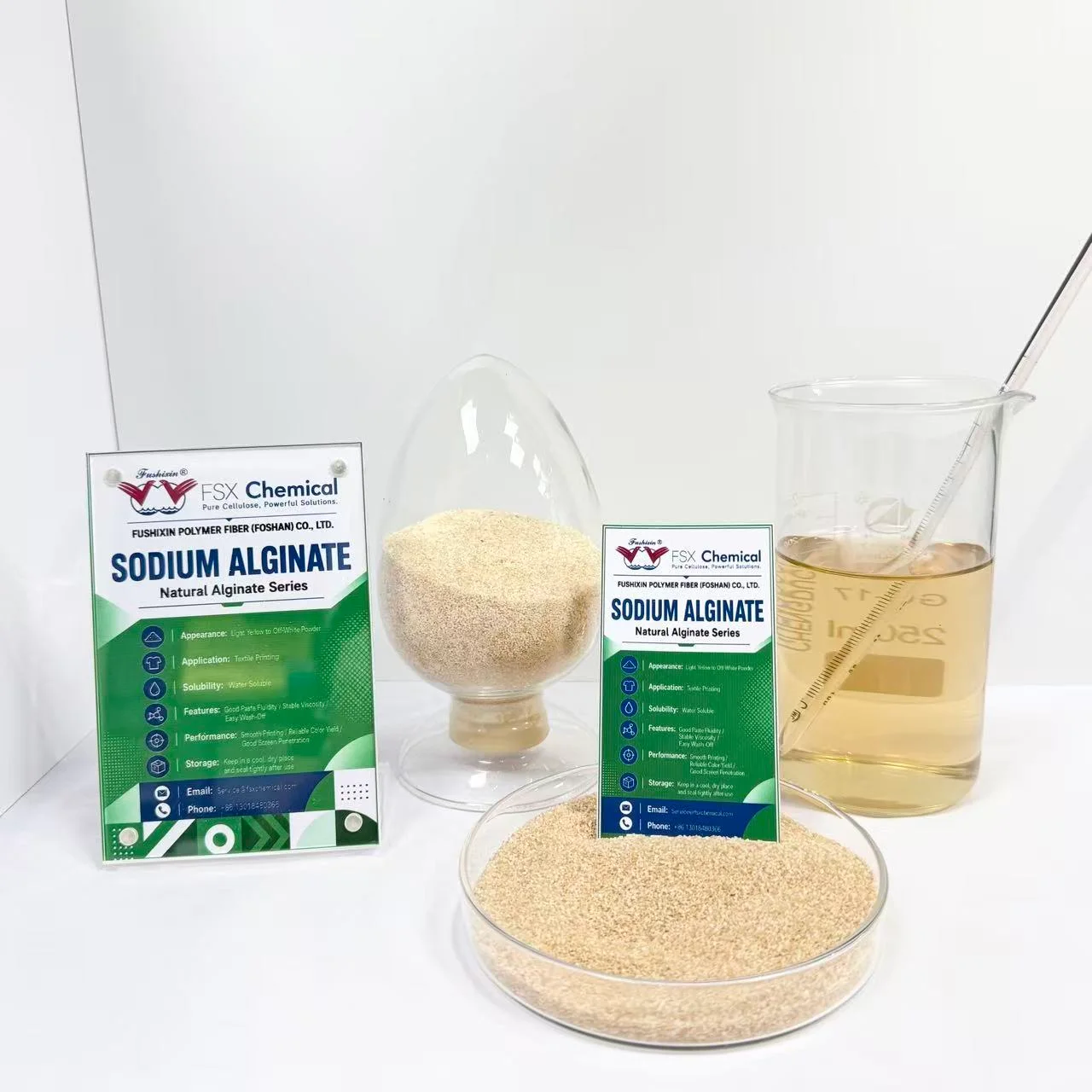
The thickener helps regulate how the formulation is applied and how the ink interacts with the fabric. Sodium alginate, CMC and compound digital printing pastes may be considered for different pretreatment requirements, but their suitability must be confirmed through application testing.
When pretreatment viscosity is too high
Excessive viscosity may make preparation, filtration and application more difficult. It can also contribute to uneven coating, poor penetration, excessive surface deposits or inconsistent pickup if the application system is not designed for the flow behavior.
High-viscosity formulations may require closer attention to dissolution, hydration time, mixing sequence and compatibility with the padding, coating or spraying equipment.
When pretreatment viscosity is too low
A formulation with insufficient body may penetrate too deeply or fail to hold functional chemicals evenly near the printing surface. Possible consequences include uncontrolled spreading, reduced line definition and variation across the fabric width.
Low viscosity does not always mean that more thickener should be added. Concentration, water quality, hydration, shear history, pH and interactions with other formulation components should be checked first.
Dynamic, Kinematic and Apparent Viscosity
Procurement specifications sometimes use different viscosity units without explaining the test method. This can create confusion when comparing a TDS, COA or laboratory report.
Dynamic viscosity
Dynamic viscosity describes the resistance of a fluid to flow under an applied force. It is commonly reported in mPa·s or cP.
Kinematic viscosity
Kinematic viscosity relates dynamic viscosity to fluid density and is commonly reported in mm²/s or cSt. A value in cSt should not be treated as directly interchangeable with a value in mPa·s unless density is considered.
Apparent viscosity
Apparent viscosity is used for materials whose flow behavior changes with shear conditions. Printing pastes and concentrated pretreatments may show shear-thinning behavior, so the reported result depends on the spindle, rotational speed or defined shear rate.
A viscosity specification is incomplete if it does not include the measurement method, instrument configuration and temperature.
How to Standardize Viscosity Measurement
A repeatable test procedure is more valuable than an isolated number. The following workflow can be adapted to the formulation and equipment used by the printing mill.
Step 1: Collect a representative sample
Use a clean container and collect the sample from a defined point. Avoid comparing a newly mixed surface sample with material taken from the bottom of an aged container.
Step 2: Condition the sample temperature
Allow the sample and measurement equipment to reach the specified test temperature. Record the actual temperature rather than relying only on room conditions.
Step 3: Homogenize without introducing air
Mix the sample gently when homogenization is required. Aggressive mixing can introduce bubbles, change shear history or affect the reading of thickened formulations.
Step 4: Use the defined test method
Low-viscosity inks may be evaluated with a suitable calibrated viscometer, capillary method or rheometer. Printing pastes and pretreatments are often measured with a rotational viscometer or rheometer under defined spindle, speed and timing conditions.
Step 5: Repeat and review the result
Make replicate measurements when required by the quality-control procedure. An unexpected result should be confirmed before the batch is adjusted or rejected.
Step 6: Record complete test information
- Product and batch number
- Sampling location and sampling time
- Instrument and measurement method
- Spindle, speed or shear rate where applicable
- Suhu sampel
- Conditioning and hydration time
- Measured viscosity and repeat results
- Operator and equipment calibration status
Recommended Control Points Across the Production Process
| Control Point | Hal-hal yang Perlu Diperiksa | Main Risk | Recommended Response |
|---|---|---|---|
| Incoming material | TDS, COA, appearance, batch identification and storage condition | Using a grade outside the approved specification | Verify the test method and compare with the approved reference |
| Ink or paste preparation | Mixing order, water quality, dosage, temperature and hydration | Incomplete dissolution or inconsistent viscosity | Standardize preparation time and mixing conditions |
| Penyimpanan | Container closure, temperature, age and contamination | Evaporation, settling or viscosity drift | Follow defined storage and reinspection procedures |
| Machine supply system | Temperature, filtration, circulation and pressure stability | Unstable ink delivery or nozzle performance | Check machine conditions before reformulating the ink |
| Pretreatment application | Pickup, coating uniformity, line pressure and fabric absorbency | Uneven chemical distribution | Review viscosity together with mechanical application settings |
| Production monitoring | Viscosity trend, temperature, nozzle status and print defects | Gradual process drift | Use trend records to identify changes before defects become severe |
Troubleshooting Common Viscosity-Related Problems
Print defects rarely have only one cause. The following checks can help narrow down the problem before a formulation change is made.
| Masalah yang Diamati | Possible Contributors | Checks to Perform |
|---|---|---|
| Ink viscosity is higher than the reference | Low sample temperature, evaporation, formulation error or aging | Confirm temperature, sample mass, storage condition, pH, conductivity and test method |
| Ink viscosity is lower than the reference | High sample temperature, dilution error or incorrect raw-material dosage | Review temperature, batch records, density and preparation procedure |
| Intermittent nozzle or jetting instability | Viscosity, surface tension, air, filtration, contamination, waveform or nozzle condition | Check the complete ink-delivery and printhead system before adjusting formulation |
| Satellite droplets or misting | Ink rheology, surface tension, waveform settings or printhead operating conditions | Compare droplet observation with the approved ink and machine parameters |
| Pretreatment viscosity changes during storage | Incomplete hydration, temperature change, microbial contamination or component interaction | Review preparation time, storage temperature, appearance, odor and formulation compatibility |
| Uneven color or line definition | Pretreatment pickup, fabric absorbency, coating uniformity, drying or ink spreading | Measure pickup across the width and review pretreatment application conditions |
What Technical Buyers Should Request from Suppliers
A technical buyer should avoid selecting an ink, thickener or digital printing paste from viscosity alone. The specification should explain how the value was obtained and how the product should be used.
Information to request for jetting inks
- Target viscosity range with measurement method and temperature
- Surface tension and density information where available
- Recommended printhead and operating conditions
- pH and conductivity specifications
- Filtration information and particle-size data for pigment systems
- Storage conditions and shelf-life statement
- Batch COA and traceability information
Information to request for digital printing pastes and pretreatments
- Viscosity specification with spindle, speed and temperature
- Recommended dosage and preparation procedure
- Hydration or maturation time
- Compatibility with dyes, pigments, salts, alkalis and auxiliaries
- Recommended fabric and application method
- Storage stability after preparation
- TDS, sample and grade-matching support
When comparing supplier data, confirm that both products were measured under equivalent conditions. Two reported values cannot be compared reliably if the instruments, temperatures or shear conditions are different.
How to Evaluate a Digital Printing Paste Sample
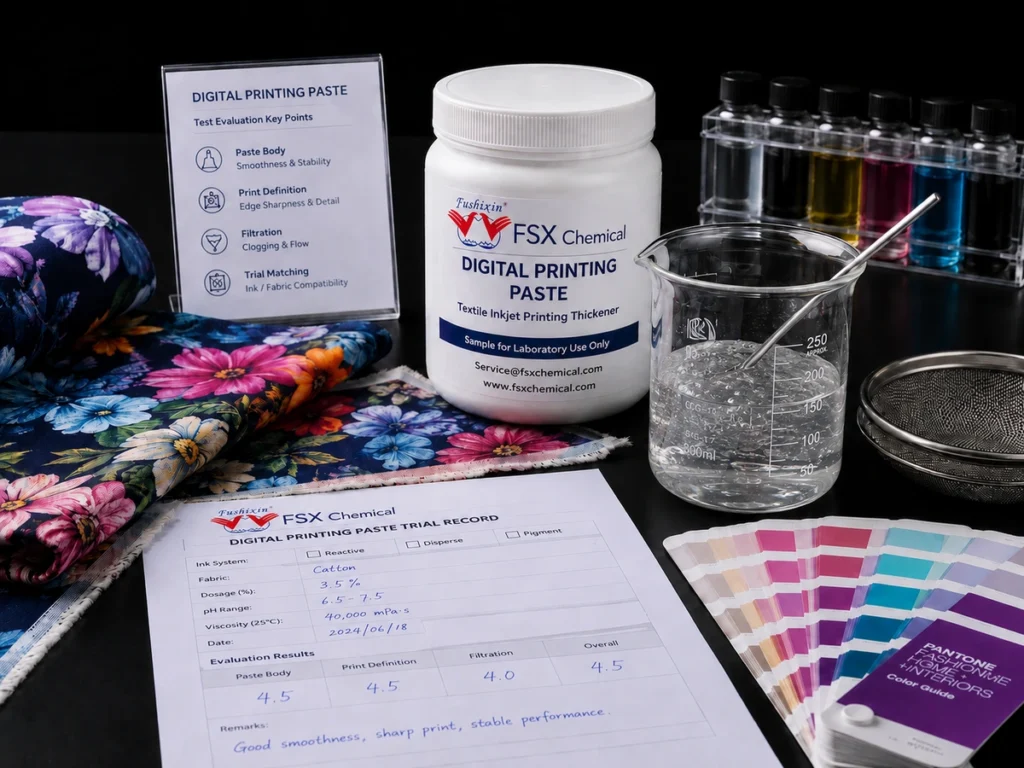
Laboratory viscosity is useful for screening, but the final decision should be supported by a controlled production or pilot test. The trial should use the actual fabric, ink, application equipment and fixation process whenever possible.
- Prepare the formulation according to the supplier’s instructions.
- Record water quality, temperature, mixing speed and hydration time.
- Measure viscosity using the agreed method.
- Apply the pretreatment under controlled pickup conditions.
- Check coating uniformity and drying behavior.
- Print a test design containing solid areas, fine lines and color gradients.
- Evaluate spreading, penetration, line definition and color consistency.
- Complete the normal fixation and washing process before final comparison.
The sample report should include both laboratory results and printing observations. This makes it easier to identify whether a difference is related to the thickener, application process, ink, fabric or fixation conditions.
Digital Printing Paste Support from FSX Chemical
To support an initial evaluation, buyers can provide:
- Fabric type and fiber composition
- Reactive, disperse, pigment or other ink system
- Padding, coating or spraying method
- Formulasi saat ini dan takaran bahan pengental
- Required viscosity and complete measurement method
- Current TDS or reference sample, when available
- Observed problem, such as spreading, penetration or uneven pickup
This information helps determine whether an existing grade should be tested or whether additional formulation matching is required.
Need Help Matching a Digital Printing Paste Grade?
Send FSX Chemical your fabric type, ink system, application method, viscosity test conditions and current production issue. Our team can review the information and recommend the next sample-evaluation step📧 Email: Service@fsxchemical.com
Ajukan Permohonan Penyesuaian Nilai | View Digital Printing Paste | Request TDS or Sample
Pertanyaan yang Sering Diajukan
What is the correct viscosity for a digital textile ink?
There is no single viscosity range suitable for every ink and printhead. The correct specification depends on printhead design, ink chemistry, operating temperature, waveform and measurement method. Use the range approved by the ink and printhead suppliers.
Can ink viscosity be adjusted directly on the printing machine?
The cause of the deviation should be identified before any adjustment is made. Check temperature, evaporation, contamination, filtration, machine circulation and the measurement procedure. Uncontrolled dilution can change color strength, surface tension, drying and jetting behavior.
Why does the viscosity result change between the laboratory and production?
Common causes include different sample temperatures, instruments, test methods, conditioning times and sampling locations. A standardized procedure is required before the results can be compared.
Is higher pretreatment viscosity always better for print sharpness?
No. Excessive viscosity may cause uneven application or excessive surface deposits, while insufficient viscosity may allow uncontrolled penetration. The target should be established through application and printing trials using the actual fabric and equipment.
Should a buyer request a TDS or a sample first?
Request the TDS first to review the test method, viscosity specification, preparation procedure and application scope. A sample should then be tested under controlled laboratory or production conditions before bulk purchasing.