CMC Purity, Sodium Chloride and Active Content: What Textile Buyers Should Compare
CMC purity should not be evaluated from one percentage alone. Textile buyers should separately compare...
CMC purity is often reduced to one percentage on a quotation, but textile buyers should look deeper. Commercial sodium carboxymethyl cellulose can contain active CMC together with moisture and process-related soluble impurities such as sodium chloride and sodium glycolate. A higher purity value can reduce non-functional salt load, but purity alone does not determine viscosity, salt tolerance or printing performance. This guide explains how textile buyers should compare CMC purity, sodium chloride and active content using aligned test methods, dry-basis logic and complete printing-paste validation.
What Does CMC Purity Actually Mean?
CMC purity generally describes how much of a commercial powder is sodium carboxymethyl cellulose rather than residual process salts, by-products, moisture or other non-CMC matter.
However, the word “purity” can be used differently by different suppliers.
A buyer may see:
CMC purity
CMC content
Active content
Active matter
Dry-basis purity
These terms should not be assumed to mean exactly the same thing unless the analytical method is defined.
For textile purchasing, a useful purity specification should answer four questions:
What is being measured?
Which impurities are removed or quantified?
Is the result reported as received or on a dry basis?
Which test method is used?
A number without this context is difficult to compare across suppliers.
Where Sodium Chloride and Other By-Products Come From
Sodium CMC is produced by alkalizing cellulose and then etherifying it with a carboxymethylating reagent.
During the reaction and neutralization process, soluble inorganic and organic by-products can form.
Common process-related impurities include:
Sodium chloride
Sodium glycolate
Residual moisture
Other small amounts of process salts depending on the manufacturing route
Purification steps wash part of these soluble materials away before drying and milling.
Published CMC manufacturing studies show that stronger purification can increase CMC content while decreasing sodium chloride and sodium glycolate.
This means “purity” is partly a measure of how much non-functional process material remains in the commercial powder.
However, a highly purified grade is not automatically the best economic choice for every textile application.
Purity vs. Active Content vs. Dry Basis
These three terms are often mixed together.
Kemurnian
Purity usually refers to the proportion of CMC relative to specified impurities according to a defined analytical method.
Active Content
Active content usually refers to the amount of functional CMC polymer in the commercial product.
But the exact calculation must still be defined.
Some suppliers may use a washed gravimetric CMC-content method. Others may report a calculated or specification-based value.
Dry Basis
Dry-basis reporting removes the effect of moisture from the comparison.
This is useful because two products can contain the same dry CMC fraction but different moisture levels as received.
The buyer should therefore ask:
“Is this purity/active-content figure reported as received or on a dry basis, and which impurities are included in the calculation?”
Do not assume:
Active Content = 100% − Moisture
because sodium chloride, sodium glycolate and other non-CMC solids may still be present.
Why Sodium Chloride Content Matters
Sodium chloride is a common process-related impurity in commercial sodium CMC.
It does not provide the same thickening function as the CMC polymer.
Therefore, a higher NaCl level can mean:
Lower active polymer per kilogram
Higher internal electrolyte load
Different viscosity response in sensitive formulations
More non-functional mass being purchased and shipped
In textile printing, this can matter because CMC is an anionic polyelectrolyte whose chain behavior responds to ionic strength.
Salt can screen electrostatic repulsion along the CMC chain and change apparent viscosity or rheology.
The practical impact depends on:
CMC degree of substitution
Molecular weight
NaCl level
Added salts in the printing formula
Water hardness
Polymer concentration
Low NaCl is useful information, but it is not a complete printing-performance specification.
What About Sodium Glycolate?
Sodium glycolate is another process-related by-product associated with CMC manufacturing.
Purified CMC grades generally aim to reduce it together with sodium chloride.
For a textile buyer, sodium glycolate matters mainly because it contributes to the non-CMC fraction of the product.
Its importance depends on the agreed product specification and application.
If a supplier declares very high CMC purity but does not specify sodium chloride, sodium glycolate or the analytical method, the buyer should ask how the purity value was established.
The objective is not to create unnecessary testing.
The objective is to understand whether two “98% purity” products are being measured on the same basis.
Why Moisture Must Be Separated from Purity
Moisture is not the same as sodium chloride or sodium glycolate.
It is normally controlled separately because it affects:
Active material per delivered kilogram
Powder flow
Caking
Stabilitas penyimpanan
Dosage calculations
If Product A contains more moisture than Product B, then one kilogram of Product A may contain less dry material even if their dry-basis CMC purity is the same.
For commercial comparison, buyers should therefore record at least:
Purity or CMC content
Moisture / loss on drying
Sodium chloride
Viscosity and method
Keeping these parameters separate makes the supplier comparison clearer.
Does Higher Purity Mean Higher Viscosity?
No.
Purity and viscosity describe different properties.
Viscosity is strongly influenced by:
Molecular weight / degree of polymerization
CMC concentration
Derajat substitusi
Substitution uniformity
Kualitas air
Suhu
Salt level
Viscosity test method
A lower-purity product can still show high viscosity if the active CMC has high molecular weight.
A high-purity grade can show lower viscosity if it is intentionally produced as a lower-molecular-weight grade.
Therefore:
High purity does not automatically mean high viscosity.
And:
High viscosity does not automatically prove high purity.
How Internal Salt Load Can Affect Formulation Response
A printing formula may already contain:
Dyes
Alkali
Sodium salts
Dispersants
Binders
Other ionic auxiliaries
If the commercial CMC itself also carries a significant internal salt load, the total ionic environment changes.
This can affect:
Hidrasi
Viscosity development
Stabilitas pasta
Blend compatibility
The effect is formulation-specific.
This is why a CMC buyer should not evaluate sodium chloride only as a “purity number.”
It can also be part of the formulation’s total electrolyte balance.
What Purity Means in Reactive Printing
Reactive printing is sensitive to the interaction among thickener, dye, alkali, salts, steaming and wash-off.
A cleaner CMC grade can reduce non-functional salt and by-product load, but purity alone does not determine whether the grade is suitable for reactive printing.
Variabel-variabel penting antara lain:
Derajat substitusi
Residual hydroxyl functionality
Molecular weight
Salt tolerance
Complete paste rheology
Dye interaction
Wash-off behavior
Therefore, a high-purity CMC should not automatically be promoted as a universal one-to-one replacement for sodium alginate.
It should be validated with the actual reactive dye system.
What Purity Means in Disperse, Pigment and Compound Systems
Disperse Systems
Purity can matter for active polymer efficiency and formula consistency, but compatibility with disperse colorants, thermal fixation and wash/clearing remains essential.
Pigment Systems
CMC purity should be evaluated together with binder compatibility, electrolyte load and curing conditions.
Pengental Majemuk
In a blended thickener, a lower-purity CMC may add more non-functional salt into the compound system.
This can alter the apparent economics because the buyer may need a higher dosage to deliver the same active CMC contribution.
However, the final blend should still be judged from complete paste and printing performance rather than purity alone.
Compare Cost per Active CMC on the Same Basis
Use an active fraction that matches the delivered powder. If purity is reported on a dry basis, convert it using moisture before calculating cost. If the assay already states active polymer as supplied, do not apply the moisture correction again.
As-supplied active fraction = (1 − moisture fraction) × dry-basis CMC fraction. Cost per kilogram of active CMC = delivered price per kilogram ÷ as-supplied active fraction.
Hypothetical example: a powder with 8% moisture and 95% CMC on a dry basis contains a calculated 0.92 × 0.95 = 0.874 kg active CMC per kilogram supplied. At an illustrative delivered price of USD 3.00/kg, the active-polymer cost is USD 3.43/kg. These figures are not an FSX specification or quotation.
Reported value
What to verify
Do not assume
Purity, 95%
Dry or as-supplied basis; method and impurities accounted for
Every 95% declaration uses the same assay
Total solids
Drying conditions and whether retained salts are included
All nonvolatile residue is functional CMC
NaCl or sodium glycolate
Unit, analytical method and moisture basis
Subtracting only one impurity establishes full polymer purity
Active-polymer cost
Comparable delivered price and verified active fraction
Lower active cost means lower cost per accepted printed metre
ASTM D1439-22 explicitly treats moisture and purity as relevant to active-polymer calculations and lists separate residual-salt tests. Use the agreed current analytical procedure; this worked example does not substitute for testing.
Finish the purchasing comparison using the dose that actually meets viscosity, holding stability, print definition, wash-off and fabric requirements. Molecular characteristics and recipe compatibility can outweigh a small difference in calculated active cost.
Why Test Method Alignment Is Essential
A purity number is only comparable when the analytical basis is aligned.
Buyers should ask:
Sample basis: as received or dry basis?
CMC-content method?
Sodium chloride test method?
Sodium glycolate test method?
Moisture / loss-on-drying method?
Published laboratory methods for CMC commonly separate soluble impurities through alcohol washing, while sodium chloride can be determined separately using chloride analysis or titration.
Different methods can produce different reported values.
Therefore, supplier A’s “98%” should not automatically be treated as equivalent to supplier B’s “98%” until the basis is understood.
What Should Be Listed on a CMC COA?
For textile-grade CMC, a practical COA can include:
Parameter
Why Buyers Need It
Penampilan
Basic batch identity
Viskositas
Thickening route and batch control
Viscosity test method
Required for meaningful comparison
Derajat substitusi
Structural and ionic behavior
Purity / CMC content
Active polymer fraction
Sodium chloride
Major soluble process salt where specified
Kelembapan
As-delivered active material and storage
pH
Formula compatibility and QC
Particle size where relevant
Dispersion and hydration behavior
Sodium glycolate can also be included when it is part of the agreed grade specification.
The COA should use the same methods that were agreed during qualification.
Incoming QC Workflow for Textile Buyers
Step 1: Verify Batch Documents
Check the grade, batch number and agreed specification.
Step 2: Check Moisture and Appearance
Look for caking, discoloration or packaging damage.
Step 3: Prepare the Standard CMC Solution
Use controlled:
Air
Konsentrasi
Pencampuran
Waktu hidrasi
Suhu
Step 4: Measure Viscosity
Use the approved instrument, spindle/rotor, RPM and temperature.
Step 5: Check Purity-Related Parameters
Use the agreed incoming inspection plan for purity, sodium chloride or other parameters.
Step 6: Run a Quick Formula Compatibility Test
Add the relevant salt, alkali, dye, binder or auxiliary package.
Step 7: Retain a Batch Sample
Keep a representative sample for traceability and later comparison.
How to Compare Two CMC Grades in the Laboratory
Use the same preparation and test sequence for both candidates.
Uji Coba
What It Shows
CMC content / purity
Active polymer vs. non-CMC fraction
Sodium chloride
Internal salt load
Kelembapan
As-delivered dry material
DS
Substitution level
Viskositas
Thickening behavior under the defined method
Pelarutan
Hydration and fish-eye tendency
Salt-addition test
Respon elektrolit
Complete paste test
Actual formulation compatibility
Percobaan pencetakan
Finished application performance
The product with the highest purity does not automatically win every category.
The best candidate is the one that delivers the required printing result at the most stable and economical dosage.
Common Purchasing Mistakes
Mistake 1: Purity and Active Content Are Always the Same
They may be reported differently. Confirm the analytical method and basis.
Mistake 2: Active Content = 100% − Moisture
This ignores sodium chloride, sodium glycolate and other non-CMC solids.
Mistake 3: Lower NaCl Automatically Means Higher Viscosity
Viscosity still depends strongly on molecular weight and test conditions.
Mistake 4: 98% Purity from Two Suppliers Means Identical Quality
DS, molecular weight, substitution uniformity, particle size and methods can differ.
Mistake 5: High Purity Automatically Means Better Printing
Application performance must still be tested.
Mistake 6: Lowest $/kg Is the Lowest-Cost CMC
Compare active polymer, required dosage and Total Cost in Use.
How to Qualify a New Supplier Without Being Misled by Purity
When qualifying a second CMC supplier, use a structured comparison.
Ask both suppliers for:
Exact grade
DS
Viscosity and method
Purity / CMC content and method
Sodium chloride
Kelembapan
Particle size where relevant
Sampel yang representatif
Then run:
Document Review → Standard Solution → Complete Formula → Printing Trial → Production Trial → Repeat-Batch Verification
This prevents a specification-sheet advantage from being mistaken for actual production equivalence.
Which Purity Route Should You Choose?
Consider a Higher-Purity Route When:
Low internal salt load is important
Active polymer efficiency is a priority
The formula is electrolyte-sensitive
Customer specifications require tighter impurity control
Printing or technical applications justify the additional purification cost
It generally refers to the proportion of sodium carboxymethyl cellulose relative to specified impurities, but the exact analytical method and reporting basis should be confirmed.
2. Why is sodium chloride found in CMC?
Sodium chloride is a common process-related by-product of CMC manufacturing and neutralization. Purification removes part of this soluble salt.
3. Is sodium chloride an active part of CMC?
No. It does not provide the same polymer thickening function as sodium carboxymethyl cellulose.
4. What is active content in CMC?
Active content refers to the amount of functional CMC polymer in the commercial product, but the calculation method must be defined before comparing suppliers.
5. Is active CMC equal to 100 minus moisture?
Not necessarily. Sodium chloride, sodium glycolate and other non-CMC solids can remain after moisture is excluded.
6. Does higher purity mean higher viscosity?
No. Viscosity depends strongly on molecular weight, concentration, DS, water quality and the test method.
7. Does lower sodium chloride improve salt tolerance?
Lower internal salt reduces part of the electrolyte load, but overall salt tolerance still depends on CMC structure and the complete formulation.
8. Why can two 98% CMC grades perform differently?
They may have different molecular weight, DS, substitution uniformity, particle size, moisture and viscosity behavior even if the reported purity is similar.
9. Should textile buyers test sodium glycolate?
It can be included when it forms part of the agreed grade specification. The required test panel should match the application and purchasing standard.
10. What should be on a textile CMC COA?
Useful parameters include viscosity and method, DS, purity/CMC content, sodium chloride, moisture, pH and other agreed grade-specific tests.
11. Is high-purity CMC always best for textile printing?
No. Higher purity can reduce non-functional salt load, but the best grade must also meet viscosity, formulation compatibility, printing performance and cost requirements.
12. What should I send FSX Chemical for CMC comparison?
Send the current TDS/COA, purity, NaCl, moisture, DS, viscosity method, printing route, formula, current dosage and performance target.
Compare CMC Purity and Active Content with FSX Chemical
If you are comparing CMC suppliers by purity, sodium chloride or active content, FSX Chemical can help align the specification with actual textile printing requirements.
For a useful comparison, send:
Your current CMC TDS or COA
Declared purity / CMC content
Sodium chloride specification
Moisture specification
Derajat substitusi
Viskositas dan metode pengujian lengkap
Printing route
Dye or pigment system
Complete or simplified formula
Water quality where relevant
Dosis saat ini
Current salt-tolerance, dissolution, viscosity or printing target
For textile buyers, the useful question is not simply “What is the purity?” It is “How much functional CMC am I buying, how much internal salt is carried with it, how is each value measured, and how does that grade perform in my complete printing formula?”
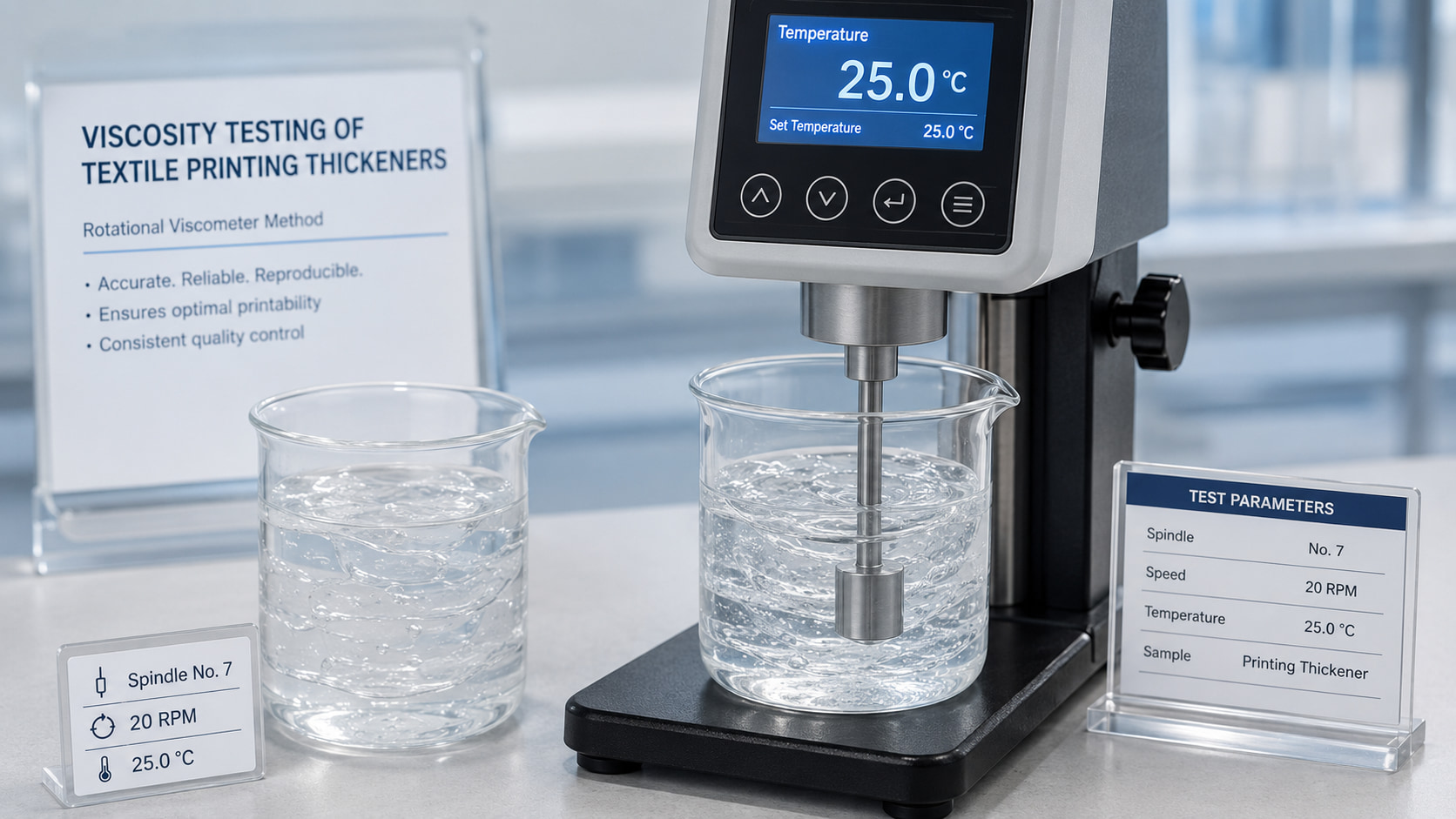
Ketahui mengapa nilai viskositas pengental dalam pencetakan tekstil tidak dapat dibandingkan tanpa menyesuaikan konsentrasi, suhu, alat ukur, spindel, kecepatan, metode persiapan, dan waktu pengujian.
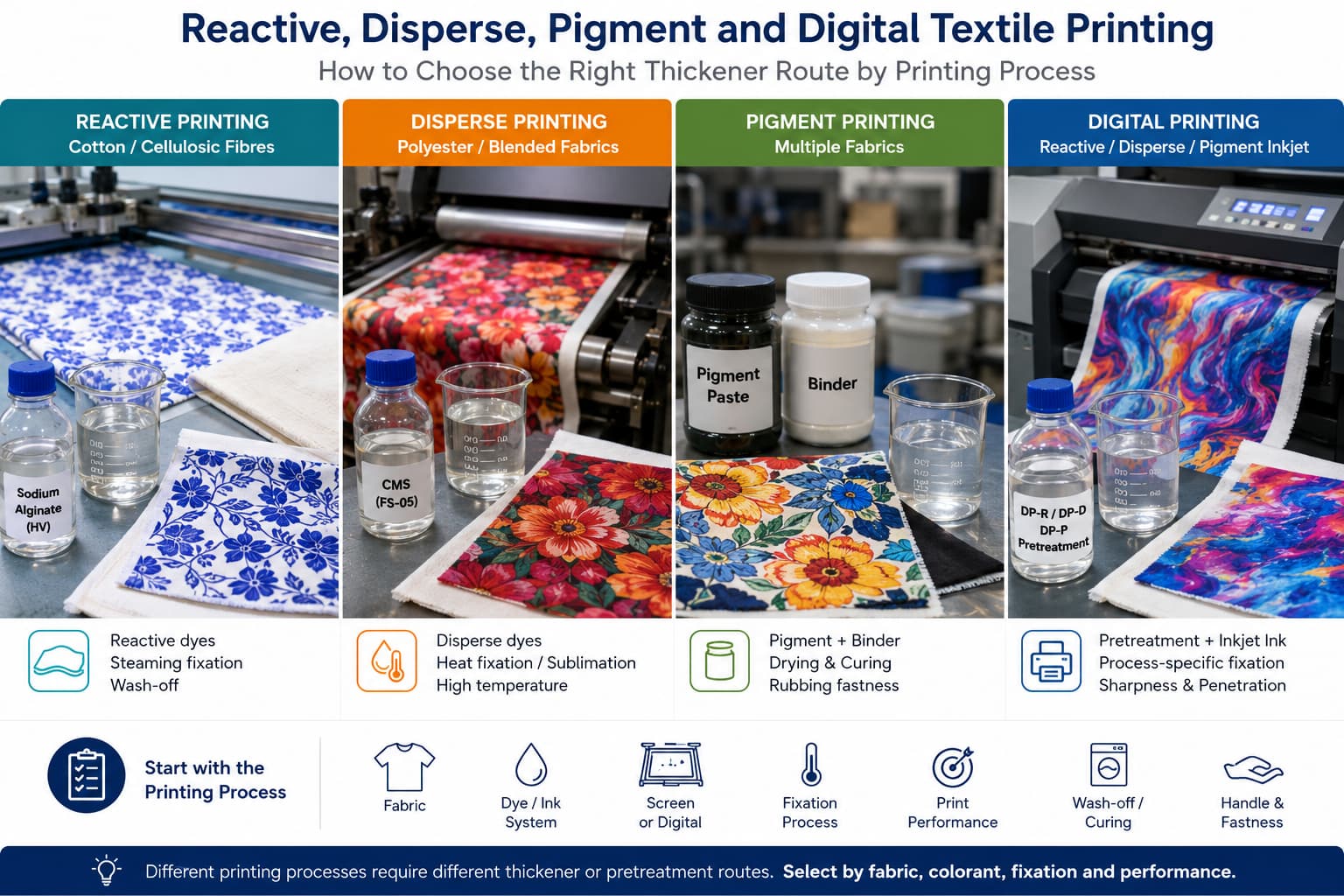
Pelajari cara memilih bahan pengental dan metode pra-perlakuan untuk pencetakan tekstil reaktif, disperse, pigmen, dan digital berdasarkan jenis kain, pewarna atau tinta, proses fiksasi, daya lepas saat pencucian, serta persyaratan kualitas cetakan.
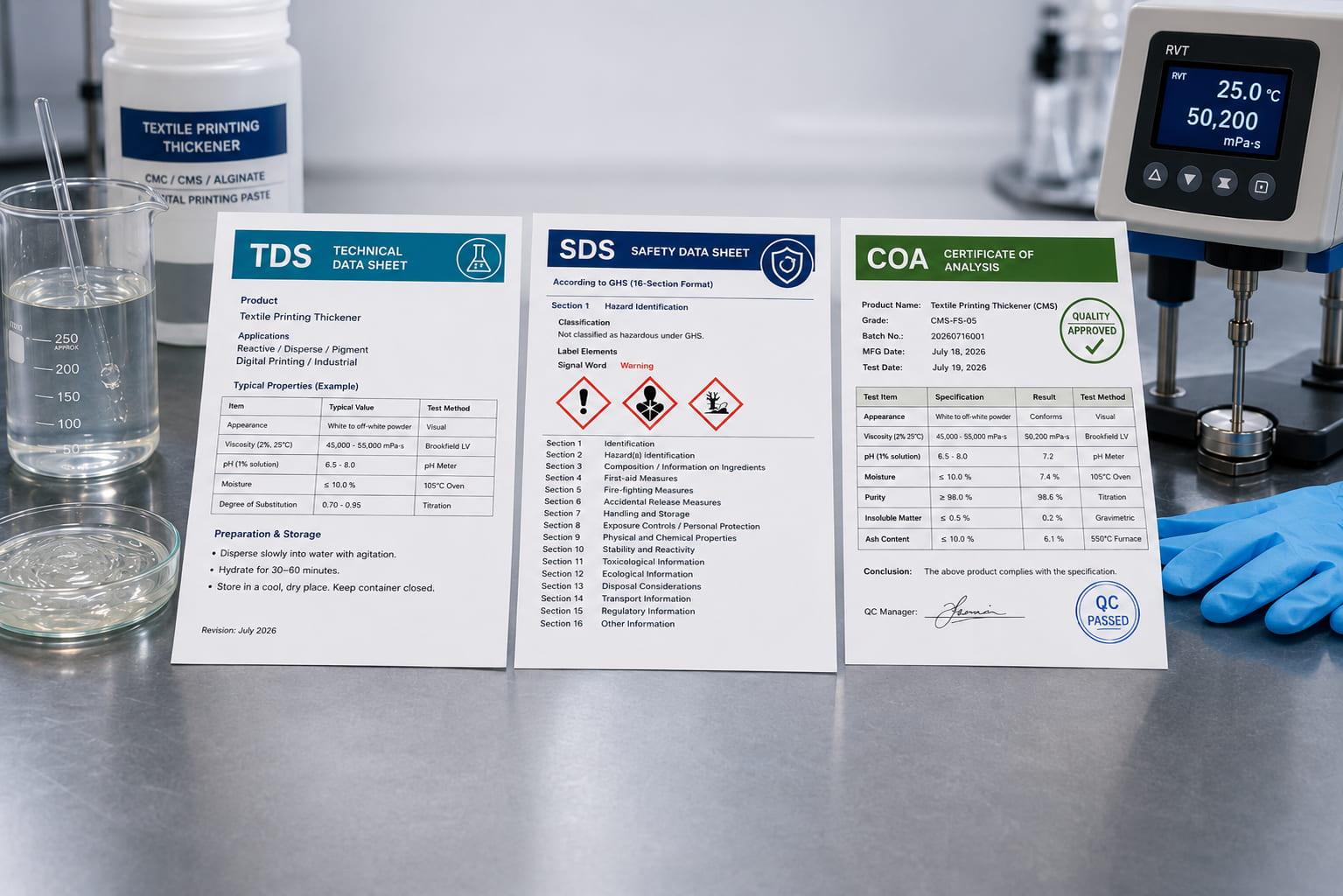
Pelajari perbedaan antara dokumen TDS, SDS, dan COA, hal-hal yang perlu diverifikasi oleh pembeli produk cetak tekstil, serta cara memeriksa spesifikasi, data keselamatan, metode pengujian, hasil pengujian per batch, dan penerbit dokumen.
Bandingkan CMC, CMS, natrium alginat, dan pasta cetak digital untuk pencetakan tekstil. Pelajari bagaimana masing-masing bahan tersebut sesuai dengan proses pencetakan reaktif, dispersi, pigmen, dan digital, serta hal-hal apa saja yang perlu diperhatikan pembeli sebelum melakukan pengujian sampel, penyesuaian kualitas, dan pembelian dalam jumlah besar.
Karboximetil selulosa (CMC) banyak digunakan dalam proses pencetakan, pelapisan, dan pewarnaan tekstil. Panduan ini akan menjelaskan cara mengevaluasi jenis-jenis CMC, parameter mana yang paling penting, serta bagaimana FSX Chemical dapat mendukung keputusan pembelian.
Karboximetil selulosa digunakan sebagai pengental dan penstabil dalam tinta berbasis air, pencetakan gravure, serta pra-perlakuan pencetakan inkjet. Panduan ini membahas parameter utama setiap jenis produk serta pertimbangan dalam pemilihan pemasok bagi tim pengadaan.
Memilih pemasok CMC yang tepat tidak hanya sekadar membandingkan harga. Panduan ini membahas kriteria evaluasi, daftar periksa dokumentasi, dan proses uji coba yang harus diikuti oleh tim pengadaan sebelum memutuskan untuk melakukan pemesanan dalam jumlah besar.
Baik natrium alginat maupun CMC digunakan sebagai pengental dalam pencetakan tekstil, namun keduanya cocok untuk sistem pewarnaan dan kondisi proses yang berbeda. Panduan ini menjelaskan perbedaan utama di antara keduanya serta kapan masing-masing harus digunakan.
CMC kelas pangan dan kelas industri memiliki struktur kimia dasar yang sama, namun berbeda secara signifikan dalam hal kemurnian, rentang DS, dan persyaratan regulasi. Panduan ini menjelaskan perbedaan-perbedaan utama tersebut serta mengapa penggunaan kelas yang salah dapat menimbulkan masalah dalam proses produksi.
Spesifikasi kemurnian natrium alginat tidak hanya mencakup satu angka saja. Panduan ini menjelaskan arti dari kandungan aktif, NaCl, zat tak larut, dan data logam berat bagi kinerja pasta cetak tekstil — serta kapan kemurnian yang lebih tinggi layak ditentukan daripada tingkat kemurnian standar industri.
Bahan baku berbasis selulosa digunakan dalam pencetakan tekstil, persiapan pasta cetak, pengental, dan sebagai pendukung formulasi. Panduan ini menjelaskan bagaimana pembeli dapat mengevaluasi CMC, CMS, natrium alginat, pengental untuk pencetakan tekstil, dan produk pasta cetak berdasarkan spesifikasi, dokumentasi, pengujian sampel, serta dukungan pemasok.
Pembelian natrium alginat dalam jumlah besar tidak hanya sekadar membandingkan harga satuan. Panduan ini menjelaskan bagaimana pembeli di bidang pencetakan tekstil dapat memastikan viskositas, ukuran jaring, tingkat kemurnian, kemasan, Sertifikat Analisis (COA), pengujian sampel, dan konsistensi batch sebelum melakukan pemesanan dalam jumlah besar.
Berikan nama produk, kegunaan, jumlah, tujuan pengiriman, serta TDS,
foto sampel, atau dokumen lain yang sudah Anda miliki. FSX Chemical akan meninjau
informasi tersebut dan merekomendasikan langkah selanjutnya terkait penawaran harga, pencocokan sampel,
atau pemilihan produk.
Informasi ProdukNama produk, grade, model, foto label, atau referensi pemasok.
Dokumen yang TersediaTDS, SDS, COA, foto sampel, daftar produk, atau data pengujian.
Rincian PesananPerkiraan jumlah, kemasan, negara tujuan, pelabuhan, atau syarat perdagangan.
Aplikasi atau KendalaProses pencetakan tekstil, kebutuhan formulasi, masalah terkini, atau target kinerja.