Cara Mengevaluasi Produsen Pengental untuk Pencetakan Tekstil Sebelum Melakukan Pembelian dalam Jumlah Besar
Learn how to evaluate a textile printing thickener manufacturer by checking company identity, production capability,...
Buyer Guide Manufacturer Audit & Supplier Approval Updated July 2026 Direct Answer
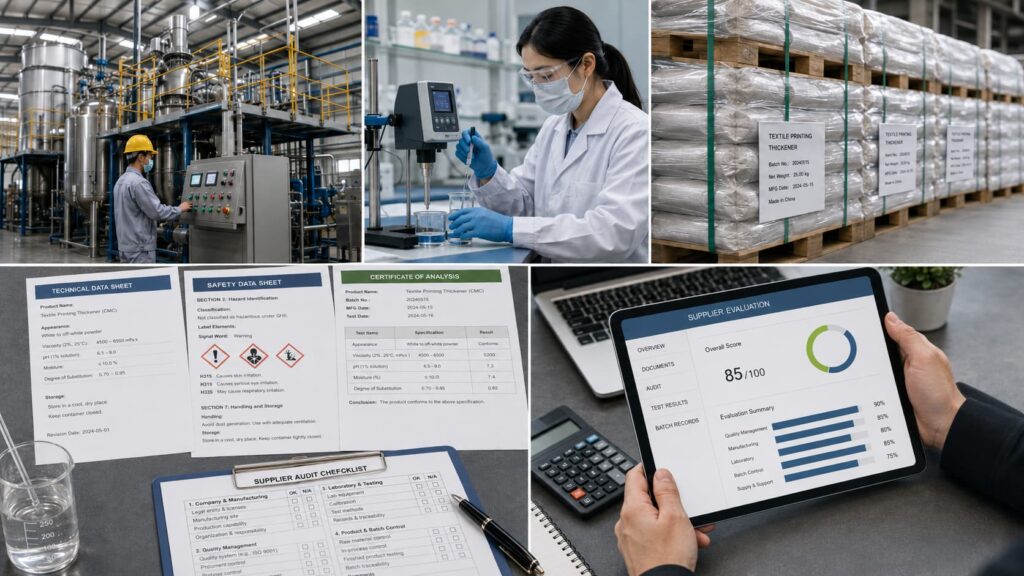
Evaluate a textile printing thickener manufacturer by confirming the legal company and production location, the product and process scope, manufacturing controls, laboratory test methods, batch traceability, TDS, SDS and COA consistency, sample-matching procedure, packaging, export capability and complaint-handling process. Factory photographs and certificates can support the review, but they should not replace product-specific evidence. Final supplier approval should include a controlled sample trial and confirmation that the commercial batch, specification and documentation match the approved product.
Quality-System Certificate ≠ Product Approval
ISO 9001 concerns the supplier’s quality-management system. It can provide confidence that processes are managed systematically, but it does not define the viscosity, purity, printing performance or acceptance limits of the product being purchased. Buyers must still define their technical requirements and verify the product through specifications, batch results, sample testing and production trials.
Quick Audit Framework
Twelve Areas to Review Before Supplier Approval
Use the following areas as a practical starting framework. The depth of review should reflect order value, technical risk and the impact that a failed batch could have on production.
Review Area
Evidence to Request
Main Buyer Question
1. Company identity
Legal company name, brand relationship, business records, official contact and manufacturing address
Which legal entity manufactures, sells and issues the documents?
2. Manufacturing role
Production-site information, process flow, equipment, production records and responsible teams
Which operations are completed at the stated facility?
3. Product scope
Product families, grades, application routes and technical specifications
Does the manufacturer have a grade developed for the required printing process?
4. Production control
Raw-material review, in-process checks, production instructions and release procedure
How is variation controlled from raw material to finished batch?
5. Laboratory capability
Test instruments, methods, calibration status, sample records and qualified personnel
Can the supplier reproduce and explain the reported results?
6. Batch traceability
Batch number, production date, packaging labels, retained sample and batch COA
Can a shipment be traced back to its production and test records?
7. Technical documents
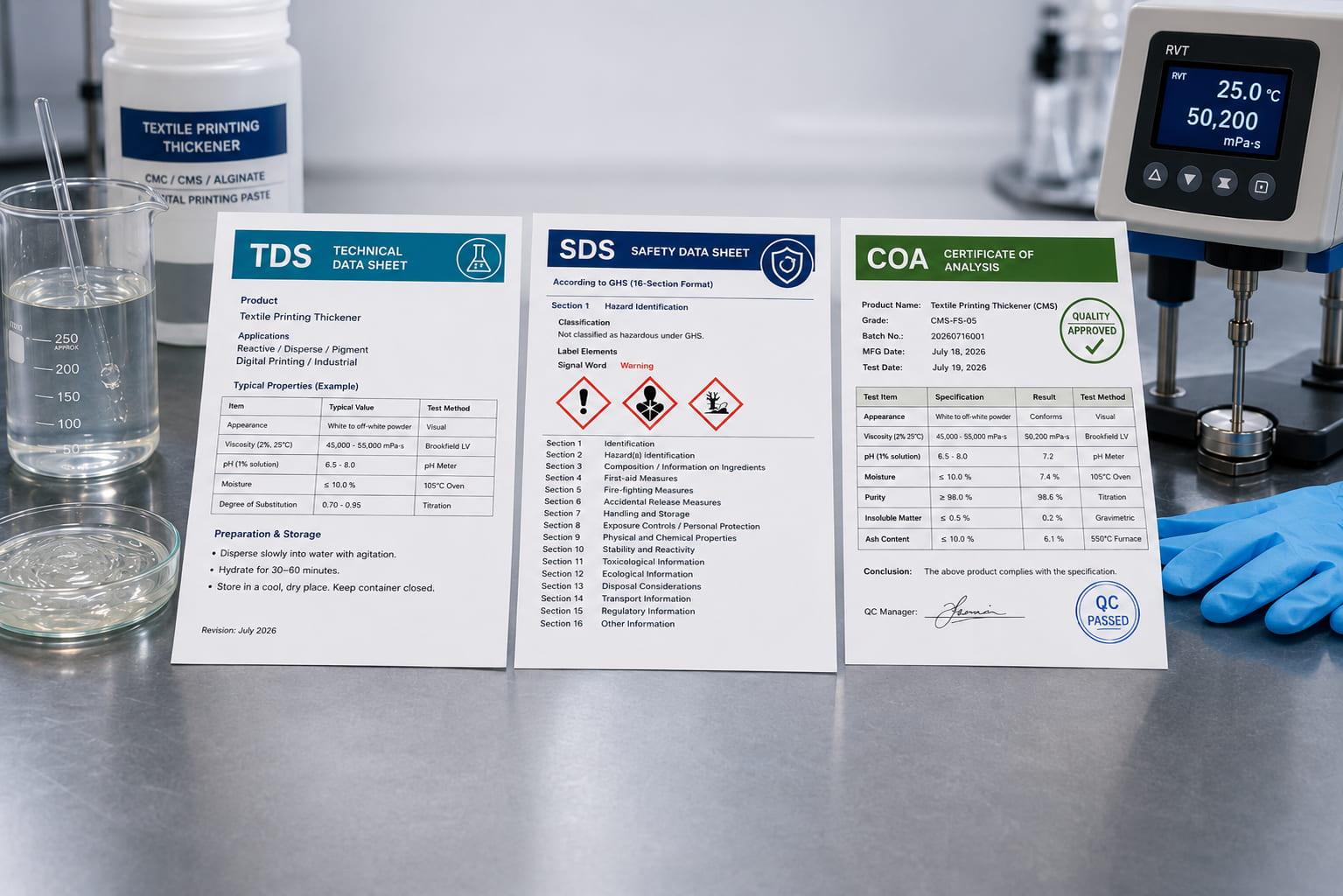
TDS, SDS, COA, revision dates, test conditions and document issuer
Are the product, grade, method and company relationships clear?
8. Sample matching
Current-sample comparison, trial procedure, recommendation basis and test feedback
Is the grade selected from the actual printing requirement?
9. Commercial consistency
Quotation, specification, sample code, order confirmation and commercial batch
Will the ordered product match the approved sample and grade?
10. Packaging and logistics
Bag or drum type, net weight, pallet plan, loading, labels and shipping documents
Can the material reach the buyer without moisture, contamination or identification problems?
11. Complaint handling
Communication route, investigation method, corrective action and replacement procedure
What happens if a batch does not meet the agreed requirement?
12. Supply continuity
Lead time, production planning, raw-material risk, backup arrangements and order-volume capability
Can the supplier support repeat orders consistently?
This is a practical buyer checklist, not an official certification standard. Buyers should adapt it to their own products, markets and contractual risks.
Company Verification
Confirm the Brand, Legal Entity and Manufacturing Site
Begin by identifying the company responsible for manufacturing, contracting, invoicing and issuing technical documents. A website brand may differ from the registered legal company name, but the relationship should be explained consistently.
Company Information
International or commercial brand
Registered legal company name
Company-registration information
Official business email and telephone
Contracting and invoicing entity
Exporting entity where applicable
Manufacturing-Site Information
Factory address and production location
Product families produced at the site
Production and laboratory areas
Warehouse and packaging areas
Responsible production and quality teams
Site-specific certificate scope where applicable
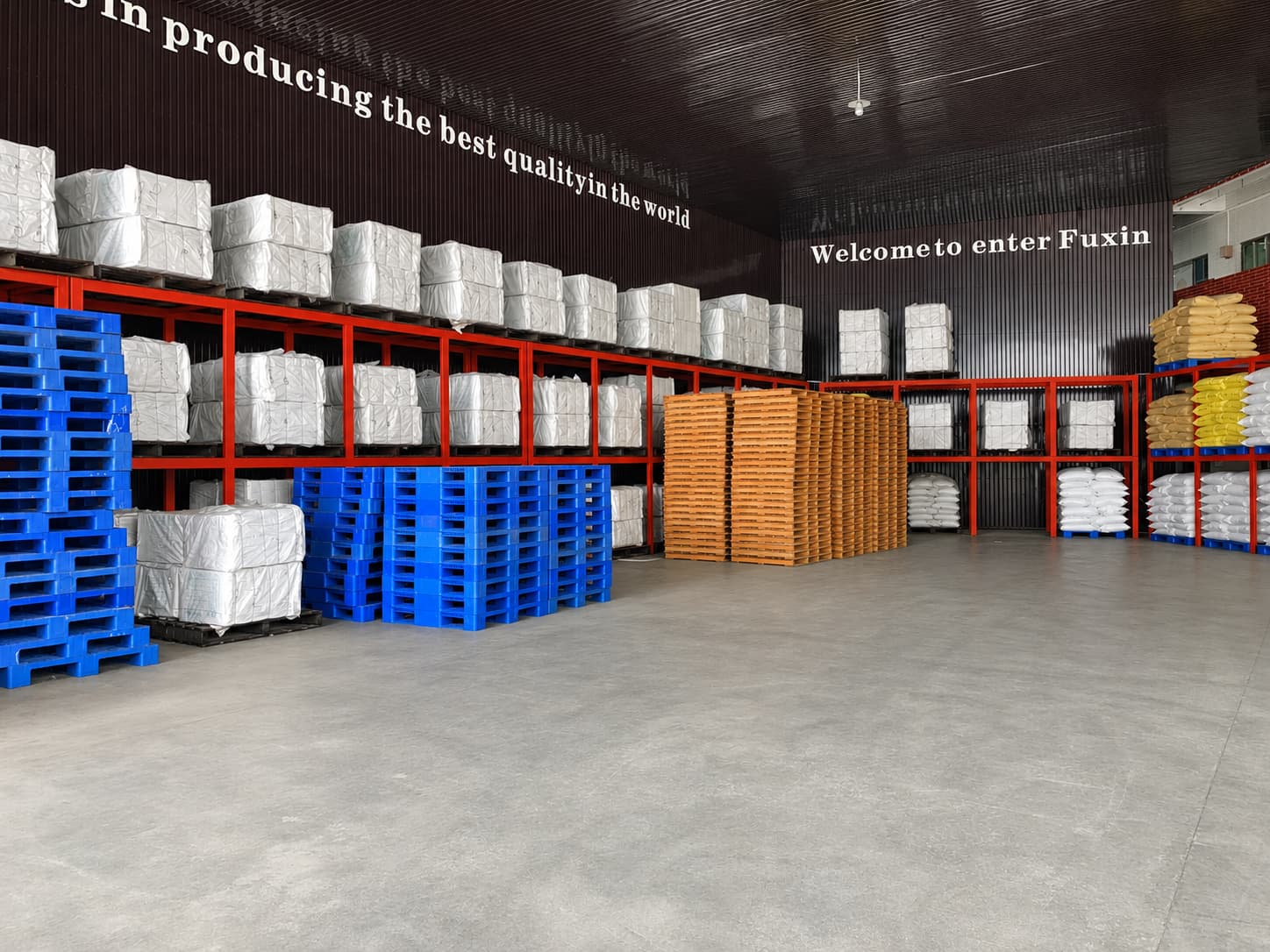
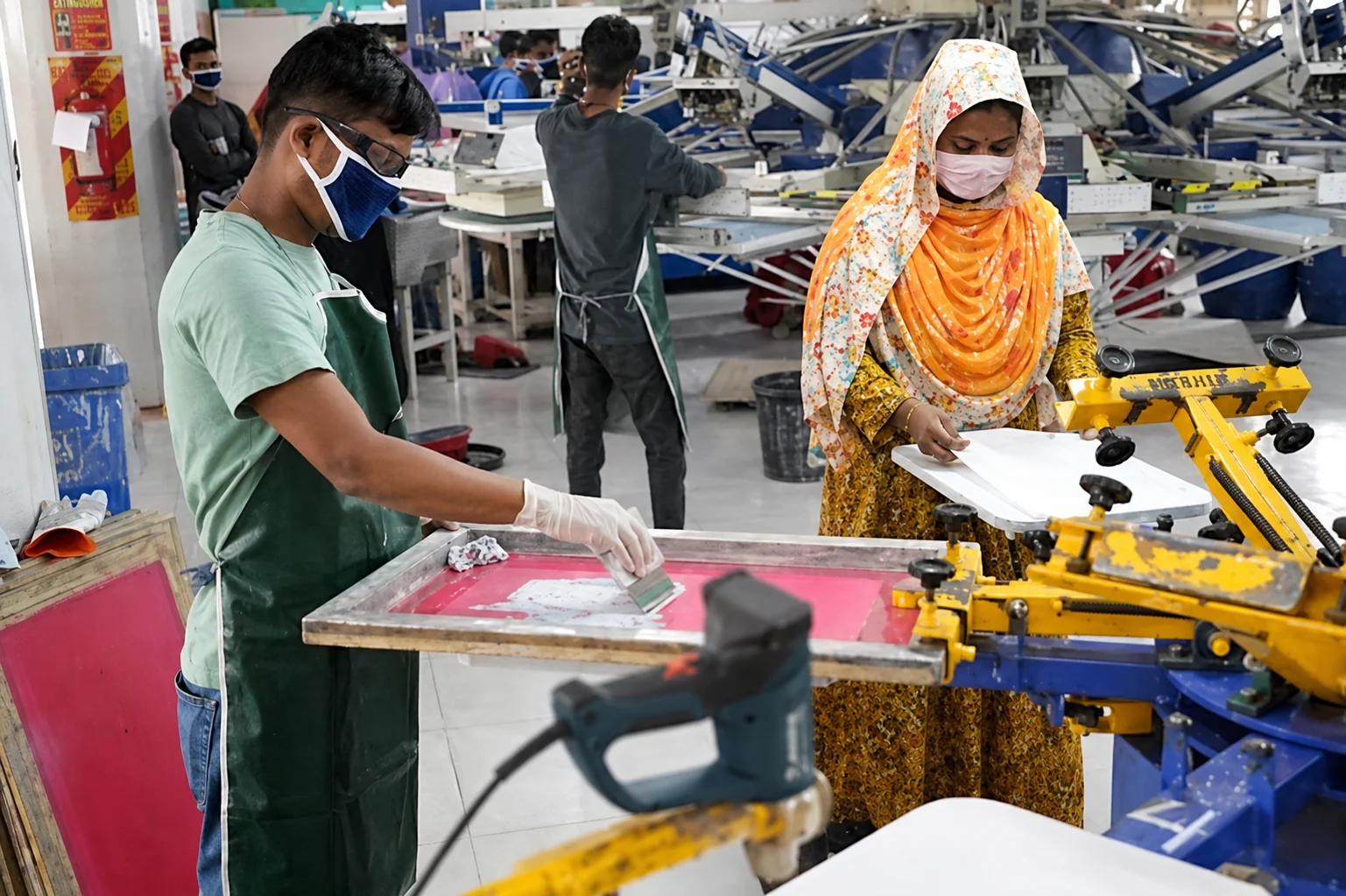
Factory images are supporting evidence, not complete proof.
Photographs and video calls can help buyers understand a facility, but they should be considered together with company records, process explanations, product documents, production data and sample results.
Product and Process Knowledge
Check Whether the Manufacturer Understands the Application
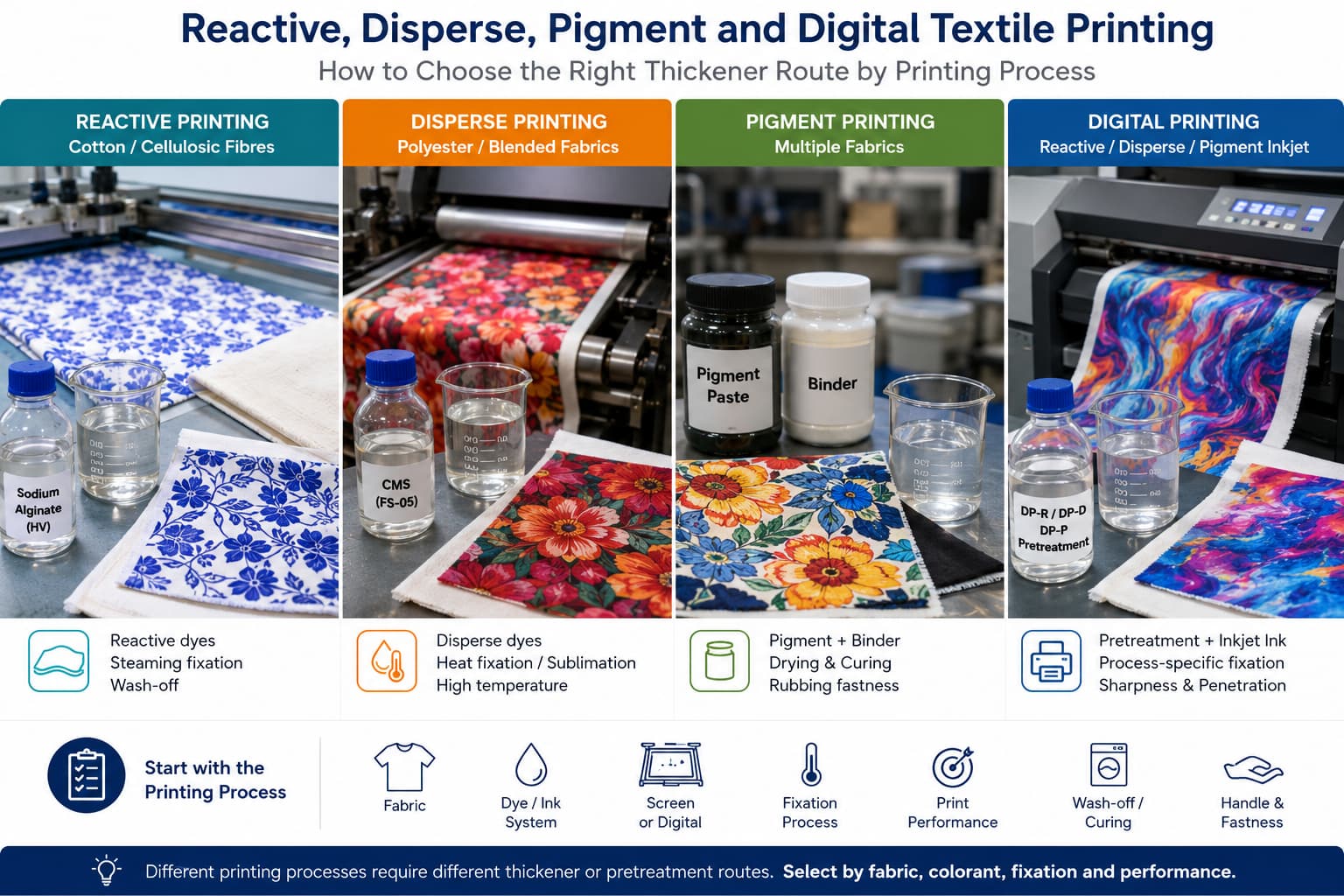
A manufacturer should be able to explain how product selection changes with the dye or ink system, fabric, printing method, test conditions and target result. 01
Grade Logic
Ask why a specific grade is recommended and which technical or application indicators distinguish it from another grade. 02
Process Boundary
The supplier should distinguish reactive, disperse, pigment, screen-printing and digital-pretreatment requirements. 03
Kondisi Pengujian
Viscosity and other values should be connected to a reproducible concentration, temperature, instrument and preparation method. 04
Trial Indicators
Recommendations should consider colour yield, definition, penetration, wash-off, fastness, handle and paste stability. 05
Replacement Limits
A responsible supplier should not promise universal one-to-one replacement before reviewing the recipe and completing trials. 06
Production Feedback
The supplier should be able to review trial results and explain whether dosage, preparation or grade direction needs adjustment.
A supplier does not need to disclose confidential formulas or process settings, but it should be able to explain the general control points used from incoming material through finished-product release. STAGE 01
Raw-Material Review
Confirm identity, supplier status and applicable incoming quality indicators before production use. STAGE 02
Production Control
Follow the applicable manufacturing instruction, process sequence and key operating controls. STAGE 03
In-Process Checks
Review intermediate appearance, reaction, mixing or other process-specific indicators where applicable. STAGE 04
Finished Testing
Test the applicable appearance, viscosity, pH, moisture, purity or application-related indicators. STAGE 05
Batch Release
Confirm conformity, batch identification and authorization before the material is released for packing. STAGE 06
Packaging & Storage
Protect the product from moisture, contamination and identification errors before shipment.
Ask for evidence of control, not only equipment photographs.
Useful evidence may include process-flow explanations, batch records, test reports, packaging labels, retained-sample procedures and examples of how out-of-specification results are handled.
Laboratory Review
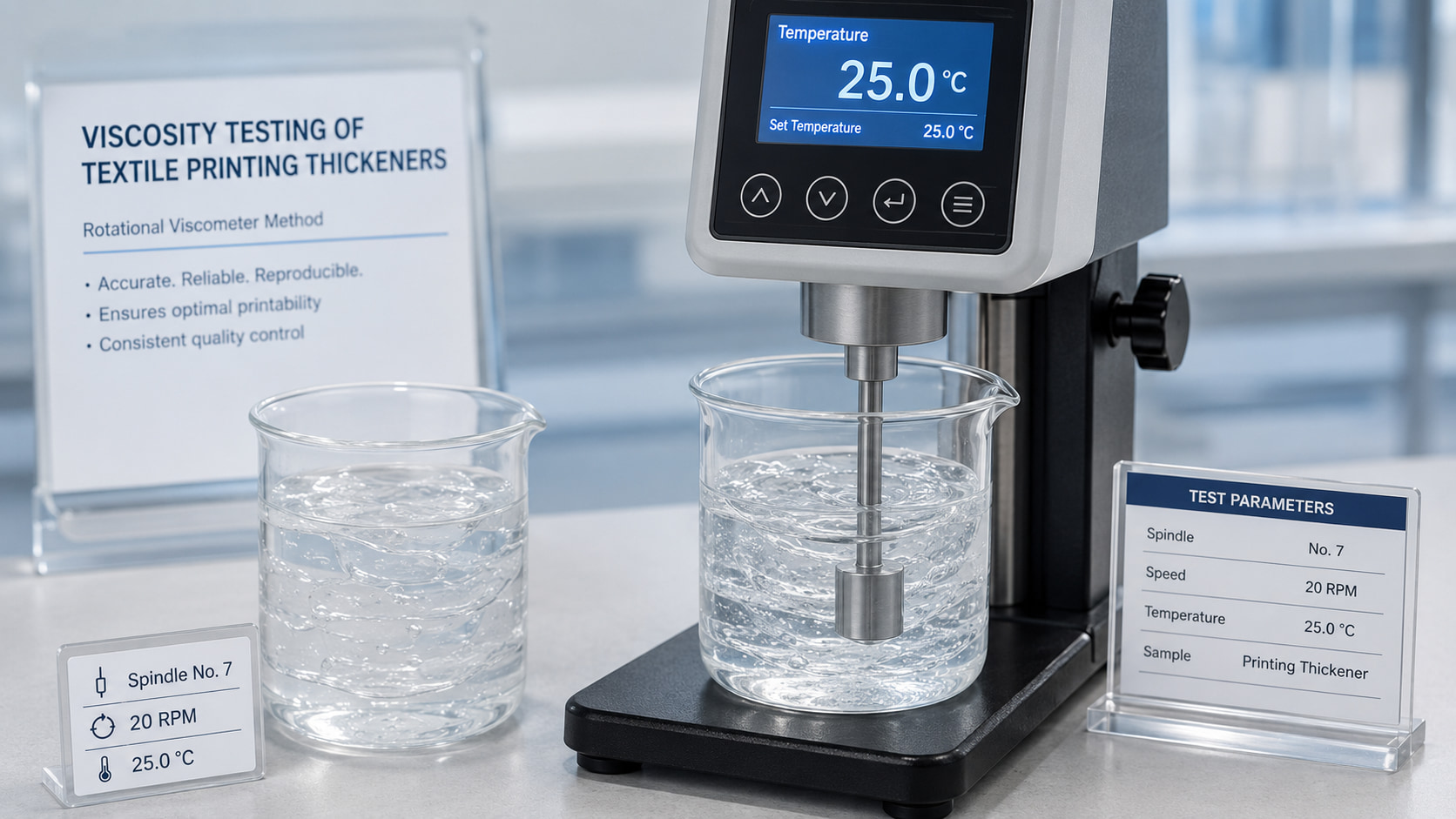
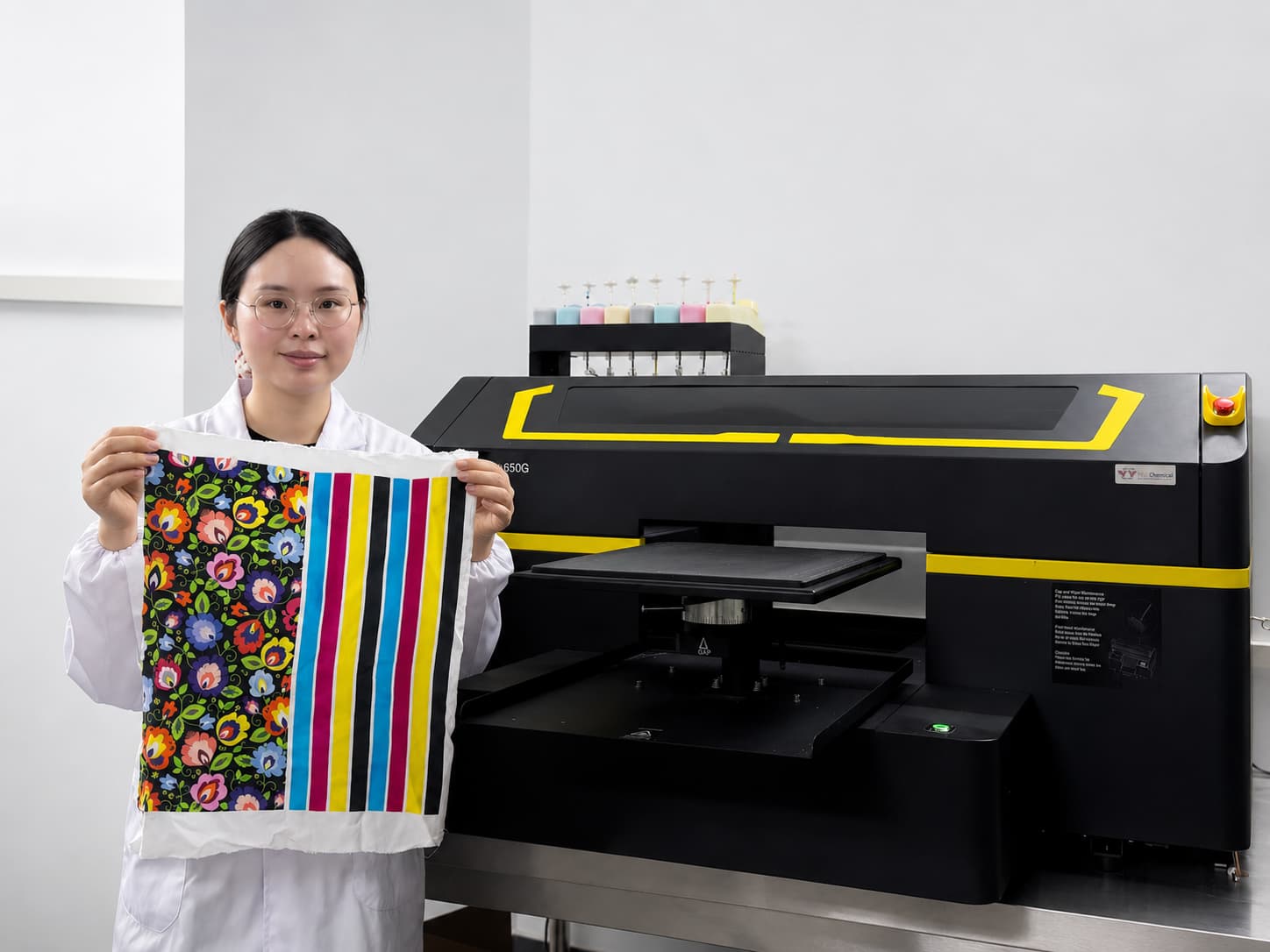
Verify the Test Method Behind the Specification
Laboratory capability should be evaluated by the reproducibility and relevance of the test method, not only by the appearance of the equipment.
The same numerical result does not guarantee the same method.
A buyer should confirm concentration, temperature, instrument, spindle or rotor, rotational speed and preparation conditions before comparing supplier data.
Traceability
Connect the Approved Sample to the Commercial Batch
Stage
Required Identification
Pemeriksaan Pembeli
Initial recommendation
Product family, suggested grade and application route
Confirm why this route was selected.
Laboratory sample
Sample code, grade, preparation date and applicable TDS
Keep the sample code with the test record.
Production trial
Trial recipe, dosage, fabric, process and result
Record the conditions under which the sample was approved.
Kutipan
Exact product name, grade, specification and packing
Confirm that the quotation matches the approved sample.
Commercial batch
Batch number, production record, package label and COA
Confirm that the supplied batch is traceable.
Repeat order
Previous grade, specification and approved conditions
Control unapproved grade or specification changes.
Do not approve only a product-family name.
Names such as CMC, CMS or sodium alginate describe broad product families. The order should identify the exact approved grade, specification and applicable test method.
Certification Review
How to Review an ISO 9001 Certificate
ISO 9001 certification may provide additional confidence that a supplier operates a quality-management system. Certification remains separate from the technical acceptance of an individual product or production batch.
Certified legal company name
Certified site address
Certificate number
Applicable ISO edition
Certification scope
Initial issue date
Current validity date
Certification body
Accreditation mark where applicable
Online or issuer verification route
What Certification Can Support
Systematic process management
Defined responsibilities
Documented information
Monitoring and measurement
Corrective action and improvement
What It Does Not Prove Alone
Suitability for your printing recipe
Specific viscosity or purity
Performance of one sample
Conformity of one production batch
Guaranteed delivery or commercial terms
Remote and On-Site Audit
Choose the Audit Depth According to Risk
Review Method
Suitable Use
Typical Evidence
Limitation
Document review
Initial screening and low-risk sample evaluation
Company records, TDS, SDS, certificates, specifications and sample information
Limited visibility of real operating conditions
Live video audit
Preliminary factory and laboratory verification
Live production areas, equipment, warehouse, labels and laboratory demonstrations
Buyer cannot independently inspect every area or record
Customer on-site audit
Higher-value, higher-risk or long-term supplier approval
Facility inspection, interviews, records, process observation and sample traceability
Requires time, travel and qualified auditors
Third-party audit
Independent review where the buyer cannot visit
Defined audit scope, findings, evidence and corrective actions
Quality depends on the audit scope and auditor competence
ISO 19011 provides general guidance for audit principles, audit programmes, audit execution and auditor competence. It does not itself certify the supplier.
Supply and Export Review
Confirm That the Manufacturer Can Support the Full Order
A technically suitable sample is not enough if packaging, lead time, batch size or documentation cannot support the commercial order.
Minimum order quantity
Standard production batch size
Normal and peak lead time
Available packing formats
Moisture-protection method
Bag, drum and pallet identification
Container-loading plan
Destination and port requirements
TDS, SDS and batch COA availability
Commercial invoice and packing list
Origin or export documents where required
Communication during production and shipment
Confirm documentation before order approval.
Document requirements, product names, issuing entities and destination requirements should be agreed before production rather than corrected after the shipment is ready.
Corrective Action
Ask How the Supplier Handles a Non-Conforming Batch
Immediate Response
Confirm the product and batch number
Collect photographs, test data and retained samples
Separate suspected material where possible
Define the immediate communication contact
Investigation and Prevention
Compare supplier and customer test methods
Review production and batch records
Identify the likely cause
Define corrective and preventive actions
Confirm replacement or commercial resolution
Communication speed is not the only evaluation point.
A useful response should identify the affected batch, examine evidence, explain the investigation and define action to reduce the chance of recurrence.
Warning Signs
Ten Supplier Claims That Require Further Verification
“All grades are the same”
CMC, CMS, sodium alginate and digital printing products require grade- and process-specific evaluation.
“Guaranteed replacement”
Replacement should not be guaranteed before reviewing the current product, test method, recipe and application trial.
Viscosity without method
A viscosity value is incomplete without concentration, temperature, instrument, spindle and RPM.
One COA for every batch
A batch COA should be traceable to the actual batch being supplied, not reused without clear batch identification.
Certificate without scope
Verify whether the certified company, site and activities cover the products under review.
Refusal to identify the grade
Confidential formulas can remain confidential, but the supplied grade and applicable specification should be identifiable.
Unexplained company names
Differences between brand, manufacturer, exporter and document issuer should be explained clearly.
No sample traceability
The buyer should be able to connect the approved sample with the ordered commercial grade.
Price changes with product changes
Confirm that a lower quotation does not quietly change the grade, test method, purity or packing.
No complaint process
Buyers should know who will investigate a problem and how batch evidence will be reviewed.
Buyer Scorecard
Practical 100-Point Manufacturer Evaluation
The following weighting is a suggested internal purchasing tool, not an ISO scoring system. Adjust it according to the technical and commercial risk of the order.
Bidang Evaluasi
Suggested Weight
Full-Score Requirement
Company identity
10 points
Legal entity, brand, manufacturing site and contracting role are clear and consistent.
Product and process capability
15 points
Supplier demonstrates relevant grades and understands the intended textile printing route.
Manufacturing control
15 points
Production stages, key controls and release responsibilities are defined.
Laboratory and methods
15 points
Test conditions are reproducible and equipment control can be explained.
Batch traceability
15 points
Product, batch, labels, records, COA and retained samples can be connected.
Documents and certificates
10 points
Current TDS, SDS, COA and applicable certificate scopes are clear and verifiable.
Sample and trial support
10 points
Supplier reviews application information and responds to trial results.
Supply and export support
5 points
Packing, lead time, order volume and export-document needs can be supported.
Complaint and corrective action
5 points
Supplier has a defined investigation, communication and corrective-action route.
A high score should not override a failed printing trial. A lower score does not automatically disqualify a supplier if the missing evidence is low-risk and can be resolved. Final approval should combine technical results, supply risk and commercial requirements.
FSX Chemical Evaluation Route
Information Buyers Can Review Before Bulk Supply
FSX Chemical supplies CMC, CMS, sodium alginate and digital printing paste routes for textile printing and selected industrial applications. Buyers can begin with application information, a current product specification or an existing sample.
How can I verify that a supplier is a real manufacturer?
Review the legal company, manufacturing address, production scope, equipment, process flow, laboratory capability, production records and batch documents. Use live video, an on-site visit or a qualified third-party audit when the order risk justifies it. Does ISO 9001 certification guarantee product quality?
No. ISO 9001 concerns the supplier’s quality-management system. Product conformity must still be confirmed through the agreed specification, test method, batch COA, sample test and production trial. Is a factory audit required for every order?
Not necessarily. Audit depth should reflect product risk, order value, supplier history and the effect of a failed batch. Document review and live video may be sufficient for an initial low-risk trial, while long-term or high-risk supply may justify an on-site audit. What documents should I request before sample testing?
Request the applicable TDS and SDS together with the product grade, test conditions and preparation information. A batch COA is normally more relevant when reviewing a commercial production batch. How do I know the bulk product will match the approved sample?
Record the approved sample code, exact grade, specification and test method. Confirm the same information in the quotation, purchase order, package label and batch COA for the commercial shipment. Should I choose the manufacturer with the lowest price?
Not solely on price. Compare dosage, printing performance, batch consistency, documentation, packaging, lead time, rejected-fabric risk and the supplier’s response if a problem occurs. Can a trading company still be a suitable supplier?
Yes, if its role is transparent and it can provide reliable product traceability, technical communication, document control and access to the responsible manufacturing source. Buyers should evaluate the full supply chain rather than relying only on the company label.
About This Buyer Guide
Prepared by the FSX Chemical Technical Content Team for textile printing mills, paste formulators, chemical distributors, importers and procurement teams evaluating printing-thickener manufacturers before sample approval and bulk purchase.
FSX Kimia Foshan Fushixin Polymer Fiber Co., Ltd. Updated July 2026
Audit and Quality References
Supporting Management-System References
These sources provide general supplier-quality and audit context. They do not replace the buyer’s product specification, contract, inspection or production trial.
International Organization for Standardization. ISO 9001:2015 — Quality management systems — Requirements. View official ISO record
International Organization for Standardization. ISO 9001 in the Supply Chain. Explains how ISO 9001 may support supplier confidence while remaining separate from product conformity. View official ISO publication
International Organization for Standardization. ISO 19011:2026 — Guidelines for auditing management systems. View official ISO record
International Accreditation Forum. Information on accredited management-system certification and certificate verification. View the official IAF website
Evaluate the Grade and the Supply Process Before Bulk Purchase
Send your current sample or TDS together with the printing process, fabric, target viscosity, test method, packing requirement and expected order volume. FSX Chemical can review an initial product route and provide available manufacturing, test, document and batch information for supplier evaluation.
Ketahui mengapa nilai viskositas pengental dalam pencetakan tekstil tidak dapat dibandingkan tanpa menyesuaikan konsentrasi, suhu, alat ukur, spindel, kecepatan, metode persiapan, dan waktu pengujian.
Pelajari cara memilih bahan pengental dan metode pra-perlakuan untuk pencetakan tekstil reaktif, disperse, pigmen, dan digital berdasarkan jenis kain, pewarna atau tinta, proses fiksasi, daya lepas saat pencucian, serta persyaratan kualitas cetakan.
Pelajari perbedaan antara dokumen TDS, SDS, dan COA, hal-hal yang perlu diverifikasi oleh pembeli produk cetak tekstil, serta cara memeriksa spesifikasi, data keselamatan, metode pengujian, hasil pengujian per batch, dan penerbit dokumen.
Pelajari cara mengevaluasi produsen pengental untuk pencetakan tekstil dengan memeriksa identitas perusahaan, kapasitas produksi, metode pengujian, keterlacakan batch, dokumen teknis, dukungan sampel, dan pasokan ekspor.
Bandingkan CMC, CMS, natrium alginat, dan pasta cetak digital untuk pencetakan tekstil. Pelajari bagaimana masing-masing bahan tersebut sesuai dengan proses pencetakan reaktif, dispersi, pigmen, dan digital, serta hal-hal apa saja yang perlu diperhatikan pembeli sebelum melakukan pengujian sampel, penyesuaian kualitas, dan pembelian dalam jumlah besar.
Sodium alginat banyak digunakan dalam pencetakan tekstil sebagai pengental yang stabil dan tahan cuci untuk pasta cetak reaktif. Pelajari cara mengevaluasi tingkat viskositas, kemurnian, dan kesesuaian penggunaannya sebelum membeli, serta bagaimana FSX Chemical mendukung pembeli di seluruh dunia dengan data teknis dan sampel.
Karboximetil selulosa (CMC) banyak digunakan dalam proses pencetakan, pelapisan, dan pewarnaan tekstil. Panduan ini akan menjelaskan cara mengevaluasi jenis-jenis CMC, parameter mana yang paling penting, serta bagaimana FSX Chemical dapat mendukung keputusan pembelian.
Karboximetil selulosa digunakan sebagai pengental dan penstabil dalam tinta berbasis air, pencetakan gravure, serta pra-perlakuan pencetakan inkjet. Panduan ini membahas parameter utama setiap jenis produk serta pertimbangan dalam pemilihan pemasok bagi tim pengadaan.
Karboximetil selulosa memiliki berbagai fungsi dalam proses pengikatan serat tekstil, pasta cetak, dan bahan pembantu pewarnaan. Panduan ini menjelaskan cara kerja masing-masing aplikasi tersebut serta parameter kualitas apa saja yang perlu ditentukan saat melakukan pengadaan.
Memilih pemasok CMC yang tepat tidak hanya sekadar membandingkan harga. Panduan ini membahas kriteria evaluasi, daftar periksa dokumentasi, dan proses uji coba yang harus diikuti oleh tim pengadaan sebelum memutuskan untuk melakukan pemesanan dalam jumlah besar.
Pasta cetak berbasis CMC digunakan dalam pencetakan tekstil pigmen, reaktif, dan digital. Panduan ini menjelaskan parameter apa saja yang penting, cara membandingkan pemasok, serta hal-hal yang perlu diminta sebelum melakukan pemesanan dalam jumlah besar.
Baik natrium alginat maupun CMC digunakan sebagai pengental dalam pencetakan tekstil, namun keduanya cocok untuk sistem pewarnaan dan kondisi proses yang berbeda. Panduan ini menjelaskan perbedaan utama di antara keduanya serta kapan masing-masing harus digunakan.
Berikan nama produk, kegunaan, jumlah, tujuan pengiriman, serta TDS,
foto sampel, atau dokumen lain yang sudah Anda miliki. FSX Chemical akan meninjau
informasi tersebut dan merekomendasikan langkah selanjutnya terkait penawaran harga, pencocokan sampel,
atau pemilihan produk.
Informasi ProdukNama produk, kelas, model, foto label, atau referensi pemasok.
Dokumen yang TersediaTDS, SDS, COA, foto sampel, daftar produk, atau data pengujian.
Rincian PesananPerkiraan jumlah, kemasan, negara tujuan, pelabuhan, atau syarat perdagangan.
Permohonan atau MasalahProses pencetakan tekstil, kebutuhan formulasi, masalah terkini, atau target kinerja.

 ID
ID  EN
EN  BN
BN  ES
ES  TR
TR  FR
FR  RU
RU  AR
AR  UR
UR