How to Scale Acrylic Thickener Pigment Paste from Lab Beaker to Production Color Kitchen
Scaling acrylic pigment paste requires more than multiplying the lab formula. Mixing geometry, feed time,...
Scaling an acrylic-thickened pigment paste from a laboratory beaker to a production color kitchen is not a matter of multiplying every ingredient by the same factor. The formulation can often scale by mass, but the manufacturing process changes with vessel geometry, impeller size, circulation pattern, ingredient feed time, local pH, heat dissipation, air entrainment and holding time. Acrylic thickeners are especially sensitive because many ASE/HASE systems develop viscosity through neutralization and, in associative grades, through interaction with binder and surfactants. A reliable scale-up therefore defines critical process variables, reproduces the laboratory mixing sequence in a production-relevant way, uses stage-by-stage pH and viscosity checks, and confirms the result through a pilot or controlled production batch before the formula is released for routine manufacture.
How Do You Scale Acrylic Thickener Pigment Paste from Lab to Production?
Scale the formula and the process separately.
The ingredient percentages can often be converted directly by mass, but the production method must be rebuilt around the larger mixing system.
A practical sequence is:
Lock Lab Formula → Define Critical Quality Outputs → Map Addition Sequence → Translate Mixing / Feed Conditions → Run Pilot or Engineering Batch → Sample Stage by Stage → Confirm pH / Viscosity / Homogeneity → Hold → Transfer → Print → Release Production SOP
The key principle is:
Same Composition Does Not Guarantee Same Paste.
The production batch must reproduce the same:
Activation state
Dispersion quality
Binder / pigment compatibility
Rheolohiya
Pagpapanatili ng katatagan
Screen-printing performance
that made the laboratory sample successful.
Why Scale-Up Is More Than Multiplying the Formula
A 500 g laboratory beaker and a 1,000 kg color-kitchen tank do not create the same mixing environment.
When scale increases, several variables change:
Vessel diameter and height
Impeller diameter
Impeller-to-tank ratio
Distance from feed point to impeller
Mixing energy per unit volume
Batch turnover time
Ingredient addition time
Heat transfer area per unit volume
A laboratory addition that takes five seconds may take several minutes in production.
During those minutes, one part of the batch can experience a very different:
pH
Thickener concentration
Electrolyte concentration
Shear history
than the final average.
Scale-up must control those temporary local conditions.
Define the Critical Quality Outputs First
Before changing equipment or batch size, define what the successful laboratory paste must reproduce.
Typical critical outputs include:
Final pH
Final viscosity under a defined method
Low / higher-shear rheology if measured
No gel / lumps / floc
Acceptable foam
Holding-time stability
Filtration / screenability
I-print ang depinisyon
Color / opacity
Dry / wet rubbing
Fabric hand
These are the targets for scale-up.
Do not define success as:
“Use the same RPM and mixing minutes.”
The mixer settings are process inputs; the paste quality is the output.
Keep Formula Mass Balance Separate from Process Scale-Up
First confirm the formula itself is correct on a mass basis.
For every ingredient, record:
Commercial product name
Active / solids content if relevant
Percentage of total batch
Production mass
Then check:
Total Ingredient Mass = Final Batch Mass
Do not mix formula conversion with operator adjustments such as:
Extra water
Extra neutralizer
Viscosity correction
Those should be controlled separately and documented.
A color kitchen cannot troubleshoot scale-up if the base mass balance is moving from batch to batch.
Why Mixing Changes as Batch Size Increases
Mixing performance depends on much more than mixer speed.
Relevant variables include:
Impeller type
Impeller diameter
Tip speed
Power input
Power per unit volume
Vessel geometry
Lapot
Batch turnover
As acrylic thickener develops viscosity, the flow pattern can change substantially.
A production tank that mixes water efficiently may become poorly circulated after viscosity rises.
Therefore, scale-up should evaluate mixing at the:
Highest Relevant Process Viscosity
not only during the initial low-viscosity water stage.
Why Laboratory RPM Should Not Be Copied Directly
RPM has meaning only together with impeller diameter and geometry.
A small laboratory impeller at high RPM does not create the same flow field as a large production agitator at the same RPM.
Possible scale-up criteria include:
Comparable tip speed
Power per unit volume
Batch turnover / circulation
Geometric similarity
Comparable shear duty
There is no universal rule that is correct for every acrylic pigment paste.
Use the criterion that controls the critical quality problem.
For example:
If lumps are the problem, dispersion and circulation may dominate.
If polymer damage is the concern, excessive local shear may matter.
If neutralization is uneven, feed / turnover may matter more than peak shear.
Impeller Geometry, Tank Geometry and Working Volume
Record the production mixer configuration.
Important information includes:
Tank diameter
Tank height
Normal batch fill level
Impeller type
Impeller diameter
Impeller clearance from bottom
Baffles if present
A color kitchen can have acceptable full-batch mixing but poor partial-batch mixing because the impeller sits differently relative to the liquid level.
Do not approve only one full batch and assume every working volume is equivalent.
Define:
Minimum validated batch
Normal batch
Maximum validated batch
where relevant.
Circulation and Batch Turnover
The thickener must reach every region of the tank before critical additions are made.
A useful production question is:
How long does it take for the full vessel contents to circulate through the main mixing zone?
Slow turnover can create:
Local thickener concentration
Uneven neutralization
Binder-rich zones
Delayed final homogeneity
Do not rely on mixer noise or a visible surface vortex as proof of complete mixing.
Use sampling or tracer / process observations if needed to confirm the vessel is homogeneous.
Ingredient Feed Time Becomes a Process Variable
In the laboratory, the full thickener or neutralizer dose may enter almost instantly.
In production, addition may take several minutes.
That creates a moving composition during the feed period.
For each critical ingredient, define:
Addition duration
Feed rate
Feed location
Pre-dilution if used
Mixing time after feed
This is especially important for:
Acrylic thickener
Neutralizer
Electrolytes
Cationic fixer
These ingredients can create strong local changes before the tank average changes significantly.
Local pH Is More Important at Production Scale
Many acrylic ASE/HASE thickeners develop viscosity after neutralization.
If concentrated alkali is added into a poorly circulated zone, the local pH can temporarily be much higher than the final tank pH.
This can create:
Instant over-swelling
Gel particles
Local viscosity spikes
Uneven final thickening
The final bulk pH can still look correct.
Therefore:
Correct Final pH ≠ Uniform Production Neutralization.
Scale-up should reproduce the laboratory activation state without creating damaging local pH gradients.
Neutralizer Addition and Acrylic Thickener Activation
Record the laboratory neutralization method exactly.
Then translate it into production terms:
Neutralizer type
Neutralizer concentration
Pre-dilution
Feed time
Feed point
Mixing during feed
Mixing after feed
For many alkali-swellable acrylic grades, adequate mixing and sufficient alkaline conditions are important during incorporation.
But addition order is grade-specific.
Some commercial acrylic thickeners support post-addition; others are better handled through a pre-dispersed or pre-neutralized route.
Use the specific grade TDS as the starting process instruction.
Preserve Addition Logic, Not Just Ingredient Order
A laboratory note such as:
Water → Thickener → Alkali → Pigment → Binder
does not fully describe the process.
Production needs to know:
How well mixed was the thickener before alkali?
How quickly was alkali added?
How long was the paste allowed to equilibrate?
What was the pH before pigment?
Was the batch homogeneous before binder?
The real scale-up target is the chemical state at each step.
Two tanks can use the same ingredient order and still produce different paste if those states are not reproduced.
Pigment Dispersion Addition at Larger Scale
Pigment dispersion adds more than pigment.
It can also add:
Tubig
Dispersant
Surfactant
Electrolytes
At production scale, a large pigment feed can temporarily create a local pigment-rich or surfactant-rich zone.
Control:
Feed rate
Circulation
Bula
pH after addition
Viscosity after equilibration
If dark shades behave differently after scale-up, compare their higher pigment loading and longer feed time before changing the thickener grade.
Binder Addition and Associative-Thickener Response
Binder can change acrylic-thickener rheology through:
Dilution
Electrolytes
Surfactants
Polymer-particle interaction
HASE thickeners can associate with binder particles and surfactants.
Therefore, a large production binder addition can change viscosity and elasticity differently if:
Feed is too fast
Mixing is weak
Local binder concentration becomes high
Record viscosity only after the batch has reached a defined post-addition mixing / equilibration state.
Fixers and High-Ionic Auxiliaries
Fixers and ionic auxiliaries can create strong local compatibility stress.
If a cationic fixer is added to an anionic acrylic-thickened paste, local concentration can be more important than final dosage.
At larger scale, define:
Fixer dilution
Feed duration
Feed location
Mixing after addition
If the lab batch was added dropwise but production pours the same percentage rapidly into the tank, the chemistry is not being scaled equivalently.
Temperature Rise and Heat Dissipation
Large batches gain and lose heat differently from beakers.
Temperature can rise from:
Mechanical mixing
Pumping
Long mixing time
Warm production environment
At larger scale, lower surface-area-to-volume ratio can also slow cooling.
Temperature changes can alter:
Apparent viscosity
Associative thickener behavior
Bula
Pagpapanatili ng katatagan
Record temperature with every critical viscosity measurement.
Do not compare a warm production sample with a cooler laboratory sample.
Air Entrainment and Foam During Scale-Up
Large mixers can introduce more air if:
A strong surface vortex develops.
Ingredient feed splashes.
Return lines enter above the liquid surface.
Surfactant levels are high.
Foam can create:
False volume
Unstable viscosity readings
Pinholes
Inconsistent screen transfer
Scale-up should preserve mixing quality without unnecessary aeration.
Do not simply increase mixer speed when the production batch looks less homogeneous than the laboratory sample.
What Happens When the Batch Thickens During Mixing?
Acrylic pigment paste often changes from a relatively low-viscosity liquid to a much thicker system during activation and formulation.
As viscosity rises:
Flow pattern can collapse.
Surface mixing can look active while the bottom becomes poorly circulated.
Ingredient dispersion slows.
Production-scale mixing must therefore be validated after the batch reaches:
Near-Final Viscosity.
A mixer that works well before neutralization may not be adequate after the paste develops full structure.
Dead Zones and Incomplete Homogeneity
Dead zones can exist:
Near walls
At tank corners
Below or above the impeller
Behind internal fittings
Symptoms can include:
Different viscosity from top and bottom samples
Local gel
Uneven pH
Delayed batch stabilization
During scale-up, sample from more than one tank location when practical.
If top and bottom samples differ, the batch should not be considered homogeneous.
Holding Time in the Color Kitchen
The laboratory sample may be printed immediately.
The production batch may wait:
Before QC release
Before transfer
Before machine startup
During production stoppages
Therefore, scale-up should include the actual:
Preparation → Hold → Transfer → Printing
timeline.
Record:
Fresh viscosity
Held viscosity
pH
Temperatura
Bula
Separation / gel
A batch is not scaled successfully if it only matches the lab immediately after preparation.
Transfer, Pumping, Filtration and Delivery to the Machine
Leaving the color kitchen adds another process stage.
The paste can experience:
Pump shear
Hose pressure drop
Pagsasala
Repeated recirculation
Air entry
Sample:
Tank Before Transfer
and:
Machine Feed After Transfer
during commissioning.
If the two samples differ significantly, the scale-up problem may be in the transfer system rather than the mixing tank.
Build a Stage-by-Stage Sampling Plan
Do not take only one final QC sample.
Useful sampling points can include:
After thickener dispersion
After neutralization
After pigment
After binder
After fixer / auxiliaries
Final batch
After holding
After transfer to machine
At each relevant stage, record:
pH
Temperatura
Lapot
Mukha
This map reveals where laboratory and production begin to diverge.
Build a Stage-by-Stage pH Map
Entablado
Lab pH
Pilot pH
Production pH
After thickener dispersion
Record
Record
Record
After neutralization
Record
Record
Record
After pigment
Record
Record
Record
After binder
Record
Record
Record
Final paste
Record
Record
Record
If the final pH is similar but intermediate pH values differ strongly, the process is not truly equivalent.
Build a Stage-by-Stage Viscosity Map
Entablado
Lab
Pilot
Produksyon
Activated thickener base
Record
Record
Record
After pigment
Record
Record
Record
After binder
Record
Record
Record
Final fresh paste
Record
Record
Record
Held paste
Record
Record
Record
Use the same:
Temperatura
Instrument
Spindle / rotor
Speed
Oras ng pagbabasa
for comparable samples.
Use a Pilot or Engineering Batch Before Full Release
A pilot or engineering batch reduces risk because it allows:
Testing of feed times
Checking circulation
Monitoring local pH / viscosity development
Evaluating foam
Testing transfer and filtration
before the largest commercial batch is committed.
The pilot should use:
Actual raw materials
Production-relevant addition sequence
Representative mixing equipment where possible
Do not treat a second laboratory beaker as a pilot-scale validation.
Build a Lab-to-Production Scale-Up Matrix
Variable
Lab
Pilot / Engineering
Production Target
Batch size
Record
Record
Record
Mixer / impeller
Record
Record
Record
Thickener feed time
Record
Ipaliwanag
Ipaliwanag
Neutralizer feed time
Record
Ipaliwanag
Ipaliwanag
Mixing after neutralization
Record
Ipaliwanag
Ipaliwanag
Final pH
Record
Match window
Control window
Pangwakas na lapot
Record
Match window
Control window
Pagpapanatili ng katatagan
Record
Verify
Release criterion
Print result
Reference
Ihambing
Approve
The matrix makes process differences visible before they become production complaints.
Define Production Acceptance Windows
Do not require every production batch to match one exact laboratory number.
Define validated ranges for:
pH
Lapot
Temperature at measurement
Mukha
Bula
Holding drift
Filtration / screenability
The ranges should come from:
Successful Pilot / Production Data + Measurement Repeatability + Finished-Print Performance.
Do not invent narrow specifications that are tighter than the measurement system can repeat.
Convert the Trial into a Color-Kitchen SOP
A robust SOP should define:
Raw-material identity and mass
Water charge
Mixer configuration
Initial mixer condition
Thickener feed point / time
Mixing after thickener
Neutralizer concentration / feed time
pH checkpoint
Pigment feed
Binder feed
Fixer / auxiliary sequence
Mixing time between stages
Final pH / viscosity method
Holding / release criteria
Transfer / filtration requirement
Avoid vague instructions such as:
“Mix well.”
Every critical stage should have an observable endpoint.
Batch-to-Batch Consistency After Scale-Up
After the first successful production batch, keep trending:
Raw-material lot
Final pH
Pangwakas na lapot
Batch temperature
Mixing time
Holding drift
Filter residue
Machine performance
This shows whether the production process is truly stable.
A scale-up is not complete after one successful batch.
The process should remain inside the approved window across repeated batches and normal raw-material variation.
Confirm the Paste on the Printing Machine
Color-kitchen approval is not final production approval.
The paste still must pass:
Pumping / circulation
Paglilipat sa screen
Screen release
I-print ang depinisyon
Pagpasok
Color / opacity
Pagpapagaling
Dry / wet rubbing
Fabric hand
Compare the production paste with the laboratory reference under representative machine conditions.
A batch that matches laboratory viscosity but prints differently has not been fully scaled.
Common Scale-Up Mistakes
1. Multiplying Ingredients and Assuming the Process Also Scales
Composition can scale directly; mixing, feeding and heat transfer usually do not.
2. Copying Laboratory RPM
RPM without impeller diameter and geometry does not define equivalent mixing.
3. Ignoring Feed Time
Production additions can take minutes, creating local concentration and pH gradients.
4. Checking Only Final pH
Intermediate local pH can create gel even when final pH is correct.
5. Validating Mixing Only Before the Paste Thickens
The vessel may circulate poorly after viscosity rises.
6. Ignoring Temperature
Large batches retain and generate heat differently from laboratory samples.
7. Approving from One Final QC Sample
Stage-by-stage data is needed to locate scale-up differences.
8. Skipping the Machine Trial
Color-kitchen viscosity does not prove screen-printing performance.
Impeller position, circulation, fill level, dead zones
Extra mixing time alone will solve it
Lab paste is smooth but production contains lumps
Feed point, mixing energy, scale-up addition time
The formula changed
Production paste is hotter and thinner
Mixing heat, pump heat, measurement temperature
Polymer was mechanically damaged
Batch leaves color kitchen correct but reaches machine thinner
Pump, filtration, transfer line, circulation
The tank mixing caused the problem
Dark shade scale-up is worse than light shade
Pigment feed time, surfactants, electrolytes, foam
The same process works for every pigment load
Full batch works but half batch fails
Liquid level, impeller submergence, tank geometry
Batch size has no effect on mixing
Total Cost in Use
Poor scale-up creates cost through:
Rejected production batches
Extra thickener corrections
Long mixing times
Filter / screen blockage
Machine downtime
Rework
Off-shade fabric
A useful model is:
Total Cost in Use = Raw Materials + Mixing Time / Energy + Corrections + Filtration + Machine Efficiency + Rework + Quality Loss
A production process with slightly longer controlled feed time can be cheaper than a faster process that repeatedly creates gel or viscosity inconsistency.
Likewise, a more scale-tolerant thickener can justify a higher purchase price if it reduces correction and batch risk.
Compare cost per acceptable production batch and printed meter.
What Information Should You Send to a Supplier?
For useful lab-to-production scale-up support, provide:
Laboratory formula
Target production batch size
Current acrylic thickener / TDS
Dosis ng pampalapot
Neutralizer type / concentration
Laboratory addition sequence
Production addition sequence
Lab mixer / impeller information
Production tank / mixer information
Feed times for thickener and neutralizer
Stage-by-stage pH if available
Stage-by-stage viscosity if available
Binder / pigment / fixer details
Pagpapanatili ng oras
Transfer / pump / filtration route
Main scale-up difference or defect
FSX Chemical can use this information through Mga Halimbawa at Pagtutugma to help structure a controlled lab-to-production comparison.
How Should a Color Kitchen Scale Acrylic Pigment Paste Reliably?
A practical control chain is:
Freeze Formula → Define Quality Outputs → Map Lab Process → Characterize Production Mixer → Set Feed Times / Locations → Control Local pH → Sample Stage by Stage → Pilot → Hold → Transfer → Print → Release SOP → Trend Repeated Batches
The key principles are:
Formula percentages can be multiplied, but mixing and addition conditions must be translated and validated.
Laboratory RPM should not be copied directly because impeller size, geometry, power input and circulation all change with scale.
Local pH and local concentration during neutralizer, thickener, pigment, binder and fixer addition become more important as feed time increases.
Production mixing must be validated at near-final viscosity, not only when the batch is still thin.
Stage-by-stage pH, viscosity, temperature and appearance data make scale-up differences visible before the batch reaches the printing machine.
A successful scale-up is a repeatable production process that reproduces the approved paste and finished-print performance at the lowest practical Total Cost in Use.
Madalas Itanong na Mga Tanong
1. Can I scale pigment paste by multiplying every laboratory ingredient?
The formulation mass can usually be scaled proportionally, but the mixing, feed rate, neutralization, heat transfer and holding process must be translated separately.
2. Should production mixer RPM be the same as laboratory RPM?
No. RPM alone does not define equivalent mixing because impeller diameter, geometry and vessel scale are different.
3. What mixing parameter should be kept constant during scale-up?
There is no universal parameter. Tip speed, power per volume, circulation and geometric similarity describe different effects. Choose the parameter linked to the critical quality problem and confirm with pilot data.
4. Why does production acrylic thickener form gel when the lab batch is smooth?
Common causes include slower circulation, longer neutralizer feed time, local high pH, thickener-rich dead zones or poor scale-up of the addition sequence.
5. Why is production viscosity lower than laboratory viscosity?
Possible causes include incomplete activation, different temperature, poor mixing, pigment/binder interactions, water addition or transfer shear. Compare stage-by-stage data before correcting with more thickener.
6. Why does the same final pH give different viscosity at production scale?
The final average pH can be the same even though the production batch experienced very different local pH and neutralization history during addition.
7. Should I use a pilot batch before full production?
Yes when the scale change is significant or the paste is process-sensitive. Pilot or engineering batches help validate mixing, feed and transfer conditions before a full commercial batch is committed.
8. Why can a half batch behave differently from a full batch?
The liquid level changes the impeller position relative to the batch and can change circulation, vortexing and dead zones.
9. Should I sample only the final production paste?
No. Stage-by-stage samples after neutralization, pigment, binder, final mixing, holding and transfer are more useful during scale-up.
10. Why does paste change after transfer from the color kitchen to the printing machine?
Pumps, filters, hoses, recirculation and air entry add new shear and process conditions. Compare tank and machine-feed samples.
11. When is scale-up considered successful?
When repeated production batches remain inside the validated pH, viscosity, stability and printing-performance windows using the documented SOP.
12. What should I send FSX Chemical for scale-up support?
Send the lab formula, production batch size, thickener and neutralizer data, addition sequence, lab/production mixer information, feed times, stage pH/viscosity data, holding time and the exact scale-up problem.
Scale Acrylic Pigment Paste by Process, Not Formula Multiplication Alone
If your laboratory pigment paste is stable but the production color-kitchen batch develops lower viscosity, gel, lumps, foam, uneven pH or different screen behavior, FSX Chemical can help structure a controlled lab-to-production comparison.
For a useful technical review, send:
Your approved laboratory formula
Target production batch size
Current acrylic thickener sample, TDS or COA
Dosis ng pampalapot
Neutralizer type, concentration and addition method
Laboratory and production addition sequence
Laboratory mixer information
Production tank / impeller information
Thickener and neutralizer feed times
Stage-by-stage pH / viscosity if available
Pigment / binder / fixer system
Holding and transfer conditions
The exact difference between laboratory and production paste
Successful scale-up means reproducing the laboratory paste’s chemical state and printing performance under a larger, slower and more complex mixing environment. The formula is only one part of that transfer; feed rate, circulation, local pH, temperature, holding and transfer conditions must also be controlled.
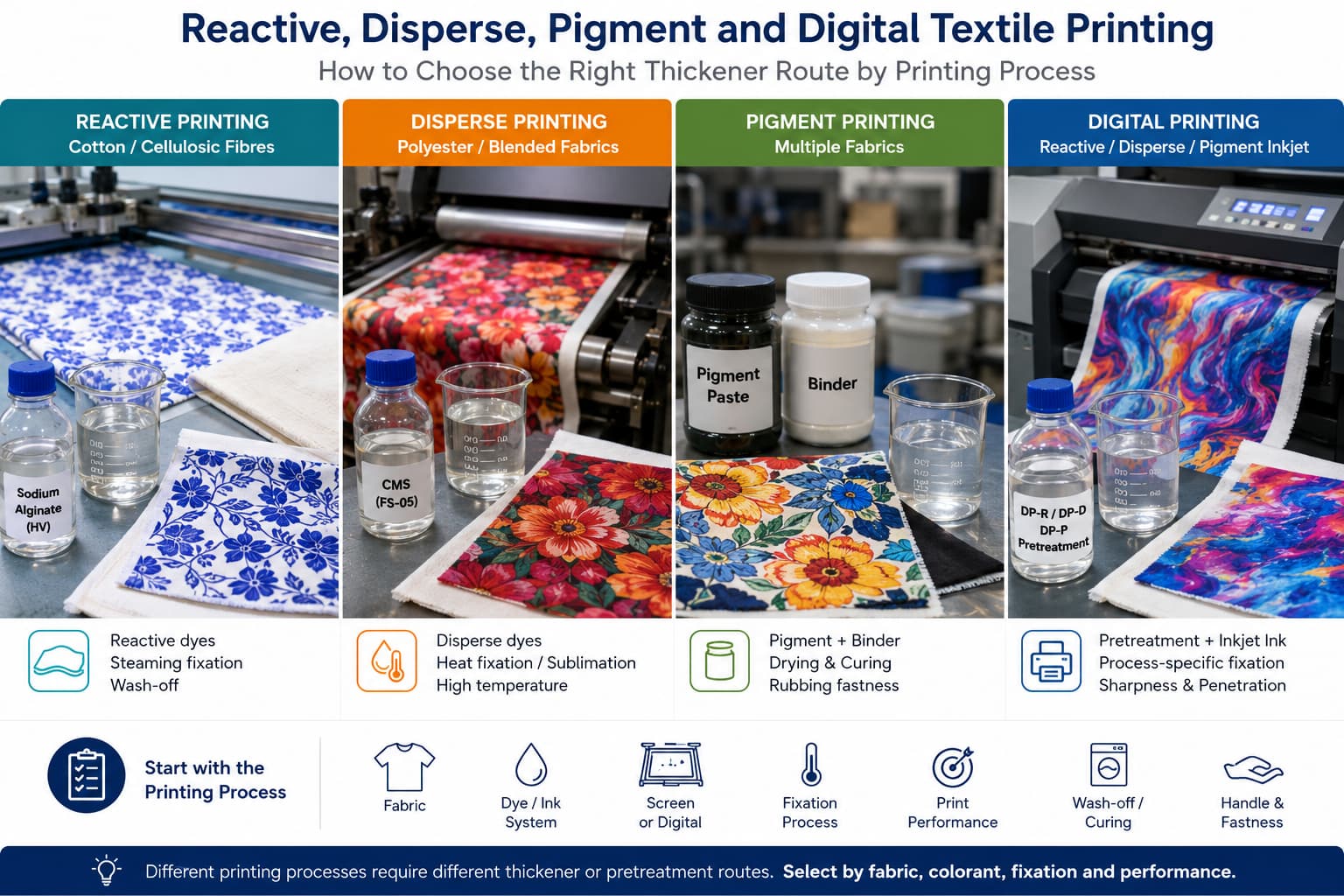
Matutong pumili ng pampatigas at mga paraan ng paunang paggamot para sa reaktibo, disperse, pigment, at digital na pagpi-print sa tela batay sa tela, tina o tinta, fiksasyon, paghuhugas, at mga kinakailangan sa kalidad ng pagpi-print.
Ang CMC-based printing paste ay ginagamit sa pigment, reactive, at digital na pagpi-print ng tela. Ipinapaliwanag ng gabay na ito kung aling mga parameter ang mahalaga, kung paano ihambing ang mga supplier, at kung ano ang dapat hilingin bago maglagay ng maramihang order.
Parehong ginagamit ang sodium alginate at CMC bilang pampalapot sa pagpi-print ng tela, ngunit angkop ang mga ito sa iba't ibang sistema ng pangkulay at kondisyon ng proseso. Ipinapaliwanag ng gabay na ito ang mga pangunahing pagkakaiba at kung kailan dapat gamitin ang bawat isa.
The right textile printing thickener is determined by more than fabric type. Buyers should match the thickener to the dye or pigment system, printing method, target rheology, wash-off requirements and actual factory trial conditions.
Ang pagganap ng pagpi-print sa tela ay nakasalalay sa isang pinag-ugnay na sistemang kemikal, hindi sa isang unibersal na additive. Ipinapaliwanag ng gabay na ito ang sampung mahahalagang pangkat ng kemikal, ang kanilang mga tungkulin, kung saan sila nagagamit, at kung ano ang dapat suriin ng mga mamimili bago ang mga pagsubok sa produksyon.
Textile printing thickeners differ in chemistry, rheology, dye compatibility and wash-off behavior. This guide compares the main thickener families, their common application directions and the parameters buyers should verify before production trials.
Ang mga digital printing paste ay dapat piliin batay sa kemistri ng tinta, tela, paraan ng aplikasyon, at post-treatment. Ikinukumpara ng gabay na ito ang sodium alginate, CMC, CMS, sintetikong polymer, at mga compound pretreatment na ruta para sa textile inkjet printing.
FSX Chemical offers separate digital printing paste routes for reactive, disperse and pigment systems, supported by application review, sample matching and technical documentation. This guide explains how buyers can evaluate the right route before bulk purchasing.
Stable digital printing paste requires more than a target viscosity. This guide explains how product selection, water quality, addition sequence, mixing, pH, temperature, filtration, hygiene, storage and quality records influence pretreatment and production consistency.
This product review examines FSX Digital Printing Paste as a textile inkjet pretreatment and thickening route, focusing on ink-system matching, rheology, filtration, print definition, stability and real production testing.
Digital textile printing requires more than advanced ink and printheads. Explore process-specific chemical solutions for reactive, disperse and pigment inkjet printing, from pretreatment and rheology to filtration, fixation and production validation.
Textile printing chemistry is evolving beyond simple viscosity and price comparisons. Explore five innovation directions shaping 2026, including safer chemical inputs, hybrid biopolymer thickeners, advanced pigment binders, shorter digital processes and multifunctional formulations.
Ibahagi ang pangalan ng produkto, aplikasyon, dami, destinasyon, at anumang TDS, larawan ng sample o dokumento na mayroon ka na. Susuriin ng FSX Chemical ang impormasyon at irekomenda ang susunod na hakbang para sa quotation, pagtutugma ng sample, o pagpili ng produkto.
Impormasyon ng ProduktoPangalan ng produkto, grado, modelo, larawan sa etiketa o sanggunian ng tagapagtustos.
Magagamit na mga dokumentoTDS, SDS, COA, larawan ng sample, listahan ng produkto o datos ng pagsubok.
Mga Detalye ng OrderTinatayang dami, pag-iimpake, bansang patutunguhan, pantalan o termino sa kalakalan.
Aplikasyon o IsyuProseso ng pagpi-print sa tela, pangangailangan sa pormulasyon, kasalukuyang isyu o target na pagganap.