How to Troubleshoot Acrylic Thickener Gel Formation and Lumps: Local pH, Electrolytes and Mixing Errors
Acrylic-thickener lumps can come from local over-swelling, poor dispersion, electrolyte shock or ionic incompatibility. Correct...
Gel particles and lumps in acrylic-thickened pigment paste are not all caused by the same problem. A lump can be a locally over-swollen acrylic polymer created by concentrated alkali, an incompletely dispersed thickener-rich region caused by poor mixing, a floc formed by electrolyte or cationic incompatibility, or simply a highly concentrated paste zone that has not yet become homogeneous. The correct troubleshooting method is therefore to identify when the defect first appears, compare local pH and addition order, separate water dilution from ionic effects, inspect filtration residue, and reproduce the problem under controlled laboratory mixing. The objective is not to destroy every lump with stronger shear, but to prevent the local chemical conditions that created it.
Why Does Acrylic Thickener Form Gel or Lumps?
Acrylic thickener forms visible gel or lumps when the polymer does not experience a uniform chemical and mechanical environment during preparation.
The most common causes are:
Concentrated alkali creating local high pH
Thickener added faster than the mixer can disperse it
Insufficient circulation or dead zones
Electrolyte shock
Cationic–anionic incompatibility
Binder or pigment colloidal incompatibility
Hard-water ions
Incorrect addition order
The key diagnostic question is:
At which exact addition step do the first gel particles or lumps appear?
Once that stage is identified, the root cause becomes much easier to isolate.
Four Different Problems That Can Look Like “Gel”
Type A: Locally Over-Swollen Polymer
Usually associated with concentrated neutralizer contacting a small thickener-rich region.
Type B: Incompletely Dispersed Thickener-Rich Lump
Usually associated with poor mixing, fast addition or a dead zone.
Type C: Ionic Floc / Polymer Complex
Often associated with electrolytes, hard-water ions or cationic auxiliaries.
Type D: Highly Concentrated but Reversible Paste Zone
Can occur when the batch is temporarily nonuniform but becomes smooth after correct mixing.
These four defects can look similar visually but require different corrective actions.
How Acrylic Thickener Activation Creates Viscosity
Many acrylic ASE/HASE thickeners are supplied as acidic, relatively low-viscosity emulsions or dispersions.
When the pH rises into the grade’s useful activation range:
This activation is useful because the product can be easy to handle before neutralization.
But it also means the polymer can react very strongly to local pH differences.
A tank with an average pH inside the target window can still contain small regions that briefly experience much higher or lower pH during addition.
Those local conditions can create gel before the batch becomes homogeneous.
1. Local High pH and Instant Over-Swelling
Concentrated alkali can cause very rapid local swelling.
If neutralizer is poured into a thickener-rich zone faster than it can disperse, the polymer near the feed point can reach a much higher pH than the final tank average.
This can create:
Soft gel particles
Stringy swollen polymer
Local viscosity spikes
Uneven final viscosity
The key point is:
Correct Final pH Does Not Prove Uniform Neutralization.
The preparation path matters.
2. Neutralizer Concentration and Addition Rate
Neutralizer can be technically suitable but still create gel if the addition method is poor.
Important variables include:
Neutralizer type
Neutralizer active concentration
Pre-dilution
Feed rate
Feed location
Mixer speed
Post-addition mixing time
A concentrated NaOH stream and a diluted NaOH stream can produce very different local pH histories even if the final amount of NaOH is identical.
Likewise, ammonia and organic amines can differ in reaction rate, volatility and mixing behavior.
Use the thickener supplier’s approved neutralization method as the starting point.
3. Poor Mixing, Dead Zones and Local Thickener Concentration
A production tank is not automatically homogeneous because the mixer is running.
Possible mixing problems include:
Dead zones near tank walls
Weak circulation near the bottom
Mixer blade too small for the batch
High viscosity reducing circulation
Ingredient addition outside the main flow path
If thickener accumulates in one region, later neutralizer addition can create a local high-polymer / high-pH zone.
This combination is especially likely to form visible gel.
During troubleshooting, inspect not only mixer RPM but also actual circulation pattern.
4. Addition Order Before Full Thickener Activation
Some acrylic thickeners are designed to be dispersed and activated before high-ionic ingredients are added.
If pigment, binder, fixer or another auxiliary is introduced too early, the polymer can encounter:
Electrolytes
Surfactants
Different pH
Polymer particles
before it has developed a uniform network.
This can create:
Uneven activation
Jel parçacıkları
Viscosity drift
However, some commercial grades are designed for direct addition to a complete paste.
Therefore:
No Universal Addition Order Applies to Every Acrylic Thickener.
5. Electrolytes and Ionic Shock
Many acrylic thickeners are anionic polyelectrolytes after neutralization.
Electrolytes can reduce electrostatic repulsion between polymer chains.
A simplified mechanism is:
Salt / Ionic Load ↑ → Charge Screening ↑ → Polymer Conformation Changes → Viscosity / Stability Can Change
In some formulas, concentrated electrolyte addition can create localized instability before the final concentration is reached.
Olası belirtiler şunlardır:
Gel-like particles
Flocculation
Sudden viscosity loss
Cloudiness
Use controlled salt / ionic challenges to distinguish this problem from neutralization gel.
6. Cationic Fixer / Anionic Thickener Interaction
Strongly cationic ingredients create a higher compatibility risk with anionic acrylic thickeners.
Oppositely charged polymers can associate and form polymer-rich complexes.
This can create:
Stringy gel
Soft floc
Sediment
Viscosity collapse
Filter residue
The effect depends on:
Cationic charge density
Dozaj
Dilution
Addition order
Ionic strength
Karıştırma
Do not assume all cationic fixers are universally incompatible.
Treat the combination as a high-risk system that requires controlled testing.
7. Binder Compatibility and Colloidal Instability
Binder can change more than dilution.
It can also introduce:
Electrolytes
Surfactants
Protective colloids
Polymer particles
pH-control chemicals
If gel appears only after binder addition, compare:
Thickener Base + Equivalent Water
with:
Thickener Base + Actual Binder.
If the binder sample produces much more gel or viscosity change than the water control, chemistry is contributing beyond dilution.
8. Pigment Dispersion and Dispersant Interaction
Pigment dispersions can contain anionic or nonionic dispersants, surfactants, salts and pH modifiers.
Possible problems include:
Pigment flocculation
Polymer–dispersant interaction
Electrolyte shock
Viscosity drift
When gel appears after pigment addition, inspect whether the defect contains:
Mostly polymer
Pigment-rich particles
Mixed polymer/pigment floc
A simple filtration and visual inspection can help separate these possibilities.
9. Calcium, Magnesium and Hard Water
Hard-water ions can change anionic polymer behavior and can also interact with pigment-dispersion chemistry.
Calcium and magnesium deserve separate attention because they are divalent ions.
If the paste is stable in laboratory water but forms gel or haze in plant water, compare:
Reference low-hardness water
Normal plant water
Representative harder-water challenge
Record:
Total hardness
Conductivity
pH
Viskozite
Gel / floc
Do not change thickener grade before confirming the water contribution.
10. Low pH, Incomplete Activation and Precipitation-Like Instability
Low pH usually produces incomplete swelling and lower viscosity in an alkali-responsive thickener.
In some acrylic systems, moving too far outside the useful pH window can also reduce solubility / colloidal stability and create haze or precipitation-like particles.
If lumps appear while pH is still low, investigate:
Whether the product was designed for that pH range
Whether strong acidic components were added too early
Whether the polymer had enough time to disperse before neutralization
Do not neutralize blindly upward without first confirming the product method.
11. Excess Thickener Dosage and Polymer-Rich Zones
Very high thickener dosage can make mixing harder.
As viscosity rises:
Tank circulation slows.
Local concentration gradients increase.
Neutralizer distribution becomes more difficult.
This can create a feedback loop:
More Thickener → Higher Viscosity → Worse Mixing → More Local Nonuniformity → More Lumps
Do not solve every low-viscosity complaint by adding more thickener.
12. Foam, Entrained Air and False Lumps
Microfoam can make the paste look heterogeneous.
Large bubbles coated with viscous paste can also resemble soft gel during visual inspection.
Before classifying a defect as polymer gel, check:
Köpük
Paste density
Appearance after deaeration
If the defect disappears after gentle deaeration, it was not a true gel problem.
13. Temperature and Holding-Time Effects
Temperature changes viscosity and can also change associative acrylic interactions.
Holding time can reveal delayed incompatibility.
Record:
Fresh appearance
Fresh pH / viscosity
Intermediate holding appearance
End-of-shift appearance
Filtreleme artığı
A paste that is smooth initially but develops gel later should be investigated for delayed polymer interaction, pH drift, electrolyte effects or colloidal instability.
ASE vs. HASE: Why Gel Risk Can Differ
ASE relies mainly on pH-driven swelling and volume exclusion.
HASE adds hydrophobic associative interaction.
Therefore, HASE can be more sensitive to changes in:
Bağlayıcı kimyası
Surfactants
Defoamers
Pigment-dispersion components
But neither ASE nor HASE is inherently “gel-forming.”
The important question is whether the grade is correctly:
Dispersed
Activated
Mixed
Matched with the formulation
Use Appearance to Classify the Defect
Görünüm
Olası Neden
Next Check
Soft clear / translucent gel
Local over-swelling
Neutralizer addition / local pH
Opaque lump with paste-like interior
Poor dispersion / mixing
Mixing path / addition point
Colored floc
Pigment or ionic interaction
Pigment/fixer compatibility
Stringy polymer-rich particles
Cationic/anionic complex or over-swelling
Fixer + pH controls
Air-filled soft “lumps”
Foam / entrained air
Deaeration
This table is a diagnostic starting point, not a universal visual identification method.
Use Filtration to Separate Gel from Incomplete Mixing
Filter a defined amount of paste through a standardized screen or filter.
Record:
Filtration time
Residue amount
Residue appearance
Whether residue redistributes in water
Persistent rubbery or polymer-rich residue suggests a stronger gel / compatibility problem.
Soft paste-rich residue that redistributes easily can indicate incomplete homogenization.
Use the same filter and sample mass for comparison.
Use a Water-Dilution Control
If a new ingredient causes lumps, prepare:
Sample A: thickener base
Sample B: thickener base + equivalent water
Sample C: thickener base + actual ingredient
If B remains smooth but C forms gel, chemistry is contributing beyond dilution.
This is especially useful for:
Binder
Pigment dispersion
Fixer
Build a Stage-by-Stage Gel Formation Map
Sahne
Kontrol et
Main Question
Water + thickener
Görünüm
Did the product disperse cleanly?
After neutralizer
pH / gel
Did local over-swelling occur?
After pigment
Floc / viscosity
Did pigment chemistry destabilize the paste?
After binder
Gel / viscosity
Is binder compatibility the issue?
After fixer
Floc / sediment
Is ionic incompatibility the trigger?
After holding
Residue / drift
Is the instability delayed?
The first stage where the defect appears becomes the focus of the next controlled test.
Build a Stage-by-Stage pH Map
Record pH after each critical addition.
A useful map is:
Water → Thickener → Neutralizer → Pigment → Binder → Fixer → Final Paste → Held Paste
If gel appears at the same stage as a major pH change, the next test should separate pH from electrolyte / compatibility effects.
Do not rely only on final pH.
Build a Mixing / Addition Map
For every critical ingredient, record:
Where it is added
How long the addition takes
Mixer speed / operating condition
Mixing time after addition
Batch temperature
Production problems often become obvious when the actual preparation sequence is written down.
A formula can be correct while the manufacturing method is not.
Run an Electrolyte Challenge Control
If salt sensitivity is suspected, prepare a controlled electrolyte ladder using a defined reference salt.
Record:
Salt level
Final pH
Viskozite
Görünüm
Gel / floc
If gel appears only above a defined ionic challenge, the commercial formula should be checked against that threshold.
Do not assume the same threshold applies to every salt.
Run a Cationic-Fixer Compatibility Control
If a cationic fixer is involved, compare:
Paste without fixer
Paste + diluted fixer
Paste + current fixer addition method
Keep fixer active solids and total formula water controlled.
If pre-dilution reduces gel significantly, local charge shock is likely contributing.
Build a Neutralizer Dilution / Addition Ladder
Use the same total neutralizer amount but compare different approved pre-dilution or feed conditions.
For each sample, record:
Neutralizer concentration
Addition time
Final pH
Immediate gel
Nihai viskozite
Filtreleme artığı
The objective is to identify the lowest local pH shock that still gives predictable activation.
Do not change neutralizer concentration without appropriate handling controls and supplier guidance.
Recommended Laboratory Troubleshooting Workflow
Photograph and classify the gel/lump appearance.
Identify the first formulation stage where it appears.
Record pH, temperature and viscosity before and after that stage.
Prepare a clean thickener baseline.
Repeat neutralization under controlled mixing.
Run a water-dilution control for the suspect ingredient.
Run an electrolyte or fixer control if relevant.
Filter a defined sample and inspect residue.
Hold the paste for the real production time.
Screen print only after the paste passes the stability checks.
The goal is to isolate one mechanism before changing the formulation.
Why Lab Batches Can Be Stable but Production Tanks Form Lumps
Scale-up changes:
Ingredient feed time
Feed location
Mixing energy per unit volume
Circulation pattern
Local pH gradients
Temperature rise
A 500 g beaker can become homogeneous within seconds.
A large tank may require much longer circulation after each addition.
Therefore:
Lab Mixing Method ≠ Production Mixing Method.
Scale the process objective—uniform local chemistry—not the laboratory RPM number.
How to Turn the Fix into a Production SOP
The final SOP should define:
Water charge
Thickener addition point and duration
Mixing condition before neutralization
Neutralizer type / concentration
Neutralizer feed duration
pH check after activation
Pigment / binder / fixer sequence
Mixing time between critical additions
Final pH / viscosity method
Filtration / visual release criteria
Do not leave the process as:
“Add until smooth.”
A documented method is necessary for batch-to-batch consistency.
Why Gel and Lumps Matter for Screen Printing
Even small gel particles can create:
Ekran tıkanması
Filtration pressure increase
Streaks
White spots
Uneven paste transfer
Frequent screen cleaning
A paste can meet viscosity specification but still fail because of gel residue.
Therefore, production approval should include:
Görünüm
Filtreleme
Screen running
in addition to viscosity.
Production Trial Approval
After the root cause has been corrected, run a production-scale trial using the new preparation method.
Record:
Thickener grade / batch
Thickener dosage
Neutralizer type / concentration
Neutralizer addition time
Final pH
Pigment / binder / fixer formula
Mixing sequence
Filtreleme artığı
Start / mid / end-run viscosity
Screen blockage / cleaning frequency
Yazdırma tanımı
Color consistency
Sertleştirme
Dry / wet rubbing
Kumaş el
Approve the new process only when paste stability and finished fabric both pass.
Common Troubleshooting Mistakes
1. Blaming Raw-Material Quality Before Identifying the First Failure Stage
Local pH and mixing errors can create gel even with a good thickener batch.
2. Using Stronger Shear to Break Every Lump
Some ionic complexes or over-swollen gel particles will not be repaired by more mixing.
3. Checking Only Final pH
Local pH during neutralizer addition can be very different from the final average.
4. Adding More Neutralizer to a Lumped Paste
This can worsen local over-swelling or ionic stress.
5. Ignoring Electrolytes and Cationic Fixers
Not every gel is a neutralization problem.
6. Assuming All Lumps Are Undispersed Thickener
Floc, polymer complex and foam can look similar.
7. Copying Laboratory RPM to a Production Tank
Scale-up must preserve circulation and homogeneity, not numerical RPM.
8. Approving Paste from Viscosity Alone
Gel residue and screen blockage can still fail production.
Troubleshooting Table
Gözlemlenen Sorun
İlk Kontrol Edilecek Değişkenler
Varsaymayın
Clear soft gel after alkali addition
Neutralizer concentration, feed rate, local pH
The thickener is contaminated
Lumps appear before neutralization
Thickener dispersion, dead zones, mixing
pH is the root cause
Gel appears after binder
Binder chemistry, electrolytes, surfactants, pH
Binder water dilution is the only effect
Stringy floc appears after fixer
Cationic/anionic interaction, dilution, addition order
More mixing will always solve it
Paste stable in DI water but gels in plant water
Ca/Mg, hardness, conductivity
The thickener batch changed
Lab batch is smooth but production has lumps
Scale-up mixing, feed point, addition time
The formula itself is wrong
Viscosity normal but filter residue high
Small gel / floc particles
Viscosity pass means production pass
Apparent lumps disappear after deaeration
Foam / entrained air
The paste contains polymer gel
Toplam Kullanım Maliyeti
Gel and lumps create cost through:
Rejected paste
Extra mixing
Filtreleme
Ekran temizliği
Makine duruş süresi
Yeniden işleme
Quality rejects
A useful model is:
Total Cost in Use = Thickener + Neutralizer / Auxiliary Control + Mixing + Filtration + Machine Downtime + Rework + Quality Loss
A better preparation method can be more valuable than a cheaper thickener if it prevents repeated gel formation.
Likewise, a more formulation-tolerant synthetic thickener can justify a higher purchase price if it reduces correction and downtime.
Compare the complete process cost.
What Information Should You Send to a Supplier?
For useful gel / lump troubleshooting, provide:
Current acrylic thickener / TDS
Thickener dosage
Neutralizer type / concentration / dosage
Ingredient addition sequence
Final pH
Viskozite ve tam test yöntemi
Pigment and dosage
Binder grade / dosage
Fixer / ionic auxiliaries
Water hardness / conductivity if available
Parti büyüklüğü
Mixing equipment
Exact stage where gel first appears
Photo of the gel / lump if available
FSX Chemical bu bilgileri şu yollarla kullanabilir: Örnekler ve Eşleştirme to structure a controlled troubleshooting trial.
How Should a Mill Troubleshoot Acrylic Thickener Gel and Lumps?
A practical control chain is:
Identify First Failure Stage → Classify Appearance → Record Local / Final pH → Check Mixing Path → Run Dilution Control → Run Electrolyte / Fixer Control → Filter → Hold → Reproduce at Lab Scale → Correct Addition Method → Confirm in Production
Temel ilkeler şunlardır:
Gel, floc, lumps and entrained-air defects can look similar but have different causes.
Correct final pH does not prove that neutralization was uniform.
Concentrated neutralizer can create local over-swelling before the bulk pH changes significantly.
Electrolytes, hard-water ions and cationic components can create a different type of gel or flocculation problem.
Poor mixing and scale-up dead zones can create lumps even when the laboratory formula is stable.
The approved solution should prevent gel formation at the process level rather than rely on stronger shear or repeated filtration after the defect has already formed.
Sık Sorulan Sorular
1. Why does acrylic thickener form gel after adding alkali?
Concentrated neutralizer can create local high pH and rapid polymer swelling before the thickener is distributed uniformly through the batch.
2. Why do lumps form before neutralization?
Possible causes include poor dispersion, rapid thickener addition, insufficient mixing or dead zones in the tank.
3. Can electrolytes create gel or lumps?
Yes. High local ionic strength can change polyacrylate conformation and colloidal stability, and strongly cationic components can form polymer complexes with anionic thickeners.
4. Why does gel appear only after binder is added?
Binder introduces surfactants, electrolytes, polymer particles and pH effects. Run a water-dilution control to separate simple dilution from chemical incompatibility.
5. Why does cationic fixer create stringy floc?
Opposite-charge interaction between cationic fixer and anionic acrylic thickener can create polymer-rich complexes, especially at high local concentration.
6. Can hard water cause acrylic-thickener lumps?
It can contribute through calcium and magnesium interactions, especially in electrolyte-sensitive or pigment-dispersion systems. Compare plant water with low-hardness reference water.
7. Should I use stronger mixing to break the gel?
Not as the first solution. True ionic complexes or over-swollen gel particles may not be repaired by higher shear. Fix the local chemistry or addition method first.
8. How can I tell whether a lump is really polymer gel?
Use visual classification, controlled dilution, filtration residue and deaeration. Record when the defect first appears in the addition sequence.
9. Why is the lab paste smooth but the production batch has lumps?
Large tanks have different feed times, circulation paths, dead zones and local concentration gradients. Scale the mixing objective rather than copying laboratory RPM.
10. Does final pH prove the neutralization step was correct?
No. Local pH can be much higher near the neutralizer feed point even when the final average pH is correct.
11. What should be included in production QC after the problem is fixed?
Check appearance, pH, viscosity, filtration residue, holding stability and screen-running behavior using the approved preparation SOP.
12. What should I send FSX Chemical for gel troubleshooting?
Send the thickener/TDS, dosage, neutralizer details, full addition sequence, pH, pigment, binder, fixer, water quality, mixing equipment, batch size and a photo showing when and how the gel appears.
Find the Cause of Acrylic Thickener Gel Before Changing the Formula
If your pigment paste develops soft gel, stringy lumps, sediment or filter residue after neutralization, binder, pigment or fixer addition, FSX Chemical can help structure a controlled stage-by-stage troubleshooting trial.
For a useful technical review, send:
Your current synthetic thickener sample, TDS or COA
Thickener dosage
Neutralizer type, concentration and addition method
Complete ingredient addition sequence
Final pH and viscosity test method
Pigment / binder / fixer system
Water hardness / conductivity
Batch size and mixing equipment
The exact addition stage where gel first appears
Photo or video of the gel / lumps if available
Şöyle başlayın: Örnekler ve Eşleştirme for a controlled current-vs-candidate evaluation.
The most reliable solution to gel and lumps is not stronger mixing after the defect appears. It is controlling local pH, ionic concentration, addition sequence and mixing so the thickener never experiences the extreme local conditions that created the defect in the first place.
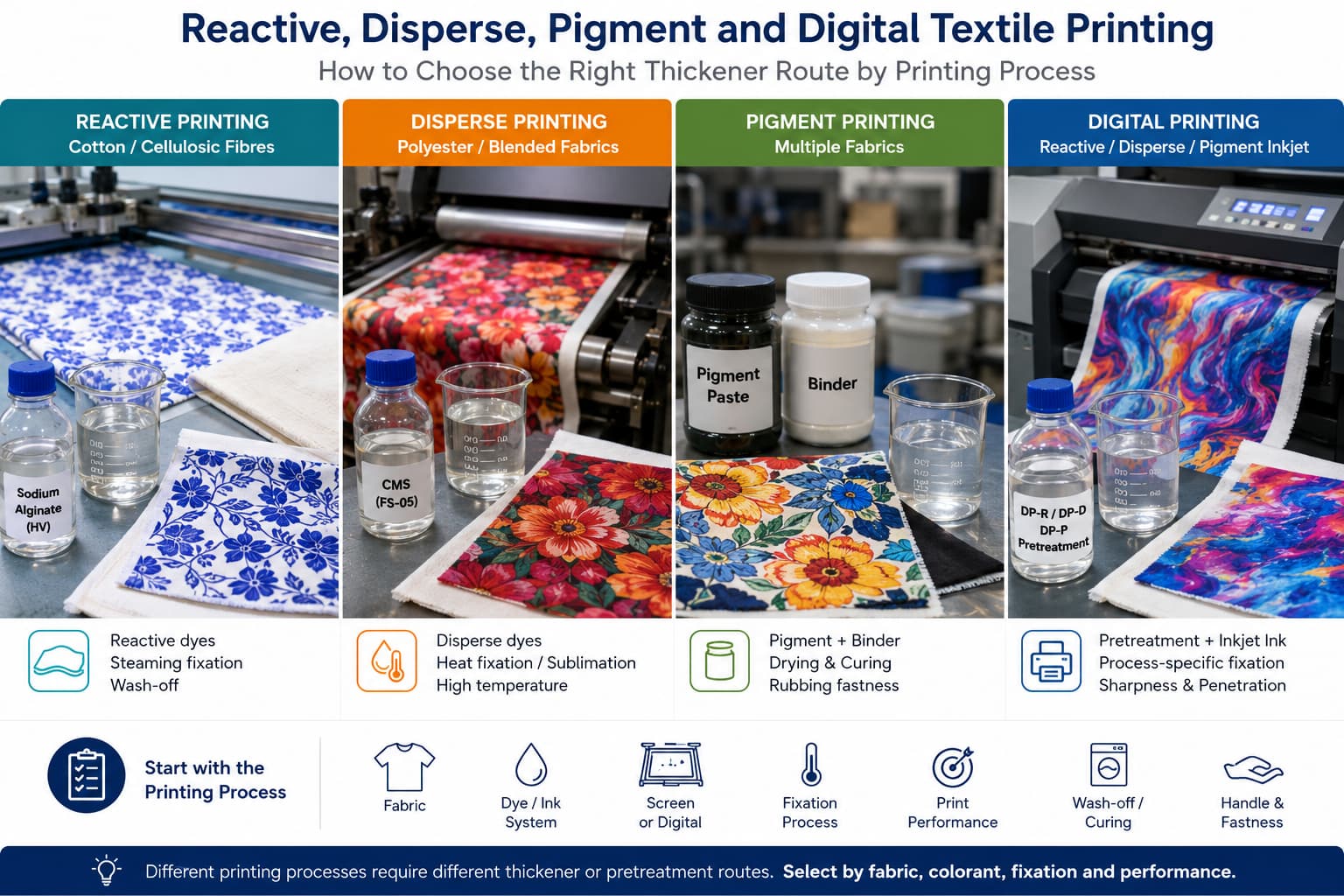
Kumaş, boya veya mürekkep, sabitleme, yıkama ve baskı kalitesi gereksinimlerine göre reaktif, dispers, pigment ve dijital tekstil baskısı için kıvam arttırıcı ve ön işlem yöntemlerini nasıl seçeceğinizi öğrenin.
CMC bazlı baskı macunu, pigmentli, reaktif ve dijital tekstil baskı alanlarında kullanılmaktadır. Bu kılavuzda, hangi parametrelerin önemli olduğu, tedarikçilerin nasıl karşılaştırılacağı ve toplu sipariş vermeden önce nelerin talep edilmesi gerektiği açıklanmaktadır.
Hem sodyum aljinat hem de CMC, tekstil baskısında kıvam arttırıcı olarak kullanılır; ancak bunlar farklı boyama sistemlerine ve işlem koşullarına uygundur. Bu kılavuzda, aralarındaki temel farklar ve her birinin ne zaman kullanılması gerektiği açıklanmaktadır.
Uygun tekstil baskı kıvamlaştırıcısının seçimi, sadece kumaş türüne bağlı değildir. Alıcılar, kıvamlaştırıcıyı boya veya pigment sistemine, baskı yöntemine, hedeflenen reolojiye, yıkama dayanıklılığı gereksinimlerine ve fiili fabrika deneme koşullarına uygun olarak seçmelidir.
Tekstil baskı performansı, tek bir evrensel katkı maddesine değil, uyumlu bir kimyasal sisteme bağlıdır. Bu kılavuzda, on önemli kimyasal grup, işlevleri, hangi aşamalarda kullanıldıkları ve alıcıların üretim denemelerinden önce neleri doğrulamaları gerektiği açıklanmaktadır.
Tekstil baskı kıvam arttırıcıları, kimyasal yapı, reoloji, boya uyumluluğu ve yıkama sırasında kaybolma davranışları bakımından farklılık gösterir. Bu kılavuzda, başlıca kıvam arttırıcı grupları, bunların genel kullanım talimatları ve alıcıların üretim denemelerinden önce doğrulamaları gereken parametreler karşılaştırılmaktadır.
Dijital baskı pastaları, mürekkep kimyası, kumaş, uygulama yöntemi ve son işlem dikkate alınarak seçilmelidir. Bu kılavuz, tekstil mürekkep püskürtmeli baskı için sodyum aljinat, CMC, CMS, sentetik polimer ve bileşik ön işlem yöntemlerini karşılaştırmaktadır.
FSX Chemical offers separate digital printing paste routes for reactive, disperse and pigment systems, supported by application review, sample matching and technical documentation. This guide explains how buyers can evaluate the right route before bulk purchasing.
Kararlı bir dijital baskı macununun elde edilmesi için hedef viskoziteden daha fazlası gerekir. Bu kılavuzda, ürün seçimi, su kalitesi, katkı maddelerinin ekleme sırası, karıştırma, pH, sıcaklık, filtreleme, hijyen, depolama ve kalite kayıtlarının ön işlem ve üretim tutarlılığını nasıl etkilediği açıklanmaktadır.
This product review examines FSX Digital Printing Paste as a textile inkjet pretreatment and thickening route, focusing on ink-system matching, rheology, filtration, print definition, stability and real production testing.
Digital textile printing requires more than advanced ink and printheads. Explore process-specific chemical solutions for reactive, disperse and pigment inkjet printing, from pretreatment and rheology to filtration, fixation and production validation.
Textile printing chemistry is evolving beyond simple viscosity and price comparisons. Explore five innovation directions shaping 2026, including safer chemical inputs, hybrid biopolymer thickeners, advanced pigment binders, shorter digital processes and multifunctional formulations.
Ürün adını, kullanım alanını, miktarı, teslimat yerini ve elinizde bulunan TDS,
örnek fotoğraf veya belgeleri bizimle paylaşın. FSX Chemical bu
bilgileri inceleyerek fiyat teklifi, numune eşleştirme
veya ürün seçimi için atılması gereken bir sonraki adımı önerecektir.
Ürün BilgileriÜrün adı, sınıfı, modeli, etiket fotoğrafı veya tedarikçi referansı.
Mevcut BelgelerTDS, SDS, COA, numune fotoğrafı, ürün listesi veya test verileri.
Sipariş DetaylarıTahmini miktar, ambalaj, varış ülkesi, liman veya ticaret şartı.
Başvuru veya SorunTekstil baskı süreci, formülasyon gereksinimi, mevcut sorun veya hedeflenen performans.