How Water Hardness Affects CMC Hydration and Viscosity in Textile Printing
Water hardness can change how CMC hydrates, expands and builds viscosity. Calcium and magnesium can...
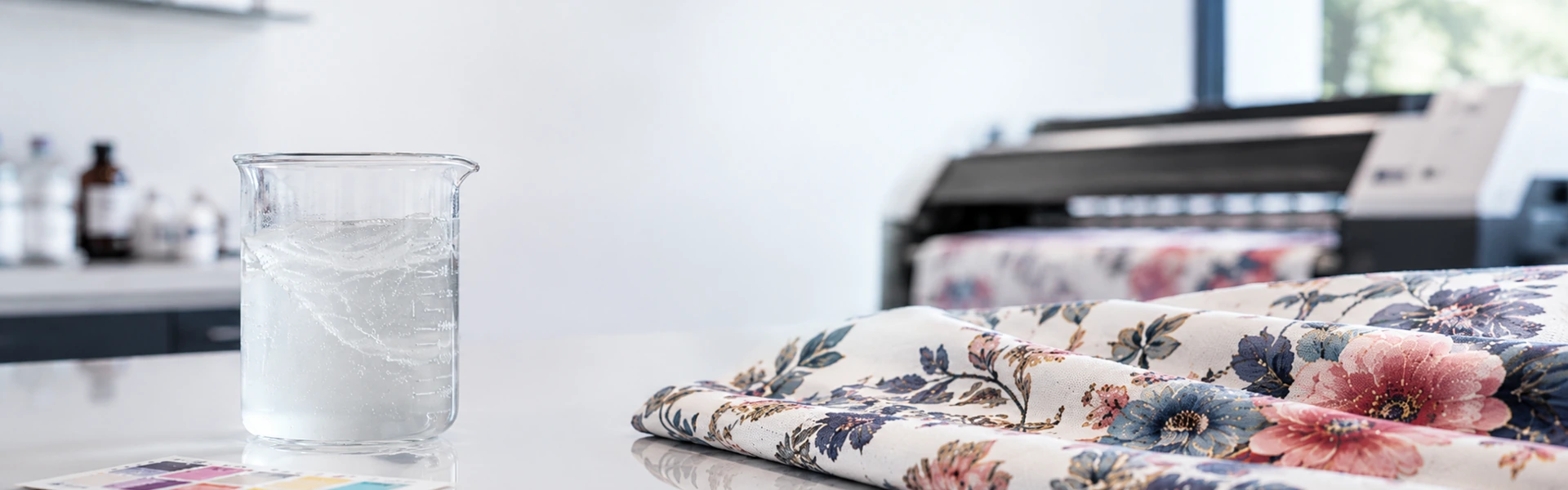
Water hardness is a hidden formulation variable in textile printing because sodium carboxymethyl cellulose (CMC) is an anionic polyelectrolyte whose hydration, chain conformation and rheology respond to dissolved ions. Calcium and magnesium can change CMC behavior differently from sodium salts, and the result is not always a simple viscosity decrease. The response depends on ion concentration, CMC degree of substitution, molecular weight, substitution distribution, polymer concentration, pH and the complete printing formula. This guide explains how textile mills should compare plant water with a controlled reference water before blaming a CMC batch for slow hydration, viscosity drift, gel particles or unstable printing paste.
What Is Water Hardness in CMC Preparation?
Water hardness mainly describes the concentration of dissolved multivalent metal ions, especially calcium and magnesium.
In textile plants, water can vary because of:
Municipal supply changes
Groundwater
Well water
Seasonal variation
Water-treatment performance
Blending of different water sources
For CMC preparation, the important question is not only whether the water is classified as “soft” or “hard.”
The mill should know:
Total hardness
Calcium level
Magnesium level
Conductivity
pH
Other dissolved salts where relevant
Two water samples with similar total hardness can still affect CMC differently if their ionic composition differs.
Why CMC Responds to Dissolved Ions
Sodium CMC contains negatively charged carboxymethyl groups under typical aqueous conditions.
These charges repel each other and influence polymer-chain expansion in water.
That electrostatic behavior contributes to:
Гідратація
Chain conformation
Solution viscosity
Реологія
When ions are added, they interact with the charged polymer environment.
Monovalent salts such as sodium chloride can screen electrostatic repulsion and change chain dimensions.
Divalent ions such as Ca²⁺ and Mg²⁺ can create stronger ionic interactions and, under some conditions, promote interchain association or bridging.
Lopez and Richtering’s CMC counterion study compared structure and flow across ion types and polymer concentrations. It supports testing the specific water–grade system rather than assuming one salt-response rule; its model CMC salts are not a universal factory-water hardness limit.
Why Calcium and Magnesium Behave Differently from Sodium Salts
Calcium and magnesium carry two positive charges, while sodium carries one.
This difference changes how they interact with anionic CMC chains.
Research on CMC has shown that divalent ions can change:
Effective polymer charge
Chain interactions
Aggregation
Viscoelastic response
Calcium and magnesium are also not necessarily identical to each other.
A 2026 scattering and conductivity study also examined monovalent and divalent CMC counterions. Its model systems help explain why one hardness number does not describe every water–CMC combination; they do not establish a textile mill’s allowable calcium or magnesium concentration.
Therefore, the practical question for a textile mill should be:
“How does our actual plant water affect this specific CMC grade?”
не:
“Is the hardness number below one universal limit?”
How Hard Water Can Affect CMC Hydration
Hydration begins when water penetrates the powder and the polymer chains separate into the aqueous phase.
If ionic strength is already high during this stage, the polymer can hydrate differently from the same CMC in deionized or softened water.
Possible observations include:
Slower viscosity development
More difficult dispersion
Persistent fish-eyes
Частинки гелю
Different final solution clarity
To check preparation response, compare the same CMC lot in plant and reference water over a documented time course. Record wetting, dispersion, residue and viscosity development under matched measurement conditions rather than assuming that saline water necessarily delays dissolution.
This means a “low viscosity” result may sometimes be a preparation problem rather than a true loss of polymer thickening capacity.
Always check whether both samples have reached complete and comparable hydration before interpreting the viscosity.
How Water Hardness Can Change CMC Viscosity
Water hardness can change measured CMC viscosity through several mechanisms.
Divalent ions can interact more strongly with carboxylate groups than monovalent ions.
Interchain Interaction
Under some conditions, multivalent ions can increase association between CMC chains.
Incomplete Hydration
Hard or saline water can slow dissolution, so a sample measured too early may appear to have lower viscosity.
The final response therefore depends on:
Hardness level
Ca²⁺ / Mg²⁺ ratio
CMC DS
Молекулярна маса
Polymer concentration
pH
Температура
Measurement method
Why Hard Water Does Not Always Mean Lower Viscosity
A common oversimplification is:
“Hard water always reduces CMC viscosity.”
This is not technically reliable.
Some systems do show viscosity reduction as ionic strength increases.
Other systems can show increased apparent viscosity or stronger association at selected concentrations of divalent ions.
Published studies have reported both viscosity loss and viscosity increase depending on CMC structure, concentration and ion conditions.
This is why the article’s practical rule is:
Hard water changes CMC viscosity; the direction and magnitude must be measured for the actual grade and formula.
For factory troubleshooting, this statement is much more useful than assuming one universal trend.
How Degree of Substitution Changes Hard-Water Tolerance
Degree of substitution (DS) is the average number of carboxymethyl substituents per anhydroglucose unit. It is an average structural measure, not a complete description of their distribution along the chains.
DS affects:
Water compatibility
Charge density
Salt tolerance
Acid response
Solution behavior
DS and substitution distribution are relevant comparison variables. Consider them with molecular weight, the actual ions and their concentrations rather than using one DS value as a stand-alone acceptance score.
Higher-substitution routes are commonly evaluated when buyers require stronger electrolyte tolerance, but:
Higher DS does not mean complete immunity to hard water.
The effect still depends on ion concentration, molecular weight and substitution distribution.
Request the current grade-specific FSX TDS and compare documented DS, viscosity method, preparation and complete-formula performance. A grade label or DS value alone is not approval for the plant-water system.
How Molecular Weight and Concentration Change the Response
Molecular weight influences the baseline viscosity-building ability of CMC.
Polymer concentration also determines whether the solution behaves in a dilute, semidilute or more strongly entangled regime.
As concentration increases, chain overlap and interaction become more important.
Therefore, the same hardness level can affect:
0.5% CMC solution
1.0% CMC solution
2.0% CMC solution
differently.
Never compare water-hardness tolerance using different CMC concentrations without clearly accounting for the difference.
Why Substitution Uniformity Matters
Average DS does not fully describe how carboxymethyl groups are distributed along the polymer chain.
Research on multivalent-ion salt tolerance has shown that CMC products with similar overall DS can have different tolerance when substitution distribution differs.
This means two grades labeled with the same DS can still respond differently to hard water.
The Nouryon CMC Book explains why substitution distribution can affect solution behaviour. Routine QC observations can screen preparation consistency and application response, but the following are not selective measurements of substitution uniformity:
Розчинення
Solution clarity
Salt-addition response
Filtration residue
Batch repeatability
Haze, slow dissolution or residue can also reflect water, dispersion, contamination, concentration or sample history. If substitution-distribution evidence is required, request an appropriate documented structural method or validated supplier characterization; these practical QC observations do not identify that structure by themselves.
What Hard Water Changes in Textile Printing Paste
The water used for CMC preparation becomes part of the printing paste.
If hardness changes CMC hydration or rheology, it can indirectly change:
Paste body
Flow
Вихід фільму на екрани
Проникнення
Визначення терміна «друк»
Color uniformity
Стабільність утримання
Hard water can also interact with:
Dyes
Pigment binders
Dispersants
Alkali
Other anionic polymers
Therefore, the complete printing paste should be checked after the water comparison.
A CMC grade that looks acceptable in a pure-water beaker can still behave differently in a full production formula.
Reactive Printing: Why Hardness Can Be Especially Important
Reactive printing formulas can contain several ionic components.
These may include:
Reactive dyes
Alkali
Salts
Anti-reducing components
Other auxiliaries
Hard water adds another ionic variable to this system.
For CMC-based or CMC-containing reactive formulations, evaluate:
Initial hydration
Viscosity after complete formula preparation
Стабільність утримання
Колірна віддача
Background staining
Змивається
CMC should not be treated as a universal one-to-one sodium alginate replacement simply because it maintains viscosity in hard water.
The final dye-thickener interaction and printing result still require validation.
Pigment, Disperse and Compound Systems
Пігментний друк
Hard water can influence CMC together with binder, cationic or anionic auxiliaries and crosslinking chemistry.
Check:
Сумісність з палітурками
Flocculation
Paste viscosity
Отвердіння
Стійкість до тертя
Дисперсійний друк
Check the interaction among CMC, dispersants, dye particles, salts and thermal fixation conditions.
Compound Thickeners
A blend can contain multiple polymers with different calcium and magnesium tolerance.
Hard-water performance of the final blend may therefore differ from the behavior of each polymer tested separately.
Always evaluate the complete thickener system.
Plant Water vs. Reference Water: A Controlled Screening Test
A paired water-source screen can help prioritize an investigation. It tests the overall difference between the waters; without controlled ionic composition, it does not identify hardness or an individual ion as the sole cause.
Sample A
Prepare the CMC using the actual plant water.
Sample B
Prepare the same CMC using softened, deionized or another controlled reference water.
Keep everything else identical:
CMC batch
CMC concentration
Powder addition rate
Mixer speed
Час змішування
Час гідратації
Температура
Viscosity method
Потім порівняйте:
Dissolution time
Fish-eyes
Solution clarity
В’язкість
Filtration residue
A repeatable difference warrants investigation of the water sources before rejecting the CMC lot, but does not isolate calcium, magnesium or hardness alone. Use the fixed schedule as an initial preparation-response screen, record viscosity development and residue over time, then confirm an appropriate hydration endpoint in each water before comparing developed viscosity.
Separate CMC Hydration Rate from Final Viscosity
A low reading shortly after mixing can reflect incomplete hydration, while a persistent difference after a defined preparation may reflect the water–grade combination. Do not assign both observations to the same mechanism.
Run a paired time-course comparison
Use the same CMC lot, concentration basis, powder-addition procedure, vessel and mixing geometry in reference water and current plant water. Record temperature, pH, hardness with its unit basis, calcium and magnesium where measured, and conductivity. Match sampling times from the end of powder addition. Use independent preparations to assess repeatability; several readings from one cup do not establish batch-to-batch reproducibility.
Result pattern
Next check
What not to conclude yet
Plant-water viscosity develops more slowly, then approaches the reference
Check wetting, agglomerates and whether the production hydration time is sufficient
That the grade has permanently lost thickening performance
A difference remains after the defined hydration endpoint
Repeat matched preparation and inspect physical stability
That calcium alone is responsible
Viscosity appears acceptable but residue remains
Inspect soft lumps and persistent particles using a documented screening procedure
That one viscosity value proves complete dissolution
Define the measurement and the endpoint
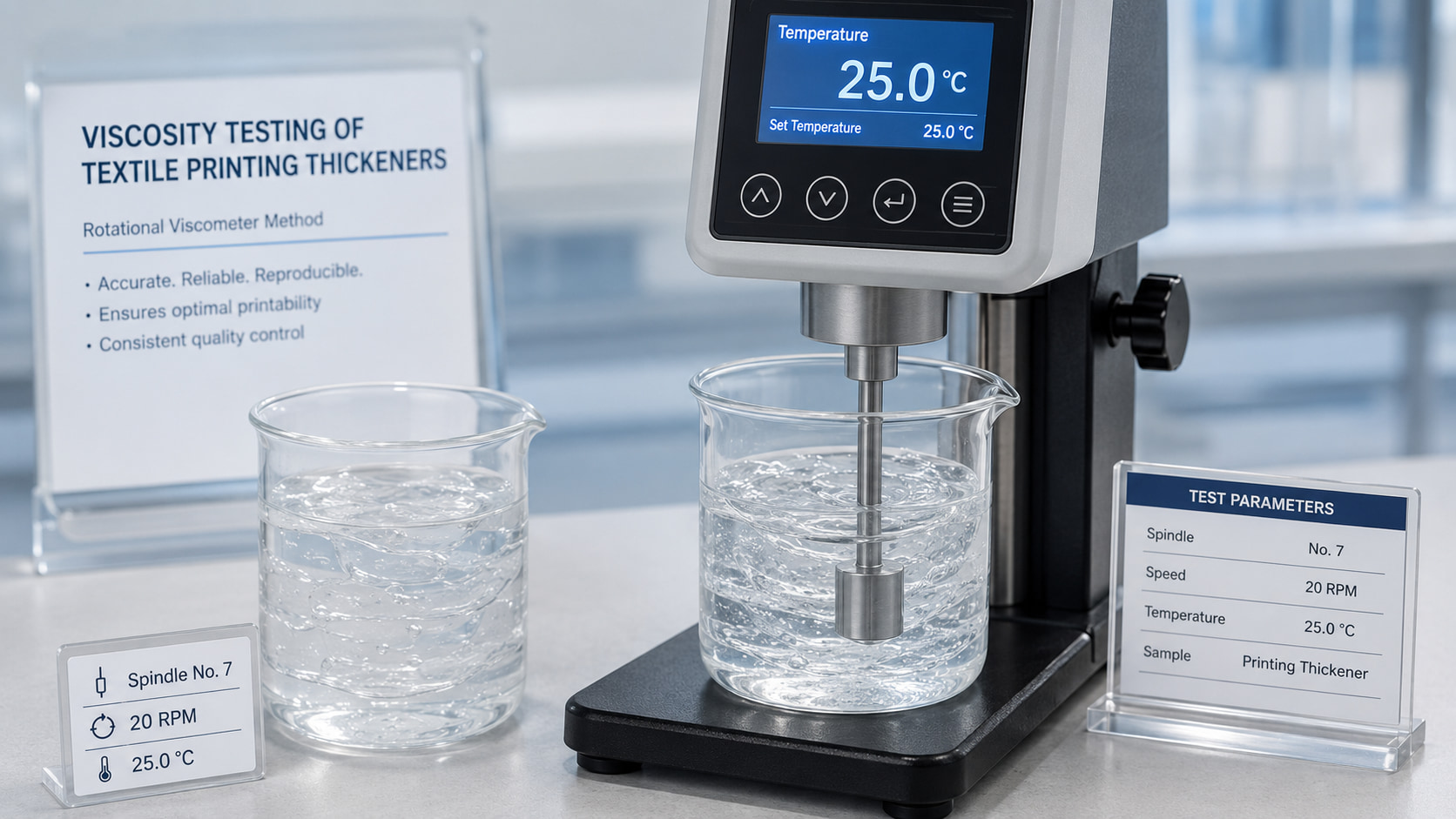
Record instrument, geometry or spindle, speed, temperature, reading time, sample history and a valid measurement range. Where repeated handling changes the sample, use matched aliquots and record their treatment. Establish an appropriate hydration endpoint for the grade and plant procedure from stable observations and application results; do not impose a universal hydration time.
The public scope of ASTM D1439 includes CMC viscosity and composition-related tests. It does not supply a universal textile water-hardness acceptance limit. A declared degree of substitution is also not sufficient evidence that two grades will behave identically in hard water.
If controlled hardness levels are needed, document the added salts, concentration basis and water balance. Plant water and deionized water differ in more than hardness, so their comparison alone cannot isolate an individual ion. Finally repeat the relevant comparison in the complete printing recipe and judge printing performance before approving a water window.
Does Mixing Order Matter?
Mixing order can matter, especially when CMC is exposed to a high ionic environment before full hydration.
A practical default development sequence is:
Water → Controlled CMC Addition → Full Hydration → Other Formula Components
rather than introducing CMC directly into a highly saline or highly concentrated auxiliary solution.
Nouryon’s preparation guidance identifies electrolyte addition order as a factor in solution behaviour. Treat initial low-salt hydration followed by electrolyte addition as one development comparison, and compare it with the intended production sequence using time-course and complete-formula checks.
However, the magnitude of this effect depends on the grade and process.
Therefore, compare the exact production addition sequence during qualification.
Hard Water, Gel Particles and Filtration Residue
Water-related CMC instability can appear as:
Soft gel particles
Flocculation
Haze
Fine mineral residue
Rapid filter loading
But not every filter residue is caused by hardness.
Also check:
Incomplete hydration
Tank contamination
Powder lumps
Other formulation incompatibility
A useful diagnostic is to compare residue from plant-water and reference-water preparations.
More residue in repeatable plant-water preparations makes water-related differences worth investigating. Check dissolved composition, suspended matter and preparation response; the observation alone does not identify hardness, calcium or a particular CMC structure as the cause.
Production QC for Water and CMC
Once the acceptable water window is established, production control can include:
Daily or shift water hardness check where variation is significant
Conductivity
pH
Water-treatment status
CMC batch number
Standard solution viscosity
Час гідратації
Complete paste viscosity
If water source changes seasonally, retain the water-quality record together with the printing-paste batch data.
This improves root-cause analysis when viscosity or printing performance changes later.
Troubleshooting Water-Related CMC Problems
Виявлена проблема
First Checks
Не робіть припущень
CMC hydrates slowly
Hardness, ionic strength, mixing, water temperature
The CMC batch is defective
Viscosity lower than normal
Water source, hardness, hydration time, test method
Water hardness, pH, conductivity, preparation method
The product grade changed
What Information Should You Send to a CMC Supplier?
If you suspect water hardness is affecting CMC, send:
Current CMC product or TDS
Ступінь заміщення
Viscosity and full test method
CMC concentration
Plant water source
Total hardness
Calcium and magnesium data where available
Conductivity
Water pH
Mixing sequence
Час гідратації
Complete printing formula
Current filtration residue or gel observations
Printing route and fabric
Current viscosity or printing problem
Компанія FSX Chemical може використовувати цю інформацію за допомогою Зразки та підбір to select current documented CMC grades for matched water and complete-formulation trials. Confirm the supplied grade code and test method in the current TDS before sampling or purchase.
How Should a Textile Mill Control Hard-Water Effects on CMC?
Практичний алгоритм дій такий:
Measure Water → Compare with Reference Water → Standardize CMC Hydration → Check Complete Formula → Print → Record Batch and Water Data
Основними принципами є:
Water hardness is part of the formulation, not just a utility parameter.
Ca²⁺ and Mg²⁺ can affect CMC differently from monovalent sodium salts.
Hard water does not always produce the same direction of viscosity change.
Hydration must be complete before viscosity is compared.
DS, molecular weight and substitution distribution influence hard-water response.
Use plant-water vs. reference-water testing before rejecting a CMC batch.
Поширені запитання
1. Does hard water affect CMC viscosity?
Yes. Calcium, magnesium and overall ionic strength can change CMC chain interactions and measured viscosity. The direction and magnitude depend on the specific CMC and formulation.
2. Does hard water always reduce CMC viscosity?
No. Some conditions reduce viscosity, while selected divalent-ion conditions can increase apparent viscosity or association. Test the actual grade and water.
3. Why does CMC dissolve more slowly in hard water?
Higher ionic strength can change chain hydration and slow dissolution. Incomplete hydration can then appear as lower viscosity or gel particles.
4. Is calcium more harmful than magnesium to CMC?
Not universally. Calcium and magnesium can interact differently with CMC, and the practical result depends on concentration, DS, polymer structure and formulation.
5. Does higher-DS CMC tolerate hard water better?
Higher-DS routes are commonly evaluated for improved electrolyte tolerance, but higher DS does not make CMC immune to calcium or magnesium.
6. Can I test CMC only with deionized water?
DI water is useful as a reference, but production qualification should also include the plant’s actual process water.
7. What is the fastest way to check whether water causes a viscosity problem?
Use the same CMC lot and declared concentration basis in plant and controlled reference water, then compare repeatable hydration time courses, viscosity and residue. A difference screens the overall water-source effect; isolate relevant ions and confirm the complete printing formula before assigning a specific cause.
8. Can hard water create CMC filtration residue?
It can contribute to aggregation or mineral-related residue in some systems, but incomplete hydration and contamination should also be checked.
9. Should CMC be hydrated before salt or alkali is added?
In many formulations this is a useful starting approach because CMC can hydrate more slowly in a high-salt environment, but the exact production sequence should be validated.
10. Can two factories get different viscosity from the same CMC?
Yes. Water hardness, pH, conductivity, preparation method, temperature and viscosity test conditions can all create different results.
11. Should water hardness be listed in CMC QC?
If water varies enough to affect performance, define the relevant hardness, pH and conductivity checks and retain them with batch records. Conductivity is a complementary ionic measurement, not a selective calcium/magnesium assay or substitute for a required hardness test.
12. What should I send FSX Chemical for hard-water CMC matching?
Send the current CMC TDS, DS, viscosity method, plant-water hardness, Ca/Mg data if available, mixing method, full formula and current hydration or viscosity problem.
Match CMC to Your Plant Water with FSX Chemical
If the same CMC behaves differently between your laboratory and production line, or between two factories, water hardness may be part of the cause.
For textile printing, water is part of the CMC formulation. The most reliable grade is not simply the one with the highest viscosity in deionized water, but the one that hydrates and maintains useful rheology in the actual plant-water and printing-paste system.
Дізнайтеся, чому показники в’язкості загущувачів для текстильного друку не можна порівнювати без урахування таких параметрів, як концентрація, температура, прилад, шпиндель, швидкість, метод підготовки та тривалість випробування.
Порівняйте CMC, CMS, альгінат натрію та пасту для цифрового друку на текстилі. Дізнайтеся, як кожен із цих матеріалів підходить для реактивних, дисперсних, пігментних та цифрових технологій друку, а також на що покупцям слід звернути увагу перед тестуванням зразків, підбором сорту та оптовою закупівлею.
Choose CMC for textile printing by application, DS, viscosity method and formulation trials. Use a practical checklist to compare grades before bulk purchase.
Карбоксиметилцелюлоза використовується як загущувач і стабілізатор у водорозчинних чорнилах, глибокому друці та підготуванні до струменевого друку. Цей посібник містить інформацію про основні параметри сортів та рекомендації щодо вибору постачальників для відділів закупівель.
Вибір відповідного постачальника CMC — це не лише порівняння цін. У цьому посібнику викладено критерії оцінки, перелік необхідної документації та процедуру тестування, яких повинні дотримуватися відділи закупівель перед тим, як укласти договір на оптове замовлення.
І альгінат натрію, і КМК використовуються як загусники в текстильному друку, але вони підходять для різних систем фарбування та умов виробництва. У цьому посібнику пояснюються основні відмінності та випадки, коли слід застосовувати кожну з цих речовин.
Food-grade and industrial-grade CMC labels do not define one universal DS, viscosity or purity comparison. Textile buyers should verify grade-specific assay and methods, then test the complete formulation; food-contact or pharmaceutical use needs separate, applicable documentation.
Match an FSX CMS printing thickener by exact grade, product form, preparation method and printing route. Compare complete-paste stability, filtration and finished-print results before approving sample-to-bulk supply.
Сировина на основі целюлози використовується у текстильному друці, для приготування друкарських паст, як загущувач та допоміжний компонент у рецептурах. У цьому посібнику пояснюється, як покупці можуть оцінювати CMC, CMS, альгінат натрію, загущувачі для текстильного друку та друкарські пасти на основі технічних характеристик, документації, випробувань зразків та підтримки з боку постачальників.
Похідні целюлози широко застосовуються у текстильному друці, для приготування друкарських паст, як загущувачі та допоміжні речовини у рецептурах. У цьому посібнику пояснюється, як закордонні покупці можуть закуповувати CMC, CMS, альгінат натрію, загущувачі для текстильного друку та друкарські пасти у компанії FSX Chemical із наданням технічних специфікацій (TDS), сертифікатів аналізу (COA), тестування зразків, підбору сортів та супроводу експортної документації.
Вибір хімічних речовин для текстильної промисловості вимагає не лише порівняння назв продуктів. У цьому посібнику пояснюється, як покупці засобів для текстильного друку можуть підібрати CMC, CMS, альгінат натрію, загусники для текстильного друку та пасти для друку, орієнтуючись на сферу застосування, технічні характеристики, технічні специфікації (TDS), сертифікати аналізу (COA), результати випробувань зразків та стабільність партії.
Chemical formulation support for textile printing should begin with clear application information. This guide explains what buyers should provide when requesting product matching, formulation adjustment, sample testing, TDS, COA, SDS, and technical support for CMC, CMS, sodium alginate, textile printing thickeners, and printing paste products.
Надайте назву продукту, сферу застосування, кількість, місце призначення, а також будь-які технічні специфікації (TDS),
зразки фотографій або документів, які у вас вже є. Компанія FSX Chemical розгляне цю
інформацію та надасть рекомендації щодо подальших кроків: підготовки комерційної пропозиції, підбору зразків
або вибору продукту.
Інформація про товарНазва товару, сорт, модель, фото етикетки або код постачальника.
Доступні документиTDS, SDS, COA, фото зразка, перелік продукції або дані випробувань.
Деталі замовленняОрієнтовна кількість, упаковка, країна призначення, порт або умови торгівлі.
Заявка чи проблемаПроцес друку на текстилі, вимоги до складу, поточні проблеми або цільові показники ефективності.