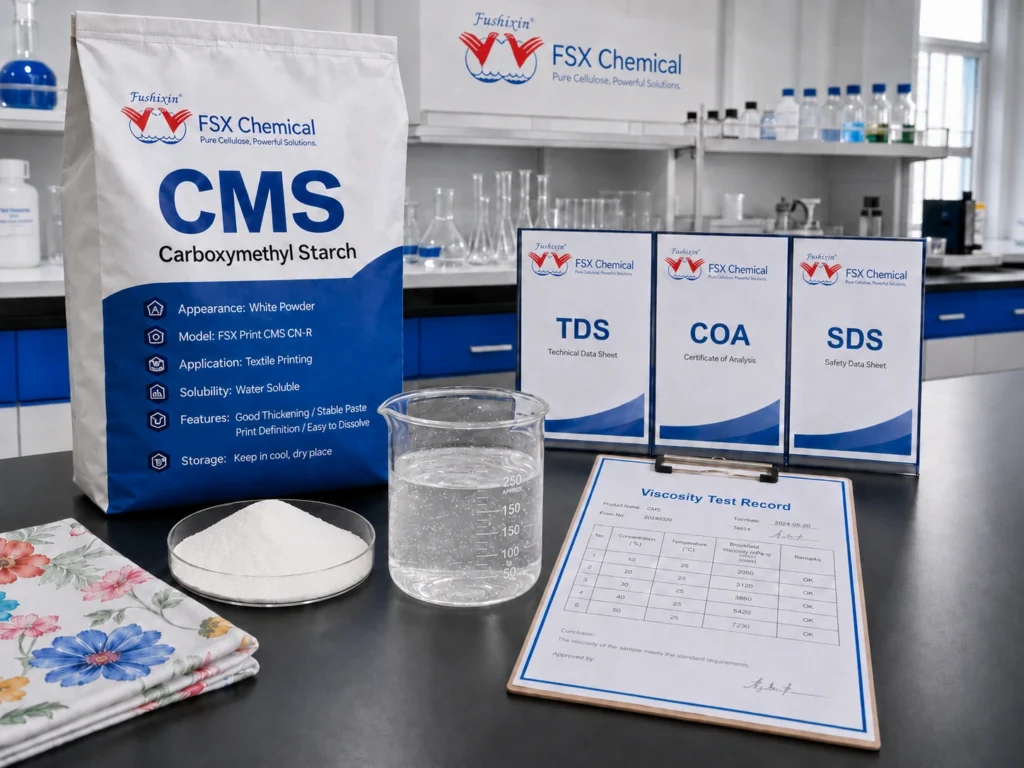
Choose carboxymethyl starch (CMS) by its declared commercial identity and the intended role: warp sizing, a screen-printing formulation or fabric-side digital pretreatment. The same abbreviation or viscosity value does not approve all three. Agree the preparation and dosage basis, then qualify yarn or finished-fabric results before a bulk order.
Generic carboxymethyl starch is a modified starch chemistry. The FSX CMS product family groups commercial textile-printing grades by application; a family name alone does not establish that every grade has the same composition, substitution level or approved use. Request the exact grade’s current TDS and SDS and connect them to the sample and quotation. The supplier-provided general CMS safety sheet identifies carboxymethyl starch but does not map every named grade or validate sizing or digital applications.
This guide explains how buyers can choose CMS more professionally by reviewing technical specifications, documents, sample testing results, batch consistency, packaging, and export requirements.
What Is Carboxymethyl Starch CMS Used For?
Textile Sizing and Formulation Support
For textile sizing, buyers should test CMS against their existing sizing material under real mill conditions before confirming bulk purchase.
Textile Printing Paste Applications
Different CMS grades may perform differently even when the product name looks similar.
Digital Printing Formulation Testing
For digital textile printing, identify the ink and fabric first, then confirm whether the candidate is intended for fabric-side pretreatment and its application method. Assess drying, storage, print definition and the route’s full fixation or curing and aftertreatment. Fabric-pretreatment approval does not permit adding an ordinary CMS grade to inkjet ink; that requires a separately approved ink formulation and printer compatibility qualification.
The buyer should confirm whether CMS affects viscosity, filtration, storage stability, fabric hand feel, drying behavior, and final printing performance under actual process conditions.
Can CMS Replace CMC?
Replacement Depends on the Application
If the buyer wants to replace CMC with CMS, the comparison should be done in the same formulation and under the same production conditions.
Cost Should Be Compared with Performance
A lower raw material price is not useful if the formulation needs major adjustment or production performance becomes unstable.
Sample Testing Is Necessary
Before replacing CMC, sodium alginate, starch, or another thickener, buyers should test CMS in their own process. The supplier can recommend a starting grade, but the final decision should be based on the buyer’s test result.
Các thông số kỹ thuật chính mà người mua nên xem xét
Cấp độ độ nhớt và phương pháp thử nghiệm
Viscosity is one of the most important parameters when choosing CMS. Buyers should review the viscosity range together with the test concentration, temperature, instrument method, and unit.
Nếu không có phương pháp kiểm tra độ nhớt rõ ràng, các giá trị từ các nhà cung cấp khác nhau có thể không thể so sánh trực tiếp với nhau.
Degree of Substitution Where Applicable
Degree of substitution can be relevant when the supplied material is a defined carboxymethyl-starch derivative and the supplier states the measurement method. Do not assign one DS to every FSX commercial CMS grade, or copy a CMC DS specification into a CMS order. Ask which identity and modification parameters are actually declared and controlled for the exact grade; a general SDS is not a DS or application-performance certificate.
The supplier should explain which parameters are included in the TDS and which are controlled internally or confirmed by COA.
Dissolution and Hydration Behavior
Dissolution behavior affects preparation efficiency and final paste quality. Poor dispersion may create lumps, unstable viscosity, filtration difficulty, or uneven application.
Buyers should test CMS under their own water quality, stirring speed, addition method, temperature, and preparation time.
pH, Moisture and Appearance
pH, moisture, and appearance are basic but important quality indicators. They affect storage, handling, quality control, and repeat purchasing.
These parameters should be reviewed in the TDS and confirmed through COA data where applicable.
Film Behavior and Fabric or Yarn Compatibility
For textile sizing or finishing-related use, film behavior and compatibility with yarn or fabric are important. Buyers should evaluate flexibility, coating uniformity, hand feel, adhesion, desizing, and downstream process compatibility.
These results cannot be confirmed only by product name or supplier claims.
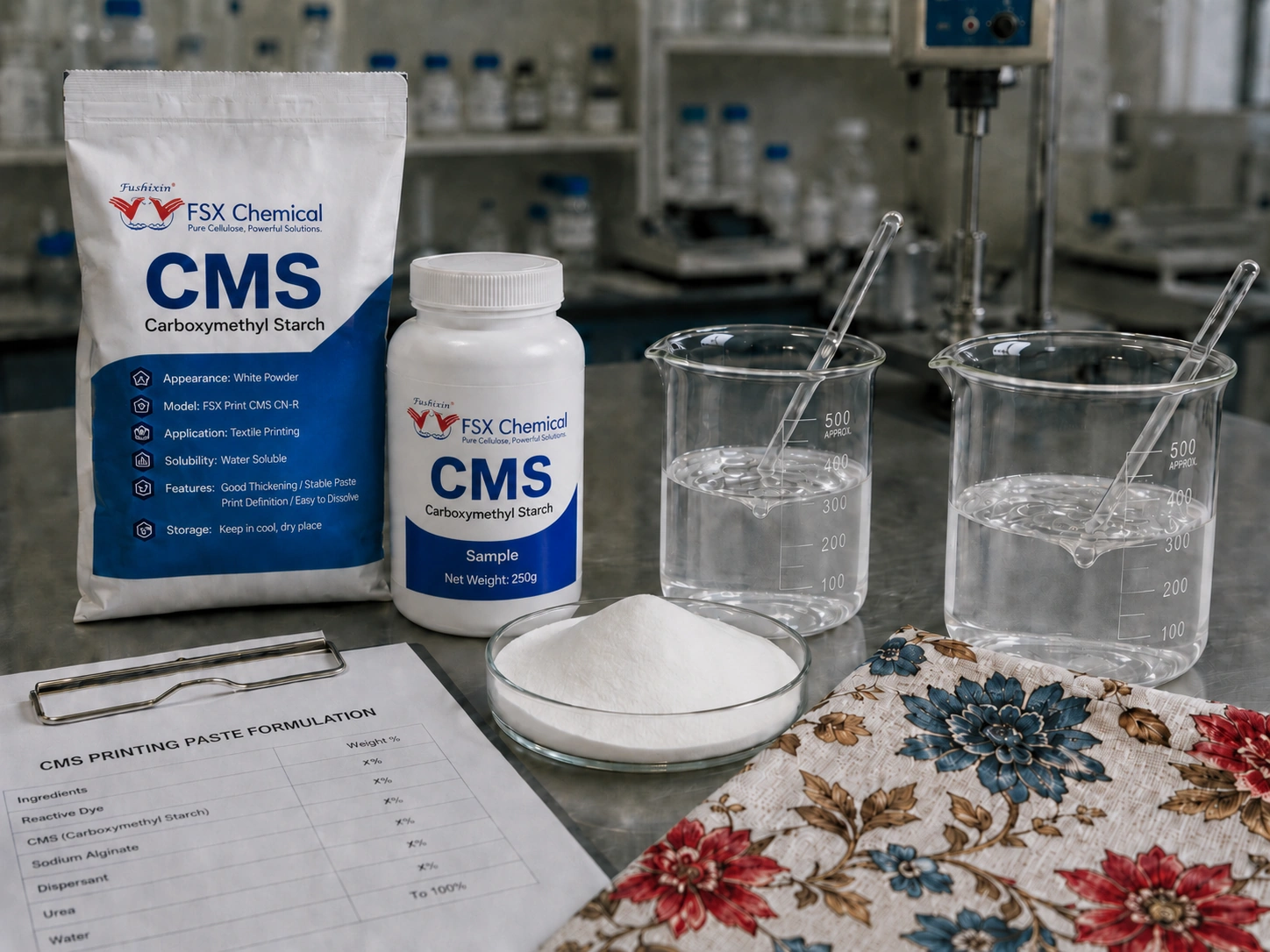
How to Test CMS Before Bulk Purchase
Test in the Actual Formulation
Sample testing should be done in the buyer’s own formulation whenever possible. Dyes, auxiliaries, water quality, pH, stirring method, paste concentration, temperature, and storage time can all affect final behavior.
Testing only in clean water may not be enough to confirm whether the CMS grade is suitable for production.
Observe Preparation and Handling
During testing, buyers should observe dissolution speed, lump formation, viscosity development, paste smoothness, filtration behavior, storage stability, and application handling.
For warp sizing, qualify the exact grade in the sizing liquor and on the actual yarn. Compare coating uniformity, flexibility, abrasion-related yarn behavior, shedding and the approved desizing result. Do not infer that a printing grade is sizing-approved, or that a CMS trade name establishes an enzyme-free removal process.
Compare with the Current Product
If the buyer is replacing CMC, starch, sodium alginate, or another product, CMS should be tested against the current material under the same conditions.
This helps the buyer judge whether CMS is technically suitable before discussing bulk supply.
Xác nhận tính nhất quán giữa mẫu và lô hàng
Before confirming a bulk order, buyers should check whether the approved sample and bulk shipment will follow the same agreed specification range, packaging format, batch traceability, and COA requirements.
Điều này giúp giảm thiểu rủi ro khi mẫu được chấp thuận nhưng hiệu suất của lô hàng sau đó lại không ổn định.

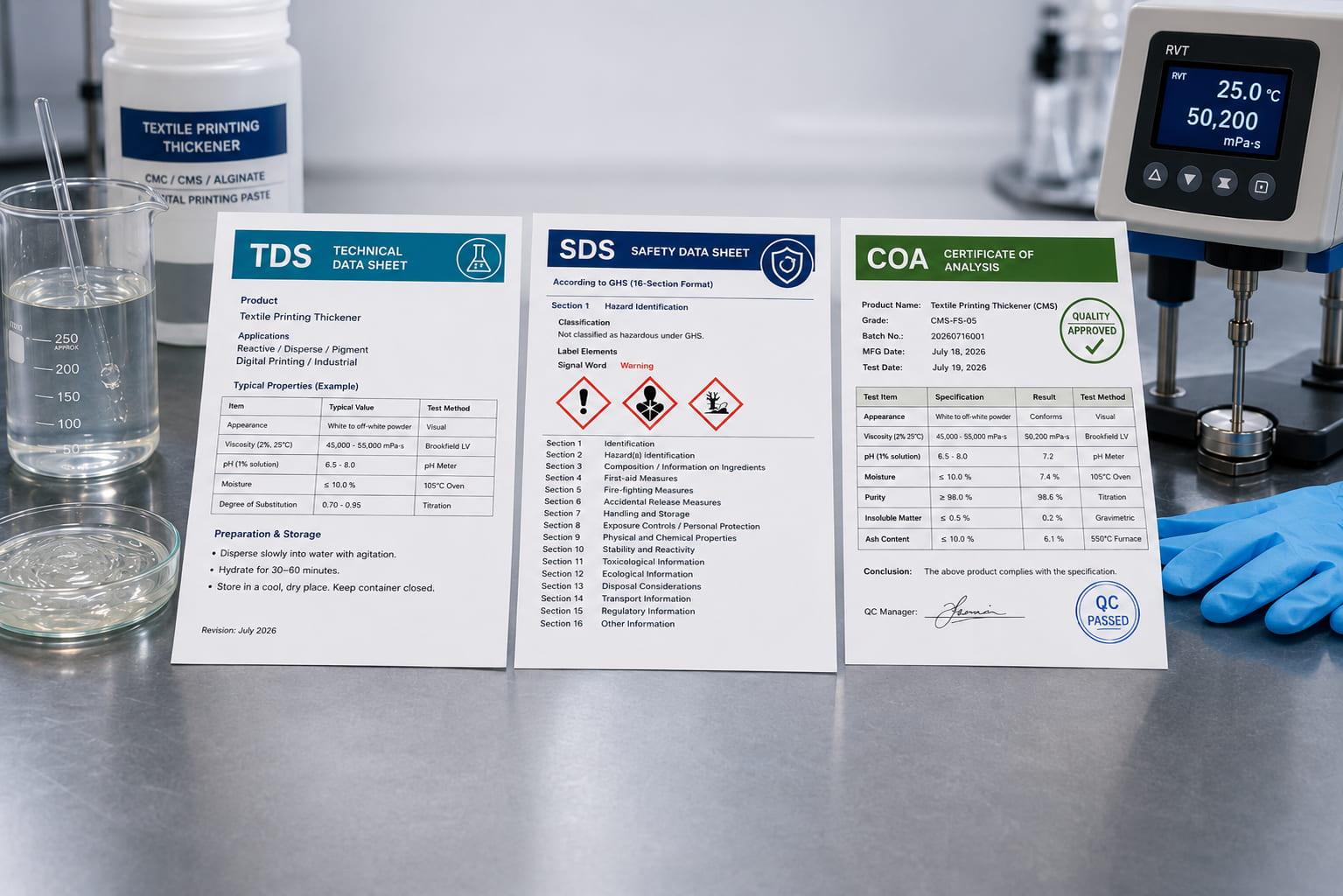
Các tài liệu mà người mua nên yêu cầu
Tài liệu kỹ thuật (TDS) để rà soát thông số kỹ thuật
The Technical Data Sheet helps buyers review the standard product specification. It should include product description, appearance, viscosity, pH, moisture, storage conditions, and testing method. Other parameters may be included depending on the CMS grade.
The TDS supports initial grade screening, but it should not replace sample testing in the buyer’s own formulation.
COA cho việc xác nhận lô hàng
Giấy chứng nhận phân tích xác nhận các dữ liệu thực tế của một lô sản xuất cụ thể. Giấy chứng nhận này rất quan trọng đối với các đơn hàng số lượng lớn, việc mua hàng định kỳ, việc cung ứng cho nhà phân phối và công tác kiểm soát chất lượng nội bộ.
Người mua có thể so sánh các hồ sơ COA giữa các lô hàng để kiểm tra xem các thông số chính có vẫn nằm trong phạm vi đã thỏa thuận hay không.
Xem xét Bảng dữ liệu an toàn hóa chất (SDS) về việc xử lý và vận chuyển
Bảng dữ liệu an toàn (SDS) hỗ trợ các hoạt động xử lý, bảo quản, vận chuyển và đánh giá an toàn nội bộ. Đối với hoạt động mua hàng quốc tế, SDS cũng có thể cần thiết cho việc vận chuyển và trao đổi thông tin liên quan đến hải quan.
Người mua cần đảm bảo rằng tên sản phẩm trên Bảng dữ liệu an toàn hóa chất (SDS) và thông tin nhà cung cấp phải khớp với các tài liệu đặt hàng.
Các tài liệu bổ sung của khách hàng hoặc liên quan đến tuân thủ
If the buyer needs restricted-substance statements, customer audit questionnaires, environmental documents, certificate copies, or third-party testing support, those requirements should be discussed before order confirmation.
Một nhà cung cấp chuyên nghiệp cần giải thích rõ ràng những tài liệu nào có thể cung cấp và những yêu cầu nào cần phải có kết quả kiểm tra hoặc chứng nhận chính thức từ bên thứ ba.
How to Choose a CMS Supplier
Check Whether the Supplier Understands the Application
A practical supplier should ask about the buyer’s application before recommending a CMS grade. Useful information includes textile sizing process, printing paste formulation, digital printing requirements, target viscosity, fabric or yarn type, and current product grade if available.
Review Specification and Batch Control
The supplier should provide a clear TDS and support batch confirmation through COA data. Buyers should confirm whether the sample grade and bulk shipment will follow the same agreed quality range.
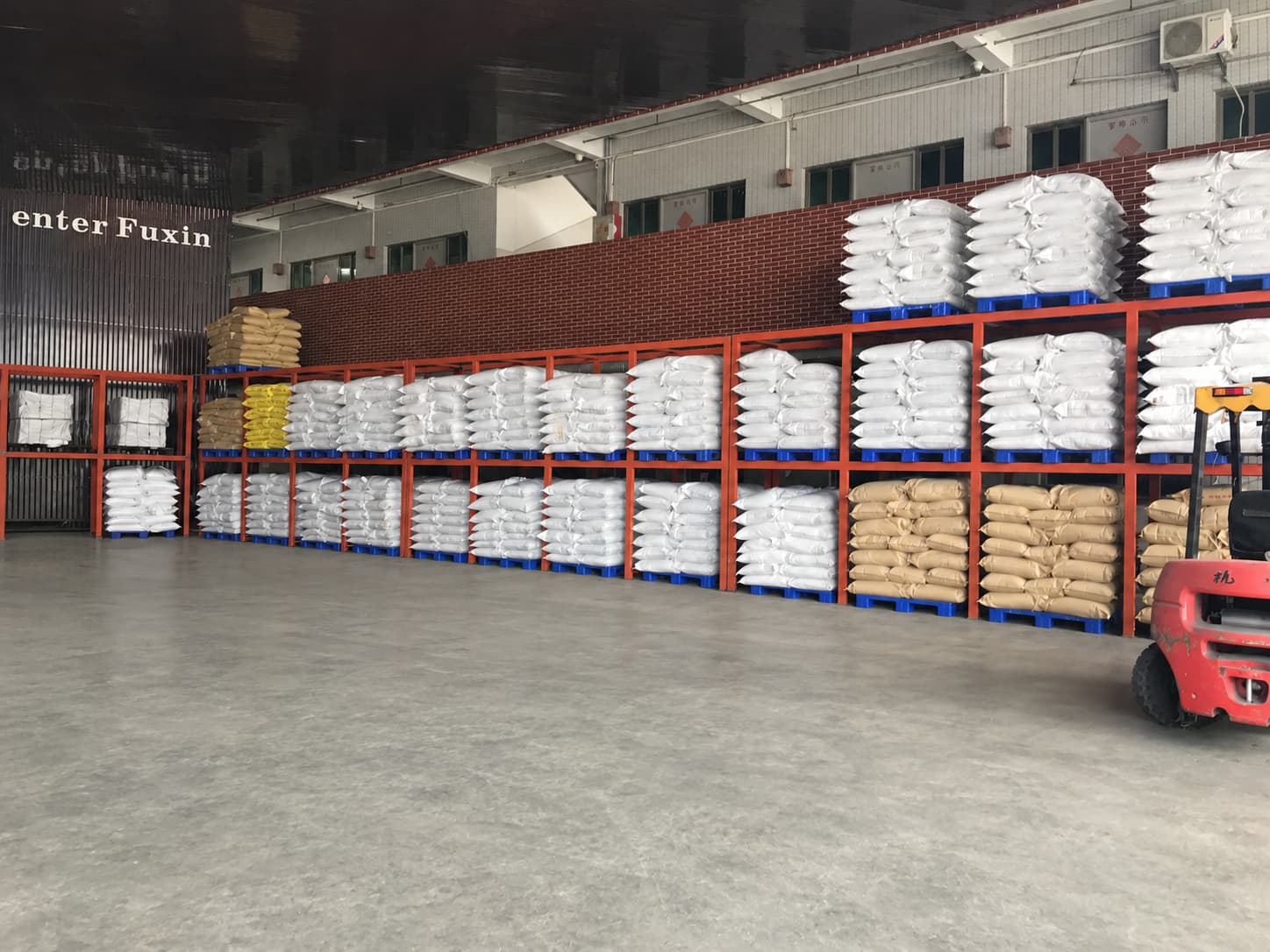
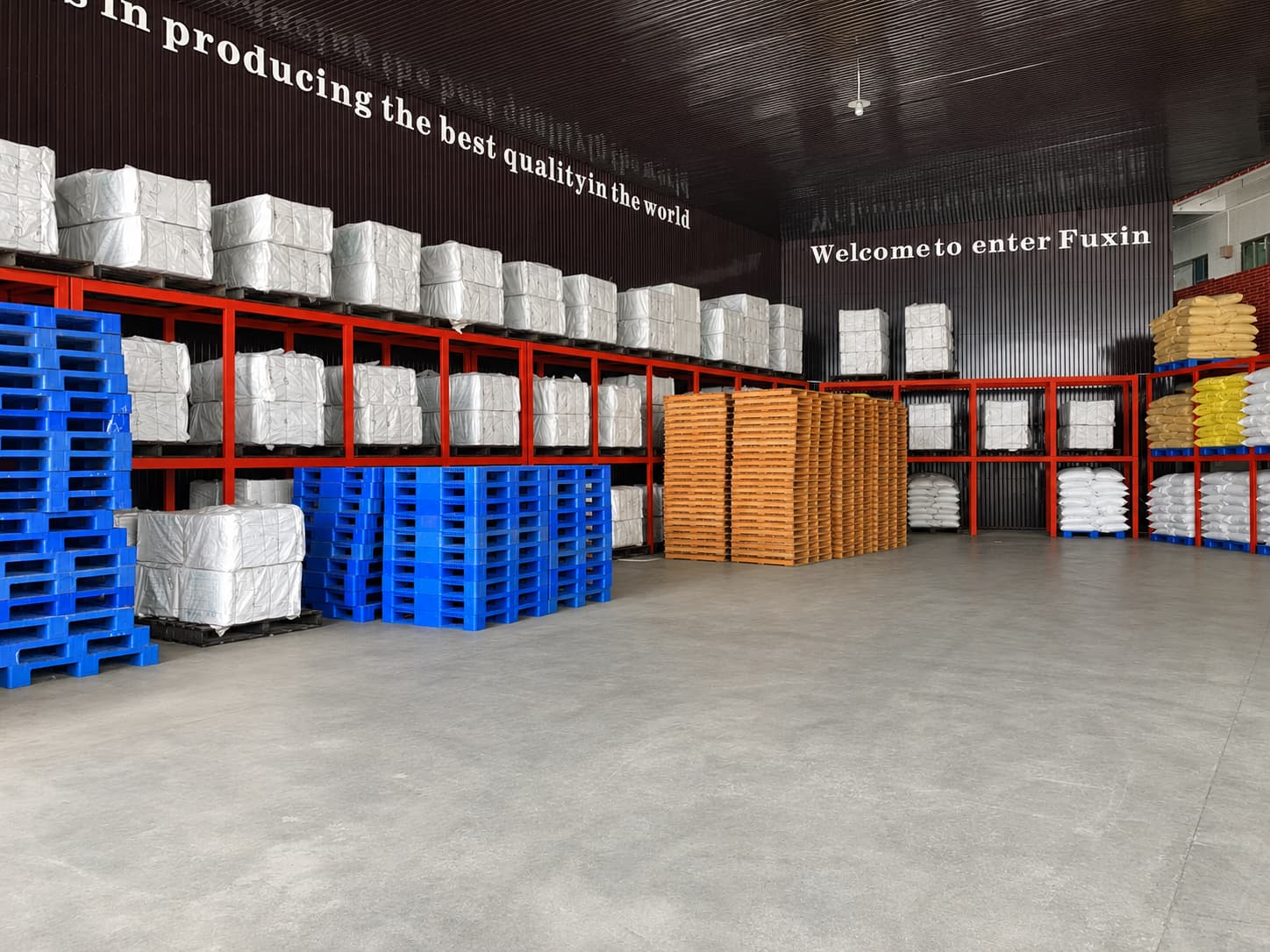
Confirm Packaging and Export Support
Packaging size, bag type, label information, batch number, storage conditions, invoice, packing list, COA, SDS, and other export-related documents should be confirmed before shipment.
Yêu cầu về hồ sơ có thể khác nhau tùy theo quốc gia nhập khẩu, loại sản phẩm và quy trình mua hàng nội bộ của người mua.
Avoid Broad Claims Without Documents
Claims such as “eco-friendly,” “compliant,” “high-performance,” “cost-saving,” or “replacement for CMC” should be supported by documents, test data, or the buyer’s own sample evaluation when they are important to the purchasing decision.
Common Mistakes When Choosing CMS
Choosing Only by Price
A lower price may not be cost-effective if the CMS grade causes unstable viscosity, poor dissolution, filtration difficulty, or formulation adjustment.
Buyers should compare price together with specifications, sample performance, COA data, packaging, and export support.
Assuming CMS Can Replace CMC Without Testing
CMS may be a possible option in some systems, but it should be tested carefully before replacing CMC or any existing product.
Ignoring the Viscosity Test Method
Two viscosity values may look similar but may be measured under different concentrations, temperatures, or instruments.
Buyers should check the test method before comparing suppliers.
Skipping Sample Approval
For textile sizing, printing paste, and digital printing formulation applications, sample testing is necessary before bulk purchase, especially when changing suppliers or changing grades.

Separate Application Approval from the Dosage Basis
Attach one application gate to the purchase specification. A water-solution viscosity result cannot release an unrelated use.
| Intended role | Before approval | Release result |
|---|---|---|
| Kích thước sợi dọc | Exact yarn, existing size system, prepared-liquor method and deposited amount. | Yarn protection through the relevant weaving trial and acceptable downstream desizing. |
| Screen-printing paste | Dye or pigment, auxiliaries, full paste preparation and actual machine. | Transfer, definition, stability and finished-fabric shade, fastness and handle. |
| Digital fabric pretreatment | Ink route, fabric, application method, dry deposit and storage before printing. | Runability and complete printed-fabric performance. This is not inkjet-ink ingredient approval. |
State powder, stock and final-formulation concentrations separately
A supplier’s stock-solution concentration is not necessarily the powder percentage in the working paste. On compatible mass bases:
Powder as supplied in the final mixture (wt%) = stock used (wt%) × powder in the stock (wt%) ÷ 100.
For a hypothetical arithmetic example, using 20 kg of a stock made with 10 wt% powder in a final 100 kg mixture introduces 2 kg of powder as supplied, or 2 wt%. This is not an FSX dosage recommendation or a sizing/printing recipe. It assumes homogeneous stock and correct final mass accounting.
Moisture, salts and other supplied components can make powder mass different from active-polymer mass. Calculate an active fraction only when it is declared for that grade and its method is defined; measured total nonvolatile solids is not automatically active CMS.
Put the exact grade, application role, concentration basis, preparation method and pass criteria on the sample request. Use sample matching for an application-specific review before comparing purchase price or proposing a replacement.
How FSX Chemical Supports CMS Buyers
We do not suggest choosing CMS only by product name, price, or broad replacement claims. The recommended CMS grade should be reviewed through technical documents and tested in the buyer’s own formulation before bulk purchase.
Các bước tiếp theo
- Share Your Application — tell us whether CMS will be used for textile sizing, printing paste, digital printing formulation, or another textile process.
- Xác định độ nhớt mục tiêu — provide your viscosity range, test concentration, temperature, instrument method, and current product grade if available.
- Yêu cầu điều chỉnh điểm — ask for a suitable CMS grade based on your actual formulation and production conditions.
- Yêu cầu bản TDS — review viscosity, pH, moisture, appearance, storage conditions, testing method, and other relevant parameters.
- Yêu cầu cấp Giấy chứng nhận xuất xứ (COA) — Xác nhận xem dữ liệu lô hàng có phù hợp với phạm vi thông số kỹ thuật đã thỏa thuận hay không trước khi xuất hàng.
- Yêu cầu cung cấp SDS — Kiểm tra quy trình xử lý, bảo quản, vận chuyển và thông tin sản phẩm.
- Yêu cầu mẫu thử — test the recommended CMS grade in your own sizing, printing, or digital printing formulation before confirming bulk orders.
- Compare with Current Materials — evaluate CMS against your existing CMC, starch, sodium alginate, or blended system under similar conditions.
- Xác nhận các tài liệu đóng gói và xuất khẩu — Kiểm tra kích thước kiện hàng, nhãn mác, khả năng truy xuất nguồn gốc lô hàng, hóa đơn, phiếu đóng gói, Giấy chứng nhận phân tích (COA), Bảng dữ liệu an toàn hóa chất (SDS) và các tài liệu bắt buộc khác trước khi giao hàng.
- Liên hệ với đội ngũ kỹ thuật của chúng tôi — discuss whether CMS is suitable for your textile sizing or digital printing đơn đăng ký📧 Email: Service@fsxchemical.com