Why Supplier Evaluation Matters for CMC Procurement
Batch Consistency and Grade Stability
When evaluating a supplier, ask specifically about their batch-to-batch viscosity tolerance and how deviations are handled. A supplier who can provide historical CoA (Certificate of Analysis) data across multiple batches gives you a much clearer picture of actual consistency than one who only provides a single datasheet.
The Cost of Switching Suppliers Mid-Production
Front-loading the evaluation process with clear specification requirements and sample trials is far less costly than discovering incompatibilities after a bulk order has arrived. This is particularly true for printing paste and sizing applications where the CMC interacts with multiple other components in the formulation.

Key Criteria for Evaluating a CMC Supplier
Product Specification Transparency
- DS (degree of substitution) range and typical value
- Viscosity specification (concentration, temperature, and measurement method)
- Purity grade, including NaCl and sodium glycolate content
- Moisture content and particle size where relevant
If a supplier cannot provide these parameters in writing before the sale, that is a meaningful signal about their technical capability and quality control process.
Documentation Availability
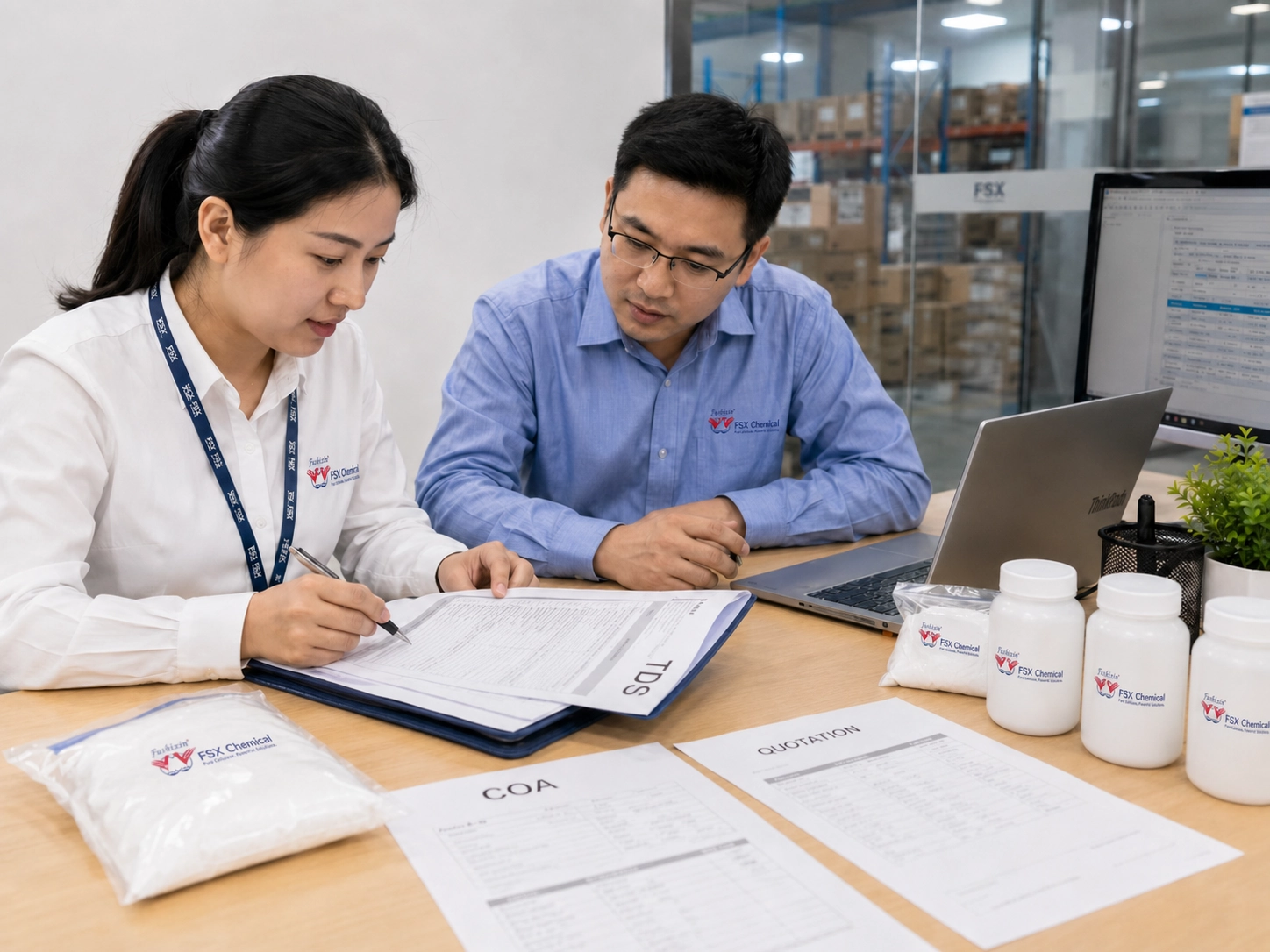
- TDS (Technical Datasheet) — product specifications and application guidance
- SDS (Safety Data Sheet) — handling, storage, and transport information
- CoA (Certificate of Analysis) — batch-specific test results that match the lot you are ordering

Technical Support Capability
For procurement teams that are switching CMC grades, formulating new paste recipes, or troubleshooting production issues, access to technical support from the supplier is a practical advantage.
Useful technical support includes: grade recommendation based on your application parameters, guidance on dissolution and preparation methods, and response to formulation compatibility questions. Evaluate whether the supplier has technical staff who can engage with your specific process requirements, rather than only a sales team.
Sample and Trial Process
A supplier who does not offer samples before bulk orders presents a procurement risk. Standard industry practice for industrial chemicals is to provide sample quantities for evaluation — typically sufficient for internal lab trials and small-scale production tests.
When requesting a sample, specify the application, the substrate or fabric type, your existing formulation parameters, and any performance criteria you are testing for. This allows the supplier to send the most appropriate grade and provide relevant application guidance alongside the sample.
Grade Verification: What to Test Before You Commit
Viscosity Consistency Across Batches
Request CoA data from at least two or three recent production batches — not just the batch the sample came from. Compare the viscosity values and DS ranges across these batches to assess real production consistency. If the supplier cannot provide multi-batch CoA data, ask why.

DS Verification and Solubility Testing
DS directly affects CMC solubility and behavior in your formulation. If DS is critical to your application — particularly for printing paste where compatibility with binders and fixatives matters — consider requesting DS verification as part of your sample evaluation.
At minimum, test solubility at your standard preparation conditions: dissolve a weighed sample at your target concentration, using your standard water temperature and mixing method, and observe whether the solution is clear and free of undissolved particles. Solubility problems that appear in the lab will be amplified at production scale.
Compatibility Testing with Your Formulation
Before running a production trial, test the sample CMC in your full formulation — including all auxiliaries, binders, dyes, or fixatives that will be present in the final paste or ink. Some combinations cause viscosity drift, phase separation, or reduced dye uptake that only become apparent when all components are present together.
A simple compatibility check involves mixing the sample CMC into your standard formulation at your target concentration, then monitoring viscosity and appearance over 24 to 48 hours under your standard storage conditions.
Red Flags to Watch for When Sourcing CMC
Vague or Unverifiable Compliance Claims
Be cautious of suppliers who make broad compliance claims without being able to provide supporting documentation. Statements such as “meets all international standards,” “certified by multiple regulatory bodies,” or specific certification claims should always be backed by actual documents — certificates with numbers, issue dates, and issuing bodies.
If a supplier references compliance with a specific regulation or certification that seems unrelated to industrial CMC, it is worth asking clarifying questions before relying on those claims.
Reluctance to Provide Documentation
A supplier who delays, deflects, or charges for standard documentation — TDS, SDS, CoA — is not operating to the norms of industrial chemical supply. These documents should be provided as a matter of course, not negotiated as a concession.
Documentation gaps create compliance risk for your own business, particularly if your buyers require material traceability or if your operation is subject to third-party audits.
No Sample or Trial Option
A supplier who requires full payment before any sample evaluation is possible — particularly for a first order or a new grade — is asking you to absorb the full procurement risk. This is not standard practice for industrial chemical supply relationships.
If a supplier genuinely cannot offer samples, ask why and consider whether the explanation is reasonable. For most industrial CMC suppliers, sample provision is a routine part of the sales process.
How FSX Chemical Approaches Supplier Transparency
Sample quantities are available for evaluation before bulk ordering. Our technical team can assist with grade matching, formulation compatibility questions, and application guidance based on your specific process parameters.
We do not make compliance claims we cannot support with documentation. If you have specific regulatory or documentation requirements for your end-use application, contact us before ordering and we will confirm what we can provide.
Các bước tiếp theo:
- Yêu cầu bản TDS — review grade specifications before committing to a trial
- Yêu cầu mẫu thử — evaluate performance in your own formulation and process
- Yêu cầu điều chỉnh điểm — share your application details for a targeted recommendation
- Liên hệ với đội ngũ kỹ thuật của chúng tôi — for documentation requirements or formulation support: Service@fsxchemical.com