Digital Pretreatment Viscosity vs. Application Method: Why the Same Product Behaves Differently in Padding, Coating and Spray Systems
Digital textile pretreatment viscosity is meaningful only when it is connected to the application method....
Match digital pretreatment rheology to the application method: padding needs repeatable wetting and pick-up; coating needs controlled metering and leveling; spray needs reliable nozzle flow and atomization. Equal Brookfield viscosity does not establish equal performance. Compare measured add-on and print results using the actual fabric, equipment, ink chemistry and supplier-approved process sequence.
Why Does the Same Pretreatment Behave Differently in Padding, Coating and Spray?
Because the pretreatment is not exposed to the same flow conditions in each machine.
Padding, coating and spray impose different combinations of:
Same Product Concentration ≠ Same Application Behavior
و:
Same Brookfield Viscosity ≠ Same Rheological Performance.
The correct pretreatment should be judged by how it behaves inside the actual application method and on the actual fabric.
Viscosity vs. Rheology: What Is the Difference?
Viscosity describes resistance to flow under a defined test condition.
Rheology describes the broader relationship between:
Stress
Shear rate
Time
Structure
التعافي
Two pretreatments can show the same viscosity at one spindle speed but behave differently when:
Pumped
Squeezed through a nip
Dragged under a coating knife
Forced through a spray nozzle
Therefore, viscosity should be treated as one rheological data point—not the full application specification.
Why One Brookfield Number Is Not Enough
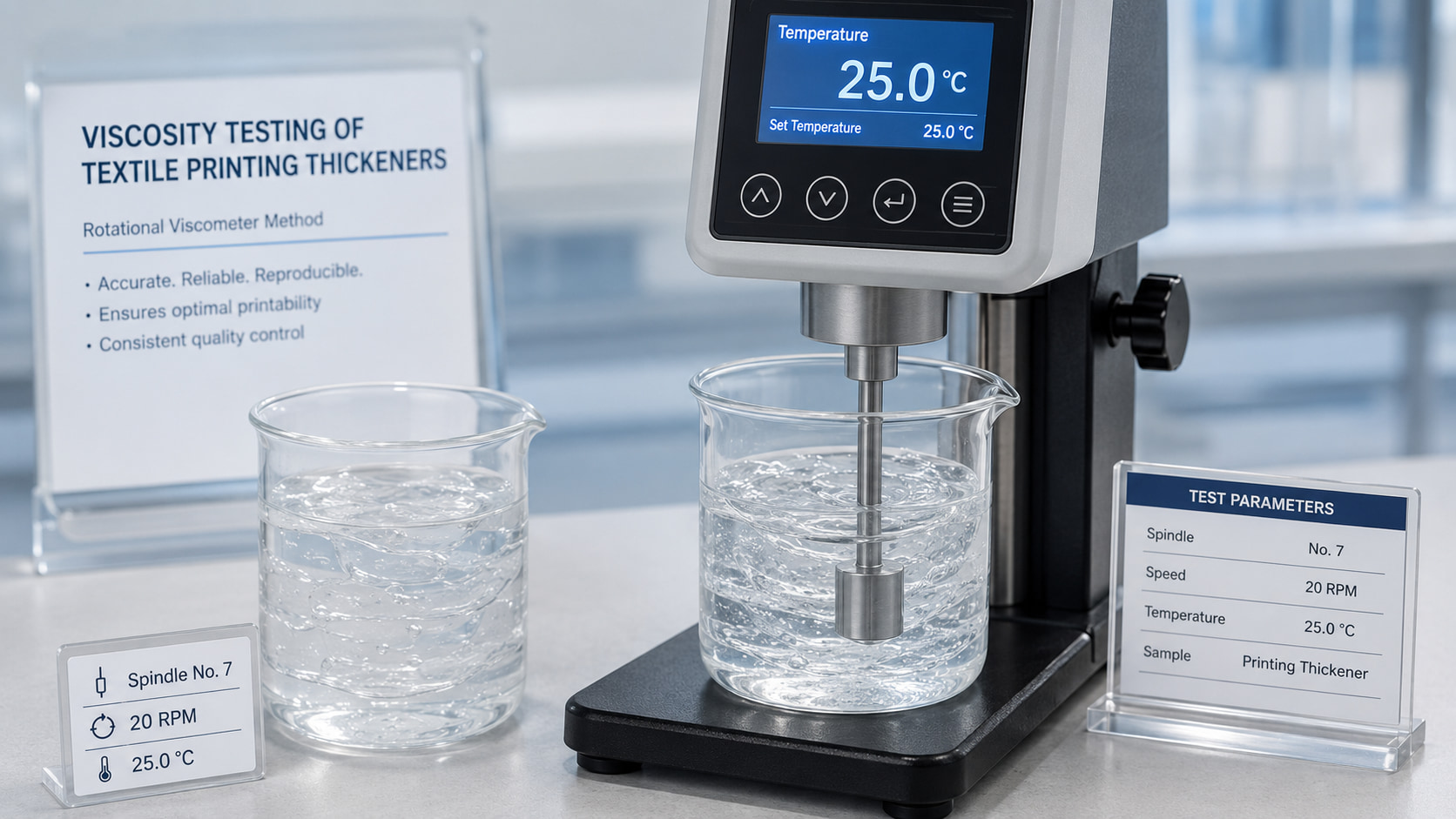
A Brookfield-type rotational reading is useful for batch control because it is simple and repeatable when the method is fixed.
But the reading depends on:
التركيز
درجة الحرارة
Spindle / rotor
سرعة الدوران
الوقت اللازم للقراءة
Preparation history
For non-Newtonian pretreatments, changing spindle speed can produce a different apparent viscosity because the polymer structure responds to shear.
Therefore, a supplier statement such as:
“Viscosity = 2,000 mPa·s”
is incomplete unless the test method is known.
A useful pretreatment TDS should define viscosity test conditions clearly. Brookfield’s DV2T operating manual explains why spindle and container geometry affect the reading. RPM is a rotational speed, not a universal shear rate; use a geometry with an established conversion when a numerical shear-rate specification is needed.
Different Application Methods Create Different Shear Conditions
The apparent viscosity that matters in a storage tank is not necessarily the apparent viscosity that matters at the coating blade or spray nozzle.
The route can expose the product to low, medium or high local shear depending on machine geometry and speed.
This means a formulation can:
Look thick at rest
Flow easily under application shear
Recover after deposition
which may be desirable in one route.
Another formulation can:
Lose structure under shear
Recover too slowly
Penetrate or level too far
which may be undesirable.
Application testing should therefore include more than one shear condition whenever process sensitivity is high.
What Padding Requires from Pretreatment Rheology
Padding requires the pretreatment liquor to wet and penetrate the fabric sufficiently before excess liquor is expressed at the nip.
Useful padding behavior generally requires:
Reliable wetting
Stable bath viscosity
Easy circulation
Low gel / residue
Consistent wet pick-up
Padding does not normally need the same high surface-holding structure as a knife coating system.
Too much structure can slow wetting or produce unstable pickup, while too little structure can increase penetration or reduce surface localization depending on the fabric.
When Padding Viscosity Is Too Low
A very low-viscosity padding liquor can:
Penetrate deeply into absorbent fabrics
Reduce surface localization of polymer
Increase face-to-back chemical distribution
Become more sensitive to fabric absorbency differences
This does not automatically mean low viscosity is wrong.
For some dense fabrics, low-viscosity flow may improve uniform wetting.
The relevant test is:
Wet Pick-Up + Dry Add-On + Surface Distribution + Final Print Performance.
When Padding Viscosity Is Too High
Excessive padding viscosity can:
Slow bath exchange into the fabric
Create uneven wetting
Increase sensitivity to roll speed
Increase foam retention
Reduce easy circulation / filtration
It may also create a false impression that higher viscosity always improves surface color.
If high viscosity reduces wetting uniformity, final shade can become less stable even if the average surface add-on increases.
What Coating Requires from Pretreatment Rheology
Coating requires the pretreatment to be metered into a controlled layer and then remain sufficiently uniform on the textile until drying.
Useful coating behavior often depends on:
Viscosity under coating shear
الترقق تحت تأثير القص
التسوية
التعافي الهيكلي
Penetration resistance
The coating should flow enough under the blade or metering element to form a uniform film.
After application, it should not continue flowing so freely that it penetrates or redistributes uncontrollably before drying.
When Coating Viscosity Is Too Low
Potential symptoms include:
الاختراق المفرط
Low surface hold
Uneven coating weight on absorbent fabrics
Edge flow / drainage
Lower surface color concentration after printing
But apparent low viscosity alone does not prove the coating will fail.
A modest reference reading alone does not predict coating failure. Check the flow curve and any time-dependent recovery separately rather than assuming that shear thinning guarantees a particular recovery response.
Measure actual coating weight and penetration.
When Coating Viscosity Is Too High
Potential symptoms include:
Poor metering
Ridges or streaks
Blade pressure sensitivity
Insufficient leveling
Widthwise sensitivity to small gap differences
High viscosity can also increase the force required to move the formulation beneath the coating head.
A product that looks “stable” in the beaker can therefore create an uneven surface layer in production.
What Spray Requires from Pretreatment Rheology
Spray adds another requirement: atomization.
The liquid must:
Pump reliably
Pass through filters
Pass through the nozzle
Break into droplets
Deposit uniformly
Wet the fabric without excessive bounce or runoff
This means spray suitability depends on more than rotational viscosity.
High polymer elasticity, stringiness, gel particles or unstable filtration can all cause problems even when the measured viscosity seems acceptable.
When Spray Viscosity Is Too Low
A very low-viscosity spray liquid may atomize easily, but it can also:
Produce very fine droplets depending on nozzle conditions
Increase mist / overspray
Penetrate rapidly into absorbent fabric
Reduce face localization
The nozzle, pressure and flow rate matter.
Do not optimize spray solely by making the pretreatment as thin as possible.
When Spray Viscosity Is Too High
Higher viscosity can create:
Larger droplets
Poor atomization
Uneven spray pattern
Higher nozzle-pressure demand
Nozzle / filter blockage risk
Polymer-rich formulations can also show filament formation or stringing during breakup.
Therefore, spray qualification should include:
Nozzle pattern
Droplet behavior
Widthwise deposition
الترشيح
not only viscosity.
Shear Thinning: Why It Matters
Many polymeric textile pretreatments are shear-thinning.
This means apparent viscosity decreases as shear rate increases.
A shear-thinning formulation may combine the following properties, but they require separate checks:
Measured low-shear viscosity or structure before application
Lower apparent viscosity under application shear
A return toward its low-shear response as shear falls; assess any delayed structural rebuild with a timed test
But the ideal degree of shear thinning differs by route.
Padding generally prioritizes wetting and pickup stability.
Coating often benefits from a stronger balance between flow under blade shear and post-application recovery.
Spray needs enough flow through the nozzle and predictable atomization.
Yield Stress and Structure at Rest
Some pretreatments behave as if a minimum stress must be applied before they flow significantly.
This structural resistance can help:
Reduce settling
Hold chemistry near the fabric surface
Reduce uncontrolled drainage
But excessive structure can create:
Poor pumpability
Coating ridges
Spray instability
Yield-like behavior can therefore be helpful in coating but problematic in spray if it is too strong.
Do not infer yield behavior from a single low-speed viscosity value alone.
Structural Recovery and Thixotropy
Thixotropy is a reversible, time-dependent viscosity decrease associated with structural breakdown during sustained shear, followed by rebuilding when shear is reduced or the material rests. Measure recovery over a stated period at low shear or with a suitable oscillatory test after a defined disturbance; two viscosity readings at different speeds do not by themselves prove thixotropy.
The recovery rate matters because:
Too-slow recovery can allow coating to penetrate or spread after application.
Too-fast recovery can reduce leveling and create ridges or streaks.
In padding, excessive time dependence can cause bath behavior to change with circulation history.
In spray, recovery after atomization affects droplet spreading on the fabric.
A product with identical initial Brookfield viscosity can therefore behave differently if structural recovery is different.
Extensional Behavior and Spray Atomization
Spray breakup is not governed only by shear viscosity.
As liquid leaves a nozzle, it stretches and breaks into droplets.
Polymer solutions can resist this stretching differently from simple Newtonian liquids.
High extensional resistance can lead to:
Longer liquid filaments
التوتير
Larger or less uniform droplets
This is one reason two pretreatments with similar rotational viscosity can atomize differently.
For spray applications, direct nozzle trials are essential.
Surface Tension and Wetting
Rheology controls flow, but wetting controls how the applied liquid interacts with the fabric surface.
Poor wetting can cause:
Beading
Patchy spray deposition
Poor coating continuity
Slow padding penetration
Excessive wetting can cause:
Too much penetration
Loss of surface localization
Higher bleeding risk later
The correct viscosity must therefore be matched with appropriate wetting behavior.
Filtration, Gel and Particle Control
For the padding, coating and spray routes discussed here, pretreatment is applied to the fabric. Spray nozzles and filters still need qualification, but success in them does not establish inkjet printhead compatibility. An integrated system that jets pretreatment needs a specifically qualified fluid and the printer manufacturer’s approval; do not put a fabric-treatment thickener into commercial ink.
The product can pass through:
Mixers
Pumps
Filters
Coating heads
Spray nozzles
Gel particles or incomplete hydration can:
Block spray nozzles
Create coating streaks
Deposit unevenly during padding
Use a standardized filtration test with the same sample mass, filter opening and holding time.
Holding Stability Before Application
A pretreatment can meet its viscosity target immediately after preparation but drift during production holding.
Possible changes include:
Viscosity increase
Viscosity decrease
الفصل
Gel formation
الرغوة
This can affect each route differently.
Padding may show pickup drift.
Coating may show coating-weight or leveling drift.
Spray may show nozzle-pattern drift.
Evaluate viscosity and application behavior over the real production holding period.
Temperature Sensitivity
Viscosity depends strongly on temperature.
A pretreatment measured at laboratory temperature can become noticeably thinner in a warm production area or warm circulation loop.
Temperature variation can therefore change:
Padding pickup
Coating weight
Spray atomization
Always record temperature with the viscosity result.
For production comparison, measure samples at the same controlled temperature or record the actual process temperature.
Electrolytes, pH and Water Quality
Reactive digital pretreatments can contain:
Alkali
اليوريا
Salts
أيونات الماء العسر
These can change polymer hydration and rheology.
The same product can therefore show different viscosity when prepared in:
Different plant water
Different alkali system
Different auxiliary package
For sensitive systems, record:
صلابة الماء
الموصلية
الرقم الهيدروجيني
together with viscosity.
Fabric Structure Changes the Viscosity Window
The optimum pretreatment viscosity depends on the textile.
A highly absorbent fabric can pull low-viscosity liquor into the structure quickly.
A dense fabric can require easier flow to achieve uniform wetting.
A stretch knit can be sensitive to mechanical tension in coating or padding.
Therefore, application viscosity should always be validated on the actual:
Fiber
البناء
GSM
Thickness
القدرة على الامتصاص
القطن
Cotton can be treated by padding, coating or spray depending on construction and target.
Absorbent cotton may allow rapid penetration of lower-viscosity pretreatment.
For cotton, compare:
Face-side add-on
Back-side penetration
Post-wash K/S
النزيف
rather than selecting viscosity from fiber name alone.
Viscose / Modal
Viscose and modal generally show high swelling and water uptake.
This can make low-viscosity padding liquor penetrate deeply and can make coating or spray rapidly absorb into the fabric.
The useful viscosity window may therefore differ from cotton even when the same reactive ink and pretreatment product are used.
Control:
Wet pick-up
Dry add-on
الاختراق
Residual moisture
Lyocell
Lyocell is regenerated cellulose but should not be treated as identical to viscose.
Fabric construction, fibrillation control and finishing history can change wetting and penetration.
Route-specific viscosity should be qualified on the actual lyocell fabric.
Woven vs. Knit
Woven fabrics are generally dimensionally more stable under coating gap and padding pressure.
Knits can change width and thickness under tension, which changes effective coating geometry and wet pickup.
لذلك:
Padding viscosity on a knit should be evaluated together with tension and width stability.
Coating rheology should be evaluated together with fabric deflection and thickness.
Spray rheology should be evaluated together with fabric support and motion.
Viscosity vs. Wet Pick-Up / Coating Add-On / Spray Add-On
Viscosity should not be optimized without measuring actual application output.
الطريق
Primary Application Output
Padding
Wet pick-up
Coating
Wet / dry coating weight
Spray
Deposited liquor per dry fabric mass or area; separately defined nonvolatile or component add-on
This prevents the mill from optimizing a beaker measurement that does not improve the fabric.
Define the basis before comparing routes. If P is deposited application liquor in kg per kg of dry fabric and c is the as-supplied product mass fraction in that liquor, P × c estimates application in kg of as-supplied product per kg of dry fabric. If the product nonvolatile fraction s is measured by a declared method, P × c × s estimates that product’s nonvolatile contribution, not all formulation solids or active polymer. Use a separately documented active-component fraction for any active-component calculation. These estimates assume representative composition and no selective loss or uptake; check them against the deposited fabric. For coating or spray recorded in kg of liquor per m², use the same calculation with an area denominator. Correct for incoming fabric moisture and include the other auxiliaries when reporting total dry treatment add-on.
Viscosity and Pretreatment Penetration
Lower viscosity often promotes easier liquid movement, but penetration is not controlled by viscosity alone.
Also important are:
Fabric porosity
Surface tension
Application pressure
Contact time
Polymer–fiber interaction
Higher viscosity can reduce penetration in some systems, but excessive viscosity can also create poor surface uniformity.
The correct objective is:
Controlled Penetration, Not Maximum Viscosity.
Viscosity, Water Load and Drying
Changing viscosity often changes how much liquid the route applies or how deeply it penetrates.
This can change:
Water load
Drying rate
Chemical migration
Residual moisture
For example, a lower-viscosity padding liquor can increase penetration but not necessarily wet pick-up.
A coating with higher surface hold can reduce deep water movement but may leave a concentrated surface film.
A qualified spray route may reduce retained carrier water, but this does not establish the required chemical deposit. Compare deposited liquor, the identified product or component add-ons and finished-print performance rather than assume equal active-polymer deposit or a universal water saving.
Revalidate dryer settings after significant rheology changes.
How Application Rheology Changes Ink Spreading and Color Yield
The pretreatment layer determines how the later inkjet droplet behaves.
If pretreatment rheology produces poor application uniformity, digital printing can show:
النزيف
Line-width variation
المناطق الصلبة غير المتساوية
Color-depth differences
A more surface-localized pretreatment can increase apparent face color if fixation remains adequate.
A deeply penetrating pretreatment can reduce surface polymer concentration and allow more ink penetration.
Therefore, evaluate:
تحديد الخطوط الدقيقة
الاختراق
Post-wash K/S
together.
How It Changes Reactive Fixation
For reactive printing, pretreatment carries fixation chemistry such as alkali and moisture-management components.
If rheology changes application add-on or penetration, it can also change:
Alkali add-on
Moisture distribution
Steaming response
A viscosity change that appears to be only a mechanical issue can therefore become a fixation issue after steaming.
Compare post-wash color and fastness before approving a rheology change.
Why Two Products with the Same Viscosity Can Print Differently
Equal apparent viscosity at one test point does not mean equal:
سلوك التخفيف بالقص
Yield structure
Thixotropic recovery
Extensional behavior
Wetting
Water retention
تحمل الإلكتروليتات
الترشيح
This explains a common mill observation:
Product A = 2,000 mPa·s
Product B = 2,000 mPa·s
but:
Application and Print Performance Are Different.
The correct comparison must include the actual machine and fabric.
Padding vs. Coating vs. Spray Rheology Comparison
مجال التقييم
Padding
Coating
Spray
Primary flow requirement
Wetting / circulation / nip expression
Metering / leveling / recovery
Pumping / atomization / deposition
هيكل منخفض القص
Moderate control useful
Often important for surface hold
Must not prevent pumping or nozzle flow
الترقق تحت تأثير القص
Useful if wetting remains stable
Often very useful
Can help nozzle flow but atomization must be verified
التعافي
Bath stability / pickup consistency
Critical for leveling vs. penetration balance
Influences droplet behavior after deposition
Extensional behavior
Less dominant
Secondary
Important for stringing / breakup
Filtration sensitivity
Moderate to high
High for streak prevention
Very high for nozzle reliability
Primary measured output
Wet pick-up
Coating weight
Deposited spray add-on / width profile
This table is a process guide, not a universal viscosity specification.
Build a Useful Viscosity Test Method
A good internal QC method should record the variables below, together with container and sample volume, spindle immersion, any guard-leg arrangement required by the method, and the torque reading. Keep the same geometry for comparison, and use the instrument manufacturer’s valid measuring range:
Sample concentration
جودة المياه
Preparation time / hydration time
درجة الحرارة
Instrument
Spindle / rotor
سرعة الدوران
الوقت اللازم للقراءة
Use the same method for:
Incoming batch QC
Laboratory matching
Production troubleshooting
If two products are compared under different methods, the viscosity numbers are not directly meaningful.
Build a Multi-Speed Shear Ladder
When one viscosity value does not explain production behavior, compare apparent viscosity at several rotational speeds with a fixed spindle, geometry, temperature and defined dwell at each step. Record the speed order and elapsed time: a low-to-high sequence changes both shear history and sample age, so the resulting profile alone does not isolate thixotropy, structural recovery or yield stress.
على سبيل المثال:
السرعة المنخفضة
Reference speed
سرعة أعلى
Compare only readings within the valid torque range. Brookfield’s spindle-and-speed guidance recommends 10%–100% torque for the standard selection procedure; follow a narrower range if the agreed method or instrument requires it. Do not calculate a viscosity ratio using under-range or overloaded readings.
Under that documented sequence, the comparison can help screen:
More shear-thinning systems
Less shear-sensitive systems
Differences in the measured speed-response profile
Assess time response separately when it matters. A proposed low–high–low sequence records a baseline at low speed, a defined high-speed interval, and the return response at the original low speed over a stated period. Control temperature, bubbles, evaporation and sample preparation; repeat the sequence on independent samples. Use a suitable rheometer where application-relevant recovery time, yield behavior or absolute shear rate is needed. This is a suggested diagnostic design, not FSX test data or a universal pass/fail criterion.
The useful profile depends on padding, coating or spray requirements. Do not assign one universal “best” PVI or shear ratio across those routes, or substitute a beaker profile for the actual coating-head or spray-nozzle trial.
Build an Application-Method Matrix
Candidate
Padding
Coating
Spray
Current pretreatment
مرجع
Trial if relevant
Trial if relevant
Lower-structure candidate
Evaluate wetting / pickup
Evaluate penetration
Evaluate atomization
Higher-structure candidate
Evaluate pickup stability
Evaluate metering / recovery
Evaluate nozzle / stringing risk
For every route, record:
Application uniformity
Actual add-on
التجفيف
Final printing result
The best product is the one that performs correctly in the intended route—not the one with the highest viscosity.
Laboratory-to-Production Scale-Up
Small laboratory tools do not reproduce all production shear and geometry.
During scale-up, recheck:
Pump and circulation behavior
Full-width pickup / coating / spray uniformity
Line speed
درجة الحرارة
مدة الانتظار
التجفيف
Residual moisture
For coating, production gap and web tension become more important.
For spray, nozzle overlap and full-width deposition become more important.
For padding, full-width nip uniformity and bath circulation become more important.
Scale-up should reproduce the fabric condition and print result, not merely the laboratory viscosity.
Common Viscosity-Matching Mistakes
1. Choosing Pretreatment by One Viscosity Number
One apparent viscosity point does not describe full rheology.
2. Using the Same Viscosity Target for Padding, Coating and Spray
Each route creates different flow and shear conditions.
Excessive structure can reduce wetting, leveling or atomization.
4. Assuming Lower Viscosity Is Always Better for Spray
Very low viscosity can increase misting or penetration and does not guarantee uniform deposition.
5. Ignoring Filtration
Gel particles can create nozzle blockage, coating streaks and uneven application.
6. Ignoring Temperature
Viscosity can change significantly between lab and production temperature.
7. Comparing Products with Different Test Methods
Viscosity values are meaningful only when the test conditions match.
8. Stopping at Application Instead of Printing
The final test is finished-print quality after the approved production sequence, followed by the agreed end-use durability tests. Reactive printing commonly includes steaming and wash-off; pigment printing develops durable binding through its specified drying and curing sequence and does not automatically require a production wash-off step. Laundering validation is a separate requirement. DuPont’s pigment process guide illustrates ink- and fabric-specific optimization of treatment and fixation; its settings are not an FSX recipe.
The cheapest pretreatment per kilogram is not necessarily the lowest-cost application system.
ومن النماذج المفيدة ما يلي:
Cost per accepted m² = allocated monetary cost of materials, preparation, application, drying, printing, required fixation or cure, finishing and rework ÷ accepted finished-fabric area (m²).
A product with slightly higher unit cost can be commercially better if it:
Applies more uniformly
Reduces nozzle / filter maintenance
Improves coating consistency
Reduces pickup drift
Improves first-pass print quality
Use one currency and production boundary. Price measured product and auxiliary consumption, labor and machine time, energy and distinct maintenance or disposal charges with stated rates. Filtration, overspray and reject losses already included in consumed materials must not be added again as the same material value. Record application speed and downtime separately unless a non-overlapping monetary allocation is defined; compare linear meters only at equivalent finished width.
What Information Should You Send to a Supplier?
For useful viscosity/application matching, provide:
Ink system
Fabric fiber / blend
Knit or woven
GSM / thickness
Current pretreatment product / TDS
Current viscosity and full test method
Application method: padding / coating / spray
Wet pick-up or coating / spray add-on
Application equipment details
Line speed
Water hardness / conductivity where relevant
Pretreatment pH / electrolyte system
Drying conditions
Main issue: pickup, streaking, penetration, atomization, bleeding or weak color
يمكن لشركة FSX Chemical الاستفادة من هذه المعلومات من خلال العينات والمطابقة to compare rheology and application fit rather than matching only one viscosity number.
How Should a Mill Match Pretreatment Viscosity to the Application Method?
A practical workflow is:
Define Fabric + Ink Chemistry + Application Route → Standardize Viscosity Method → Check Speed and Time Response Where Needed → Verify Filtration / Holding → Apply at Measured Add-On → Follow the Approved Drying / Printing / Fixation / After-Treatment Sequence → Compare Finished Print and Durability. For pigment systems, use the specified cure and keep durability laundering distinct from production wash-off. For reactive systems, include the qualified steaming and washing stages. Some integrated pigment platforms use wet-on-wet treatment, so an offline drying step is not universal.
المبادئ الأساسية هي:
Viscosity is a test result; rheology is the broader flow behavior that controls application.
Padding, coating and spray require different balances of wetting, shear thinning, recovery and flow.
Same Brookfield viscosity does not mean the same application performance.
Application output—wet pick-up, coating weight or spray add-on—must be measured together with viscosity.
Fabric structure and water/electrolyte conditions can shift the useful viscosity window.
Select a pretreatment whose application behavior remains repeatable in the intended route and whose finished print meets the agreed image, hand and durability requirements at an acceptable Total Cost in Use.
الأسئلة الشائعة
1. Can the same pretreatment viscosity be used for padding, coating and spray?
Not automatically. Each application method creates different shear, pressure, wetting and recovery requirements, so the useful viscosity window can differ.
2. Why do two products with the same Brookfield viscosity behave differently?
They can differ in shear thinning, yield structure, recovery, extensional behavior, wetting, filtration and electrolyte tolerance.
3. Is higher viscosity better for padding?
Not always. Excessive viscosity can reduce wetting and bath exchange, while very low viscosity can increase penetration. Measure actual wet pick-up and print performance.
4. Is higher viscosity better for coating?
Only within a useful rheological window. Too little structure can cause penetration and flow; too much can cause poor metering, ridges and poor leveling.
5. Does spray require the lowest viscosity?
No. Spray requires reliable pumping and atomization, but very low viscosity can increase misting or penetration. The nozzle and formulation must be matched together.
6. Why does spray string or form large droplets?
High viscosity, polymer elasticity, extensional resistance, nozzle geometry or pressure can contribute. Direct nozzle testing is necessary.
7. Why is filtration important for fabric pretreatment?
Gel and incompletely hydrated particles can block spray nozzles, create coating streaks or cause uneven application even though the pretreatment is not printed through an inkjet head.
8. Should viscosity always be measured at one speed?
A single speed is useful for routine QC, but multi-speed measurements can help explain shear-thinning differences when products with similar reference viscosity behave differently.
9. Why does production viscosity differ from laboratory viscosity?
Temperature, water quality, holding time, shear history, concentration and mixing can all change apparent viscosity.
10. How does fabric type affect the useful viscosity?
Absorbency, thickness, porosity and stretch determine how quickly pretreatment penetrates and how application geometry behaves.
11. Should I match a competitor product only by viscosity?
No. Match viscosity method, rheology, filtration, add-on, drying and final printing performance. Same viscosity alone does not prove equivalent behavior.
12. What should I send FSX Chemical for viscosity matching?
Send the current TDS or sample, full viscosity test method, application route, fabric, wet/dry add-on, line speed, water/pH conditions and the exact application or printing problem.
Match Pretreatment Rheology to the Machine, Not Just the Viscosity Number
If a digital pretreatment performs well in one machine but becomes unstable in padding, coating or spray, FSX Chemical can help compare the current product by viscosity method, rheology, filtration, application add-on and final printing result.
ابدأ بـ العينات والمطابقة and provide your current pretreatment, fabric, viscosity test conditions and application route.
Select the application window that moves reliably through the intended equipment, deposits uniformly on the actual fabric and delivers the required finished color, definition, hand and durability after the system’s approved processing sequence. A familiar laboratory viscosity number is only one control point in that decision.
تعرف على السبب الذي يجعل من المستحيل مقارنة قيم لزوجة مكثفات الطباعة النسيجية دون مطابقة كل من التركيز، ودرجة الحرارة، والجهاز المستخدم، والمغزل، والسرعة، وطريقة التحضير، ووقت الاختبار.
تعرف على كيفية اختيار المُكثِّف وطرق المعالجة المسبقة للطباعة النسيجية التفاعلية، والطباعة بالتشتت، والطباعة بالصبغات، والطباعة الرقمية، بناءً على متطلبات النسيج، والصبغة أو الحبر، والتثبيت، وقابلية الغسل، وجودة الطباعة.
تختلف متطلبات المعجون والمعالجة المسبقة في الطباعة الرقمية بنفث الحبر على المنسوجات عن تلك الخاصة بالطباعة بالشاشة الحريرية. يشرح هذا الدليل كيفية استخدام ألجينات الصوديوم في الطباعة الرقمية على المنسوجات، والمعايير التي يجب على فرق المشتريات تحديدها فيما يتعلق بدرجات الجودة.
Sodium alginate for textile coating is a vital bio-based option for global textile/printing firms. It solves key issues like poor adhesion (ideal for cotton) and low durability (boosts polyester coating resilience by 30%), while meeting regional rules—EU REACH (biodegradable) and US OEKO-TEX (non-toxic for babywear). This guide covers application tips (digital printing), alternatives comparison (vs acrylic binders), and how to pick global suppliers like fsxchemical.
يُستخدم ألجينات الصوديوم عادةً كمكثف في معجون الطباعة التفاعلي للمنسوجات، لكن الاستخدامات الأخرى في مجال المنسوجات تتطلب التحقق من ملاءمتها لكل تطبيق على حدة. يقارن هذا الدليل بين الطباعة، والمعالجة التمهيدية الرقمية، وتجهيز خيوط السداة، والتركيبات المتعلقة بالصباغة، والطلاء، والتشطيب، وذلك من حيث الوظيفة والمتطلبات الفنية والمخاطر والوثائق واختبارات العينات.
يتضمن التحكم في اللزوجة في الطباعة الرقمية على المنسوجات نظامين مختلفين: الحبر المستخدم في الطباعة النفاثة وتركيبة المعالجة المسبقة للنسيج. يشرح هذا الدليل كيف تؤثر درجة الحرارة والتركيبة وطرق القياس وظروف العملية على استقرار عملية الطباعة النفاثة وجودة الطباعة.
أفضل معجون للطباعة الرقمية هو الذي يتوافق مع التركيب الكيميائي للحبر ونوع النسيج وطريقة التثبيت. يقارن هذا الدليل متطلبات المعالجة المسبقة للطباعة التفاعلية بنفث الحبر على الأقمشة السليلوزية والطباعة المباشرة بالتشتت بنفث الحبر على البوليستر، ثم يشرح كيف ينبغي للمشترين تقييم العينات قبل الشراء بالجملة.
The future of textile printing thickeners will be shaped by application-specific rheology, digital pretreatment, bio-based materials, hybrid formulations, faster preparation and data-driven process control. This guide explains which trends are commercially relevant and which still require industrial validation.
An FSX-authored guide to checking digital pretreatment fit, trial evidence, product documents and sample-to-bulk traceability before supplier approval.
إن اختيار الدرجة المناسبة من مادة CMC لا يقتصر على مجرد تحديد رقم اللزوجة. يشرح هذا الدليل كيف يمكن لمشتري المنسوجات مقارنة طرق الاستخدام، ودرجة الاستبدال، والنقاء، وحجم الجسيمات، والترطيب، وخصائص الريولوجيا، والتحمل الكيميائي، وأداء العينات.
لا يقتصر الأمر في الحصول على معجون طباعة رقمي مستقر على مجرد تحقيق اللزوجة المستهدفة. يشرح هذا الدليل كيف تؤثر عوامل مثل اختيار المنتج، وجودة المياه، وتسلسل إضافة المكونات، والخلط، ودرجة الحموضة، ودرجة الحرارة، والترشيح، والنظافة، والتخزين، وسجلات الجودة على المعالجة المسبقة واتساق الإنتاج.
Textile printing chemical innovation in 2026 is moving beyond higher viscosity and stronger color. The leading developments focus on safer inputs, renewable polymers, waterborne nano-binders, stable pigment dispersions, lower-energy fixation and multifunctional printing systems.
يرجى إرسال اسم المنتج، والتطبيق، والكمية، والوجهة، وأي بيانات تقنية (TDS)،
أو صورة عينة أو مستند متوفر لديكم بالفعل. وستقوم شركة FSX Chemical بمراجعة
هذه المعلومات وتقديم توصية بشأن الخطوة التالية سواء كانت تقديم عرض أسعار، أو مطابقة العينة،
أو اختيار المنتج.
معلومات عن المنتجاسم المنتج، الدرجة، الطراز، صورة الملصق أو مرجع المورد.
الوثائق المتاحةTDS، SDS، COA، صورة العينة، قائمة المنتجات أو بيانات الاختبار.
تفاصيل الطلبالكمية التقديرية، والتعبئة، وبلد المقصد، والميناء، أو الشروط التجارية.
الطلب أو المشكلةعملية طباعة المنسوجات، متطلبات التركيبة، المشكلات الحالية أو الأداء المستهدف.