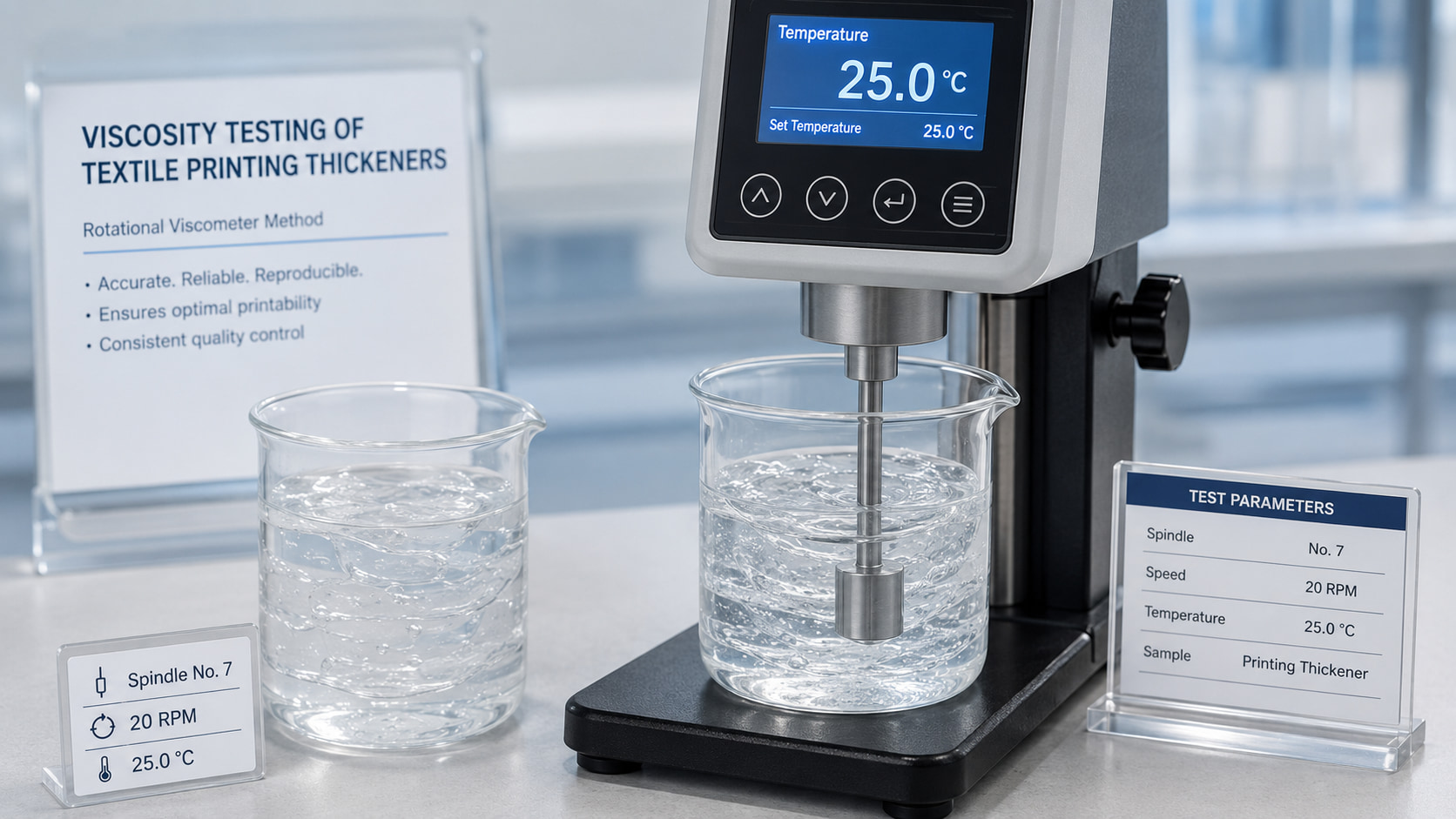
Effective viscosity management requires more than reaching one target number. This guide explains how test...
Viscosity is one of the most frequently discussed parameters in textile printing. Printing mills use it to inspect stock pastes, compare thickeners, adjust color pastes and monitor production batches.
However, viscosity is also one of the most frequently misunderstood parameters. A value such as 5,000, 20,000 or 50,000 mPa·s has limited meaning unless the concentration, preparation procedure, temperature, instrument, spindle and rotational speed are known.
Even when two products provide the same reading under one laboratory condition, they may behave differently during pumping, screen passage, coating, fabric penetration and storage. This is because printing performance depends on rheology, not only on a single viscosity result.
Professional viscosity management therefore requires three connected controls: a repeatable measurement method, a stable preparation process and verification under the actual printing conditions.
Why Viscosity Management Matters
Printing paste must remain sufficiently stable during preparation and storage while still flowing through the printing equipment. After it reaches the fabric, it must help control spreading, penetration and pattern definition.
Poor viscosity management can affect both production efficiency and final textile quality.
Viscosity that is too high may cause
Difficult pumping or paste circulation
Reduced screen passage
Incomplete paste transfer
المناطق الصلبة غير المتساوية
Excessive surface deposition
Higher filtration or cleaning requirements
Viscosity that is too low may cause
Uncontrolled spreading
Loss of fine-line definition
Excessive fabric penetration
Uneven colorant placement
Separation or settling in some formulations
Variation in application pickup
The correct viscosity is process-specific
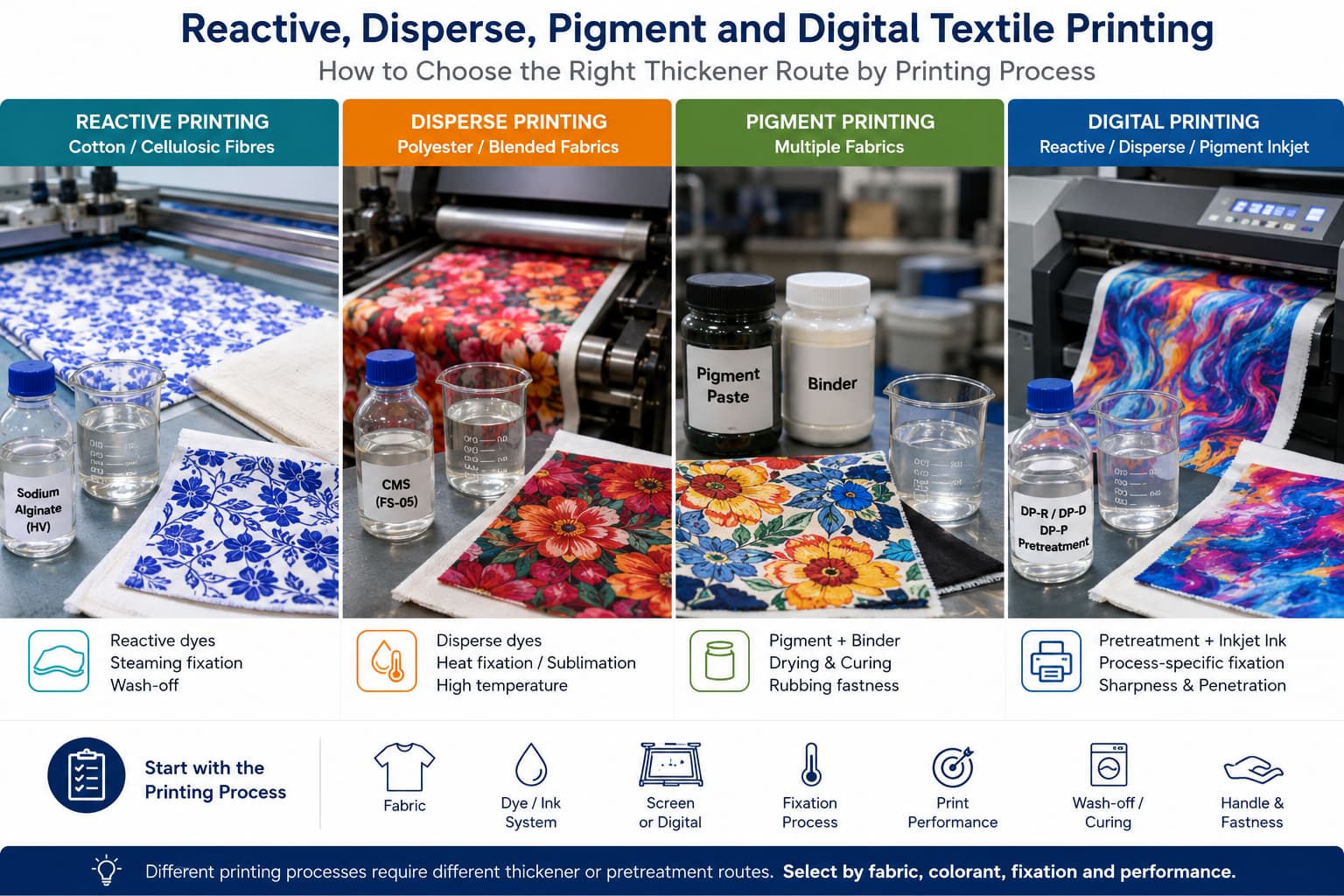
The target depends on the thickener, printing method, fabric, design, colorant system, equipment speed and post-treatment. A value that works well in rotary-screen reactive printing may not be suitable for pigment printing or digital pretreatment.
Viscosity and Rheology Are Not the Same
Viscosity describes resistance to flow under a defined measurement condition. Rheology describes how the paste behaves across different shear, time and structural conditions.
اللزوجة أحادية النقطة
A single-point measurement reports apparent viscosity for one defined instrument, spindle or geometry, speed, temperature and reading time. Also check the instrument’s valid operating range and sample setup. A displayed number outside the approved method is not a reliable batch-control result.
سلوك التخفيف بالقص
Many printing pastes show lower apparent viscosity as the applied shear rate increases. This shear-thinning response is different from a viscosity change with time at a fixed shear condition. Screen pressure or mixer rpm alone does not define a universal shear rate for the paste.
التعافي الهيكلي
After the mechanical force is reduced, the paste may recover part of its original structure. Appropriate recovery helps control spreading after the paste reaches the fabric.
Time-dependent behavior
Time-dependent behavior should be evaluated with a defined shear and rest sequence. Keep speed or shear condition, duration, temperature and reading times controlled. A change caused by continued hydration, evaporation or heating should not automatically be labelled thixotropy.
Why equal viscosity does not prove equal performance
Two products can show the same value at one test speed while producing different values at another speed. They may therefore behave differently during screen passage and after deposition on the textile.
1. Define a Complete Viscosity Test Method
A viscosity value should never be separated from its measurement method. Without the method, buyers cannot make a reliable supplier or batch comparison.
A complete method should record
Product or paste identification
Sample concentration
Concentration calculation basis
مصدر المياه
Powder or liquid addition procedure
Mixer and mixing speed
وقت الخلط والترطيب
Sample resting time
درجة حرارة القياس
Instrument model or measurement principle
المغزل، الدوار أو الشكل الهندسي
سرعة الدوران
الوقت اللازم للقراءة
الوحدة المُبلغ عنها
Use one method for reference and candidate
Prepare reference and candidate samples using documented conditions and confirm the required hydration endpoint for each. Apply the agreed measurement setup consistently. If a preparation difference is required, record it rather than hiding it inside an apparently identical test.
A supplier value may use another method
A supplier TDS can provide a useful specification reference, but the buyer should not compare it directly with an internal result unless the methods are aligned.
Preserve the approved method
Retain the agreed incoming-QC method for release comparisons with the approved reference and first commercial lot. Keep that test distinct from each grade’s documented preparation and complete application trial; one measurement does not replace application qualification.
2. Control Measurement Temperature
Temperature can significantly influence apparent viscosity. Samples measured immediately after high-speed mixing may be warmer than samples that have rested in the laboratory.
Condition all samples equally
Reference and candidate samples should reach the same defined temperature before measurement.
Record the actual temperature
Writing “room temperature” may be insufficient when the laboratory temperature changes by season or shift.
Control mixing-generated heat
Extended high-speed mixing can raise the sample temperature. A lower result may reflect heat rather than a weaker thickener.
Monitor production temperature
Pumping, circulation, workshop conditions and machine operation can change paste temperature during a long production run.
Do not correct temperature-related change immediately
Before adding more thickener or water, condition the sample and repeat the measurement under the approved temperature.
3. Standardize Concentration and Water Quality
Small concentration differences can produce large viscosity differences, especially in polymer-thickened systems.
Use accurate weighing
Record the actual weight of water, thickener and other ingredients. Do not rely only on container marks or visual estimates.
Define the concentration basis
Clarify whether concentration is based on supplied product weight, dry polymer, active content or total finished paste.
Control water loss
Water remaining in transfer containers or lost through evaporation changes the final concentration.
استخدم نفس مصدر المياه
Water hardness, conductivity and pH can affect polymer hydration and chemical compatibility.
Test actual production water
Deionized water is useful for controlled screening, but final approval should include the water used in routine factory preparation.
4. Control Dispersion and Hydration
Incomplete hydration is a common cause of unstable viscosity. A paste may appear uniform while dry material remains trapped inside hydrated lumps.
Create liquid circulation before powder addition
Start the mixer and establish stable movement before introducing powdered sodium alginate, CMC, CMS or another thickener.
Add powder gradually
Dumping the complete quantity into one location encourages surface hydration and lump formation.
Use a repeatable addition time
One operator may add the product in two minutes while another requires ten minutes. This difference can change dispersion and final viscosity.
Allow the required hydration period
Visible dispersion does not prove that the polymer has developed its final properties. Follow the current grade instructions and use defined measurement times.
Check different vessel positions
Material near the surface, wall or bottom may not experience the same circulation as material near the impeller.
5. Understand the Effect of Shear
Printing paste experiences different shear conditions during preparation, pumping, circulation, screen passage and fabric application.
Laboratory mixing shear
Mixer type, impeller design, speed, vessel size and filling level determine how mechanical energy enters the sample.
Viscometer shear
Changing the spindle or rotational speed changes the measurement condition and may produce a different apparent viscosity.
Machine shear
Pumps, pipes, screens, squeegees and coating units expose the paste to conditions that a low-speed laboratory test may not represent.
Excessive shear during preparation
Unnecessary high-speed mixing after hydration may introduce air, increase temperature or change the structure of the formulation.
Compare multiple speeds where useful
Multi-speed measurements can compare rate-dependent flow when instrument geometry, temperature, sample history, speed order and reading times are controlled. They do not by themselves measure recovery with time. If recovery is relevant, define a low-shear reference, a high-shear interval and a timed return to the reference setting using suitable equipment. Record the full sequence and independent preparation repeats; do not treat mixer RPM as a universal shear rate or an instrument result as a direct prediction of screen transfer.
6. Evaluate Dyes, Salts, Alkalis and Binders
A thickener does not operate in clean water during textile printing. Colorants and auxiliaries can change viscosity, rheology and holding stability.
الطباعة التفاعلية
Salts, alkalis, reactive dyes and humectants should be added at realistic production concentrations. The ألجينات الصوديوم grade should be evaluated in the complete reactive paste.
الطباعة الصبغية
Pigment, binder, crosslinker and other auxiliaries may influence both viscosity and physical stability. Binder compatibility is more important than the thickener’s clean-water result.
CMC and CMS systems
CMC و CMS grades can respond differently to pH, salts and other polymers.
Digital printing pretreatment
A معجون الطباعة الرقمية should be tested with the actual reactive, disperse or pigment ink route, fabric and pretreatment process.
Control the order of addition
Local exposure to concentrated salts, alkalis or binders may create a different result from gradual addition into a well-prepared polymer phase.
7. Monitor Viscosity Over Time
One immediate measurement cannot describe how the paste will behave during storage and production.
Suggested measurement stages
Immediately after mixing
After the specified hydration period
After completion of the full formulation
After the normal factory holding period
During a representative production run
After extended circulation where relevant
Viscosity increase over time
Possible causes include continued hydration, evaporation, lower temperature or concentration error.
Viscosity decrease over time
Possible causes include chemical interaction, temperature increase, excessive shear, contamination or incompatibility between formulation components.
Relate change to performance
A numerical change becomes commercially important when it affects paste transfer, fabric pickup, print definition, shade or production stability.
8. Control Evaporation and Unrecorded Dilution
Open storage and repeated correction are common causes of unexplained viscosity variation.
Keep laboratory samples covered
Two samples cannot be compared fairly when one loses more water during hydration or storage.
Review production-tank exposure
Long circulation, warm workshops and open tanks may gradually increase paste concentration.
Record every water addition
Operators should not add water only until the paste appears familiar. Record the quantity, time and reason for each correction.
Avoid repeated correction cycles
Adding water, then adding thickener, and then adding more water can move the formulation away from the approved chemical balance.
Investigate the cause first
Confirm temperature, hydration, concentration and test method before changing the formula.
9. Connect Filtration, Foam and Viscosity
Filtration and foam can influence both the measurement result and machine performance.
Undissolved material
Lumps and gels can make a sample appear nonuniform and may create unstable or nonrepeatable readings.
Air entrainment
Air introduced by high-speed mixing can interfere with viscometer contact, increase apparent volume and produce irregular readings.
Define the filtration method
Record the filter opening, sample quantity, pressure or gravity condition and filtration time.
Inspect retained material
Determine whether the residue consists of dry powder, hydrated polymer, precipitated chemicals, fibres or foreign contamination.
Do not use filtration to hide incompatibility
Filtration removes particles but does not permanently correct a chemically unstable formulation.
10. Build Production Viscosity Control Points
Reliable production requires clearly defined checkpoints rather than irregular testing only after a problem appears.
Record water, product weight, addition time, mixer settings, temperature and hydration period.
Completed color paste
Measure after the full chemical system has been added and sufficiently mixed.
Pre-production release
Confirm viscosity, appearance, pH and filtration before the paste enters routine production.
In-process monitoring
Record paste temperature, viscosity, circulation behavior and any corrective additions during long runs.
End-of-run review
Compare fabric and paste data from the beginning, middle and end of the production run.
Viscosity Priorities by Printing Process
عملية الطباعة
Viscosity Management Priority
Additional Checks
Reactive flat-screen printing
Paste transfer, edge control and holding stability
Dye compatibility, penetration and wash-off
Reactive rotary-screen printing
Circulation, high-shear flow and recovery
Screen passage and long-run consistency
الطباعة الصبغية
Binder compatibility and shear response
Curing, rubbing performance and handle
Selected disperse printing
Paste stability, screen transfer and fixation compatibility
Color uniformity and final surface result
المعالجة التمهيدية الرقمية التفاعلية
Uniform application pickup and storage stability
Ink spreading, fixation and wash-off
Disperse digital pretreatment
Application uniformity and filtration
Drying, fixation and migration control
Pigment digital pretreatment
Binder stability, pH and application consistency
Curing, fastness and fabric handle
These priorities identify what should be monitored. They do not establish one universal viscosity target for each process.
How to Correct High or Low Viscosity
When viscosity is higher than expected
First confirm temperature, concentration, evaporation, hydration time, measurement settings and sample identification.
Controlled dilution may be considered only after the cause has been identified and the effect on every other formulation component has been reviewed.
When viscosity is lower than expected
First confirm weighing, water quantity, hydration, temperature, chemical additions and test method.
Adding more thickener immediately can create incomplete hydration and local high-concentration areas. Prepare any correction using a controlled procedure.
When viscosity changes after chemical addition
Use a staged formulation check to locate when the change appears. Prepare independent reference and test portions with matched starting polymer content, temperature, mixing and elapsed measurement time. Where an addition dilutes the paste, include an appropriate carrier or water control so dilution and extra handling are not mistaken for a chemical effect; document any unavoidable differences. Repeat the relevant comparison and the complete formulation before changing production. A stage-linked difference is a diagnostic lead, not proof of one ingredient’s mechanism: interactions and addition order may require a planned comparison.
When the number is correct but printing is poor
Review rheology, filtration, foam, fabric absorbency, machine conditions and application quantity. The target number itself may not represent the correct performance window.
Laboratory-to-Production Scale-Up
A small laboratory beaker and a production tank do not create identical mixing, heat transfer or circulation.
Keep the laboratory record
Record the approved mixer, addition time, hydration period, temperature and measurement method.
Use a limited production batch
A pilot or controlled first batch can reveal dispersion, foam, filtration and transfer issues before full conversion.
Do not copy mixer RPM directly
Identical rotational speed does not produce identical liquid movement in vessels of different diameter, depth and impeller design.
Check vessel uniformity
Where appropriate, compare samples from different positions before releasing the paste.
Monitor the actual operating period
Production paste may remain in storage or circulation much longer than a laboratory sample.
How to Compare Thickener Samples
Step 1: Select a current reference
Use a representative sample of the product approved in routine production.
Step 2: Align the test method
Define the concentration basis, water and measurement setup, including temperature, instrument, spindle, speed and reading times. Separate a common factory-SOP challenge from a grade-ready application comparison. A common mixing and hydration deadline tests fit with the present process; report an unready candidate as a limitation under that SOP. For application qualification, follow each grade’s documented preparation method to agreed readiness criteria and record any differences. Check uniformity, repeatable conditioned viscosity and defined filtration behavior rather than assuming one stable reading proves readiness.
Step 3: Compare equal concentration
Begin with an equal-concentration comparison on the declared mass basis, stating the preparation route used. Keep this separate from a later dosage-optimized trial. Equal apparent viscosity at one setting does not establish equal recovery, chemical compatibility or finished-fabric performance.
Step 4: Compare more than viscosity
Dispersion
وقت الترطيب
الترشيح
الرغوة
Multi-speed behavior
استقرار الحيازة
Step 5: Test the complete formulation
Add the actual dyes, pigments, salts, alkalis, binders and auxiliaries.
Step 6: Complete an application trial
Evaluate printing, fixation, washing or curing on representative fabric.
Step 7: Optimize dosage
Adjust the candidate in controlled steps while maintaining the same final quality requirements.
How to Read Viscosity Information on a TDS
Check the concentration
Confirm whether the value is measured using a one-percent, two-percent, three-percent or another defined solution or paste.
Check the temperature
The stated result should be connected with a measurement temperature.
Check the instrument and speed
A complete method may identify the instrument, spindle and rotational speed. Ask the supplier when these details are not shown.
Distinguish typical values from specifications
A typical value describes a reference result. An agreed specification defines the commercial acceptance range.
Check whether the value belongs to the raw material or final paste
Powder-solution viscosity, supplied-liquid viscosity and completed printing-paste viscosity are different measurements.
Confirm batch-document expectations
Ask whether viscosity will appear on the batch COA and which method will be used.
A correct number does not prove appropriate screen passage, recovery or final print quality.
Comparing supplier values without methods
Results obtained using different concentrations and speeds should not be treated as directly equivalent.
تجاهل درجة حرارة العينة
Temperature differences can be mistaken for product or batch differences.
Measuring before complete hydration
The result may continue changing after the test has been completed.
Correcting with unrecorded water
This changes every chemical concentration in the paste and prevents reliable troubleshooting.
Using clean-water viscosity as final approval
The completed formulation may respond differently after colorants and auxiliaries are added.
Changing several variables simultaneously
Uncontrolled changes to dosage, water, chemicals and machine settings prevent a clear attribution. Use recorded reference comparisons for initial diagnosis and a planned design when interactions must be evaluated.
Skipping the first commercial-batch check
The approved method should be repeated before routine use of the first bulk shipment.
Troubleshooting Viscosity Problems
المشكلة الملاحظة
الأسباب المحتملة
Recommended Checks
Result changes between operators
Different mixing, resting, temperature or reading procedure
Standardize the complete method and operator training
Laboratory and supplier results differ
Different concentration, water, instrument, spindle or speed
Exchange complete methods and test one shared sample
Viscosity rises during storage
Continued hydration, evaporation or lower temperature
Review hydration time, container closure and temperature
Viscosity falls during storage
Chemical interaction, contamination, heat or excessive shear
Review pH, electrolytes, hygiene, temperature and mixing history
High viscosity but poor transfer
Excessive resistance, unsuitable rheology or incomplete screen passage
Review dosage, multi-speed behavior and machine conditions
Correct viscosity but print spreads
Slow recovery, excessive penetration or fabric absorbency
Review rheology, pickup, fabric and application conditions
Irregular readings
Air bubbles, lumps, nonuniform sample or unstable temperature
Inspect, degas where appropriate and repeat controlled preparation
Paste changes after salt or alkali
Electrolyte sensitivity or incorrect addition sequence
Compare staged additions with time-, temperature-, mixing- and dilution-matched controls; repeat the complete formulation before assigning a cause
Bulk product differs from sample
Grade identity, batch variation, method or storage difference
Review product codes, COA, retained samples and test conditions
Confirm the Reading Is Valid Before Correcting the Paste
تحقق
Action before interpreting the result
Instrument and spindle
Confirm the selected code, condition, immersion and setup required by the instrument method
Measurement range
Review torque or other range indicators against the applicable instrument instructions
Sample condition
Check temperature, bubbles, lumps, fill level and the defined rest period
Reading sequence
Use the stated duration and speed sequence; retain the original result if a repeat is required
If a different spindle or speed is needed, document a revised method and its relationship to the established control; do not change the setup merely to obtain an in-specification number. Check the instrument with the appropriate reference material when required by the quality procedure. A valid measurement is the starting point for investigating the paste, not evidence by itself that dilution or extra thickener is the right correction.
How FSX Chemical Supports Viscosity Matching
FSX Chemical supplies sodium alginate, CMC, CMS and digital printing paste for different textile printing and formulation routes.
Viscosity matching begins with the application and complete measurement method rather than a single target number.
Buyers can provide
اسم المنتج الحالي، أو وثيقة المواصفات الفنية (TDS)، أو عينة تمثيلية
A matched viscosity result is an initial qualification step. Final approval requires complete formulation testing, representative textile evaluation and verification of the commercial batch📧 البريد الإلكتروني: Service@fsxchemical.com
تعرف على السبب الذي يجعل من المستحيل مقارنة قيم لزوجة مكثفات الطباعة النسيجية دون مطابقة كل من التركيز، ودرجة الحرارة، والجهاز المستخدم، والمغزل، والسرعة، وطريقة التحضير، ووقت الاختبار.
تعرف على كيفية اختيار المُكثِّف وطرق المعالجة المسبقة للطباعة النسيجية التفاعلية، والطباعة بالتشتت، والطباعة بالصبغات، والطباعة الرقمية، بناءً على متطلبات النسيج، والصبغة أو الحبر، والتثبيت، وقابلية الغسل، وجودة الطباعة.
تعرف على كيفية تقييم شركة مصنعة لمكثفات طباعة المنسوجات من خلال التحقق من هوية الشركة، والقدرة الإنتاجية، وطرق الاختبار، وإمكانية تتبع الدُفعات، والوثائق الفنية، ودعم العينات، والقدرة على التوريد للتصدير.
قارن بين CMC وCMS وألجينات الصوديوم ومعجون الطباعة الرقمية المستخدمة في طباعة المنسوجات. تعرف على مدى ملاءمة كل خيار لعمليات الطباعة التفاعلية، والطباعة بالتشتت، والطباعة بالصبغات، والطباعة الرقمية، وما يجب على المشترين مراجعته قبل اختبار العينات، ومطابقة الدرجات، والشراء بالجملة.
يُستخدم ألجينات الصوديوم على نطاق واسع في طباعة المنسوجات كمكثف مستقر وقابل للغسل لمعجون الطباعة التفاعلي. تعرف على كيفية تقييم درجة اللزوجة والنقاء ومدى ملاءمة الاستخدام قبل الشراء، وكيف تدعم شركة FSX Chemical المشترين العالميين من خلال توفير البيانات الفنية والعينات.
Choose CMC for textile printing by application, DS, viscosity method and formulation trials. Use a practical checklist to compare grades before bulk purchase.
يُستخدم كربوكسي ميثيل السليلوز كمكثف ومثبت في الأحبار المائية، والطباعة بالحفر، والمعالجة المسبقة في الطباعة بنفث الحبر. يتناول هذا الدليل المعايير الرئيسية للدرجات واعتبارات التوريد التي يجب على فرق المشتريات أخذها في الاعتبار.
يُستخدم كل من ألجينات الصوديوم وCMC كمكثفات في طباعة المنسوجات، لكنهما يناسبان أنظمة صبغ وظروف معالجة مختلفة. يشرح هذا الدليل الاختلافات الرئيسية بينهما ومتى يتم استخدام كل منهما.
تختلف متطلبات المعجون والمعالجة المسبقة في الطباعة الرقمية بنفث الحبر على المنسوجات عن تلك الخاصة بالطباعة بالشاشة الحريرية. يشرح هذا الدليل كيفية استخدام ألجينات الصوديوم في الطباعة الرقمية على المنسوجات، والمعايير التي يجب على فرق المشتريات تحديدها فيما يتعلق بدرجات الجودة.
Food-grade and industrial-grade CMC labels do not define one universal DS, viscosity or purity comparison. Textile buyers should verify grade-specific assay and methods, then test the complete formulation; food-contact or pharmaceutical use needs separate, applicable documentation.
Prepare sodium alginate printing paste with a grade-specific concentration and controlled powder dispersion. Validate hydration, viscosity, filtration, air removal and holding time before production.
Assess sodium alginate in reactive-printing wastewater using measured COD load, product-specific biodegradation evidence and controlled process comparisons. Includes a buyer checklist and illustrative load calculation.
يرجى إرسال اسم المنتج، والتطبيق، والكمية، والوجهة، وأي بيانات تقنية (TDS)،
أو صورة عينة أو مستند متوفر لديكم بالفعل. وستقوم شركة FSX Chemical بمراجعة
هذه المعلومات وتقديم توصية بشأن الخطوة التالية سواء كانت تقديم عرض أسعار، أو مطابقة العينة،
أو اختيار المنتج.
معلومات عن المنتجاسم المنتج، الدرجة، الطراز، صورة الملصق أو مرجع المورد.
الوثائق المتاحةTDS، SDS، COA، صورة العينة، قائمة المنتجات أو بيانات الاختبار.
تفاصيل الطلبالكمية التقديرية، والتعبئة، وبلد المقصد، والميناء، أو الشروط التجارية.
الطلب أو المشكلةعملية طباعة المنسوجات، متطلبات التركيبة، المشكلات الحالية أو الأداء المستهدف.